Chapter 09 – Cardiac Physiology
50. Any variation from the normal rhythm and sequence of excitation of the heart is termed an arrhythmia.
a.
True
b.
False
True
51. During most of ventricular diastole, the atrium is still also in diastole.
a.
True
b.
False
True
52. Closure of the aortic valve produces a disturbance or notch on the aortic pressure curve, the dicrotic notch.
a.
True
b.
False
True
53. When the body is at rest, one complete cardiac cycle lasts eight seconds.
a.
True
b.
False
False
54. An insufficient heart valve is often called a leaky valve because it lets blood leak back through when the valve should
be closed.
a.
True
b.
False
True
55. A diastolic murmur occurs between the second and the first heart sounds.
a.
True
b.
False
True
56. The main effect of parasympathetic stimulation on the SA node is to speed up depolarization so that contraction is
reached more rapidly.
a.
True
b.
False
False
57. Parasympathetic stimulation and epinephrine enhance the heart’s contractility.
a.
True
b.
False
False
58. Cardiac contraction is graded by varying the strength of contraction of all the cardiac muscle cells by intrinsic and
extrinsic control mechanisms.
a.
True
b.
False
True
59. The Frank–Starling curve shifts up and to the left in a failing heart.
a.
True
b.
False
False
60. Left-sided heart failure has more serious consequences than right-sided failure.
Chapter 09 – Cardiac Physiology
a.
True
b.
False
True
61. About 30% of coronary arterial flow occurs during systole, driven by ventricular contraction.
a.
True
b.
False
True
62. Coronary artery disease is the underlying cause of about 10% of all deaths in the United States and worldwide.
a.
True
b.
False
False
63. In response to the presence of oxidized HDL or other irritants, the endothelial cells produce chemicals that attract
phagocytes, a type of white blood cell, to the site.
a.
True
b.
False
False
64. Nitroglycerin brings about coronary vasodilation by being metabolically converted to nitric oxide, which in turn
relaxes the vascular smooth muscle.
a.
True
b.
False
True
65. Collateral circulation exists when large peripheral branches from adjacent veins nourish the same area.
a.
True
b.
False
Chapter 09 – Cardiac Physiology
66. The heart lies in the __________ cavity about midline between the __________ anteriorly and the vertebrae
posteriorly.
67. Blood returning from the systemic circulation enters the right atrium via two large veins, the __________, one
returning blood from above and the other returning blood from below heart level.
68. The left side of the heart receives __________ blood from the __________ circulation and pumps it into the systemic
circulation.
69. The right AV valve is also called the __________ valve.
70. The individual cardiac muscle cells are interconnected to form branching fibers, with adjacent cells joined end to end
at specialized structures called __________.
71. An autorhythmic cell membrane’s slow drift to threshold is called the __________ potential.
72. __________ fibers are small terminal fibers that extend from the bundle of His and spread throughout the ventricular
myocardium.
73. The typical resting heart rate beats at __________ beats per minute.
74. Random, uncoordinated excitation and contraction of cardiac cells is known as __________.
75. An ECG represents comparisons in __________ detected by electrodes at __________ points on the body surface, not
the actual potential.
76. The amount of blood pumped out of each ventricle with each contraction is called the __________.
77. Atrial repolarization and ventricular depolarization occur __________.
78. The first heart sound is associated with closure of the __________ valves, whereas the second sound is associated with
closure of the __________ valves.
79. A(n) __________ valve is a stiff, narrowed valve that does not open completely.
80. Most often, both valvular stenosis and insufficiency are caused by __________ fever, an autoimmune disease
triggered by a(n) __________ bacterial infection.
81. The average resting HR is __________ beats per minute, established by __________ node rhythmicity.
82. The difference between the cardiac output at rest and the maximum volume of blood the heart can pump per minute is
called the __________.
83. Parasympathetic stimulation of the __________ contractile cells shortens the __________ phase of the action potential
by reducing the slow inward current carried by Ca2+.
84. Specifically, as a cardiac muscle fiber is stretched as a result of greater ventricular filling, its __________ are pulled
closer together side by side.
85. Heart failure can be of two types: __________ HF, in which the heart has difficulty pumping blood out, or
__________ HF, in which the heart has trouble filling.
86. The primary means by which more O2 can be made available to the heart muscle is by increasing __________ blood
flow.
87. Cardiac cells form and release more __________ when cardiac activity increases, which leads to vasodilation of the
coronary vessels.
88. Atherosclerosis is characterized by __________ forming beneath the vessel lining within arterial walls.
89. People with elevated levels of __________, a blood-borne marker of inflammation, have a higher risk for developing
coronary artery disease.
90. Further contributing to vessel narrowing, oxidized LDL inhibits release of __________ from the endothelial cells.
Chapter 09 – Cardiac Physiology
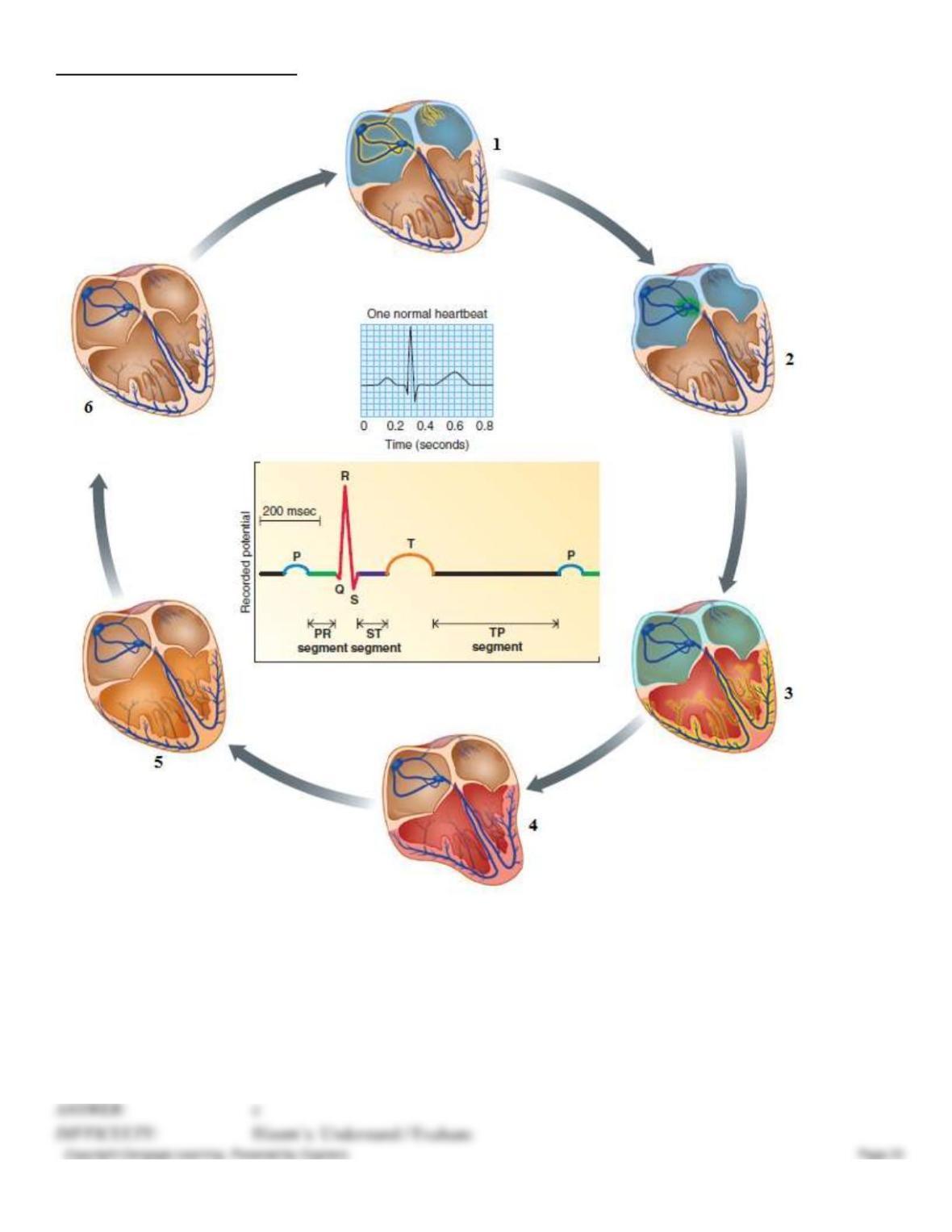
Use the figure above (Figure 9–14) to answer the corresponding questions.
91. Which number in the figure represents the QRS complex (ventricular depolarization)?
a.
1
b.
2
c.
3
d.
4
e.
5
f.
6
92. Which number in the figure represents the P wave (atrial depolarization)?
a.
1
b.
2
c.
3
d.
4
e.
5
f.
6
93. Which number in the figure represents the T wave (ventricular repolarization)?
a.
1
b.
2
c.
3
d.
4
e.
5
f.
6
94. Which number in the figure represents the PR segment (AV nodal delay)?
a.
1
b.
2
c.
3
d.
4
e.
5
f.
6
b
95. Which number in the figure represents the ST segment (ventricles are contracting and emptying)?
a.
1
b.
2
c.
3
d.
4
e.
5
f.
6
d
96. Discuss the distinct layers within the heart.
97. Describe the specialized types of cardiac muscle cells.
98. Describe the normal sounds associated with heart valves.
99. Explain the ejection fraction in regards to the heart.
100. Discuss the nutrient supply to the heart.