
Chapter 9 — Partnerships: Ownership Changes and Liquidations
MULTIPLE CHOICE
1. Which of the following results in dissolution of a partnership?
a.
contribution of additional assets to the partnership by an
existing partner
b.
receipt of a draw by an existing partner
c.
winding up of the partnership and the distribution of remaining
assets to the partners
d.
withdrawal of a partner from a partnership
2. Changes in partnership ownership are presumed to be arm’s length
transactions that may require which of the following actions?
a.
recognitions of goodwill to existing partners
b.
revaluation of existing partnership assets
c.
recognition of goodwill or other intangible assets attributable to
the incoming partner
d.
all of the above are possible
3. The admission of a new partner under the bonus method will result in a
bonus to
a.
the old partners only.
b.
the new partner only.
c.
either the new partner or the old partners, but not both.
d.
none of the above.
4. When a new partner is admitted to a partnership under the goodwill
method, an original partner’s capital account may be adjusted for
a.
a proportionate share of the incoming partner’s investment.
b.
his or her share of previously unrecorded intangible assets
traceable to the original partners.
c.
his or her share of previously unrecorded intangible assets
traceable to the incoming partner.
d.
none of the above.

Chapter 9
9-2
5. Under the bonus method, when a new partner is admitted to the
partnership, the total capital of the new partnership is equal to:
a.
the book value of the previous partnership + the fair market value
of the consideration paid to the existing partnership by the
incoming partner
b.
the book value of the previous partnership + any necessary asset
write ups from book value to market value + the fair market value
of the consideration paid to the existing partnership by the
incoming partner
c.
the book value of the previous partnership – any asset write downs
from book to market value + the fair market value of the
consideration paid to the existing partnership by the incoming
partner
d.
the fair market value of the new partnership as implied by the
value of the incoming partner’s consideration in exchange for an
ownership percentage in the new partnership
6. If a bonus is traceable to the previous partners rather than an
incoming partner, it is allocated among the partners according to the
a.
profit-sharing percentages of the previous partnership.
b.
profit-sharing percentages of the new partnership.
c.
capital percentages of the previous partners.
d.
capital percentages of the new partnership.
7. Which of the following characterizes the bonus method, compared to the
goodwill method, when unrecorded intangibles are traceable to the
previous partners?
a.
The intangibles are actually recorded.
b.
The legal significance of a change in ownership structure of the
partnership is emphasized.
c.
This method generally produces more equitable results if the
former partners do not share profits and losses in the same
relationship to each other as they did before a new partner was
admitted.
d.
The market value concept rather than the historical cost concept
is emphasized.
8. The fair market value of a partnership can be implied by
a.
adding the incoming partner’s market value of consideration to the
book value of the existing partnership.
b.
the tax basis of the old partner’s assets added to the incoming
partner’s consideration.
c.
The incoming partner’s market value of consideration divided by
the incoming partner’s percentage share in profit and loss.
d.
The incoming partner’s market value of consideration divided by
the incoming partner’s percentage ownership share in the new
partnership.

Chapter 9
9-3
9. If goodwill is traceable to the previous partners, it is
a.
allocated among the previous partners according to their interest
in capital.
b.
allocated among the previous partners only if there are no other
assets to be revalued.
c.
allocated among the previous partners according to their original
profit-and-loss-sharing percentages.
d.
not possible for goodwill to also be traceable to the incoming
partner.
10. If goodwill is traceable only to the previous partners,
a.
the book value of the previous partnership plus the investment of
the incoming partner will be greater than the fair market value of
the partnership as suggested by the incoming partner’s investment.
b.
the new partner’s initial capital balance is equal to his or her
investment in the partnership.
c.
existing assets of the previous partnership will never be
revalued.
d.
none of the above.
11. If goodwill is traceable to the incoming partner, the new partner’s
capital balance equals
a.
the fair market value of consideration paid by the incoming
partner
b.
the book value of the older partnership divided by the existing
partners’ ownership percentage in the new partnership minus the
book value of the old partnership.
c.
incoming partner’s ownership percentage multiplied by the capital
of the new partnership
d.
none of the above.
12. Palit buys Quincy’s partnership interest in the Q-R-S partnership.
Quincy thus retires, leaving Reale and Susien as Palit’s co-partners.
Prior to Palit entering the partnership, Quincy, Reale, and Susien
split profits and losses equally. Palit pays $75,000 for Quincy’s
capital which, at the time, totaled $60,000. No revaluation of
partnership assets or liabilities occurs at the time. In recording this
event on the partnership books
a.
Goodwill is booked based on the book value/fair value difference.
b.
$7,500 bonuses are added to Reale and Susien capital.
c.
$5,000 bonuses are added to Quincy, Real, and Susien capital.
d.
Palit capital is created in the amount of $60,000.

Chapter 9
13. If an existing partner withdraws from a partnership,
a.
his or her interest may be sold to the partnership or an
individual partner.
b.
the consideration received for that partner’s interest may suggest
the existence of undervalued existing assets and/or goodwill.
c.
either the bonus or the goodwill method may be used to record the
transaction if the partnership acquires the withdrawing partner’s
interest.
d.
all of the above.
14. If goodwill is suggested by the consideration paid to a withdrawing
partner,
a.
only the goodwill traceable to the withdrawing partner may be
recorded.
b.
goodwill traceable to the original partnership is allocated among
the partners according to their respective interests in capital.
c.
the goodwill traceable to the withdrawing partner represents the
difference between the partner’s capital balance and the
consideration he or she receives.
d.
none of the above.
15. Callie is admitted to the Adams & Beal Partnership under the bonus
method. Callie contributes cash of $20,000 and non-cash assets with a
market value of $30,000 and book value of $15,000 in exchange for a 20%
ownership interest in the new partnership. Prior to the admission of
Callie, the capital of the existing partnership was $130,000 and an
appraisal showed the partnership net assets were fairly stated.
What will be Callie’s initial capital balance?
a.
$36,000
b.
$50,000
c.
$35,000
d.
$30,000

Chapter 9
9-5
16. Callie is admitted to the Adams & Beal Partnership under the bonus
method. Callie contributes cash of $20,000 and non-cash assets with a
market value of $30,000 and book value of $15,000 in exchange for a 20%
ownership interest in the new partnership. Prior to the admission of
Callie, the capital of the existing partnership was $130,000 and an
appraisal showed the partnership net assets were fairly stated. Adams &
Beal shared profits and losses at a ratio of 80/20, respectively.
Which of the following bonus amounts would be recorded?
a.
$14,000 to Callie capital
b.
$2,800 increase to Beal capital
c.
$2,800 decrease to Beal capital
d.
$7,000 increase to Adams capital
17. Assume the existing capital of a partnership is $100,000. Two partners
currently own the partnership and split profits 40/60. A new partner is
to be admitted and will contribute net assets with a fair value of
$50,000. An appraisal of existing partnership assets indicates accounts
receivable overstated by $10,000, inventory overstated by $12,000 and
land understated by $25,000. What is the total capital of the new
partnership if the bonus method is being used?
a.
$153,000
b.
$128,000
c.
$175,000
d.
$150,000
18. Assume that the capital of an existing partnership is $90,000 and all
existing assets reflect fair market values. If an incoming partner
acquires a 40% interest in the partnership for $55,000, the goodwill
traceable to the incoming partner is
a.
$15,000
b.
$5,000
c.
$3,000
d.
$2,000
19. Assume that the capital of an existing partnership is $130,000 and that
existing assets are overvalued by $10,000. If an incoming partner
acquires a 25% interest in the partnership for $37,000, goodwill
traceable to the incoming partner is __________.
a.
$1,000
b.
$9,667

Chapter 9
9-6
c.
$3,000
d.
$5,000
20. The following is the priority sequence in which liquidation proceeds
will be distributed for a partnership:
a.
partnership drawings, partnership liabilities, partnership loans,
partnership capital balances.
b.
partnership liabilities, partnership loans, partnership capital
balances.
c.
partnership liabilities, partnership loans, partnership drawings,
partnership capital balances.
d.
partnership liabilities, partnership capital balances, partnership
loans.
21. Which of the following statements is correct regarding a partner’s
debit capital balances?
a.
The partner should make contributions to reduce the debit balance
to whatever extent possible.
b.
If contributions are not possible, the other partners with credit
capital balances will be allocated a portion of the debit balance
based on their proportionate profit-and-loss-sharing percentages.
c.
Partners who absorb another’s debit capital balance have a legal
claim against the deficient partner.
d.
All of these statements are correct.
22. The doctrine of marshaling of assets
a.
is applicable only if the partnership is insolvent.
b.
allows partners to first contribute personal assets to unsatisfied
partnership creditors.
c.
is applicable if either the partnership is insolvent or individual
partners are insolvent.
d.
provides that when the Uniform Partnership Act is adopted, amounts
owed to personal creditors and to the partnership for debit
capital balances are shared proportionately from the personal
assets of the partners.
23. If a partnership has only non-cash assets, all liabilities have been
properly disbursed, and no additional liquidation expenses are
expected, the maximum potential loss to the partnership in the
liquidation process is:
a.
the fair market value of the non-cash assets
b.
the book value of the non-cash assets
c.
the estimated proceeds from the sale of the assets less the book
value of the non-cash assets

Chapter 9
d.
none of the above
24. Allen, Branden & Caylin are in the process of liquidating their
partnership. They have the following capital balances and profit and
loss percentages:
Capital Balance Profit/Loss %
Allen 5,000 debit 20%
Branden 18,000 credit 50%
Caylin 6,000 credit 30%
The partnership balance sheet shows cash of $5,000, non-cash assets of
$14,000, and no liabilities. Assuming no liquidation expenses, what
safe payment could be made?
a.
$5,000 split between Branden & Caylin by a ratio of 5/8 and 3/8,
respectively.
b.
$5,000 to Branden only
c.
$1,000 to Allen, $2,500 to Branden, and $1,500 to Caylin
d.
$18,000 to Branden only
25. A partner’s maximum loss absorbable is calculated by
a.
dividing the partner’s capital balance by his or her profit-and–
loss-sharing percentage.
b.
multiplying the partner’s capital balance by his or her profit–
and-loss-sharing percentage.
c.
multiplying distributable assets by the partner’s profit-sharing
percentage.
d.
dividing the partner’s capital balance by his or her percentage
interest in capital.
26. Under the doctrine of marshaling of assets, unsatisfied partnership
creditors
a.
must first proceed against the partner with the largest capital
balance.
b.
may attach to the assets of an individual partner before
individual creditors have been satisfied.
c.
may proceed against any personally solvent partner.
d.
may proceed against any personally solvent partner but only to the
extent of their capital balance in the partnership.

9-8
27. Partner T is personally insolvent, owing $400,000. Personal assets will
only bring $150,000 when liquidated. At the same time, T has a credit
capital balance in the partnership of $85,000. The capital amounts of
the other partners total a (credit) balance of $200,000. Under the
doctrine of marshaling of assets, the personal creditors of T can
collect up to __________.
a.
$150,000
b.
$235,000
c.
$400,000
d.
$435,000
28. Partners Thomas, Adams and Jones have capital balances of $24,000,
$45,000, and $90,000 respectively. They split profits in the ratio of
3:3:4, respectively. Under a predistribution plan, one of the partners
will get the following total amount in liquidation before any other
partners get anything:
a.
$22,500
b.
$30,000
c.
$40,000
d.
$75,000
29. Assume that a partnership had assets with a book value of $240,000 and
a market value of $195,000, outside liabilities of $70,000, loans
payable to partner Able of $20,000, and capital balances for partners
Able, Baker, and Chapman of $70,000, $30,000, and $50,000. How much
would Able receive upon liquidation of the partnership assuming profits
and losses are allocated equally?
a.
$70,000
b.
$90,000
c.
$75,000
d.
$55,000
30. Assume that a partnership had assets with a book value of $240,000 and
a market value of $195,000, outside liabilities of $70,000, loans
payable to partner Able of $20,000, and capital balances for partners
Able, Baker, and Chapman of $70,000, $30,000, and $50,000. How would
the first $100,000 of available assets be distributed assuming profits
and losses are allocated equally?
a.
$70,000 to outside liabilities, $20,000 to Able, and the balance
equally among the partners
b.
$70,000 to outside liabilities and $30,000 to Able
c.
$70,000 to outside liabilities, $25,000 to Able, and $5,000 to
Chapman
d.
$40,000 to Able, $20,000 to Chapman, and the balance equally among
the partners

Chapter 9
31. Assume that a partnership had assets with a book value of $240,000 and
a market value of $195,000, outside liabilities of $70,000, loans
payable to partner Able of $20,000, and capital balances for partners
Able, Baker, and Chapman of $70,000, $30,000, and $50,000. If all
outside creditors and loans to partners had been paid, how would the
balance of the assets be distributed assuming that Chapman had already
received assets with a value of $30,000 assuming profits and losses are
allocated equally?
a.
Each of the partners would receive $25,000.
b.
Each of the partners would receive $40,000.
c.
Able: $70,000, Baker: $30,000, Chapman: $20,000
d.
Able: $55,000, Baker: $15,000, Chapman: $5,000
32. Partners Able, Baker, and Chapman have the following personal assets,
personal liabilities, and partnership capital balances:
Able Baker Chapman
Personal assets……… $30,000 $ 80,000 $60,000
Personal liabilities…. 25,000 50,000 72,000
Capital balances…….. 50,000 (32,000) 70,000
Assume profits and losses are allocated equally.
After applying the doctrine of marshaling of assets, the capital
balances for Able, Baker, and Chapman, respectively, would be
a.
$50,000, $(2,000), and $58,000.
b.
$48,000, 0, and $58,000.
c.
$49,000, 0, and $57,000.
d.
$34,000, 0, and $54,000.
33. Partners Dalton, Edwards, and Finley have capital balances of $40,000,
90,000 and $30,000, respectively, immediately prior to liquidation.
Total remaining assets have a book value of $160,000, the liabilities
having been paid. Among these remaining assets is a machine with a fair
value of $35,000. The partners split profits and losses equally.
Edwards covets the machine and is willing to accept it for $35,000 in
lieu of cash. The other partners have no designs on specific assets,
only cash in liquidation. How much cash, in addition to the machine,
would be first distributed to Edwards, before any of the other partners
received anything?
a.
$15,000
b.
$50,000
c.
$166,667
d.
$300,000
Chapter 9
9-10
PROBLEM
1. Lee, Alverez, and Tyne have a partnership. Their capital balances are
$50,000, $70,000 and $30,000, respectively. The partner profit
percentages are 30%, 40%, and 30%, respectively. They are considering
on what basis to admit Patton, a prospective new partner. Based on
appraisal analysis, the net assets of the partnership are worth
$180,000. Patton is willing to put up cash of $30,000, plus a machine
with book value of $12,000 and a fair value of $20,000.
Required:
Calculate, using the goodwill method, what the partnership balances
will be if the existing partners recognize the differential between
fair value and book value of the partnership’s net assets as goodwill.
What will Patton’s percentage of partnership capital be, assuming the
above deal goes through?
2. Smith, Thompson and Nickels have a partnership. Their capital balances
are $90,000, $130,000 and $150,000, respectively. They share profits
and losses 25%, 35% and 40%, respectively. Foster wants to become a
partner with a 10 percent share in partnership capital with a $60,000
cash contribution to the partnership. Appraisal of the partnership
reveals that the assets of the partnership are fairly valued.
Required:
Calculate Smith, Thompson, and Nickel’s ending capital balances under
the:
a. Bonus Method
b. Goodwill Method
Chapter 9
9-11
3. Wright, Smith, and Young are partners with present capital balances of
$60,000, $35,000, and $30,000, respectively. The partners share profits
and losses according to the following percentages: 40% for Wright, 30%
for Smith, and 30% for Young. Locke is to join the partnership upon
contributing $40,000 to the partnership in exchange for a 20% interest
in capital and a 20% interest in profits and losses. The existing
assets of the original partnership are undervalued by $20,000. The
original partners will share the balance of profits and losses in
proportion to their original percentages.
Required:
Calculate the capital balances for each individual in the new
partnership, assuming use of the bonus and goodwill methods.
Chapter 9
9-12
4. Martel, Tusk, and Davis are partners with present capital balances of
$40,000, $50,000, and $20,000, respectively. The partners share profits
and losses according to the following percentages: 60% for Martel, 30%
for Tusk, and 10% for Davis. Frank is to join the partnership upon
contributing $40,000 to the partnership in exchange for a 25% interest
in capital and a 20% interest in profits and losses. An appraisal of
the existing partnerships’ assets reveals the following:
Accounts Receivable $20,000 overvalued
Inventory $10,000 overvalued
Land $10,000 undervalued
Building $15,000 undervalued
Required:
Calculate the capital balances for each individual in the new
partnership assuming use of the bonus and goodwill methods.
Chapter 9
9-13
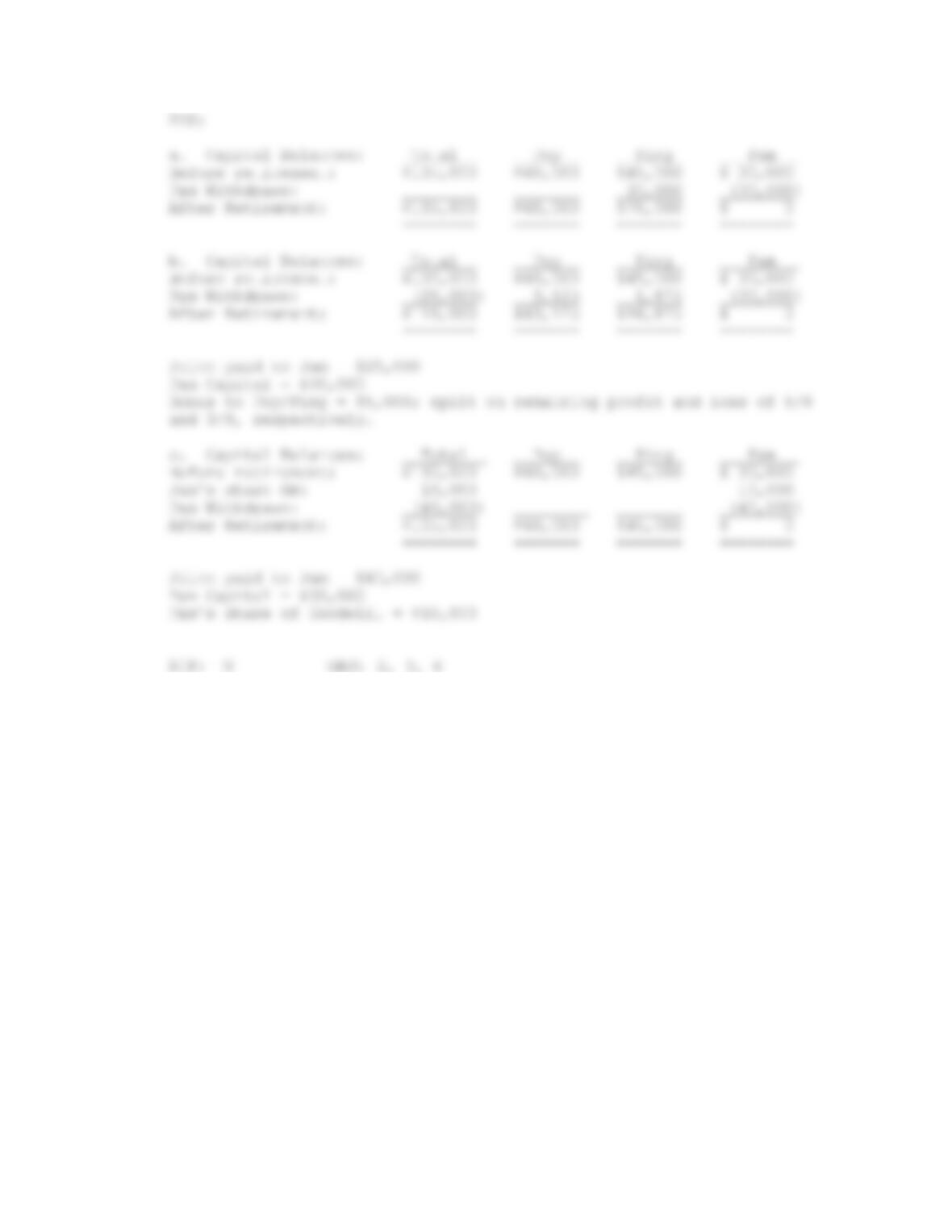
5. Long-term partners, Pop, Ping, and Pam have capital balances of
$60,000, $45,000 and $30,000, respectively. They share in profits and
losses 50%/30%/20%, respectively. All assets are valued fairly. Pam
decides to retire from the partnership. Calculate the remaining
partners’ capital balances after the Pam withdrawal under the following
situations:
a. Pam sells the interest to Ping for $25,000.
b. Pam sells the interest to the partnership for $25,000; bonus
method is used
c. Pam sells the interest to the partnership for $40,000;goodwill
attributable only to the exiting partner is recorded
Chapter 9
9-14
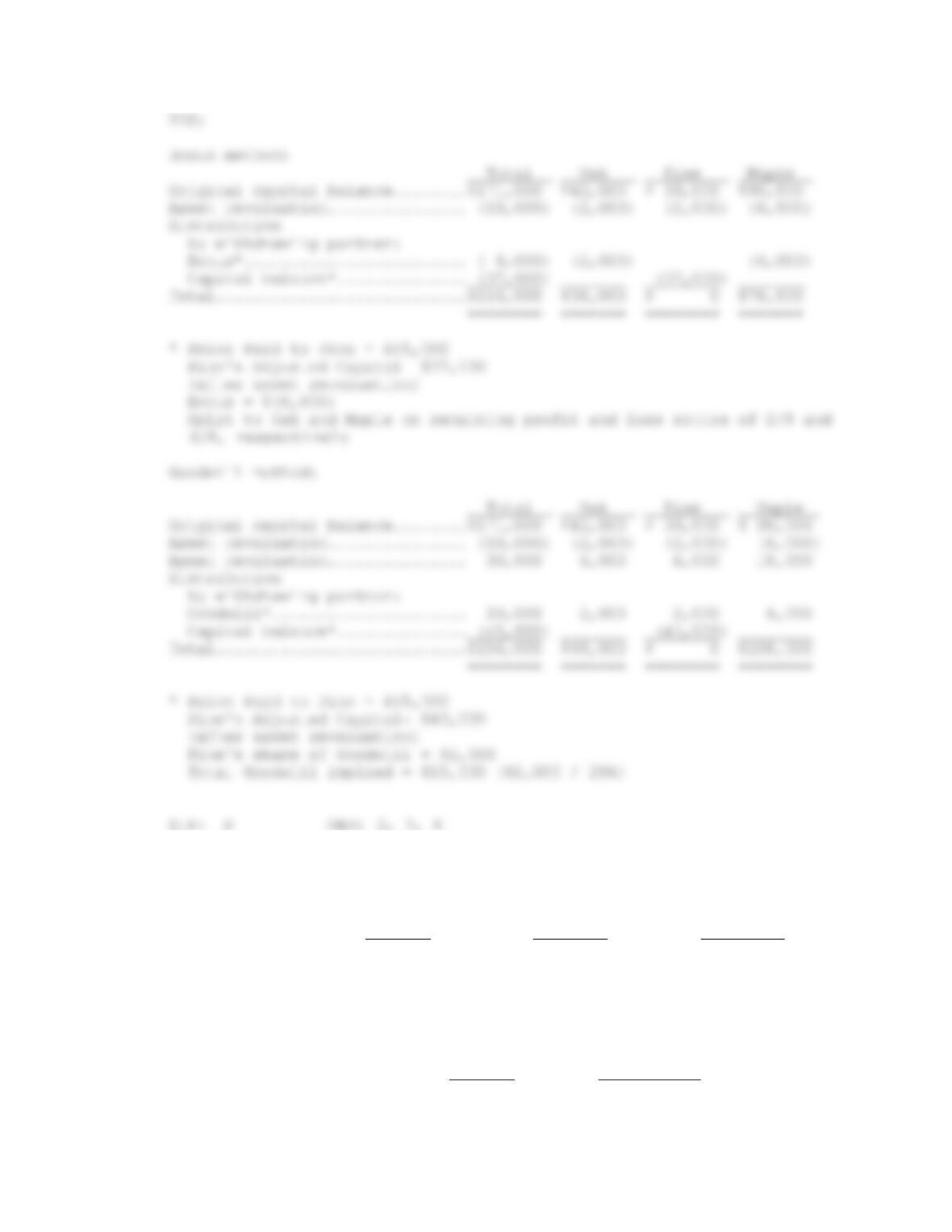
6. Oak, Pine, and Maple are partners with present capital balances of
$42,000, $39,000, and $90,000, respectively. The partners share profits
and losses according to the following percentages: 20% for Oak, 20% for
Pine, and 60% for Maple. The existing assets of the original
partnership have market values equal to book values except for the
following:
Accounts Receivable: overvalued by $10,000
Land: undervalued by $30,000.
Pine has agreed to sell her interest to the partnership for $45,000.
Required:
Calculate the capital balances for each individual in the new
partnership, assuming use of the bonus and goodwill methods. The
goodwill method should recognize the goodwill traceable to all
partners.
Chapter 9
9-15
7. The partnership of Able, Bower, and Cramer was liquidated. The partners
have shared profits and losses in the ratio of 2:4:4. Prior to
liquidation, their capital balances were the following*:
Able Bower Cramer
$10,000 $(5,000) $(15,000)
* Deficit shown in parentheses
Cash totaled $20,000, with liabilities amounting to $30,000. A review
of the individual partners’ personal financial status reveals the
following:
Assets Liabilities
Able $ 5,000 $20,000
Baker 6,000 4,000
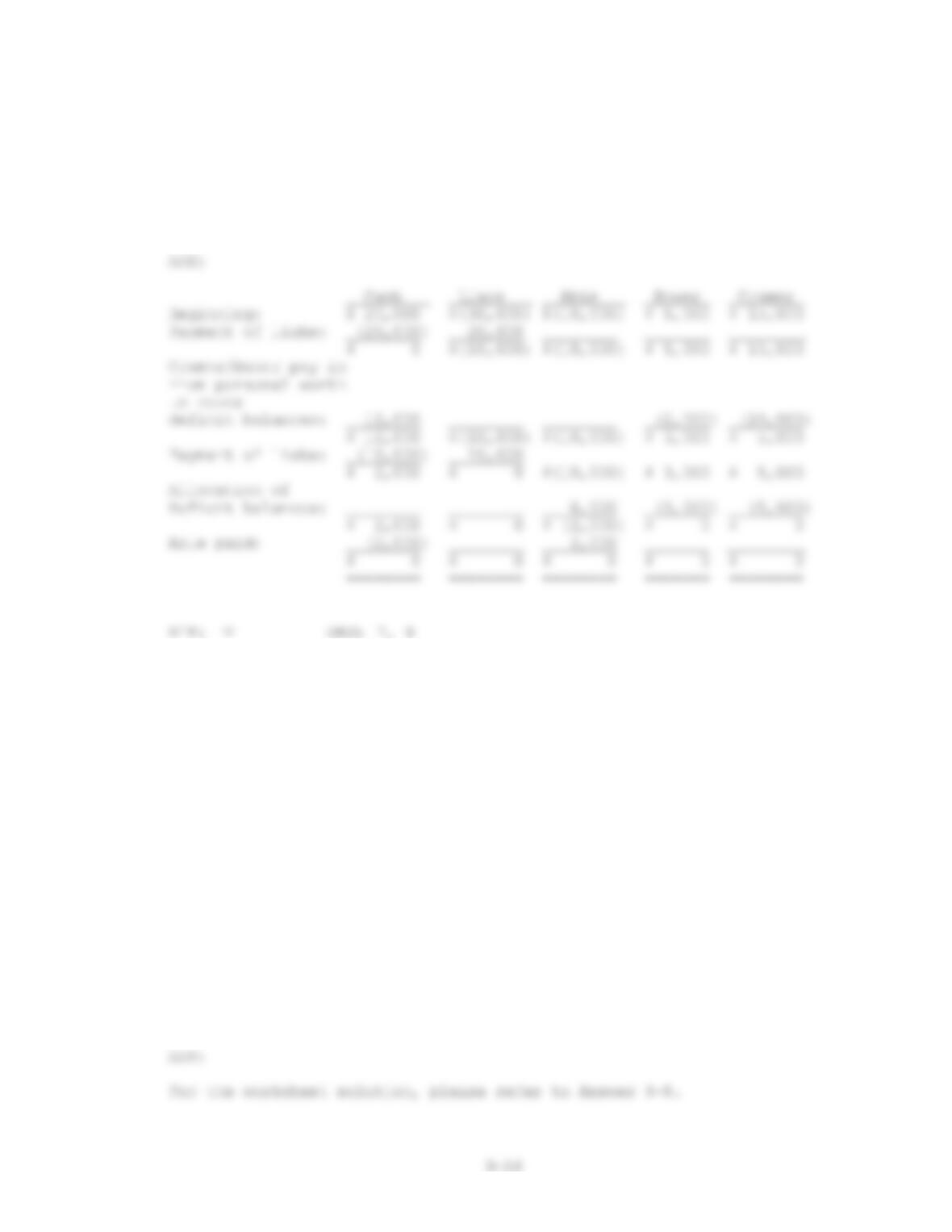
Chapter 9
Cramer 30,000 20,000
Required:
Prepare a worksheet to liquidate the partnership.
8. Merz, Dechter, and Flowers are partners in a partnership and share
profits and losses 40%, 40%, and 20%, respectively. The partners have
agreed to liquidate the partnership and anticipate that liquidation
expenses will total $14,000. Prior to the liquidation, the partnership
balance sheet reflects the following book values:
Cash……………………………………………. $ 25,000
Noncash assets…………………………………… 200,000
Note payable to Flowers…………………………… 12,000
Other liabilities………………………………… 165,000
Capital, Merz……………………………………. 40,000
Capital Dechter………………………………….. 18,000
Capital deficit, Flowers………………………….. (10,000)
Required:
Assuming that the actual liquidation expenses are $20,000 and that
noncash assets are sold for $160,000, determine how the assets will be
distributed. Flowers has net personal assets of $10,000.

9-17
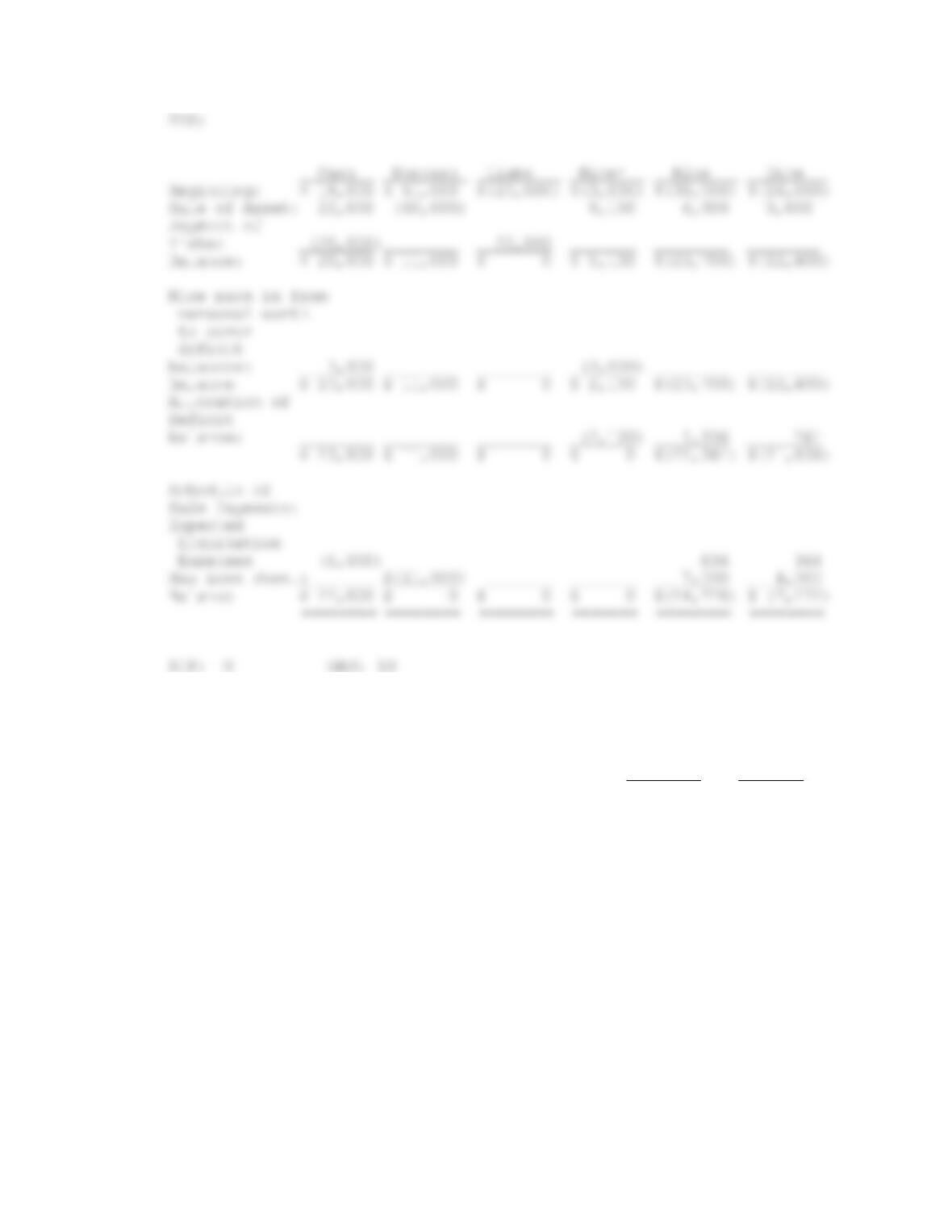
9. The Nice, Rice, and Dice Partnership has not been successful. The
partners have determined they must liquidate their partnership. The
partners have agreed to liquidate the partnership and anticipate that
liquidation expenses will total $1,000. Prior to the liquidation, the
partnership balance sheet reflects the following book values:
Cash……………………………………………. $18,000
Noncash assets…………………………………… 51,000
Note receivable-Nice……………………………… 3,000
Other liabilities………………………………… 20,000
Capital, Nice……………………………………. 6,000
Capital, Rice……………………………………. 30,000
Capital, Dice……………………………………. 16,000
Profits and losses are shared 45% to Nice, 35% to Rice, and 20% to
Dice. A review of the individual partner’s personal net worth reveals
the following:
Assets Liabilities
Nice 165,000 162,000
Rice 200,000 110,000
Dice 185,000 90,000
The following transactions occur:
a. Assets having a book value of $40,000 are sold for $22,000 cash
b. Liabilities are paid, where possible
c. Partners contribute from their personal net worth, according to
UPA requirements and Marshaling of Assets concepts
Required:
Prepare liquidation schedule and determine how the available assets
will be distributed using a schedule of safe payments.
Chapter 9
9-18
10. The Tyler, Russell, and Colby partnership is liquidating. The three
partners share profits and losses equally. The following is the post–
closing trial balance for the partnership:
Dr. Cr.
Assets…………………………………. $177,000
Liabilities (including
$15,000 loan from Russell……………. $85,000
Tyler, Capital………………………….. 30,000
Russell, Capital………………………… 12,000
Colby, Capital………………………….. 50,000
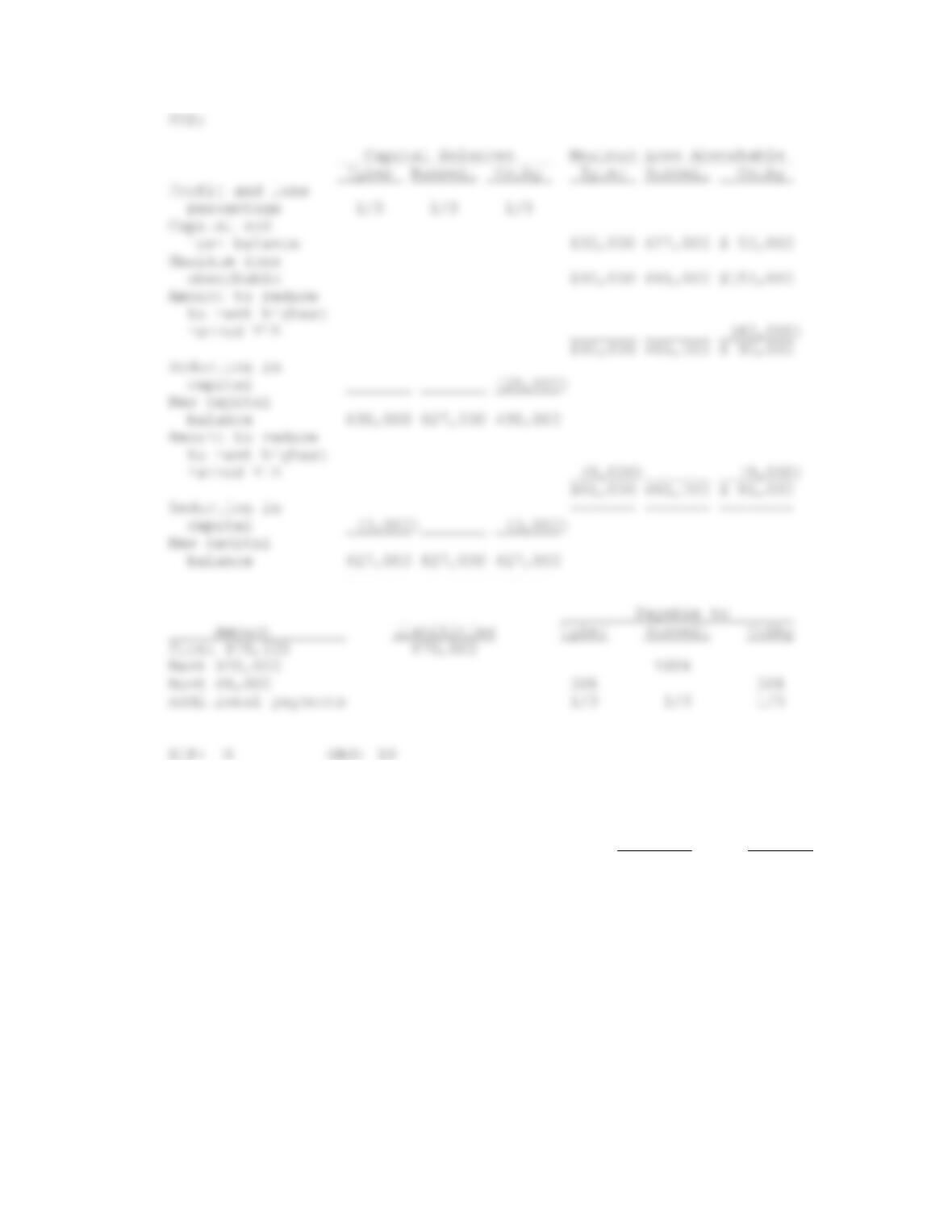
Required:
Draft a predistribution plan for the partnership liquidation and
provide a schedule of payments.
Chapter 9
9-19
11. The J & L Partnership has total assets of $20,000 and total liabilities
of $26,000. Information relating to individual partners is as follows:
Jacoby Larson
Total personal assets………………… $21,000 $25,000
Total personal liabilities……………. 16,000 20,000
Partnership capital balance…………… (8,000) 2,000
Required:
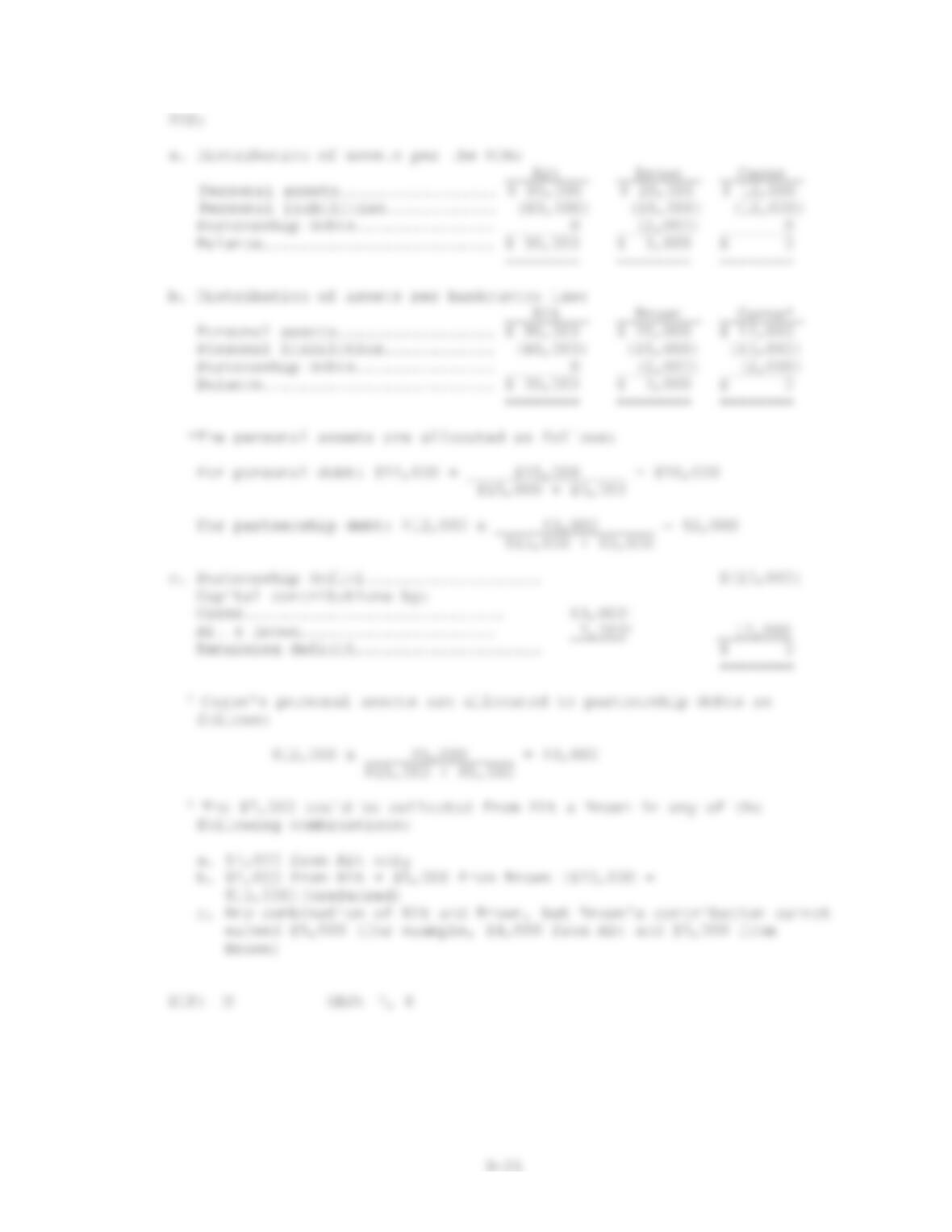
a.
Prepare a schedule showing the correct distribution of assets
in accordance with the marshaling of assets.
b.
Prepare a schedule showing the correct distribution of assets
in accordance with the federal bankruptcy law.
c.
Discuss which distribution seems more equitable, and give
reasons supporting your conclusion.
Chapter 9
9-20
12. The partnership of Alt, Brown, and Carns has total assets and
liabilities of $30,000 and $25,000, respectively. Information relating
to the partners is as follows:
Alt Brown Carns
Total personal assets………….. $90,000 $20,000 $12,000
Total personal liabilities……… 60,000 15,000 15,000
Partnership capital balance
(deficit)…………………… 10,000 (2,000) (3,000)
Required:
a.
Assuming that the Uniform Partnership Act is applicable,
indicate how the partners’ personal assets would be
distributed.
b.
Assuming that federal bankruptcy laws are applicable, indicate
how the partners’ personal assets would be distributed.
c.
Assume that the partnership had a deficit of $10,000,
allocated among Alt, Brown, and Carns as follows: $2,000
surplus, $7,000 deficit, and $5,000 deficit, respectively.
Indicate how the deficit would be satisfied when bankruptcy
laws are applicable.
a.
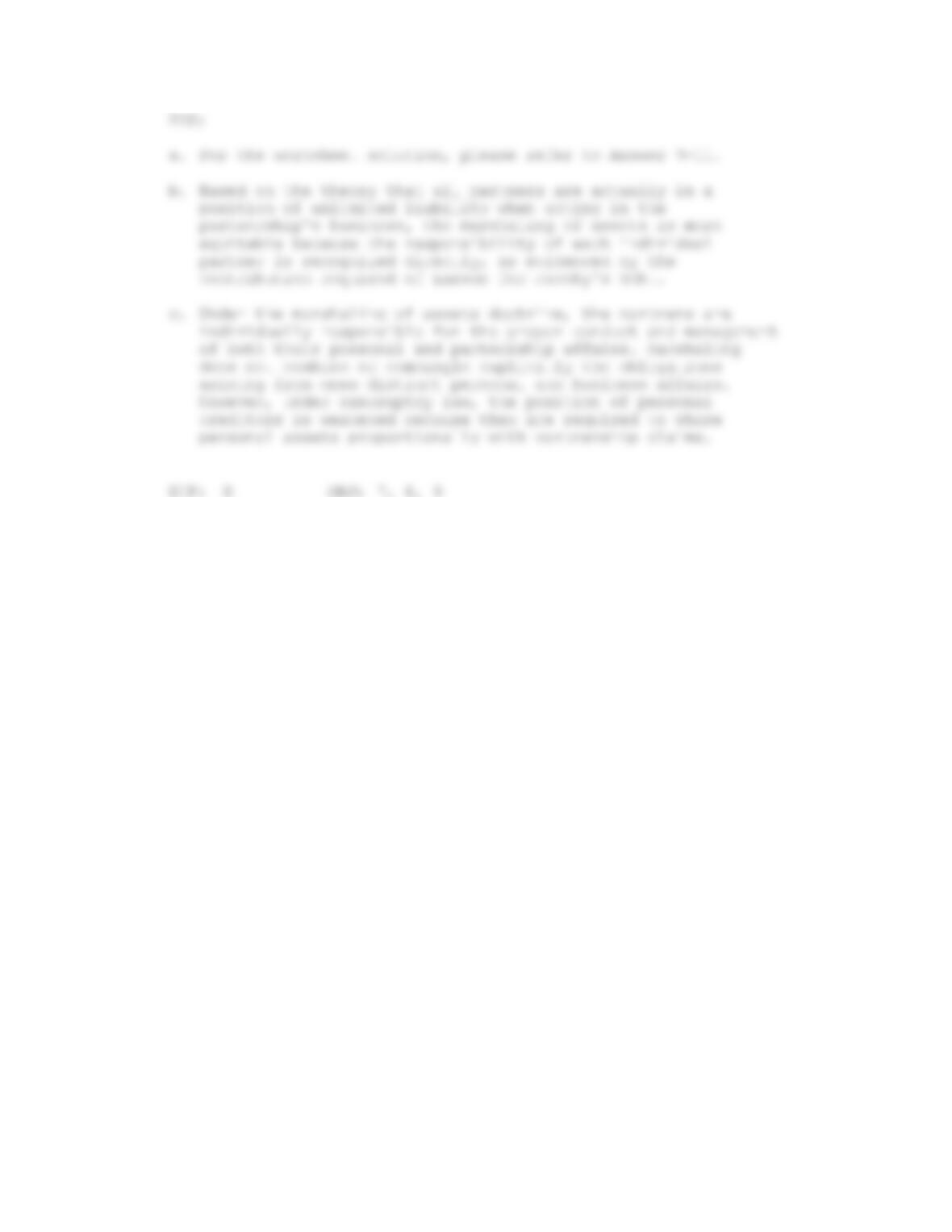
For the worksheet solution, please refer to Answer 9-11.
partnership’s business, the marshaling of assets is more
equitable because the responsibility of each individual
partner is recognized directly, as evidenced by the
contribution required of Larson for Jacoby’s debt.
does not combine or commingle explicitly the obligations
arising from ones distinct personal and business affairs.
creditors is weakened because they are required to share
Chapter 9
Chapter 9
13. Richardson and George have been partners in the medical supply business
since July 18, 20X3. Since the formation of the partnership, profits
and losses have been shared in the ratio of 55:45, respectively.
Capital balances on December 31, 20X7, were $159,000 for Richardson and
$106,000 for George. They have agreed to admit Keller as a partner on
January 1, 20X8. Keller will receive a 30% interest in partnership
capital, and future profits and losses will be allocated equally among
the partners.
Required:
Prepare journal entries in the partnership books to record Keller’s
admission in each of the following situations:
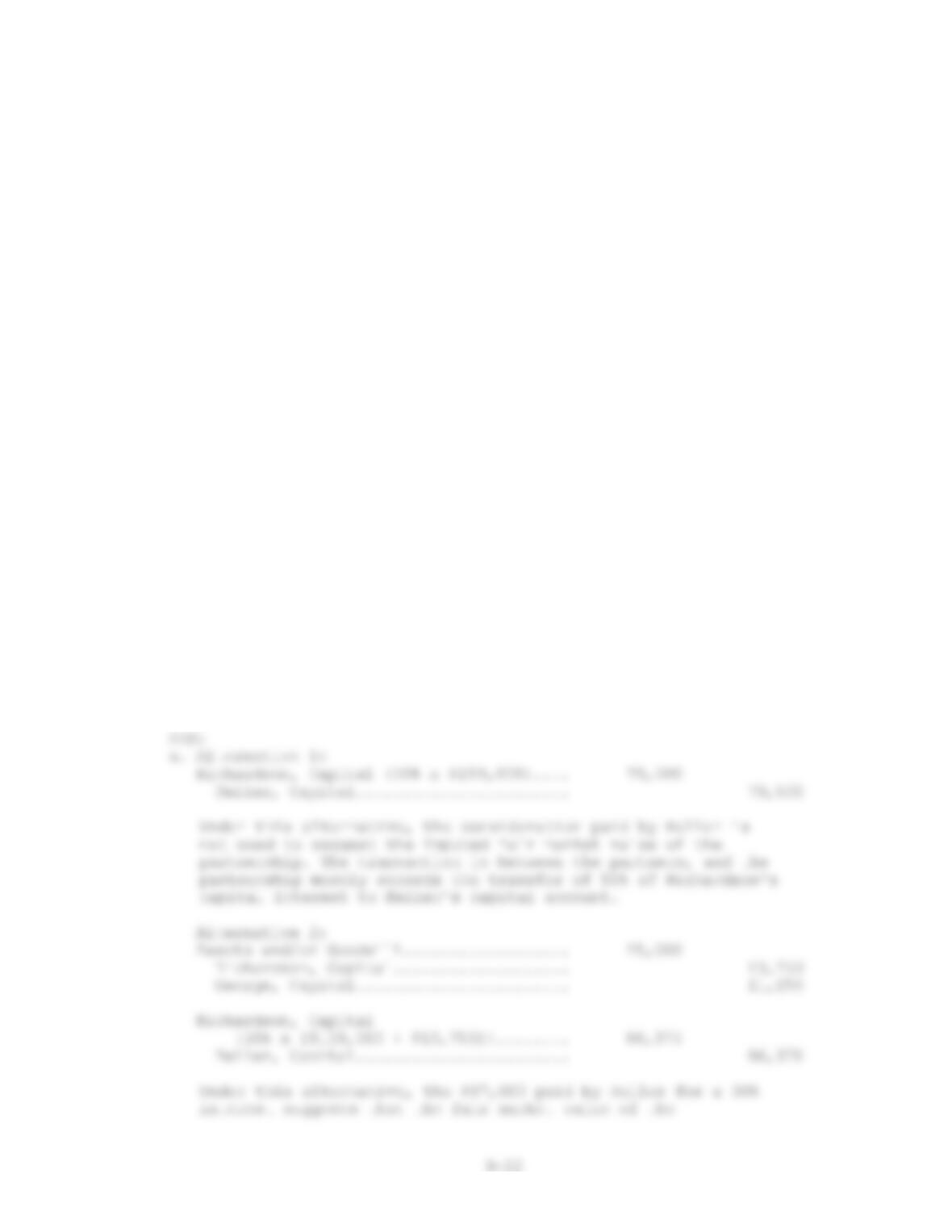
a.
Keller deals directly with Richardson and agrees to exchange
land with a book value of $60,000 and a fair market value of
$87,000 for 50% of Richardson’s interest in capital. Record
Keller’s contribution under the two alternative methods. What
assumption is made under each alternative?
b.
Keller contributes $130,000 cash and a 1-year note with a
value of $20,000 to the partnership entity. Record journal
entries under the bonus and goodwill methods.
c.
Using the bonus method, assume that (1) Keller contributes
$84,000 and an established clientele, or (2) Keller’s
contribution of $84,000 is sufficient because existing
partnership assets are overvalued.
d.
Keller invests $84,000 in the partnership entity. Use the
goodwill method and assume that net assets should not be
written down.
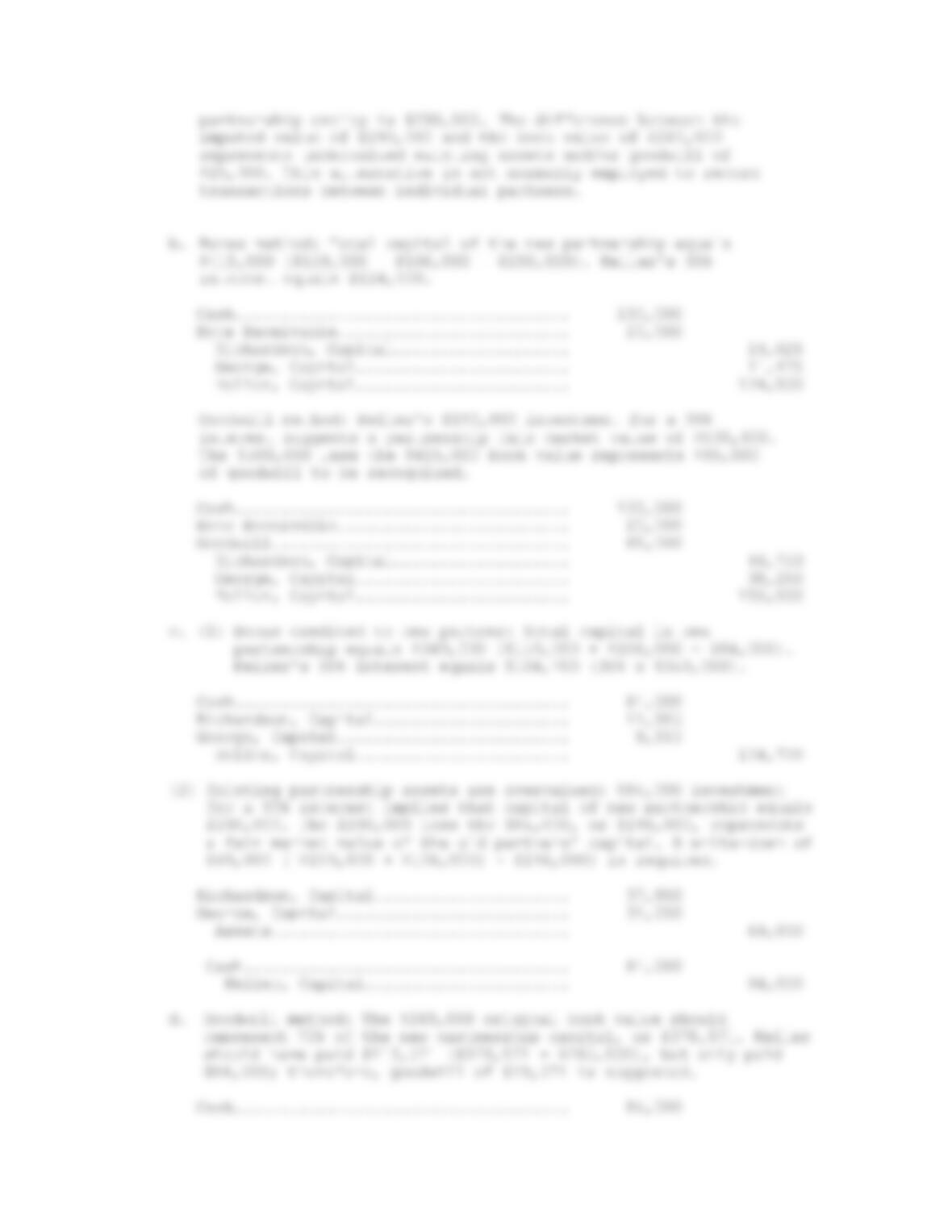
partnership. The transaction is between the partners, and the
capital interest to Keller’s capital account.
Under this alternative, the $87,000 paid by Keller for a 30%
interest suggests that the fair market value of the
Chapter 9
9-23
Chapter 9
14. Luc, Denis, and Rollande have capital balances of $30,000, $70,000, and
$15,000, respectively. The partners share profits/losses 2:6:2. All
assets book values equal market except as noted. The partnership
agreement states the bonus method is to be used to account for partner
sale of interest to the partnership.
Required:
Calculate Luc’s new capital balance resulting from each of the
following independent situations:
Situation 1:
Rollande sells his interest to the partnership for
$25,000. Bonus method is used.
Situation 2:
Rollande sells his interest to Luc for $25,000.
Situation 3:
Martel purchases a 20% interest from the partnership for
$35,000. The bonus method is used to account for the
incoming partner.
Situation 4:
The same as Situation 3 except that the goodwill method
is used to account for the incoming partner.
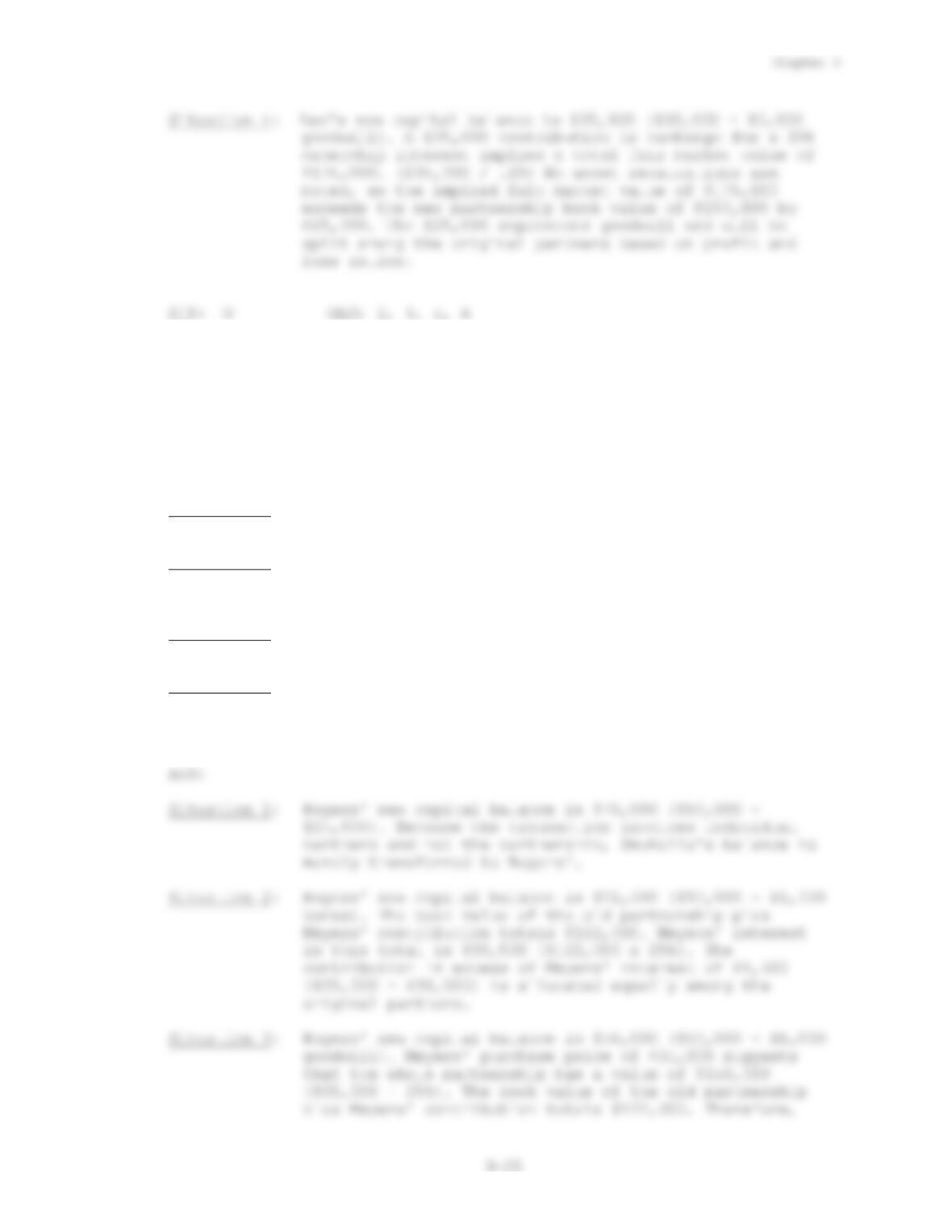
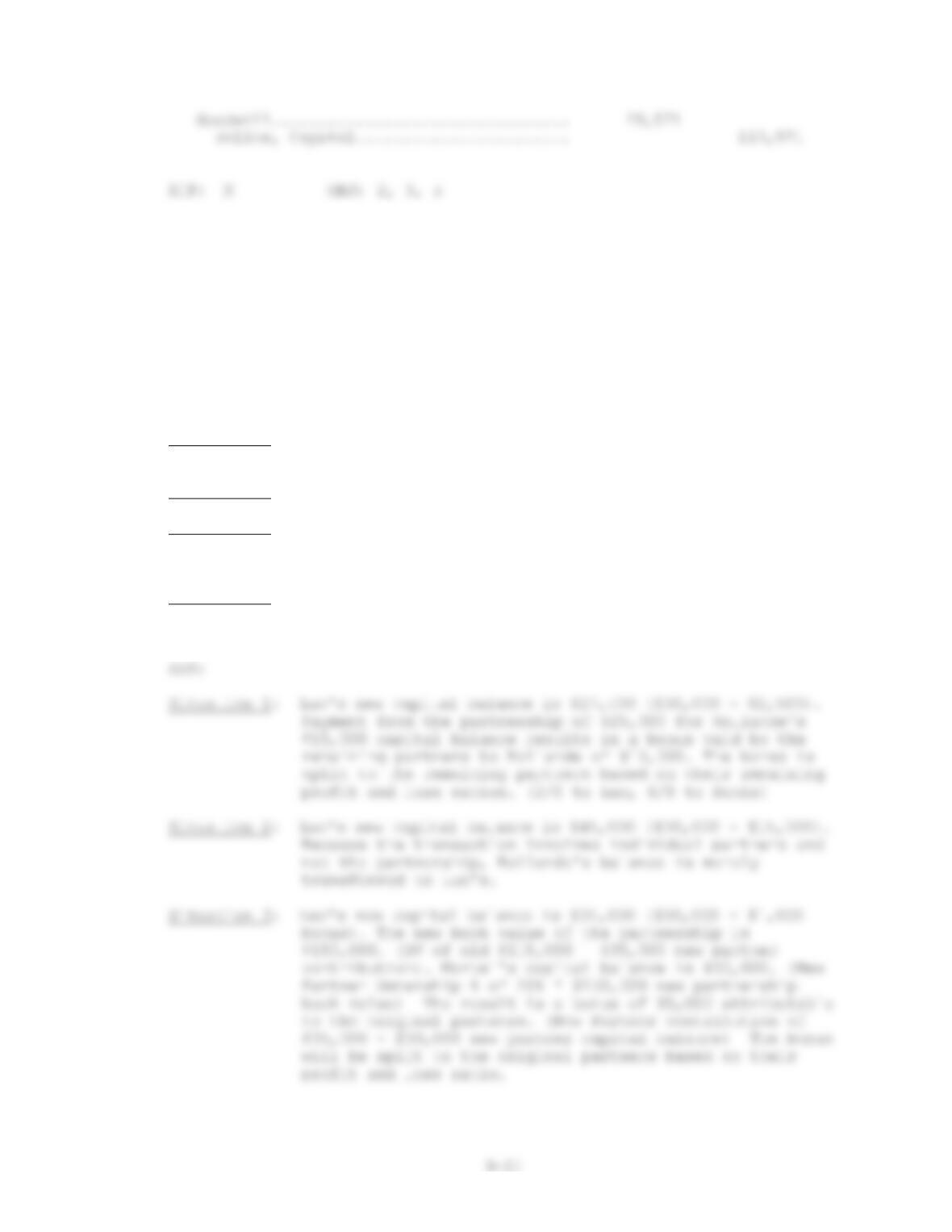
$25,000). Because the transaction involves individual
partners and not the partnership, Smukalla’s balance is
merely transferred to Rogers’.
contribution in excess of Meyers’ interest of $4,500
($35,000 – $30,500) is allocated equally among the
original partners.
that the whole partnership has a value of $140,000
($35,000 ÷ 25%). The book value of the old partnership
plus Meyers’ contribution totals $122,000. Therefore,
15. Rogers, Davis, and Smukalla have capital balances of $50,000, $26,100,
and $10,900, respectively. The partners share profits/losses equally.
Required:
Calculate Rogers’ new capital balance resulting from each of the
following independent situations:
Situation 1:
Smukalla sells his interest in the partnership to Rogers
for $25,000.
Situation 2:
Meyers purchases a one-fourth interest from the
partnership for $35,000. The bonus method is used to
account for the incoming partner.
Situation 3:
The same as Situation 2 except that the goodwill method
is used to account for the incoming partner.
Situation 4:
Davis sells her interest to the partnership for $30,000.
The total amount of suggested goodwill is to be
recorded.
Chapter 9
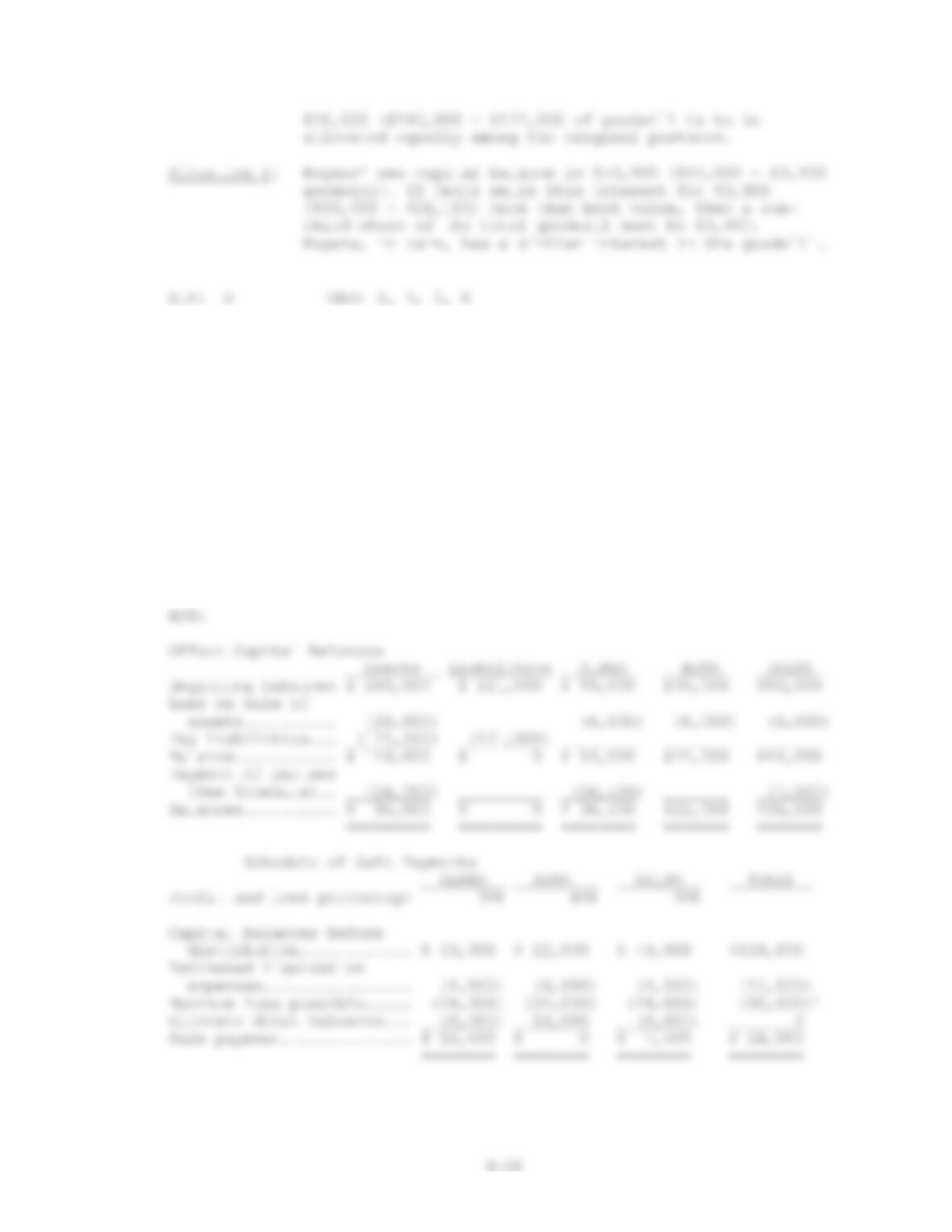
16. The ALPHA, BETA, AND DELTA partnership has total assets of $260,000.
Capital balances for partners ALPHA, BETA, and DELTA are $50,000,
$30,000, and $50,000, respectively. The profit/loss percentages for
partners ALPHA, BETA, and DELTA are 30%, 40%, and 30%, respectively.
Included in the liabilities is a $9,000 loan payable to ALPHA. The
partnership has elected to liquidate over the next several months.
Liquidation expenses are estimated to be $15,000.
Required:
Assuming assets with a book value of $80,000 were sold for $60,000, and
that $160,000 cash is available, how should the available cash be
distributed?
Chapter 9
17. On July 1, 20X9, the Crawford Company has the following balance sheet:
Assets Liabilities and Capital
Cash……………. $ 17,000 Accounts payable……… $ 32,000
Other assets…….. 183,000 Due to Palmer………… 12,000
Other liabilities…….. 70,000
Palmer, capital………. 24,000
Lake, capital………… 62,000
Total assets…….. $200,000 Total liabilities and
======== capital……………. $200,000
========
As of July 1, 20X9, the partners have personal net worth as follows:
Palmer Lake
Assets……………………………… $52,000 $ 76,000
Liabilities…………………………. 47,000 102,000
The personal net worth of each partner does not include any amounts due
to or from the partnership.
Required:
Assume the other assets are sold for $103,000 after incurring
liquidation expenses of $4,000. After liquidation of the partnership,
determine how much is available to Lake’s unsatisfied personal
creditors based on the following:
a.
Application of the Uniform Partnership Act
b.
Application of common law
b.
If common law is applied, Palmer’s debit balance would share

Chapter 9
9-28