9
Multiple Choice
Identify the choice that best completes the statement or answers the question.
____ 1. Artistic devices used to glorify a ruler’s image include an idealized image and ____.
a.
lots of gold
b.
symbols
c.
angels
d.
fabulous clothes
____ 2. In the Egyptian sculpture Menkaure and His Wife, Queen Khamerernebty, the figures are shown
____.
a.
formally dressed, with expensive jewelry
b.
seated formally
c.
seated casually
d.
standing side by side
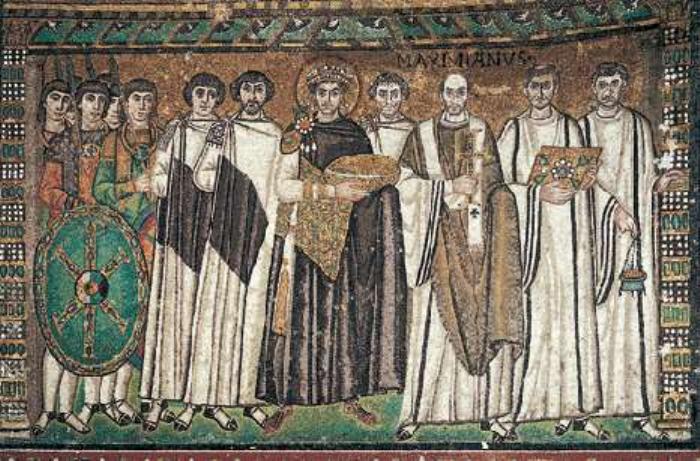
____ 3. In this image, Justinian is shown as a(n)____.
a.
god
b.
emperor-priest
c.
absolute monarch
d.
celestial being
____ 4. This image is an example of a(n) ____.
a.
mosaic
b.
fresco
c.
encaustic
d.
alla prima
____ 5. The twelve figures flanking Emperor Justinian in this image allude to ____.
a.
the twelve apostles
b.
the twelve allegories for good government
c.
the twelve stations of the cross
d.
the great Roman emperors and generals who inspired him
____ 6. The Crowned Head of an Oni demonstrated the Yoruba and Benin skill in ____.
a.
ceramic
b.
wood carving
c.
stone masonry
d.
metallurgy
____ 7. In ancient Hawaii, only royalty could own or wear precious objects made of ____.
a.
gold
b.
eelskin
c.
feathers
d.
metal
____ 8. Royal kahili were simply ____.
a.
large staffs
b.
fly whisks
c.
flower leis
d.
bracelets
____ 9. Triumph of the Will was a film glorifying ____.
a.
Hawaii
b.
the Olympic games
c.
Mussolini
d.
Hitler
____ 10. Palaces are different from ordinary residences by ____.
a.
their location
b.
their grand size
c.
their simplicity of design
d.
their emphasis on symmetry
____ 11. Achaemenid architecture is especially distinguished by ____.
a.
its large size
b.
its small scale
c.
its grand use of columns
d.
its shunning of columns
____ 12. Versailles was built in the ____ style.
a.
Baroque
b.
Rococo
c.
Neoclassical
d.
Georgian
____ 13. The Lamassu was a figure that stood on ____.
a.
three legs
b.
four legs
c.
five legs
d.
a dragon’s claws
____ 14. The Houses of Parliament were built in the ____ style
a.
Neoclassical
b.
Renaissance
c.
Baroque
d.
Gothic Revival
____ 15. The Maori Meeting House represented the ____ of a great ancestor.
a.
soul
b.
wings
c.
family
d.
body
____ 16. To remember military victories, the Romans built ____.
a.
towers
b.
arches
c.
temples
d.
sports arenas
____ 17. An apotheosis means that someone has become ____.
a.
deified
b.
crucified
c.
magnified
d.
humbled
____ 18. A warrior on horseback is called a(n) ____.
a.
atlatl
b.
equestrian
c.
equalizer
d.
centaur
____ 19. The Benin Plaque with Warrior and Attendants represented the king’s ____.
a.
guardians
b.
warning
c.
power
d.
aloofness
____ 20. Picasso’s Guernica dramatized the 1937 destruction of the Basque capital during the ____.
a.
Mexican Civil War
b.
U.S. Civil War
c.
Spanish Civil War
d.
French Civil War
____ 21. The Palette of King Narmer glorifies ____.
a.
war
b.
peace
c.
unification
d.
apotheosis
____ 22. The Assyrians dominated the Near East for over three hundred years and were known for their ____.
a.
astronomical studies
b.
impressive libraries
c.
ruthlessness and brutality
d.
ritual blood sacrifices
____ 23. A fantastic creature, the Lamassu had the head of a ____.
a.
human
b.
bird
c.
lion
d.
bull
____ 24. England’s Houses of Parliament used new building materials such as ____.
a.
reinforced concrete
b.
steel
c.
cast iron
d.
shatter resistant glass
____ 25. The first to photograph war, ____ made 3,500 photographs covering both sides of the U.S. Civil War.
a.
Leni Riefenstahl
b.
Sergei Eisenstein
c.
Walker Evans
d.
Mathew Brady
____ 26. ____ have symbolized peace in Western art.
a.
doves
b.
winged allegorical figures
c.
women
d.
all of the above
____ 27. A ruler’s image is often ____, meaning it is depicted without flaws and often with youthful vigor.
a.
abstracted
b.
naturalistic
c.
idealized
d.
veristic
____ 28. The Palette of King Narmer represents the forceful ____.
a.
invasion of Phoenicia
b.
siege of Rome
c.
conquest of the Dacians
d.
unification of Egypt
____ 29. To emphasize Christianity in the image The Emperor Justinian and his Attendants, a soldier’s shield displays
the ____, an ancient symbol of Christ.
a.
Chi-Rho
b.
ankh
c.
lamb
d.
Orant
____ 30. The film ____ established Adolph Hitler as the first media hero of the modern age.
a.
The Battleship Potemkin
b.
The Triumph of the Will
c.
Guernica
d.
Birth of a Nation
____ 31. The Assyrian ____, guarded the palace gate in Khorsabad to terrify and intimidate all who entered the palace.
a.
Minotaur
b.
Sphinx
c.
Centaur
d.
Lamassu
____ 32. Abandoned prior to Spanish conquest, the ____ created Palenque, a large palace complex with high platforms
and relief sculpture.
a.
Aztecs
b.
Incas
c.
Mayans
d.
Olmecs
____ 33. The ____ in China was built as a sign of Imperial power and as an instrument to maintain power.
a.
Forbidden City
b.
Arch of Titus
c.
Hall of Mirrors
d.
Palace at Palenque
____ 34. The seat of power for King Louis XIV of France, ____ was originally Louis’s grandfather’s hunting lodge.
a.
Fontainebleau
b.
Luxembourg
c.
Palais-Royal
d.
Versailles
____ 35. The ____ of China, considered to be a “wonder of the world,” is a monumental example of war architecture.
a.
Hall of Supreme Harmony
b.
Great Stupa
c.
Tula Warrior Columns
d.
Great Wall
____ 36. Known for its cinematic technique, the film The Battleship Potempkin used ____ to allow viewers to piece
together the story from fleeting images.
a.
collage
b.
montage
c.
frottage
d.
assemblage
Essay
37. Discuss the Palette of King Narmer and its artistic symbolism.
38. Describe The Burning of the Sanjo Palace and its artistic style.
39. Compare The Battleship Potemkin images with Picasso’s Guernica.
40. Describe the significance and symbolism of the Maori meeting house.
41. Describe the Vietnam Veteran’s War Memorial. What made it so controversial?
True/False
Indicate whether the statement is true or false.
____ 42. Maya Lin’s Vietnam Veteran’s Memorial in Washington, D.C., was designed to glorify the Vietnam War.
____ 43. Guernica was a temporary memorial honoring the victims of September 11.
____ 44. Emperor Justinian’s wife, Theodora, was depicted as having equal rank and power to her husband.
____ 45. Hawaiian royal objects were made of materials that were taboo to all others except royalty.
____ 46. The imagery in Leni Riefenstahl’s Triumph of the Will was strictly documentary and was not manipulated by
the director.
____ 47. King Louis XIV of France was also called the Sun King because he identified himself with the god Apollo.
____ 48. The Palette of King Narmer was used for mixing black eye makeup worn by ancient Egyptian men and
women.

9
Answer Section
MULTIPLE CHOICE
ESSAY
TRUE/FALSE