Chapter 9—Membranes and Membrane Transport
MULTIPLE CHOICE
1. The plasma membrane is responsible for all EXCEPT:
a.
energy transduction.
b.
exclusion of certain toxic ions and molecules.
c.
signal transduction.
d.
accumulation of cell nutrients.
e.
all are true.
2. Lipids that spontaneously form micelles, monolayers and bilayers have what property?
a.
waxy
b.
polar
c.
amphipathic
d.
bipolar
e.
polyisoprenoid
3. Lipid bilayers differ from micelles in that micelles are:
a.
self limiting structures.
b.
formed spontaneously.
c.
stable in aqueous solution.
d.
often transformed into vesicles.
e.
all are true.
4. Which of the following is an example of a unilamellar vesicle?
a.
monolayer
b.
bilayer
c.
liposome
d.
micelle
e.
an inside out micelle
5. Liposomes are all EXCEPT:
a.
used to introduce contrast agents into the body for diagnostic imaging procedures.
b.
able to fuse with cells.
c.
highly stable structures.
d.
possible to prepare with different inside and outside solutions.
e.
all are true.
6. Which of the following IS NOT a property of integral membrane proteins (intrinsic proteins)?
a.
they contain both hydrophobic surfaces and hydrophilic surfaces
b.
they dissociate from the membrane by treatment with salt solutions
c.
they are exposed to at least one aqueous surface surrounding the membrane
d.
they are inserted into the membrane and sequestered largely by hydrophobic interactions
e.
they have significant lateral mobility
7. Which of the following would be the most likely interaction between a peripheral membrane protein
that contained a high lysine content and a membrane?
a.
ionic interaction
b.
hydrophobic interaction
c.
hydrogen bonding
d.
covalent bonding
e.
both a and c
8. When we say that biological membranes are asymmetric structures we mean that:
a.
The lipids are not evenly distributed transversely in the membrane.
b.
The proteins are not evenly distributed over the surface of the membrane.
c.
Patches of cholesterol and other lipids occur on the surface of the membrane.
d.
Certain membrane proteins seem to prefer association with specific lipids.
e.
All are true
9. The two major phospholipids on the outer leaflet of erythrocytes are:
a.
phosphatidylcholine and phosphatidylethanolamine.
b.
phosphatidylcholine and sphingomyelin.
c.
phosphatidylethanolamine and sphingomyelin.
d.
phosphatidylserine and sphingomyelin.
e.
phosphatidylcholine and phosphatidylserine.
10. In eukaryotic cells phospholipids, glycolipids and cholesterol are synthesized by enzymes located in
the ____ and ____, and flow of these components to other membranes in the cell is mediated by ____.
a.
plasma membrane; mitochondria; osmosis
b.
endoplasmic reticulum; Golgi; osmosis
c.
plasma membrane, Golgi; lipid transfer proteins
d.
endoplasmic reticulum; Golgi; lipid transfer proteins
e.
endoplasmic reticulum; plasma membrane; flippases
11. Flippases are enzymes that flip:
a.
fatty acids from one position on glycerol to another position.
b.
glucose from – to –glucose.
c.
amino acids from one position to another in a protein.
d.
cholesterol from one organelle to another.
e.
phospholipids across to the other side of a membrane.
Garrett/Grisham 5e Test Bank 3
12. All are true for phase transitions of lipid bilayers EXCEPT:
a.
the transitions are exothermic.
b.
particular phospholipids display characteristic transition temperatures.
c.
pure phospholipid bilayers have narrow transition ranges.
d.
volume changes usually are associated with phase transitions.
e.
solutes interacting with membrane lipids affect transition temperatures.
13. Glycophorin is a membrane protein with:
a.
multiple transmembrane segments.
b.
most of the mass oriented outside the surface of the cell.
c.
about 10% carbohydrate and 90% protein.
d.
transmembrane -barrel segments.
e.
All are true
14. Generally, over 90% of all membrane phosphatidyl serine (PS) is found on the inner monolayer of the
cell membrane. Which of the following explains this phenomenon?
a.
when PS is found in the outer monolayer, a floppase enzyme is used to move it to the
inner monolayer
b.
the movement of phospholipids from one monolayer to another is a very slow reaction
despite the fact that it works with the concentration gradient
c.
under normal conditions within the cell, the activity of scramblase enzymes is relatively
low and thus does not allow for movement between monolayers
d.
All of the above are correct
e.
B and C above are correct
15. The porin proteins (e.g., maltoporin) utilize the ____ structural motif.
a.
single transmembrane -helix
b.
multiple transmembrane -helixes
c.
single -sheet
d.
multiple -sheet
e.
none of the above
16. Which of the following is a commonly used mechanism for anchoring a protein to a membrane?
a.
attaching a fatty acid to a serine residue to form an ester
b.
attaching a fatty acid to a methionine residue to form a thioester
c.
attaching a farnesyl group to a cysteine residue to form a thioether
d.
attaching a fatty acid to a glutamine residue to form an amide
e.
none of the above
17. G protein--subunits are anchored into membranes by:
a.
amine-linked myristoyl anchors.
b.
thioester-linked fatty acyl anchors.
c.
amide-linked prenyl anchors.
d.
thioester-linked prenyl anchors.
e.
amide-linked glycosyl phosphatidylinositol anchors.
18. The Ras proteins are associated to the membrane via what mechanism?
a.
thioester-linked fatty acyl anchor
b.
thioether-linked prenyl anchor
c.
carboxy terminal ester-linked prenyl anchor
d.
insertion of a portion of an amphipathic helix into the membrane
e.
both b and c
19. Which of the following is true regarding membrane function?
a.
a caveola contains a very high concentration of cholesterol and unsaturated phospholipids
b.
scaffolding proteins, particularly those containing BAR domains, result in curvature of the
cell membrane
c.
lateral membrane diffusion within a biological membrane is a completely unrestricted
process
d.
membrane fusion with vesicles is often accomplished with the aid of a SNARE protein
e.
both b and d are correct
20. In passive diffusion, the transported species moves across the membrane in the ____ favored direction
____.
a.
kinetically; using a transport protein
b.
kinetically; without a specific transport system/molecule
c.
thermodynamically; using a transport protein
d.
thermodynamically; without a specific transport system/molecule
e.
none of the above.
21. Facilitated diffusion of neutral metabolites is characterized by:
a.
Lineweaver-Burk plots which pass through the origin.
b.
its large dependence on membrane potential.
c.
an upper limit in the transport velocity as the metabolite concentration increases.
d.
a linear plot when velocity is plotted versus the concentration of the metabolite.
e.
the ability to facilitate net movement against the thermodynamically favored direction.
22. Glucose transport across cell membranes varies depending upon blood glucose levels. When glucose
levels are high, glucose transport exhibits saturation kinetics. When glucose concentrations are low,
the transport of glucose across the membrane is dependent upon the sodium ion concentration. What
types of transport is observed for glucose?
a.
facilitated diffusion at high [glucose], secondary active transport at low [glucose]
b.
simple diffusion at high [glucose], secondary active transport at low [glucose]
c.
facilitated diffusion at high [glucose], primary active transport at low [glucose]
d.
simple diffusion at high [glucose], primary active transport at low [glucose]
e.
none of the above are correct
23. Hydropathy plots for transport proteins are utilized to reveal:
a.
amino acid residues which may be highly modified.
b.
amino acid residues which may be directly involved in facilitated transport.
c.
stretches of amino acid residues that make up hydrophobic regions, which may be directly
associated with the lipid bilayer.
d.
amino acid residues which are hyper-reactive due to their location.
e.
whether there is interaction between N-terminal and C-terminal amino acids.
24. The anion transporter of erythrocytes exchanges HCO3− for ____ and operates by ____.
a.
Cl−; facilitated diffusion
b.
Cl−; active transport
c.
HPO42−; facilitated diffusion
d.
CO2; active transport
e.
HPO42−; passive diffusion
25. Active transport is uniquely characterized by:
a.
transport of hydrophobic molecules.
b.
transport of hydrophilic molecules.
c.
transport of a molecule or ion across a membrane, with the species going from a greater
concentration to a lesser concentration.
d.
the tight coupling of an input of energy to drive a thermodynamically unfavorable
reaction.
e.
absolute requirement for ATP hydrolysis, and light energy or ion gradient energy will not
work.
26. Secondary active transport is:
a.
establishment of a cation or anion gradient with an ATPase that subsequently drives
transport of an amino acid or sugar against a concentration gradient.
b.
the use of an ATPase to establish an anion or cation gradient.
c.
the antiport process of transporting species in opposite directions.
d.
establishment of an ATP gradient across a membrane that drives uptake of sugars.
e.
symport of malate and glutamate so that metabolism can synthesize ATP.
27. In the Na+, K+-ATPase mechanism, ATP is involved in all EXCEPT:
a.
binding E2 to change conformation to E1 and release of K+.
b.
binding E1 to facilitate binding of Na+.
c.
transferring a phosphate group to make sodium phosphate.
d.
hydrolysis to ADP and E1–P.
e.
none of the above.
28. Ouabain, an effective inhibitor of Na+, K+-ATPase, exhibits all of the following characteristics
EXCEPT:
a.
It has a basic steroid structure.
b.
It contains an unsaturated lactone ring at C-17.
c.
It binds on the extracellular surface of Na+, K+-ATPase.
d.
It binds tightly to the enzyme/ATP complex in producing the inhibition.
e.
It is a cardiac glycoside.
29. People with high blood pressure have high blood levels of an endogenous Na+, K+-ATPase ____ that
results in ____ of sodium and calcium in cells lining the blood vessel wall.
a.
inhibitor; decrease
b.
stimulator, decrease
c.
inhibitor; accumulation
d.
stimulator; accumulation
e.
none of the above
30. Muscle Ca2+-ATPase resembles Na+, K+–ATPase in many ways EXCEPT:
a.
Both have -subunits of similar size.
b.
Both form covalent E-P intermediates during ATP hydrolysis.
c.
Both have similar mechanisms of ATP hydrolysis.
d.
Both have similar ion transport mechanisms.
e.
Both have residence on the sarcoplasmic reticulum.
31. Nearly all of the calcium ions in muscle are sequestered inside vesicles called:
a.
mitochondria.
b.
sarcoplasmic reticulum.
c.
endoplasmic reticulum.
d.
Golgi.
e.
secretory vesicles.
32. The Ca2+-ATPase structure is like many of the other active transport proteins in that it has all of the
components EXCEPT:
a.
transmembrane domain of ten -helical segments.
b.
a large cytoplasmic domain with nucleotide binding domain.
c.
a phosphorylation domain.
d.
an actuator domain.
e.
all are true.
33. All are characteristic of the gastric proton pump EXCEPT:
a.
Gastric proton pump requires high levels of dietary K+ to create a K+ gradient.
b.
Gastric proton pump is a H+, K+-ATPase.
c.
Gastric proton pump maintains a pH gradient of about 6.6 across the mucosal cell
membrane.
d.
Gastric proton pump is electroneutral.
e.
Gastric proton pump produces a net influx of HCl into the stomach.
34. H+-transporting ATPases found in ____ break down bone during normal bone remodeling are of the
____ type of ATPases.
a.
osteoclasts; vacuolar (V-)
b.
osteoclast; H+, K+-ATPase
c.
osteoblast; H+, K+-ATPase
d.
osteoblast; vacuolar (V-)
e.
osteoclast; Na+, K+-ATPase
35. Yeast -factor ATPase and MDR ATPase are two members of a superfamily of transport proteins that
actively transport:
a.
H+ to dissolve bone mineral.
b.
Ca2+ into the sarcoplasm.
c.
a broad group of diverse organic molecules across membranes.
d.
Mg2+ against a concentration gradient.
e.
none of the above.
36. Multiple Drug Resistant (MDR)-ATPase is a ____ repeat protein that uses ATP hydrolysis to actively
transport a wide variety of drugs ____ the cell.
a.
multiple; into
b.
multiple; out of
c.
tandem; into
d.
tandem; out of
e.
triple; into
37. Bacteriorhodopsin affects a light driven ____ proton transport that results in a proton gradient
sufficient to drive ____.
a.
inward; Na+-import
b.
outward; ATP synthesis
c.
inward; K+-export
d.
outward; light emission
e.
none are true
38. The System A for alanine transport into liver is a(n) ____ system that can be activated by ____ and
____.
a.
Na+-symport; substrate (alanine); hormones
b.
K+-symport; substrate (alanine); hormones
c.
H+-antiport; pH change; alanine
d.
ATP-antiport; alanine; pH change
e.
None are true
39. Pore-forming toxins solve the problem of a need to provide hydrogen-bonding partners for the
polypeptide background N−H and C=O groups in the bilayer that lacks hydrogen-bond donors and
acceptors by utilizing extensive:
a.
salt bridge formation.
b.
disulfide bond formation.
c.
-turns.
d.
-helices and –sheets.
e.
none of the above.
40. Melittin is a 26-residue peptide in honeybee venom that:
a.
has ionophore antibiotic properties.
b.
is a phospholipase that attacks red blood cells causing hemolysis.
c.
forms -helical aggregates with amphipathic character in membranes.
d.
is toxic to Na+, K+-ATPase.
e.
discharges mitochondrial proton gradients and ATP synthesis.
41. Gap junctions allow cells to communicate metabolically and are sensitive to:
a.
pH changes.
b.
membrane potentials.
c.
intracellular calcium levels.
d.
hormonal signals.
e.
all of the above.
42. Ionopore antibiotics are small-molecule toxins produced by microorganisms to facilitate ion transport
across membranes and include all EXCEPT:
a.
actinomycin.
b.
valinomycin.
c.
nonactin.
d.
monensin.
e.
gramicidin A.
43. Mobile carriers and pores (or channels) can be distinguished based on the ____ dependence of mobile
carrier transport.
a.
pH
b.
ionic strength
c.
proton gradient
d.
temperature
e.
none of the above
44. Secondary active transport across a membrane refers to
a.
Movement of a molecule across a membrane and against its concentration gradient
powered by an ion gradient that is created by a different transporter
b.
Movement of a molecule across a membrane and against its concentration gradient
through a transporter that is directly powered by ATP hydrolysis
c.
Movement of a molecule across a membrane powered by its own concentration gradient
d.
Movement of a molecule across a membrane through a transporter that has an alpha-
helical secondary structure.
e.
none of the above
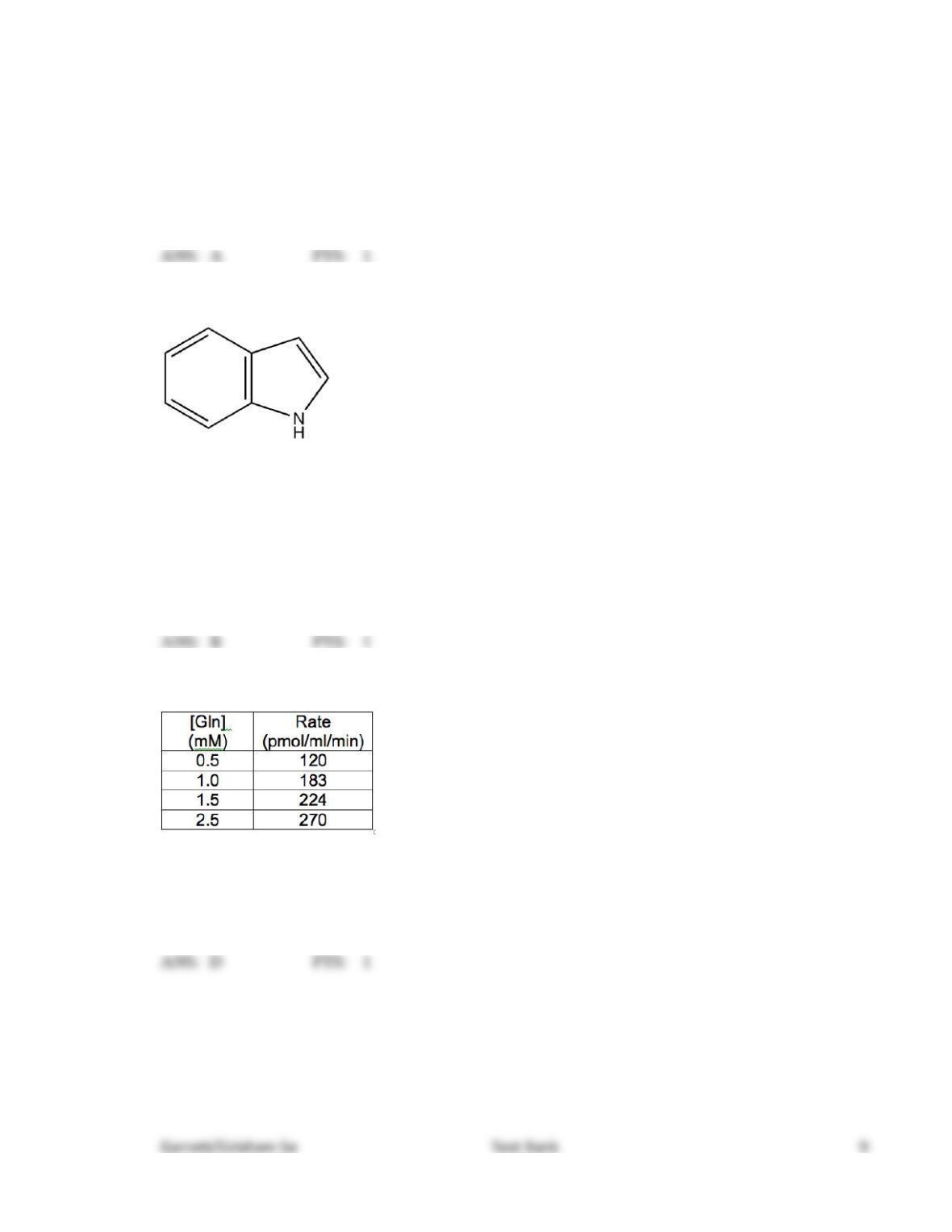
45. Indole (the structure shown below) will cross a membrane about 1000 times faster than tryptophan.
Which of the following is the most likely explanation for this phenomenon?
a.
there is a specific secondary active transporter for indole while tryptophan moves by
facilitated diffusion
b.
indole can easily move through a lipid bilayer by simple diffusion while tryptophan
movement is slowed by the presence of ionized functional groups
c.
both tryptophan and indole use the same transporter protein which has a much higer
affinity for indole than for tryptophan
d.
since indole is not normally present in biological systems, it is not bound to proteins that
would prevent transport in the manner that tryptophan is
e.
none of the above
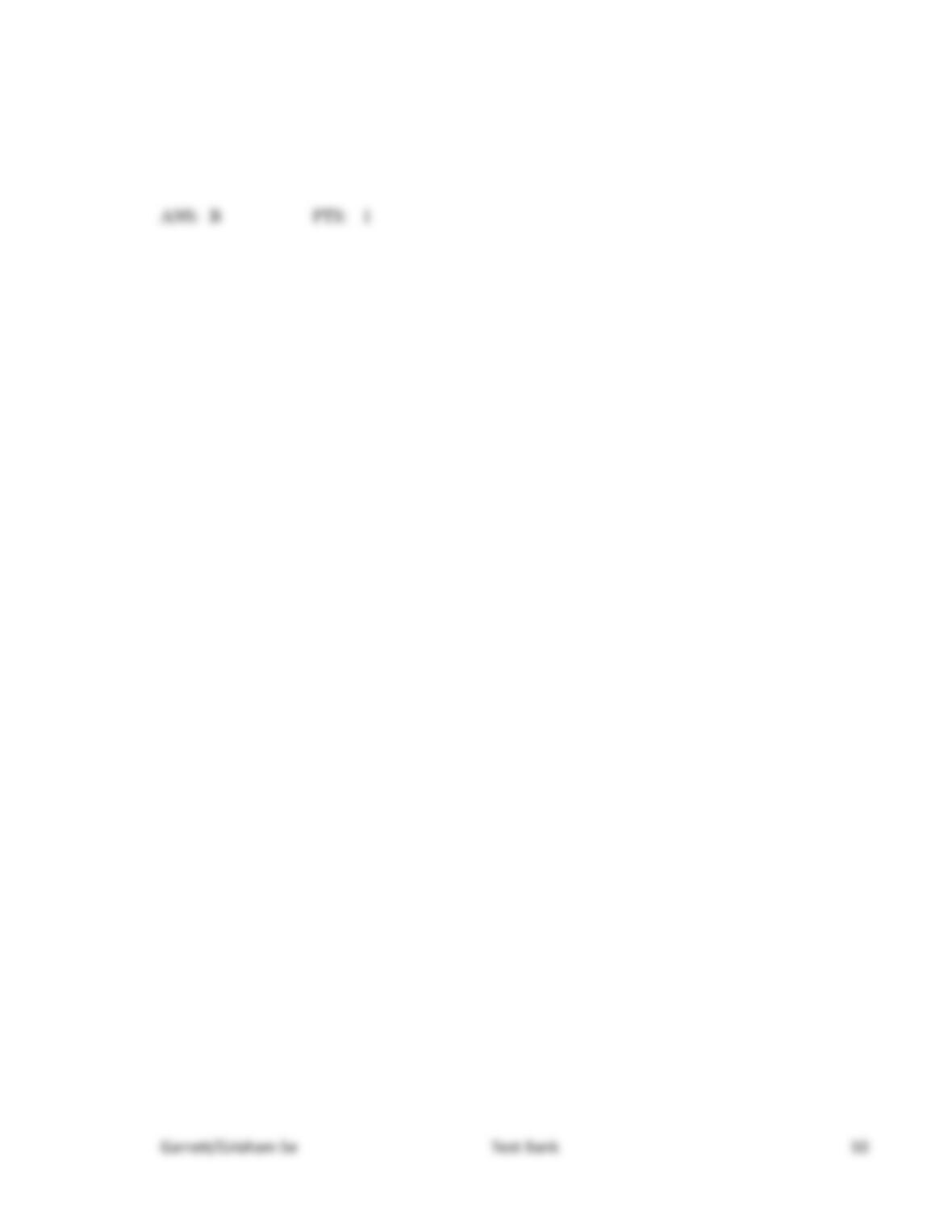
46. The transport of glutamine across a membrane was measured, and the results obtained are presented in
the following table. What type of transport does Gln exhibit?
a.
primary active transport
b.
secondary active transport
c.
passive diffusion
d.
facilitated diffusion
e.
cannot determine from the given data
47. In a typical Na+,K+-ATPase, _____ sodium ions are moved from the _____ of the cell while _____
potassium ions are moved from the _____ of the cell
a.
2; inside to outside; 3; outside to inside
b.
3; inside to outside; 2; outside to inside
c.
2; outside to inside; 3; inside to outside
d.
3; outside to inside; 2; inside to outside
e.
none of the above