
Exam
Name___________________________________
MULTIPLE CHOICE. Choose the one alternative that best completes the statement or answers the question.
1)
Which of the following statements about comets best describes the light we can observe?
1)
A)
A comet emits no light, but reflects visible light.
B)
A comet emits visible light and infrared light.
C)
A comet emits infrared light and reflects visible light.
D)
A comet emits visible light and reflects infrared light.
2)
What evidence led astronomers to conclude that the Oort cloud is a spherical distribution of
comets?
2)
A)
the observation that comets enter the solar system from random directions
B)
direct observation of comets orbiting the sun in the Oort cloud
C)
Astronomers did not draw that conclusion; the Oort cloud is shaped like a flat ring in the
same plane as the planets.
A
3)
The discovery of Eris ________.
3)
A)
was surprising, since we thought we knew about all large objects in the solar system
B)
was not surprising, because the existence of a massive “Planet X” had been predicted nearly a
century ago
C)
was surprising, due to its “backwards” orbit around the Sun
D)
was not surprising, because other Kuiper belt objects approaching the size of Pluto had
already been discovered
D
C

4)
What characteristic distinguishes a meteorite from a terrestrial rock?
4)
A)
Meteorites contain rare elements, such as iridium, that terrestrial rocks do not.
B)
A meteorite is usually covered with a dark crust from burning in Earth’s atmosphere.
C)
Meteorites have different isotope ratios of particular elements when compared to terrestrial
rocks.
D)
A meteorite usually has a high metal content.
E)
All of the above are true.
5)
Why does the plasma tail of a comet always point away from the Sun?
5)
A)
Radiation pressure from the Sun’s light pushes the ions away.
B)
It is allergic to sunlight.
C)
The solar wind blows the plasma ions directly away from the Sun.
D)
Gases from the comet, heated by the Sun, push the tail away from the Sun.
E)
The conservation of the angular momentum of the tail keeps it always pointing away from
the Sun.
6)
Suppose that large jovian planets had never formed in our solar system. Which of the following
would most likely be true?
6)
A)
Earth would orbit much closer to the Sun.
B)
Earth would have suffered far fewer impacts.
C)
There would be a large empty region in our solar system between the orbit of Mars and the
Kuiper belt.
D)
Neither the asteroid belt nor Oort cloud would exist.
7)
What is the name of the largest known Kuiper Belt Object?
7)
A)
Eris
B)
Pluto
C)
Quaoar
D)
Charon
E)
Sedna

8)
When we see a meteor shower, it means that ________.
8)
A)
an Earth–approaching asteroid has recently come very close to our planet
B)
the solar wind is unusually strong
C)
Earth is crossing the orbit of a comet
D)
you should duck and run for cover to avoid being blasted on the head by a rock from space
9)
If we could put all the asteroids together, their total mass would be ________.
9)
A)
about the mass of Mercury
B)
greater than the mass of Earth but less than the mass of Jupiter
C)
about the mass of Earth
D)
much less than the mass of any terrestrial planet
10)
Which of the following statements best describes the size of the largest asteroid, Ceres?
10)
A)
It is about the size of a terrestrial planet.
B)
It is no larger than a typical mountain on one of the terrestrial planets.
C)
It is a little less than half the diameter of our Moon.
D)
It is smaller than the jovian planets but larger than the terrestrial planets.
11)
When a comet passes near the Sun, part of it takes on the appearance of a large, bright ball from
which the tail extends. This part is called ________.
11)
A)
the coma
B)
the Oort core
C)
the nucleus
D)
the plasma tail

12)
On average, how often do impacts large enough to produce mass extinction on the Earth occur?
12)
A)
once in Earth’s history
B)
once every hundred million years
C)
once every century
D)
once every thousand years
E)
once every million years
13)
Where are the Trojan asteroids located?
13)
A)
on orbits that cross Earth’s orbit
B)
on orbits that cross Mars’s orbit
C)
surrounding Jupiter
D)
in the center of the asteroid belt
E)
along Jupiter’s orbit, 60° ahead of and behind Jupiter
E
14)
According to the nebular theory, how did the asteroid belt form?
14)
A)
It is made of planetesimals between the orbits of Mars and Jupiter that never formed into a
planet.
B)
It is made of planetesimals formed in the outer solar system that were flung into distant orbits
by encounters with the jovian planets.
C)
It is material left over from the interstellar cloud that never contracted with the rest of the
gases to form the solar nebula.
D)
It is made of planetesimals that formed beyond Neptune‘s orbit and never accreted to form a
planet.
E)
It consists of objects that fragmented from the protosun during a catastrophic collision early in
the formation of the solar system.
A
B

15)
What would be the consequence(s) of more frequent collisions between planets and asteroids?
15)
A)
We would find more Martian meteorites on Earth.
B)
We would observe more meteor showers.
C)
Earth and other planets would have more large craters.
D)
A and B
E)
A and C
16)
A typical meteor is created by a particle about the size of a ________.
16)
A)
car
B)
basketball
C)
baseball
D)
pea
D
17)
Approximately how long ago was Pluto discovered?
17)
A)
about 25 years ago
B)
about 2000 years ago
C)
about 200 years ago
D)
in ancient history
E)
about 75 years ago
E
18)
How was Pluto’s surface mapped?
18)
A)
by imaging with the Hubble Space Telescope
B)
by imaging with powerful ground based telescopes
C)
by measuring the change in brightness as Charon eclipsed Pluto
D)
by mapping with the New Horizons spacecraft
E)
Pluto is too far away for its surface to be mapped.
C
E

19)
What do astronomers mean when they refer to “gaps” in the asteroid belt between Mars and
Jupiter?
19)
A)
Asteroids seem to avoid certain orbits around the Sun, creating “gaps” in the orbits that
asteroids can have.
B)
There are very few asteroids with diameters between 1 and 100 kilometers, creating a “gap” in
the size distribution.
C)
There are either pure metal or pure rock asteroids, but no mixtures. Thus there is a “gap” in
the composition of asteroids.
D)
Asteroids typically cluster together and this creates “gaps” on the sky.
E)
There is a large population of asteroids too faint to see called the “gap” asteroids.
20)
Which of the following is furthest from the Sun?
20)
A)
an asteroid in the asteroid belt
B)
Pluto
C)
a comet in the Kuiper belt
D)
a comet in the Oort cloud
E)
Neptune
D
21)
A rocky leftover planetesimal orbiting the Sun is
21)
A)
a meteor.
B)
a comet.
C)
a meteorite.
D)
an asteroid.
E)
possibly any of the above
D
22)
Which direction do a comet’s dust and plasma tails point?
22)
A)
perpendicular to the ecliptic plane
B)
always almost due north
C)
generally away from the Sun
D)
straight behind the comet in its orbit
C
A
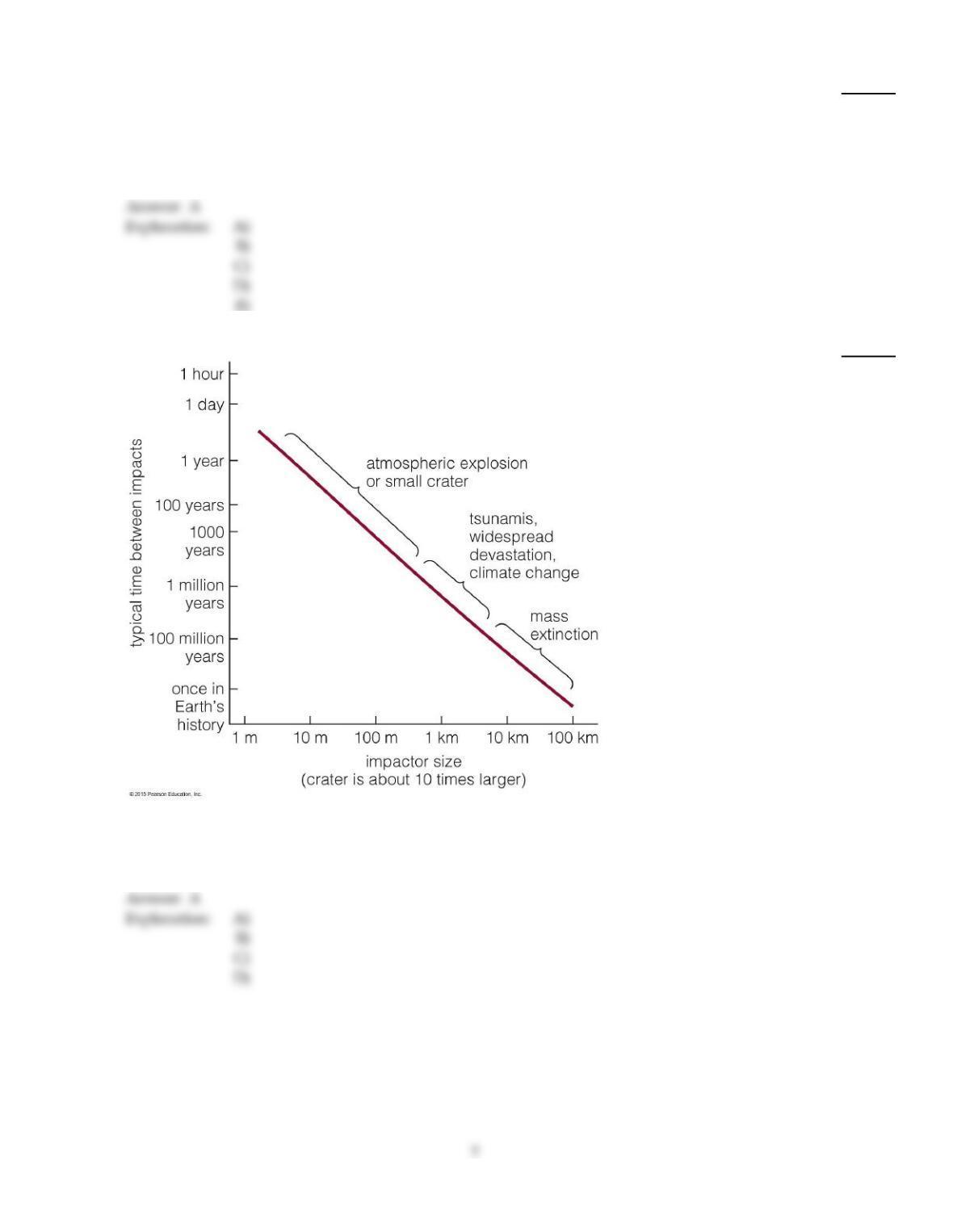
23)
Which of the following does not lend support to the idea that Pluto is a Kuiper–belt object?
23)
A)
Pluto is smaller than many known comets, such as Halley’s comet.
B)
Some Kuiper–belt objects have their own moons.
C)
Some known Kuiper–belt objects are hundreds of kilometers across.
D)
Pluto has a comet–like composition and density.
E)
Pluto has a more eccentric orbit than other planets.
24)
How frequently do objects that threaten widespread devastation hit the Earth?
24)
A)
about once every million years
B)
about once every year
C)
about once every thousand years
D)
about once every hundred million years

25)
How many moons is Pluto known to have?
25)
A)
none
B)
one
C)
four
D)
three
E)
two
26)
What part of a comet always points most directly away from the Sun?
26)
A)
the plasma tail
B)
the nucleus
C)
the jets of gas
D)
the dust tail
E)
the coma
27)
Processed meteorites with high metal content probably are
27)
A)
chunks of rock chipped off the planet Mercury.
B)
chunks of rock chipped off the planet Mars.
C)
pieces of comets rather than of asteroids.
D)
leftover chunks of rock from the earliest period in the formation of the solar system.
E)
chunks of the core of a larger asteroid that was shattered by a collision.
28)
Pluto is different from the Jovian planets in all of the following ways except which one?
28)
A)
It is made mostly of ices.
B)
It formed outside of the frost line in the solar nebula.
C)
It doesn’t have rings.
D)
It has a solid surface.
E)
Its orbit is not very close to being circular.

29)
The total number of comets orbiting the Sun is estimated to be about ________.
29)
A)
1 trillion
B)
1 million
C)
100,000
D)
1,000
30)
Which of the following objects are probably not located in the same general region of the solar
system in which they originally formed?
30)
A)
Oort cloud comets
B)
asteroids of the asteroid belt
C)
Pluto
D)
Kuiper belt comets
31)
Kirkwood gaps in the asteroid belt occur at distances where
31)
A)
the period of an orbiting asteroid would be the same as Mars’s orbital period.
B)
the density of asteroids is high enough for a large collision to pulverize a number of asteroids.
C)
the period of an orbiting asteroid would be the same as Jupiter’s orbital period.
D)
the orbit would take the asteroid beyond the “frost line” in the solar system.
E)
the period of an orbiting asteroid would be a simple fraction (like 1/3 or 1/4) of Jupiter’s
orbital period.
32)
How do asteroids appear in long exposure images?
32)
A)
as points of light, like the stars
B)
as resolved disks, like the planets
C)
as complex curving and looping lines
D)
as straight lines across a background of stars

33)
During the time that a comet passes through the inner solar system, the comet can appear quite
bright because
33)
A)
sunlight reflects off the comet’s nucleus.
B)
sunlight reflects off the comet’s tail and coma.
C)
heat from the Sun causes the comet’s nucleus to glow.
D)
increasing friction causes the comet’s nucleus to glow.
34)
Why won’t Pluto collide with Neptune?
34)
A)
Pluto’s orbit never comes anywhere close to Neptune’s orbit.
B)
Actually, a collision of the two is inevitable within the next billion years.
C)
Pluto orbits the Sun exactly two times for every three Neptune orbits, which ensures they
never come close together.
D)
Pluto is always much farther from the Sun than Neptune.
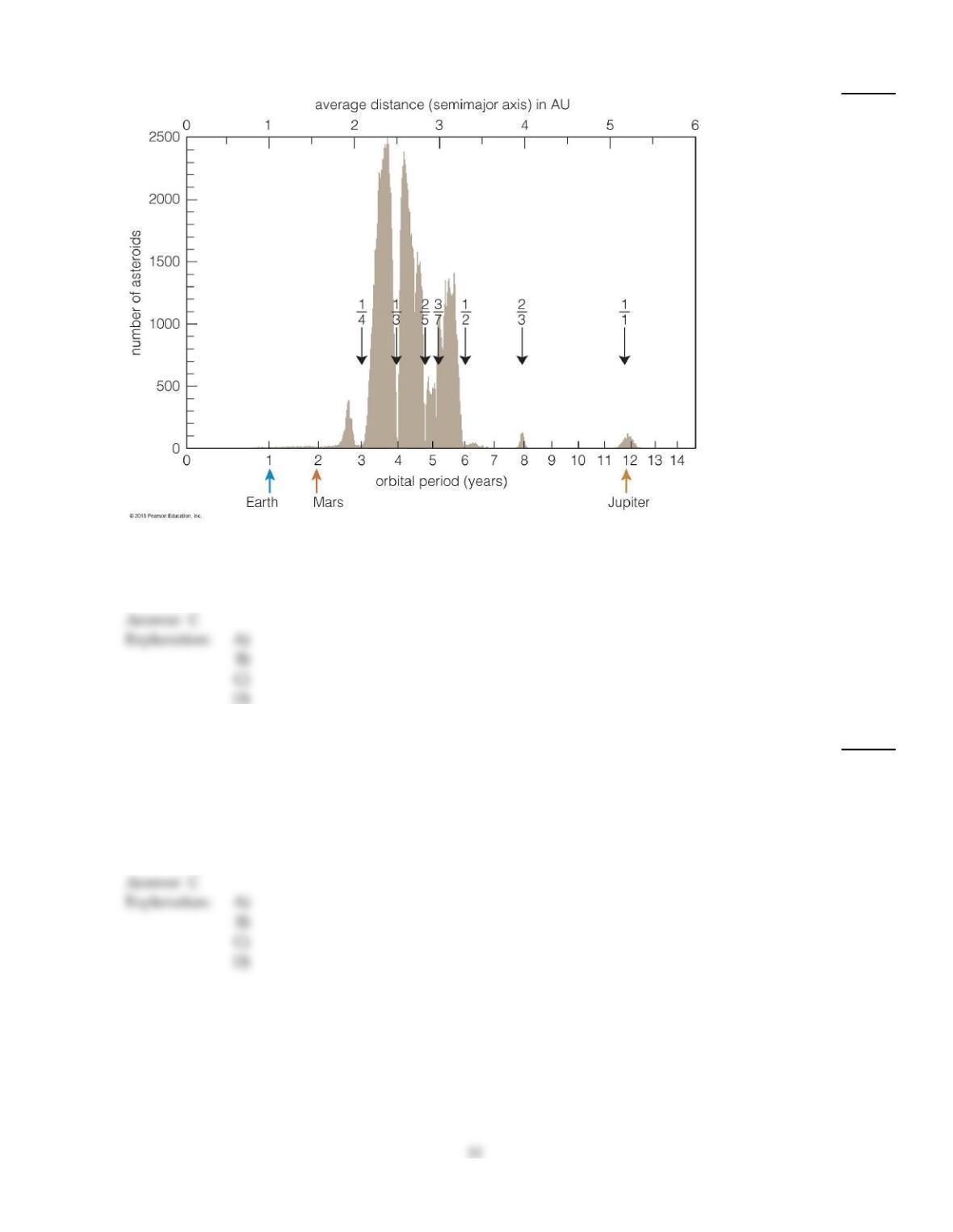
35)
The greatest number of asteroids are found
35)
A)
between 1 and 2 AU from the sun.
B)
between 3 and 4 AU from the sun.
C)
between 2 and 3 AU from the sun.
D)
between 4 and 5 AU from the sun.
36)
Suppose you find a meteorite made almost entirely of metal. According to current science, which of
the following statements must be true?
36)
A)
Radiometric dating will show the age of your meteorite to date to the formation of our solar
system.
B)
Your meteorite is a fragment of an object from the Kuiper belt.
C)
Your meteorite is a fragment from the core of a large asteroid that shattered in a collision.
D)
Your meteorite was blasted off the surface of Mars by an impact.

37)
What is Charon?
37)
A)
the largest known asteroid
B)
a captured moon of Neptune
C)
the largest known Kuiper belt object
D)
the largest of Pluto’s five known moons
38)
The asteroid belt is located ________.
38)
A)
between the orbits of Mars and Jupiter
B)
between the orbits of Jupiter and Saturn
C)
beyond the orbit of Neptune
D)
between the orbits of Earth and Mars
39)
What do we mean by a mass extinction?
39)
A)
the extinction of large animals, such as dinosaurs
B)
the extinction of any species of plant or animal that has mass
C)
an extinction caused by the impact of an asteroid or comet
D)
the extinction of a large fraction of the world’s plant and animal species in a relatively short
period of time
40)
What is the typical size of a comet’s nucleus?
40)
A)
1 meter
B)
100 km
C)
10 km
D)
1000 km
E)
Sizes are unknown because the nucleus is obscured by the coma.

41)
Will Pluto eventually collide with Neptune?
41)
A)
No, because Pluto’s orbit is completely inside Neptune’s orbit.
B)
No, because Pluto’s orbit never comes anywhere close to Neptune’s orbit.
C)
No, because Pluto‘s orbit is completely outside Neptune’s orbit.
D)
Yes.
E)
No, because the two planets have an orbital resonance that prevents them from colliding.
42)
If a major asteroid collision in the asteroid belt occurs, on average, 1 time in 100,000 years, then
how many major collisions have occurred over the approximately 4 billion year history of the solar
system?
42)
A)
about 4 million
B)
about 4,000
C)
about 4 billion
D)
about 40,000
43)
Assume that the average rate of 1–km sized asteroids hitting the Earth is about 1 every million
years. The chance of the Earth being hit by a 1–km sized asteroid in the next 100 years is about:
43)
A)
one in 100 million.
B)
one in ten thousand.
C)
one in a million.
D)
inevitable, it has to happen sometime.
E)
zero.
44)
What do asteroids and comets have in common?
44)
A)
Most are unchanged since their formation in the solar nebula.
B)
They have similar densities.
C)
They have a similar range of orbital inclinations.
D)
They have similar orbital radii.
E)
They have nothing in common with each other.

45)
What is the approximate diameter of the largest asteroid?
45)
A)
100 km
B)
10,000 km
C)
10 km
D)
1,000 km
E)
1 km
46)
The impact of a 100 meter asteroid could kill many people if it struck a major city. Suppose the
probability of such an impact in any single year is 1 in 1,000, and suppose we know (somehow) that
it has been 1200 years since the last impact. What would that tell us?
46)
A)
We are now due for such an impact, so the actual probability for the coming year must be
much higher than 1 in 1000.
B)
Nothing, we would still presume that the chance of such an impact during the next year is 1
in 1000.
C)
We are overdue for such an impact, so we should expect to be hit by something even larger
during the next few years.
D)
The prediction must be wrong, since the time since the last impact has been 1200 years.
47)
In what way(s) has Pluto long been known to be different from the planets?
47)
A)
It is composed primarily of ices.
B)
It is far smaller than the terrestrial planets.
C)
It has a highly eccentric orbit.
D)
Its orbit is more inclined to the ecliptic plane.
E)
All of the above
48)
Why do asteroids and comets differ in composition?
48)
A)
Asteroids are much larger than comets.
B)
Comets formed from the jovian nebula, while asteroids did not.
C)
Comets are much larger than asteroids.
D)
Asteroids formed inside the frost line, while comets formed outside.
E)
Asteroids and comets formed at different times.

49)
Which of the following statements about comets and asteroids is true?
49)
A)
Comets are balls of ice and dust.
B)
Only asteroids collide with Earth.
C)
There are about 1 million known asteroids in the solar system.
D)
Most of the trillions of comets in our solar system have tails.
E)
All asteroids lie in the asteroid belt between Mars and Jupiter.
50)
Comets with extremely elliptical orbits, like Hyakutake and Hale–Bopp,
50)
A)
come from the Kuiper belt.
B)
come from the asteroid belt.
C)
come from the Oort cloud.
D)
are Trojan comets.
E)
are captured by Jupiter.
C
51)
Pluto is most like a
51)
A)
jovian (gas giant) planet.
B)
star.
C)
comet.
D)
terrestrial planet.
C
52)
According to current evidence, Pluto is best explained as ________.
52)
A)
a very small jovian planet
B)
a large member of the Kuiper belt
C)
a terrestrial planet that is surprisingly far from the Sun
D)
an escaped moon of Jupiter or Saturn
B
A

53)
According to the nebular theory, how did the Oort cloud form?
53)
A)
It is material left over from the interstellar cloud that never contracted with the rest of the
gases to form the solar nebula.
B)
It is made of planetesimals that formed beyond Neptune‘s orbit and never accreted to form a
planet.
C)
It is made of planetesimals between the orbits of Mars and Jupiter that never formed into a
planet.
D)
It consists of objects that fragmented from the protosun during a catastrophic collision early in
the formation of the solar system.
E)
It is made of planetesimals formed in the outer solar system that were flung into distant orbits
by encounters with the jovian planets.
54)
What lucky factor prevented the Chelyabinsk object from causing much damage at ground level?
54)
A)
It hit Earth at an oblique angle and thus exploded high in the air.
B)
A prototype asteroid defense system was being tested nearby.
C)
It was made entirely of ices and thus exploded high in the air.
55)
The last major dinosaurs were wiped out as a consequence of a major impact with the Earth about
65 million years ago. All but one of the following statements would be regarded as evidence for this
claim.
55)
A)
Multiple historical accounts describe a planetary–level flood and storm that wiped out most
living things.
B)
A layer of iridium in 65–million year old sediments in the Earth’s crust
C)
At least 150 craters from past impacts have been identified, including one of the right age and
size in Mexico.
D)
The fossil record shows a mass extinction event 65 million years ago, where only 25% of the
species survived.
56)
A rock found on Earth that crashed down from space is called ________.
56)
A)
an impact
B)
a meteorite
C)
an asteroid
D)
a meteor

57)
What is Tunguska?
57)
A)
the Gulf of Mexico basin that is the crater of the asteroid impact that caused the mass
extinction of the dinosaurs 65 million years ago
B)
the site of an asteroid impact that occurred in Siberia in 1908
C)
a long period comet that struck Jupiter in 1994
D)
a newly discovered moon of Pluto
E)
a postulated binary companion to the Sun thought to be responsible for mass extinctions
58)
An icy leftover planetesimal orbiting the Sun is
58)
A)
a comet.
B)
a meteorite.
C)
a meteor.
D)
an asteroid.
E)
possibly any of the above
59)
What is Charon?
59)
A)
the largest known comet
B)
the largest known asteroid
C)
one of the Galilean moons of Jupiter
D)
Pluto’s largest moon
E)
a moon of Neptune
60)
Why didn’t a planet form where the asteroid belt is now located?
60)
A)
The temperature in this portion of the solar nebula was just right to prevent rock from
sticking together.
B)
There was not enough material in this part of the solar nebula to form a planet.
C)
There was too much rocky material to form a terrestrial planet, but not enough gaseous
material to form a jovian planet.
D)
Gravitational tugs from Jupiter prevented material from collecting together to form a planet.

61)
A typical shooting star in a meteor shower is caused by a ________ entering Earth’s atmosphere.
61)
A)
microscopic particle of interstellar dust
B)
pea–size particle from a comet
C)
boulder–size particle from a comet
D)
boulder–size particle from an asteroid
E)
pea–size particle from an asteroid
62)
Among discovered meteorites, we have found some with all the following origins except ________.
62)
A)
being a fragment from the surface of Mars
B)
being a fragment from the surface of the Moon
C)
being a fragment of a shattered asteroid
D)
being a fragment from Comet Halley
63)
Which statement is not thought to be true of all comets in our solar system?
63)
A)
All comets orbit the Sun.
B)
Comets always have tails.
C)
All comets are icy in composition.
D)
All comets are leftover planetesimals that originally condensed beyond the frost line in the
solar nebula.
64)
Where did comets that are now in the Kuiper belt originally form?
64)
A)
between the orbits of Jupiter and Neptune
B)
in the Oort cloud
C)
inside Jupiter’s orbit
D)
in the asteroid belt
E)
near the radius at which they orbit today

65)
What do we mean by a primitive meteorite?
65)
A)
a meteorite that fell to Earth at least 4 billion years ago
B)
a type of meteorite that is usually made mostly of high–density metals
C)
a meteorite that was discovered by primitive people
D)
a piece of rock that is essentially unchanged since it first condensed and accreted in the solar
nebula some 4.6 billion years ago
66)
Which of the following statements is not true?
66)
A)
Objects in the Oort cloud contain large proportions of ice.
B)
Objects in the asteroid belt and Kuiper belt orbit the Sun in nearly the same plane as the
planets, but objects in the Oort cloud do not.
C)
Objects in the Kuiper belt are made mostly of rock and metal.
D)
Objects in the asteroid belt are made mostly of rock and metal.
67)
What was the Stardust mission?
67)
A)
a mission to study the composition of a comet by collecting material from its tail and return
that material to Earth
B)
a mission to study the outer planets of the solar system by sending a probe from one to the
next with a wide variety of instruments
C)
a mission to study the surface structure of a comet by dropping a lander onto its surface
D)
a mission to study the composition of an asteroid by hitting it with a massive object and
observing the material thrown into space
68)
What is Eris?
68)
A)
the largest known extrasolar planet
B)
the largest known asteroid
C)
the largest known Kuiper Belt object
D)
Pluto’s largest moon
E)
the largest moon of Saturn
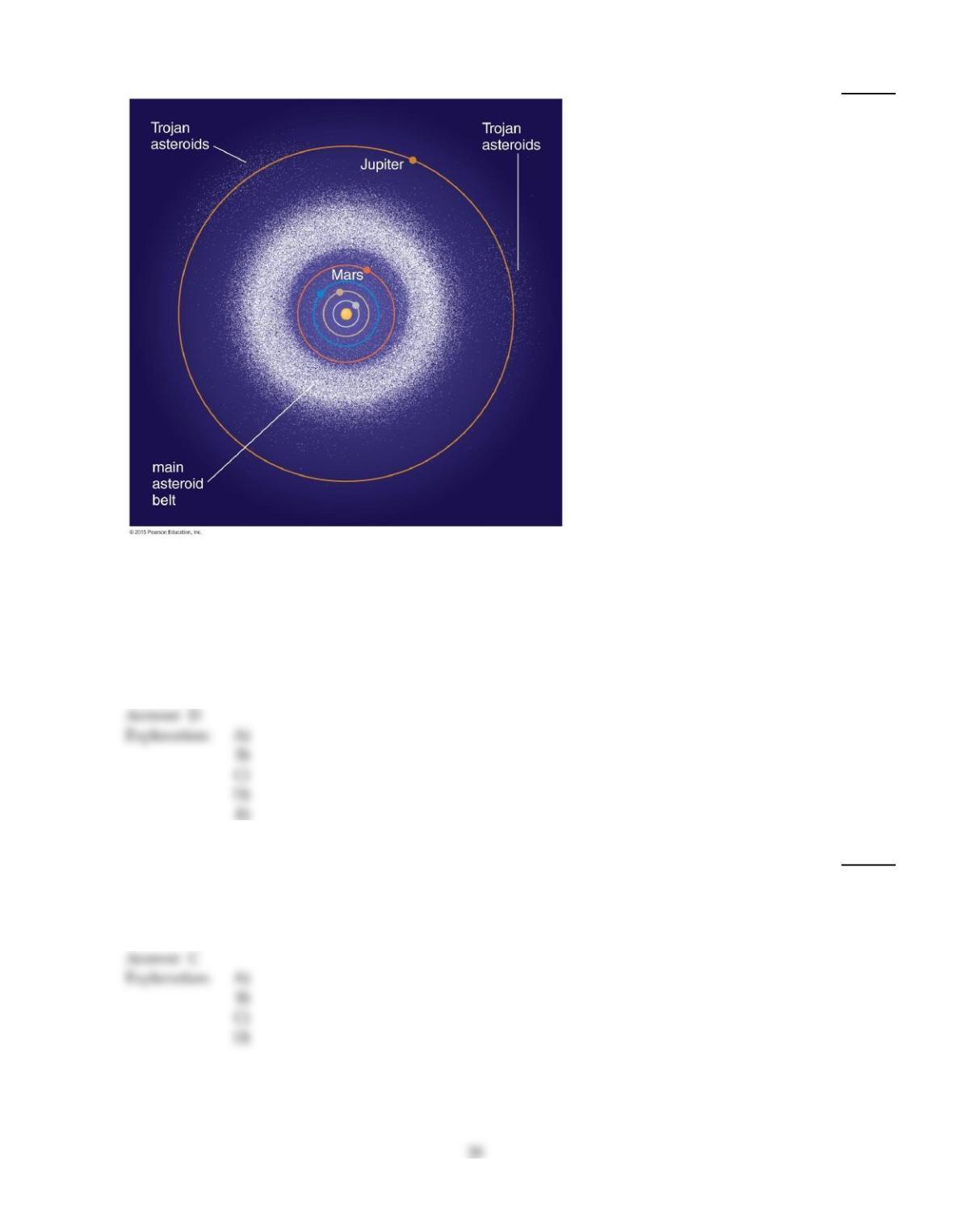
69)
In what way(s) does this figure give a poor representation of the asteroid belt?
69)
A)
For a correct scale, the asteroids should be drawn much smaller. This image gives the
impression that the asteroid belt is very crowded.
B)
The image does not show the vertical distribution of asteroids relative to the ecliptic plane.
C)
It shows the positions of the asteroids at a mix of times.
D)
A and B
E)
A and C
70)
In science fiction movies, spaceships are often shown dodging through large numbers of closely
spaced, boulder–size objects. Which of the following real things in our solar system would look
most like such science fiction dangers?
70)
A)
the atmosphere of Jupiter
B)
the Oort cloud
C)
the rings of Saturn
D)
the asteroid belt

71)
Meteorites can come from
71)
A)
Mars.
B)
the Moon.
C)
the crusts and mantles of asteroids.
D)
the cores of asteroids.
E)
all of the above
72)
Why do we sometimes observe asteroids at the distances of the gaps in the asteroid belt?
72)
A)
A gap is located at an average orbital distance, and asteroid orbits often have large
eccentricities.
B)
They are held in place by resonances with other asteroids.
C)
Jupiter’s gravitational tugs keep them there.
D)
Actually, we never see asteroids in the gaps.
E)
They are kept in place by shepherding asteroids.
A
73)
What happened to the “Impactor” of the Deep Impact mission?
73)
A)
It missed the comet altogether.
B)
It blasted straight through the comet leaving a small hole.
C)
It blasted the comet apart, thus preventing a potential Earth collision.
D)
It landed safely on the surface of the comet and returned material to Earth.
E)
It created a small crater on the comet.
E
74)
When you see the bright flash of a meteor, what are you actually seeing?
74)
A)
a star that has suddenly shot across the sky
B)
the flash that occurs when a speeding rock from space hits the ground
C)
the glow from a pea–size particle and the surrounding air as the particle burns up in our
atmosphere
D)
emission of visible light from a particle that has not yet entered Earth’s atmosphere
C
E

75)
Suppose we discover a new comet on an orbit that brings it closer to the Sun than Mercury every
125 years. What can we conclude?
75)
A)
It came from the Kuiper belt.
B)
It has been on its current orbit for only a very short time compared to the age of our solar
system.
C)
It has a coma and tail during most of each orbit.
D)
It came from the Oort cloud.
76)
If all the asteroids were gathered into a single object, it would make an object
76)
A)
about the size of Earth’s moon.
B)
about half the diameter of Earth’s moon.
C)
about the size of the Earth.
D)
with enough mass to gather hydrogen and helium and become a gas giant.
77)
If the hypothesis tracing the extinction of the dinosaurs to an impact is correct, the dinosaurs died
off largely because ________.
77)
A)
the impact caused massive earthquakes worldwide
B)
of global climate effects initiated by dust and smoke that entered the atmosphere after the
impact
C)
radiation from iridium in the asteroid caused the dinosaurs to die of cancer
D)
of injuries suffered from direct hits of pieces of the asteroid or comet
78)
Which of the following is not a piece of evidence supporting the idea that Pluto is a large comet of
the Kuiper belt?
78)
A)
Pluto grows a coma and a long tail when it is at the point in its orbit closest to the Sun.
B)
Pluto’s composition appears to match that of other known Kuiper belt comets.
C)
Pluto is not the largest object orbiting in the region of the Kuiper belt.
D)
Pluto’s orbit is very similar to the orbits of other known Kuiper belt comets.
E)
Triton, which must once have orbited the Sun before being captured by Neptune, is
significantly larger than Pluto.

79)
According to the nebular theory, how did the Kuiper belt form?
79)
A)
It is material left over from the interstellar cloud that never contracted with the rest of the
gases to form the solar nebula.
B)
It consists of objects that fragmented from the protosun during a catastrophic collision early in
the formation of the solar system.
C)
It is made of planetesimals that formed beyond Neptune‘s orbit and never accreted to form a
planet.
D)
It is made of planetesimals between the orbits of Mars and Jupiter that never formed into a
planet.
E)
It is made of planetesimals formed in the outer solar system that were flung into distant orbits
by encounters with the jovian planets.
80)
Which statement about asteroids is not true?
80)
A)
If we could put all the asteroids together, they would make an object about the size of Earth.
B)
Many, but not all, orbit the Sun in the asteroid belt.
C)
Most asteroids are not spherical in shape.
D)
Some are more like loosely bound piles of rubble than solid chunks of rock.
81)
What is Eris?
81)
A)
a moon of Pluto
B)
an icy object that orbits in the Kuiper belt and is larger than Pluto
C)
the largest known asteroid
D)
an extrasolar planet ejected by another solar system and captured by ours
82)
Gaps in the asteroid belt (often called Kirkwood gaps) are caused by ________.
82)
A)
tidal forces from Jupiter
B)
orbital resonances with Jupiter
C)
tidal forces from the Sun
D)
the competing gravitational tugs of Mars and Jupiter

83)
Why was the Shoemaker–Levy 9 impact so important to astronomers?
83)
A)
It dredged up material that gave us our first direct look at Jupiter’s interior composition.
B)
It was the first event in modern history that was brighter than the full moon in the sky.
C)
It confirmed our theory of solar system formation.
D)
It wiped out the dinosaurs.
E)
It was the first direct proof that impacts really occur.
84)
How do asteroids differ from comets?
84)
A)
Asteroids are made of rocky material. Comets are made of icy material.
B)
Asteroids are made of icy material. Comets are made of rocky material.
C)
Asteroids and comets are both made of rocky and icy material, but asteroids are smaller in
size than comets.
D)
Asteroids and comets are both made of rocky and icy material, but asteroids are larger in size
than comets.
85)
What was the Shoemaker–Levy 9 impact?
85)
A)
the 1994 impact of a chain of comet fragments into Jupiter
B)
the impact that created the Moon’s largest crater
C)
the impact thought to have wiped out the dinosaurs
D)
the ninth impact witnessed by astronomers in modern times
86)
Which of the following are evidence for an asteroid impact being the cause of the extinction of the
dinosaurs 65 million years ago (as well as 75% of all species alive at the time)?
86)
A)
no dinosaur fossils being present in rocks younger than 65 million years old
B)
a worldwide layer of the element iridium in 65 million year old rocks
C)
a buried crater more than 100 km across in the Gulf of Mexico
D)
all of the above

87)
Where did comets that are now in the Oort cloud originally form?
87)
A)
inside Jupiter’s orbit
B)
near the jovian planets
C)
outside Neptune’s orbit
D)
within the solar nebula, but far outside the orbit of Pluto
E)
all of the above
88)
Why aren’t small asteroids spherical in shape?
88)
A)
Large asteroids were once molten and therefore became spherical, but small asteroids were
never molten.
B)
The strength of gravity on small asteroids is less than the strength of the rock.
C)
Large asteroids became spherical because many small collisions chipped off pieces until only
a sphere was left; this did not occur with small asteroids.
D)
Small asteroids have odd shapes because they were all chipped off larger objects.
89)
What is a meteorite?
89)
A)
a streak of light caused by a star moving across the sky
B)
a small moon that orbits one of the giant planets
C)
a fragment of an asteroid from the solar system that has fallen to Earth’s surface
D)
a comet that burns up in Earth’s atmosphere
E)
a streak of light caused by a small particle from space burning up in Earth’s atmosphere
90)
Rather than being a planet, Pluto is really just a large member of
90)
A)
the asteroid belt.
B)
the moon system around Neptune.
C)
the Kuiper belt.
D)
an extrasolar planetary system.
E)
the Oort cloud.

91)
What is Pluto’s moon Charon thought to have in common with our own Moon?
91)
A)
It probably formed as a result of a giant impact.
B)
It has the same average density.
C)
It has the same basic composition.
D)
It has the same approximate mass.
92)
Suppose there were no solar wind. How would the appearance of a comet in our inner solar system
be different?
92)
A)
It would be much brighter in appearance.
B)
It would have only one tail instead of two.
C)
It would not have a coma.
D)
It would not have a nucleus.
93)
Which of the following is not a piece of evidence supporting the idea that an impact caused the
mass extinction that occurred 65 million years ago?
93)
A)
Unusually large abundances of iridium and other rare metals are found in a layer of clay that
dates to 65 million years ago.
B)
Grains of quartz formed under high pressure are found in a layer of clay that dates to 65
million years ago.
C)
Fossilized dinosaur bones contain fragments of rock from the impact.
D)
A large impact crater along the coast of Mexico dates to 65 million years ago.
94)
Primitive meteorites can be distinguished from other meteorites and terrestrial rocks because they
94)
A)
contain a noticeable fraction of pure metallic flakes.
B)
resemble the composition of rocks from lava flows that occurred on asteroids very shortly
after the formation of the solar system.
C)
contain a lot of iron and were used by humans to make iron tools.
D)
resemble the composition of Earth’s mantle.
E)
resemble the composition of Earth’s core.
SHORT ANSWER. Write the word or phrase that best completes each statement or answers the question.
95)
Why is the Kuiper belt flat but the Oort cloud spherical?
95)
Refer to the following choices to answer the questions below. Choose the answer that best describes the chemical composition of the object.
A. nickel and iron
B. 80 percent nitrogen, 20 percent oxygen
C. 95 percent carbon dioxide
D. mostly hydrogen and helium
E. frozen methane, ammonia, water, and other gases and dust
96)
a Kuiper–belt object
96)
Refer to the following scenario for the questions below.
Lost in the Solar System: You have been abducted by an alien being. After performing experiments on you, the alien gives
you a “life–support belt“, allowing you to survive in any environment, and dumps you somewhere in the solar system. Each
question below gives a brief description of a place where you were left by the alien. Identify your location. Be as specific as
possible. Include a brief explanation for your answer.
97)
You find yourself on a silent airless world! The lack of an atmosphere means that you must
be very careful not to look at the Sun so that you will not be blinded by its ultraviolet and
X–ray radiation. However, you are able to determine that the Sun has about the same
angular size that you are used to on Earth. Although this world is clearly lifeless, you are
surprised to find footprints and car tracks etched in the powdery surface.
97)
98)
Briefly describe the evidence suggesting that a 10–km asteroid or comet hit Earth at the
time of the dinosaur extinction.
98)
99)
Describe some ways in which a meteorite can be distinguished from a terrestrial rock.
99)
Refer to the following choices to answer the questions below. Choose the answer that best describes the chemical composition of the object.
A. nickel and iron
B. 80 percent nitrogen, 20 percent oxygen
C. 95 percent carbon dioxide
D. mostly hydrogen and helium
E. frozen methane, ammonia, water, and other gases and dust
100)
Jupiter
100)
D
101)
Mercury’s core
101)
A
102)
Why is Pluto now considered to be a Kuiper–belt object?
102)
103)
Suppose the planet Jupiter had never formed. How do you think the distribution of
asteroids and comets in our solar system would be different? Explain.
103)
104)
Describe the Deep Impact and Stardust missions and what they were designed to achieve.
104)
Refer to the following choices to answer the questions below. Choose the answer that best describes the chemical composition of the object.
A. nickel and iron
B. 80 percent nitrogen, 20 percent oxygen
C. 95 percent carbon dioxide
D. mostly hydrogen and helium
E. frozen methane, ammonia, water, and other gases and dust
105)
the atmosphere of Mars
105)
Refer to the following scenario for the questions below.
Lost in the Solar System: You have been abducted by an alien being. After performing experiments on you, the alien gives
you a “life–support belt“, allowing you to survive in any environment, and dumps you somewhere in the solar system. Each
question below gives a brief description of a place where you were left by the alien. Identify your location. Be as specific as
possible. Include a brief explanation for your answer.
106)
You are walking on a solid surface. The surface gravity is comfortable, but it is “hot, hot,
hot!” Your body is being squeezed in all directions due to the high pressure; it’s almost like
being deep in the ocean. Your life–support belt is corroding. The Sun, barely visible
through the haze, is near your meridian. You hope for nightfall (unaware that it would
provide no relief), but you already have been stuck on this planet for nearly 72 hours, and
the Sun seems not to have moved through the sky (and, if it moved at all, it moved
eastward from the meridian).
106)
107)
You find yourself in a maelstrom, whipped by winds gusting at 10,000 km/hr, rising and
falling in convective currents. On the rare occasions when you can assess your
surroundings, you notice a horizon that seems to go on “forever” (or, at least, much farther
than the horizon on Earth), and no solid surface anywhere. You get a glimpse of several
large moons. The Sun races through your sky, requiring only about 5 hours to rise nearly
due east, cross the meridian at an altitude of about 55° in the north, and then set due west.
107)
Refer to the following choices to answer the questions below. Choose the answer that best describes the chemical composition of the object.
A. nickel and iron
B. 80 percent nitrogen, 20 percent oxygen
C. 95 percent carbon dioxide
D. mostly hydrogen and helium
E. frozen methane, ammonia, water, and other gases and dust
108)
Comet Hale–Bopp
108)
109)
the atmosphere of Venus
109)
110)
Briefly describe how an impact could lead to a mass extinction.
110)
Refer to the following scenario for the questions below.
Lost in the Solar System: You have been abducted by an alien being. After performing experiments on you, the alien gives
you a “life–support belt“, allowing you to survive in any environment, and dumps you somewhere in the solar system. Each
question below gives a brief description of a place where you were left by the alien. Identify your location. Be as specific as
possible. Include a brief explanation for your answer.
111)
It is very cold, but otherwise comfortable. You breathe deeply. Although there is no
oxygen, the air pressure is quite tolerable and seems almost Earth–like (because it is mostly
nitrogen). Your vista includes the breathtaking sights of an ocean of liquid methane and
methane–snow–capped mountains (although the atmosphere is very smoggy, and the
visibility is limited). Your solar day is about 16 Earth days long. A large, ringed object
seems to hang in your sky, never rising or setting; however, it does go through phases from
new to full and back to new again with the same 16–day period as the rising and setting of
the Sun.
111)
Refer to the following choices to answer the questions below. Choose the answer that best describes the chemical composition of the object.
A. nickel and iron
B. 80 percent nitrogen, 20 percent oxygen
C. 95 percent carbon dioxide
D. mostly hydrogen and helium
E. frozen methane, ammonia, water, and other gases and dust
112)
Earth‘s atmosphere
112)
113)
What are “dwarf planets”?
113)
Refer to the following scenario for the questions below.
Lost in the Solar System: You have been abducted by an alien being. After performing experiments on you, the alien gives
you a “life–support belt“, allowing you to survive in any environment, and dumps you somewhere in the solar system. Each
question below gives a brief description of a place where you were left by the alien. Identify your location. Be as specific as
possible. Include a brief explanation for your answer.
114)
You’ve been dropped at the edge of a cliff, looking down for what seems to be miles!
There’s only one way to go from here: up! But it’s going to be quite a climb, requiring all of
your mountaineering skills. The atmosphere is very thin even at the mean surface level of
this place. No matter, though, as you could not breathe this atmosphere anyway because it
is mostly carbon dioxide and contains no oxygen. You climb and climb. This mountain
must be three times the height of Mt. Everest and much broader at its base. There are
clouds around you, and you can find water ice as well. When you try to melt some ice,
however, it does not turn to liquid but sublimes to gas.
114)
115)
Describe at least three ways in which our solar system would be different if orbital
resonances had never been important.
115)

Refer to the following scenario for the questions below.
Lost in the Solar System: You have been abducted by an alien being. After performing experiments on you, the alien gives
you a “life–support belt“, allowing you to survive in any environment, and dumps you somewhere in the solar system. Each
question below gives a brief description of a place where you were left by the alien. Identify your location. Be as specific as
possible. Include a brief explanation for your answer.
116)
It‘s cold. You are sitting on what appears to be a water ice–covered world. The Sun is low
on the horizon and circles the horizon once every 24 hours. Despite the low Sun, you can
almost “feel” the Sun‘s ultraviolet radiation on your exposed face because there is little
ozone to protect you. Despite these discomforts, you are pleased to find that the air is quite
satisfactory; oxygen seems plentiful and you are able to breathe even without the
life–support belt.
116)
TRUE/FALSE. Write ‘T’ if the statement is true and ‘F’ if the statement is false.
117)
A comet that has an orbit around the Sun inclined to the ecliptic plane by 65° probably originated
in the Kuiper belt.
117)
118)
Pluto has 5 known moons.
118)
119)
The discovery of Charon allowed astronomers to determine Pluto’s mass.
119)
120)
No spacecraft has ever visited an asteroid or comet.
120)
121)
A spacecraft has captured and brought material to Earth from a comet.
121)
122)
All meteorites collected on Earth come from asteroids or comets.
122)
123)
All comets orbit the Sun in the same direction as the planets.
123)

124)
Pluto’s surface features are completely unknown and await the visit by the New Horizon’s
spacecraft in 2015.
124)
125)
Oort–cloud comets are so far from the Sun that the gravity of neighboring stars can alter their
orbits.
125)
126)
A spacecraft traveling through the asteroid belt has a high risk of being destroyed through a
collision.
126)
127)
Viewed from Pluto, the Sun would appear more than a thousand times fainter than on Earth.
127)
128)
Aside from Pluto, no Kuiper belt objects are known to have moons.
128)
ESSAY. Write your answer in the space provided or on a separate sheet of paper.
129)
How would you search for Kuiper belt objects? What features would you include in a systematic search for Kuiper
belt objects where in the sky would you look, and in which wavelength regime? What features would you
look for in images? What other types of objects might you accidentally find, as well?
130)
Can rocks fall from the sky? Many astronomers resisted the idea that rocks could fall from the sky until
undeniable eyewitness testimony was available. (The tide turned in 1803 when several thousand stone
fragments fell to the ground near L’Aigle, France, in the presence of hundreds of witnesses). Suppose that, for
whatever reason, no meteorite falls could ever be witnessed. Would it still be possible to make the scientific case
that some rocks on the Earth had to have fallen from interplanetary space? How would you make this case?
131)
The Oort Cloud: The objects in the Oort Cloud are frozen “snowballs,” each a few kilometers across, seen at a
distance of approximately 100,000 astronomical units. What do you think the potential is to directly observe (via
some sort of telescope or directly visit (via a space mission) an object in the Oort cloud? Do you think that the
existence of this component of the solar system is less well established than other components, such as the
Kuiper Belt? What role does the solar nebular theory for the formation of the solar system play in supporting the
existence of the Oort Cloud?

132)
Visiting comets and asteroids: In recent years, several space probes have been sent to comets and asteroids to
physically interact with them. Briefly describe three of these missions, and compare how each allows
astronomers to better study the composition of these objects.
133)
Classification in Science: Usually, the first task of any science is to classify the available observations. Often, the
initial classification scheme reflects the historical order of discovery in addition to nature itself. In this question,
we will use our solar system as an example. Make a complete list of all of the solar system components that you
have studied in the last three chapters. Then try to place this list in historical order of discovery. For example,
start your list with the Sun, Moon, Earth, and 5 “classical” planets, which have been known for all of human
history, and end your list with Eris, the largest currently known Kuiper Belt object. Can you see the historical
order of discovery reflected in the classification of objects on your list? Have there been occasions when this
classification scheme has been revised? Finally, does the classification scheme for the solar system introduce any
artificial divisions, making strict categories from objects with a continuous range of properties?

Answer Key
Testname: C9
35
Answer Key
Testname: C9
Answer Key
Testname: C9
Answer Key
Testname: C9