Exam
Name___________________________________
MULTIPLE CHOICE. Choose the one alternative that best completes the statement or answers the question.
Solve the problem.
1)
If P dollars is invested in an account at an annual interest rate of r, with interest compounded
annually, after 2 years the amount A in the account is given by A = P(1 + r)2. Use this formula to
determine the interest rate if $3000 grows to $3245 in 2 years, with interest compounded annually.
1)
A)
1.04%
B)
1.08%
C)
4%
D)
0.04%
Answer the question.
2)
Suppose that a problem asks you to find the height of a triangle, and that the problem leads to a
quadratic equation. If h represents the height of the triangle, which of the following solutions to the
equation cannot be an answer to the problem?
2)
A)
h =2+7
B)
h =7
2
C)
h =7
4
D)
h =2–7
3)
Which one of the following methods cannot be used to solve the equation x2– 4x – 6 = 0?
3)
A)
Completing the square
B)
Factoring
C)
Quadratic formula
D)
All of the methods can be used.
SHORT ANSWER. Write the word or phrase that best completes each statement or answers the question.
4)
What is the first step in order to solve the equation 3x2– 8x =4 by completing the square?
4)
5)
To complete the square from an equation in the form x2– ax = b, is it ever appropriate to
subtract a positive number from each side?
5)
6)
Use the equation 5x2+ 3x = c to explain how to solve a quadratic equation by completing
the square.
6)
7)
To complete the square of 2x2+ 4x = 8, is it ever a good idea to divide by the coefficient of
x2?
7)
MULTIPLE CHOICE. Choose the one alternative that best completes the statement or answers the question.
Use the quadratic formula to solve the equation. Simplify any radicals.
8)
8x2=5x – 8
8)
A)
–5±231
16
B)
5±231
16
C)
5±231
8
D)
Solve the equation by completing the square.
9)
2t2– 2t + 9 = 0
9)
A)
±10
3
B)
±10 10
3
C)
10 ±10
3
D)
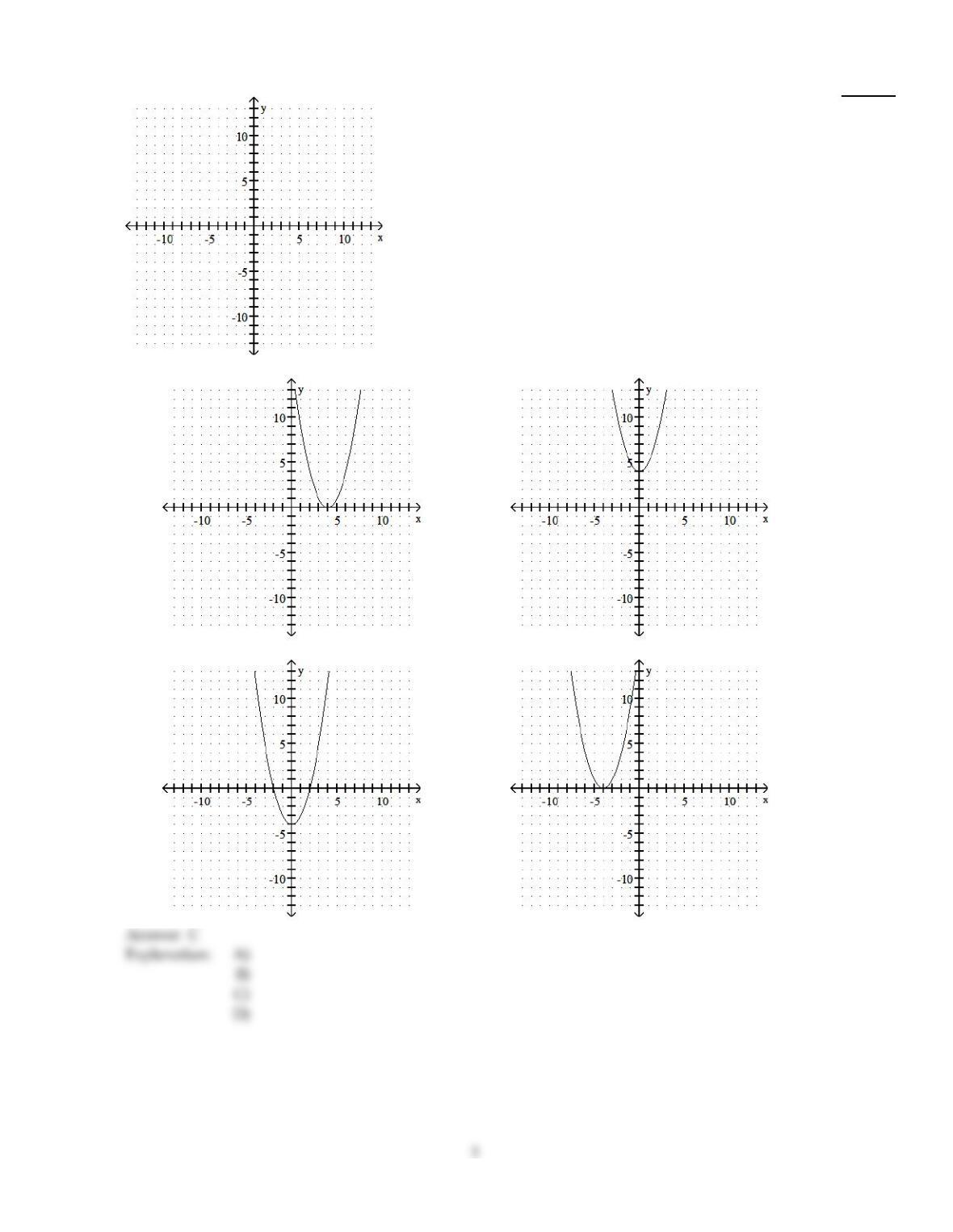
Give the coordinates of the vertex and sketch the graph of the equation.
2
10)
y = x2– 4
10)
A)
(4, 0)
B)
(0, 4)
C)
(0, –4)
D)
(–4, 0)
11)
m2=18
11)
A)
{2 3}
B)
{±3 2}
C)
{6}
D)
{±2 3}
Answer the question.
12)
If we apply the quadratic formula and find that the value of b2– 4ac is positive, what can we
conclude about the solutions?
12)
A)
The equation has two real number solutions.
B)
The equation has exactly one rational solution.
C)
The equation has no real number solutions.
D)
The equation has two irrational solutions.
13)
z2–2
11z +
13)
A)
1
11
B)
1
121
C)
2
121
D)
4
121
Use a calculator to solve the equation. Round to the nearest hundredth, if necessary.
14)
(m + 2.72)2=21.16
14)
A)
{2.95, –6.25}
B)
{1.88}
C)
{1.88, –7.32}
D)
{4.29, –4.29}
4
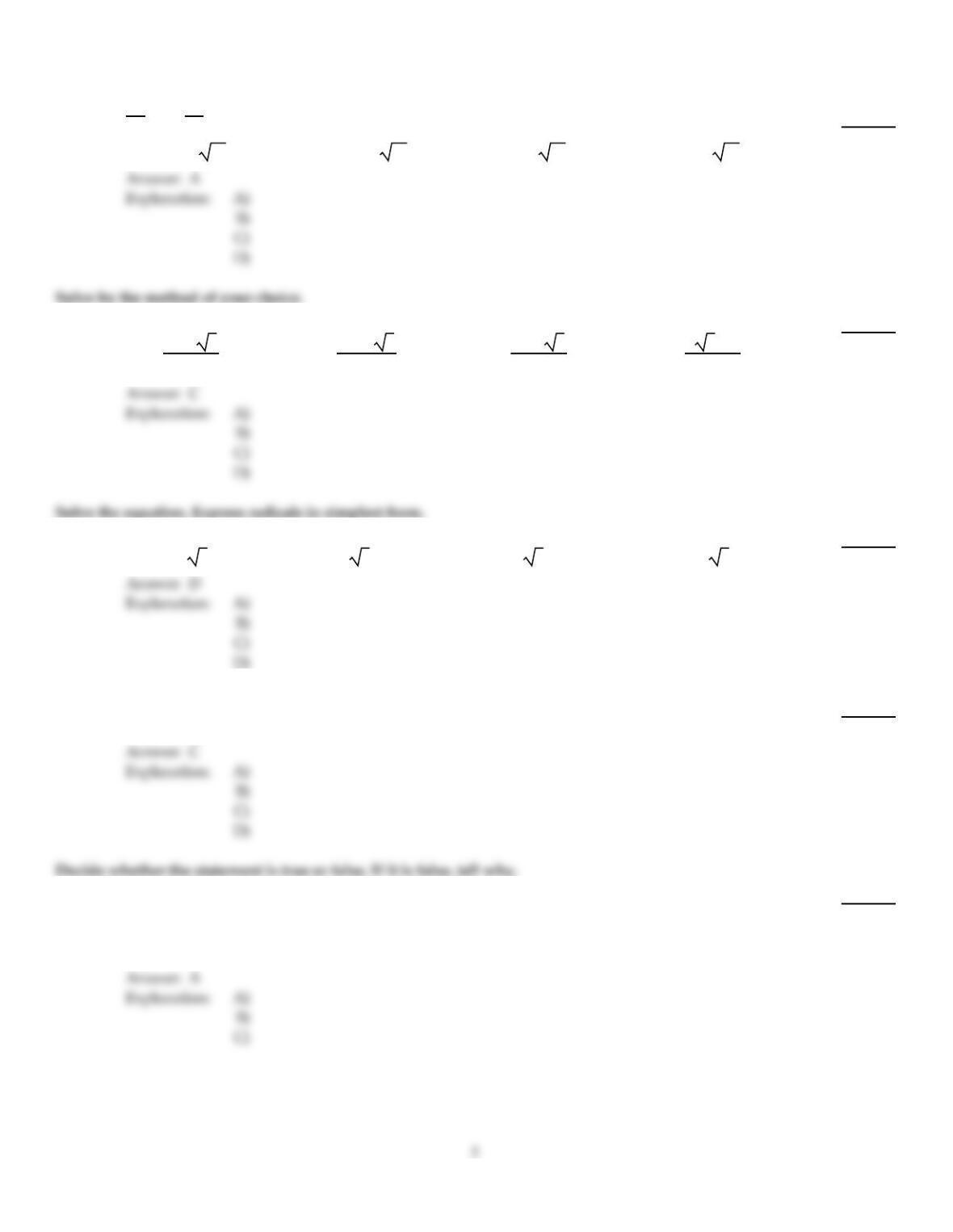
Solve the equation. Express radicals in simplest form.
15)
x2
16 + x +43
16 = 0
15)
A)
{–8±21}
B)
{–16 +43}
C)
{8 +21}
D)
{8 ±43}
16)
(4x – 7)2=96
16)
A)
7 +4 6
4
B)
7 ±6 4
4
C)
7 ±4 6
4
D)
4 6 ± 7
4
Solve the equation. Express radicals in simplest form.
17)
2n2–56 = 0
17)
A)
{±4 7}
B)
{4 7}
C)
{7 2 }
D)
{±2 7}
18)
–2k2– 17 = –35
18)
A)
{3}
B)
{–17.5}
C)
{–3, 3}
D)
{–6, 6}
19)
The equation (5x – 1)2= –31 has two real number solutions.
19)
A)
False; the equation has no real number solutions.
B)
False; the equation has one real number solution.
C)
True
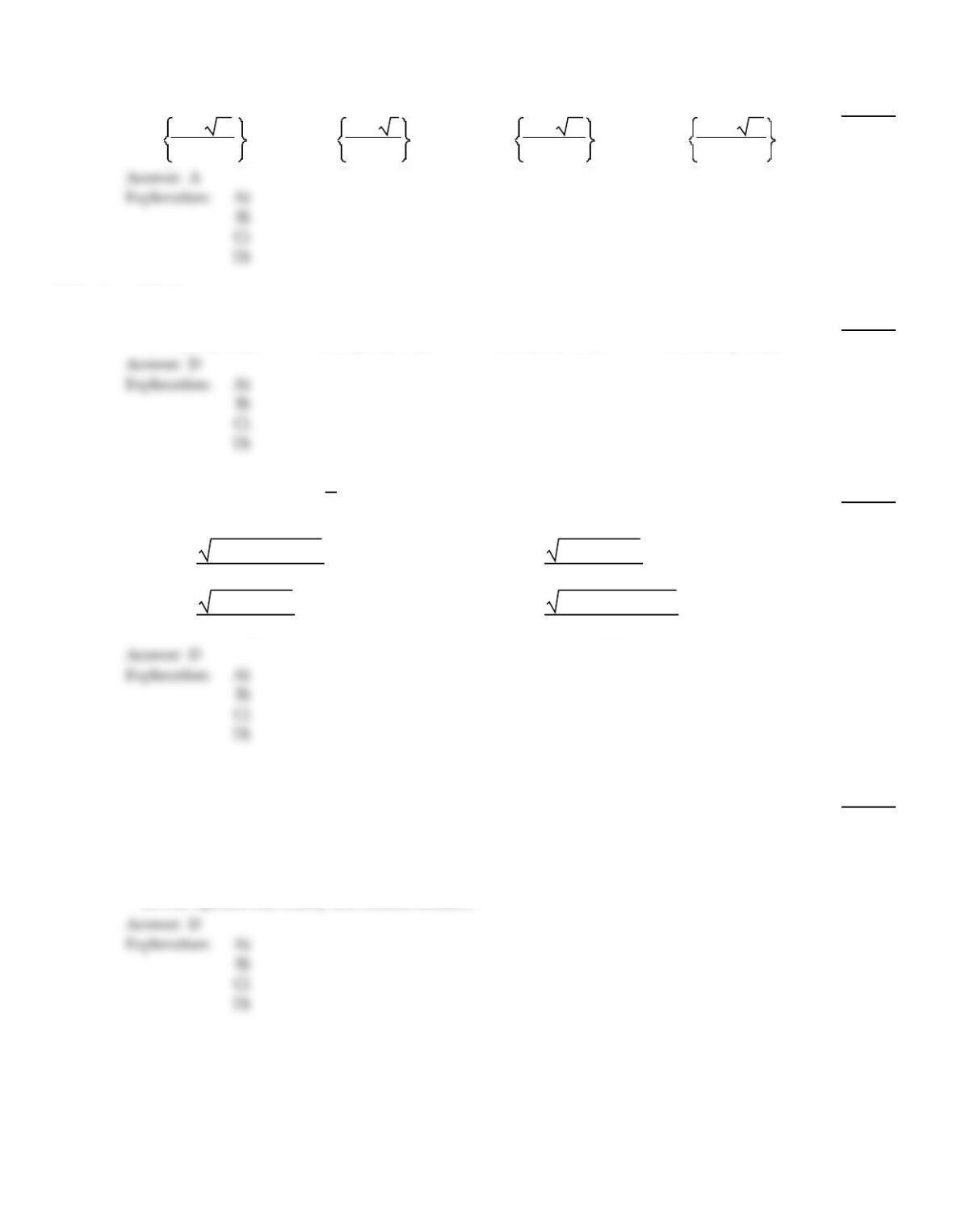
Solve the equation by completing the square.
20)
2x2+ 12x = – 7
20)
A)
–6±22
2
B)
–6±2
2
C)
–6±22
4
D)
–12 ±22
2
Solve the problem.
21)
Find the dimensions of a rectangular enclosure with a perimeter of 52 yd and an area of 160 yd2.
21)
A)
11 yd by 16 yd
B)
11 yd by 15 yd
C)
10 yd by 15 yd
D)
10 yd by 16 yd
22)
Solve the formula V =r2h+1
3R2h for r by writing it in the form ar2+ br + c = 0 and then using
the quadratic formula.
22)
A)
r = ± (3V –R2h)(h)
h
B)
r = ± (3V –R2h)
h
C)
r = ± (3V –R2h)
h
D)
r = ± (3V –R2h)(3h)
h
Answer the question.
23)
If the trinomial ax2+ bx + c is a perfect square, what can we conclude about the solutions of the
equation ax2+ bx + c = 0?
23)
A)
The equation has exactly one irrational solution.
B)
The equation has two different rational solutions.
C)
The equation has no real number solutions.
D)
The equation has exactly one rational solution.
6
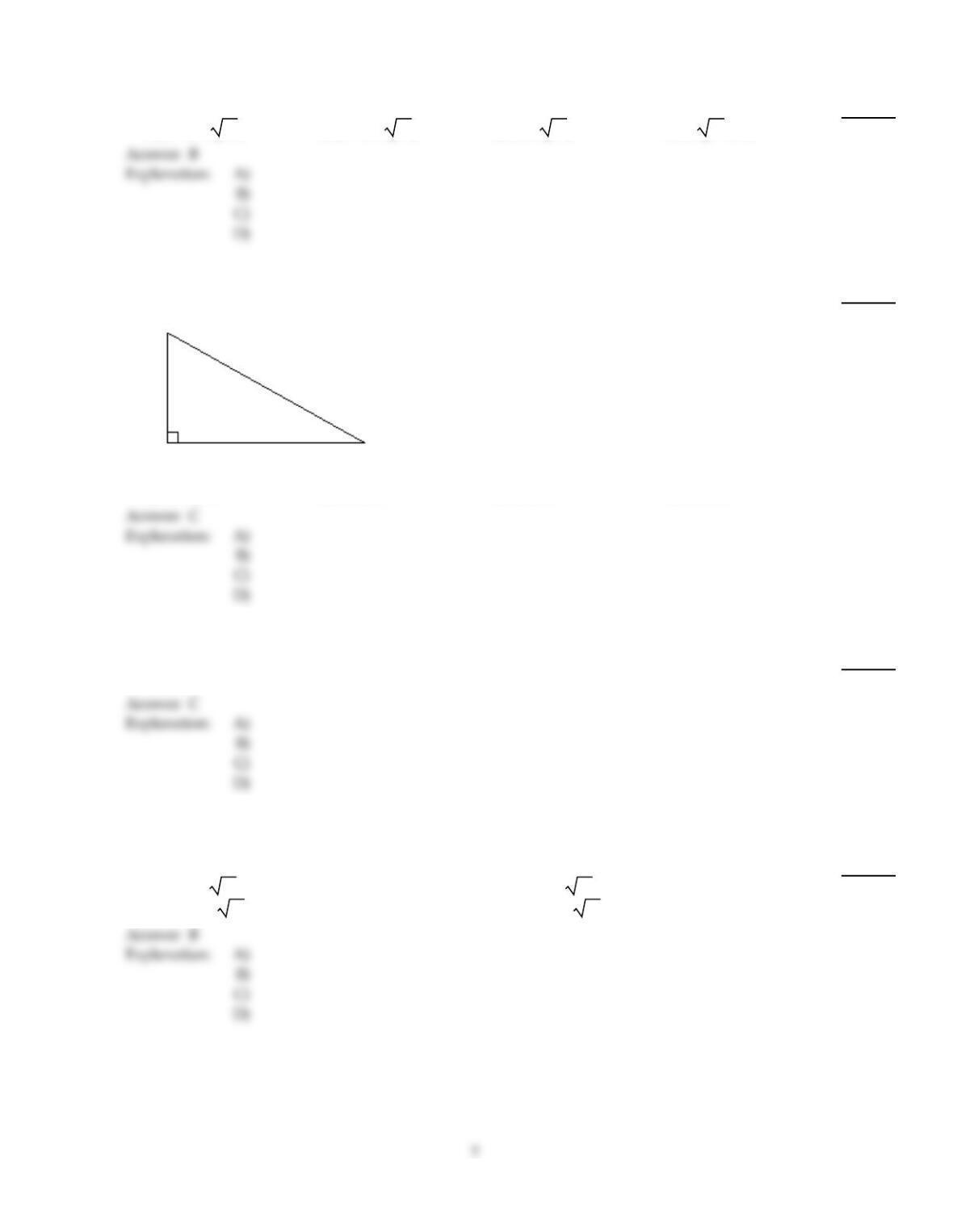
Solve the equation by completing the square.
24)
x2+14x + 5 = 0
24)
A)
{–7± 2 22}
B)
{–7± 2 11}
C)
{ ± 2 11}
D)
{2 11 ±7}
Solve the problem.
25)
Find the lengths of the three sides of the right triangle.
x +4
x
x +2
25)
A)
10, 12, 14
B)
8, 10, 12
C)
6, 8, 10
D)
7, 9, 11
Solve the equation. Express radicals in simplest form.
26)
2z2+ 2 =290
26)
A)
{145}
B)
{–13, 13}
C)
{–12, 12}
D)
{12}
Solve the equation by completing the square. Then (i) give the exact solutions and (ii) give the solutions rounded to the
nearest thousandth.
27)
x2=7– 4x
27)
A)
(i) {2+11} (ii) {5.317}
B)
(i) {–2±11} (ii) {1.317, –5.317}
C)
(i) {–1±11} (ii) {2.317, –4.317}
D)
(i) {–2±211} (ii) {4.633}
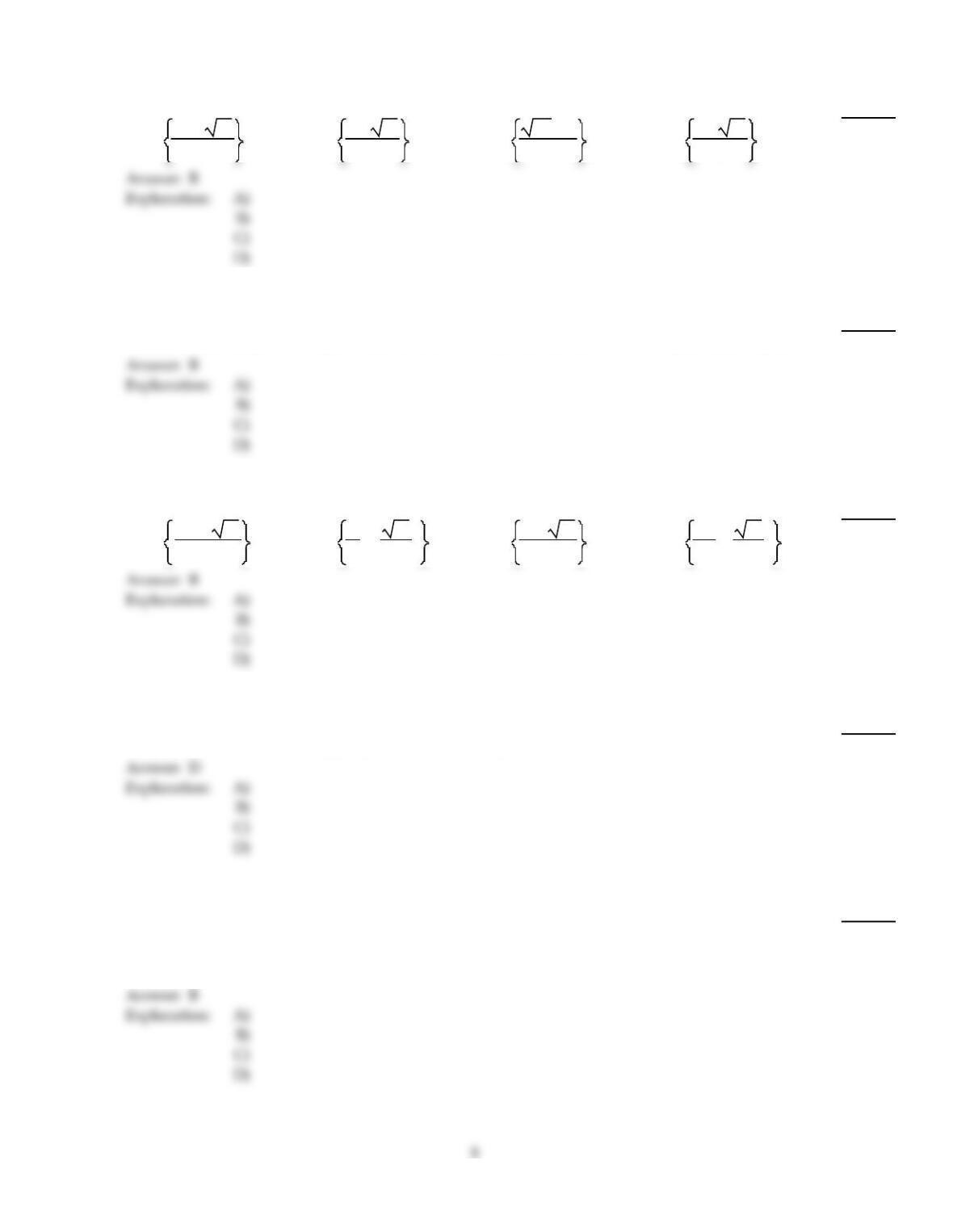
Solve the equation. Express radicals in simplest form.
28)
(2 –7x)2=29
28)
A)
–2±29
7
B)
2±29
7
C)
29 ±2
7
D)
7±29
2
Use a calculator to find an approximate solution to the equation. Round your answer to the nearest thousandth.
29)
2m2+ 4m + 1 = 0
29)
A)
{–0.854, –0.146}
B)
{–0.293, –1.707}
C)
{–2.707, –1.293}
D)
{–2.225, –2.225}
Solve by the quadratic formula.
30)
2x2– 5x + 5 = 0
30)
A)
–5±15
4
B)
5
4±15
4 i
C)
5±15
4
D)
–5
4±15
4 i
Solve the equation by using the square root property. Simplify all radicals.
31)
x2= –169
31)
A)
{±13}
B)
{–13}
C)
{–84.5}
D)
Solve the problem.
32)
The distance traveled by a falling object is given by d = 16t2, where d is the distance (in feet) the
object falls in t seconds. A stuntman jumps from a rooftop 300 ft off the ground. How long will it
take him, falling freely, to reach the ground? Round your answer to the nearest tenth of a second.
32)
A)
9.4 sec
B)
4.3 sec
C)
18.8 sec
D)
69.3 sec
Use the quadratic formula to solve the equation. Simplify any radicals.
33)
m2–20 = 0
33)
A)
{±5 2}
B)
{5 2}
C)
{±2 5}
D)
{2 5}
Complete the trinomial so that it is a perfect square.
34)
k2– 18k +
34)
A)
–81
B)
81
C)
324
D)
9
Solve the equation. Express radicals in simplest form.
35)
1
3m2= – 1
6m +1
2
35)
A)
–3
2, 1
B)
C)
3
2, –1
D)
–3
2
Solve the equation by the zero–factor property.
36)
6z2+ 5 =299
36)
A)
{7}
B)
{149.5}
C)
{–8, 8}
D)
{–7, 7}
Use the quadratic formula to solve the equation. Simplify any radicals.
37)
3x2+ 12x = –2
37)
A)
–6±30
6
B)
–6±30
3
C)
–6±42
3
D)
9
38)
a2– 8a + 15 = 0
38)
A)
{–5, –3}
B)
{5, 3}
C)
{12, 3}
D)
{±1}
Solve the equation by using the square root property. Simplify all radicals.
39)
m2=6.25
39)
A)
{±2.5}
B)
{±3}
C)
D)
{2.5}
A
D)
If necessary, write the equation in the standard form ax2+ bx + c = 0. Then identify the values of a, b, and c. Do not
actually solve the equation.
40)
8x2+15x –2= 0
40)
A)
a =8, b =15, c = –2
B)
a =8, b = –15, c = –2
C)
a =8, b = –15, c =2
D)
a =8, b =15, c =2
A
D)
Solve the equation. Express radicals in simplest form.
41)
3z2–507= 0
41)
A)
{±14}
B)
{±13}
C)
{255.5}
D)
{13}
B
D)
42)
(3x +6)2=12
42)
A)
–6± 2 3
3
B)
2 3±6
3
C)
–6± 4 3
3
D)
–6+ 2 3
3
A
D)
10
B
D)

Solve the equation by the zero–factor property.
43)
x2+ 2 =11
43)
A)
{5.5}
B)
{–2, 2}
C)
{3}
D)
{–3, 3}
Answer the question.
44)
If we apply the quadratic formula and find that the value of b2– 4ac equals zero, what can we
conclude about the solutions?
44)
A)
The equation has no real number solutions.
B)
The equation has exactly one irrational solution.
C)
The equation has exactly one rational solution.
D)
The equation has two different rational solutions.
Use a calculator to find an approximate solution to the equation. Round your answer to the nearest thousandth.
45)
x2+ 7x = –4
45)
A)
{–0.628, –6.372}
B)
{6.372, 0.628}
C)
{0.531, –7.531}
D)
{–4.128, –4.128}
Solve the problem.
46)
A rock falls from a tower that is 88.2 m high. As it is falling, its height is given by the formula
h =88.2 – 4.9t2. How many seconds will it take for the rock to hit the ground (h=0)? Round to the
nearest tenth, if necessary.
46)
A)
9.4 sec
B)
9.1 sec
C)
4.2 sec
D)
1587.6 sec
Solve the equation. Express radicals in simplest form.
47)
3
4s2+1
2s +1
12 = 0
47)
A)
1
3
B)
–6 ± 3 3
18
C)
D)
–1
3
Use the quadratic formula to solve the equation. Simplify any radicals.
48)
4x2– x +3= 0
48)
A)
1 ±47
8
B)
1 ±47
4
C)
{1 ±47 }
D)
Solve the equation by completing the square.
49)
m2–18m +81 = 0
49)
A)
{18}
B)
{±9}
C)
{–9}
D)
{9}
50)
x2–4x +1= 0
50)
A)
{2 ±3}
B)
{ 3 ±2}
C)
{5}
D)
{–2±3}
Solve the equation. Express radicals in simplest form.
51)
1
2x2+1
4x –1
2= 0
51)
A)
{–1}
B)
C)
–5
4, 3
4
D)
–1 ±17
4
52)
8x2=7x
52)
A)
a =8, b = 0, c =7
B)
a =8, b = –7, c = 0
C)
a =8, b = –7
D)
a = 3, b =7, c = 0
Solve by completing the square.
53)
z2+ 14z = –34
53)
A)
{–14 +34 }
B)
{7 ±34 }
C)
{7 +15 }
D)
{–7±15 }
Solve the problem.
54)
A rug is to fit in a room so that a border of even width is left on all four sides. If the room is 10 feet
by 20 feet and the area of the rug is 119 square feet, how wide will the border be?
54)
A)
3.5 ft
B)
4 ft
C)
1.5 ft
D)
2.5 ft
Solve the equation by completing the square.
55)
x2+4x =36
55)
A)
{± 2 10}
B)
{–2± 2 20}
C)
{2 10 ±2}
D)
{–2± 2 10}
Solve the problem.
56)
A ball is thrown downward from a window in a tall building. Its position at time t in seconds is
s = 16t2+ 32t, where s is in feet. How long (to the nearest tenth) will it take the ball to fall 208 feet?
56)
A)
3.6 sec
B)
2.5 sec
C)
2.7 sec
D)
7.3 sec
Decide whether the statement is true or false. If it is false, tell why.
57)
The equation x2=49
25 has two irrational solutions.
57)
A)
False; the equation has two integer solutions.
B)
False; the equation has two rational solutions that are not integers.
C)
True
58)
The area of a triangular poster is 832 square centimeters. Its altitude is 12 feet shorter than twice its
base. Find the lengths of the altitude and base.
58)
A)
base =64 cm; altitude =13 cm
B)
base =16 cm; altitude =52 cm
C)
base =32 cm; altitude =26 cm
D)
base =32 cm; altitude =52 cm
59)
The area of a circle is found by the equation A =r2. If the area A of a certain circle is 4 square
centimeters, find its radius r.
59)
A)
r =2 cm
B)
r = ± 2 cm
C)
r =2 cm
D)
r =2 cm
Solve the equation. Express radicals in simplest form.
60)
b2+4
5b = – 1
5
60)
A)
4
5
B)
0, 4
5
C)
D)
4 ±5
10
Use a calculator to find an approximate solution to the equation. Round your answer to the nearest thousandth.
61)
6n2= –12n – 5
61)
A)
{–0.592, –1.408}
B)
{–1.592, –2.408}
C)
{0.354, –2.354}
D)
{–0.296, –0.704}
Solve the equation by completing the square.
62)
(x +4)(x –1) =6
62)
A)
{–5±3}
B)
{2 ±3}
C)
{–5, 2}
D)
{–2, 5}
Use the quadratic formula to solve the equation. Simplify any radicals.
63)
12y2+ 35y + 25 = 0
63)
A)
5
3, –5
4
B)
5
3, 5
4
C)
–5
3, –5
4
D)
–5
12, –1
5
64)
p2–22p +121= 0
64)
A)
{0, 11}
B)
{±11}
C)
{0, 22}
D)
{11}
65)
15n2= –21n
65)
A)
{0}
B)
–7
5
C)
–7
5, 21
D)
–7
5, 0
If necessary, write the equation in the standard form ax2+ bx + c = 0. Then identify the values of a, b, and c. Do not
actually solve the equation.
66)
–8x2–11x +19 = 0
66)
A)
a =8, b = –11, c =19
B)
a = –8, b = –11, c =19
C)
a =19, b =11, c = –8
D)
a =8, b =11, c =19
15
Use a calculator to solve the equation. Round to the nearest hundredth, if necessary.
67)
(2.74p + 3.22)2=7.08
67)
A)
{0.72, –0.72}
B)
{–0.20, –2.15}
C)
{2.15, –0.20}
D)
{0.20, –0.20}
Solve the problem.
68)
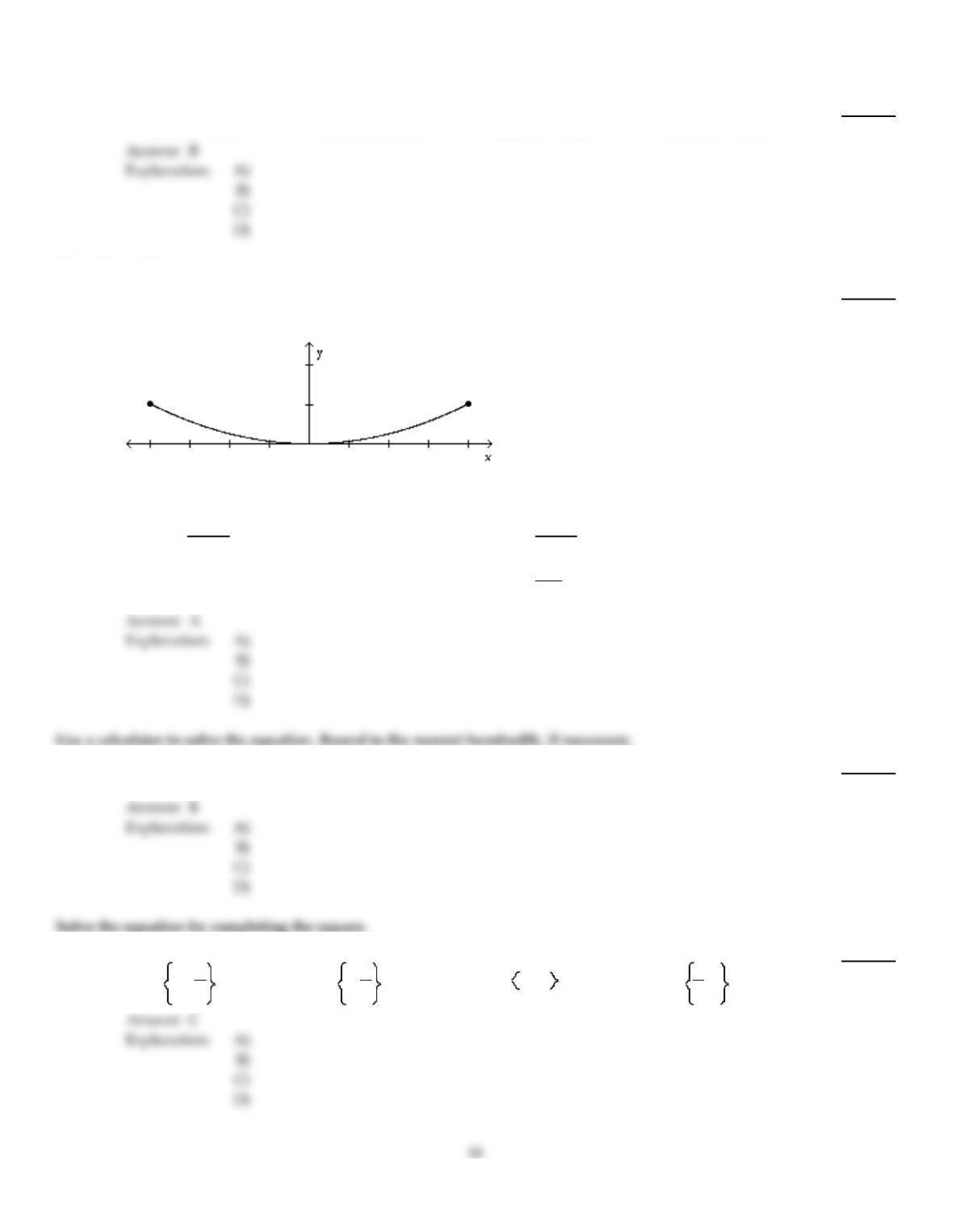
The cross section of a large telescope having a diameter of 440 feet and a maximum depth of 47 feet
is depicted below.
110
(–220, 47) (220, 47)
55
What is the equation of this parabola?
68)
A)
y =47
48400x2
B)
y =47
24200x2
C)
Not enough information
D)
y =47
220x2
Use a calculator to solve the equation. Round to the nearest hundredth, if necessary.
69)
(3.13m – 6.30)2=6.20
69)
A)
{–1.22, 2.81}
B)
{2.81, 1.22}
C)
{2.83, 0.01}
D)
{2.81, –2.81}
70)
2x2– 6x – 8 = 0
70)
A)
–1, 1
4
B)
0, 1
4
C)
–1, 4
D)
1
4, 1
71)
a2– 12a = –27
71)
A)
{24, 3}
B)
{9, 3}
C)
{±27}
D)
{–9, –3}
72)
The length and width of a rectangle have a sum of 70. What dimensions give the maximum area?
72)
A)
Length 25 and width 45
B)
Length 34 and width 36
C)
Length 26 and width 44
D)
Length 35 and width 35
73)
2p2+ 5 =54
73)
A)
±7 2
2
B)
{–9, 5}
C)
7 2
2
D)
±7
2
Solve the problem.
74)
Find two numbers whose sum is 90 and whose product is a maximum.
74)
A)
35 and 55
B)
90 and 0
C)
45 and 45
D)
44 and 46
Solve the equation by completing the square.
75)
x2+ 4x =3
75)
A)
{–1±7}
B)
{2 +7}
C)
{–2±7}
D)
{–2±2 7}
17
Solve the problem.
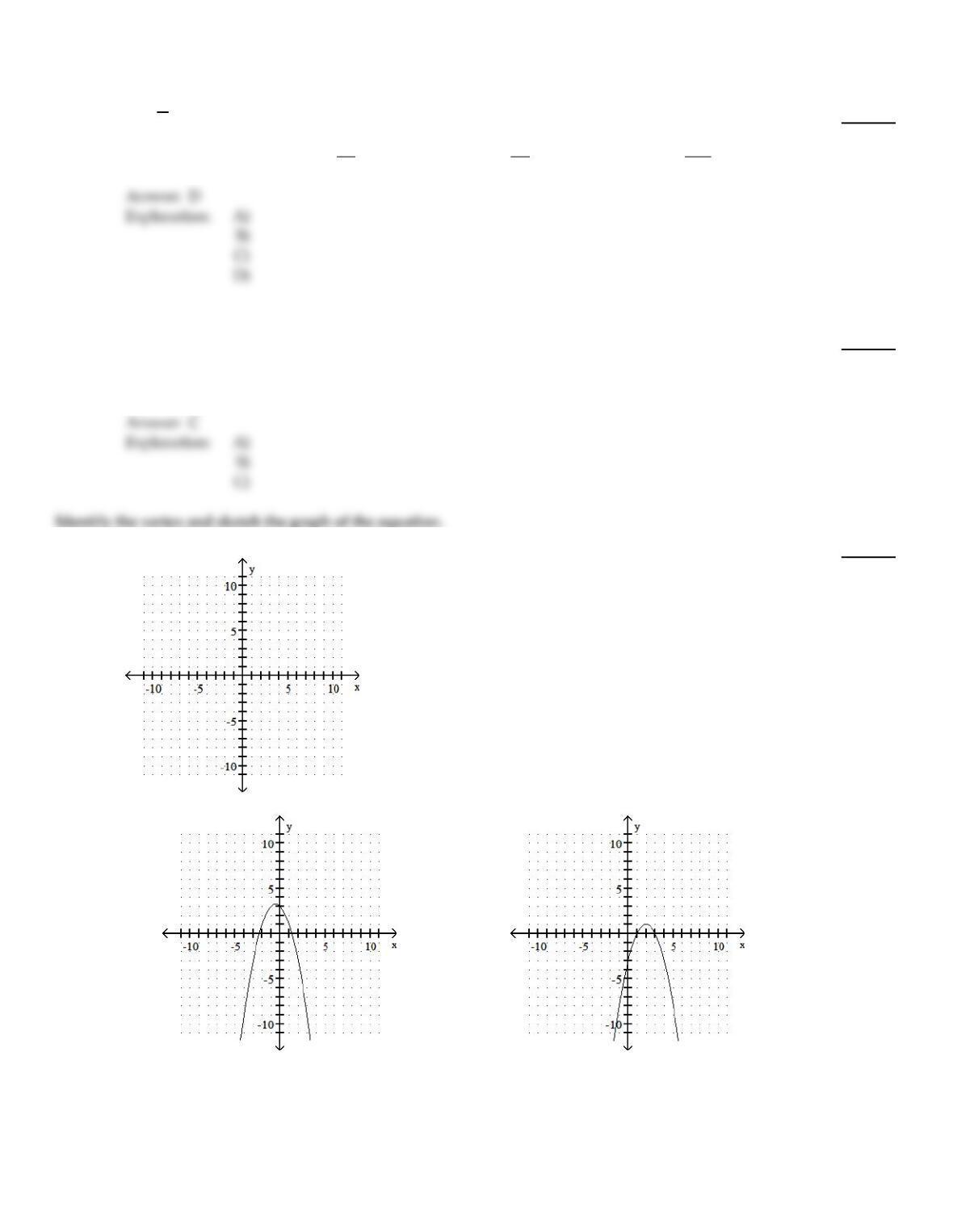
Complete the trinomial so that it is a perfect square.
76)
x2+1
5x +
76)
A)
100
B)
1
25
C)
1
10
D)
1
100
Decide whether the statement is true or false. If it is false, tell why.
77)
If k is a perfect square, then x2= k will have two integer solutions.
77)
A)
False; the equation will have two rational solutions that are not integers.
B)
False; the equation will have one integer solution
C)
True
78)
y = –x2–4x –3
78)
A)
vertex: (–0.5, 3.25)
B)
vertex: (2, 1)
18
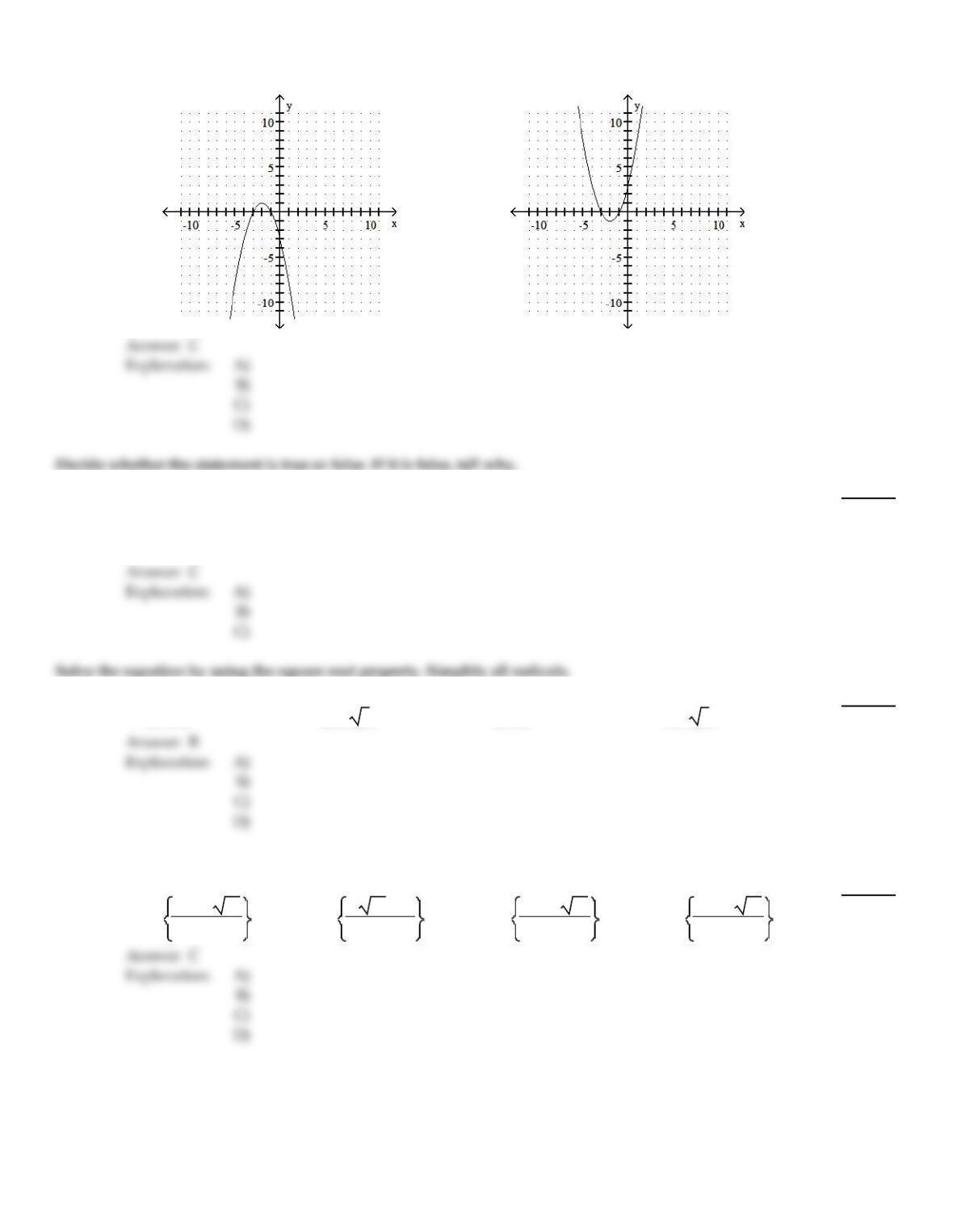
C)
vertex: (–2, 1)
D)
vertex: (–2, –1)
79)
If k is a prime number, then x2= k will have two rational solutions.
79)
A)
False; the equation will have no real number solutions.
B)
True
C)
False; the solutions will be irrational because a prime number cannot be a perfect square.
80)
r2–2= 0
80)
A)
{±1}
B)
{±2}
C)
{4}
D)
{ 2}
Solve by using the square root property.
81)
(3x +5)2=44
81)
A)
–5± 4 11
3
B)
2 11 ±5
3
C)
–5± 2 11
3
D)
–5+ 2 11
3
19
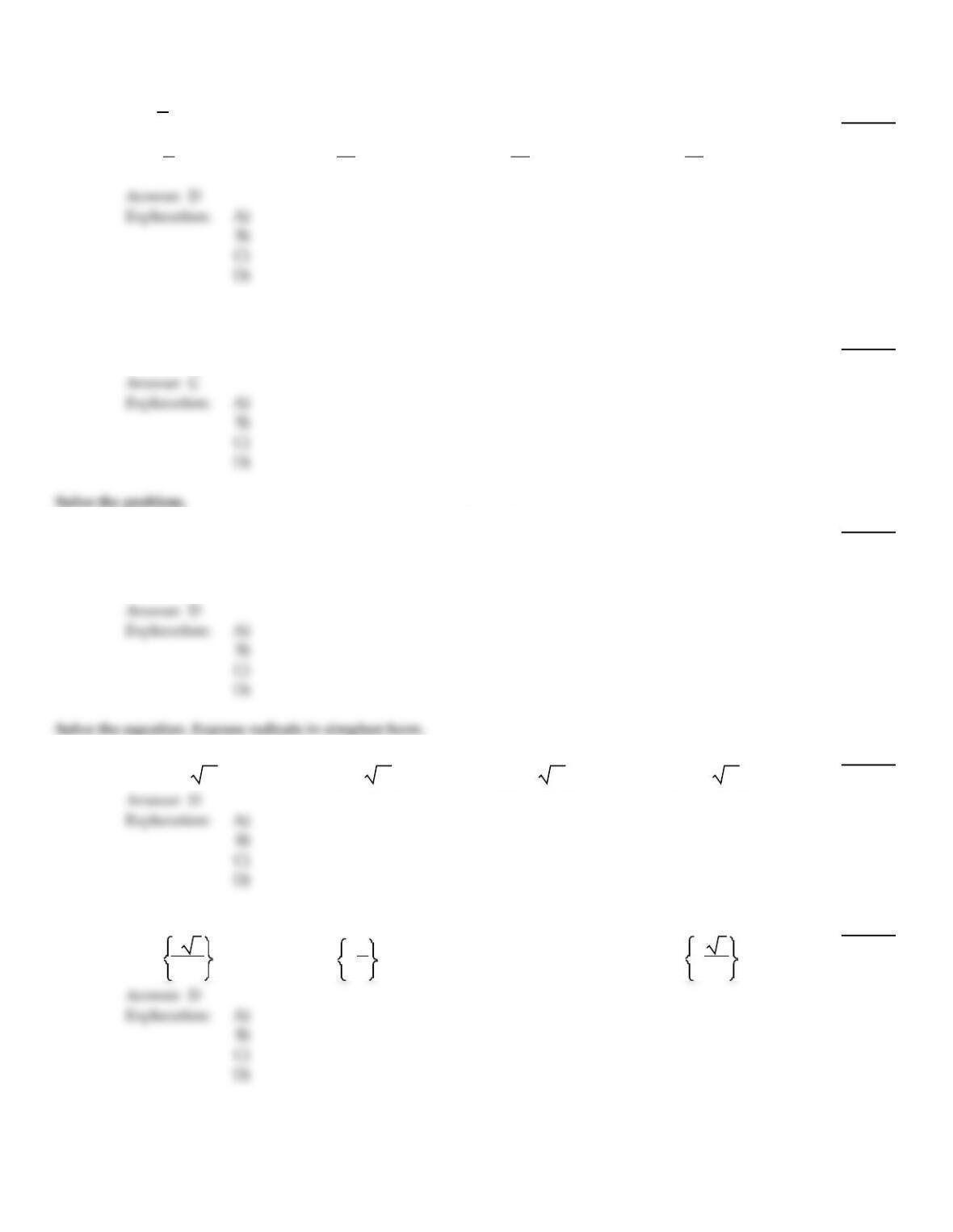
Complete the trinomial so that it is a perfect square.
82)
x2+2
9x +
82)
A)
1
9
B)
2
81
C)
4
81
D)
1
81
Solve the equation. Express radicals in simplest form.
83)
(x – 4)2=36
83)
A)
{6, –6}
B)
{–2, –10}
C)
{10, –2}
D)
{40}
84)
A ball is thrown downward from a window in a tall building. After t seconds, its distance from the
window (in feet) is given by s = 16t2+ 32t. How long will it take the ball to fall 111 ft? Round your
answer to the nearest tenth of a second.
84)
A)
2.6 sec
B)
1.6 sec
C)
3.2 sec
D)
1.8 sec
Solve the equation. Express radicals in simplest form.
85)
0.1x2– 0.2x = 0.10
85)
A)
{2 –11}
B)
{2 ±11}
C)
{1 +11}
D)
{1 ±11}
86)
9p2+ 3 =10
86)
A)
7 3
3
B)
±7
3
C)
{–10, 4}
D)
±7
3
20
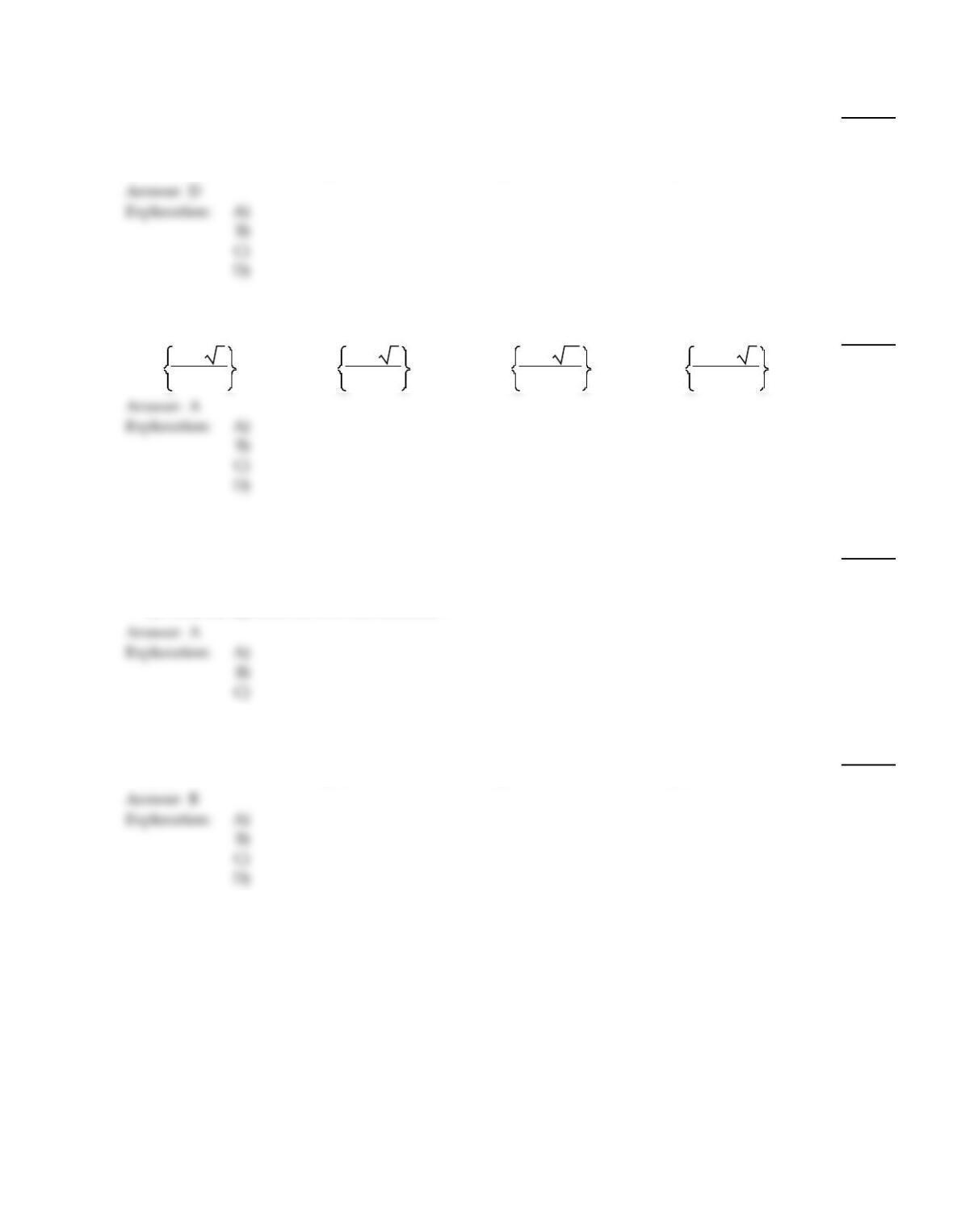
Solve the problem.
87)
The position of an object moving in a straight line is given by s = 2t2– 3t, where s is in meters and t
is the time in seconds the object has been in motion. How long (to the nearest tenth) will it take the
object to move 13 meters?
87)
A)
29.9 sec
B)
3.2 sec
C)
14.0 sec
D)
3.4 sec
Solve the equation. Express radicals in simplest form.
88)
0.4m2+ 1.2m + 0.4 = 0
88)
A)
–3±5
2
B)
–3±5
8
C)
–3±13
2
D)
–12 ±5
2
Decide whether the statement is true or false. If it is false, tell why.
89)
The equation (x + 8)2= 0 has exactly one real solution.
89)
A)
True
B)
False; the equation has no real solutions.
C)
False; the equation has two real solutions.
Complete the trinomial so that it is a perfect square.
90)
x2+ 8x +
90)
A)
64
B)
16
C)
8
D)
4
Give the coordinates of the vertex and sketch the graph of the equation.
21
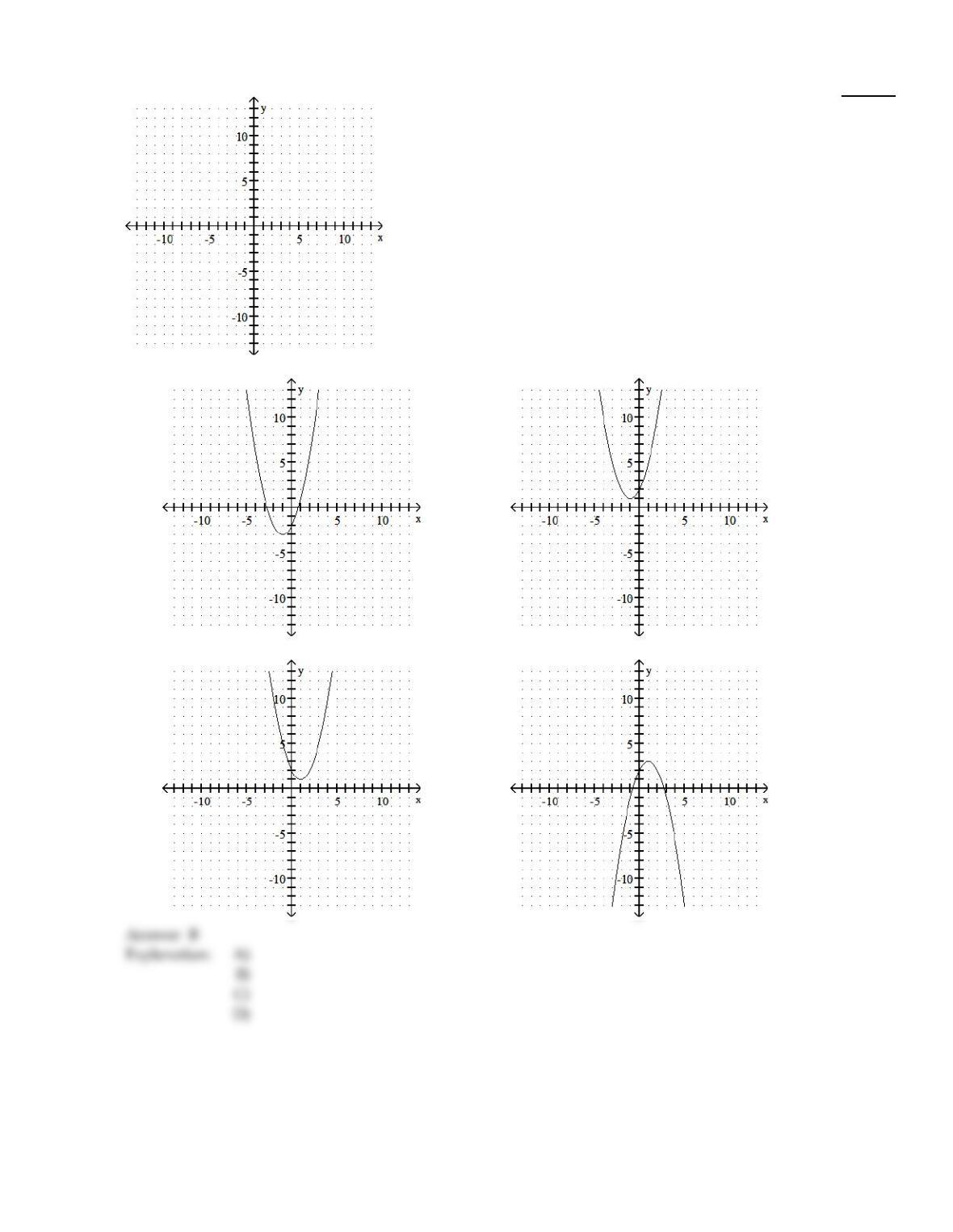
91)
y = x2+ 2x + 2
91)
A)
(–1, –3)
B)
(–1, 1)
C)
(1, 1)
D)
(1, 3)
22
Use the quadratic formula to solve the equation. Simplify any radicals.
92)
(2x – 1)(x + 1) =1
92)
A)
1 ±17
2
B)
–1 ±17
4
C)
1 ±17
4
D)
–1 ±33
2
Solve the problem.
93)
A ball is thrown vertically upward from the top of a building 144 feet tall with an initial velocity of
128 feet per second. The height, s (in feet), of the ball after t seconds is given by
s = –16t2+128t +144 . After how many seconds does the ball strike the ground?
93)
A)
9 sec
B)
145 sec
C)
11 sec
D)
8 sec
94)
t2= 9
64
94)
A)
3
8
B)
3
8
C)
±3
64
D)
±3
8
95)
f(x) = x2– 2x – 3
95)
23
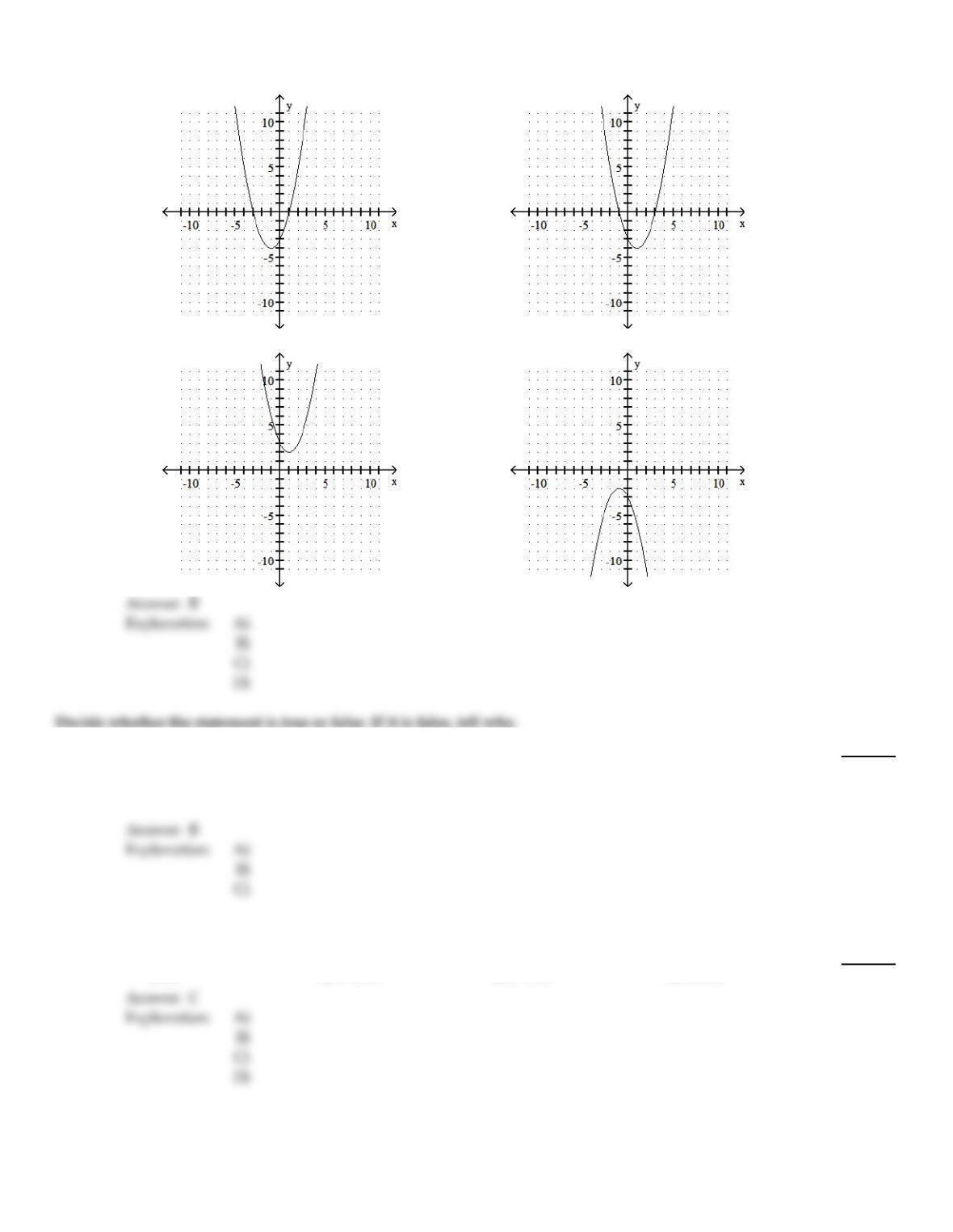
A)
vertex: (–1, –4)
B)
vertex: (1, –4)
C)
vertex: (1, 2)
D)
vertex: (–1, –2)
96)
If k is a negative integer, then x2= k will have two irrational solutions.
96)
A)
False; the equation will have two rational solutions.
B)
False; the equation will have no real number solutions.
C)
True
Solve the equation. Express radicals in simplest form.
97)
x2+ 2 =27
97)
A)
{5}
B)
{–4, 4}
C)
{–5, 5}
D)
{13.5}
24
Use the quadratic formula to solve the equation. Simplify any radicals.
98)
81k2+18k + 1 = 0
98)
A)
–1
9
B)
{0, 9}
C)
±1
9
D)
{±9}
Solve the equation by completing the square.
99)
(x +3)(x –2) =1
99)
A)
1±29
2
B)
–1±29
2
C)
1±29
D)
–1±29
Solve the equation. Express radicals in simplest form.
100)
y2
3–y
12 =1
24
100)
A)
–1
4, 1
2
B)
1
2
C)
D)
2 ± 2 –7
16
101)
(x –4)(x –9) = 0
101)
A)
a = 0, b =13, c =36
B)
a = 1, b = –13, c = –36
C)
a = 1, b = –13, c =36
D)
a = 1, b = 0, c =36
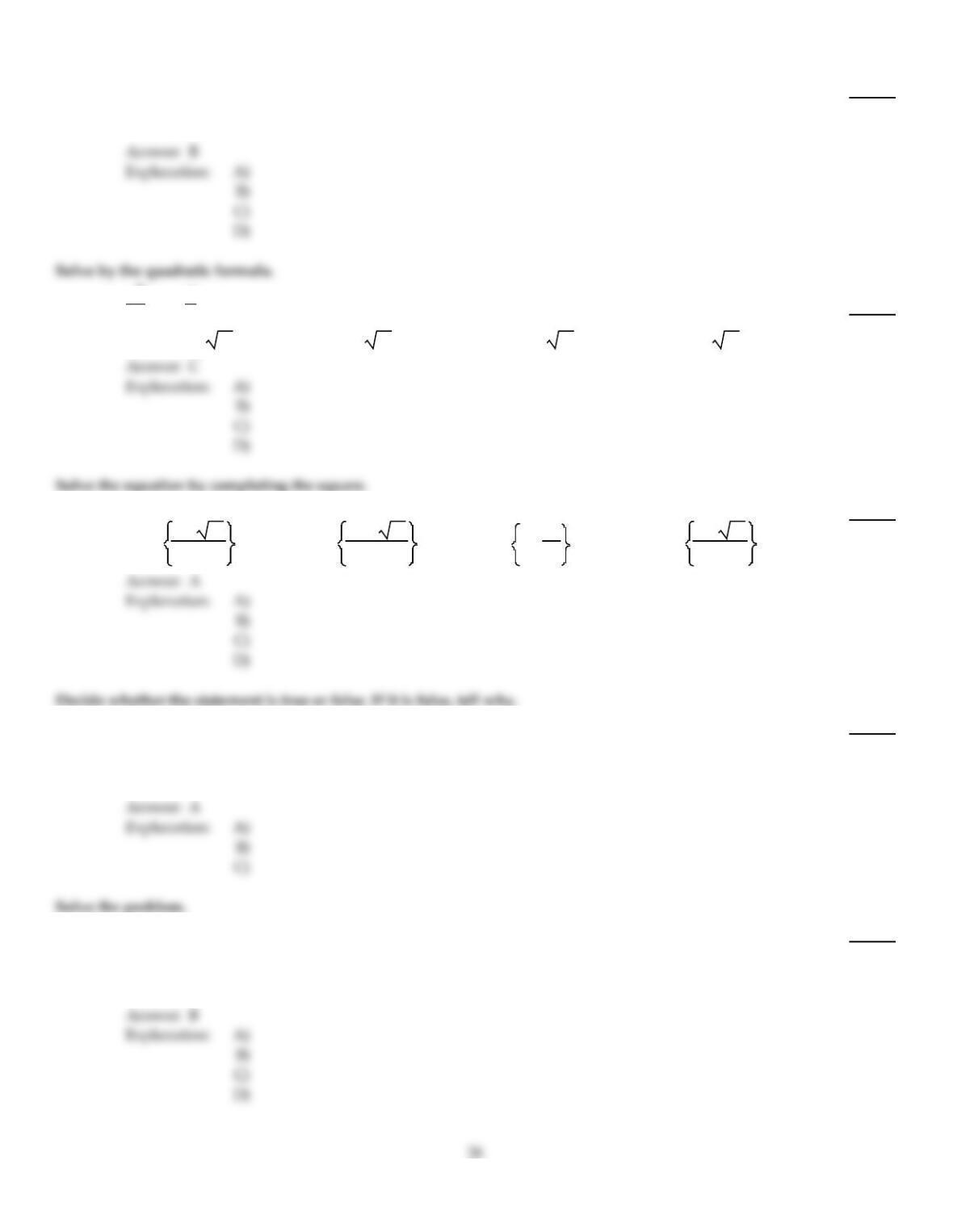
102)
–5x2+7x =8
102)
A)
a = –5, b = –8, c =7
B)
a = –5, b =7, c = –8
C)
a = –5, b =8, c =7
D)
a = –5, b =7, c =8
103)
x2
12 + x +7
6= 0
103)
A)
{–12 ±14}
B)
{6 ±14}
C)
{–6±22}
D)
{6 ±22}
104)
3x2– 2x –3= 0
104)
A)
1 ±10
3
B)
–1 ±10
3
C)
–3, 11
3
D)
3±10
9
105)
The equation (x – 6)2– 47 = 0 has two irrational solutions.
105)
A)
True
B)
False; the equation has exactly one real number solution.
C)
False; the equation has two rational solutions.
106)
The position of an object moving in a straight line is given by s = 2t2– 3t, where s is the distance in
meters and t is the time in seconds the object has been in motion. How long (to the nearest tenth)
will it take the object to move 15 meters?
106)
A)
40.5 sec
B)
3.6 sec
C)
3.4 sec
D)
16.0 sec
107)
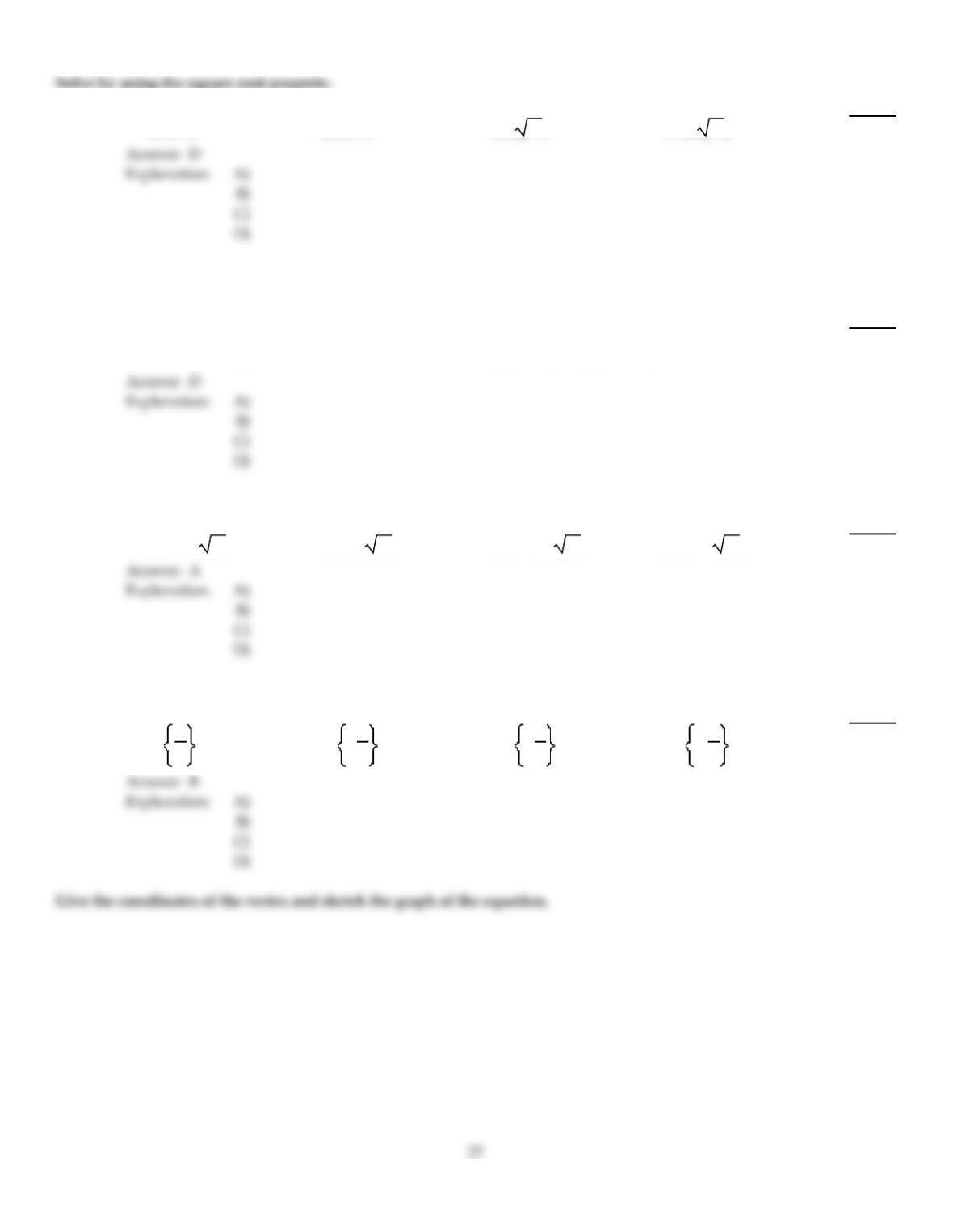
y2=19
107)
A)
{361}
B)
{±9.5}
C)
{19}
D)
{±19}
D
If necessary, write the equation in the standard form ax2+ bx + c = 0. Then identify the values of a, b, and c. Do not
actually solve the equation.
108)
(4x +8)(5x –2) = x(x +2)
108)
A)
a = –19, b =38, c = –8
B)
a =21, b =42, c =16
C)
a =20, b =6, c = –16
D)
a =19, b =30, c = –16
D
Solve the equation by completing the square.
109)
x2+ 11 = –10x
109)
A)
{–5±14}
B)
{5 ±11}
C)
{–10 +11}
D)
{5 +14}
A
Use the quadratic formula to solve the equation. Simplify any radicals.
110)
49k2– 81 = 0
110)
A)
9
7
B)
±9
7
C)
±7
9
D)
0, 7
9
B
111)
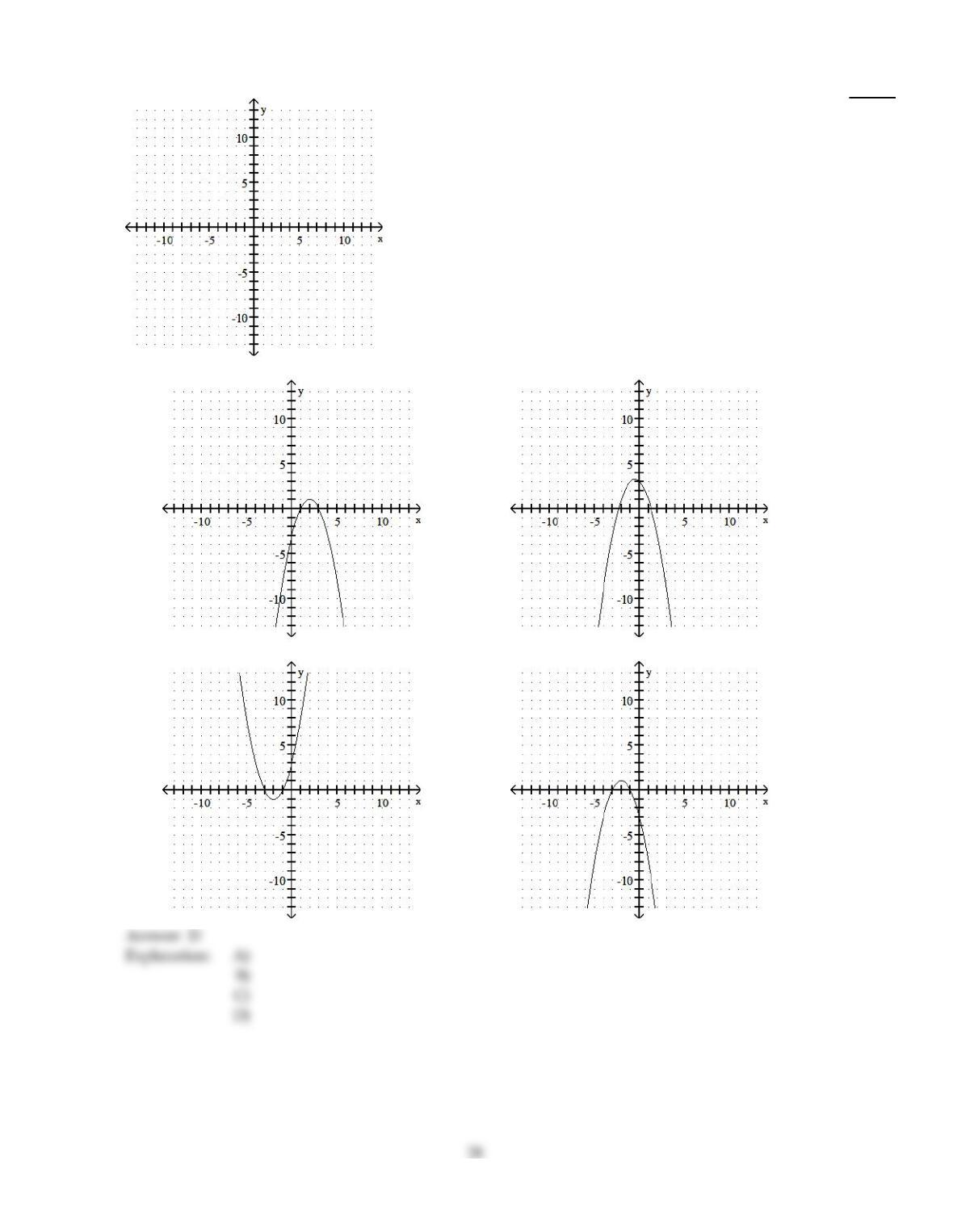
y = –x2–4x –3
111)
A)
(2, 1)
B)
(–0.5, 3.25)
C)
(–2, –1)
D)
(–2, 1)
Solve the problem.
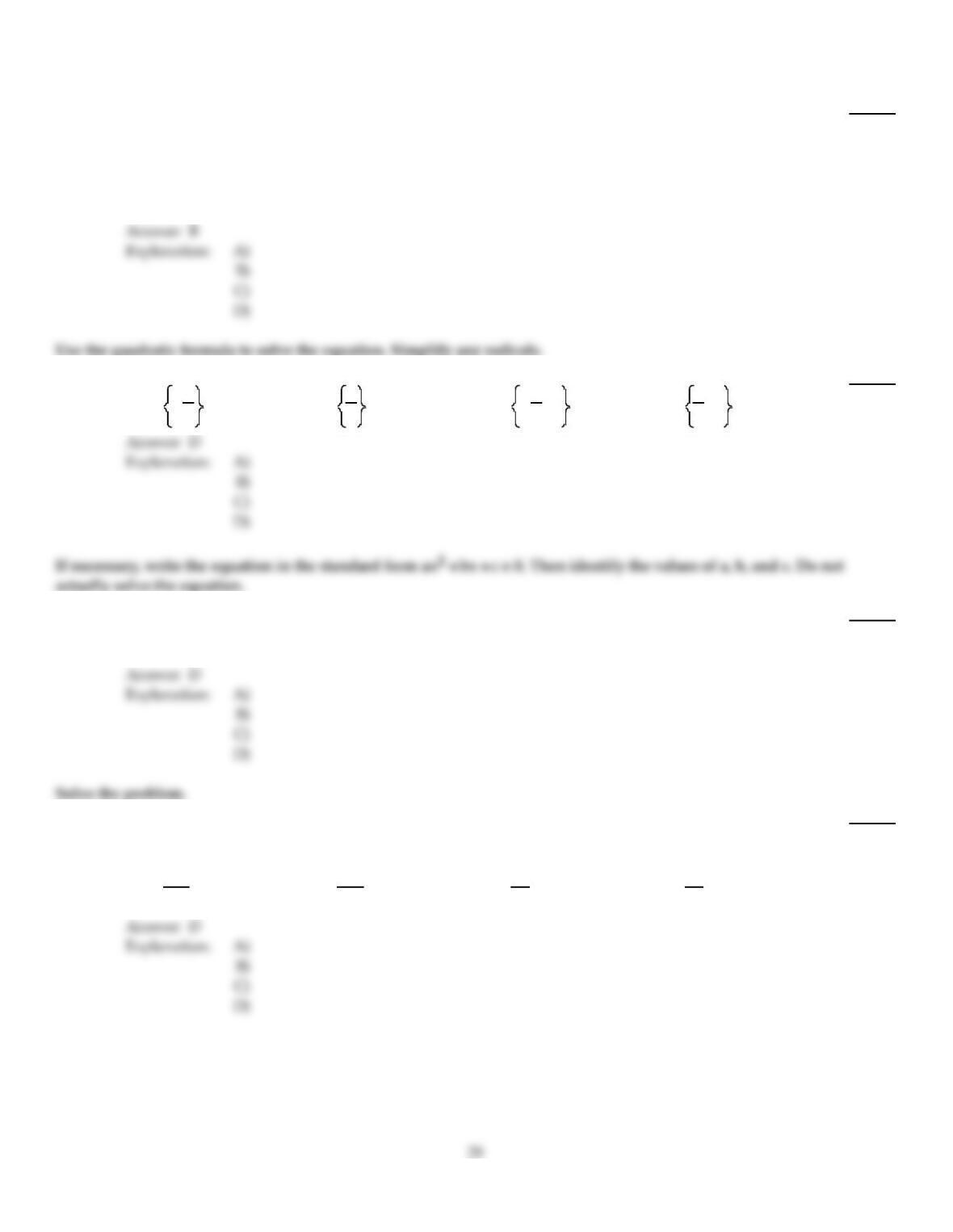
112)
A grasshopper is perched on a reed 7 inches above the ground. It hops off the reed and lands on the
ground about 11.7 inches away. During its hop, its height is given by the equation
h = –0.2x2+1.75x +7, where x is the distance in inches from the base of the reed, and h is in inches.
How far was the grasshopper from the base of the reed when it was 3.25 inches above the ground?
Round to the nearest tenth.
112)
A)
11.7 inches
B)
10.5 inches
C)
3.8 inches
D)
1.8 inches
113)
8m2– 14m = 0
113)
A)
±7
4
B)
7
4
C)
–7
4, 0
D)
7
4, 0
114)
3x2=14x –21
114)
A)
a =3, b =14, c = –21
B)
a =3, b =14, c =21
C)
a =3, b = –14, c = –21
D)
a =3, b = –14, c =21
Solve the problem.
115)
A construction worker tosses a scrap piece of lumber from the roof of a building. How long does it
take the piece of lumber to reach the ground 121 feet below? Use the formula d = 16t2 where d is
the distance (in feet) a freely falling object falls in t seconds. Give your answer as a fraction.
115)
A)
16
121 sec
B)
121
16 sec
C)
4
11 sec
D)
11
4 sec
Use the quadratic formula to solve the equation. Simplify any radicals.
116)
3p2=5p
116)
A)
5
3
B)
±15
3
C)
0, 5
3
D)
0, 3
5
117)
x2+6x +4= 0
117)
A)
{ 5 ±3}
B)
{3 ±5}
C)
{2}
D)
{–3±5}
Solve the equation by completing the square.
118)
k2+16k +64 = 0
118)
A)
{±8}
B)
{8}
C)
{–16}
D)
{–8}
Solve the problem.
119)
Two pipes can fill a large tank in 6 hours. One of the pipes, used alone, takes 9 hours longer than
the other to fill the tank. How long would each pipe take to fill the tank alone?
119)
A)
6 hr for one, and 9 hr for the other
B)
15 hr for one, and 30 hr for the other
C)
9 hr for one, and 18 hr for the other
D)
15 hr for one, and 18 hr for the other
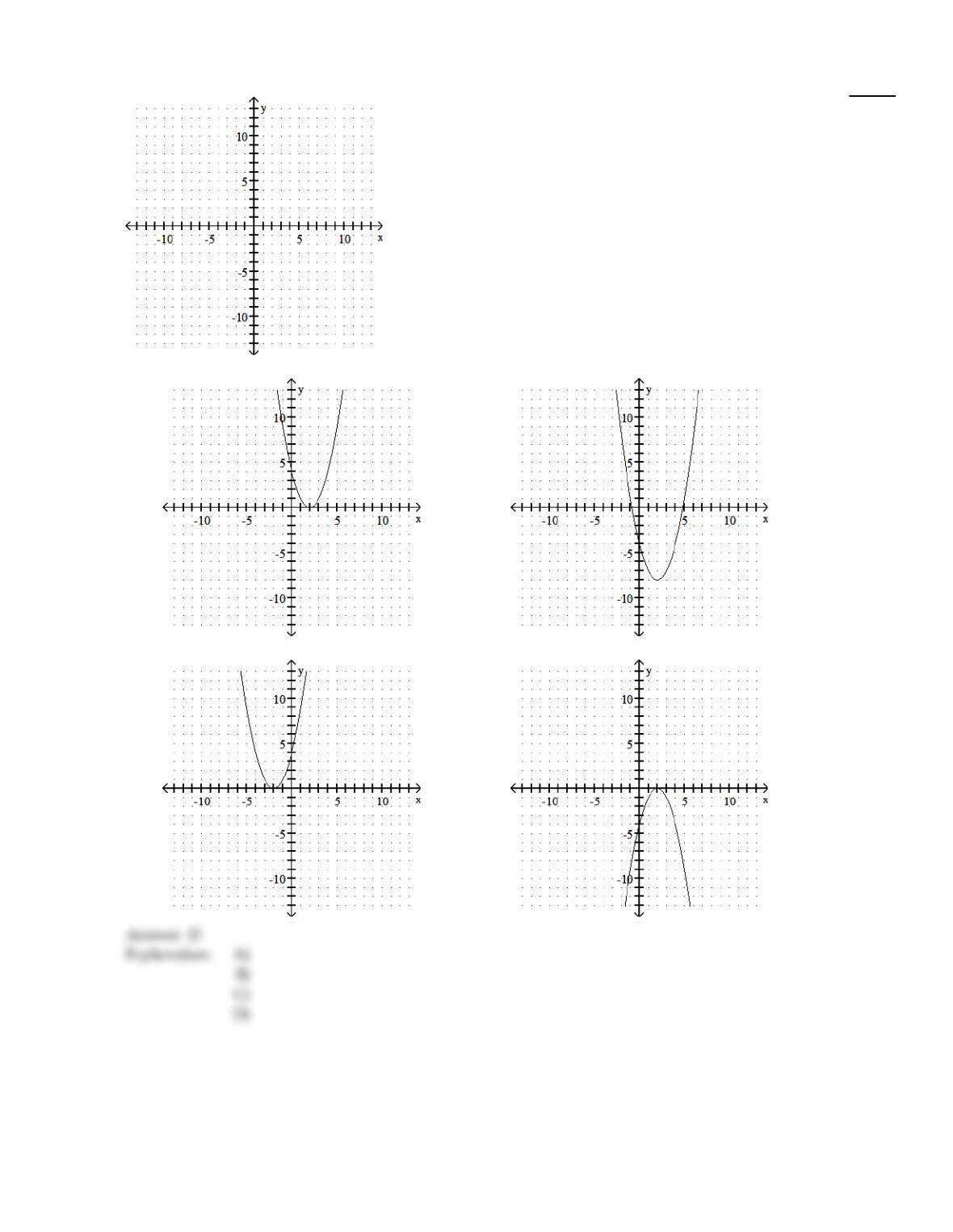
120)
y = –x2+ 4x – 4
120)
A)
(2, 0)
B)
(2, –8)
C)
(–2, 0)
D)
(2, 0)
31
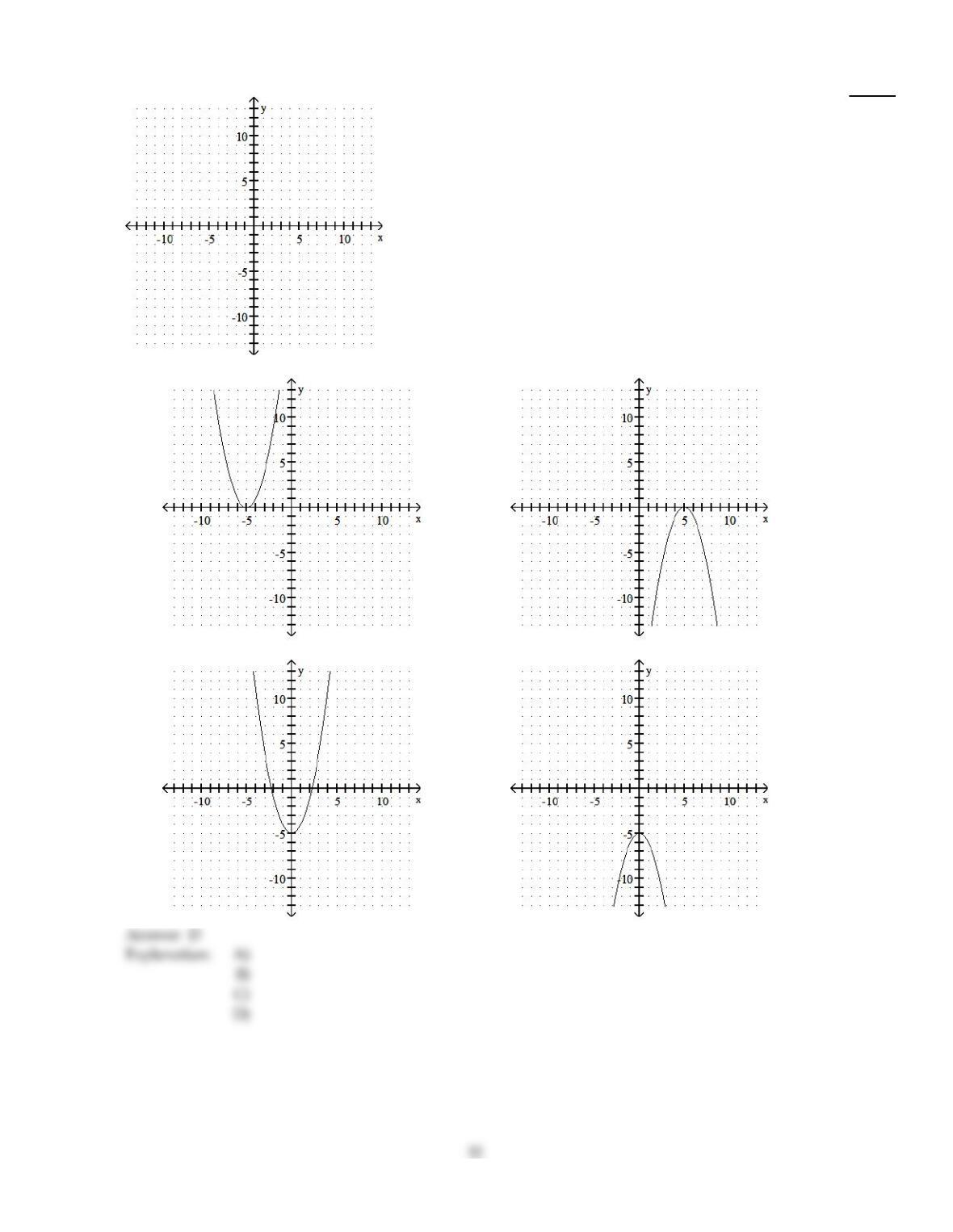
121)
y = –x2– 5
121)
A)
(–5, 0)
B)
(5, 0)
C)
(0, –5)
D)
(0, –5)
Solve the problem.
122)
Solve the formula S = 2rh +r2 for r by writing it in the form ar2+ br + c = 0 and then using the
quadratic formula.
122)
A)
r =–h±2– 4S
B)
r =h ±2h2+ 2S
4
C)
r =–h ±2h2+ 2S
2
D)
r =–h ±2h2– 2S
2
Solve by the method of your choice.
123)
x2+4x –2= 0
123)
A)
{–2±6}
B)
{ 6 ±2}
C)
{2 ±6}
D)
{4}
Decide whether the statement is true or false. If it is false, tell why.
124)
The equation –x2= –49 has no real solutions.
124)
A)
False; the equation has one real number solution, 7.
B)
False; the equation is equivalent to x2=49 and has two real solutions, 7 and –7.
C)
True
Solve the problem.
125)
The length of a table is 12 inches more than its width. If the area of the table is 1645 square inches,
what is its length?
125)
A)
70 in.
B)
23 in.
C)
35 in.
D)
47 in.
126)
The distance traveled by a falling object is given by d = 16t2, where d is the distance (in feet) the
object falls in t seconds. How long would it take an object to fall freely from a bridge 930 ft above
the water? Round your answer to the nearest tenth of a second.
126)
A)
122.0 sec
B)
13,838,400.0 sec
C)
7.6 sec
D)
58.1 sec
Solve by the method of your choice.
127)
t2+64 =16t
127)
A)
{0, 16}
B)
{–8}
C)
{0, 8}
D)
{8}
Solve the equation by completing the square.
128)
6x2+ 12x + 5 = 0
128)
A)
–6±6
12
B)
–6±6
6
C)
–12 ±6
6
D)
–6±66
6
Solve the equation. Express radicals in simplest form.
129)
(2x + 4)2=36
129)
A)
{20, –20}
B)
{1, –5}
C)
{0, 1}
D)
{1, 5}
Solve by the quadratic formula.
130)
6k2– 53k – 9 = 0
130)
A)
{–6, 9}
B)
–1
6, 9
C)
–1
6, 6
D)
–1
6 , 1
53
Solve the equation. Express radicals in simplest form.
131)
4
9w2–4
3w = –1
131)
A)
–3
2
B)
C)
3
2
D)
3 ± 2 2
2
132)
11p2=2
132)
A)
±22
11
B)
±22
11
C)
±2
11
D)
±22
121
133)
3x2=49
133)
A)
±3
7
B)
±7
3
C)
±7 3
3
D)
±3 7
7
134)
A rock falls from a tower that is 160 feet high. As it is falling, its height is given by the formula
h =160– 16t2. How many seconds will it take for the rock to hit the ground (h=0)? Round to the
nearest tenth, if necessary.
134)
A)
3.2 sec
B)
1600 sec
C)
12.6 sec
D)
12 sec
Solve the equation. Express radicals in simplest form.
135)
(2m – 1)2–72 = 0
135)
A)
–1 +6 2
2
B)
1 ±6 2
2
C)
1 ±2 6
2
D)
6 2 ± 1
2
136)
(r + 6)2=17
136)
A)
{17, 17}
B)
{–6+17, –6–17}
C)
{11}
D)
{6 +17, 6–17}
B
Use the quadratic formula to solve the equation. Simplify any radicals.
137)
(x +5)(x –8) =4
137)
A)
–3±185
B)
3±185
2
C)
–3±185
2
D)
3±185
B
Solve the equation by completing the square. Then (i) give the exact solutions and (ii) give the solutions rounded to the
nearest thousandth.
138)
(6t + 2)2=14
138)
A)
(i) 14 + 2
6 (ii) {0.911}
B)
(i) {–2±14} (ii) {1.742, –5.742}
C)
(i) ±12
6 (ii) {0.577, –0.577}
D)
(i) –2±14
6 (ii) {0.29, –0.957}
D
36
B
Solve by using the square root property.
139)
(x – 3)2=49
139)
A)
{–4, –10}
B)
{7, –7}
C)
{10, –4}
D)
{52}
Use the quadratic formula to solve the equation. Simplify any radicals.
140)
2m2+ 10m + 2 = 0
140)
A)
–5±21
4
B)
–5±29
2
C)
–5±21
2
D)
–10 ±21
2
Solve the equation by using the square root property. Simplify all radicals.
141)
4x2=60
141)
A)
{±15}
B)
{30}
C)
{16}
D)
{±15}
142)
The surface area S of a sphere with radius r is given by the formula S =4r2. If a sphere has surface
area 196 square inches, what is its radius?
142)
A)
14 in.
B)
7 in.
C)
7 in.
D)
49 in.
143)
The position of an object moving in a straight line is given by s =t2– 8t, where s is the distance in
feet and t is the time in seconds the object has been in motion. How long (to the nearest tenth) will it
take the object to move 19 feet?
143)
A)
9.9 sec
B)
20.0 sec
C)
9.7 sec
D)
20.9 sec
Solve the equation by the zero–factor property.
144)
x2=144
144)
A)
{12}
B)
{–72, 72}
C)
{–12, 12}
D)
{13}
Solve the equation. Express radicals in simplest form.
145)
t2
5=t
6+1
30
145)
A)
1
3, 1
2
B)
{1}
C)
D)
–1
6, 1
146)
If k is a positive integer, then x2= k will have one rational and one irrational solution.
146)
A)
False; there will always be two rational solutions.
B)
False; there will be either two rational solutions or two irrational solutions.
C)
True
Solve the equation by completing the square.
147)
z2+ 16z + 43 = 0
147)
A)
{8 ±43}
B)
{–16 +43}
C)
{8 +21}
D)
{–8±21}
Use the quadratic formula to solve the equation. Simplify any radicals.
148)
x2=3– 4x
148)
A)
{2 +7}
B)
{–2±2 7}
C)
{–1±7}
D)
{–2±7}
Solve the problem.
149)
A ball is thrown vertically upward from the top of a building 144 feet tall with an initial velocity of
128 feet per second. The height, s (in feet), of the ball after t seconds is given by
s = – 16t2+128t +144. After how many seconds does the ball strike the ground?
149)
A)
9 sec
B)
145 sec
C)
11 sec
D)
8 sec
If necessary, write the equation in the standard form ax2+ bx + c = 0. Then identify the values of a, b, and c. Do not
actually solve the equation.
150)
9x2+ 15 = 0
150)
A)
a =9, b =15, c = 0
B)
a =9, b = 0, c =15
C)
a = 0, b =9, c =15
D)
a = 2, b = 0, c = –15
Use the quadratic formula to solve the equation. Simplify any radicals.
151)
4x2–3x +7=10x +5
151)
A)
13 ±137
8
B)
8±137
8
C)
–13 ±137
8
D)
–8±137
8
Solve by the method of your choice.
152)
(x +8)(x –3) =2
152)
A)
{–5±129}
B)
5±129
2
C)
–5±129
2
D)
{5 ±129}
39
Solve by the quadratic formula.
153)
3m2+ 10m = 0
153)
A)
–10
3, 0
B)
–3
10, 0
C)
±10
3
D)
0, 10
3
Solve the equation by completing the square.
154)
4= 2z2– 18z
154)
A)
9 ±83
2
B)
9 ±89
2
C)
9 ±89
3
D)
–9 ±89
2
155)
Solve S =1
2r2+ (r +9)h for r by writing it in the form ar2+ br + c = 0 and then using the quadratic
formula..
155)
A)
r =–h ±h2–18h + 2S
B)
r =–h ±h2+18h + 2S
C)
r =–h ±h2–18h – 2S
D)
r =h ±h2–18h + 2S
Solve the equation. Express radicals in simplest form.
156)
5y2+3
2=11
2y
156)
A)
–1
2, –3
5
B)
1
2, 5
3
C)
1
2, 3
5
D)
2, 3
5
40
Solve the equation by using the square root property. Simplify all radicals.
157)
y2=2
157)
A)
{ 2}
B)
{±2}
C)
{4}
D)
{±1}
Solve the problem.
158)
Working together, Rick and Juanita can complete a job in 10 hours. It would take Rick 15 hours
longer than Juanita to do the job alone. How long would it take Juanita alone?
158)
A)
30 hr
B)
10 hr
C)
25 hr
D)
15 hr
159)
(x – 9)(x – 1) =14
159)
A)
{–5–2 5, –5+2 5}
B)
{5 –30, 5+30}
C)
{–5–30, –5+30}
D)
{5 –2 5, 5+2 5}
160)
(x –4)2=12
160)
A)
{2 3±4}
B)
{± 2 3}
C)
{4 ± 2 3}
D)
{4 ± 2 6}
Use a calculator to find an approximate solution to the equation. Round your answer to the nearest thousandth.
161)
3x2+ 9x = – 3
161)
A)
{0.303, –3.303}
B)
{–3.382, –5.618}
C)
{–0.382, –2.618}
D)
{–0.127, –0.873}
41
Solve by completing the square.
162)
3x2– 24x –7= 0
162)
A)
– –12 ±69
3
B)
– –12 ±165
3
C)
–12 ±69
3
D)
– –12 +165
3
163)
3n2= –12n – 7
163)
A)
–6±15
6
B)
–12 ±15
3
C)
–6±57
3
D)
–6±15
3
D)
Solve the equation by completing the square. Then (i) give the exact solutions and (ii) give the solutions rounded to the
nearest thousandth.
164)
2x2+9x = –1+15x
164)
A)
(i) 3±7
2 (ii) {2.823, 0.177}
B)
(i) {3±7} (ii) {5.646, 0.354}
C)
(i) –3±7
2 (ii) {–0.177, –2.823}
D)
(i) {–3±7} (ii) {–0.354, –5.646}
D)
Solve by the quadratic formula.
165)
7x2+ 12x = – 2
165)
A)
–12 ±22
7
B)
–6±2
7
C)
–6±22
14
D)
–6±22
7
D)
42
D)
Decide whether the statement is true or false. If it is false, tell why.
166)
If k = 0, then x2= k will have exactly one real solution.
166)
A)
False; the equation will have no real solution.
B)
False; the equation will have two real solutions.
C)
True
167)
9k2– 62k – 7 = 0
167)
A)
–1
9, 9
B)
–1
9, 7
C)
1
62, –1
9
D)
{–9, 7}
168)
Two cars travel at right angles to each other from an intersection until they are 25 miles apart. At
that point, one car has gone 5 mi farther than the other. How far did the slower car travel?
168)
A)
20 mi
B)
30 mi
C)
10 mi
D)
15 mi
169)
15d2+ 28d + 12 = 0
169)
A)
6
5, 2
3
B)
–5
6, –2
3
C)
5
6, 3
2
D)
–6
5, –2
3
170)
–x2+ 2x = –4
170)
A)
{1, 5}
B)
{–1 ±5}
C)
1 ±5
2
D)
{1 ±5}
43
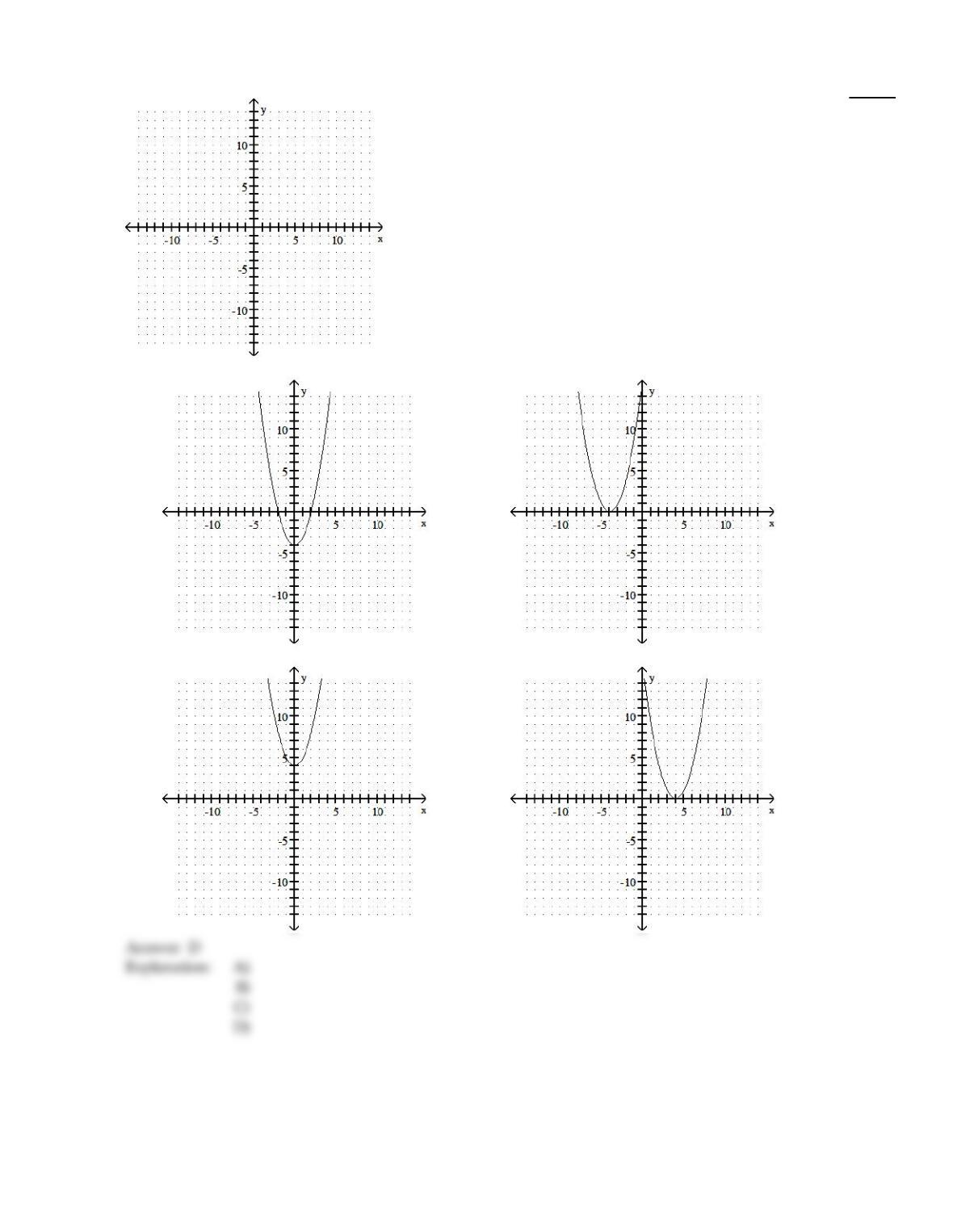
171)
y =x2–8x +16
171)
A)
(0, –4)
B)
(–4, 0)
C)
(0, 4)
D)
(4, 0)
44
Solve the equation. Express radicals in simplest form.
172)
(t + 6)2= –14
172)
A)
{–6+14, –6–14}
B)
{8}
C)
{6 +14, 6–14}
D)
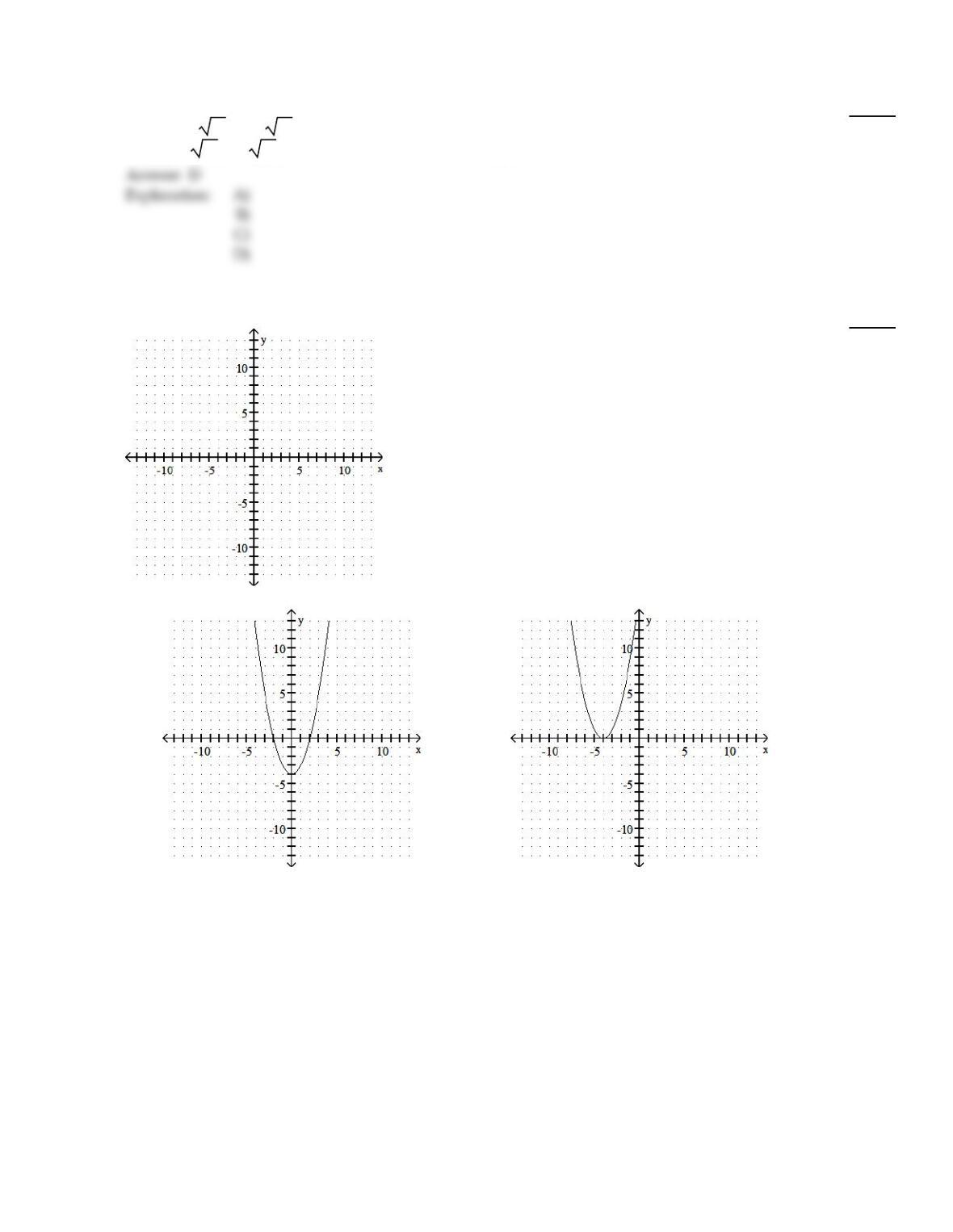
Give the coordinates of the vertex and sketch the graph of the equation.
173)
y = (x + 4)2
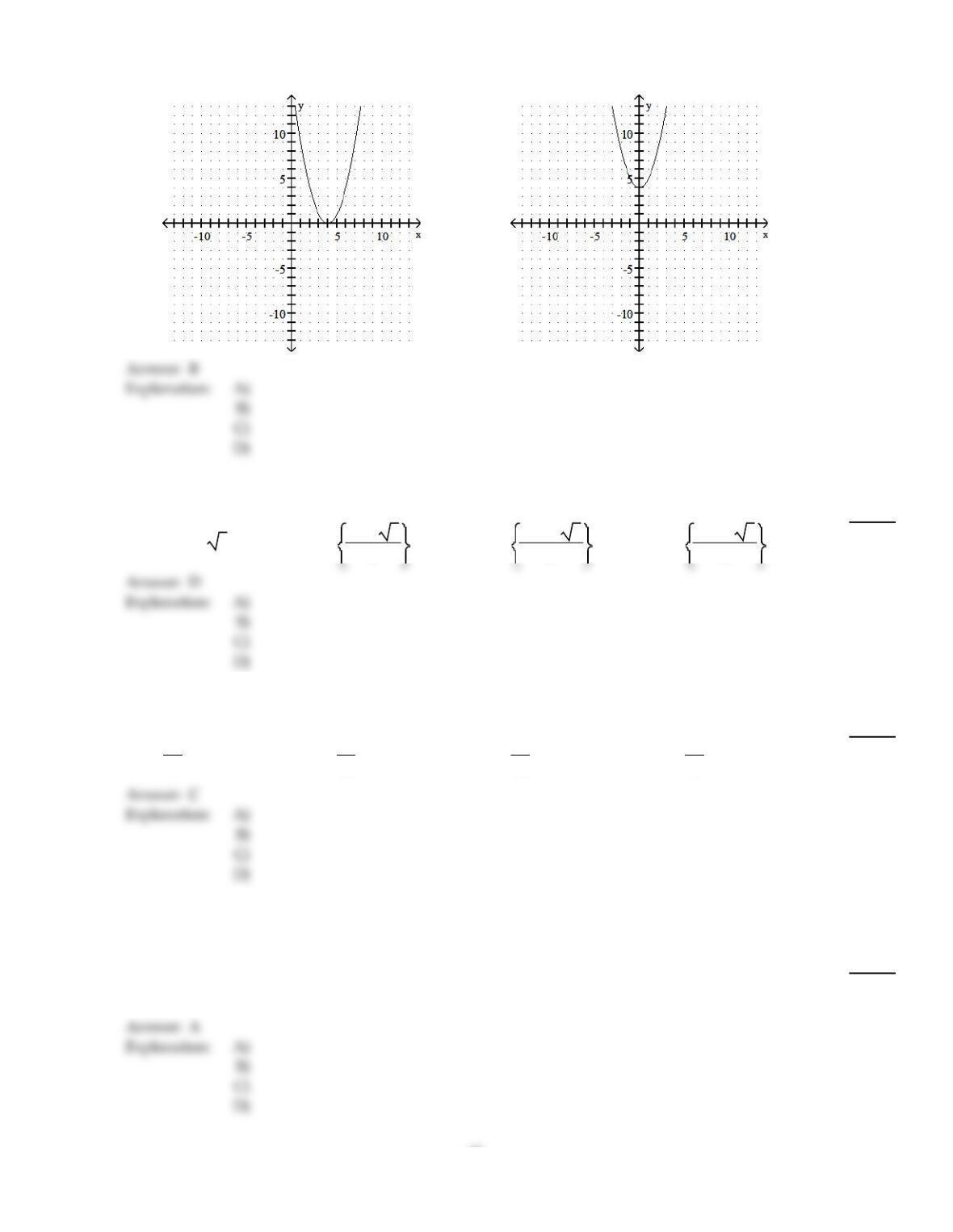
173)
A)
(0, –4)
B)
(–4, 0)
45
D
C)
(4, 0)
D)
(0, 4)
Solve the equation by completing the square.
174)
p2+ 3p – 9 = 0
174)
A)
{–3±3 5}
B)
3+ 3 5
2
C)
–3– 3 5
2
D)
–3±3 5
2
Complete the trinomial so that it is a perfect square.
175)
m2– 7m +
175)
A)
–7
4
B)
49
2
C)
49
4
D)
–7
2
If necessary, write the equation in the standard form ax2+ bx + c = 0. Then identify the values of a, b, and c. Do not
actually solve the equation.
176)
(x –7)2=3
176)
A)
a = 1, b = –14, c =46
B)
a = –7, b = –14, c =52
C)
a = –1, b =14, c = –46
D)
a = 1, b =7, c =49
46
Solve the equation. Express radicals in simplest form.
177)
(2m – 1)2=9
177)
A)
{2, –4}
B)
{2, –1}
C)
{1, –2}
D)
{4, –2}
178)
1
2x – 6 2=147
178)
A)
{12 + 14 3 , 12 – 14 3}
B)
{6+ 7 3
2 , 6– 7 3
2}
C)
{14 3+ 12 , 14 3– 12}
D)
{–12 + 14 3 , –12 – 14 3}
Give the coordinates of the vertex and sketch the graph of the equation.
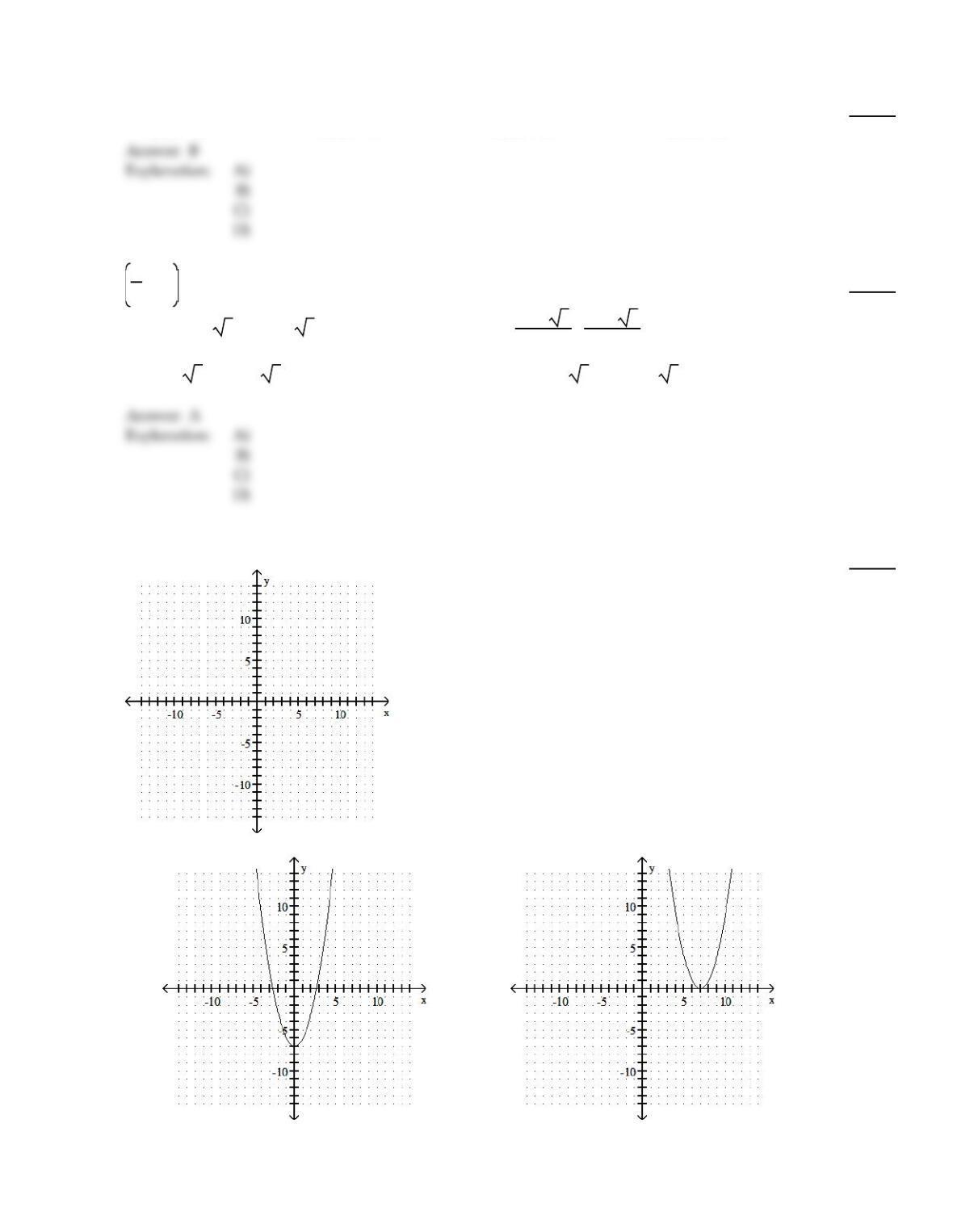
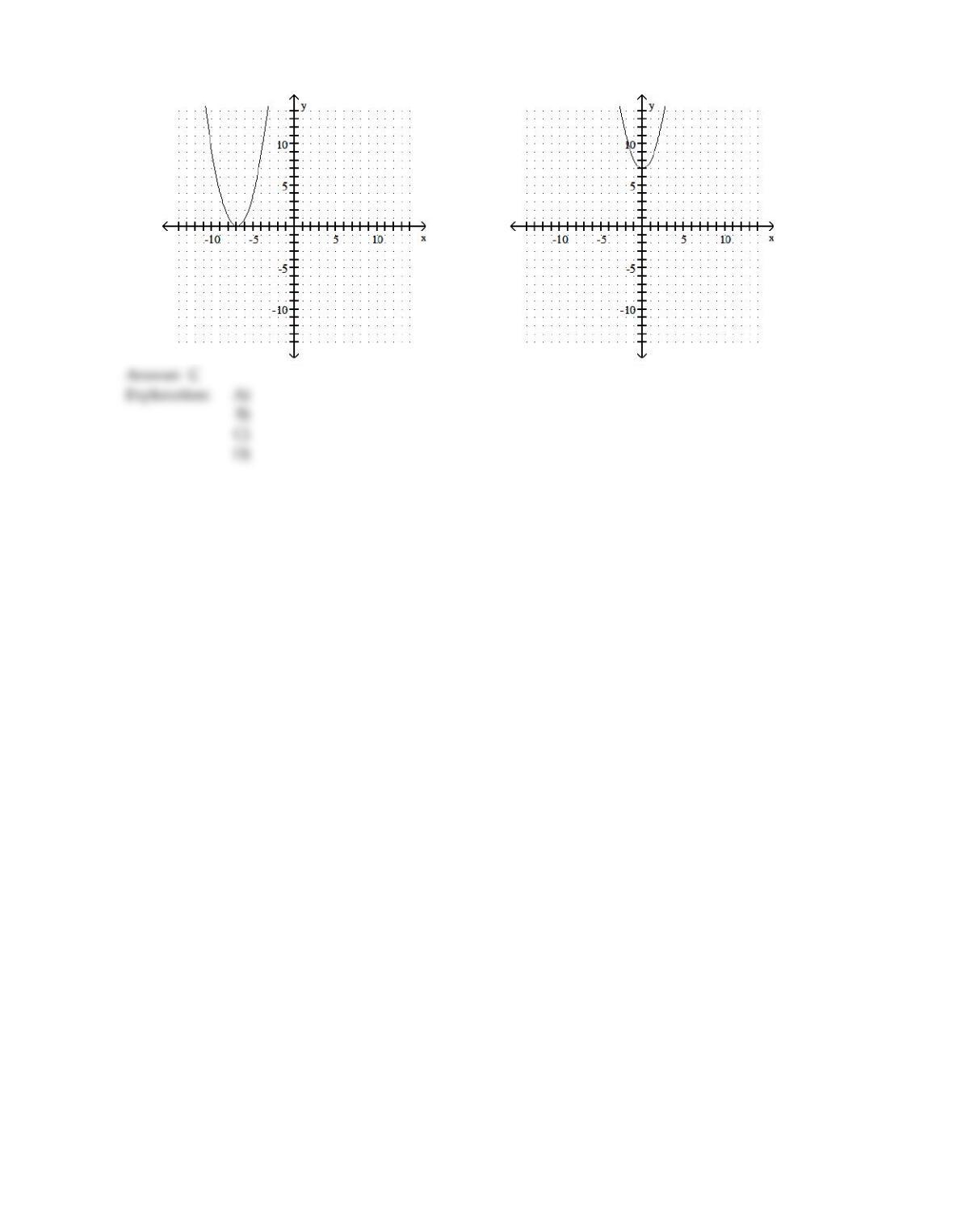
179)
y =x2+14x +49
179)
A)
(0, –7)
B)
(7, 0)
47
C)
(–7, 0)
D)
(0, 7)
48
Answer Key
Testname: C9
Answer Key
Testname: C9
Answer Key
Testname: C9
Answer Key
Testname: C9