Chapter 9 – Auditing the Revenue Cycle
72. The major risk associated with receivables is related to which of the following?
a.
They may be sold to a bank with recourse.
b.
They may be recorded as long-term when in fact they will be realized in the current period.
c.
They will not be realized for the entire amount due.
d.
They are pledged as collateral as disclosed in the footnotes to financial statements.
United States – BUSPORG: Analytic
73. Which of the following is a proper control for the detection of unusual sales transactions recorded in the
general ledger?
a.
Electronic authorization prior to posting.
b.
Use of sequentially numbered sales documents.
c.
Random statements to customers.
d.
Review of transactions by upper management or the board.
United States – BUSPORG: Analytic
74. A control that may be implemented to ensure all sales that occur are recorded in the general ledger includes
which of the following?
a.
Use of prenumbered shipping, invoice and sales documents.
b.
Use of prenumbered statements, inventory lists and credit memos.
c.
Reconciliation of invoices with customer statements.
d.
Use of pre-authorized price lists.
United States – BUSPORG: Analytic
75. The internal audit department at Monument Company receives electronic exceptions reports for all sales
transactions entered over $10,000 in total. This process is performed for which purpose?
a.
Drafting financial statements.
b.
Monitoring revenue transactions.
c.
Providing management reports to the controller.
d.
Providing suggestions for operational improvement.
76. Auditors will examine significant sales returns immediately subsequent to the period under audit in order to
do which of the following?
a.
Substantiate cutoff and the occurrence of net sales transactions.
b.
Test the sufficiency of cash balances to cover refunds.
c.
Monitor customer satisfaction for disclosure.
d.
Assess the nature of procedures that will be performed for the next period’s audit.
United States – BUSPORG: Analytic
77. The auditor of the revenue cycle of ABC Company computes an estimate of ABC’s allowance for doubtful
accounts and compares it to the estimate provided by ABC’s management. The purpose for this procedure is to
substantiate which assertion?
a.
Existence of receivables.
b.
Cutoff of receivables.
c.
Valuation of receivables.
d.
Rights to receivables.
United States – BUSPORG: Analytic
78. What evidence is utilized by the auditor for analytical purposes in substantiating the completeness of the
allowance for bad debt estimate?
a.
Accounts receivable aging schedule.
b.
Copies of checks received from customers.
c.
Confirmations returned without exception.
d.
Stock prices of customer companies.
United States – BUSPORG: Analytic
Testing Accounts Receivable
79. Much of the understanding of revenue transactions for compliance with GAAP can be performed by
accomplishing which of the following tasks?
a.
Examining sales contracts and inquiry of management.
b.
Confirming sales with customers.
c.
Discussing the transactions with qualified members of the Financial Accounting Standards Board.
d.
Comparing shipping documents with invoices.
80. The auditor traces recorded sales to invoices, sales orders and shipping documents in order to substantiate
which assertion?
a.
Cutoff.
b.
Completeness.
c.
Legality.
d.
Occurrence.
d
1
United States – BUSPORG: Analytic
Testing Revenue
81. In the audit of the revenue of Hiram Manufacturing Company, the auditors obtain a number of shipping
documents shortly before year-end and immediately following the year under audit. The auditors compare the
documents to the sales journal in order to test which of the following assertions?
a.
Existence of sales.
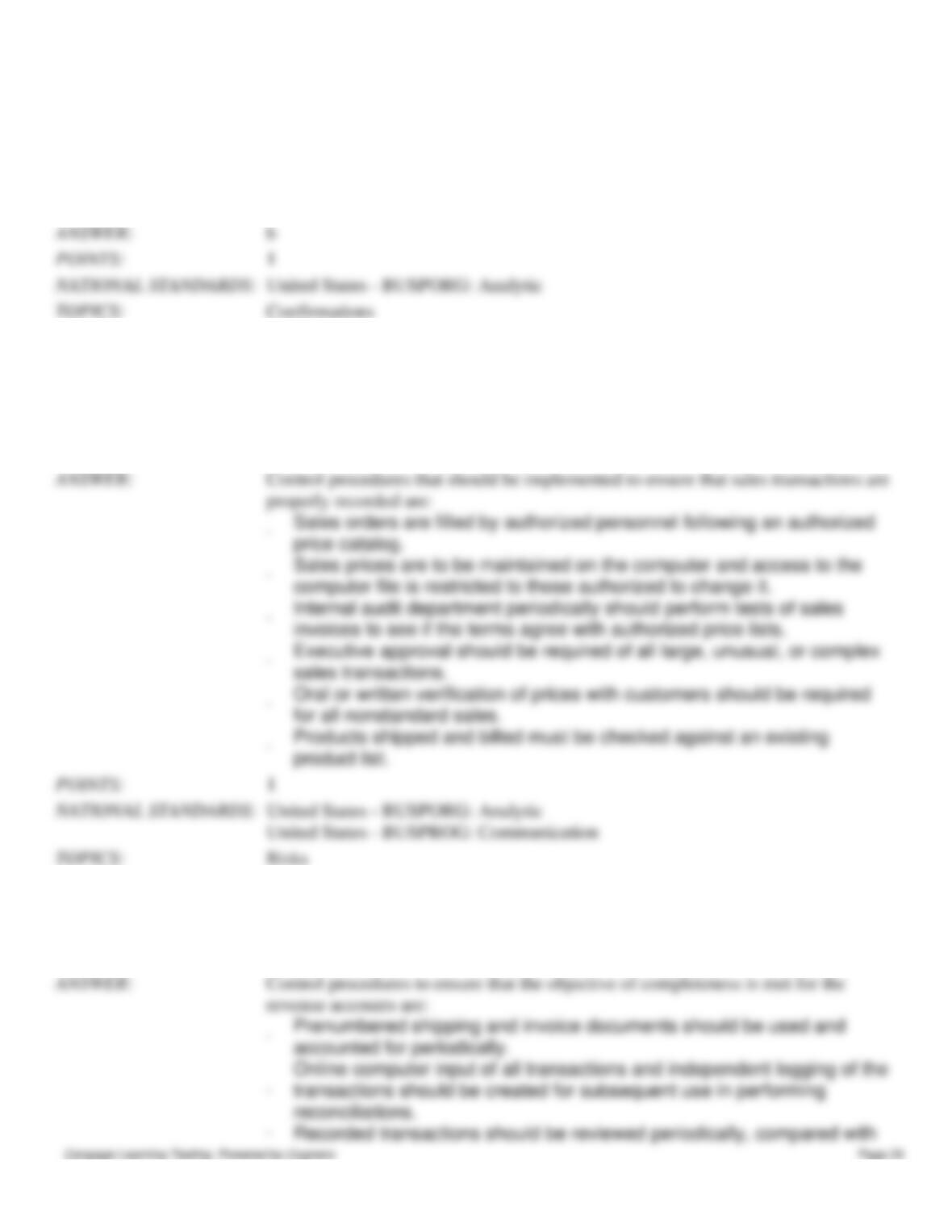
b.
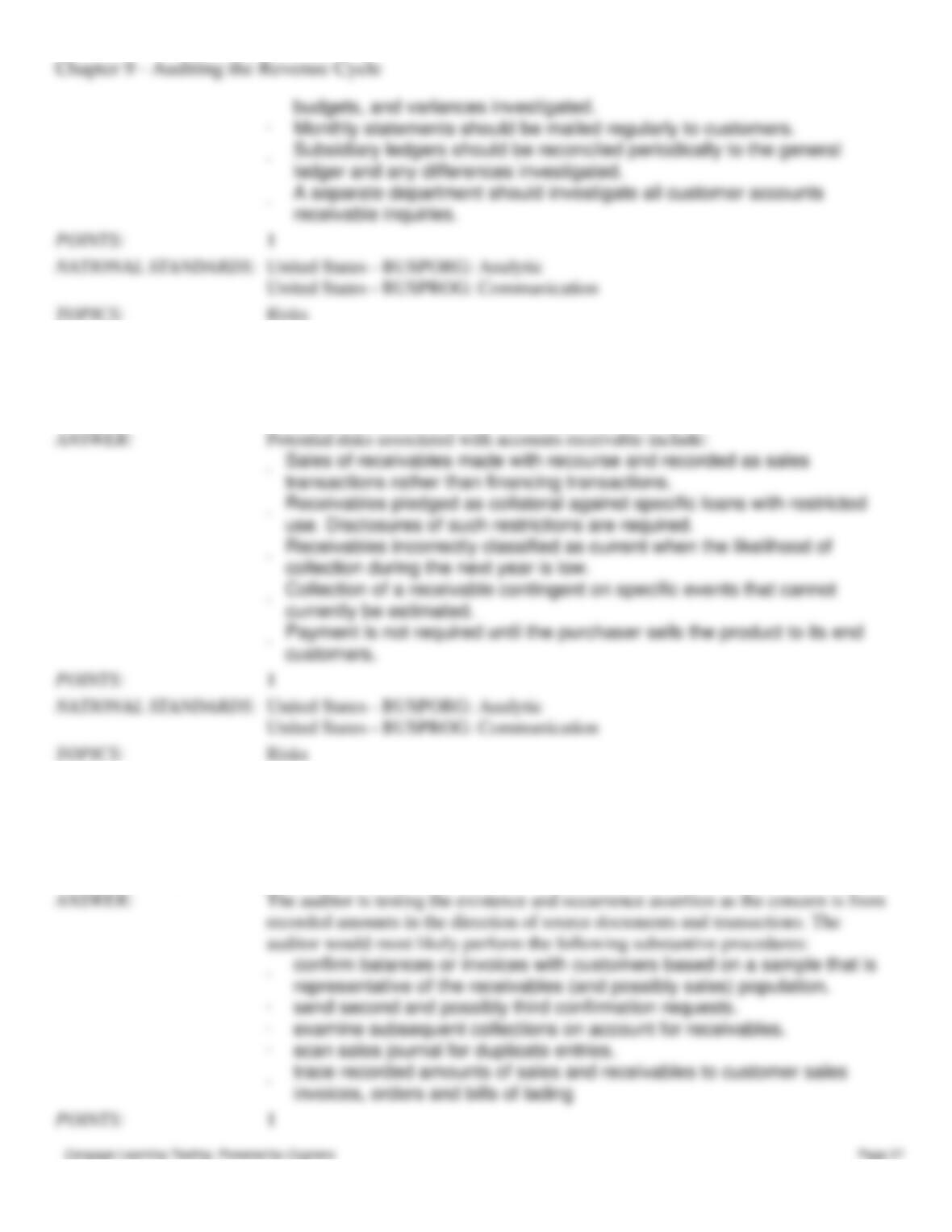
Presentation and disclosure of receivables.
c.
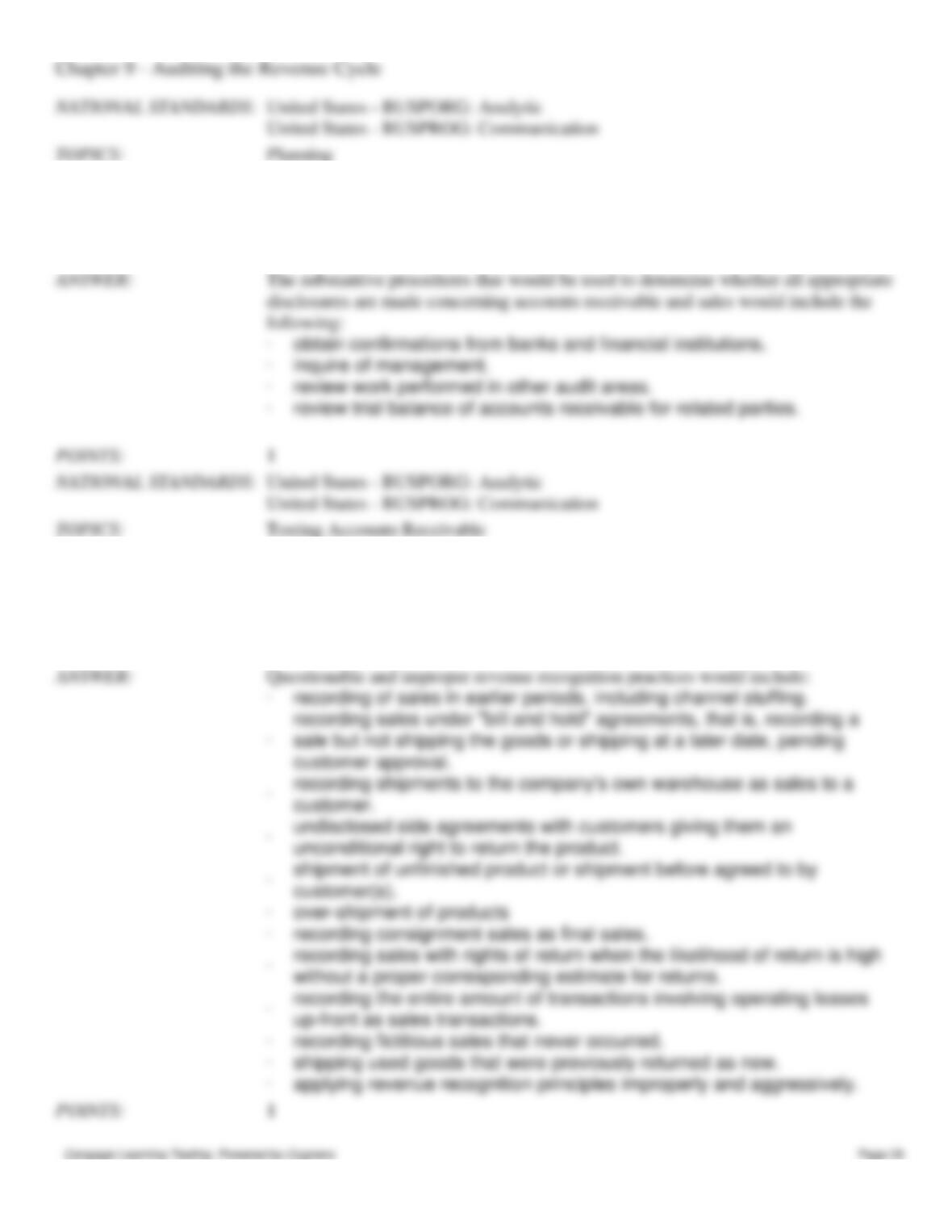
Cutoff of sales transactions.
d.
Completeness of receivables.
1
United States – BUSPORG: Analytic
Testing Revenue
82. Completeness of revenues may be tested by the auditor through the selection of a sample of which of the
following?
a.
Shipping documents and tracing them to the sales journal.
b.
Accounts receivable and tracing them to cash receipts.
c.
Recorded sales transactions and tracing them to the general ledger.
d.
Inventory records and tracing them to the shipping documents.
1
United States – BUSPORG: Analytic
Testing Revenue
83. Homer and Moe, PC are auditing the financial statements of Lyoncraft, Inc. and decide to confirm a sample
of accounts receivable. This test is performed by Homer and Moe primarily to substantiate which of the
following assertions?
a.
Existence of related party transactions.
b.
Existence of accounts receivable.
1
United States – BUSPORG: Analytic
Testing Revenue
Chapter 9 – Auditing the Revenue Cycle
c.
Obligation of debt.
d.
Cutoff of the allowance for bad debt.
United States – BUSPORG: Analytic
Testing Accounts Receivable
84. The aged accounts receivable report is utilized by the auditor to accomplish which of the following?
a.
Encourage the client to collect on receivables that are long past due.
b.
Select the type of confirmations that will be sent to banks.
c.
Assess the adequacy of the allowance for doubtful accounts.
d.
Identify debits in the receivables balance that should be reclassified to payables.
United States – BUSPORG: Analytic
Testing Accounts Receivable
85. According to auditing standards, accounts receivable confirmations are required to be used in which of the
following situations?
a.
On every audit engagement.
b.
If the client agrees in writing to the procedure.
c.
If the balance is material.
d.
If environmental risk is low.
United States – BUSPORG: Analytic
Testing Accounts Receivable
86. The primary difference between positive and negative confirmations used in the audit of accounts receivable
is which of the following?
a.
The mode of response.
b.
The amount of information included.
c.
The control of the confirmation process by the auditor.
d.
The method in which accounts are selected for confirmation.
United States – BUSPORG: Analytic
Revenue Cycle
87. For which of the following accounts receivable customer populations would the use of negative
Chapter 9 – Auditing the Revenue Cycle
confirmations be most appropriate?
a.
A retail truck and trailer sales company with high inherent risk and moderate control risk over the
revenue cycle.
b.
A utility company with control risk over the revenue cycle assessed high.
c.
A mortgage banking company with excellent control over the purchasing cycle.
d.
A cable company with control risk over the revenue cycle assessed low.
United States – BUSPORG: Analytic
Testing Accounts Receivable
88. Accounts receivable confirmations usually provide strong evidence about which of the following?
a.
The existence of receivables.
b.
The completeness of receivables.
c.
The presentation and disclosure of receivables.
d.
The obligations of receivables.
United States – BUSPORG: Analytic
Testing Accounts Receivable
89. Confirmations that are sent to select customers asking them to review the current balance due the client as
shown on the client’s statement and return the letters directly to the auditor indicating whether they agree with
the indicated balance, are known by which of the following terms?
a.
Direct confirmations.
b.
Indirect confirmations.
c.
Positive confirmations.
d.
Negative confirmations.
United States – BUSPORG: Analytic
Testing Accounts Receivable
90. Which one of the following procedures would be considered improper by the auditor in the process of
confirming receivables?
a.
The auditor allows the client’s staff to prepare the confirmation letters after the auditor has chosen the
items to be confirmed.
b.
The auditor allows the client to sign the confirmations after they are prepared.
c.
The auditor allows the client’s staff to mail the confirmation letters after he or she has proofed the
typing of the letters.
d.
The auditor asks the addressee to return the confirmation to the audit firm’s office.
91. An auditor’s examination of the sales account using a cut-off test would most likely detect which of the
following?
a.
Kiting.
b.
Sales made with improper credit terms.
c.
Lapping of accounts receivable.
d.
Sales recorded in the wrong period.
d
1
AUDT.JOHN.10.09.01
United States – BUSPORG: Analytic
Revenue Cycle
92. Alternative procedures that would provide evidence of the existence of receivables would include which of
the following?
a.
Physical observation of customer facilities.
b.
Review of subsequent collections.
c.
Analysis of the aged trial balance.
d.
A confirmation to the client management for customer accounts.
b
1
United States – BUSPORG: Analytic
Testing Accounts Receivable
93. Auditors are concerned with the addresses provided for customers in the confirmation of accounts
receivable because of which of the following reasons?
a.
Confirmations are selected based upon zip codes.
b.
A P.O. Box is more reliable than a street address.
c.
Confirmations should be sent only to business addresses and not residential.
d.
The address may be routed to the client for retrieval and fraudulent signing.
d
1
United States – BUSPORG: Analytic
Testing Accounts Receivable
94. Unreturned positive confirmations for accounts receivable warrant which of the following actions?
a.
Replacing the sample selection with a new customer.
b.
Sending second requests and possibly performing subsequent procedures.
1
United States – BUSPORG: Analytic
Testing Accounts Receivable
Chapter 9 – Auditing the Revenue Cycle
c.
The projection of larger misstatements to the population.
d.
Requesting that the client send additional audit correspondence to customers.
United States – BUSPORG: Analytic
Testing Accounts Receivable
95. An example of alternative procedures for the confirmation of accounts receivable includes which of the
following actions?
a.
Inquiry of management.
b.
Tracing source documents to recorded amounts.
c.
Review of subsequent collections on account by the client.
d.
Providing an estimate of the allowance for doubtful accounts to be recorded by the client.
United States – BUSPORG: Analytic
Testing Accounts Receivable
96. A key indicator of fraud in the revenue cycle is the auditor’s detection of which of the following?
a.
Customer collections that are over 90 days past due.
b.
Credit entries in customer accounts receivable for authorized writeoffs.
c.
Recurring entries in the sales journal.
d.
Altered shipping documents and invoices.
United States – BUSPORG: Analytic
Fraud Indicators
97. In the audit of accounting estimates, such as the allowance for doubtful accounts, the auditor strives to
provide reasonable assurance about which of the following?
a.
All material accounting estimates have been developed properly.
b.
The estimates are reasonable.
c.
The estimates are presented in accordance with GAAP.
d.
All of the above are true.
United States – BUSPORG: Analytic
Audit of Allowance
98. The allowance for doubtful accounts will not be precise by either the client or the auditor because of which
of the following reasons?
a.
It is an accounting estimate based upon judgment.
Chapter 9 – Auditing the Revenue Cycle
b.
GAAP is not clear on the calculation of the allowance.
c.
It is merely a reserve that is reversed by the client as income is needed for profitable results.
d.
The precision is determined by the results of confirmation responses.
United States – BUSPORG: Analytic
Audit of Allowance
99. To determine whether any accounts receivable are pledged or assigned to others, the auditor would most
likely perform which of the following procedures?
a.
Examine subsequent collections.
b.
Test a sample of transactions to the general ledger.
c.
Review loan agreements and board of directors’ meeting minutes.
d.
Derive an independent estimate of the allowance and compare it to pledged assets.
United States – BUSPORG: Analytic
Testing Accounts Receivable
100. Which of the following criteria must be met in order to recognize revenue in the current accounting
period?
a.
Delivery has occurred or the services have been rendered.
b.
Price is fixed or determinable.
c.
Collectibility if reasonably assured.
d.
All of the above.
United States – BUSPORG: Analytic
Revenue Recognition
101. Management has been found involved in many fraudulent schemes; a common one is “channel stuffing.”
What does “channel stuffing” involve?
a.
Overly complex transactions.
b.
Growth through stock acquisitions.
c.
Shipment of goods not ordered.
d.
Management compensation schemes.
United States – BUSPORG: Analytic
Revenue Recognition
102. Which of the following is not a form of ratio analysis?
Chapter 9 – Auditing the Revenue Cycle
a.
Turnover of receivables.
b.
Monthly sales analysis compared with past years.
c.
Gross margin analysis.
d.
Sales in last month to total sales.
United States – BUSPORG: Analytic
Analytical Procedures
103. Sources of audit planning information may come from which of the following?
a.
Knowledge of client’s business and industry.
b.
Assessment of risk of material misstatement.
c.
Results of analytical procedures.
d.
All of the above.
United States – BUSPORG: Analytic
104. Which of the following audit procedures does not address existence/occurrence for accounts receivables
and sales?
a.
Trace bill of lading to sales invoice and sales journal.
b.
Confirm balances of unpaid invoices with customers.
c.
Examine subsequent collection.
d.
Scan sales journal for duplicate entries.
United States – BUSPORG: Analytic
Substantive Tests of Revenue
105. Which of the following audit procedures does not address the rights, presentation and disclosure assertion
for pledged, discounted, assigned, and related-party accounts receivable?
a.
Review work performed in other audit areas.
b.
Inquire of management.
c.
Review adequacy of allowance for doubtful accounts.
d.
Review loan agreements.
United States – BUSPORG: Analytic
Substantive Tests of Revenue
106. A sample of positive confirmations is mailed for material accounts receivable balances. Frequently there is
Chapter 9 – Auditing the Revenue Cycle
a lack of response. Which of the following is not an acceptable alternative procedure?
a.
Reviewing collections on the account subsequent to the confirmation date.
b.
Inquiry of management.
c.
Mailing second and third confirmations.
d.
Examination of supporting documents.
United States – BUSPORG: Analytic
107. Internal control over the revenue cycle
White Floyd, Inc., a retail store, is concerned about the lack of control procedures over the recording of sales
transactions. The company is concerned that the transactions might not be recorded accurately and valued
properly in accordance with GAAP. Recommend control procedures to help ensure that transactions are
recorded accurately and valued properly.
United States – BUSPROG: Communication
108. Control over completeness for the revenue cycle
What control procedures should be implemented to ensure the completeness objective is met with respect to
sales?
109. Accounts receivable risks
In the financial statements, there are many risks associated with an audit that must be considered. Identify and
discuss five separate risks that may exist related to accounts receivable.
110. Substantive procedures for sales and receivables assertions
The auditor for Knowles, Inc. is attempting to determine whether the recorded sales and accounts receivable are
supported by valid transactions. Identify the assertions being tested and develop the substantive procedures to
be used to satisfy the auditor’s objectives.
111. Accounts receivable presentation and disclosure
Develop a list of substantive tests to test whether pledged, discounted, assigned, and related-party accounts
receivable are properly disclosed.
112. Improper revenue recognition
Historically the accounting profession has come under fire for fraudulent financial reporting due to questionable
improper revenue recognition. Identify at least six examples of questionable revenue recognition practices that
an auditor must consider in performing an audit engagement.
113. Analytical Procedures
Explain ratio analysis as an analytical procedure used by auditor. Give examples of the ratios that auditor might
want to compute for revenue cycle accounts.
114. Requirements for confirming accounts receivable
Confirmation of accounts receivable is required under GAAS unless certain conditions exist. Identify the
conditions that will be present in an audit that does not confirm accounts receivable.
115. Confirmations of receivables
You are the auditor of Maple Bank for the year 2010. Maple has a large number of customers with consumer
loan accounts. The loan accounts have balances averaging $800 in a homogeneous population and the
customers usually pay close attention to their balances.
Your preliminary assessment of internal control over the loan area is that control risk is low and results of tests
of controls support that assessment. Inherent risk is deemed to be lower as well.
Discuss the confirmation process and the types of confirmations that may be used for the audit of Maple Bank.
Which confirmation type would you select for Maple and why?
116. Confirmations of receivables at an interim date
When internal controls are strong, the auditor may decide to confirm receivables before year end. Roll-forward
procedures are then used to obtain adequate evidence for the roll-forward period. Discuss why the auditor
would want to confirm receivables before balance sheet date, the risks involved, and at least three of the roll-
forward procedures that the auditor performs to gain assurance on the roll-forward period.
Chapter 9 – Auditing the Revenue Cycle