Chapter 9
Accounting for Financing Transactions
MULTIPLE CHOICE QUESTIONS
1. The recognition of a deferred tax liability that results from the use of straight-line
depreciation on financial statements and double-declining balance on tax returns will
a. increase the current ratio.
b. increase the debt/equity ratio.
c. increase the quick ratio.
d. decrease the debt/asset ratio.
2. An increase in a deferred tax liability is recognized when
a. the tax accountant omits taxable revenue from the tax returns.
b. net income measured under GAAP is greater than taxable income on tax returns
because of temporary timing differences.
c. the amount of tax paid to the government is more than that calculated by the
accountant on the company’s tax return.
d. a tax audit by the IRS causes an increase in taxes due from a previous year’s tax
return.
3. In addition to recognizing income tax expense, the accounting necessary to record
income taxes requires
a. a credit to income tax payable based on net income times the tax rate.
b. a debit to the income tax expense account for the amount of cash that must be paid
for taxes.
c. computations of the amounts to record in the deferred income tax account.
d. all companies to report taxable income on the income statement
4. Two types of differences exist between computing income for tax purposes and
computing income for financial accounting purposes. The differences are
a. defined benefit taxes and defined contribution taxes.
b. deferred tax assets and deferred tax liabilities.
c. revenues and expenses.
d. temporary and permanent.
9-2 Test Bank – Chapter 9 – Accounting for Financing Activities
5. The debt/equity ratio will increase if a company
a. pays off its long-term debt.
b. decides to pay cash for more of its capital purchases.
c. purchases long-term investments for cash.
d. declares more current cash dividends.
6. Payments on an installment obligation typically include the payment of
a. principal only.
b. both principal and interest.
c. interest only.
d. interest, but only if collateral is involved.
7. Which one of the following is needed in order to find the present value of an obligation?
a. The discount rate of the associated cash flows
b. All debt covenants that are a component of the obligation
c. The gross profit rate of the borrower
d. The rate of inflation during the year
8. How is interest expense calculated according to GAAP?
a. Stated rate of interest x maturity value.
b. Effective interest rate x maturity value of the obligation.
c. Effective interest rate x balance sheet value.
d. Stated rate of interest x balance sheet value.
9. Interest expense calculated under GAAP is equal to the stated rate of interest times the
maturity value if the interest-bearing obligation is issued at
a. a discount.
b. either a discount or a premium.
c. a premium.
d. par.
Test Bank – Chapter 9 – Accounting for Financing Activities 9-3
10. If a company issues a note payable when the market rate of interest is greater than the
stated rate, then
a. the cash received will exceed the maturity value of the note.
b. the note will be issued at a discount.
c. the note will be issued at a premium.
d. the cash received will be equal to the maturity value of the note.
11. If a company issues a note payable when the market rate of interest is less than the
stated rate, then
a. the note will be discounted at maturity.
b. the cash received will be equal to the maturity value of the note.
c. the cash received will exceed the maturity value of the note.
d. the note will be issued at a discount.
12. If a company issues a note payable when the market rate of interest is equal to the
stated rate, then
a. the cash received will exceed the maturity value of the note.
b. the note will be issued at a discount.
c. the note will be issued at a premium.
d. the note will be issued at par.
13. If an interest-bearing note payable is issued at par, then the contractual cash payment
for interest is
a. equal to interest expense.
b. less than interest expense.
c. greater than interest expense.
d. It cannot be determined from the information given.
14. If an interest-bearing note payable is issued at a discount, then the contractual cash
payment for interest is
a. less than interest expense.
b. greater than interest expense.
c. equal to interest expense.
d. ignored since no interest payment will be made.
9-4 Test Bank – Chapter 9 – Accounting for Financing Activities
15. If an interest-bearing note payable is issued at a premium, then the contractual cash
payment for interest is
a. generally less than the principal.
b. less than interest expense.
c. equal to interest expense.
d. based on the market rate of interest.
16. The actual interest rate used to calculate the interest payments by the issuer of the
obligation is
a. the market rate of interest.
b. the effective interest rate.
c. the stated interest rate.
d. equal to the actual interest expense rate.
17. Capital leases are rental agreements of which
a. periodic rental payments are recorded as rental revenue on the asset owner’s
income statement.
b. the contractual arrangements are similar to a purchase in all respects.
c. the period of the lease is generally a very small portion of the leased asset’s useful
life.
d. the lessee desires to have rights to use the asset but not ownership of such asset.
18. GAAP requires the lessee party to a capital lease
a. to record the lease on its balance sheet at the present value of future lease
payments.
b. to record rental revenue as each lease payment is received.
c. to depreciate the leased asset.
d. to transfer ownership to the lessee.
19. Operating leases are treated as
a. increases in liabilities for both the lessor and the lessee.
b. a sale if the leased asset has been transferred from the lessor to the lessee.
c. capital leases by the lessee.
d. rental expense by the lessee.
Test Bank – Chapter 9 – Accounting for Financing Activities 9-5
20. Which one of the following is one of the capital lease criteria?
a. The lease term is 75% or more of the useful life of the leased property.
b. Ownership of the property is transferred back to lessor at the end of the lease term.
c. The present value of the lease payments equals or exceeds 75% of the FMV of the
property.
d. The lease does not contain a bargain purchase option.
21. A corporation issued common stock instead of debt to finance the purchase of non-
depreciable property. Which statement is true?
a. Ownership by existing shareholders will be diluted.
b. The company’s debt/equity ratio will be higher.
c. Income tax expense will be lower because expenses increase.
d. Net income will be lower.
22. Which one of the following is a result of a company issuing common stock instead of
debt to finance the purchase of property?
a. Leverage will be more effective.
b. The company will probably experience cash flow problems.
c. It will have a lower debt/equity ratio.
d. It will report a lower net income.
23. Information related to Lamar Co. for the years ending December 31, 2009 and 2008
follows:
12–31-09
12–31-08
Common stock
$120,000
$80,000
Retained earnings at year end (after closing)
100,000
70,000
Dividends declared for 2009 totaled $20,000. How much was generated through
operations?
a. $30,000
b. $50,000
c. $10,000
d. $70,000
9-6 Test Bank – Chapter 9 – Accounting for Financing Activities
24. A corporation generated assets by issuing equity securities and through profitable
operations. Which effects likely occurred?
a. Common stock and retained earnings increased.
b. Common stock increased and retained earnings stayed the same.
c. Retained earnings increased, and there was no effect on common stock.
d. Liabilities and common stock increased.
25. Which one of the following is a valid reason for a stock split?
a. To increase ownership percentages of individual shareholders
b. To adjust the market price of the shares to a level where more individuals can afford
to invest in the stock
c. To increase reported net income during subsequent accounting periods
d. To increase the book value per share of common stock
26. Cash dividends are paid based on the number of shares which are
a. authorized.
b. issued.
c. outstanding.
d. outstanding minus the number of treasury shares.
27. Which one of the following represents the economic effects of declaring and issuing a
stock dividend?
a. Has no effect on total assets or total shareholders’ equity
b. Decreases the debt/equity ratio
c. Decreases total shareholders’ equity
d. Increases the current ratio
28. Which one of the following represents the economic effects of issuing a 2-for-1 stock
split?
a. No effect on par value per share or retained earnings
b. Decrease par value per share, and no effect on retained earnings
c. No effect on par value per share, and decrease retained earnings
d. Increase par value per share and retained earnings
Test Bank – Chapter 9 – Accounting for Financing Activities 9-7
29. Which one of the following is an effect when a company buys back it own shares of
stock?
a. Leverage is affected.
b. It will pay more dividends.
c. It will have a higher debt/equity ratio.
d. Fixed assets will decrease.
30. If a corporation uses retention of earnings to finance the purchase of property instead of
issuing equity securities, then
a. it will have a higher debt/equity ratio.
b. it will pay more dividends.
c. leverage is being used.
d. a company’s earnings per share will decrease.
31. If a corporation issues debt instead of common stock to finance the purchase of
property, then the corporation has
a. a disadvantage of higher tax payments because dividends are a bigger deduction
than interest.
b. no ability to avoid interest payments from the debt issuance under any
circumstances.
c. required dividend payments that are usually double-taxed.
d. a higher earnings per share.
32. Which one of the following is a characteristic of equity as opposed to debt?
a. Voting rights are typically attached.
b. There is a fixed maturity date.
c. There is a legal contract.
d. There is a fixed payment schedule.
33. Which one of the following serves to differentiate debt from equity?
a. Interest on debt may be deferred, but dividends are a legal liability and must be paid
every year.
b. Interest on debt is tax deductible while dividends to equity investors are not.
c. Debt has a maturity date which is much shorter than the maturity period of equity.
d. Debt holders are appointed while the board of directors elects equity holders.
9-8 Test Bank – Chapter 9 – Accounting for Financing Activities
34. Which of the following is considered to be an important economic consequence of
incentive compensation plans using stock options?
a. dilution of ownership interests.
b. the current ratio is affected.
c. the effects on the financial statements are costly to quantify.
d. the effect on cash flows
35. Which one of the following is ‘debt’ with the appearance of ‘equity’?
a. Long-term debt with a rate of interest that depends upon the current prime rate of
interest
b. Long-term debt that can be converted into common stock
c. Notes payable in ten years
d. Convertible bonds
36. Haggar Corp’s $1 par value, common stock was selling for $20 per share. Haggar
Corp’s owners’ equity accounts were as follows:
Common stock
$600,000
Additional paid-in capital
200,000
Retained earnings
400,000
How many shares of common stock are outstanding?
a. 30,000
b. 600,000
c. 800,000
d. Not enough information to determine.
37. Which one of the following events increases the debt/equity ratio?
a. Purchase of inventory on account
b. Sale of treasury stock for less than its cost
c. The payment of cash dividends that were previously recorded
d. Recognition of net income for the year
38. Treasury stock is
a. an asset representing a corporate investment in itself.
b. highly-valued stock owned by a corporation.
c. illegal for U.S. corporations.
d. a decrease of shareholders’ equity.
Test Bank – Chapter 9 – Accounting for Financing Activities 9-9
39. Preferred stock is “preferred” by investors as compared to common stock because
a. it pays higher dividends than common.
b. it has advantages of special rights to dividends and/or asset claims during
liquidation.
c. preferred stock pays dividends and common stock pays interest.
d. dividends are expected to grow exponentially.
40. What effect will the acquisition of treasury stock have on shareholders’ equity?
a. No effect
b. Increase
c. Depends on whether it cost more or less than the par value of the stock
d. Decrease
41. Which one of the following events increases the debt/equity ratio?
a. Purchase of treasury stock
b. Sale of treasury stock for more than its cost
c. Sale of treasury stock for less than its cost
d. Payment of cash dividends that were previously declared
42. A company declared cash dividends in 2008, and paid the dividends in 2009. The
payment in 2009
a. decreases the debt/equity ratio.
b. increases the number of shares of stock outstanding.
c. decreases shareholders’ equity.
d. decreases net income.
43. The declaration of cash dividends
a. increases total expenses.
b. decreases current liabilities.
c. decreases earnings per share.
d. increases the debt/equity ratio.
9-10 Test Bank – Chapter 9 – Accounting for Financing Activities
44. How will a company classify ‘proceeds received from the issuance of long-term bonds’
on its statement of cash flows?
a. Cash provided from operations
b. Cash used in operations
c. Cash provided from investing activities
d. Cash provided from financing activities
45. How will a company classify the exchange of common stock for land on its statement of
cash flows?
a. An operating activity
b. An investing activity
c. A financing activity
d. A footnote
46. How will a company classify the sale of treasury stock at an amount equal to its cost on
its statement of cash flows?
a. Operating activity
b. Investing activity
c. Extraordinary activity
d. Financing activity
47. A company declares cash dividends on the last day of the year. Payment will be made
during the following fiscal period. Cash flows
a. from operations will be less than if dividends were not declared.
b. from operations will be more than if dividends were not declared.
c. from investing activities will be less than if dividends were not declared.
d. from financing activities will be less than if dividends were not declared.
e. will be the same as if dividends had not been declared.
Test Bank – Chapter 9 – Accounting for Financing Activities 9-11
MATCHING QUESTIONS
1. Identify the effect(s) on the debt/equity ratio (a through c) as a result of each transaction
numbered 1 through 6 below. You may use each letter more than once or not at all.
Effects
a. Increase in debt/equity ratio
b. Decrease in debt/equity ratio
c. Does not change debt/equity ratio
____ 1. Acquired the use of equipment under a capital lease
____ 2. Paid the interest portion of the payment on a capital lease
____ 3. Paid the principal portion of the payment on a capital lease
____ 4. Acquired the use of equipment under an operating lease
____ 5. Payment required on an operating lease
2. Management wishes to obtain financing. For each attribute/characteristic listed in 1
through 5, determine which type of financing it describes from management’s
perspective by placing a D in the space if it applies to debt financing, or E if it applies to
equity financing.
1. No tax savings
2. Credit rating effects
3. Contractual restrictions
4. Contractual future payments
5. Cash flows are discretionary

9-12 Test Bank – Chapter 9 – Accounting for Financing Activities
3. Select the effect (a, b, or c) that each transaction listed in 1 through 9 would most likely
cause on the debt/equity ratio.
Effects
a. Decrease in debt/equity ratio
b. Increase in debt/equity ratio
c. Does not change debt/equity ratio
1. Issued debt to finance the purchase of property
2. 2. Issued common stock to finance the purchase of property
3. Used money resulting from profits to finance the purchase of property
4. 4. Declared dividends to shareholders
5. 5. Paid the previously declared dividends
6. 6. Skipped dividends on cumulative preferred stock
7. 7. Declared and paid a 10% stock dividend
8. 8. Declared and paid a 200% stock dividend
9. 9. Distributed a two-for-one stock split
Solution:
Test Bank – Chapter 9 – Accounting for Financing Activities 9-13
4. Indicate the effect of each of the following transactions (1 through 6) on total
shareholders’ equity by selecting the letter of the effect (a, b, and c) and placing it in the
space provided.
Accounting Effects
a. Decrease in total shareholders’ equity
b. Increase in total shareholders’ equity
c. Does not change total shareholders’ equity
1. Treasury stock is resold at more than cost
2. Operating loss for the period
3. Declaration of a stock dividend
4. Acquisition of machinery for common stock
5. Declaration of cash dividend
6. Payment of cash dividend previously
recorded
9-14 Test Bank – Chapter 9 – Accounting for Financing Activities
SHORT PROBLEMS
1. List two distinct examples of financing activities.
Solution:
2. Tanner Corporation shareholders’ equity section of its balance sheet as of December 31,
2008 is as follows:
Common stock, $5 par value; 40,000 shares authorized
$50,000
Additional paid-in capital
100,000
Retained earnings
180,000
Total
$330,000
The following events occurred during 2009:
• March 3 – 5,000 shares of authorized and unissued common stock were sold for
$22 per share.
• March 16 – Declared a cash dividend of $3 per share payable May 15 to holders
of record on May 5.
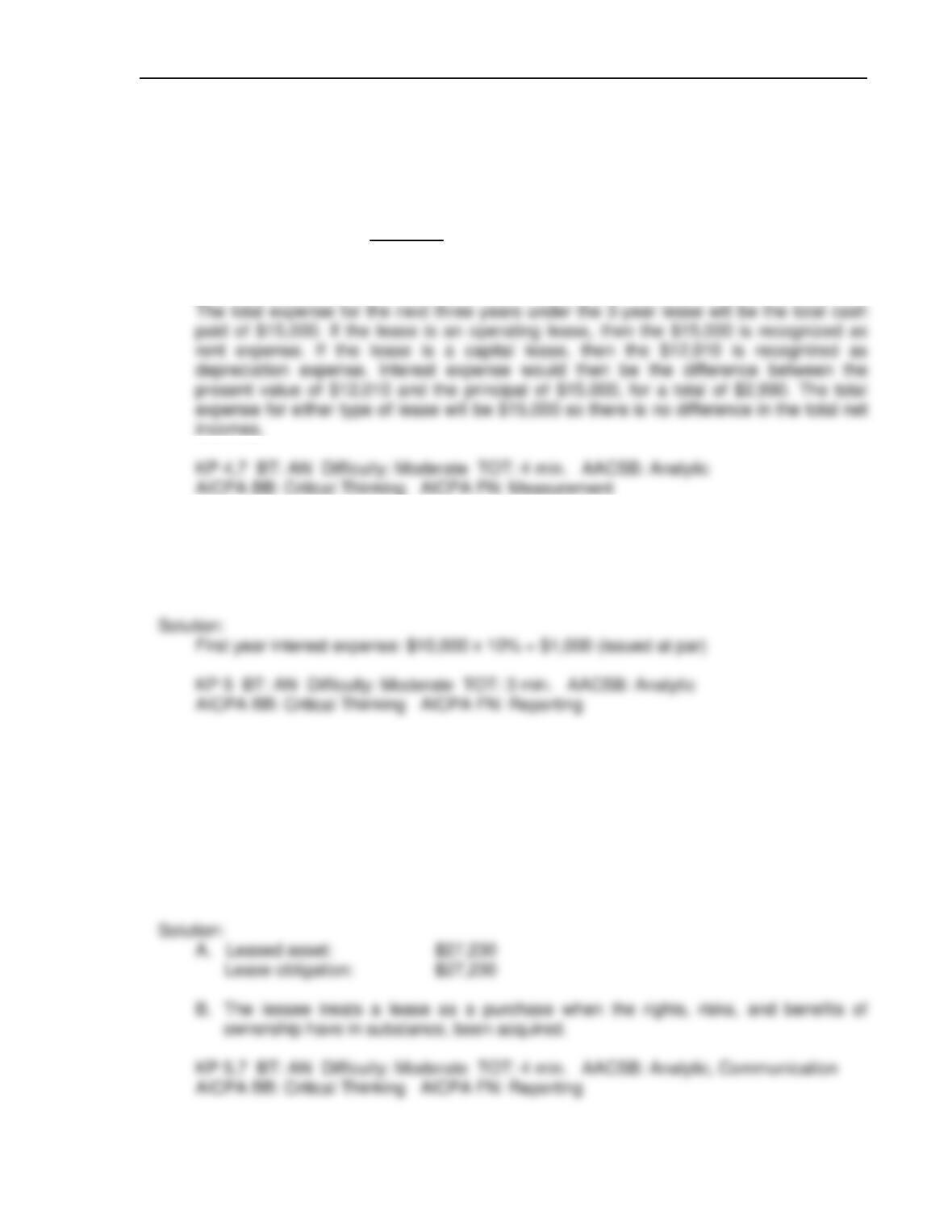
A. At March 31, 2009, how many more shares of stock can be issued?
B. At March 31, 2009, how many shares are issued and outstanding?
Solution:
Test Bank – Chapter 9 – Accounting for Financing Activities 9-15
3. On January 1, 2009, Parker Company leased equipment under a 3-year lease with
payments of $5,000 on each December 31 of the lease term. The present value of the
lease payments at a discount rate of 12% is $12,010. If the lease is considered a capital
lease, depreciation expense (straight-line) and interest expense are recognized. If the
lease is considered an operating lease, then rent expense is recognized. What is the
difference in the total combined net incomes of 2009, 2010, and 2011, if the lease is
considered a capital lease instead of an operating lease?
Solution:
4. On January 1, 2009, Alcon Corporation issued a 5-year, 10%, $10,000 bond payable.
Beginning in 2010, interest is payable every January 1 over the life of the bond. The
market rate of interest on the issue date is 10%. Calculate the interest expense for 2009
using the effective interest method.
5. On January 1, 2009, Mega Company leased equipment under a 5-year lease with
payments of $7,000 on each December 31 of the lease term. The present value of the
lease payments at a discount rate of 9% is $27,230. The lease is considered a capital
lease.
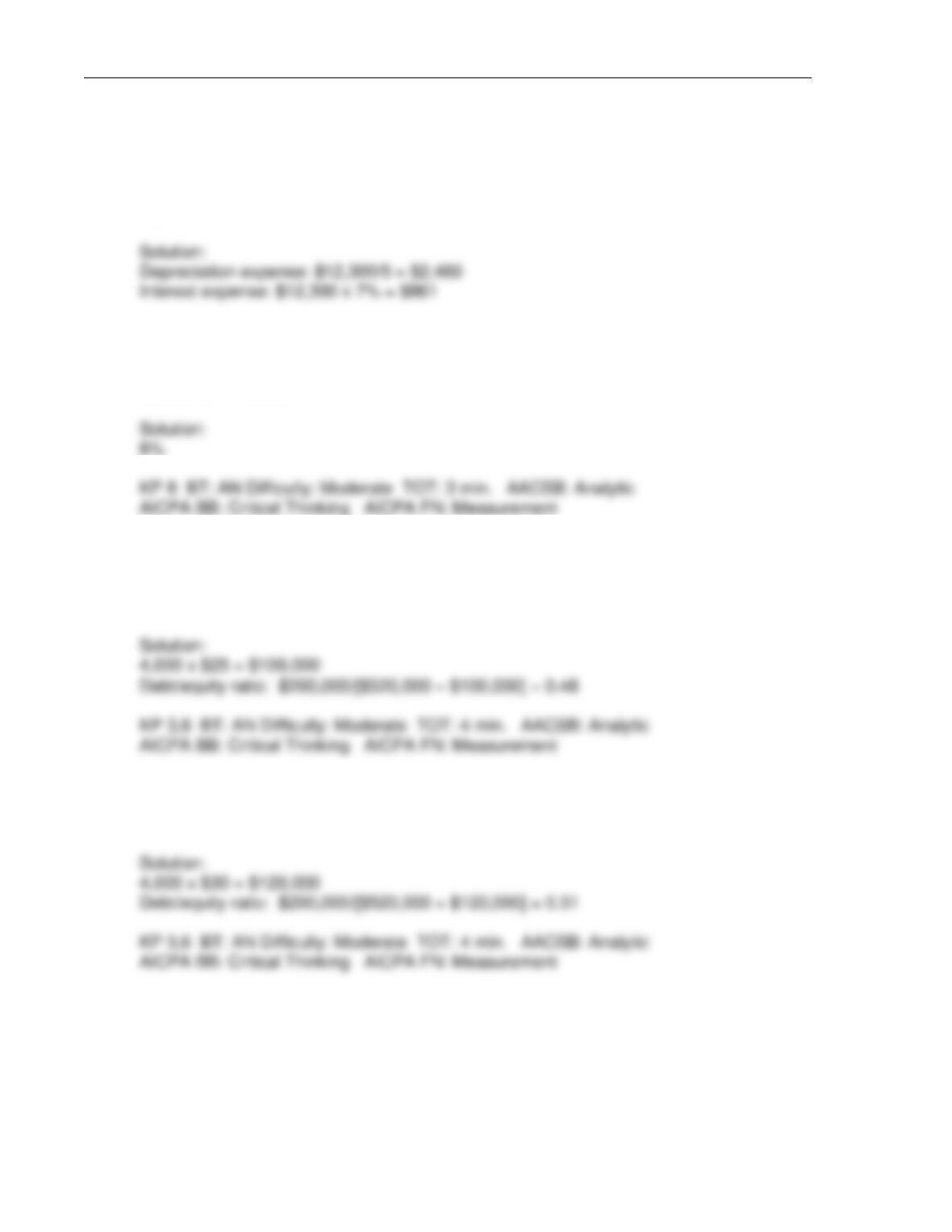
A. Determine the amount of the leased asset and lease obligation on January 1, 2009.
B. Why are some leases accounted for as purchases by the lessee?
9-16 Test Bank – Chapter 9 – Accounting for Financing Activities
6. On January 1, 2009, Seaside Company leased equipment under a 5-year lease with
payments of $3,000 on each December 31 of the lease term. The present value of the
lease payments at a discount rate of 7% is $12,300. The lease is considered a capital
lease. Calculate depreciation expense (straight-line with no salvage) and interest
expense for 2009.
7. If an investor owns 8% of a corporation prior to a 2-for-1 stock split, what percentage
does the investor own after receiving 2 shares of $5 par value stock for each $10 par
value share of stock?
8. Immediately before Satin Corporation purchased 4,000 shares of its own common stock
for $25 a share, it had total liabilities of $200,000 and total shareholders’ equity of
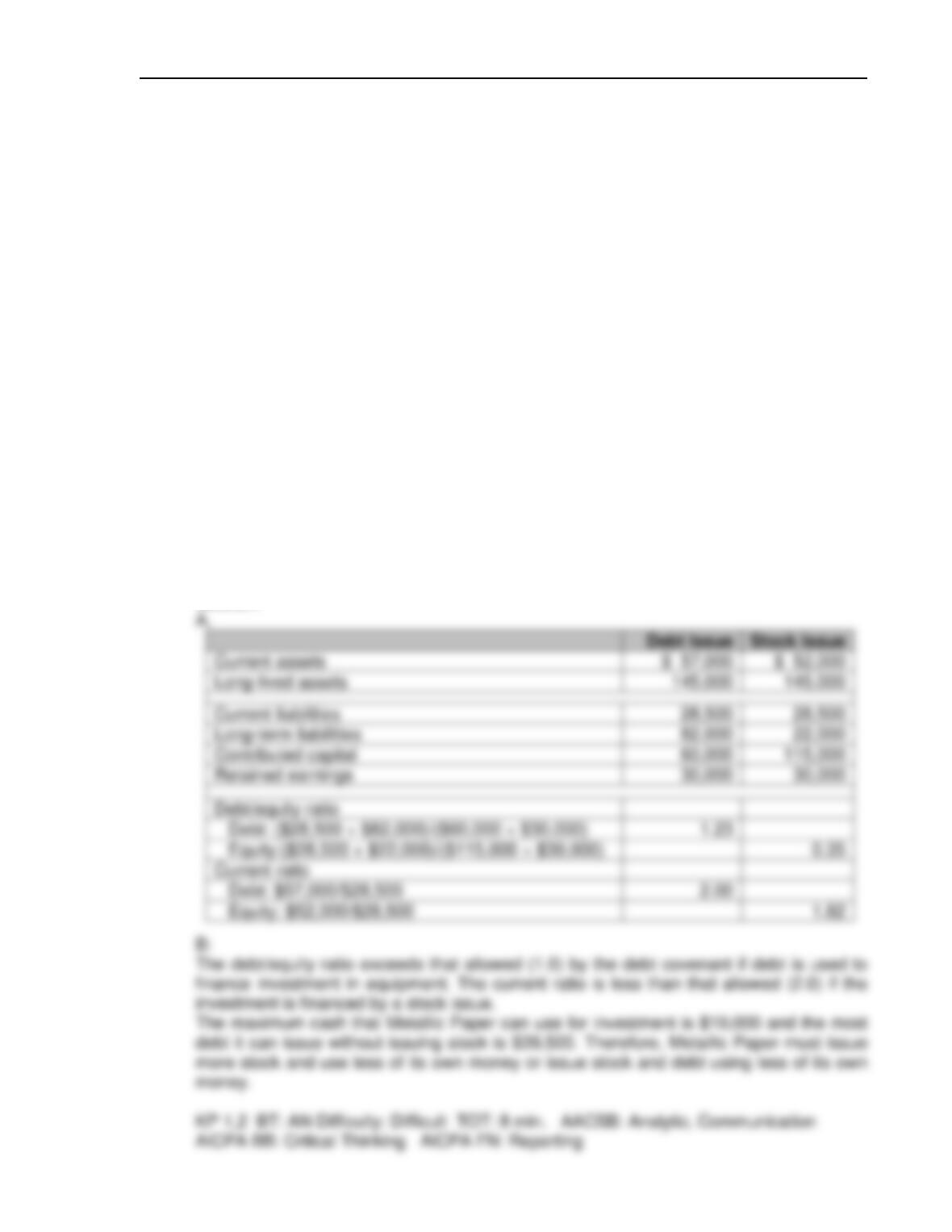
$520,000. Calculate Satin’s debt/equity ratio immediately subsequent to the purchase of
the treasury stock.
9. Immediately before Farris Corporation sold 4,000 shares of its own common stock for
$30 a share, it had total liabilities of $200,000 and total shareholders’ equity of $520,000.
Determine Farris’ debt/equity ratio immediately subsequent to the stock issue.
Test Bank – Chapter 9 – Accounting for Financing Activities 9-17
10. Metallic Paper Corporation has the following balance sheet accounts immediately
preceding an investing and financing decision:
Current assets
$67,000
Long-lived assets
75,000
Current liabilities
28,500
Long-term liabilities
22,000
Contributed capital
60,000
Retained earnings
30,000
A long-term debt covenant specifies that Metallic Paper’s debt/equity ratio cannot be
greater than 1.0 and its current ratio must be at least 2.0.
Metallic Paper is going to invest $70,000 in new equipment. It is considering two
methods of financing the investment. It can use $10,000 of its own money and obtain
$60,000 from the issue of long-term debt. Alternatively, Metallic Paper can use $15,000
of its own money and obtain the remaining financing from the issue of stock.
A. Recalculate the balance sheet amounts given above for each of the two financing
alternatives immediately after financing is achieved and the investment is
undertaken.
B. Use numerical calculations to determine if the debt covenants are respected under
each of the two financing alternatives. If the covenants are broken for each
alternative, suggest financing options that Metallic Paper might use to finance the
$70,000 investment in equipment.
Solution:
9-18 Test Bank – Chapter 9 – Accounting for Financing Activities
SHORT ESSAY QUESTIONS
1. What concerns might management have with additional debt on its balance sheet?
2. For what reasons might a company purchase treasury stock?
Solution:
3. Identify the two components of shareholders’ equity. How do they differ?
Test Bank – Chapter 9 – Accounting for Financing Activities 9-19
4. Explain par value.
Solution:
5. Which characteristics make equity financing more advantageous than debt financing?
6. Why is debt financing considered less expensive than equity financing?
7. How do the book value and market value of stock compare?