Introduction to General, Organic & Biological Chemistry, 12e (Timberlake)
Chapter 9 Solutions
9.1 Multiple-Choice Questions
1) The O-H bond in water is polar because ________.
A) it is an ionic bond
B) oxygen is much more electronegative than hydrogen
C) oxygen occupies more space than hydrogen
D) hydrogen is much more electronegative than oxygen
E) it is a hydrogen bond
2) A hydrogen bond is ________.
A) an attractive force between molecules where partially positive hydrogen atoms are attracted to
partially negative atoms of F,O, or N
B) a covalent bond between H and O
C) an ionic bond between H and another atom
D) a bond that is stronger than a covalent bond
E) the polar O–H bond in water
3) In a solution, the solvent ________.
A) is a liquid.
B) can be a liquid or gas.
C) can be a solid, liquid, or gas.
D) is never a solid.
E) is the substance present in the smallest concentration.
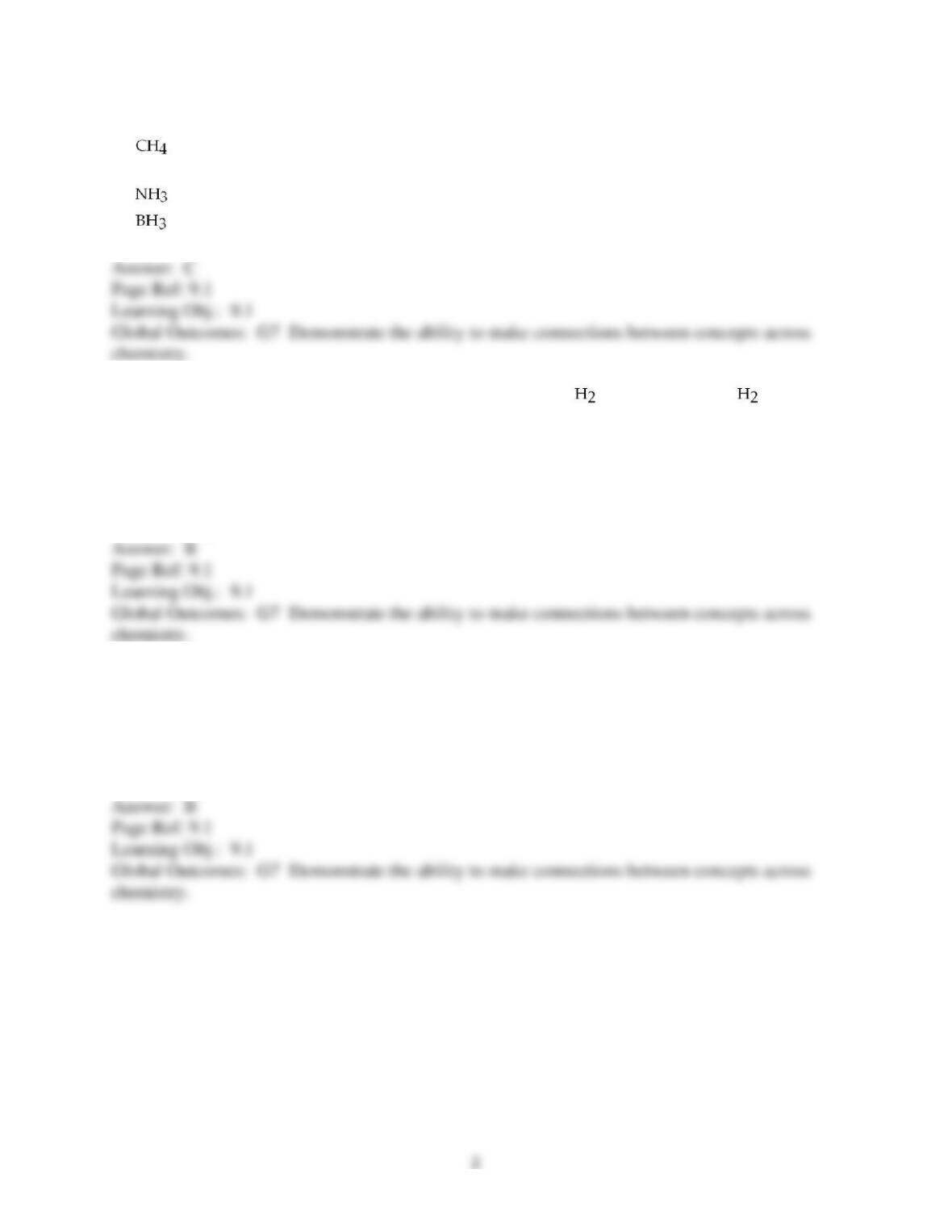
4) Which of the following molecules can form hydrogen bonds?
A)
B) NaH
C)
D)
E) HI
5) A mixture is prepared by dissolving 2 g of KCl in 100 g of O. In this mixture, O is the
________.
A) solute
B) solvent
C) solution
D) solid
E) ionic compound
6) Oil does not dissolve in water because ________.
A) oil is polar
B) oil is nonpolar
C) water is nonpolar
D) water is saturated
E) oil is hydrated
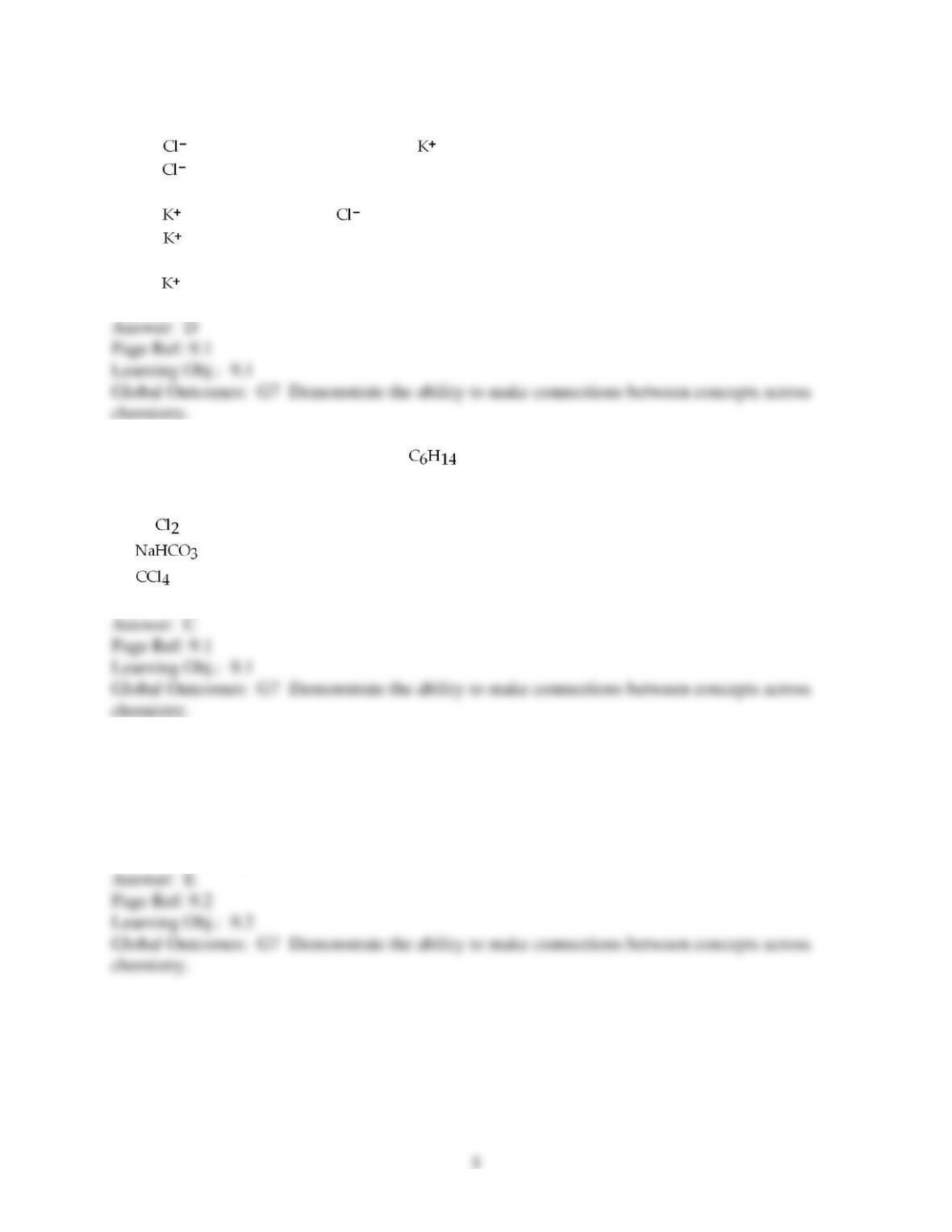
7) When KCl dissolves in water ________.
A) the ions are attracted to dissolved ions
B) the ions are attracted to the partial negative charge on the oxygen atom of the water
molecule
C) the ions are attracted to ions on the KCl crystal
D) the ions are attracted to the partial negative charge on the oxygen atom of the water
molecule
E) the ions are attracted to the partial positive charge on the hydrogen atoms of the water
molecule
8) Water is a polar solvent and hexane ( ) is a nonpolar solvent. Which of the following
correctly describes the solubility of the solute in the given solvent?
A) mineral oil, soluble in water
B) Ca , soluble in hexane
C) , soluble in water
D) , soluble in water
E) octane, soluble in water
9) In water, a substance that ionizes completely in solution is called a ________.
A) weak electrolyte
B) nonelectrolyte
C) semiconductor
D) nonconductor
E) strong electrolyte
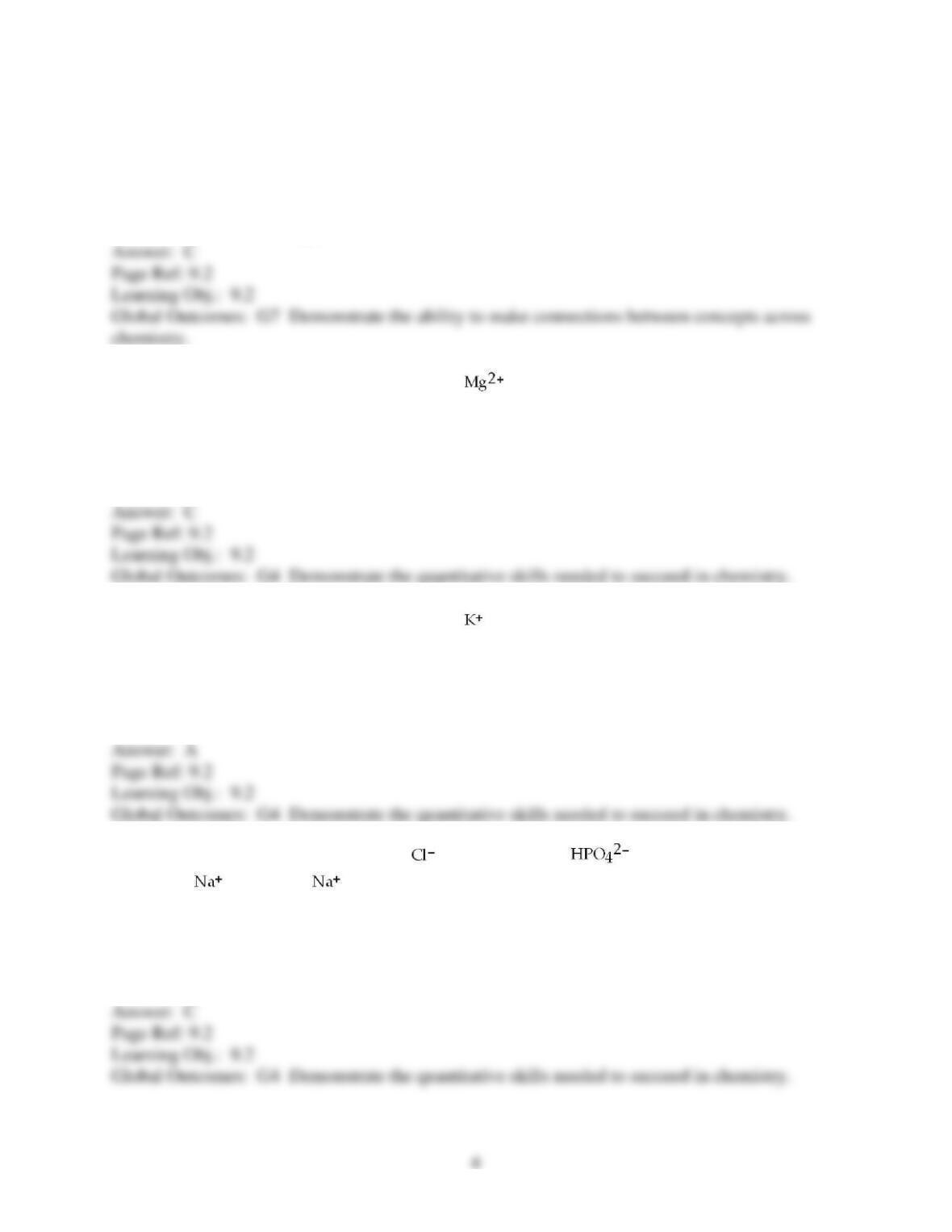
10) An equivalent is ________.
A) the amount of ion that has a 1+ charge
B) the amount of ion that has a 1- charge
C) the amount of ion that carries 1 mole of electrical charge
D) 1 mole of any ion
E) 1 mole of an ionic compound
11) How many equivalents are in 0.60 mole of ?
A) 0.60 Eq
B) 0.30 Eq
C) 1.2 Eq
D) 2.0 Eq
E) 1.0 Eq
12) How many equivalents are in 0.40 mole of ?
A) 0.40 Eq
B) 0.80 Eq
C) 0.20 Eq
D) 2.0 Eq
E) 1.0 Eq
13) A solution contains 43 mEq/L of of and 11 mEq/L of . If the only cation in the
solution is ,what is the concentration in mEq/L?
A) 43 mEq/L
B) 11 mEq/L
C) 54 mEq/L
D) 32 mEq/L
E) 2.0 mEq/L
14) When some of the sugar added to iced tea remains undissolved at the bottom of the glass, the
solution is ________.
A) dilute
B) polar
C) nonpolar
D) saturated
E) unsaturated
15) The solubility of KI is 50 g in 100 g of O at 20 °C. If 110 grams of KI are added to 200
grams of O, ________.
A) all of the KI will dissolve
B) the solution will freeze
C) the solution will start boiling
D) a saturated solution will form
E) the solution will be unsaturated
16) The compound KOH is ________.
A) soluble, because all compounds containing are soluble
B) insoluble, because all compounds containing are in soluble
C) soluble, because all compounds containing are soluble
D) insoluble, because all compounds containing are insoluble
E) insoluble, because KOH is insoluble
17) An increase in the temperature of a solution usually ________.
A) increases the boiling point
B) increases the solubility of a gas in the solution
C) increases the solubility of a solid solute in the solution
D) decreases the solubility of a solid solute in the solution
E) decreases the solubility of a liquid solute in the solution
18) According to Henry’s law, the solubility of a gas in a liquid ________.
A) decreases as the gas pressure above the liquid increases
B) increases as the gas pressure above the liquid increases
C) remains the same as the temperature increases
D) depends on the liquid polarity
E) depends on the liquid density
19) The mass percent concentration refers to ________.
A) grams of solute in 1 kg of solvent
B) grams of solute in 1 kg of solution
C) grams of solute in 100 g of solvent
D) grams of solute in 100 g of solution
E) grams of solvent in 100 g of solution
20) What is the concentration, in mass percent (m/m), of a solution prepared from 50.0 g NaCl
and 150.0 g of water?
A) 0.250% (m/m)
B) 33.3% (m/m)
C) 40.0% (m/m)
D) 25.0% (m/m)
E) 3.00% (m/m)
7
21) Rubbing alcohol is 70.% (m/v) isopropyl alcohol by volume. How many mL of isopropyl
alcohol are in a 1 pint (473 mL) container?
A) 70. mL
B) 0.15 mL
C) 680 mL
D) 470 mL
E) 330 mL
22) What is the concentration, mass/volume percent (m/v), of a solution prepared from 50. g
NaCl and 2.5 L of water?
A) 5.0% (m/v)
B) 2.0% (m/v)
C) 0.020% (m/v)
D) 0.050% (m/v)
E) 20.% (m/v)
23) How many grams of glucose are needed to prepare 400. mL of a 2.0%(m/v) glucose
solution?
A) 800. g
B) 0.0050 g
C) 8.0 g
D) 2.0 g
E) 200. g
24) What volume (mL) of a 15% (m/v) NaOH solution contains 120 g NaOH?
A) 18 mL
B) 0.13 mL
C) 13 mL
D) 120 mL
E) 8.0 × mL
25) How many milliliters of a 25% (m/v) NaOH solution would contain 75 g of NaOH?
A) 25 mL
B) 75 mL
C) 33 mL
D) 19 mL
E) 3.0 × mL
26) What is the molarity of a solution that contains 17 g of in 0.50 L of solution?
A) 34 M
B) 2.0 M
C) 0.50 M
D) 0.029 M
E) 1.0 M
27) The molarity (M) of a solution refers to ________.
A) moles of solute/L of solution
B) moles of solute/ L of solvent
C) moles of solute/100 mL of solution
D) grams of solute/100 mL of solution
E) grams of solute/L of solution
28) What is the molarity of a solution containing 5.0 moles of KCl in 2.0 L of solution?
A) 2.5 M
B) 1.0 M
C) 5.0 M
D) 10. M
E) 2.0 M
29) What is the molarity of a solution which contains 58.5 g of sodium chloride dissolved in
0.500 L of solution?
A) 0.500 M
B) 1.00 M
C) 1.50 M
D) 2.00 M
E) 4.00 M
30) How many moles of are in 250 mL of a 3.0 M of solution?
A) 750 moles
B) 1.3 moles
C) 83 moles
D) 0.75 mole
E) 3.0 moles
31) What volume of a 1.5 M KOH solution is needed to provide 3.0 moles of KOH?
A) 3.0 L
B) 0.50 L
C) 2.0 L
D) 4.5 L
E) 0.22 L
32) What mass of KCl is in 350 mL of 0.24 M KCl?
A) 0.84 g
B) 1.1.g
C) 84 g
D) 18 g
E) 6.3 g
10
33) During the process of diluting a solution to a lower concentration, ________.
A) the amount of solute does not change
B) the amount of solvent does not change
C) there is more solute in the concentrated solution
D) the volume of the solution does not change
E) water is removed from the concentrated solution
34) What is the molarity of a KCl solution made by diluting 75.0 mL of a 0.200 M solution to a
final volume of 100. mL?
A) 0.267 M
B) 0.150 M
C) 0.200 M
D) 6.67 M
E) 0.100 M
35) What volume of 2.5% (m/v) KOH can be prepared from 125 mL of a 5.0% (m/v) KOH
solution?
A) 0.0040 mL
B) 63 mL
C) 0.10 mL
D) 125 mL
E) 250 mL
36) What volume of 0.10 M NaOH can be prepared from 250. mL of 0.30 M NaOH?
A) 0.075 L
B) 0.25 L
C) 0.75 L
D) 0.083 L
E) 750 L
37) What volume of a 2.00 M KCl solution is required to prepare 500. mL of a 0.100 M KCl
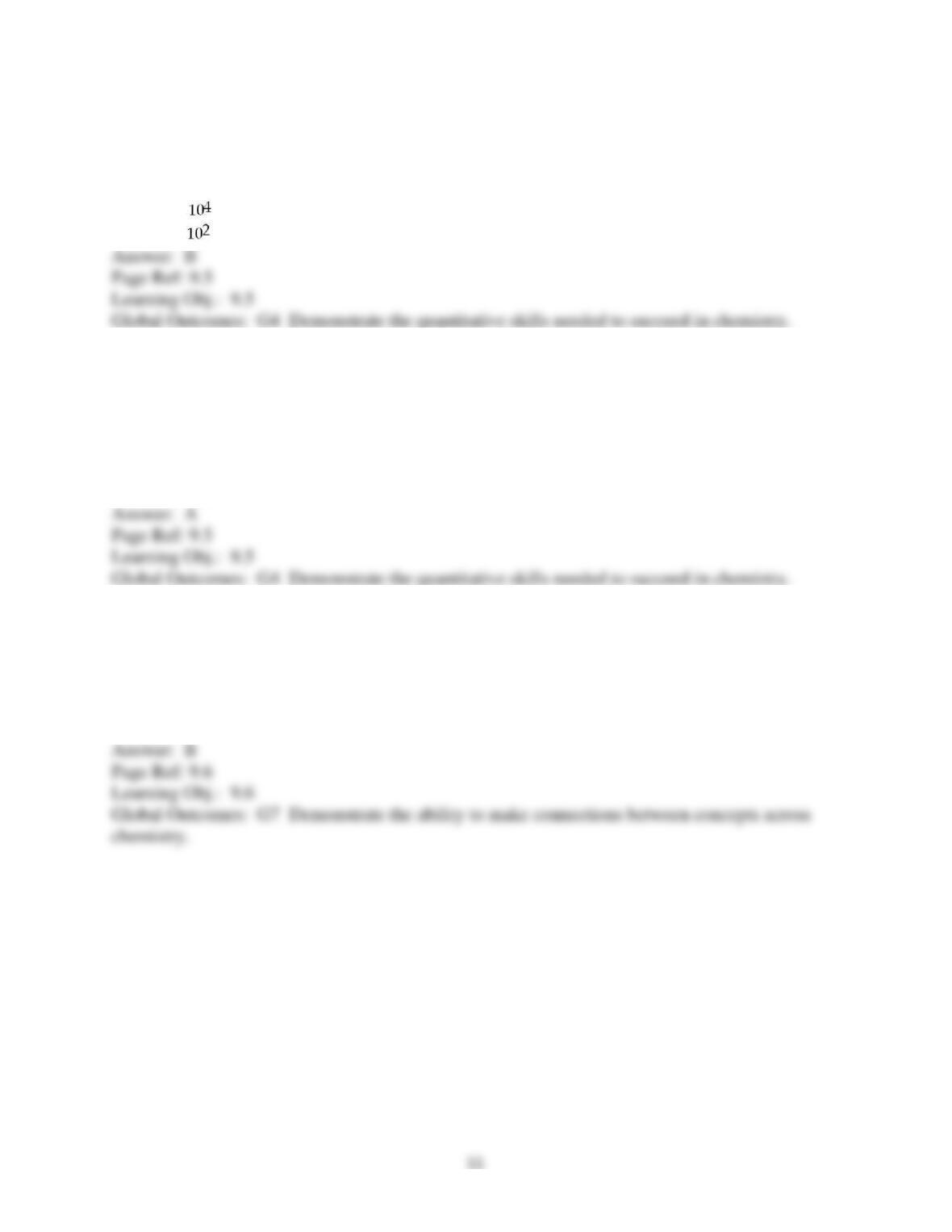
solution?
A) 0.0400 mL
B) 25.0 mL
C) 2.00 mL
D) 1.00 × mL
E) 5.00 × mL
38) What is the new mass/volume percent (m/v) of a KOH solution that is prepared by diluting
110 mL of a 6.0% (m/v) KOH solution to 330 mL?
A) 2.0% (m/v)
B) 1.0% (m/v)
C) 6.0% (m/v)
D) 12% (m/v)
E) 18% (m/v)
39) A homogeneous mixture that does not settle out upon standing is ________.
A) an element
B) a colloid
C) a suspension
D) solid
E) hydrated
40) In the process known as osmosis, ________ moves through a semipermeable membrane into
an area of ________ concentration.
A) solute, lower solute
B) solute, higher solute
C) solvent, lower solute
D) solvent, lower solvent
E) solvent, higher solvent
For the following question(s), consider a 4% starch solution and a 10% starch solution
separated by a semipermeable membrane.
41) Which starch solution will decrease in volume as osmosis occurs?
A) 4%
B) 10%
C) Neither exerts osmotic pressure.
D) They exert equal osmotic pressures.
E) They exert opposite osmotic pressures.
42) The process that occurs in this system is ________.
A) filtration
B) hydration
C) neutralization
D) dialysis
E) osmosis
43) Which of the following also occurs in this system?
A) Water flows equally in both directions.
B) There is a net flow of water from the 4% starch solution into the 10% starch solution.
C) There is a net flow of water from the 10% starch solution into the 4% starch solution.
D) Water does not cross the membrane at all.
E) Starch moves out of the 10% starch solution into the 4% starch solution.
44) A solution with the same osmotic pressure as the blood is ________.
A) isotonic to the blood
B) hypotonic to the blood
C) hypertonic to the blood
D) nontonic to the blood
E) molar to the blood
45) A 10% starch solution is separated from a 2% starch solution by a semipermeable membrane.
Starch is a colloid. Which of the following is correct?
A) The 10% solution has the higher osmotic pressure.
B) The 2% solution has the higher osmotic pressure.
C) Neither solution has osmotic pressure.
D) The solutions have the same osmotic pressure.
E) The solutions have opposite osmotic pressures.
46) A solution that has an osmotic pressure less than that of red blood cells is called ________.
A) saturated
B) hypertonic
C) isotonic
D) hypotonic
E) unsaturated
47) A red blood cell will undergo crenation in ________.
A) water
B) 0.5% NaCl
C) 3% glucose
D) 5% glucose
E) 7% NaCl
48) Which solution is isotonic to a red blood cell?
A) water
B) 0.5% NaCl
C) 2% glucose
D) 0.9% NaCl
E) 10% glucose
49) A red blood cell will undergo hemolysis in ________.
A) water
B) 0.9% NaCl
C) 5% glucose
D) 5% NaCl
E) 10% glucose
50) The process by which a semipermeable membrane allows water molecules, small molecules,
and ions to pass through while retaining large particles is called ________.
A) osmotic pressure
B) dialysis
C) solvation
D) dilution
E) hydration
51) An aqueous mixture containing starch (a colloid), NaCl, glucose, and albumin (a colloid) is
placed in a dialysis bag and immersed in distilled water. Which of the following correctly
describes the location of the indicated substance after dialysis?
A) albumin inside
B) starch outside
C) albumin inside and outside
D) water inside only
E) starch inside and outside
9.2 Bimodal Questions
1) Acetic acid can be classified as a ________.
A) gas
B) solid
C) weak electrolyte
D) strong electrolyte
E) ionic compound
2) The molarity of a solution of 5.0 g of KCl in 100. mL of solution is ________.
A) 0.038 M
B) 0.067 M
C) 0.67 M
D) 0.13 M
E) 1.3 M
3) Using a kidney machine to remove waste products from the blood is known as ________.
A) osmosis
B) osmolysis
C) autolysis
D) hemolysis
E) hemodialysis
4) A ________ will pass through a filter but not a semipermeable membrane.
A) solid
B) precipitate
C) solution
D) suspension
E) colloid
9.3 Short Answer Questions
1) Polar solutes are soluble in ________ solvents.
2) A substance that carries an electric current when dissolved in water is called a(n) ________.
3) A substance that produces only a small number of ions in solution is known as a ________
electrolyte.
4) A substance that completely ionizes in water is a ________ electrolyte.
18
5) How many equivalents are in 0.036 mole of Ca2+?
6) When KCl is added to water, the salt will be ________.
7) When MgO is added to water, the salt will be ________.
8) When NH4Cl is added to water, the salt will be ________.
9) A 2.0% (m/v) NaCl solution contains ________ g NaCl in 300. mL of solution.
10) 200. mL of a 12.0% (m/v) NaCl solution is diluted to 600. mL. The new concentration is
________ %.
11) A solution which has 12 g of solute dissolved in 200.mL of solution has a m/v concentration
of ________.
12) The number of moles of a compound dissolved in one liter of a solution is called the
________.
13) When 50. mL of 10.% (m/v) NaCl is diluted to 500. mL, the NaCl concentration is _____%.
14) If 450. mL of 6.0 M KBr solution is diluted to 900. mL, the concentration of the KBr
solution is _____M.
15) Which has a higher osmotic pressure 1.0 M sucrose or water?
16) ________ can pass through filters but cannot pass through semipermeable membranes.
17) If a red blood cell is placed in 5% NaCl solution, the red blood cell will________.
20
18) If a red blood cell is placed in 1% glucose solution, the red blood cell will________.
9.4 Matching Questions
Identify the term defined in each description.
A) hydration
B) unsaturated
C) saturated
D) hypertonic
E) hypotonic
F) hydrogen bonding
1) the major attractive forces between water molecules
Page Ref: 9.1
Learning Obj.: 9.1
Global Outcomes: G7 Demonstrate the ability to make connections between concepts across
chemistry.
2) the association of several water molecules with ions produced in a solution
Page Ref: 9.1
Learning Obj.: 9.1
Global Outcomes: G7 Demonstrate the ability to make connections between concepts across
chemistry.
3) a solution that contains the highest amount of solute that dissolves at a given temperature
Page Ref: 9.3
Learning Obj.: 9.3
Global Outcomes: G7 Demonstrate the ability to make connections between concepts across
chemistry.
4) a solution in which more solute can be dissolved
Page Ref: 9.3
Learning Obj.: 9.3
Global Outcomes: G7 Demonstrate the ability to make connections between concepts across
chemistry.
5) a solution that has a higher osmotic pressure than the red blood cells of the body
Page Ref: 9.6
Learning Obj.: 9.6
Global Outcomes: G7 Demonstrate the ability to make connections between concepts across
chemistry.
21
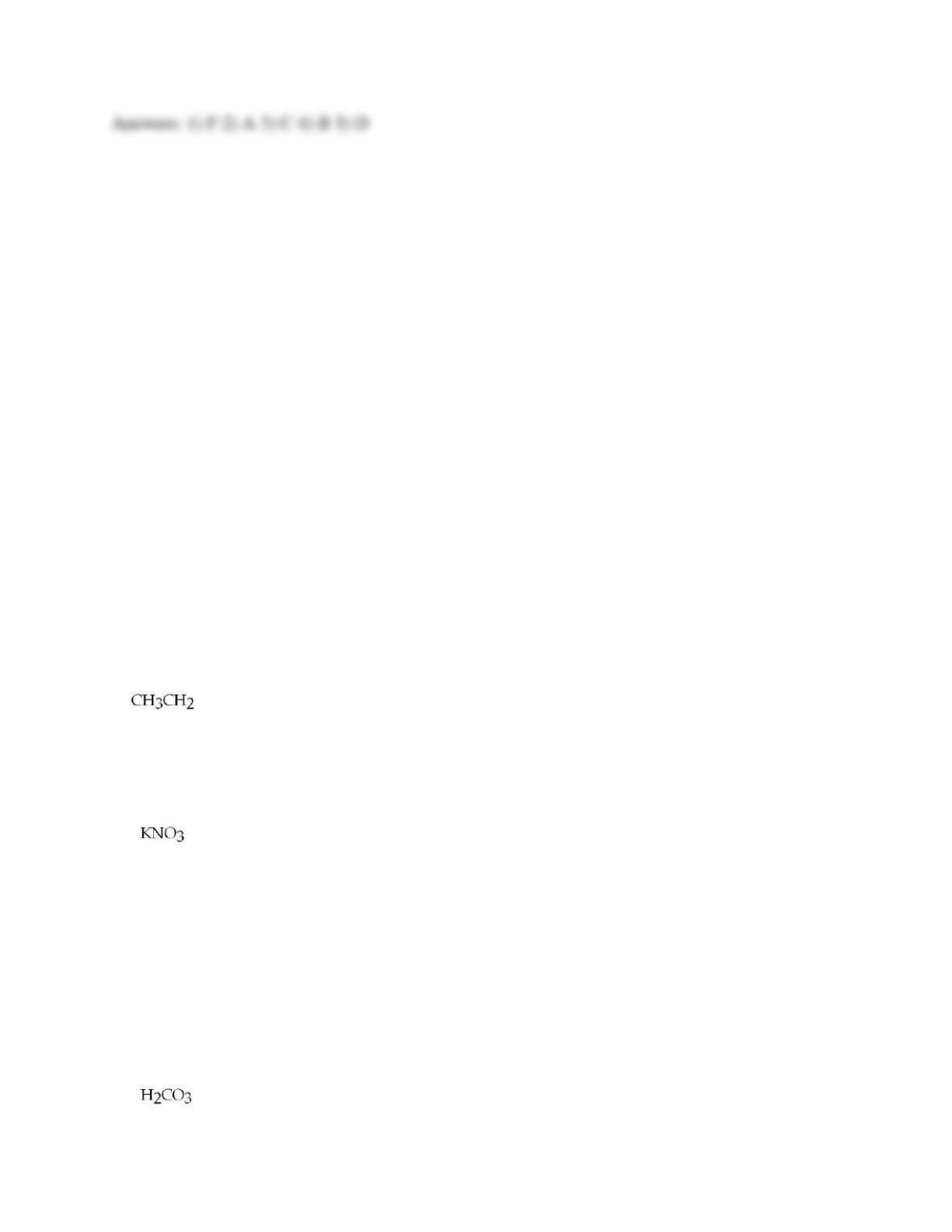
Indicate whether each of the following compounds dissolves in water to give ions, molecules, or
both.
A) molecules
B) both
C) ions
6) NaCl, a strong electrolyte
Page Ref: 9.2
Learning Obj.: 9.2
Global Outcomes: G7 Demonstrate the ability to make connections between concepts across
chemistry.
7) urea, a nonelectrolyte
Page Ref: 9.2
Learning Obj.: 9.2
Global Outcomes: G7 Demonstrate the ability to make connections between concepts across
chemistry.
8) HF, a weak electrolyte
Page Ref: 9.2
Learning Obj.: 9.2
Global Outcomes: G7 Demonstrate the ability to make connections between concepts across
chemistry.
9) OH, a nonelectrolyte
Page Ref: 9.2
Learning Obj.: 9.2
Global Outcomes: G7 Demonstrate the ability to make connections between concepts across
chemistry.
10) , a soluble salt
Page Ref: 9.2
Learning Obj.: 9.2
Global Outcomes: G7 Demonstrate the ability to make connections between concepts across
chemistry.
11) glucose, a nonelectrolyte
Page Ref: 9.2
Learning Obj.: 9.2
Global Outcomes: G7 Demonstrate the ability to make connections between concepts across
chemistry.
12) , a weak electrolyte
Page Ref: 9.2
22
Learning Obj.: 9.2
Global Outcomes: G7 Demonstrate the ability to make connections between concepts across
chemistry.
Match the type of mixture with the appropriate characteristics.
A) solution
B) colloid
C) suspension
13) a mixture of sodium chloride in water
Page Ref: 9.6
Learning Obj.: 9.6
Global Outcomes: G7 Demonstrate the ability to make connections between concepts across
chemistry.
14) a mixture whose particles settle on standing
Page Ref: 9.6
Learning Obj.: 9.6
Global Outcomes: G7 Demonstrate the ability to make connections between concepts across
chemistry.
15) a homogeneous mixture in which suspended particles cannot pass through a semipermeable
membrane
Page Ref: 9.6
Learning Obj.: 9.6
Global Outcomes: G7 Demonstrate the ability to make connections between concepts across
chemistry.
16) a mixture whose particles cannot be separated by filters or semipermeable membranes
Page Ref: 9.6
Learning Obj.: 9.6
Global Outcomes: G7 Demonstrate the ability to make connections between concepts across
chemistry.
17) a mixture whose particles can be separated by filters
Page Ref: 9.6
Learning Obj.: 9.6
Global Outcomes: G7 Demonstrate the ability to make connections between concepts across
chemistry.
Compare the osmotic pressure of these solutions to the osmotic pressure of red blood cells.
A) hypertonic

B) hypotonic
C) isotonic
18) water
Page Ref: 9.6
Learning Obj.: 9.6
Global Outcomes: G7 Demonstrate the ability to make connections between concepts across
chemistry.
19) 0.5% NaCl
Page Ref: 9.6
Learning Obj.: 9.6
Global Outcomes: G7 Demonstrate the ability to make connections between concepts across
chemistry.
20) 0.9% glucose
Page Ref: 9.6
Learning Obj.: 9.6
Global Outcomes: G7 Demonstrate the ability to make connections between concepts across
chemistry.
21) 7% glucose
Page Ref: 9.6
Learning Obj.: 9.6
Global Outcomes: G7 Demonstrate the ability to make connections between concepts across
chemistry.
22) 5% NaCl
Page Ref: 9.6
Learning Obj.: 9.6
Global Outcomes: G7 Demonstrate the ability to make connections between concepts across
chemistry.
23) 5% glucose
Page Ref: 9.6
Learning Obj.: 9.6
Global Outcomes: G7 Demonstrate the ability to make connections between concepts across
chemistry.
24) 0.9% NaCl
Page Ref: 9.6
Learning Obj.: 9.6
Global Outcomes: G7 Demonstrate the ability to make connections between concepts across
chemistry.