196 Chapter 9 Capital Budgeting Techniques
42. In comparing two mutually exclusive projects of equal size and equal life, which of the following
statements is most correct?
a.
The project with the higher NPV may not always be the project with the higher IRR.
b.
The project with the higher NPV may not always be the project with the higher MIRR.
c.
The project with the higher IRR may not always be the project with the higher MIRR.
d.
All of the above answers are correct.
e.
Answers a and c are both correct.
43. Which of the following statements is correct?
a.
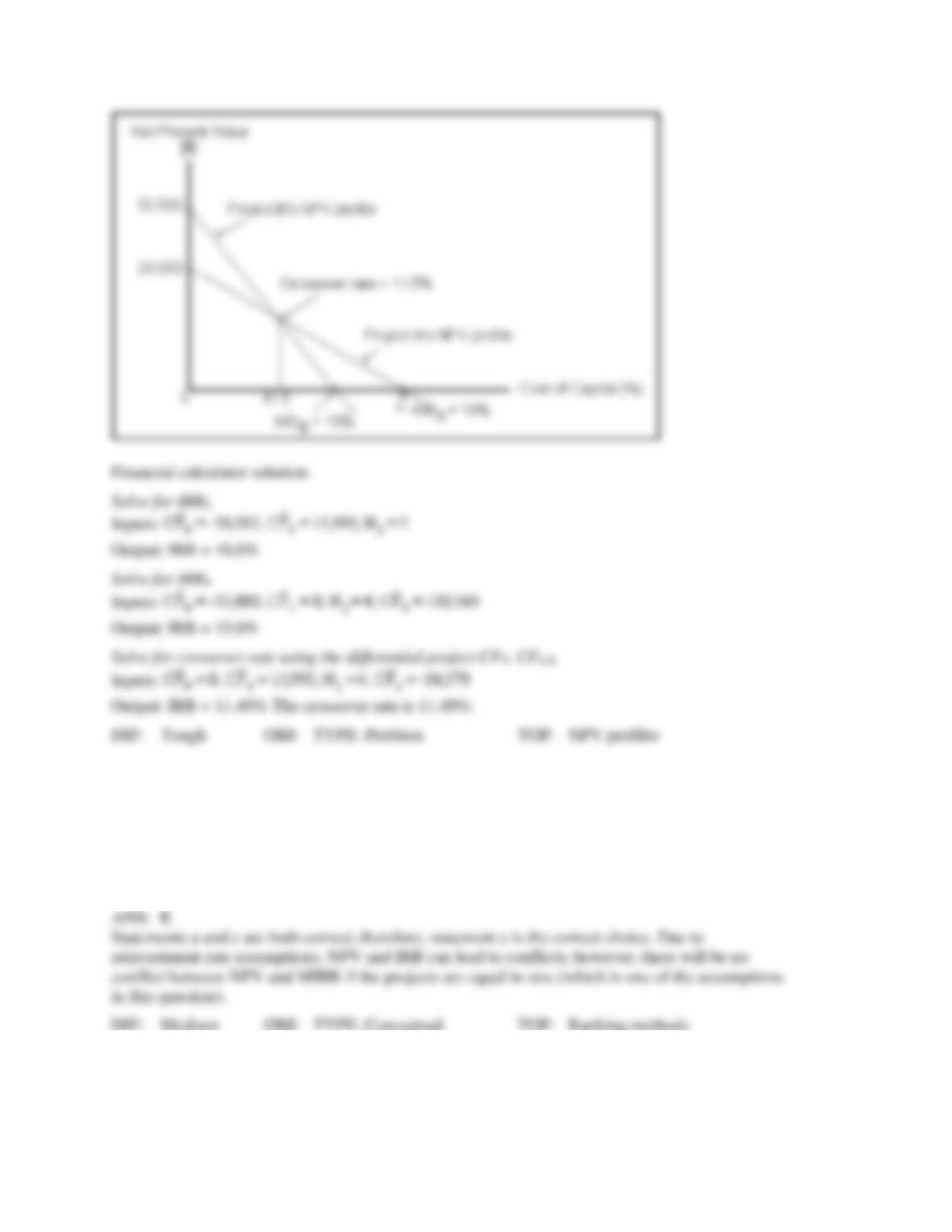
One can find the “cross-over rate,” or the discount rate at which two normal projects have
the same NPV, by finding the IRR of the differences in the projects’ yearly cash flows.
b.
If you calculate a project’s MIRR and find it to be the same as the regular IRR, you can be
sure you made a mistake.

Chapter 9 Capital Budgeting Techniques 197
c.
If a project’s IRR is less than its required rate of return, then the discounted payback
period will be less than the regular payback period.
d.
If a project has a cash outflow at t = 0 followed by a single cash inflow at t = 10, then the
MIRR will be less than the regular IRR.
e.
If a project has a cash outflow at t = 0 followed by a single cash inflow at t = 10, then the
MIRR will be greater than the regular IRR.
44. Which of the following is most correct? The modified IRR (MIRR) method:
a.
Always leads to the same ranking decision as NPV for independent projects.
b.
Overcomes the problem of multiple rates of return.
c.
Compounds cash flows at the required rate of return.
d.
Overcomes the problem of cash flow timing and the problem of project size that leads to
criticism of the regular IRR method.
e.
Answers b and c are both correct.
45. The modified IRR (MIRR) is normally
a.
Less than the regular IRR if IRR > k.
b.
Greater than the regular IRR if IRR > k.
c.
Equal to the regular IRR if IRR = k.
d.
Answers a and c are both correct.
e.
Answers b and c are both correct.
46. Which of the following statements is correct?
a.
When dealing with independent projects, discounted payback (using a payback
requirement of 3 or less years), NPV, IRR, and modified IRR always lead to the same
accept/reject decisions for a given project.
b.
When dealing with mutually exclusive projects, the NPV and modified IRR methods
always rank projects the same, but those rankings can conflict with rankings produced by
the discounted payback and the regular IRR methods.
c.
Multiple rates of return are possible with the regular IRR method but not with the
modified IRR method, and this fact is one reason given by the textbook for favoring
MIRR (or modified IRR) over IRR.
d.
Statements a, b and c are all false.
47. Which of the following statements is correct?
a.
There can never be a conflict between NPV and IRR decisions if the decision is related to
a normal, independent project, i.e., NPV will never indicate acceptance if IRR indicates
rejection.
b.
To find the MIRR, we first compound CFs at the regular IRR to find the TV, and then we
discount the TV at the required rate of return to find the PV.
c.
The NPV and IRR methods both assume that cash flows are reinvested at the required rate
of return. However, the MIRR method assumes reinvestment at the MIRR itself.

198 Chapter 9 Capital Budgeting Techniques
d.
If you are choosing between two projects which have the same cost, and if their NPV
profiles cross, then the project with the higher IRR probably has more of its cash flows
coming in the later years.
e.
A change in the required rate of return would normally change both a project’s NPV and
its IRR.
48. Which of the following statements is correct?
a.
The modified internal rate of return (MIRR) of a project increases as the discount rate
increases.
b.
The internal rate of return (IRR) of a project increases as the required rate of return
increases.
c.
Both IRR and MIRR can produce the multiple rates of return.
d.
When comparing two projects, the project with the higher IRR will also have the higher
MIRR.
e.
Both a and c are correct.
49. Alyeska Salmon Inc., a large salmon canning firm operating out of Valdez, Alaska, has a new
automated production line project it is considering. The project has a cost of $275,000 and is
expected to provide after-tax annual cash flows of $73,306 for eight years. The firm’s
management is uncomfortable with the IRR reinvestment assumption and prefers the modified
IRR approach. You have calculated a required rate of return for the firm of 12 percent. What is
the project’s MIRR?
a.
15.0%

Chapter 9 Capital Budgeting Techniques 199
b.
14.0%
c.
12.0%
d.
16.0%
e.
17.0%
50. Below are the returns of Nulook Cosmetics and the “market” over a three-year period:
Year
Nulook
Market
1
8%
6%
2
9%
9%
3
32%
22%
Nulook finances internally using only retained earnings, and it uses the Capital Asset Pricing
Model with a historical beta to determine its required rate of return. Currently, the risk-free rate is
7 percent, and the estimated market risk premium is 6 percent. Nulook is evaluating a project
which has a cost today of $2,028 and will provide estimated cash inflows of $1,000 at the end of
the next 3 years. What is this project’s MIRR?
a.
12.4%
b.
16.0%
c.
17.5%
d.
20.0%
e.
22.9%

200 Chapter 9 Capital Budgeting Techniques
Chapter 9 Capital Budgeting Techniques 201
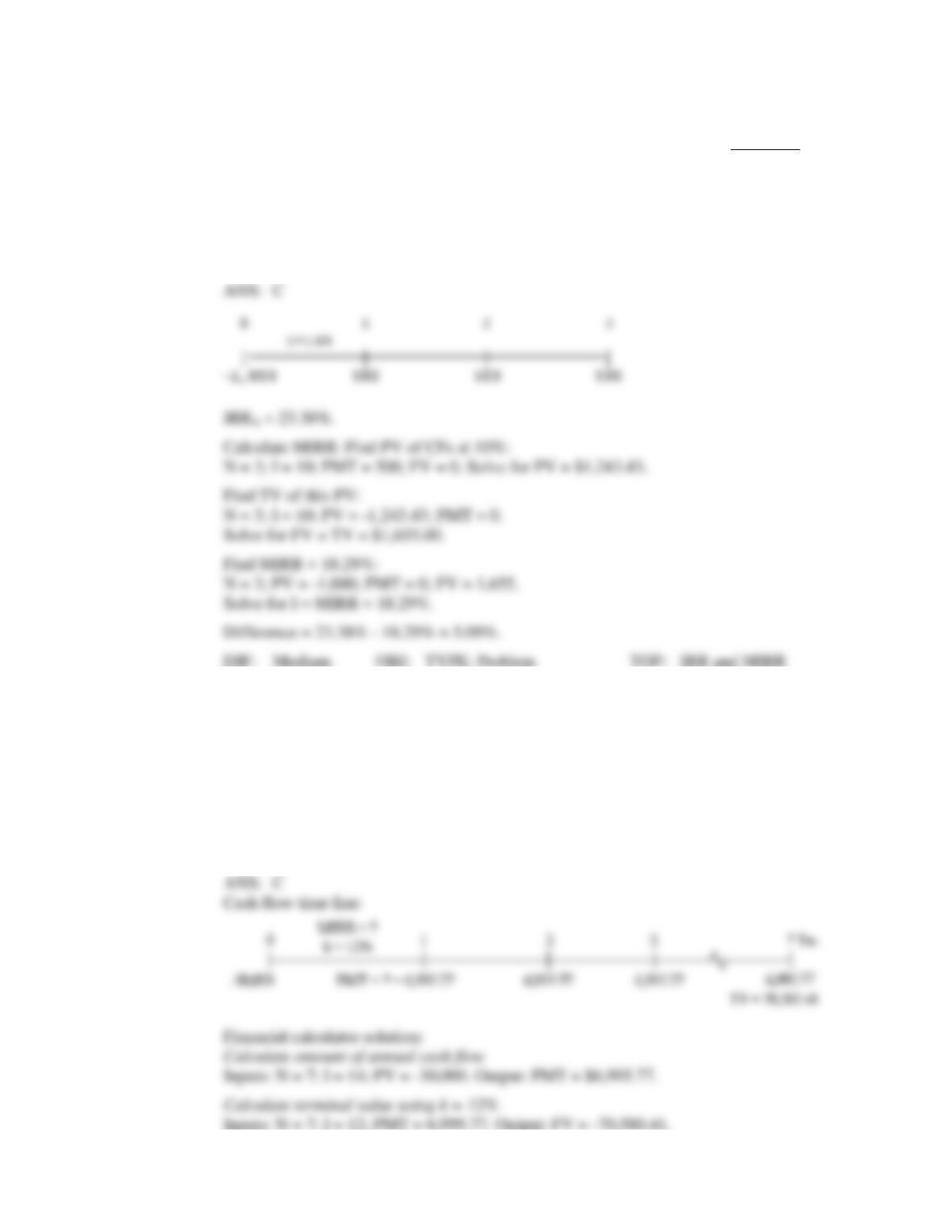
51. Project A has a cost of $1,000, and it will produce end-of-year net cash inflows of $500 per year
for 3 years. The project’s required rate of return is 10 percent. What is the difference between the
project’s IRR and its MIRR?
a.
3.88%
b.
4.31%
c.
5.09%
d.
5.75%
e.
6.21%
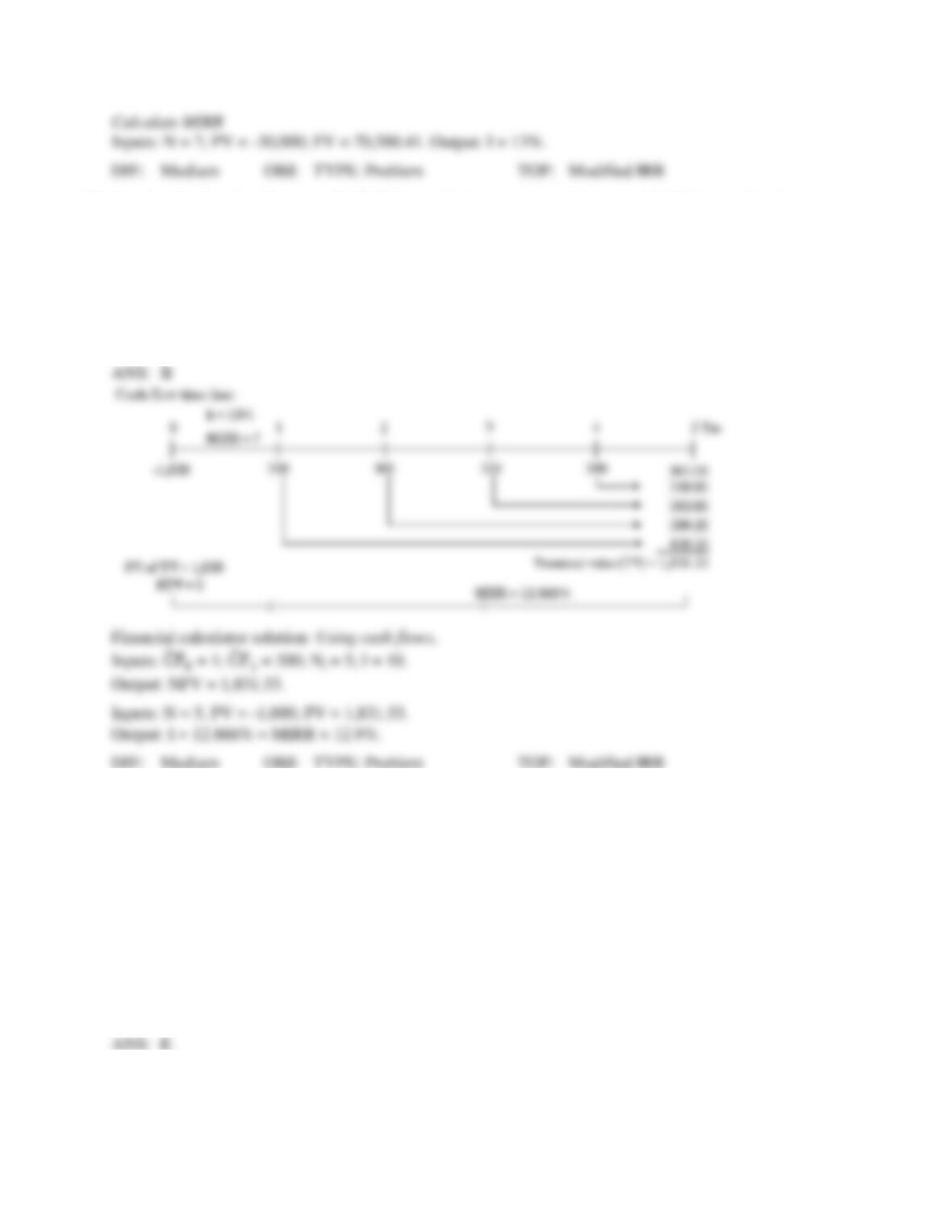
52. Project X has a cost of $30,000 at t = 0, and it is expected to produce a uniform cash flow stream
for 7 years, i.e., the CF’s are the same in Years 1 through 7, and it has a regular IRR of 14
percent. The required rate of return for the project is 12 percent. What is the project’s modified
IRR (MIRR)?
a.
11.87%
b.
12.42%
c.
13.00%
d.
13.36%
e.
13.59%
202 Chapter 9 Capital Budgeting Techniques
53. Los Angeles Lumber Company (LALC) is considering a project with a cost of $1,000 at t = 0 and
inflows of $300 at the end of Years 1-5. LALC‘s cost of capital is 10 percent. What is the project’s
modified IRR (MIRR)?
a.
10.0%
b.
12.9%
c.
15.2%
d.
18.3%
e.
20.7%
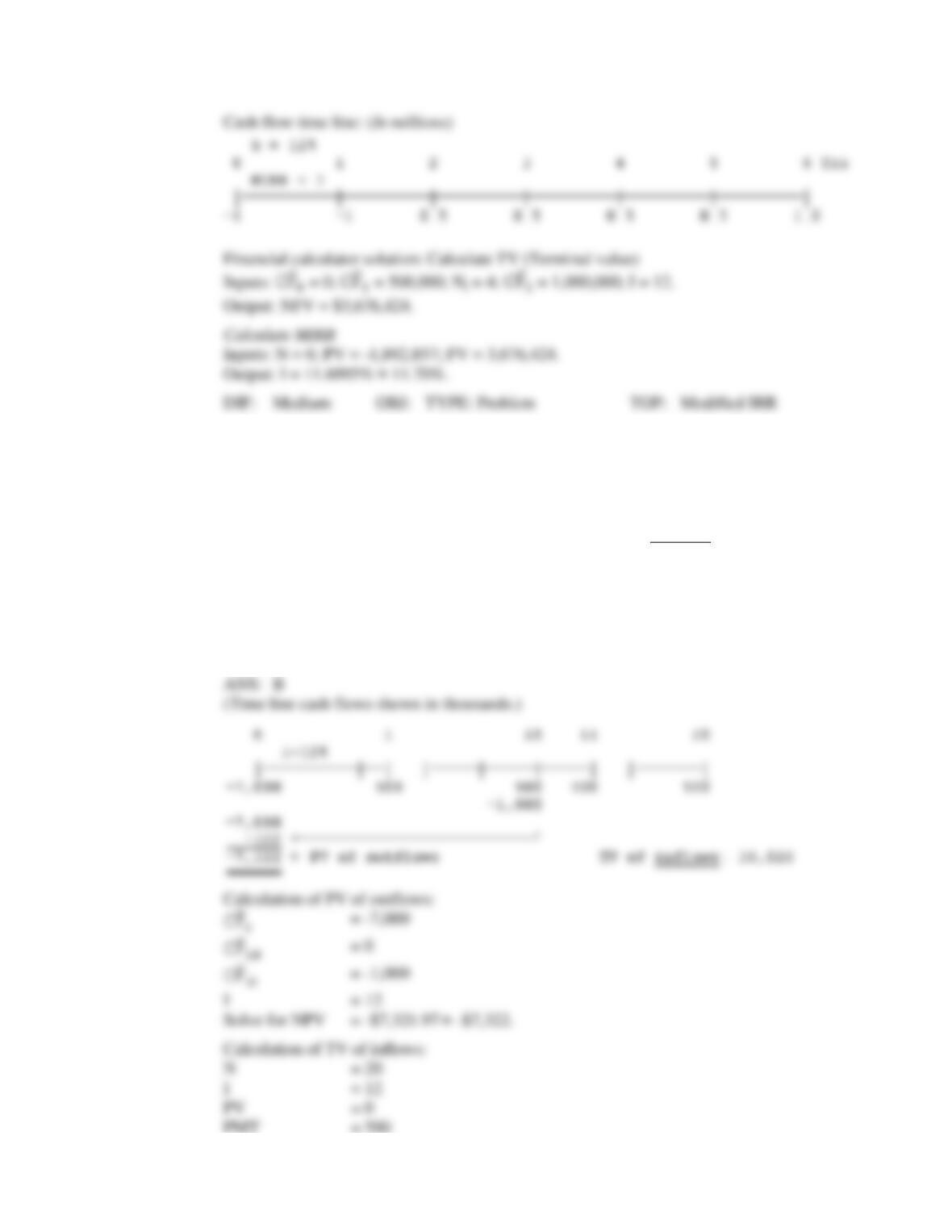
54. Capitol City Transfer Company is considering building a new terminal in Salt Lake City. If the
company goes ahead with the project, it must spend $1 million immediately (at t = 0) and another
$1 million at the end of Year 1 (t = 1). It will then receive net cash flows of $0.5 million at the
end of Years 2-5, and it expects to sell the property and net $1 million at the end of Year 6. All
cash inflows and outflows are after taxes. The company’s required rate of return is 12 percent, and
it uses the modified IRR criterion for capital budgeting decisions. What is the project’s modified
IRR (MIRR)?
a.
11.9%
b.
12.0%
c.
11.4%
d.
11.5%
e.
11.7%
Chapter 9 Capital Budgeting Techniques 203
55. Houston Inc. is considering a project which involves building a new refrigerated warehouse
which will cost $7,000,000 at t = 0 and which is expected to have operating cash flows of
$500,000 at the end of each of the next 20 years. However, repairs which will cost $1,000,000
must be incurred at the end of the 10th year. Thus, at the end of Year 10 there will be a $500,000
operating cash inflow and an outflow of $1,000,000 for repairs. If Houston’s required rate of
return is 12 percent, what is the project’s MIRR? (Hint: Think carefully about the MIRR equation
and the treatment of cash outflows.)
a.
7.75%
b.
8.29%
c.
9.81%
d.
11.45%
e.
12.33%
204 Chapter 9 Capital Budgeting Techniques
56. Your company is considering two mutually exclusive projects, X and Y, whose costs and cash
flows are shown below:
Year
X
Y
0
-$2,000
-$2,000
1
200
2,000
2
600
200
3
800
100
4
1,400
75
The projects are equally risky, and the firm’s required rate of return is 12 percent. You must make
a recommendation, and you must base it on the modified IRR. What is the MIRR of the better
project?
a.
12.00%
b.
11.46%
c.
13.59%
d.
12.89%
e.
15.73%

Chapter 9 Capital Budgeting Techniques 205
57. International Transport Company is considering building a new facility in Seattle. If the company
goes ahead with the project, it will spend $2 million immediately (at t = 0) and another $2 million
at the end of Year 1(t = 1). It will then receive net cash flows of $1 million at the end of Years 2–
5, and it expects to sell the property for $2 million at the end of Year 6. The company’s required
rate of return is 12 percent, and it uses the modified IRR criterion for capital budgeting decisions.
Which of the following statements is most correct?
a.
The project should be rejected because the modified IRR is less than the regular IRR.
b.
The project should be accepted because the modified IRR is greater than the required rate
of return.
c.
The regular IRR is less than the required rate of return. Under this condition, the modified
IRR will also be less than the regular IRR.
d.
If the regular IRR is less than the required rate of return, then the modified IRR will be
greater than the regular IRR.
e.
Given the data in the problem, the NPV is negative. This demonstrates that the modified
IRR criterion is not always a valid decision method for projects such as this one.

206 Chapter 9 Capital Budgeting Techniques
58. Mooradian Corporation estimates that its required rate of return is 11 percent. The company is
considering two mutually exclusive projects whose after-tax cash flows are as follows:
Year
Project S
Project L
0
-$3,000
-$9,000
1
2,500
-1,000
2
1,500
5,000
3
1,500
5,000
4
-500
5,000
What is the modified internal rate of return (MIRR) of the project with the highest NPV?
a.
11.89%
b.
13.66%
c.
16.01%
d.
18.25%
e.
20.12%
Chapter 9 Capital Budgeting Techniques 207
59. O’Donnell Inc. has a required rate of return of 11.5 percent. The company has a project with the
following cash flows:
Year
Cash flow
0
-$200
1
235
2
-65
3
300
What is the project’s modified internal rate of return (MIRR)?
a.
28.15%
b.
32.90%
c.
36.27%
d.
39.87%
e.
40.15%
Solve for NPV = –$252.28.
Solve for NPV = $427.18.

208 Chapter 9 Capital Budgeting Techniques
Financial Calculator Section
The following question(s) may require the use of a financial calculator.
60. An investment project has an initial cost, and then generates inflows of $50 a year for the next
five years. The project has a payback period of 3.6 years. What is the project’s internal rate of
return?
a.
11.18%
b.
12.05%
c.
13.47%
d.
14.66%
e.
15.89%
61. Your company is choosing between following non-repeatable, equally risky, mutually exclusive
projects with the cash flows shown below. Your required rate of return is 10 percent. How much
value will your firm sacrifice if it selects the project with the higher IRR?
a.
$243.43
b.
$291.70
c.
$332.50
d.
$481.15
e.
$535.13

Chapter 9 Capital Budgeting Techniques 209
62. Given the following net cash flows, determine the IRR of the project:
Time
Net cash flow
0
$1,520
1
-1,000
2
-1,500
3
500
a.
36%
b.
32%
c.
28%
d.
24%
e.
20%
63. A company is analyzing two mutually exclusive projects, S and L, whose cash flows are shown
below:
The company’s required rate of return is 12 percent. What is the IRR of the better project? (Hint:
Note that the better project may or may not be the one with the higher IRR.)
a.
13.09%
b.
12.00%
c.
17.46%
d.
13.88%
e.
12.53%

210 Chapter 9 Capital Budgeting Techniques
64. Woodson Inc. has two possible projects, Project A and Project B, with the following cash flows:
Year
Project A
Project B
0
-150,000
-100,000
1
100,000
45,000
2
105,000
65,000
3
40,000
80,000
At what required rate of return do the two projects have the same net present value (NPV)? (In
other words, what is the “crossover rate” of the projects’ NPV profiles?)
a.
10.3%
b.
13.5%
c.
15.8%
d.
21.7%
e.
34.8%
40,000
Chapter 9 Capital Budgeting Techniques 211
65. As the capital budgeting director for Chapel Hill Coffins Company, you are evaluating
construction of a new plant. The plant has a net cost of $5 million in Year 0 (today), and it will
provide net cash inflows of $1 million at the end of Year 1, $1.5 million at the end of Year 2, and
$2 million at the end of Years 3 through5. Within what range is the plant’s IRR?
a.
14-15%
b.
15-16%
c.
16-17%
d.
17-18%
e.
18-19%
66. After getting her degree in marketing and working for 5 years for a large department store, Sally
started her own specialty shop in a regional mall. Sally’s current lease calls for payments of
$1,000 at the end of each month for the next 60 months. Now the landlord offers Sally a new 5–
year lease which calls for zero rent for 6 months, then rental payments of $1,050 at the end of
each month for the next 54 months. Sally’s required rate of return is 11 percent. By what absolute
dollar amount would accepting the new lease change Sally’s theoretical net worth? (Hint: The
required rate of return per month is 11%/12 = 0.9166667%.)
212 Chapter 9 Capital Budgeting Techniques
a.
$2,810.09
b.
$3,243.24
c.
$3,803.06
d.
$4,299.87
e.
$4,681.76