Chapter 9: Standard Costing: A Functional-Based Control Approach
84. If a company produces fewer units than expected, there will be
a. a favorable budget variance.
b. an unfavorable spending variance.
c. a favorable volume variance.
d. an unfavorable volume variance.
85. Total fixed overhead budget variance is always equal to
a. fixed overhead volume variance.
b. fixed overhead volume variance plus fixed overhead spending variance.
c. total variable overhead budget variance plus fixed overhead spending variance.
d. total variable overhead budget variance.
86. Croissant Company‘s standard fixed overhead cost is $6 per direct labor hour based on budgeted fixed costs of
$600,000. The standard allows one direct labor hour per unit. During 2016, Crawford produced 110,000 units of
product, (within the relevant range of activity) incurred $630,000 of fixed overhead costs, and recorded 212,000
actual hours of direct labor.
What is Croissant’s fixed overhead spending variance for 2016? a.
$60,000 (F)
b. $24,000 (F)
c. $30,000 (U)
d. $36,000 (U)
87. Somalian Corporation uses a standard costing system. Information for the month of May is as follows:
Actual manufacturing overhead costs ($26,000 is fixed) $80,000
Direct labor:
Actual hours worked 12,000 hrs.
Standard hours allowed for actual production 10,000 hrs.
Average actual labor cost per hour $18
The factory overhead rate is based on a normal volume of 12,000 direct labor hours. Standard cost data at 12,000
direct labor hours were as follows:
Variable factory overhead
$48,000
Fixed factory overhead
24,000
Total factory overhead
$72,000
What is the variable overhead efficiency variance for Somalian?
a. $2,000 (U)
b. $20,000 (U)
c. $4,000 (U)
d. $8,000 (U)
Chapter 9: Standard Costing: A Functional-Based Control Approach
88. Somalian Corporation uses a standard costing system. Information for the month of May is as follows:
Actual manufacturing overhead costs ($26,000 is fixed) $80,000
Direct labor:
Actual hours worked 12,000 hrs.
Standard hours allowed for actual production 10,000 hrs.
Average actual labor cost per hour $18
The factory overhead rate is based on a normal volume of 12,000 direct labor hours. Standard cost data at 12,000
direct labor hours were as follows:
Variable factory overhead $48,000
Fixed factory overhead 24,000
Total factory overhead $72,000
What is the fixed overhead spending variance for Somalian?
a. $4,000 (U)
b. $8,000 (U)
c. $2,000 (U)
d. $20,000 (U)
89. Croissant Company‘s standard fixed overhead cost is $6 per direct labor hour based on budgeted fixed costs of
$600,000. The standard allows 1 direct labor hour per unit. During 2016, Croissant produced 110,000 units of
product, incurred $630,000 of fixed overhead costs, and recorded 212,000 actual hours of direct labor.
What is the standard activity level on which Croissant based its fixed overhead rate?
a. 100,000 direct labor hours
b. 105,000 direct labor hours
c. 110,000 direct labor hours
d. 50,000 direct labor hours
Chapter 9: Standard Costing: A Functional-Based Control Approach
90. Croissant Company‘s standard fixed overhead cost is $6 per direct labor hour based on budgeted fixed costs of
$600,000. The standard allows 1 direct labor hour per unit. During 2016, Croissant produced 110,000 units of
product, incurred $630,000 of fixed overhead costs, and recorded 212,000 actual hours of direct labor.
What is Croissant’s fixed overhead volume variance for 2016?
a. $60,000 (U)
b. $24,000 (F)
c. $36,000 (U)
d. $60,000 (F)
91. If actual fixed manufacturing overhead was $55,000 and there was a $1,400 unfavorable spending variance and a
$1,000 unfavorable volume variance, budgeted fixed manufacturing overhead must have been
a. $57,400.
b. $53,600.
c. $54,000.
d. $51,700.
92. Fixed manufacturing overhead was budgeted at $200,000, and 25,000 direct labor hours were budgeted. If the fixed
overhead volume variance was $8,000 favorable and the fixed overhead spending variance was $6,000 unfavorable,
fixed manufacturing overhead applied must be
a. $208,000.
b. $206,000.
c. $202,000.
d. $194,000.
93. Fixed manufacturing overhead was budgeted at $105,000, and 25,000 direct labor hours were budgeted. If the fixed
overhead volume variance was $4,000 unfavorable and the fixed overhead spending variance was $1,500 favorable,
fixed manufacturing overhead applied must be
a. $109,000.
b. $106,500.
c. $106,500.
d. $101,000.
Chapter 9: Standard Costing: A Functional-Based Control Approach
94. The formula for the fixed overhead spending variance is:
a. Standard fixed overhead rate × Standard Hours
b. AFOH – BFOH
c. Applied fixed overhead – budgeted fixed overhead
d. (AH – SH) × SVOR
Figure 9-3
Alumni Manufacturing Company has the following information pertaining to a normal monthly activity of 10,000
units:
Standard factory overhead rates are based on a normal monthly volume of one standard direct hour per unit.
Standard factory overhead rates per direct labor hour are:
Fixed
$ 6.00
Variable
10.00
$16.00
Units actually produced in current month
9,000 units
Actual factory overhead costs incurred
(includes $70,000 fixed)
$156,000
Actual direct labor hours
9,000 hours
95. Refer to Figure 9-3. What is the variable overhead spending variance for Alumni?
a. $0
b. $4,000 (F)
c. $86,000 (U)
d. $10,000 (F)
96. Refer to Figure 9-3. What is the fixed overhead spending variance for Alumni?
a. $10,000 (U)
b. $6,000 (U)
c. $4,000 (F)
d. $–0–
Chapter 9: Standard Costing: A Functional-Based Control Approach
97. Refer to Figure 9-3. What is the fixed overhead volume variance for Alumni?
a. $10,000 (F)
b. $–0–
c. $4,000 (F)
d. $6,000 (U)
98. Formidable Company collected the following information:
Standard costs per unit:
Variable overhead 4 machine hours @ $6 per machine hour
Fixed overhead 4 machine hours @ $10 per machine hour
Actual output 20,000 units
Denominator (normal capacity) output 21,000 units
Actual machine hours 79,000 machine hours
Actual variable overhead cost $540,000
Actual fixed overhead cost $810,000
Using the two variance method, what is the budget variance?
a. $70,000 (U)
b. $30,000 (F)
c. $30,000 (U)
d. $70,000 (F)
Chapter 9: Standard Costing: A Functional-Based Control Approach
99. Formidable Company collected the following information:
Standard costs per unit:
Variable overhead 4 machine hours @ $6 per machine hour
Fixed overhead 4 machine hours @ $10 per machine hour
Actual output 20,000 units
Denominator (normal capacity) output 21,000 units
Actual machine hours 79,000 machine hours
Actual variable overhead cost $540,000
Actual fixed overhead cost $810,000
Using the two variance method, what is the total variance?
a. $30,000 (U)
b. $70,000 (U)
c. $70,000 (F)
d. $30,000 (F)
100. Formidable Company collected the following information:
Standard costs per unit:
Variable overhead 4 machine hours @ $6 per machine hour
Fixed overhead 4 machine hours @ $10 per machine hour
Actual output 20,000 units
Denominator (normal capacity) output 21,000 units
Actual machine hours 79,000 machine hours
Actual variable overhead cost $540,000
Actual fixed overhead cost $810,000
Using the two variance method, what is the volume variance?
a. $6,000 (F)
b. $40,000 (F)
c. $40,000 (U)
d. $6,000 (U)
Chapter 9: Standard Costing: A Functional-Based Control Approach
101. Formidable Company collected the following information:
Standard costs per unit:
Variable overhead 4 machine hours @ $6 per machine hour
Fixed overhead 4 machine hours @ $10 per machine hour
Actual output 20,000 units
Denominator (normal capacity) output 21,000 units
Actual machine hours 79,000 machine hours
Actual variable overhead cost $540,000
Actual fixed overhead cost $810,000
Using the three variance method, what is the spending variance?
a. $36,000 (F)
b. $30,000 (U)
c. $36,000 (U)
d. $30,000 (F)
102. Formidable Company collected the following information:
Standard costs per unit:
Variable overhead 4 machine hours @ $6 per machine hour
Fixed overhead 4 machine hours @ $10 per machine hour
Actual output 20,000 units
Denominator (normal capacity) output 21,000 units
Actual machine hours 79,000 machine hours
Actual variable overhead cost $540,000
Actual fixed overhead cost $800,000
Using the three variance method, what is the budget variance?
a. $24,000 (U)
b. $24,000 (F)
c. $6,000 (U)
d. $6,000 (F)
Chapter 9: Standard Costing: A Functional-Based Control Approach
103. A mix variance is
a. created whenever the actual mix of inputs differs from the standard mix.
b. the difference in the standard cost of the actual mix of inputs used and the standard cost of the mix of inputs
that should have been used.
c. both ‘a’ and ‘b’ are correct.
d. none of these are correct.
Figure 9-4
San Francisco Corporation uses two materials in the production of its product. The materials, X and Y, have the
following standards:
Material
Standard Mix
Standard Unit Price
Standard Cost
X
3,500 units
$1.00 per unit
$3,500
Y
Yield
1,500 units
4,000 units
3.00 per unit
$4,500
During April, the following actual production information was provided:
Material Actual Mix
X 30,000 units
Y 20,000 units
Yield 36,000 units
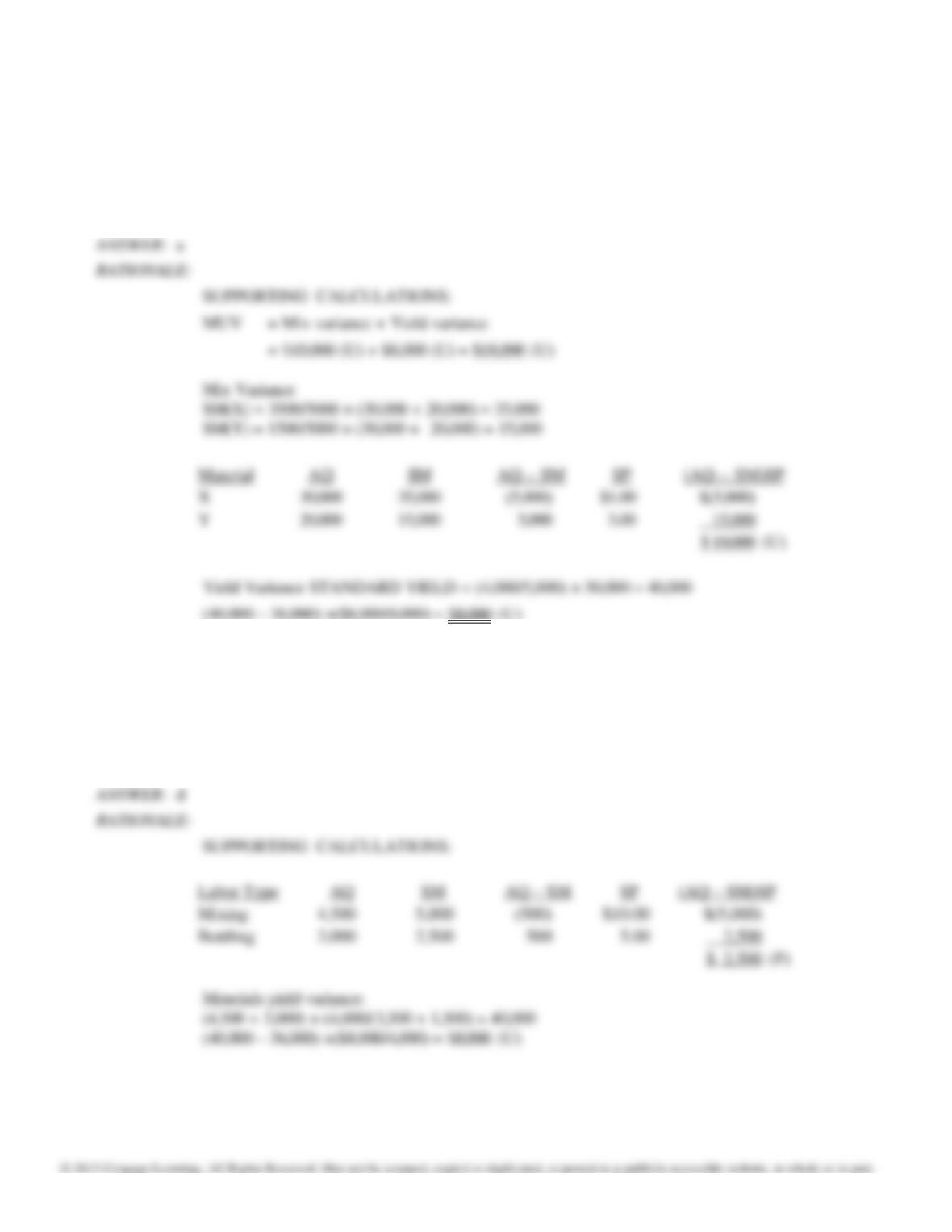
104. Refer to Figure 9-4. What is the materials mix variance?
a. $10,000 (U)
b. $5,000 (F)
c. $10,000 (F)
d. $15,000 (F)
Chapter 9: Standard Costing: A Functional-Based Control Approach
105. Refer to Figure 9-4. What is the materials usage variance?
a. $18,000 (U)
b. $ 8,000 (U)
c. $ 8,000 (F)
d. $10,000 (U)
106. Refer to Figure 9-4. What is the materials yield variance?
a. $4,000 (F)
b. $4,000 (U)
c. $8,000 (F)
d. $8,000 (U)
Chapter 9: Standard Costing: A Functional-Based Control Approach
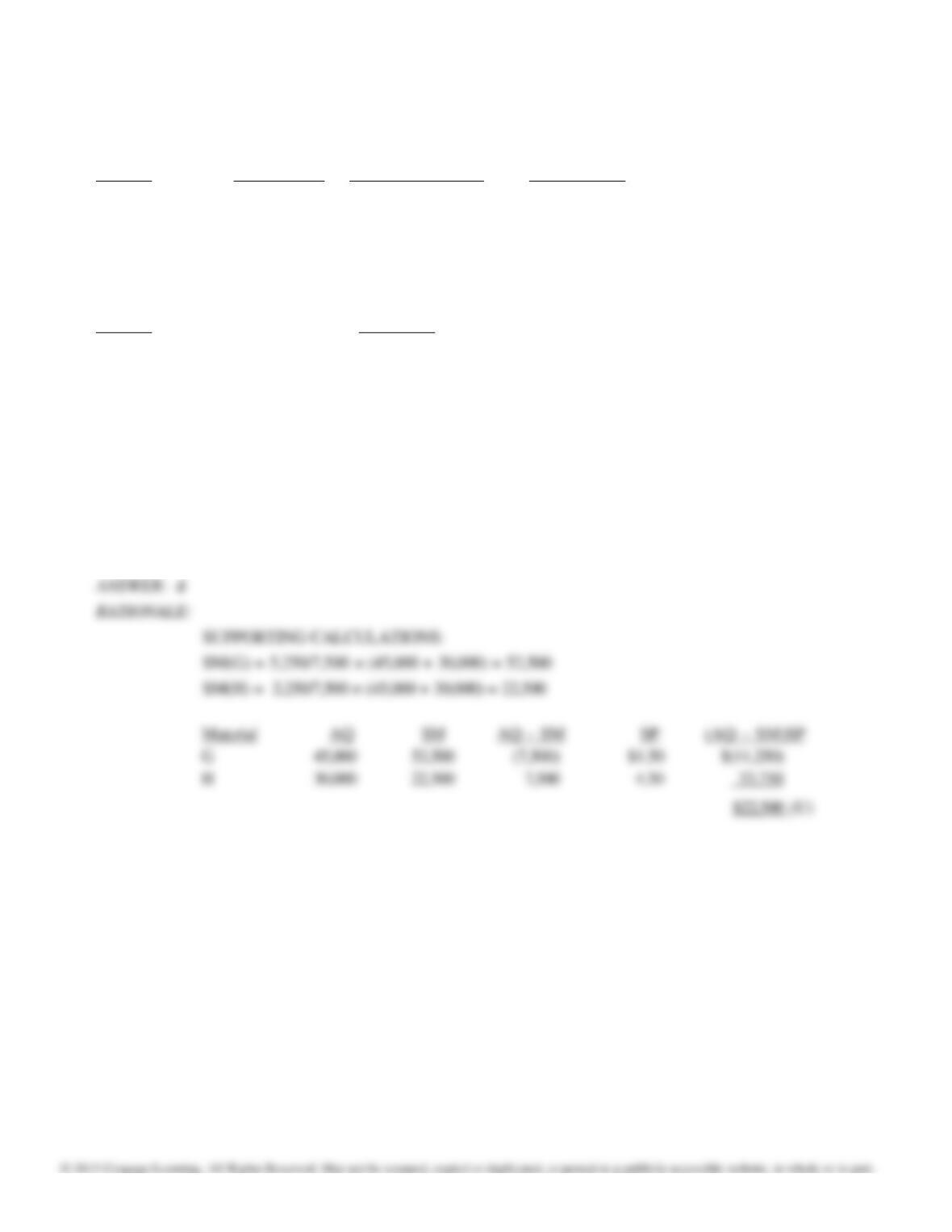
107. The San Jose Corporation uses two materials in the production of its product. The materials, G and H, have the
following standards:
Material
Standard Mix
Standard Unit Price
Standard Cost
G
5,250 units
$1.50 per unit
$7,875
H
Yield
2,250 units
6,000 units
4.50 per unit
$10,125
During June, the following actual production information was provided:
Material Actual Mix
G 45,000 units
H 30,000 units
Yield 54,000 units
What is the materials mix variance?
a. $18,000 (F)
b. $18,000 (U)
c. $22,500 (F)
d. $22,500 (U)
Chapter 9: Standard Costing: A Functional-Based Control Approach
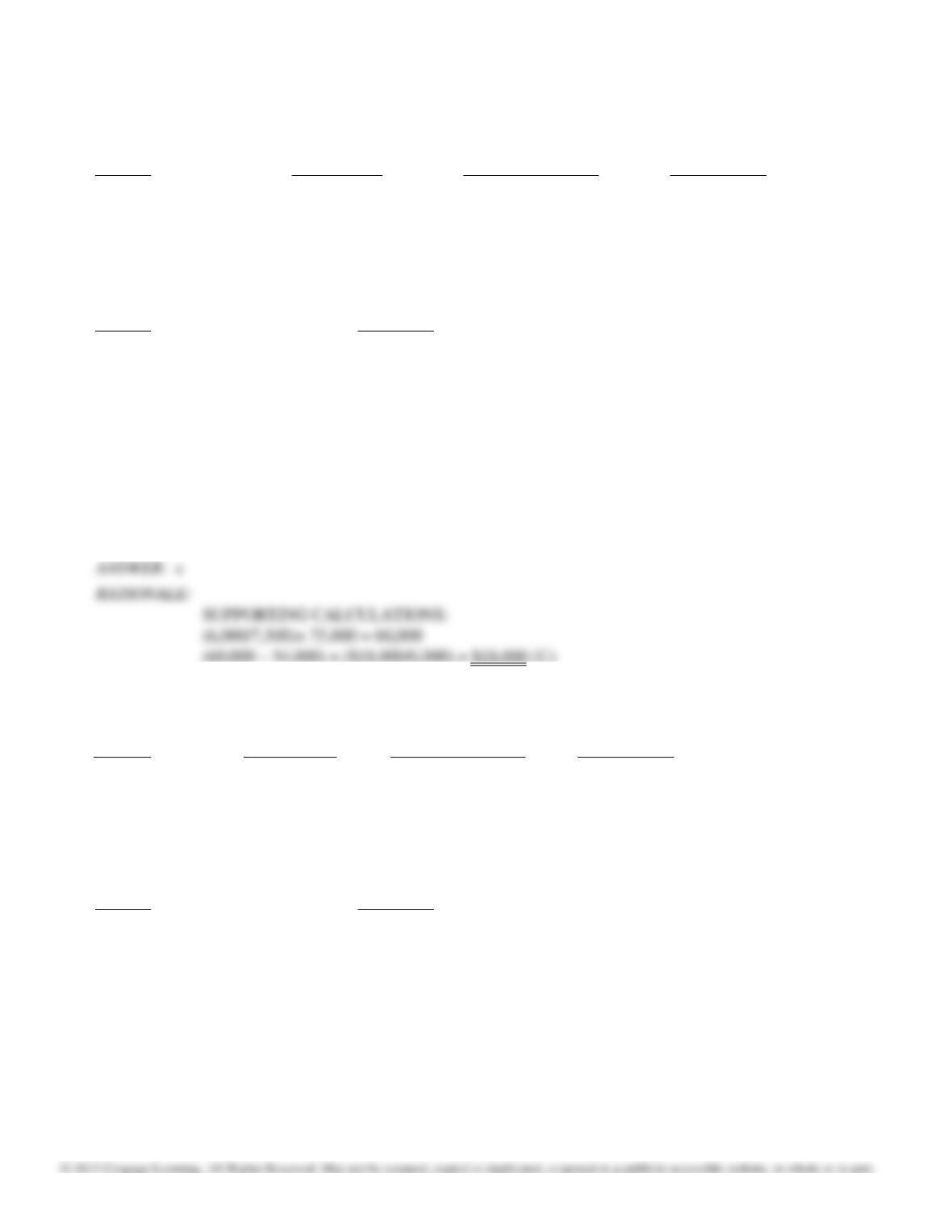
108. The San Jose Corporation uses two materials in the production of its product. The materials, G and H, have the
following standards:
Material
Standard Mix
Standard Unit Price
Standard Cost
G
5,250 units
$1.50 per unit
$ 7,875
H
Yield
2,250 units
6,000 units
4.50 per unit
$10,125
During June, the following actual production information was provided:
Material Actual Mix
G 45,000 units
H 30,000 units
Yield 54,000 units
What is the materials yield variance?
a. $6,000 (F)
b. $6,000 (U)
c. $18,000 (U)
d. $18,000 (F)
109. Artigas Enterprises uses two materials in the production of its product. The materials, L and M, have the following
standards:
Material
Standard Mix
Standard Unit Price
Standard Cost
L
1,750 units
$0.50 per unit
$ 875
M
750 units
1.50 per unit
$1,125
Yield
2,000 units
During January, the following actual production information was provided:
Material Actual Mix
L 15,000 units
M 10,000 units
Yield 18,000 units
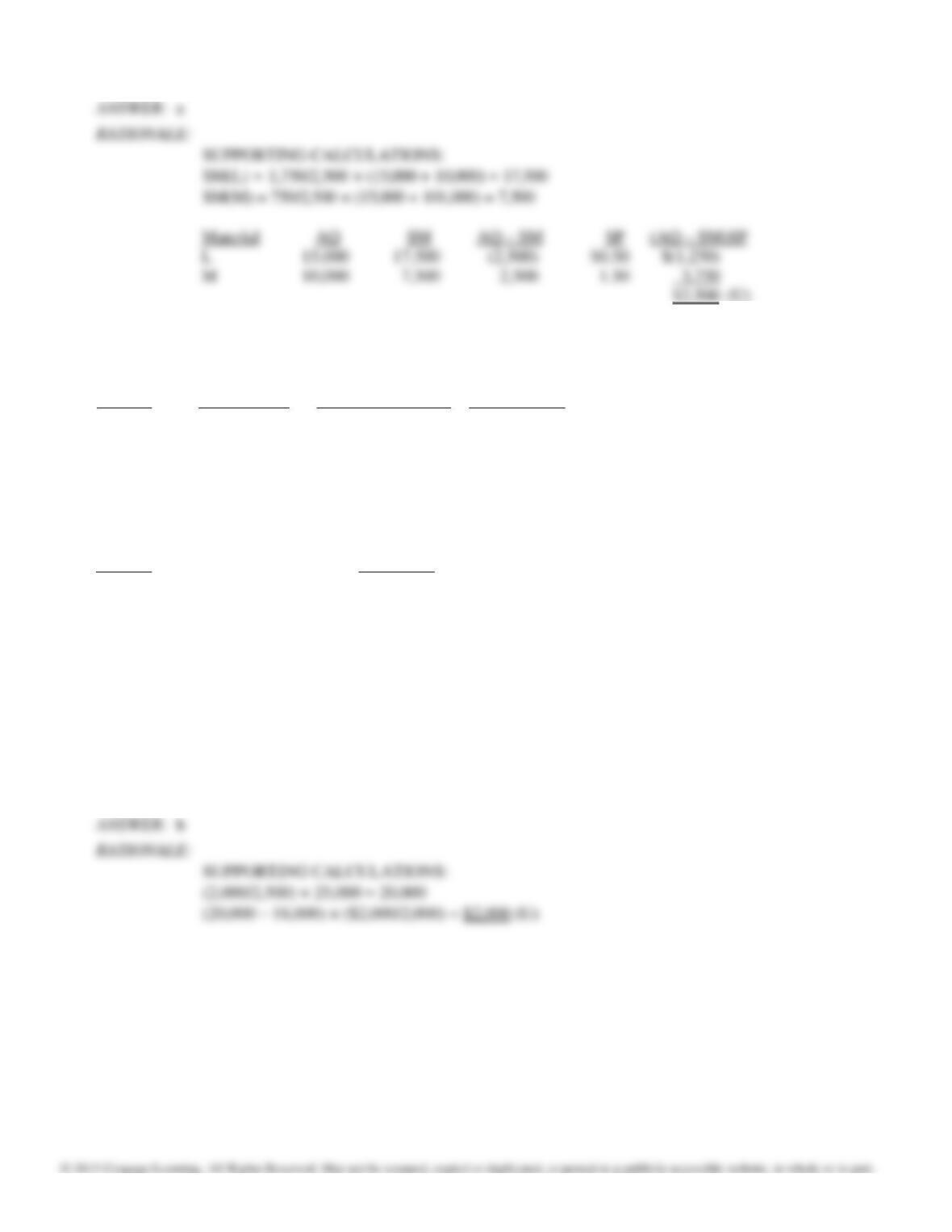
What is the materials mix variance?
a. $2,500 (U)
b. $2,000 (F)
c. $2,500 (F)
d. $2,000 (U)
Chapter 9: Standard Costing: A Functional-Based Control Approach
110. Artigas Enterprises uses two materials in the production of its product. The materials, L and M, have the following
standards:
Material Standard Mix Standard Unit Price Standard Cost
L 1,750 units $0.50 per unit $ 875
M 750 units 1.50 per unit $1,125
Yield 2,000 units
During January, the following actual production information was provided:
Material Actual Mix
L 15,000 units
M 10,000 units
Yield 18,000 units
What is the materials yield variance?
a. $2,500 (U)
b. $2,000 (U)
c. $2,500 (F)
d. $2,000 (F)
Chapter 9: Standard Costing: A Functional-Based Control Approach
111. The following information is provided about three materials utilized in the production of a product:
Material Standard Mix Standard Unit Price Standard Cost
X 1,250 units $3.00 per unit $3,750
Y 750 units 5.00 per unit $3,750
Z 500 units 4.00 per unit $2,000
Yield 2,250 units
During May, the following actual production information was provided:
Material Actual Mix
X 10,000 units
Y 5,000 units
Z 2,500 units
Yield 15,000 units
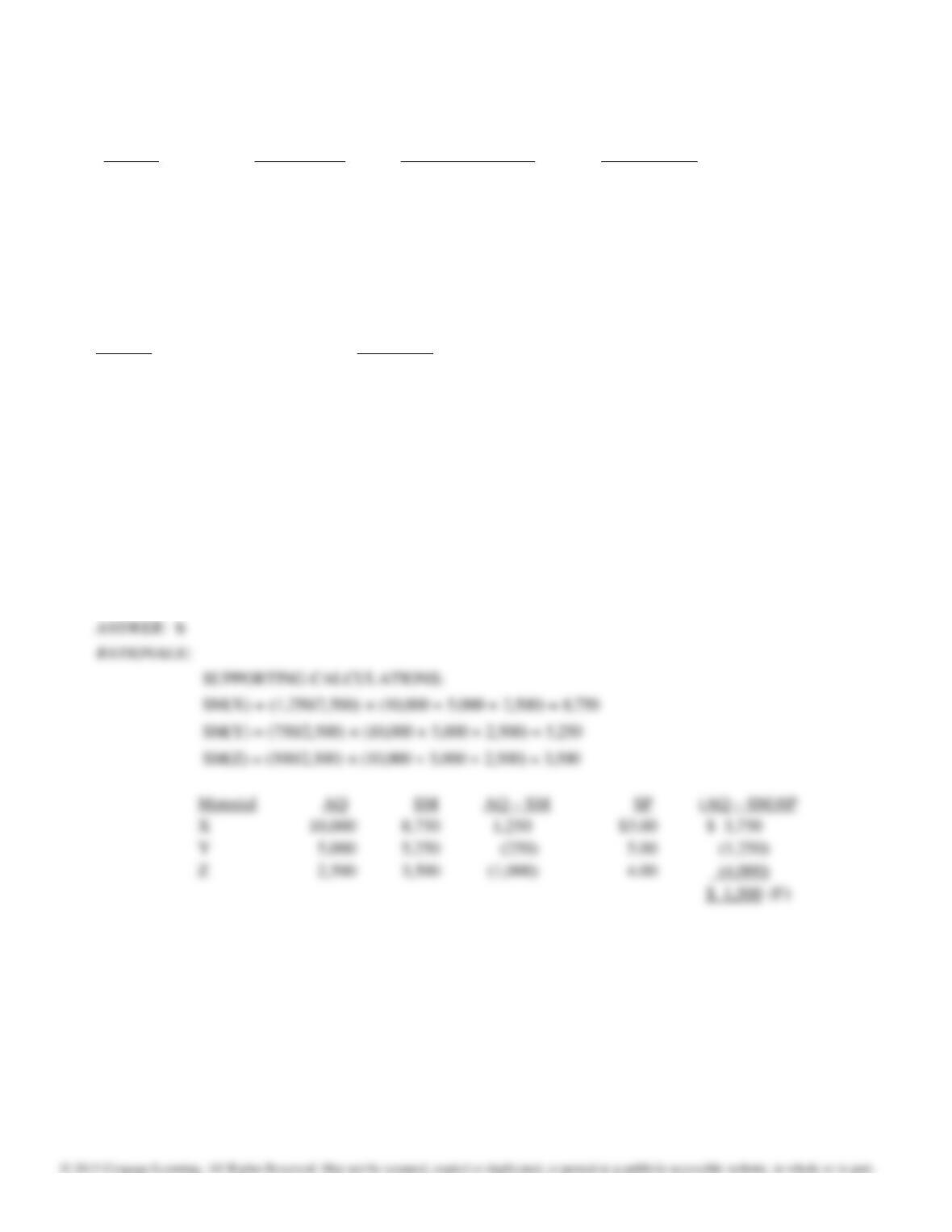
Calculate the Material mix variance.
a. $1,500(U)
b. $1,500(F)
c. $1,250(U)
d. $1,250(F)
Chapter 9: Standard Costing: A Functional-Based Control Approach
112. The following information is provided about three materials utilized in the production of a product:
Material Standard Mix Standard Unit Price Standard Cost
X 1,250 units $3.00 per unit $3,750
Y 750 units 5.00 per unit $3,750
Z 500 units 4.00 per unit $2,000
Yield 2,250 units
During May, the following actual production information was provided:
Material Actual Mix
X 10,000 units
Y 5,000 units
Z 2,500 units
Yield 15,000 units
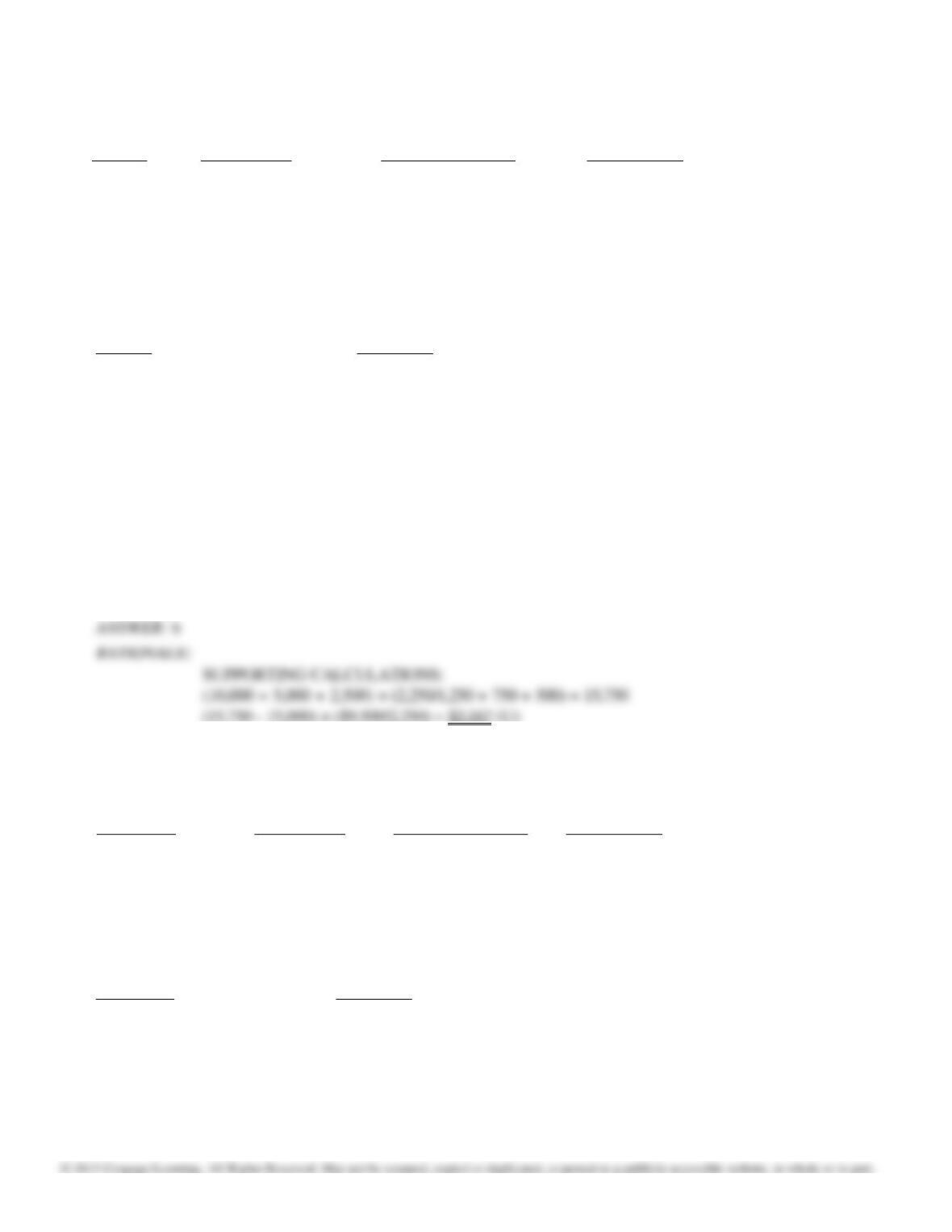
What is the Material yield variance.
a. $3,167(F)
b. $3,167(U)
c. $6,333(F)
d. $6,333(U)
113. Montecino Corporation uses two different types of labor to manufacture its product. The types of labor, Cutting and
Setup, have the following standards:
Labor Type Standard Mix Standard Unit Price Standard Cost
Cutting 500 hours $7.50 per unit $3,750
Setup 125 hours 5.00 per unit $ 625
Yield 3,125 units
During July, the following actual production information was provided:
Labor Type Actual Mix
Cutting 4,375 hours
Setup 1,875 hours
Yield 28,125 units
Chapter 9: Standard Costing: A Functional-Based Control Approach
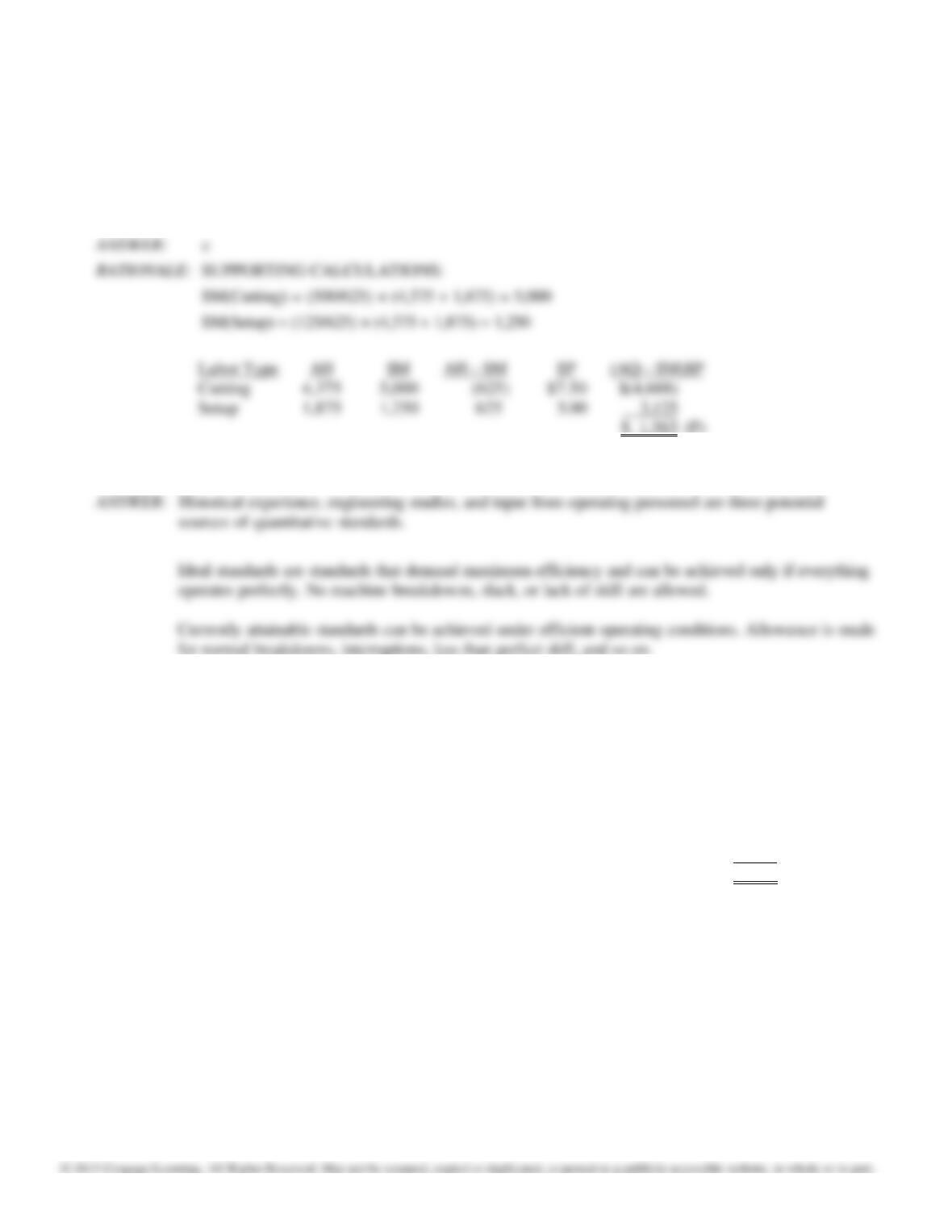
What is the Labor mix variance?
a. $3,750(F)
b. $3,750(U)
c. $1,563(F)
d. $1,563(U)
114. How are standards developed? What is the difference between ideal and currently attainable standards?
115. The Awesome Systems Company, which uses direct labor hours to assign overhead costs to products, developed
the following standard cost for one of their products:
STANDARD COST CARD PER UNIT
Materials: 10 pounds × $8 per pound $80.00
Direct labor: 3 hours × $32 per hour 96.00
Variable manufacturing overhead: $20 per direct labor hour ?
Fixed manufacturing overhead ?
Total standard cost per unit ?
The following information is available regarding the company‘s operations for the period:
Units produced: 15,000
Materials purchased: 180,000 pounds @ $7.20 per pound
Materials used: 160,000 pounds
Direct labor: 18,000 hours @ $37.00 per hour
Manufacturing overhead incurred:
Variable $880,000
Fixed $2,560,000
Chapter 9: Standard Costing: A Functional-Based Control Approach
Budgeted fixed manufacturing overhead for the period is $4,800,000, and expected capacity for the period is 60,000
direct labor hours.
Required:
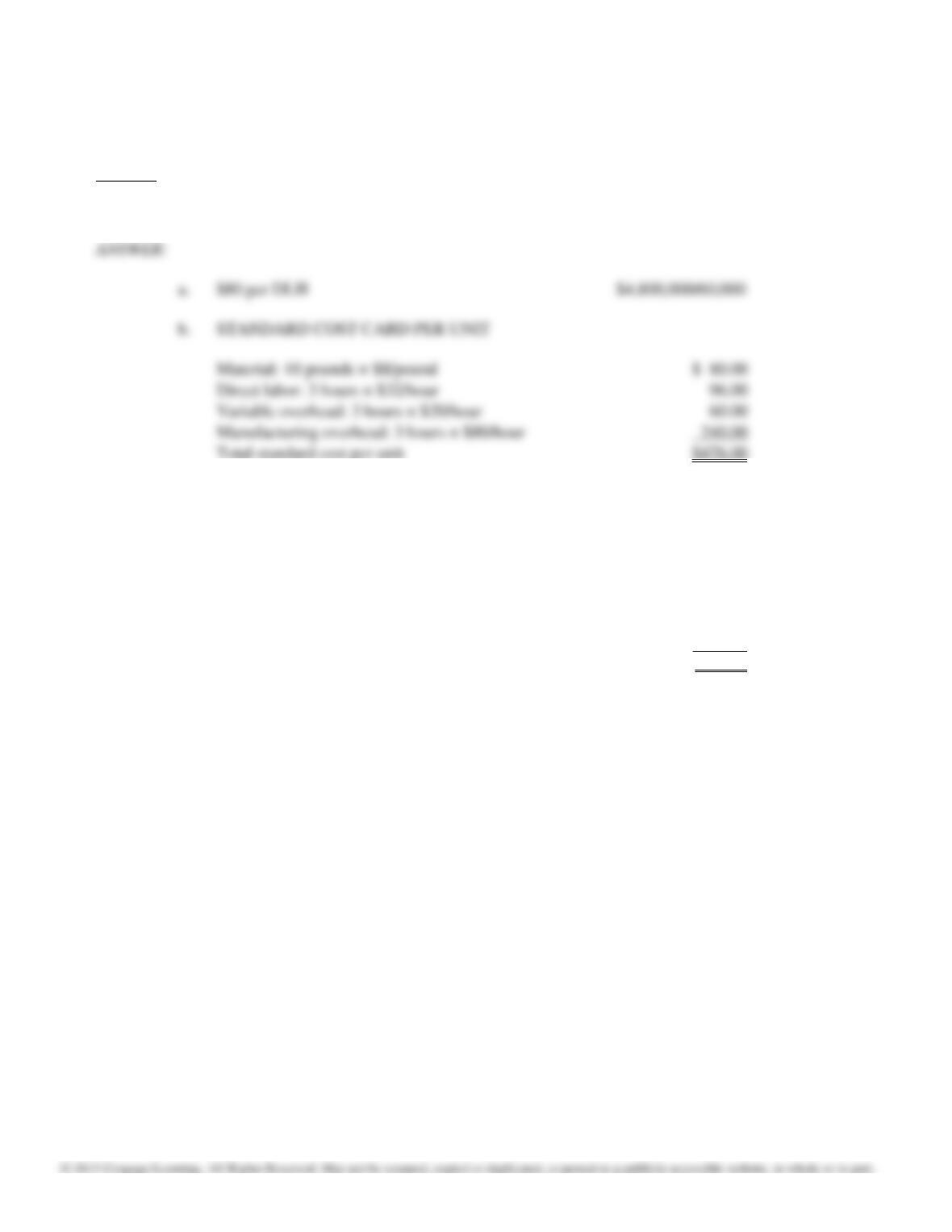
a. Calculate the standard fixed manufacturing overhead rate.
b. Complete the standard cost card for the product.
116. The following standard costs were developed for one of the products of Razzmatazz Corporation:
STANDARD COST CARD PER UNIT
Materials: 4 feet × $14.25 per foot $ 57.00
Direct labor: 8 hours × $10 per hour 80.00
Variable overhead: 8 direct labor hours × $8 per hour 64.00
Fixed overhead: 8 direct labor hours × $12 per hour 96.00
Total standard cost per unit $297.00
The following information is available regarding the company‘s operations for the period:
Units produced: 11,000
Materials purchased: 52,000 feet @ $13.95 per foot
Materials used: 40,000 feet
Direct labor: 84,000 hours costing $840,000
Manufacturing overhead incurred:
Variable $756,000
Fixed $1,000,000
Budgeted fixed manufacturing overhead for the period is $960,000, and the standard fixed overhead rate is based on
expected capacity of 80,000 direct labor hours.