Chapter 9: Current Liabilities, Contingencies, and the Time Value of Money
147. On September 1, 2015, Ensign Inc. borrowed $21,000 from Emerald City National Bank by issuing a 12–
month note. The bank discounted the note at 7.5%.
REQUIRED:
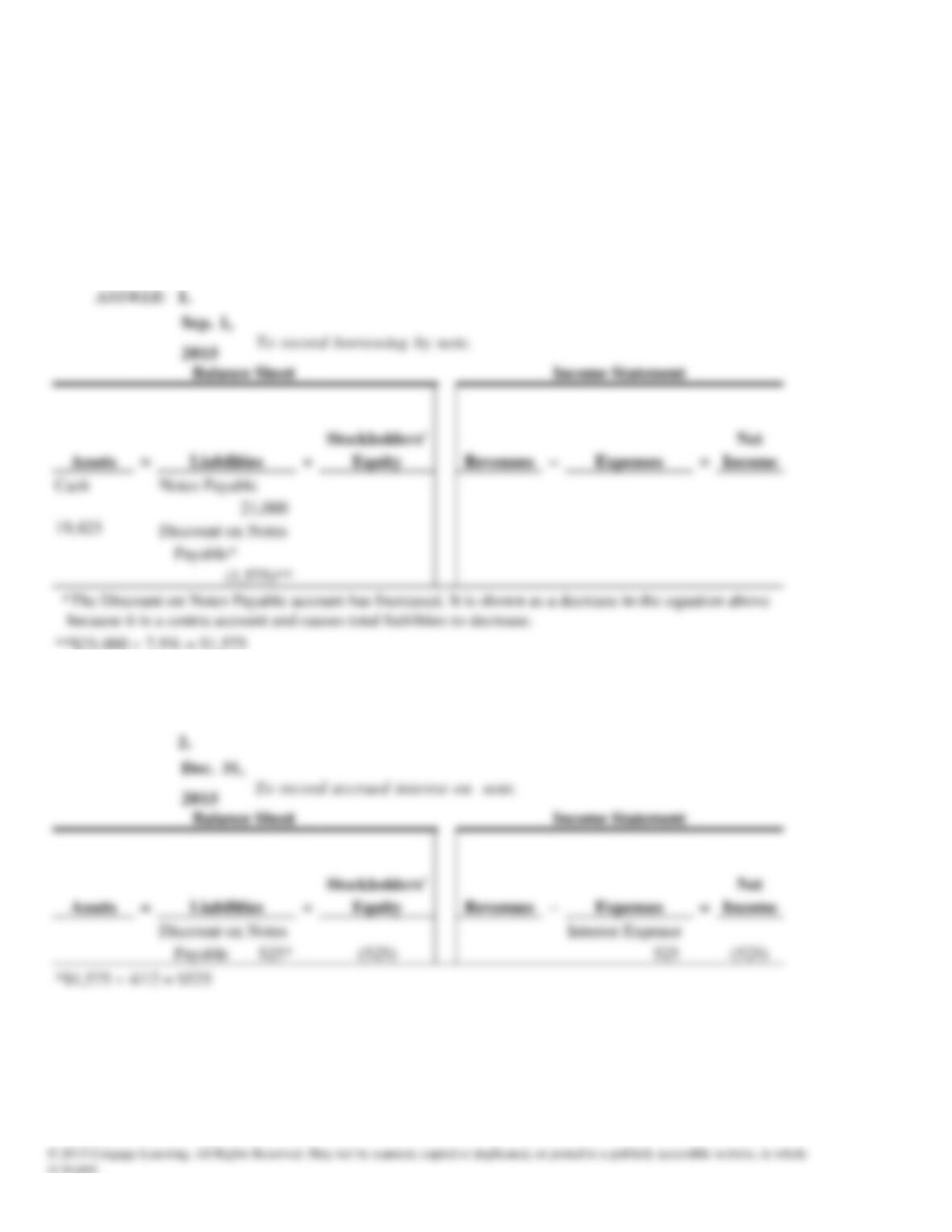
1. Identify the accounting equation effects to record the issuance of the note.
2. Identify the accounting equation effects needed at December 31, 2015, to accrue interest.
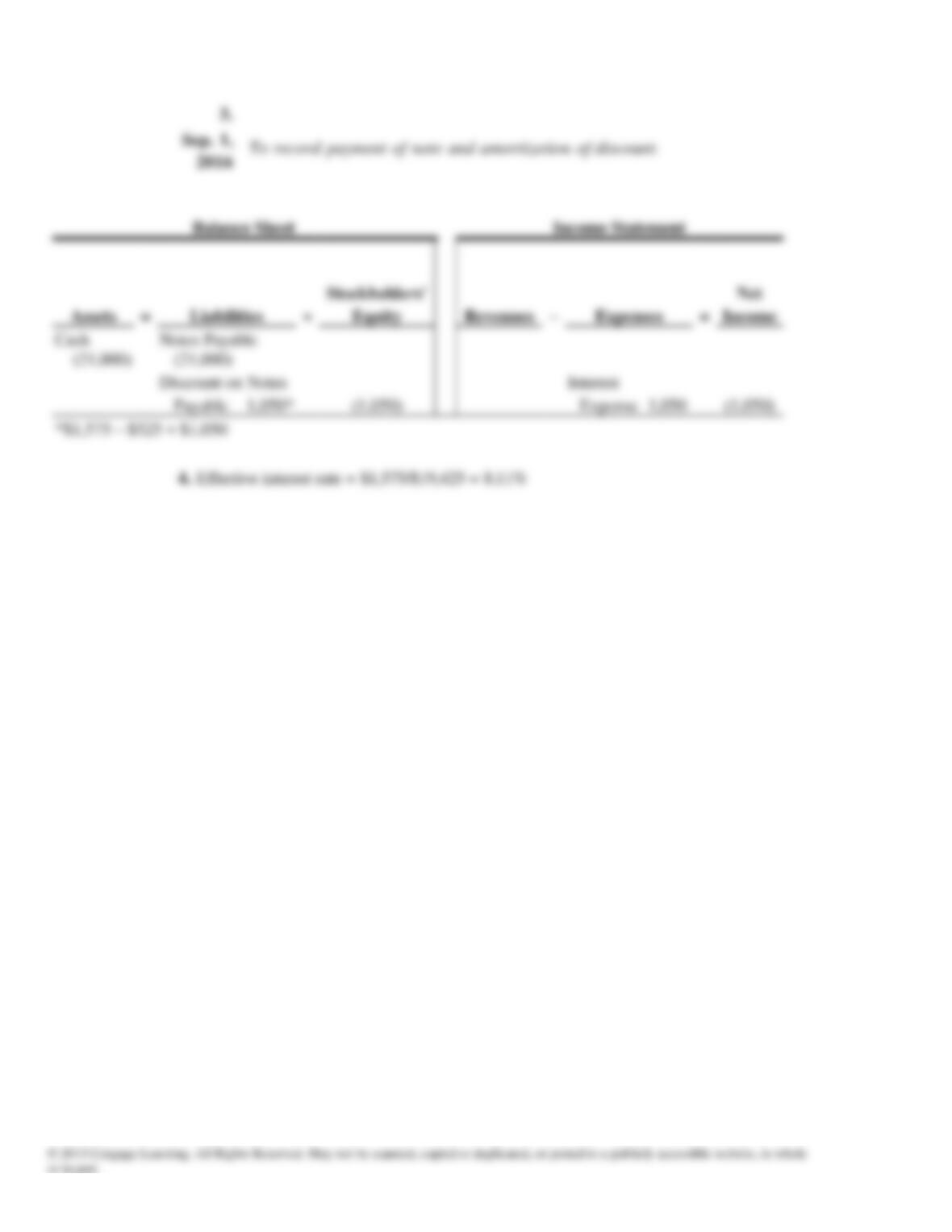
3. Identify the accounting equation effects to record the payment of the note on September 1, 2016.
4. What effective rate of interest did Ensign pay?
Chapter 9: Current Liabilities, Contingencies, and the Time Value of Money
Chapter 9: Current Liabilities, Contingencies, and the Time Value of Money
148. The solution to this problem requires time value of money calculations. Reference to Tables 9-1 through 9-4
in the text is necessary to complete the calculations.
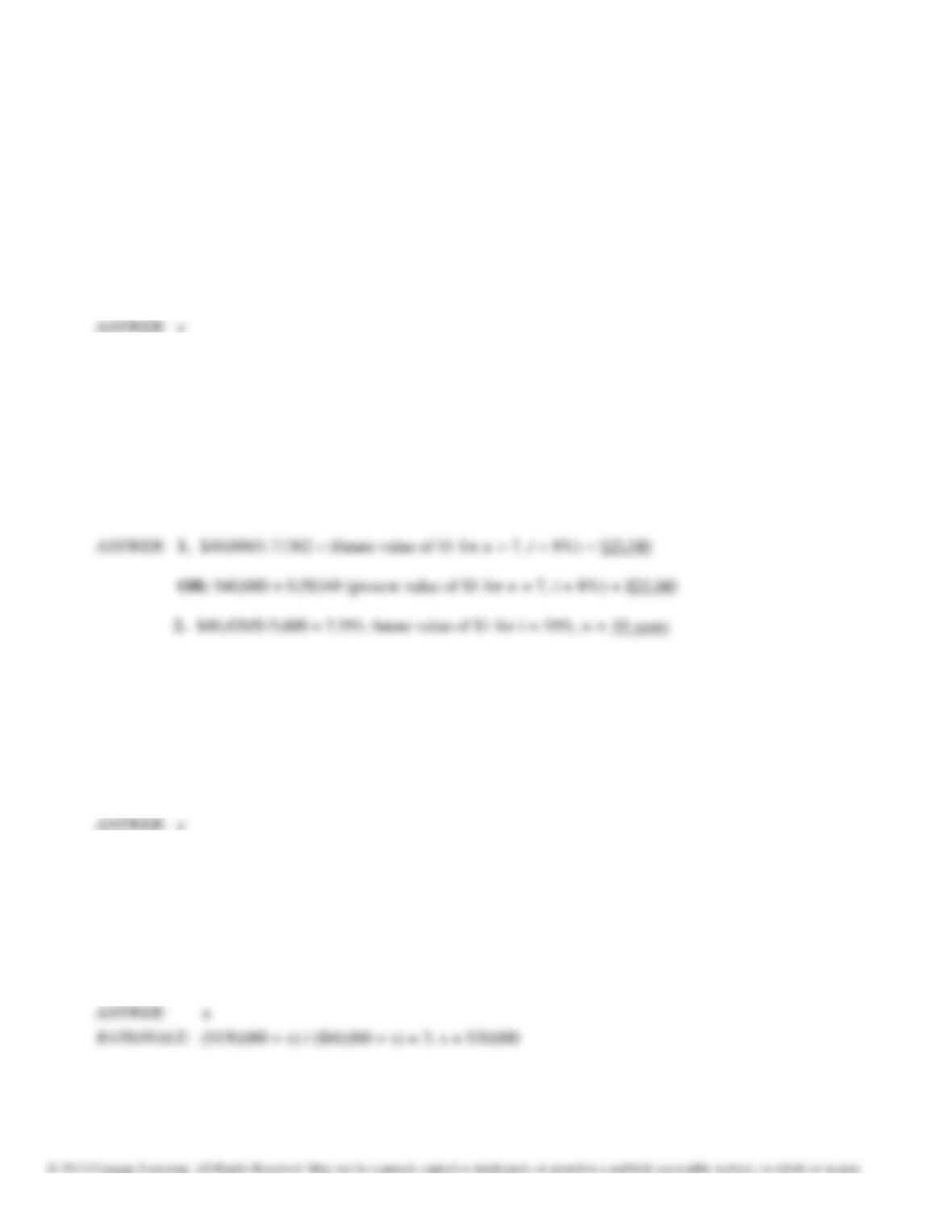
If Garrett has $5,000 per year to invest for 10 years and wants to accumulate $87,745 at the end of that time, he must
find an investment that is earning at a rate of
a. 6%
b. 15%
c. 12%
d. 11%
149. Apply the time value of money in the following independent situations:
1. Margaret Carlson made a deposit in the bank on January 1, 2008. The bank pays interest at the rate of 8%
compounded annually. On January 1, 2015, the deposit has accumulated to $40,000. How much money did Margaret
originally deposit on January 1, 2008?
2. Claude Cooper deposited $15,600 in the bank on January 1 a few years ago. The bank pays an interest rate of
10% compounded annually, and the deposit is now worth $40,420. For how many years has the deposit been
invested?
150. Clarion Inc. issues numerous discount coupons throughout the year. A balance in the Estimated Liability for Coupon
Redemption
a. indicates an error had been made in posting.
b. should equal the same amount of coupons redeemed.
c. is the amount of outstanding coupons it expects to be redeemed.
d. indicates that more coupons were redeemed than estimated.
151. Redfearn Company has current assets of $150,000 and current liabilities of $60,000. How much inventory could it
purchase on account and achieve its minimum desired current ratio of 2 to 1?
a. $30,000
b. $40,000
c. $10,000
d. $20,000
Chapter 9: Current Liabilities, Contingencies, and the Time Value of Money
152. Terms of 2/10, n30 mean that if the discount is not taken, full payment is due within
___________________________ days.
153. You are interested in accumulating $10,000 so that you can take a cruise in 3 years. If you trying to solve for the
amount that you need to invest each year, earning 6% interest compounded annually, the $10,000 represents:
a. the amount to invest.
b. an annuity.
c. a future value.
d. a present value.
154. Each of the following situations involves the use of discounts:
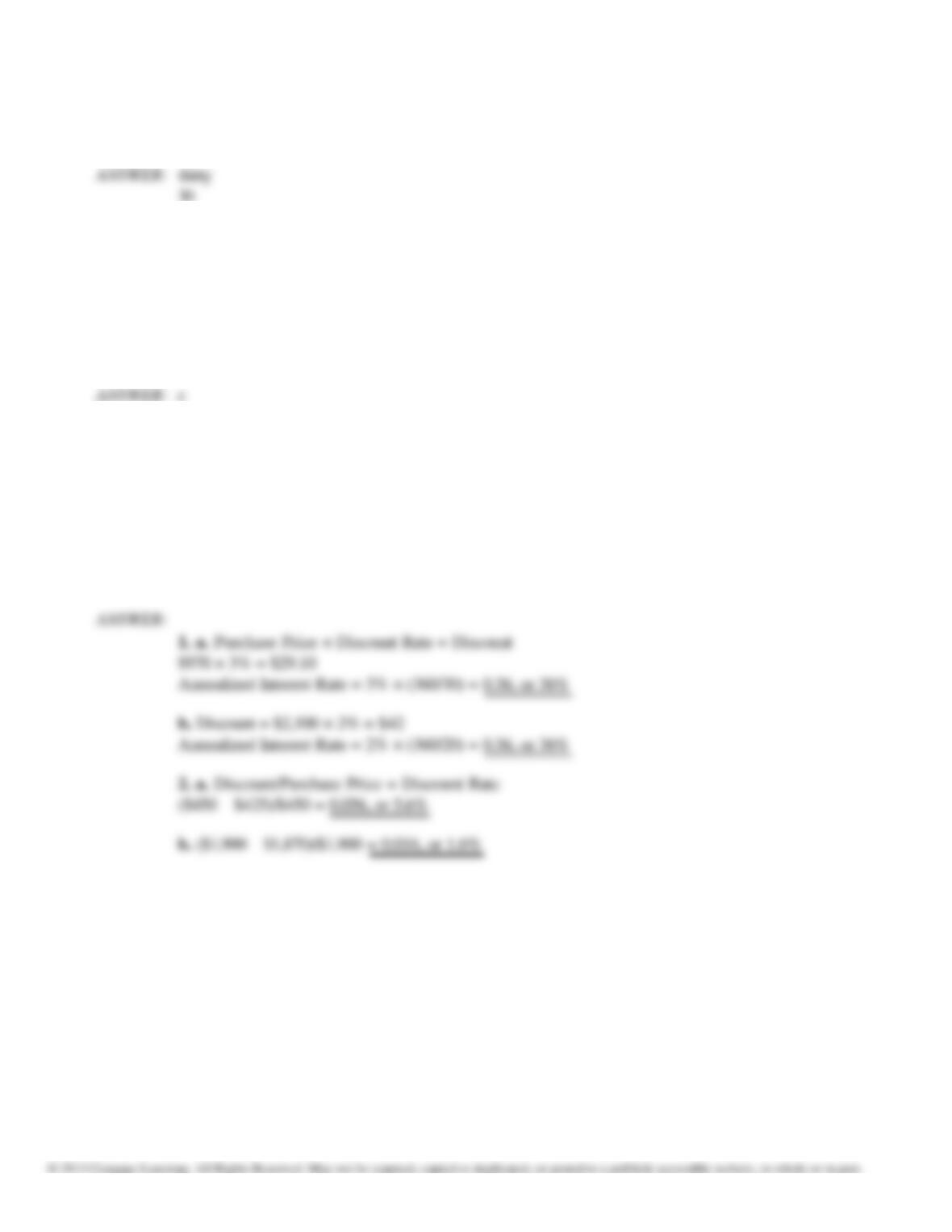
1. How much discount may Mallory Inc. take in each of the following transactions? What was the annualized
interest rate?
a. Mallory purchases inventory costing $970, terms 3/10, n/40.
b. Mallory purchases new office furniture costing $2,100, terms 2/10, n/30.
2. Calculate the discount rate that Mallory received in each of these transactions.
a. Mallory purchased office supplies costing $450 and paid within the discount period with a check for $425.
b. Mallory purchased merchandise for $1,900. It paid within the discount period with a check for $1,870.

Chapter 9: Current Liabilities, Contingencies, and the Time Value of Money
155. The solution to this problem requires time value of money calculations. Reference to Tables 9-1 through 9-4
in the text is necessary to complete the calculations.
The present value of $7,000 to be received in 7 years at 7% compounded annually is
a. $7,000
b. $3,430
c. $4,361
d. $6,657
156. The total amount of simple interest calculated annually on a $6,000 note payable for 3 years at 11% is
a. $7,980
b. $1,980
c. $2,205
d. $6,600
157. The solution to this problem requires time value of money calculations. Reference to Tables 9-1 through 9-4
in the text is necessary to complete the calculations.
Cory and Ginger want to buy an airplane. They find one that will cost $200,000. They must pay 10% down, and can
get the balance financed with a 10 year loan at 7% interest and annual payments. What is their annual payment?
a. $26,826
b. $24,457
c. $25,626
d. $19,260
158. The solution to this problem requires time value of money calculations. Reference to Tables 9-1 through 9-4
in the text is necessary to complete the calculations.
Denise wants to help pay for her niece’s college tuition. Her niece will begin college in one year. How much would
Denise need to put into a savings account today at 6% so that her niece can withdraw $10,000 per year for 4 years,
and reduce the account balance to zero at the end of the 4 years?
a. $34,650
b. $37,720
c. $37,600
d. $31,680
Chapter 9: Current Liabilities, Contingencies, and the Time Value of Money
159. Current liabilities are defined as those liabilities which will be satisfied
a. within one year or within the operating cycle, whichever is shorter.
b. by the end of the operating cycle.
c. within one year.
d. within one year or within the operating cycle, whichever is longer.
160. An annuity is a series of equal payments made at equal intervals in the future.
a. True
b. False
161. On November 1, 2014, Chancellor Co. borrowed $80,000 from State Bank and signed a 12%, six-month note payable,
all due at maturity. The interest on this loan is stated separately. At December 31, 2014, Chancellor Co.‘s overall
liability for this loan amounts to:
a. $83,200
b. $84,800
c. $80,000
d. $81,600
162. When a bank deducts the interest on a note in advance, the note has been .
163. The terms referring to contingencies differ between U.S. GAAP and IFRS.
a. True
b. False
164. Carrington, Inc. recorded $97,000 in salary expense for January, 2015. Its beginning balance in salaries payable was
$3,000 and its ending balance was $4,000. How much was paid in cash for salaries during January, 2015?
a. $96,000
b. $97,000
c. $99,000
d. $98,000

Chapter 9: Current Liabilities, Contingencies, and the Time Value of Money
Dec. 30, 2015
Dec. 31, 2014
Inventories
$1,780
$1,649
Total current assets
$9,428
$8,625
Liabilities in order of significance:
Long-term debt
$14,465
$15,001
Other noncurrent liabilities
4,421
3,148
Deferred income taxes
3,504
3,543
Accounts payable
2,556
2,468
Other current liabilities
2,066
1,738
Accrued salaries and wages
1,538
1,082
Short-term borrowings
1,200
1,126
Accrued advertising expense
793
928
Income taxes payable
658
1,142
165. Which of the following is not classified as a noncurrent liability?
a. Mortgage payable
b. Current portion of long-term debt
c. Bonds payable
d. Capital lease obligations
166. Interest payable on a loan becomes a liability:
a. at the maturity date.
b. when the borrowed money is received.
c. as it accrues.
d. when the note payable is issued.
Auto Designs, Inc.
Use the selected data from the comparative financial statements for Auto Designs, Inc. to answer the questions that
follow.
Auto Designs, Inc.
Balance Sheet Accounts
(all accounts have normal balances)
(in millions)
Chapter 9: Current Liabilities, Contingencies, and the Time Value of Money
167. Refer to the account information for Auto Designs, Inc.
REQUIRED:
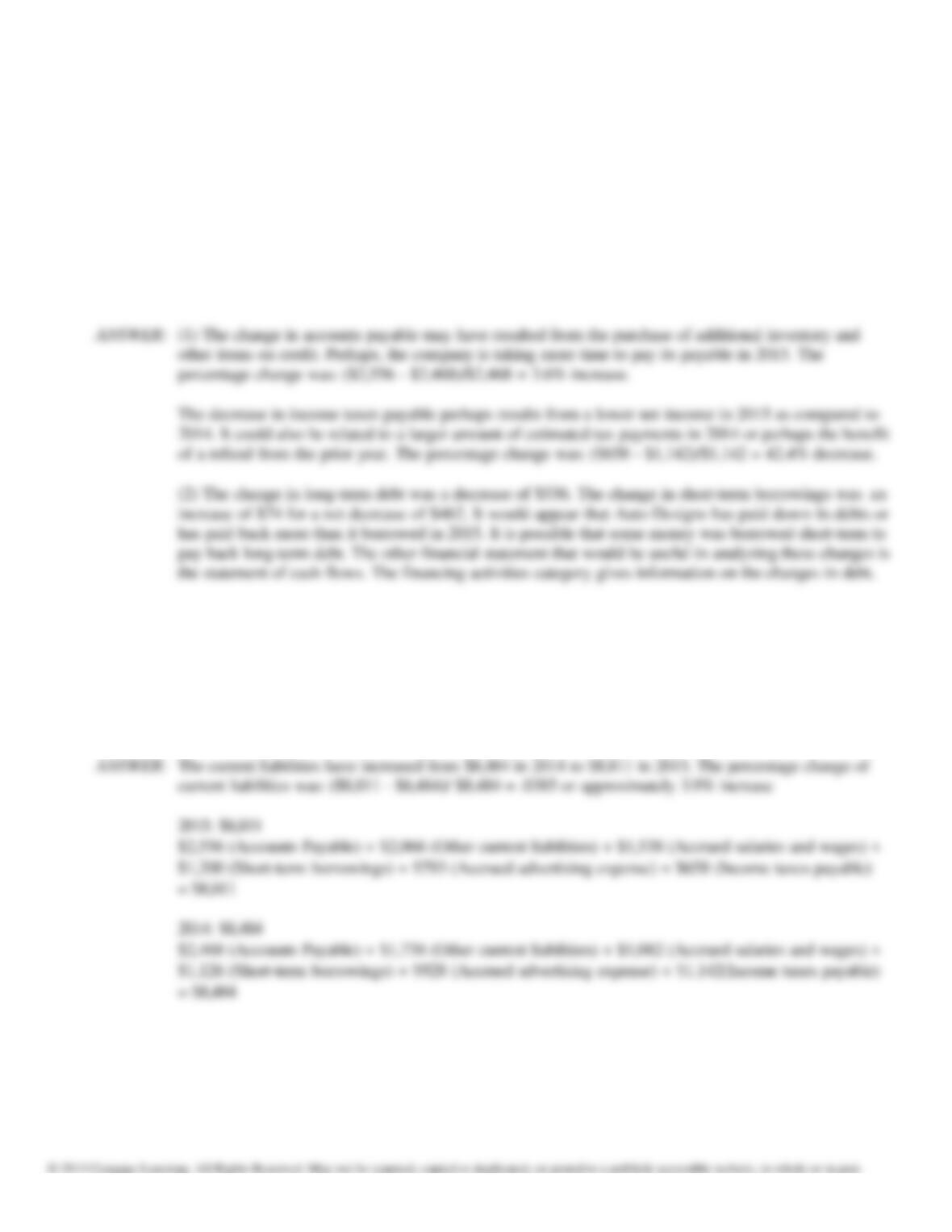
(1) Calculate percentage changes in accounts payable and income taxes payable. Give a possible explanation for the
changes in these accounts.
(2) By how much did Auto Designs’ long-term and short-term borrowings change from 2014 to 2015? Give a
possible explanation for the change in debt. What other financial statement would be useful in analyzing the change in
borrowings? Why?
168. Refer to the account information for Auto Designs, Inc.
REQUIRED:
Compute the total current liabilities for the years 2015 and 2014. Calculate the percentage change in the total current
liabilities.
Chapter 9: Current Liabilities, Contingencies, and the Time Value of Money
169. Refer to the account information for Auto Designs, Inc.
REQUIRED:
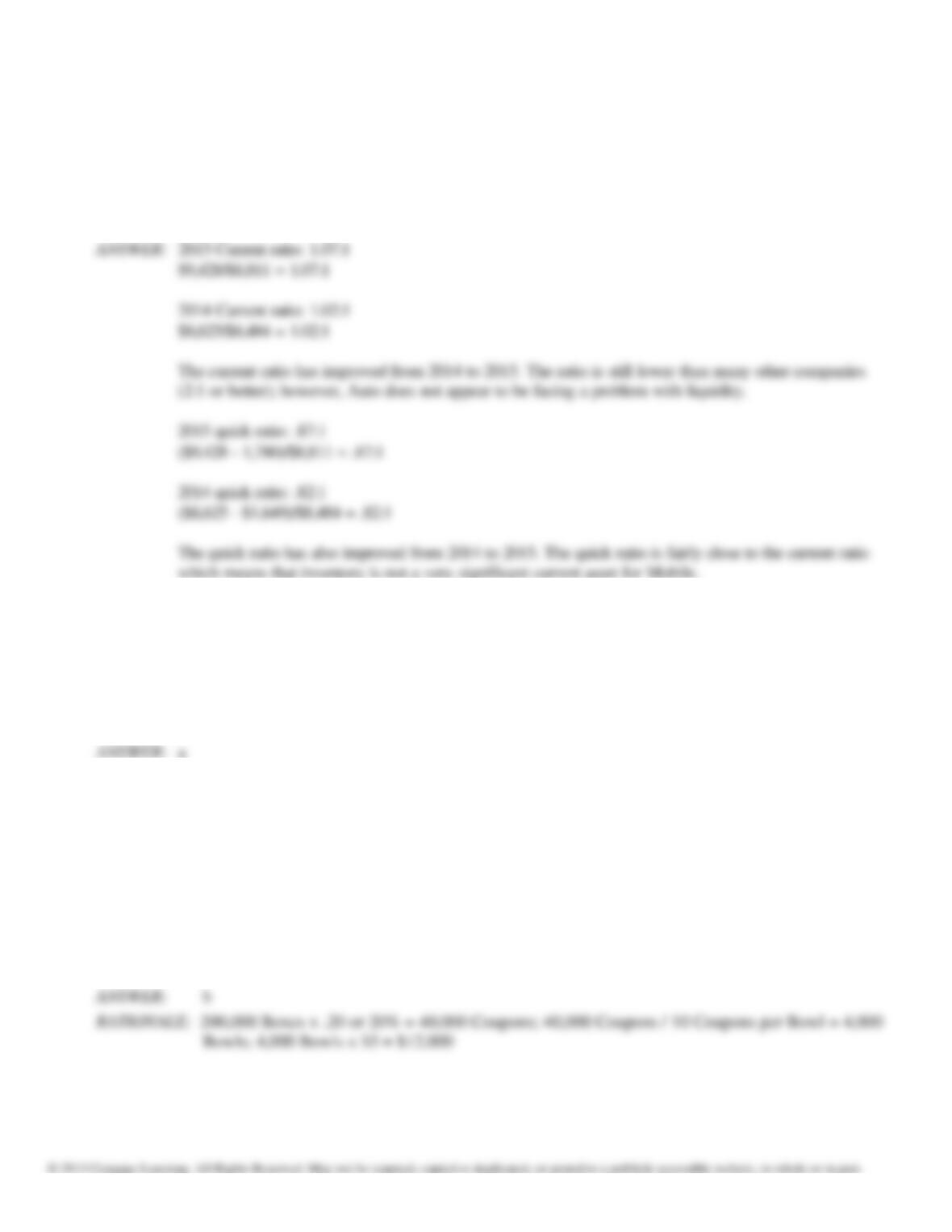
Calculate the current and quick ratios for 2015 and 2014. Comment on the direction and significance of the change in
the ratios.
170. Assume the current ratio is 3 to 4. Purchases of inventory on account would cause the current ratio to
a. increase.
b. be unchanged since the effects offset each other.
c. be unchanged since it has no effects on any current accounts.
d. decrease.
171. A cereal company includes one premium coupon in every cereal box. Upon returning 10 such coupons to the
company, a customer will be sent a free cereal bowl. In a recent year, the company sold 200,000 boxes of cereal for
$1 a box. It is estimated that 20% of the coupons will be returned. If the cereal bowls cost the company $3 each,
what amount of liability for premium redemptions must be recorded by the company?
a. $ 6,000
b. $ 12,000
c. $200,000
d. $ 24,000
Chapter 9: Current Liabilities, Contingencies, and the Time Value of Money
172. Long-term assets are $5,000, current liabilities are $700, and long–term liabilities are $3,000. If the current ratio is 3 to
1, then current assets are
a. $4,300
b. $2,100
c. $9,000
d. $6,900
173. Which of the following would appear on the balance sheet as a current liability?
a. A loss from an anticipated strike by employees.
b. Premium offers in cereal boxes.
c. Potential damages from possible explosions in a fireworks factory.
d. The possible loss from a lawsuit.
174. On November 1, 2014, Chancellor Co. borrowed $80,000 from State Bank and signed a 12%, six-month note payable,
all due at maturity. The interest on this loan is stated separately. At December 31, 2014, the adjustment for this note
includes:
a. an increase to Notes Payable for $1,600.
b. an increase to Interest Payable for $1,600.
c. an increase to Interest Expense for $3,200.
d. a decrease to Cash for $4,800.
175. If a company purchases $3,200 worth of inventory with terms of 2/10, n/30 on March 3 and pays April 2, then the
amount paid to the seller would be
a. $3,150
b. $3,136
c. $3,200
d. $3,168
176. There are some liabilities, such as income tax payable, for which the amounts must be estimated. Failure to estimate
these amounts and record them would be a violation of the
a. convention of conservation.
b. concept of historical cost.
c. practice of consistency.
d. matching principle.
Chapter 9: Current Liabilities, Contingencies, and the Time Value of Money
177. A bank loaned York Construction Company $35,000 on a 1-year, 6% note, but deducted the interest in advance.
The transaction recorded on York‘s books for the receipt of the cash would include an
a. decrease in Notes Payable for $32,900.
b. increase in Interest Revenue for $2,100.
c. increase in Discount on Notes Payable for $2,100.
d. increase in Cash for $35,000.
178. If current assets amount to $150, total assets $350, current liabilities $65, and total liabilities $100, then the current
ratio is
a. 3.03 to 1
b. 2.12 to 1
c. 2.31 to 1
d. 3.50 to 1
179. The solution to this problem requires time value of money calculations. Reference to Tables 9-1 through 9-4
in the text is necessary to complete the calculations.
The total amount of interest compounded quarterly on a $1,500 note payable for 1 year at 12% is
a. $180.00
b. $187.50
c. $ 45.00
d. $189.00
180. Which of the following statements about current liabilities is true?
a. The current ratio is defined as current assets divided by current liabilities.
b. The current liability section never contains any portion of long-term liabilities.
c. Current liabilities are listed in order of decreasing amounts in the current liability section of the balance sheet.
d. The amount of current liabilities has little implication for a company‘s liquidity.
181. A company’s balance sheet shows the account, Notes Payable. This resulted from a loan made by the company’s
bank. If the end–of-year balance in the notes payable account exceeds the beginning-of–year balance by $5,000, this is
shown on the cash flow statement as an
a. inflow of cash of $5,000 in the operating activities category.
b. inflow of cash of $5,000 in the financing activities category.
c. outflow of cash of $5,000 in the operating activities category.
d. outflow of cash of $5,000 in the financing activities category.
Chapter 9: Current Liabilities, Contingencies, and the Time Value of Money
182. A company’s weekly payroll amounts to $50,000 and payday for the week is every Friday. Employees work five days
per week, Monday through Friday. The appropriate journal entry was recorded at the end of the accounting period,
Monday, March 31, 2014. What amount is wages expense for April for the payday, Friday, April, 4, 2014?
a. $40,000
b. $50,000
c. $ -0-
d. $10,000
183. The total amount of simple interest calculated annually on a $4,000 note payable in 5 years at 9% is:
a. $2,154.60
b. $1,800.00
c. $1,411.20
d. $554.04
184. The solution to this problem requires time value of money calculations. Reference to Tables 9-1 through 9-4
in the text is necessary to complete the calculations.
Mackie’s individual retirement account (IRA) currently has a balance of $100,000 and is earning 6%. Beginning one
year from today, what equal annual amounts can be withdrawn from the IRA for 10 years so that the balance after
the tenth withdrawal is zero?
a. $14,237
b. $13,587
c. $12,950
d. $10,000
185. Assume the current ratio is 2 to 1. Payment on accrued salaries payable would cause the current ratio to
a. decrease.
b. be unchanged since the effects offset one another.
c. increase.
d. be unchanged since it has no impact on any current accounts.
186. On November 1, Greenfield Corporation borrowed $55,000 from a bank and signed a 12%, 90–day note payable in the
amount of $55,000. If you assume 360 days in year, the November 30 adjustment will include:
a. an increase in Discount on Notes Payable, $1,100 and an increase in Interest Payable, $1,100.
b. an increase in Interest Expense, $550 and an increase in Interest Payable, $550.
c. an increase in Interest Expense, $550 and an increase in Notes Payable, $550.
d. an increase in Interest Expense, $550 and a decrease in Cash, $550.
Chapter 9: Current Liabilities, Contingencies, and the Time Value of Money
187. $2,000 invested today at 12% with compound interest will yield $2,480 in 2 years.
a. True
b. False
188. If current assets amount to $62,000, total assets $350,000, current liabilities $31,000, and total liabilities $125,000, then
the current ratio is
a. 3.0 to 1
b. 0.5 to 1
c. 2.0 to 1
d. 2.8 to 1
189. Almost all current liabilities affect the operating category of the statement of cash flows, but one that does not
affect cash provided by operating activities is
a. interest payable.
b. notes payable.
c. accounts payable.
d. taxes payable.
190. If your bank gives you a $2,000 loan at 8% per year, but deducts the interest in advance, is 8% the “real“ rate of
interest that you will pay?
a. There is not enough information to answer this question accurately.
b. Yes.
c. No. The interest rate is actually higher than 8 percent.
d. No. The interest rate is actually lower than 8 percent.
191. The solution to this problem requires time value of money calculations. Reference to Tables 9-1 through 9-4
in the text is necessary to complete the calculations.
David, a high school math teacher, wants to set up an IRA account into which he will deposit $2,000 per year. He
plans to teach for 20 more years and then retire. If the interest on his account is 7% compounded annually, how much
will be in his account when he retires?
a. $81,990
b. $74,458
c. $ 4,800
d. $21,118
Chapter 9: Current Liabilities, Contingencies, and the Time Value of Money
192. Proctor Inc. has a weekly payroll of $8,000 for a 5-day workweek, Monday through Friday. If December 31, the last
day of the accounting year, falls on Wednesday, Proctor would make an adjustment that would
a. decrease cash $4,800.
b. decrease wages payable $4,800.
c. increase wages expense $4,800.
d. increase wages payable $8,000.
193. The present value is the value today of a single amount to be paid or received at a specific date in the future.
a. True
b. False
194. According to the text, almost all current liabilities appear in the Operating Activities category of the statement of cash
flows, but there are exceptions. Explain the exceptions and give an example.
195. International accounting standards require companies to present classified balance sheets with liabilities classified as
either current or long term.
a. True
b. False
196. The solution to this problem requires time value of money calculations. Reference to Tables 9-1 through 9-4
in the text is necessary to complete the calculations.
The future value of $6,000 at 12% compounded quarterly for 5 years is
a. $ 9,600
b. $ 6,954
c. $10,572
d. $10,836
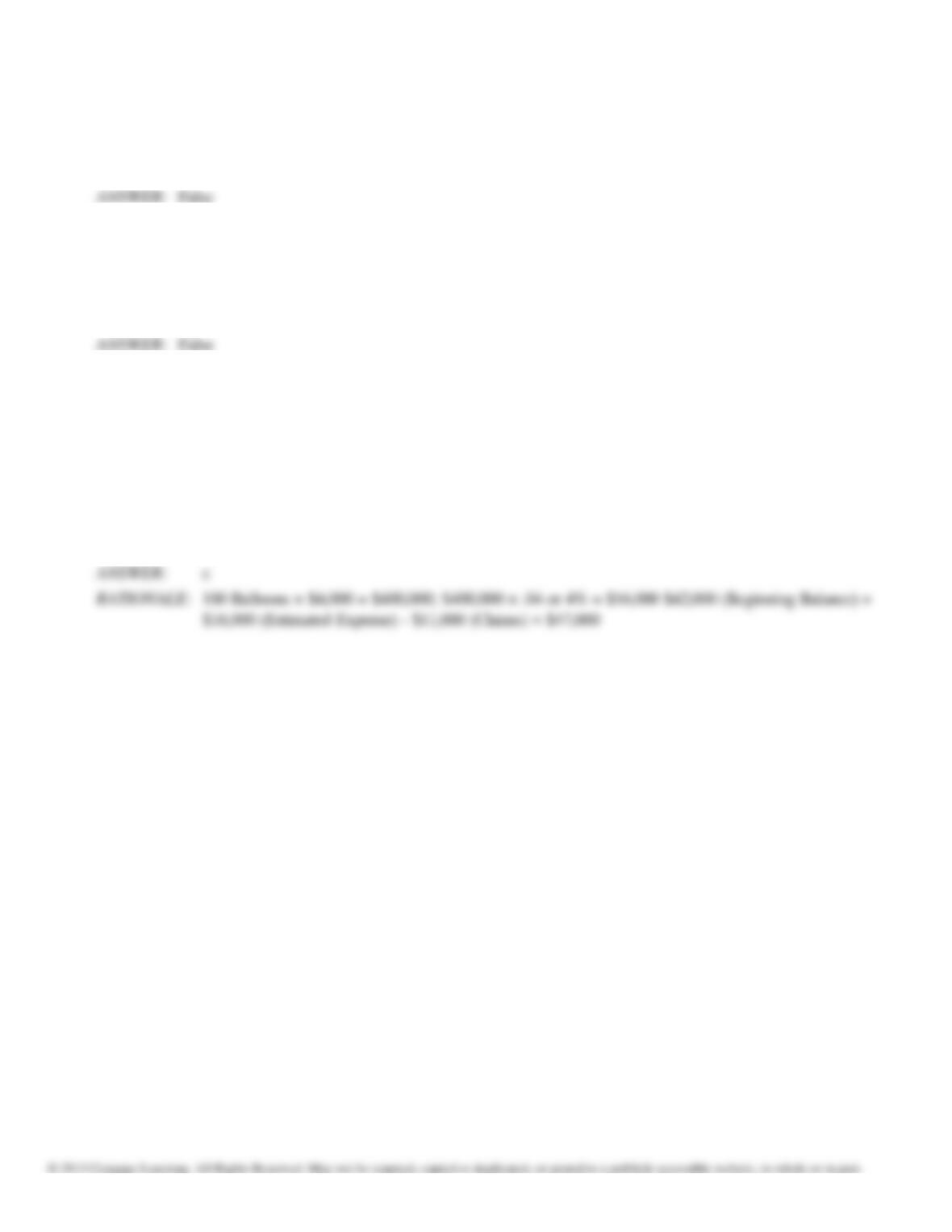
197. If a 12% interest rate is compounded quarterly for 3 years, then there would be ________________
compounding periods.
Chapter 9: Current Liabilities, Contingencies, and the Time Value of Money
198. The liability for a premium offer estimated to be redeemed is not a current liability.
a. True
b. False
199. In the statement of cash flows, a decrease in accounts payable would be shown as an increase in the Operating
Activities category.
a. True
b. False
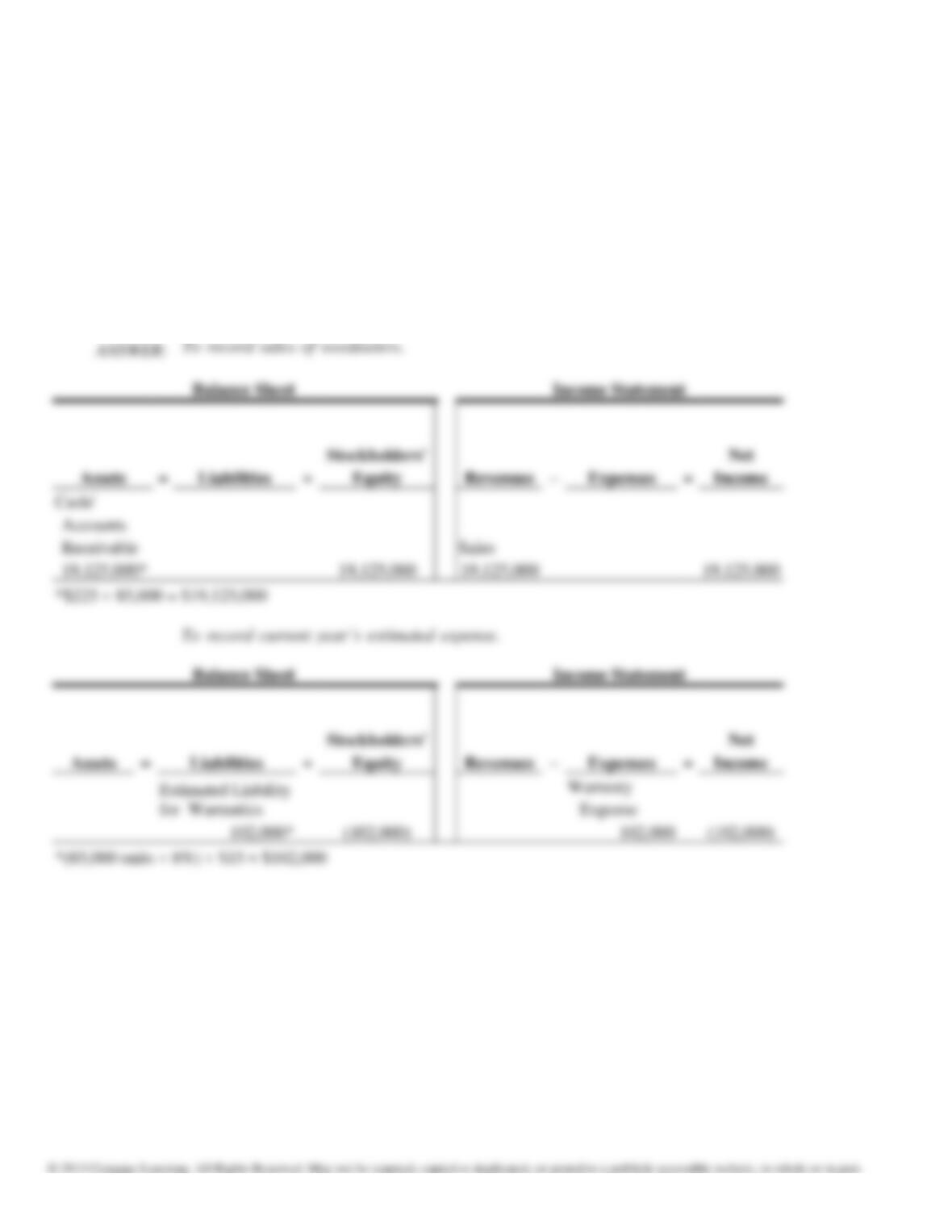
200. In 2015, Morton Co. sold 100 hot air balloons at $4,000 each. The balloons carry a 5-year warranty for defects.
Morton estimates that repair costs will average 4% of the total selling price. The estimated warranty liability at the
beginning of the year was $42,000. $11,000 in claims was actually incurred during the year to honor their warranty.
What was the balance in the ending estimated warranty liability at the end of the year?
a. $42,000
b. $37,000
c. $47,000
d. $ 5,000
Chapter 9: Current Liabilities, Contingencies, and the Time Value of Money
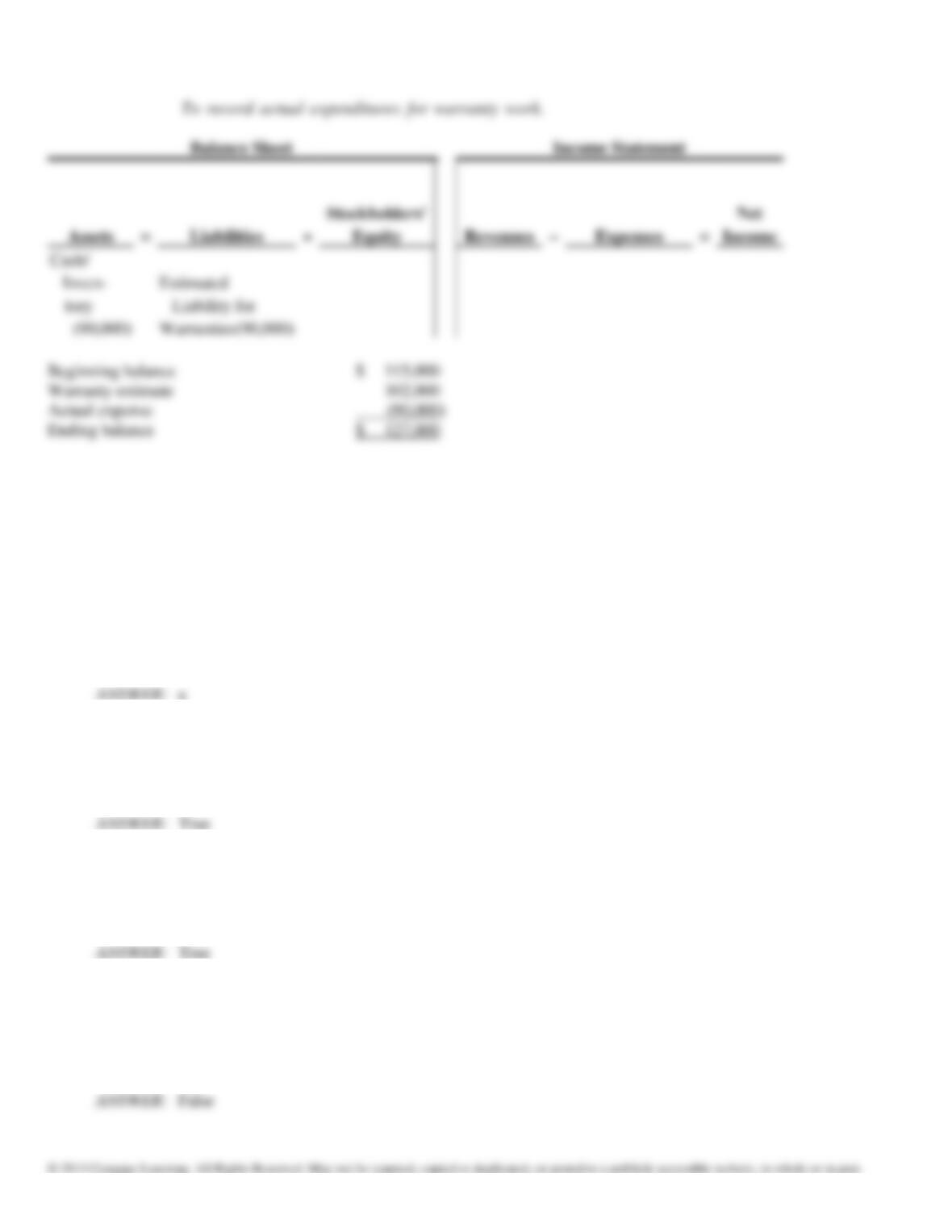
201. Riley Corporation manufactures and sells weedeaters. Riley provides all customers with a three-year warranty
guaranteeing to repair, free of charge, any defects reported during this time period. During the year, it sold 85,000
weedeaters for $225 each. Analysis of past warranty records indicates that 8% of all sales will be returned for repair
within the warranty period. Riley expects to incur expenditures of $15 to repair each weedeater. The account
Estimated Liability for Warranties had a balance of $115,000 on January 1. Riley incurred $90,000 in actual
expenditures during the year.
REQUIRED:
Identify all necessary transactions to record the events related to the warranty transactions during the year and show
their accounting equation effects. Determine the adjusted ending balance in the Estimated Liability for Warranties
account.
Chapter 9: Current Liabilities, Contingencies, and the Time Value of Money
202. The solution to this problem requires time value of money calculations. Reference to Tables 9-1 through 9-4
in the text is necessary to complete the calculations.
If you must calculate the present value of an amount at 8% compounded quarterly for 2 years, then the interest factor
used in the calculation is
a. 2% for eight periods
b. twice that for one period at 8% multiplied by 2
c. 8% for two periods
d. the interest factor for 8% for two periods divided by 4
203. Income taxes payable is a current liability.
a. True
b. False
204. Discount on Notes Payable is treated as a reduction of notes payable on the balance sheet.
a. True
b. False
205. For a given contingent liability, the company has the choice of either recording it on the balance sheet or disclosing it
in the notes.
a. True
b. False
Chapter 9: Current Liabilities, Contingencies, and the Time Value of Money
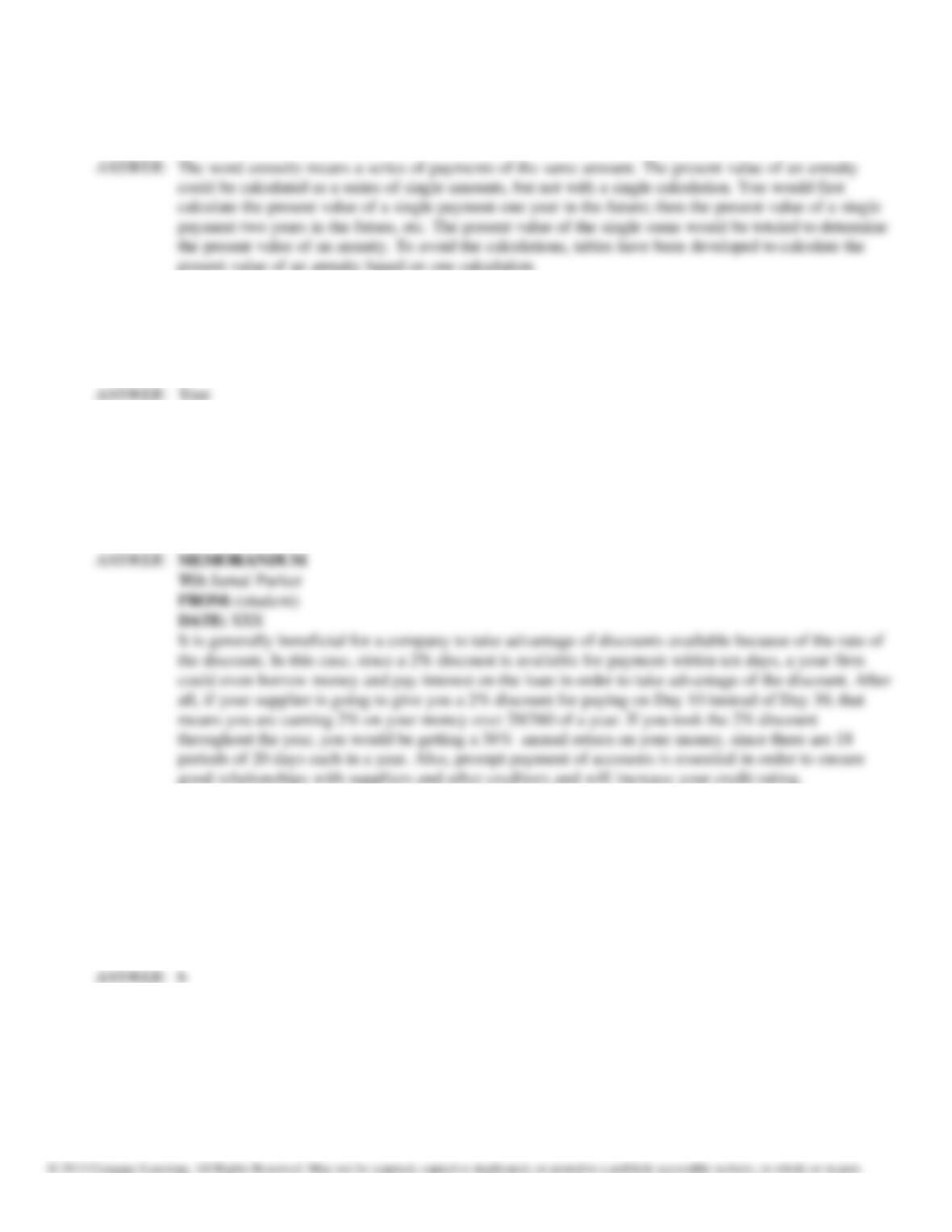
206. What is the meaning of the word annuity? Can the present value of an annuity be calculated as a series of single
amounts? If so, how?
207. A contingent liability is recorded if it is probable and can be reasonably estimated.
a. True
b. False
208. You have received an email from a new accounting client, Jamal Parker, who has just started a new business.
Jamal would like you to explain whether it is really that beneficial for him to take advantage of a 2/10, net 30 discount
offered by one of his suppliers, given his limited cash flow. In a memo, explain to him why this is or is not a sound
financial move for his new company. Most firms attempt to pay their accounts payable within the discount period to
take advantage of the discount. Why is that normally a sound financial move?
209. To determine whether a lottery winner would prefer to receive the money in a single lump sum immediately or
receive an equal amount over a period of years, you would use which type of time value of money calculation?
a. The future value of an annuity.
b. The present value of an annuity.
c. The present value of a single amount.
d. The future value of a single amount.