Chapter 9: Standard Costing: A Functional-Based Control Approach
Required:
a. Calculate the materials price variance.
b. Calculate the materials usage variance.
c. Calculate the direct labor rate variance.
d. Calculate the direct labor efficiency variance.
e. Calculate the variable manufacturing overhead spending variance.
f. Calculate the variable manufacturing overhead efficiency variance.
g. Calculate the fixed manufacturing overhead spending variance.
h. Calculate the fixed manufacturing overhead volume variance.
117. Sparingly Manufacturing has developed the following standards for one of its products.
STANDARD VARIABLE COST CARD
One Unit of Product
Materials: 5 yards × $6 per yard $30.00
Direct labor: 2 hours × $8 per hour 16.00
Variable manufacturing overhead: 2 hours × $5 per hour 10.00
Total standard variable cost per unit $56.00
The company records materials price variances at the time of purchase.
The following activity occurred during the month of December:
Materials purchased: 5,200 yards costing $29,900
Materials used: 4,750 yards
Units produced: 1,000 units
Direct labor: 2,100 hours costing $17,850
Required:
a. Calculate the direct materials price variance.
b. Calculate the direct materials usage variance.
c. Calculate the direct labor rate variance.
d. Calculate the direct labor efficiency variance.
Chapter 9: Standard Costing: A Functional-Based Control Approach
118. Barbaro Production Company has developed the following standards for one of its products.
STANDARD VARIABLE COST CARD
One Unit of Product
Materials: 30 square feet × $5 per square foot
$150.00
Direct labor: 16 hours × $7 per hour
112.00
Variable manufacturing overhead: 16 direct labor hours × $5 per hour
80.00
Total standard variable cost per unit
$342.00
The company records materials price variances at the time of purchase. The following activity occurred during the
month of April:
Materials purchased: 80,000 sq. feet at $5.30 per sq. foot
Materials used: 74,000 square feet
Units produced: 2,500 units
Direct labor: 42,000 hours at $6.70 per hour
Actual variable manufacturing overhead: $228,000
Required:
a. Calculate the direct materials price variance.
b. Calculate the direct materials usage variance.
c. Calculate the direct labor rate variance.
d. Calculate the direct labor efficiency variance.
e. Calculate the variable overhead spending variance.
f. Calculate the variable overhead efficiency variance.
Chapter 9: Standard Costing: A Functional-Based Control Approach
119. Mulligan Company uses standard costing for direct materials and direct labor. Management would like to use
standard costing for variable and fixed overhead.
The following monthly cost functions were developed for manufacturing overhead items:
Overhead Item Cost Function
Indirect materials $1.00 per DLH
Indirect labor $1.25 per DLH
Utilities $0.50 per DLH
Insurance $10,000
Depreciation $40,000
The cost functions are considered reliable within a relevant range of 20,000 to 40,000 direct labor hours. The
company expects to operate at 25,000 direct labor hours per month.
Information for the month of June is as follows:
Actual overhead costs incurred: Indirect materials $ 20,000
Indirect labor 30,000
Utilities 12,000
Insurance 11,000
Depreciation 40,000
Total $113,000
Actual direct labor hours worked: 24,000
Standard direct labor hours allowed for production achieved: 27,000
Required:
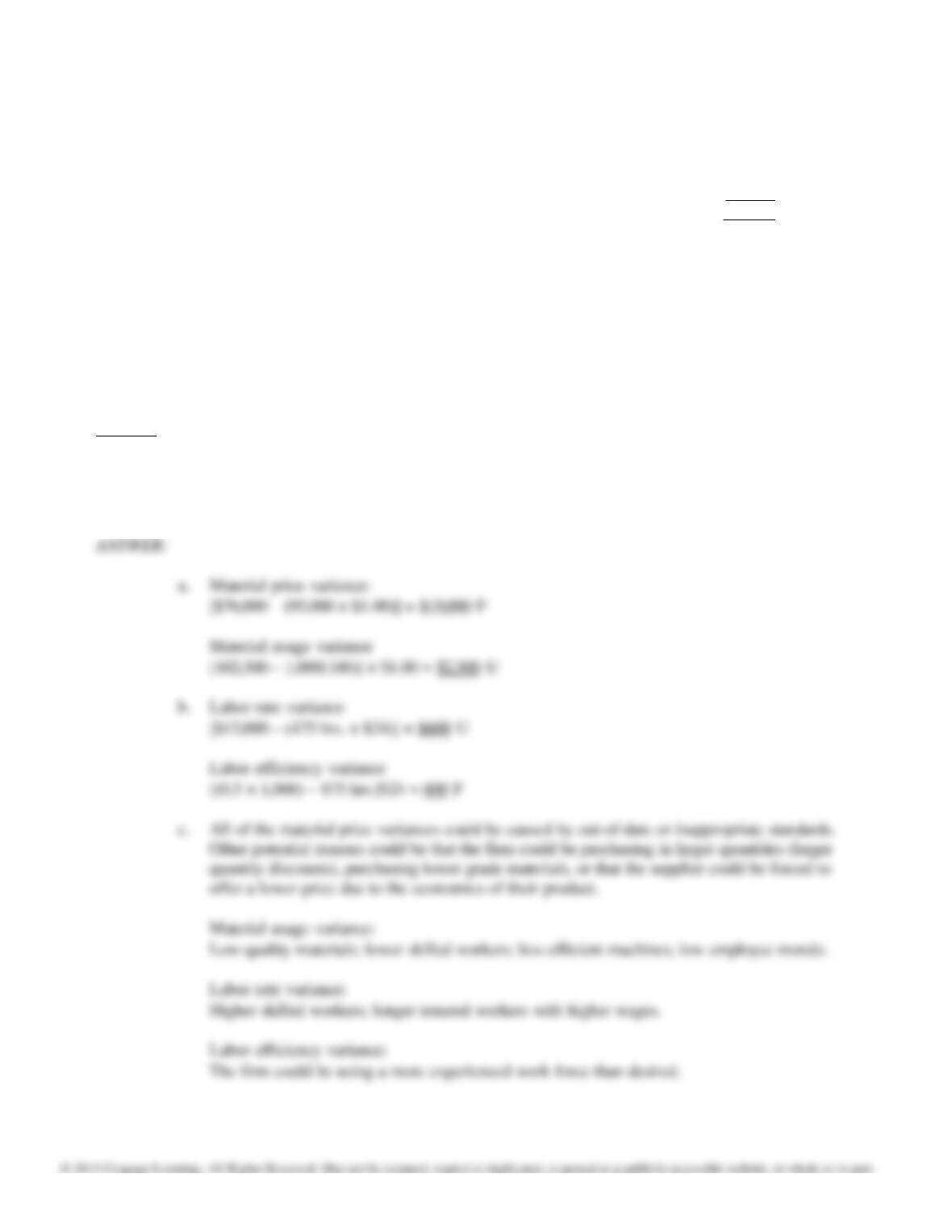
a. Calculate the following standard manufacturing overhead rates based upon expected capacity:
Variable manufacturing overhead
Fixed manufacturing overhead rate
Total manufacturing overhead rate
b. Calculate the following variances:
Variable overhead spending variance
Variable overhead efficiency variance
Fixed overhead spending variance
Fixed overhead volume variance
c. Prepare the journal entries to record and apply overhead costs.
Chapter 9: Standard Costing: A Functional-Based Control Approach
Chapter 9: Standard Costing: A Functional-Based Control Approach
120. United Carborundum Company manufactures 100-pound bags of chemicals that have the following unit standard
costs for direct materials and direct labor:
Direct materials (100 lbs. @ $1.00 per lb.) $100.00
Direct labor (0.5 hours at $24 per hour) 12.00
Total standard direct cost per 100 lb. bag $112.00
The following activities were recorded for October:
• 1,000 bags were manufactured.
• 95,000 lbs. of materials costing $76,000 were purchased.
• 102,500 lbs. of materials were used.
• $12,000 was paid for 475 hours of direct labor.
There were no beginning or ending work-in–process inventories.
Required:
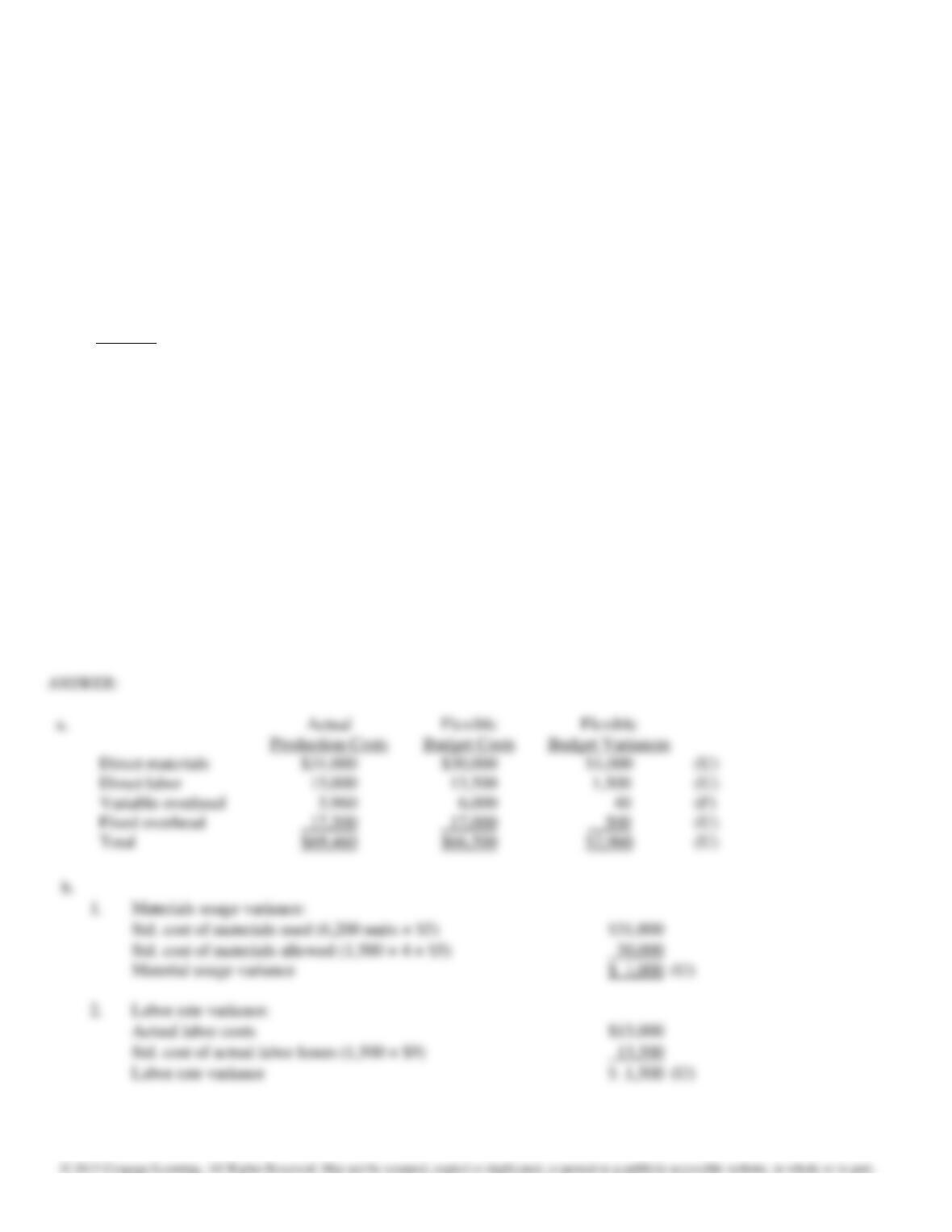
a. Compute the direct materials variances.
b. Compute the direct labor variances.
c. Give possible reasons for the occurrence of each of the preceding variances.
Chapter 9: Standard Costing: A Functional-Based Control Approach
121. Glenville Company manufactures a single product that has a standard materials cost of $20 (4 units of materials at $5
per unit), standard direct labor cost of $9 (1 hour per unit), and standard variable overhead cost of $4 (based on
direct labor hours). Fixed overhead is budgeted at $17,000 per month. The following data pertain to operations for
May 2016:
Materials purchased: 8,000 units costing $39,400
Materials used in production of 1,500 units of finished product: 6,200 units of materials
Direct labor used: 1,500 hours costing $15,000
Variable overhead costs incurred: $5,960
Fixed overhead costs incurred: $17,500
Required:
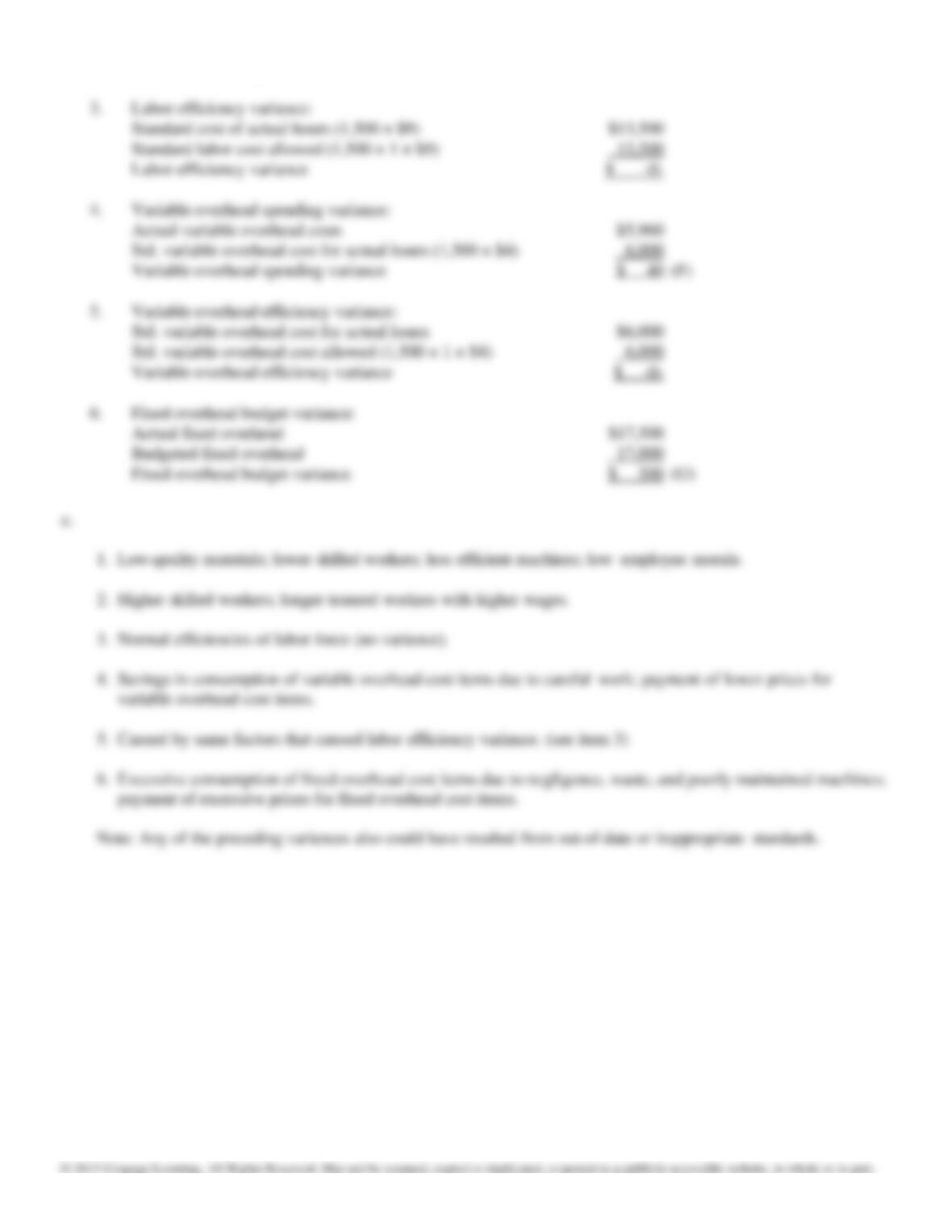
a. Prepare a performance report for Glenville for May using the following headings:
1. Actual Production Costs
2. Flexible Budget Costs
3. Flexible Budget Variances
b. Compute the following variances (show calculations):
1. Materials usage variance
2. Labor rate variance
3. Labor efficiency variance
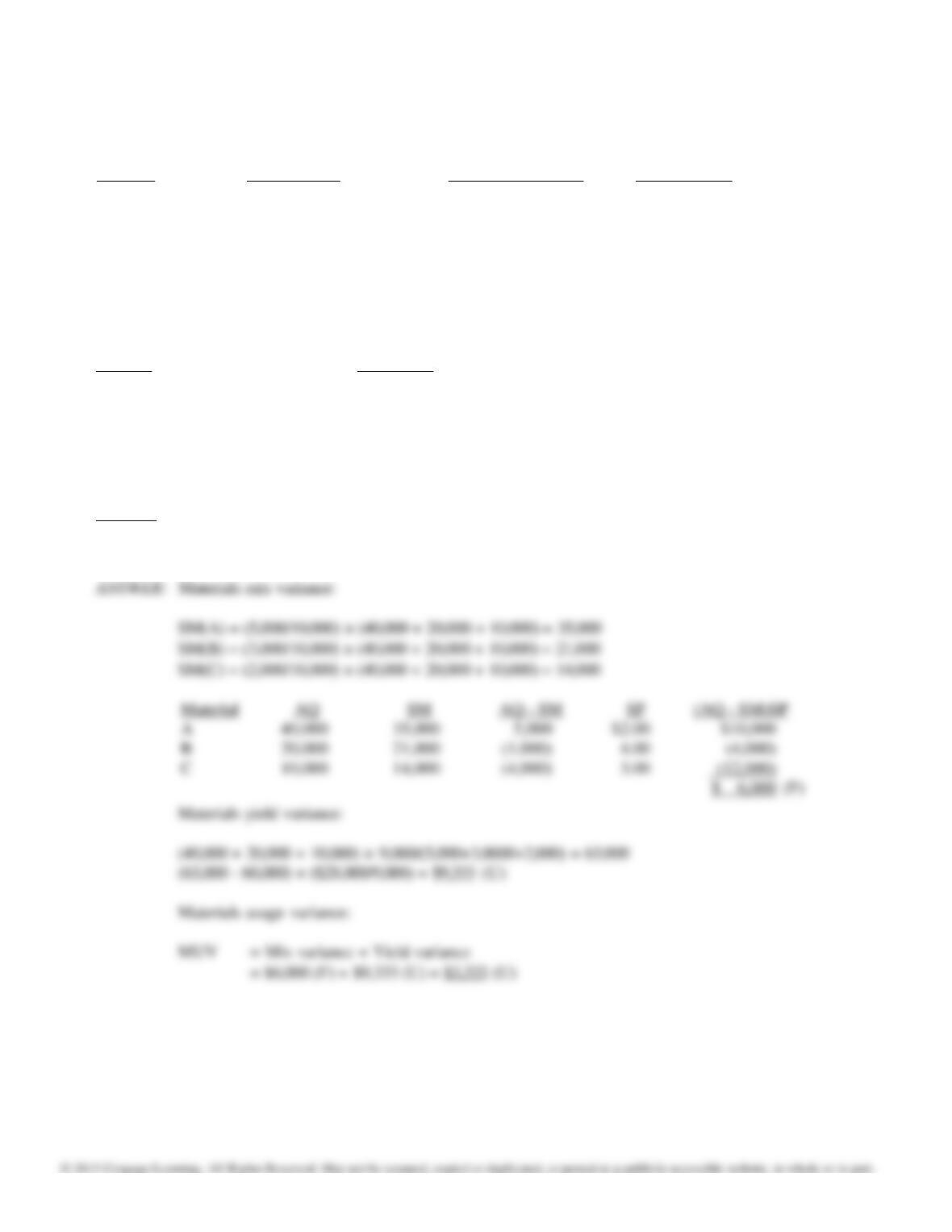
4. Variable overhead spending variance
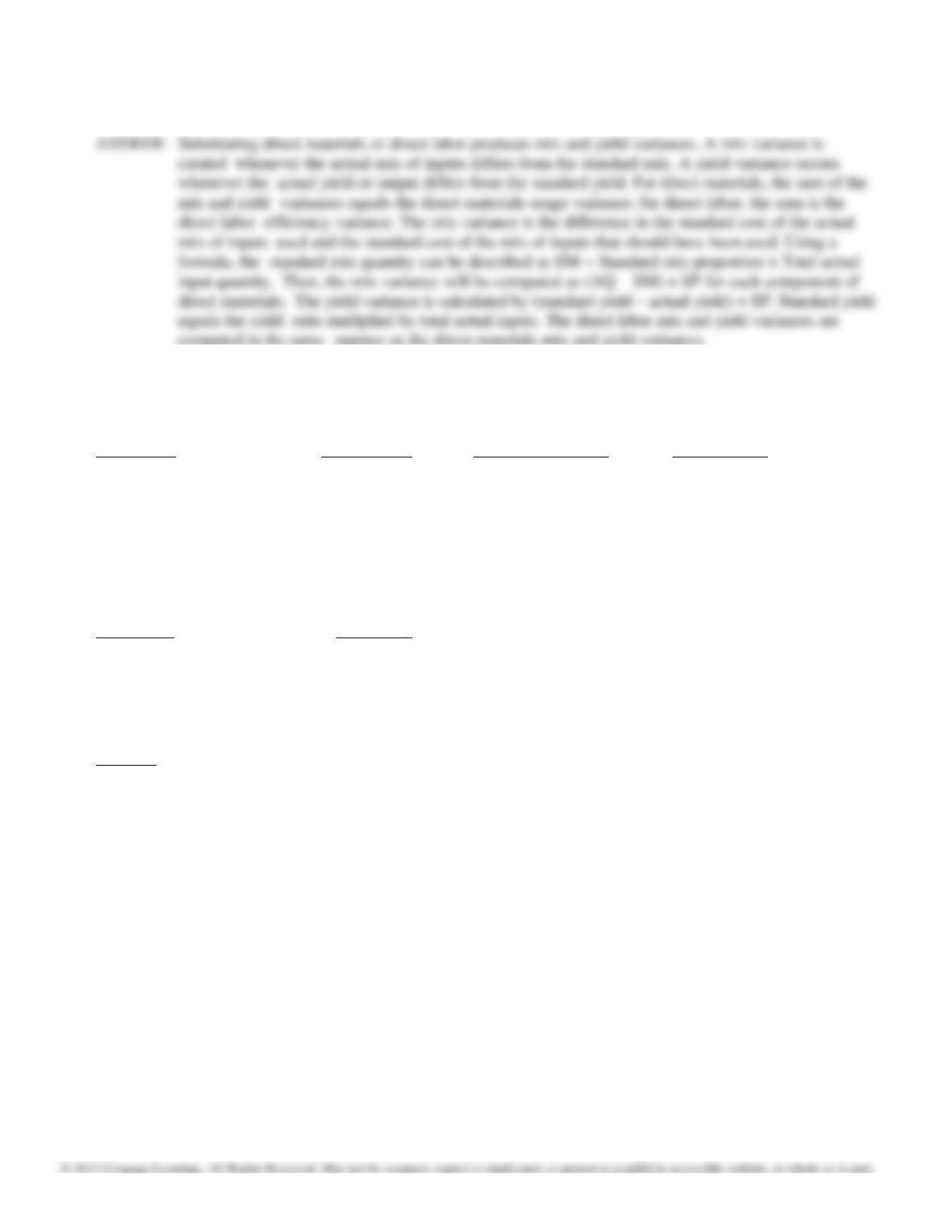
5. Variable overhead efficiency variance
6. Fixed overhead budget variance
c. Give one possible explanation for each of the six variances computed in part (b).
Chapter 9: Standard Costing: A Functional-Based Control Approach
Chapter 9: Standard Costing: A Functional-Based Control Approach
122. Stammer Company uses three materials in the production of their product. The materials, A, B, and C, have the
following standards:
Material Standard Mix Standard Unit Price Standard Cost
A 5,000 units $2.00 per unit $10,000
B 3,000 units 4.00 per unit $12,000
C 2,000 units 3.00 per unit $ 6,000
Yield 9,000 units
During April, the following actual production information was provided:
Material Actual Mix
A 40,000 units
B 20,000 units
C 10,000 units
Yield 60,000 units
Required:
Calculate the materials usage, mix, and yield variances.
Chapter 9: Standard Costing: A Functional-Based Control Approach
123. Compare and contrast mix and yield variances.
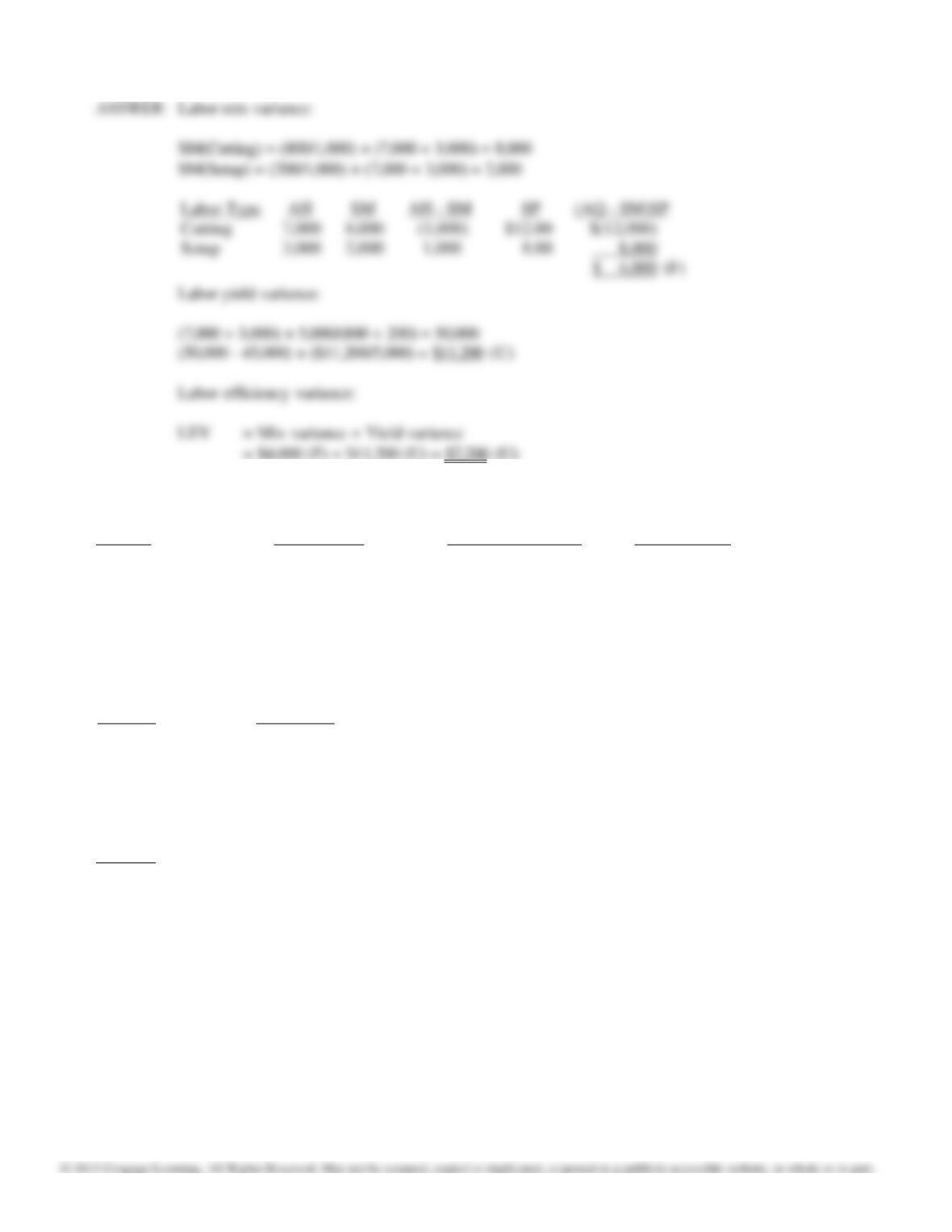
124. LaPointe Corporation uses two different types of labor to manufacture its product. The types of labor, Cutting and
Setup, have the following standards:
Labor Type
Standard Mix
Standard Unit Price
Standard Cost
Cutting
800 hours
$12.00 per unit
$9,600
Setup
200 hours
8.00 per unit
$1,600
Yield 5,000 units
During January, the following actual production information was provided:
Labor Type Actual Mix
Cutting 7,000 hours
Setup 3,000 hours
Yield 45,000 units
Required:
Calculate the labor efficiency and mix and yield variances.
Chapter 9: Standard Costing: A Functional-Based Control Approach
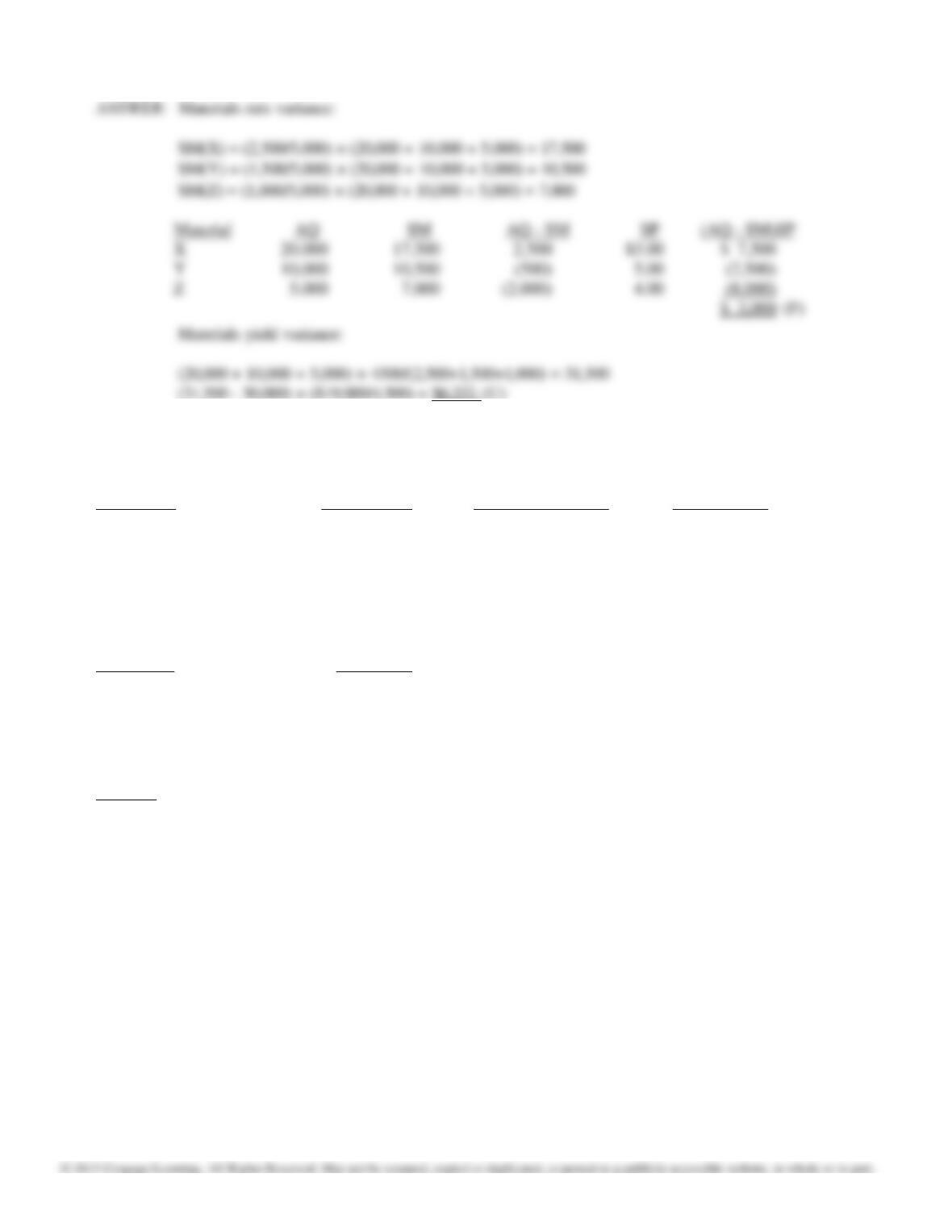
125. The following information is provided about three materials utilized in the production of a product:
Material Standard Mix Standard Unit Price Standard Cost
X 2,500 units $3.00 per unit $7,500
Y 1,500 units 5.00 per unit $7,500
Z 1,000 units 4.00 per unit $4,000
Yield 4,500 units
During May, the following actual production information was provided:
Material
Actual Mix
X
20,000 units
Y
10,000 units
Z
5,000 units
Yield 30,000 units
Required:
Calculate the materials mix and yield variances.
Chapter 9: Standard Costing: A Functional-Based Control Approach
126. Organics Corporation uses two different types of labor to manufacture its product. The types of labor, Cutting and
Setup, have the following standards:
Labor Type
Standard Mix
Standard Unit Price
Standard Cost
Cutting
400 hours
$6.00 per unit
$2,400
Setup
Yield 2,500 units
100 hours
4.00 per unit
$ 400
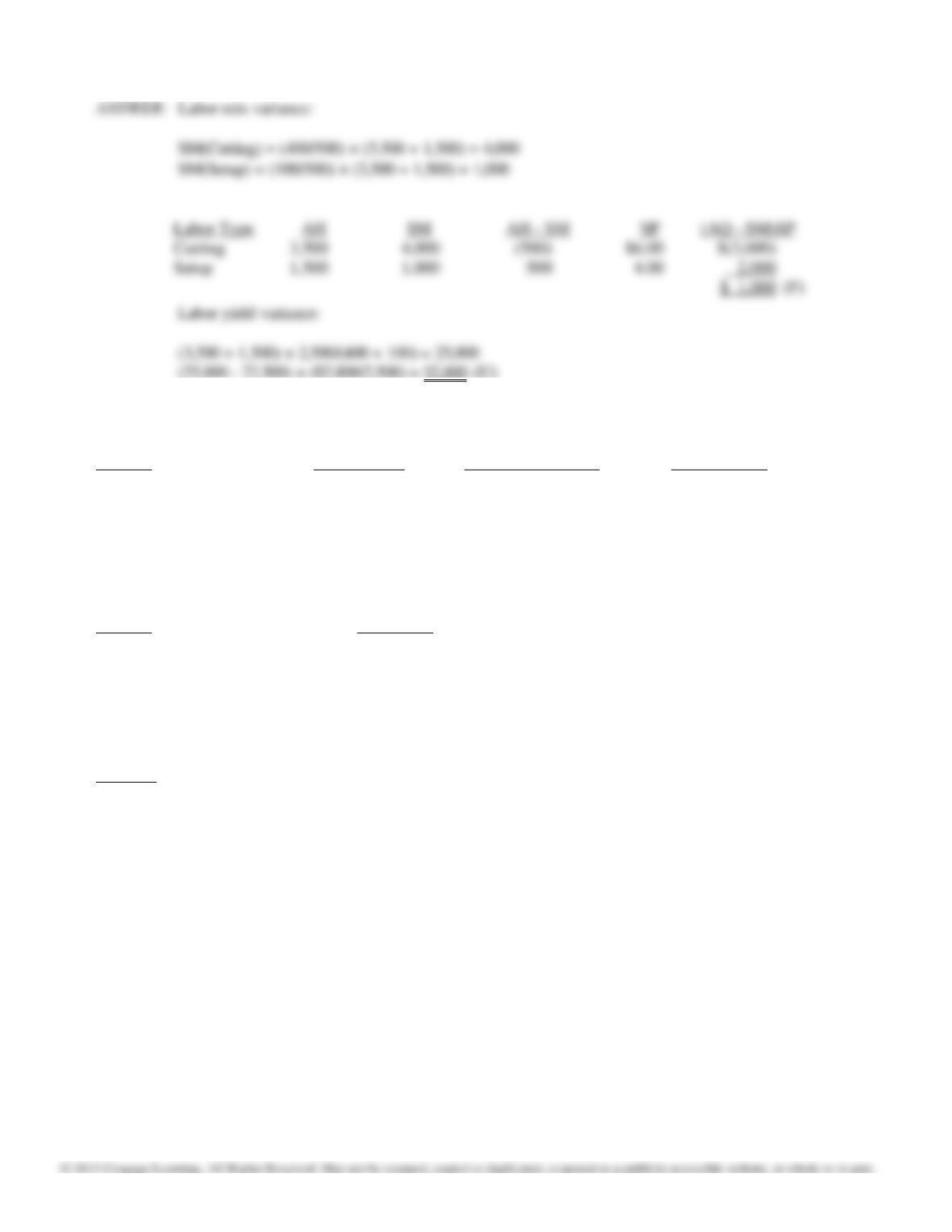
During July, the following actual production information was provided:
Labor Type Actual Mix
Cutting 3,500 hours
Setup 1,500 hours
Yield 22,500 units
Required:
Calculate the labor mix and yield variances.
Chapter 9: Standard Costing: A Functional-Based Control Approach
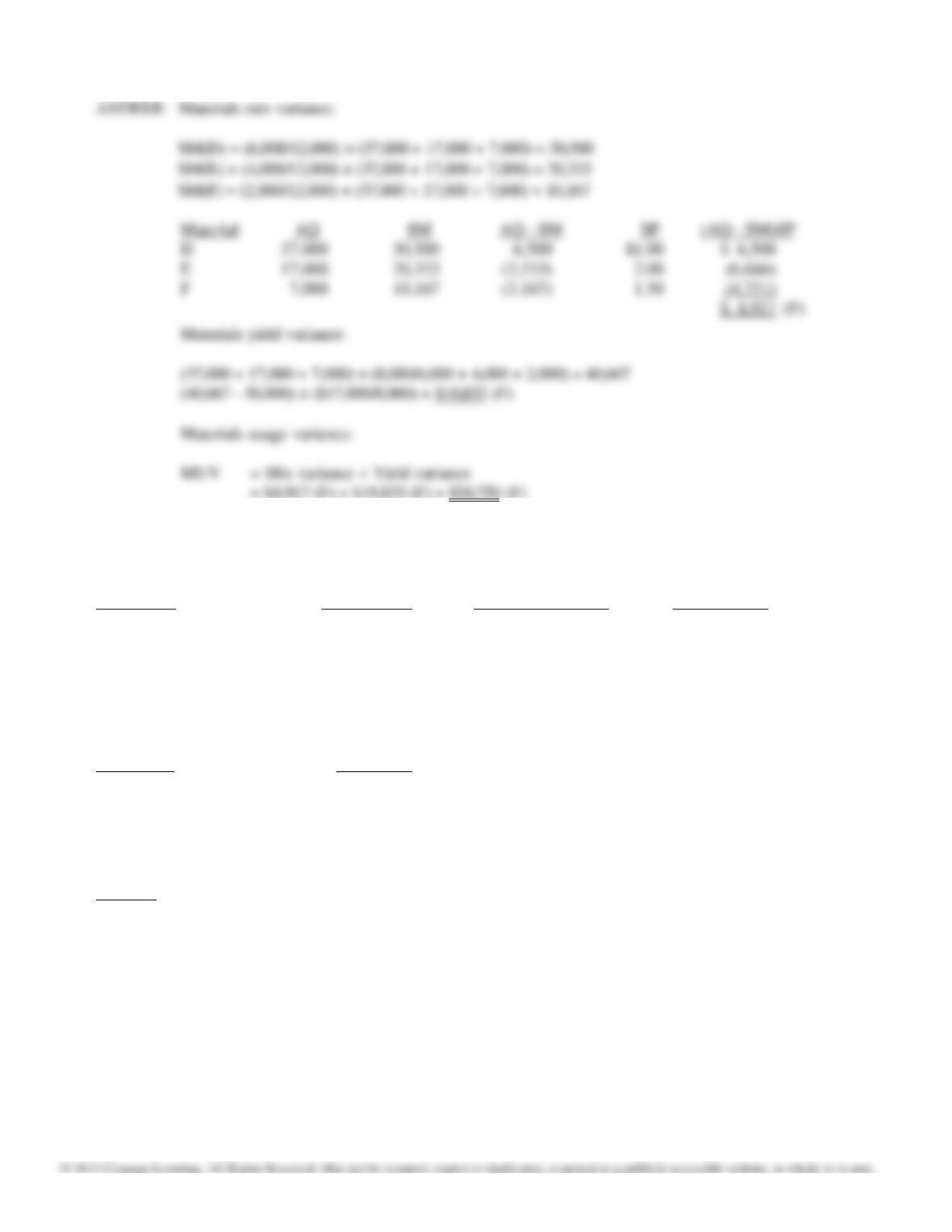
127. Production of a product utilizes materials D, E, and F. The following are their standards:
Material
Standard Mix
Standard Unit Price
Standard Cost
D
6,000 units
$1.00 per unit
$6,000
E
4,000 units
2.00 per unit
$8,000
F
Yield 8,000 units
2,000 units
1.50 per unit
$3,000
During August, the following actual production information was provided:
Material Actual Mix
D 37,000 units
E 17,000 units
F 7,000 units
Yield 50,000 units
Required:
Calculate the materials mix, yield, and usage variances.
Chapter 9: Standard Costing: A Functional-Based Control Approach
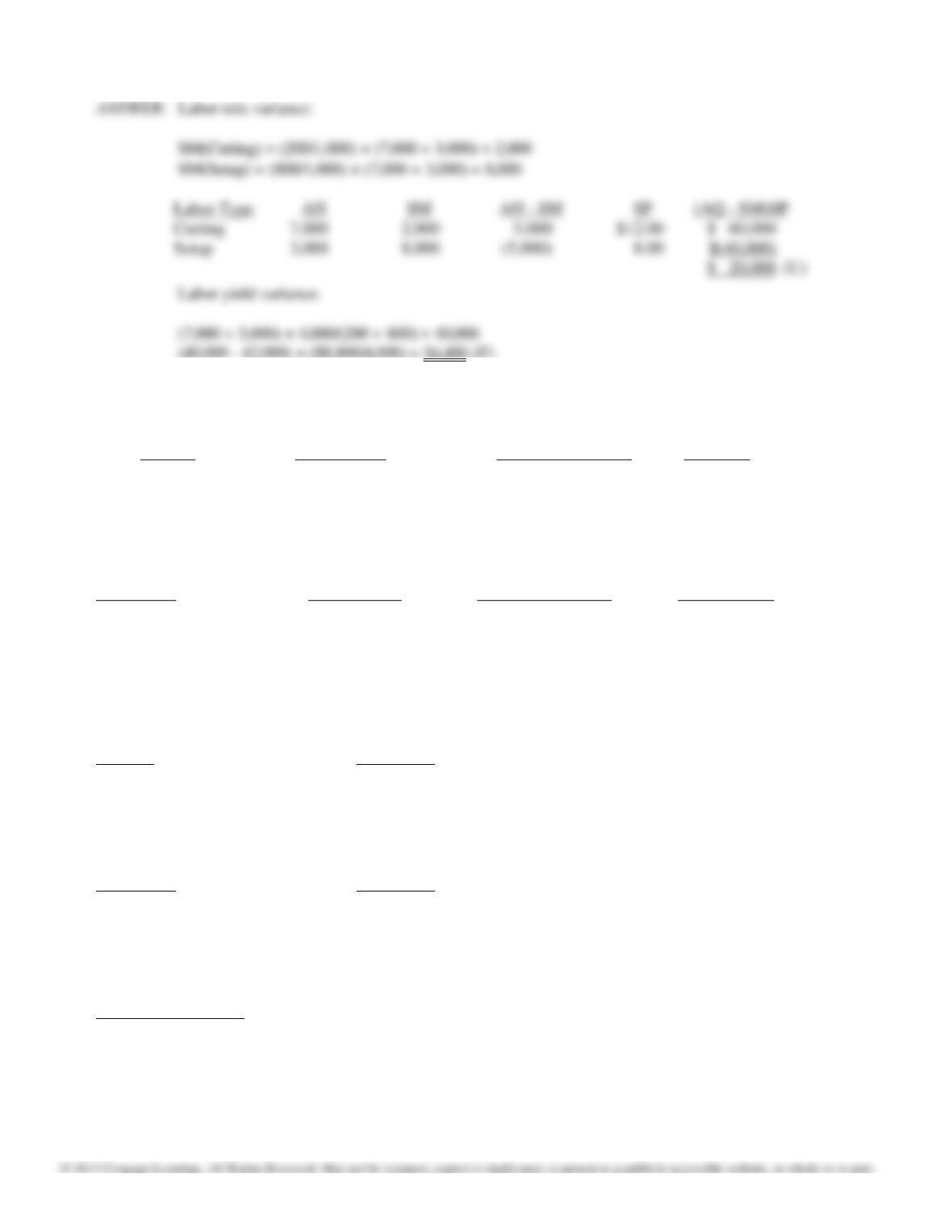
128. Mozambique Industries uses two different types of labor to manufacture its product. The types of labor, Cutting and
Setup, have the following standards:
Labor Type
Standard Mix
Standard Unit Price
Standard Cost
Cutting
200 hours
$12.00 per unit
$2,400
Setup
Yield 4,000 units
800 hours
8.00 per unit
$6,400
During September, the following actual production information was provided:
Labor Type Actual Mix
Cutting 7,000 hours
Setup 3,000 hours
Yield 42,000 units
Required:
Calculate the labor mix and yield variances.
Chapter 9: Standard Costing: A Functional-Based Control Approach
129. The Stronghold Corporation uses two materials and two types of labor to manufacture a product. The following are
their standards:
Material
Standard Mix
Standard Unit Price
Standard
P
5,500 units
$2.00 per unit
$ 8,000
Q
4,500 units
5.00 per unit
$22,500
Yield 5,000 units
Labor Type Standard Mix Standard Unit Price Standard Cost
Grinding 300 hours $8.00 per unit $2,400
Polishing 150 hours 6.00 per unit $ 900
Yield 6,000 units
During the month of November, the following actual production information was provided:
Material Actual Mix
P 30,000 units
Q 20,000 units
Yield 30,000 units
Labor Type Actual Mix
Grinding 4,500 hours
Polishing 2,500 hours
Yield 30,000 units
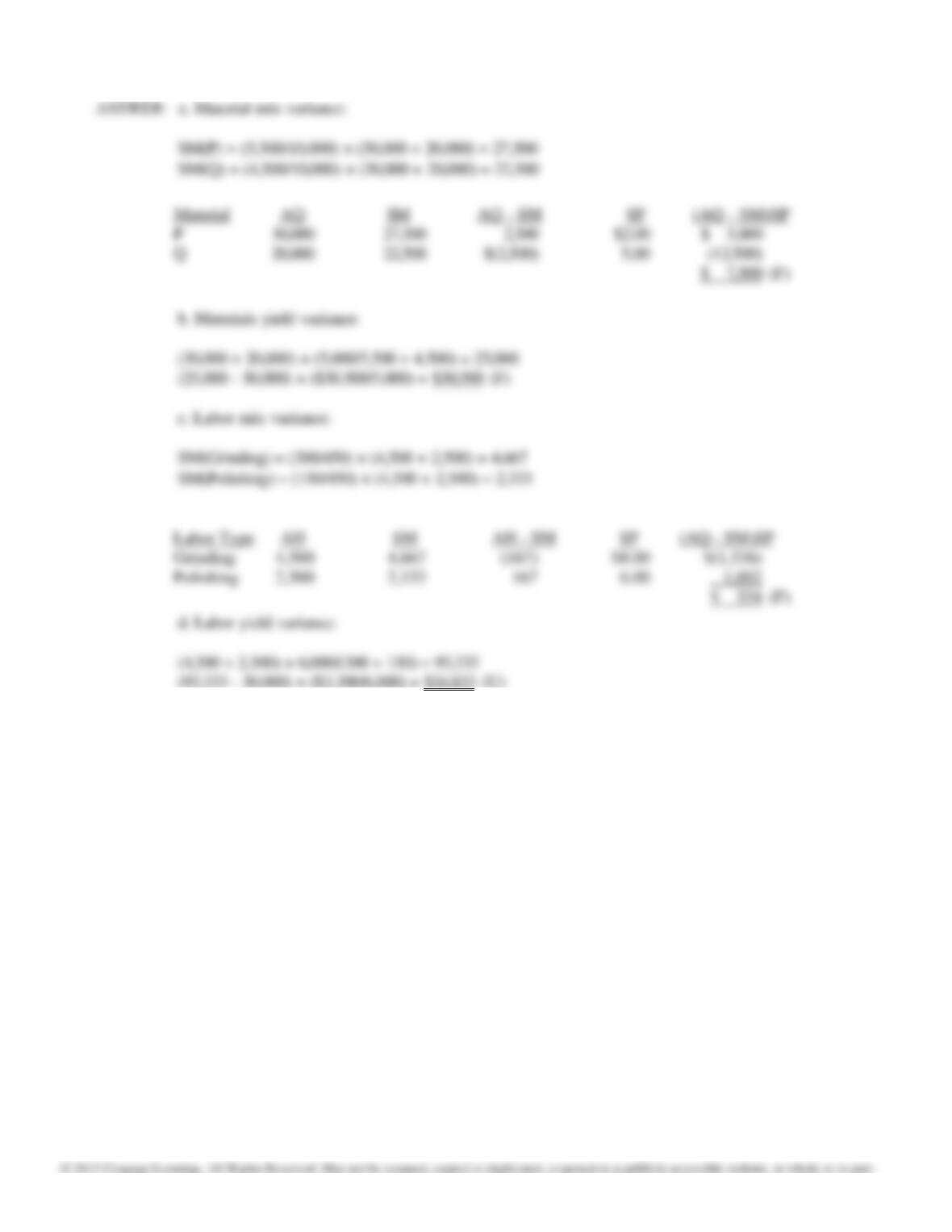
Required calculations:
a. Material mix variance
b. Material yield variance
c. Labor mix variance
d. Labor yield variance
Chapter 9: Standard Costing: A Functional-Based Control Approach