Chapter 9 Test Questions
9.4.1. You are a manager with nine employees reporting directly to you. (You have full span of
control.) All nine employees have essentially the same responsibilities. They all have
numerous opportunities to make mistakes (of various types) in their jobs, but only a small
chance of making any one particular mistake at any one time. In the past year you have
recorded the following number of mistakes for each employee. Assume that all mistakes
are equally critical, so that you cannot distinguish between employees based on the type
of mistake they make.
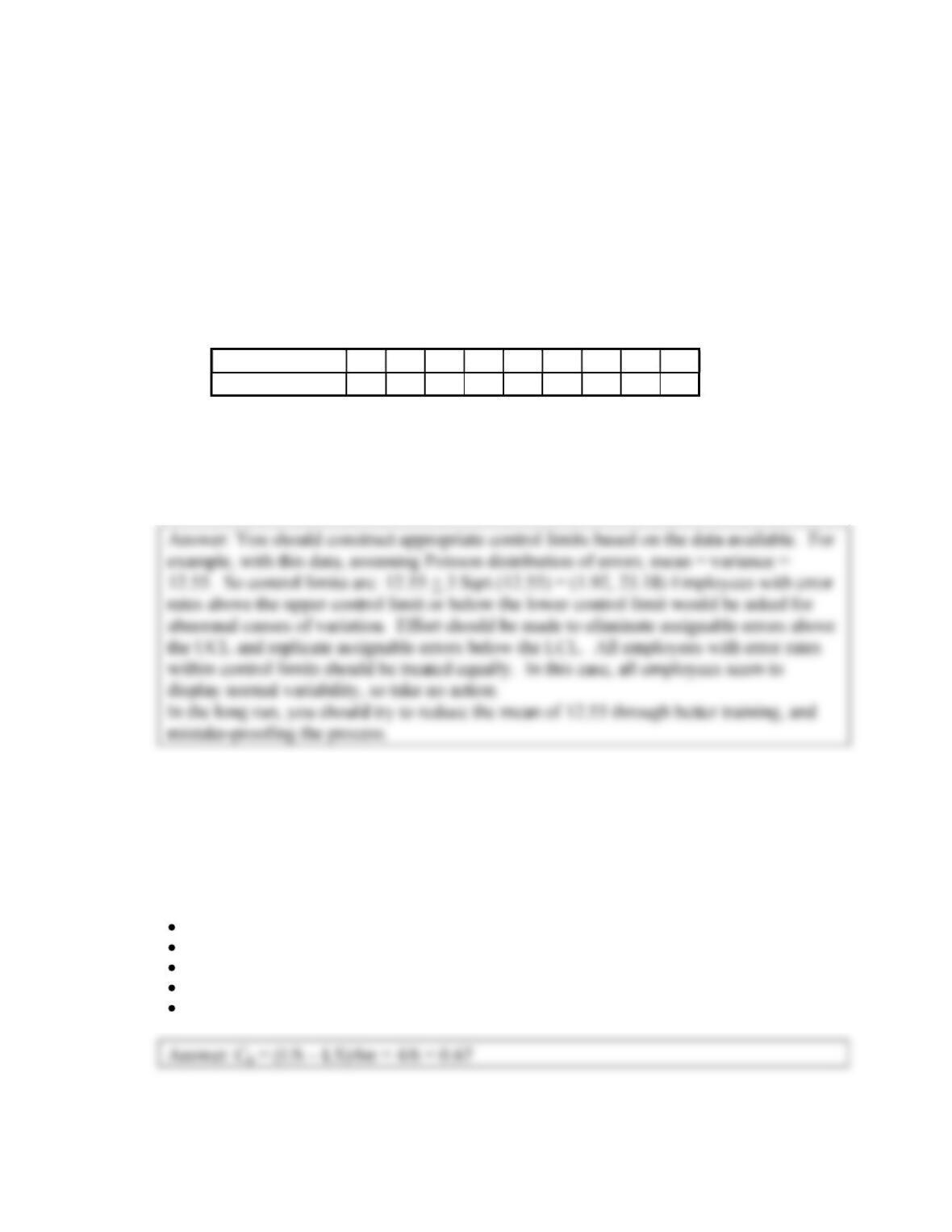
Employee 1 2 3 4 5 6 7 8 9
No. of Mistakes
10 15 11 5 17 22 11 12 10
It is time for evaluations and merit raise recommendations. Suggest an approach (you do
not have to show any computations) to decide who to reward and who to penalize?
Assume that the total number of transactions performed by each employee are the same
during the year.
9.4.2 A customer wants delivery to be ensured between 10 am and 2 pm. Your truck leaves the
factory at 4 am and the time taken to reach the customer is normally distributed with an average
of 8 hrs and a standard deviation of 1 hr.
(a) What is the process capability ratio of the process?
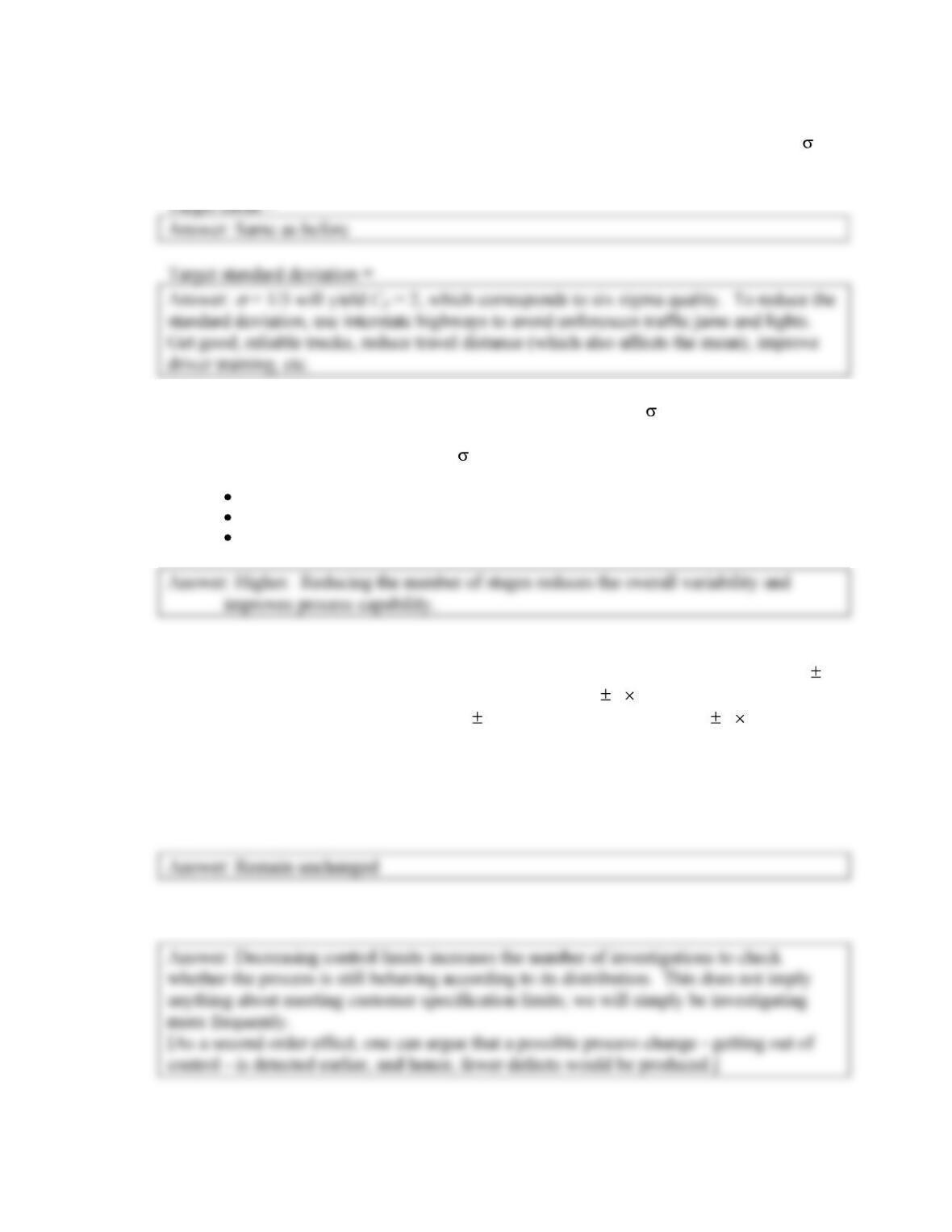
0.67
0.50
1.00
2.00
None of the above
(b) What specific action(s) (in terms of mean and standard deviation targets to be
achieved) would you take to improve the ability of the delivery process to be a 6–
process (like Motorola)?
9.4.3 An assembly process has twenty successive stages, each with 3- capability. The
company has come up with a new design that will require only ten assembly stages. The
capability at each stage still remains 3- . The overall assembly process capability with
the new design will be
Higher than the original design.
Same as the original design.
Lower than the original design.
9.4.4 A machine produces drive shafts. Manufacturing currently takes samples of 10 shafts
every half an hour to check if the process is in control. Control limits have been set at 3
standard deviations of the sample means and are set at 10 3 0.001 cm. A suggestion
calls for control limits to be tightened to 2 standard deviations, i.e., 10 2 0.001 cm.
As a result the proportion of shafts produced that are defective (outside specification
limits) will
(i) Increase
(ii) Decrease
(iii) Remain unchanged
Explain.
9.4.5 K-Log produces cereals that are sold in boxes labeled to contain 390 grams. If the cereal
content is below 390 grams, K-Log may invite FDA scrutiny. Filling much more than 390
grams costs the company since it essentially means giving away more of the product.
Accordingly, K-Log has set specification limits between 390 and 410 grams for the
weight of cereal boxes. Currently the boxes are filled automatically by a filling machine
and they have an average weight of 405 g with a standard deviation of 4 g. What process
targets (in terms of mean and standard deviation of the filling process) are needed for the
filling machine to have a six- capability?