82. On March 3, 2012, Binford Tools acquired the following assets from Mace Hardware for $360,000:
Book
Fair Market
Value
Value
Accounts Receivable
$ 58,000
$ 33,000
Inventory
92,000
76,000
Equipment
139,000
182,000
Patent
13,000
8,000
How much goodwill should Binford record for this acquisition?
83. The ratio that measures how efficiently a company is using its property, plant, and equipment is the
84. The fixed asset turnover ratio is interpreted as the
85. Johnston Company’s financial statements on December 31, 2012, showed the following:
Sales
$275,000
Property, plant, and equipment, 1/1/12
$ 73,000
Property, plant, and equipment, 12/31/12
$ 67,000
Total assets, 1/1/12
$ 97,000
Total assets, 12/31/12
$100,000
Given this information, Johnston Company’s fixed asset turnover ratio for 2012 was (round to two decimal places)
86. In order to calculate the third year’s depreciation on an asset using the sum-of-the-years’-digits method,
which of the following must be known about the asset?
87. Which of the following methods will always produce more depreciation expense in the early years of an
asset’s useful life than in the later years?
88. Which depreciation formula does NOT include salvage value?
89. Four widely used methods of allocating the cost of equipment over its useful life are
90. The straight-line depreciation method usually provides for a higher amount of depreciation expense during
the last year of an asset’s life than does
91. Which depreciation method usually allows the highest amount of net income to be reported during the first
year an asset is owned?
92. Which of the following depreciation methods can NOT depreciate an asset below its salvage value?
93. Which of the following methods applies a declining depreciation rate each period to an asset’s constant
value?
94. Which of the following depreciation methods initially ignores salvage value in its calculation?
95. Which of the following depreciation methods applies a uniform depreciation rate each period to an asset’s
book value?
96. The sum-of-the-years’-digits method of depreciation is being used for a machine with a 5-year estimated
useful life. Which fraction would be applied to the cost to be depreciated in the second year?
97. Rexford Company purchased a machine on January 1, 2012, for $57,600 cash. The machine has an
estimated useful life of 8 years and a salvage value of $15,040. Rexford uses the double-declining-balance
method of depreciation for all its assets. What will be the depreciation expense for 2012?
98. Rexford Company purchased a machine on January 1, 2012, for $57,600 cash. The machine has an
estimated useful life of 8 years and a salvage value of $15,040. Rexford uses the double declining-balance
method of depreciation for all its assets. What will be the machine’s book value as of December 31, 2013?
99. Spears Corporation bought a machine on January 1, 2011. In purchasing the machine, the company paid
$50,000 cash and signed an interest-bearing note for $100,000. The estimated useful life of the machine is 5
years, after which time the salvage value is expected to be $15,000. The company uses the sum-of-the-years’-
digits depreciation method. Given this information, how much depreciation expense would be recorded for the
year ending December 31, 2012?
100. On September 1, 2012, Tan Party Supplies purchased catering equipment for $4,680. The equipment is
estimated to have a useful life of 8 years and no salvage value. If Tan selected the sum-of-the-years’-digits
method, what will be the depreciation expense for 2012?
101. Ferrott Company purchased a machine that was installed and placed in service on January 2, 2011, at a
total cost of $480,000. Salvage value was estimated at $80,000. The machine is being depreciated over ten years
by the double-declining-balance method. For the year 2012, Ferrott should record depreciation expense of
102. On January 1, 2009, McMahan Company purchased equipment at a cost of $420,000. The equipment was
estimated to have a useful life of 5 years and a salvage value of $60,000. McMahan uses the sum-of-the-years’-
digits method of depreciation. What should the accumulated depreciation be at December 31, 2012?
103. On January 1, 2010, Mena Co. purchased a new machine for $2,000,000. The machine has an estimated
useful life of 5 years and a salvage value of $200,000. Mena uses the sum-of-the-years’-digits method of
depreciation. The amount of depreciation expense for 2012 is
104. On January 1, 2010, Mena Co. purchased a new machine for $2,000,000. The machine has an estimated
useful life of 5 years and a salvage value of $200,000. Mena uses the double-declining-balance method of
depreciation. The amount of depreciation expense for 2012 is
105. A machine is purchased on January 1, 2012, for $72,000 cash. The machine has an estimated useful life of
8 years and a salvage value of $17,200. If the double-declining-balance method of depreciation is used, what
will be the machine’s book value as of December 31, 2013?
106. On January 1, 2011, Meri-Ann Corporation purchased computer equipment for $23,000. The equipment
had an estimated useful life of 4 years and a salvage value of $400. Meri-Ann uses the sum-of-the-years-digits
method of depreciation. The accumulated depreciation at December 31, 2012, would be
107. On January 1, 2011, Gecho Corporation purchased computer equipment for $23,000. The equipment has
an estimated useful life of 4 years and a salvage value of $400. Given this information, if Gecho uses the
double-declining-balance method of depreciation and sells the equipment of December 31, 2012, for $250, it
will have a
108. On September 1, 2012, Tan Party Supplies purchased catering equipment for $4,680. The equipment is
estimated to have a useful life of 8 years and no salvage value. Assuming that the sum-of-the-years’-digits
method is used, what will be the depreciation expense for 2013?
109. On January 1, 2011, Heather Locks Corporation purchased drilling equipment for $11,500. The equipment
has an estimated useful life of 4 years and a salvage value of $200. Given this information, if Heather uses the
double-declining-balance method of depreciation and sells the equipment on December 31, 2012, for $3,000, it
will have a
110. Luray Company purchased a new $40,000 truck on January 1, 2012. The truck was expected to last 4 years
and have no salvage value. During 2013, Loray’s depreciation expense on the truck was $12,000. Which of the
following depreciation methods is Loray Company using to depreciate the truck?
111. If the estimate of an asset’s useful life is changed, then

112. Shanahan Construction purchased a crane on January 1, 2010, for $102,750. At the time of purchase, the
crane was estimated to have a life of 6 years and a residual value of $6,750. In 2012, Shanahan determined that
the crane had a total useful life of 7 years and a residual value of $4,500. If Shanahan uses the straight-line
method of depreciation, what will be the 2012 depreciation expense for the crane?
113. A truck that cost $8,000 was originally being depreciated over 4 years using the straight-line method with
no salvage value. At the beginning of year two, it was decided that the truck would last 5 more years. Given this
information, the second year’s depreciation would be
114. Trans-State Movers purchased a truck on January 1, 2011, for $51,375. At the time of purchase, the truck
was estimated to have a useful life of 6 years and a residual value of $3,375. In 2012, Trans-State determined
that the truck had a total useful life of 10 years and the residual value is unchanged. If Trans-State uses the
straight-line method of depreciation, what will be the 2012 depreciation expense for the truck?
115. Claflin Construction Company purchased a machine on January 1, 2011 for $411,000. The machine has an
estimated useful life of 8 years and a salvage value of $27,000. In 2013, Claflin determines that the machine
will actually have a total useful life of 5 years and the salvage value will be $15,000. If Claflin uses straight-line
depreciation, what will be the balance of the accumulated depreciation account on December 31, 2013?
116. Norton Company owns a machine that was bought on January 2, 2009, for $376,000. The machine was
estimated to have a useful life of 5 years and a salvage value of $24,000. Norton uses the sum-of-the-years’-
digits method of depreciation. At the beginning of 2012, Norton determined that the useful life of the machine
should have been 4 years and the salvage value $35,200. For the year 2012, Norton should record depreciation
expense on this machine of
117. On January 1, 2012, Versachi Industries, a calendar-year corporation, leased an airplane under a 7-year,
noncancelable lease agreement that requires Versachi to pay the lessor $30,000 at the end of each year. The first
payment is due December 31, 2012. The present value of the lease payments is $150,990, assuming an interest
rate of 9 percent. At the end of the 7-year lease term, the airplane will be returned to the lessor unless Versachi
Corporation chooses to purchase the airplane at its appraised market value. At January 1, 2012, the airplane has
an estimated economic life of 10 years and a fair market value of $190,000.
1.
Determine whether the airplane lease is an operating or a capital lease and explain your classification.
2.
Without regard to your answer to (1), assume the lease is a capital lease and interest for 2012 is $13,600. Give the journal entries to record
the lease at January 1 and the first payment at December 31, 2012.
b.
There is no bargain purchase option.
2.
January 1
Leased Airplane
150,990
Liability
December 31
Lease Liability
16,400
Interest Expense
13,600
Cash
30,000
118. Atchison Corporation purchased equipment, a building, and land for $1,000,000 ($200,000 in cash and
$800,000 in notes). After the purchase, the property was appraised. Fair market values were determined to be
$240,000 for the equipment, $540,000 for the building, and $420,000 for the land.
Prepare the entry to record the purchase of this property by Atchison Corporation.
Equipment
200,000
Building
450,000
Land
350,000
Cash
200,000
Notes Payable
800,000
119. Belpre Inc. constructed a new office building. Building material costs for the new building were
$3,000,000; total labor costs were $2,500,000; total company overhead was $9,000,000 (25% of which could be
assigned to the new project); and interest paid on a new construction loan for the project was $1,250,000.
Calculate the total cost of the self-constructed building.
Materials
$3,000,000
Labor costs
2,500,000
Overhead ($9,000,000 ´ .25)
2,250,000
Interest
1,250,000
Total building cost
$9,000,000
120. Saria Supply Printing Company, a calendar-year corporation, purchased a new scale for $165,000 on April
1, 2012. Additional costs of the scale included sales tax of 5 percent, freight-in of $5,800, and installation costs
of $5,100. The scale has a useful life of 5 years with no salvage value.
a.
Compute the amount at which the scale should be recorded as an asset.
b.
Compute the depreciation expense for 2012 and 2013 using the straight-line depreciation method.
a.
$165,000 + ($165,000 ´ .05) + $5,800 + $5,100 = $184,150
2012: ($184,150 ¸ 5) ´ 9/12
$27,622.50
2013: ($184,150 ¸ 5)
$36,830.00
Asset
Allocation
Cost
Equipment
$ 240,000
20% ´ $1,000,000
$ 200,000
Building
540,000
45% ´ $1,000,000
450,000
Land
420,000
35% ´ $1,000,000
350,000
$1,200,000
$1,000,000
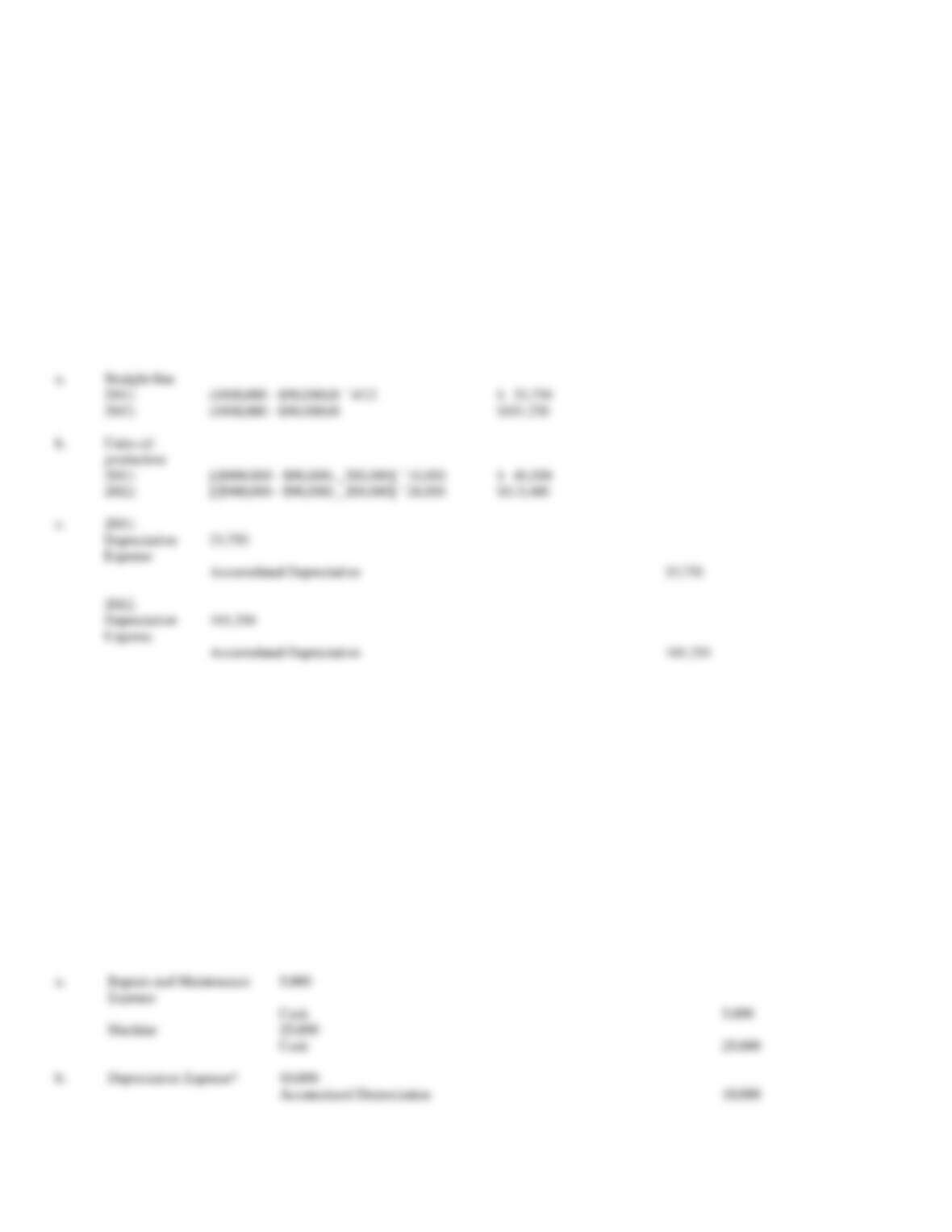
121. Smolan Company purchased a new machine on September 1, 2011. It was expected to produce 200,000
units of product over its estimated useful life of eight years. Total cost of the machine was $900,000, and
salvage value was estimated to be $90,000. Actual units produced by the machine in 2011 and 2012 are shown
below:
2011
10,000 units
2012
28,000 units
a.
Compute the depreciation expense for 2011 and 2012 using the straight-line depreciation method.
b.
Compute the depreciation expense for 2011 and 2012 using the units–of-production method.
c.
Prepare the journal entries to record depreciation expense at the end of 2011 and 2012 using the straight-line depreciation method.
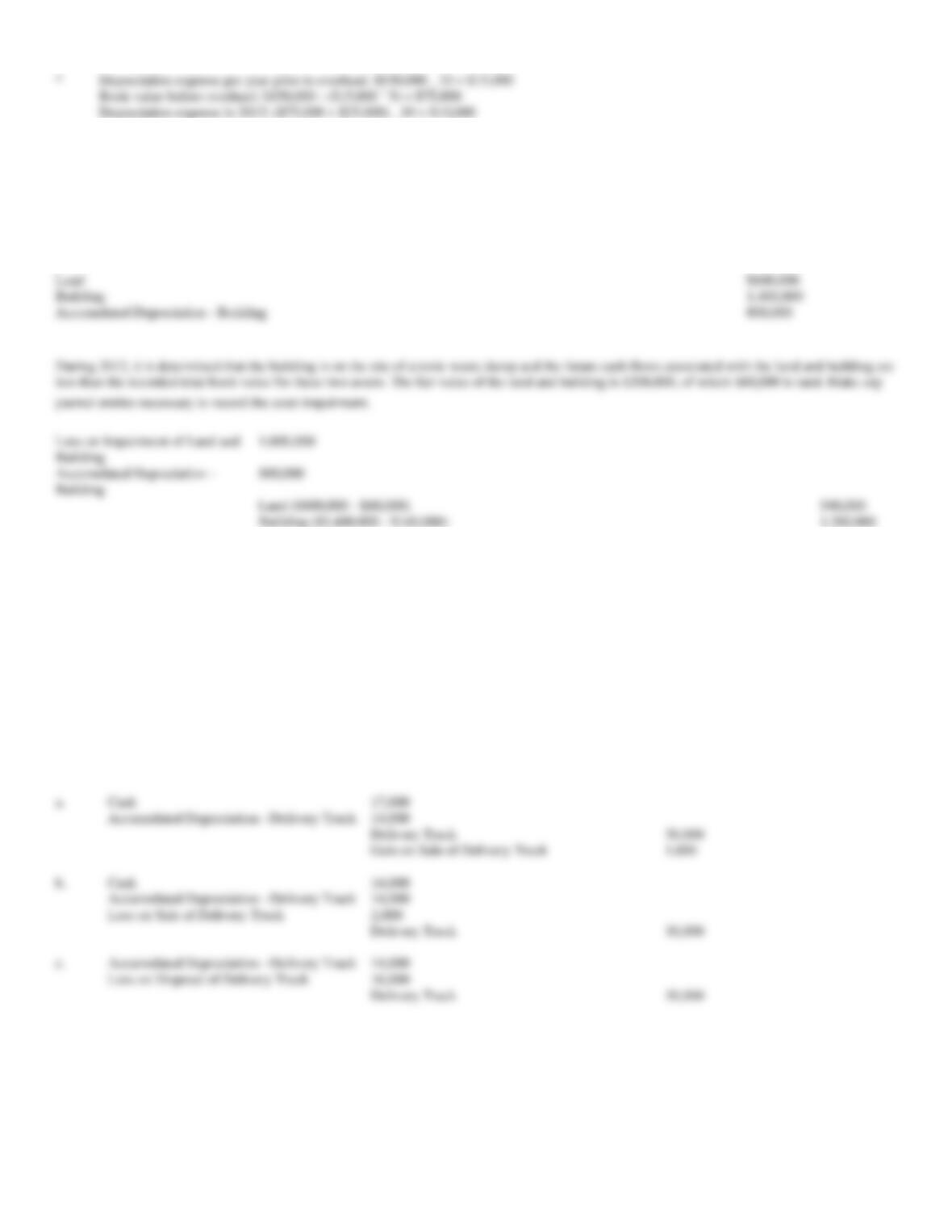
122. Whiting Company purchased a machine in 2007 for $150,000. The machine was being depreciated by the
straight-line method over an estimated useful life of 10 years, with no salvage value. At the beginning of 2012,
after 5 years of use, Whiting paid $30,000 on maintenance to the machine. Whiting determined that $5,000 of
this expense was normal maintenance and did not extend the life of the machine. However, the rest of the
expenditure was an overhaul of the machine and was expected to extend the machine’s estimated useful life by
an additional 5 years. What would be the depreciation expense recorded for the above machine in 2012?
a.
Prepare the appropriate journal entries to record the expenditures on January 1, 2012.
b.
Prepare the appropriate journal entry to record depreciation on December 31, 2012
Cash
5,000
Machine
25,000
Cash
25,000
2011:
($900,000 – $90,000)/8 ´ 4/12
$ 33,750
2012:
($900,000 – $90,000)/8
$101,250
2011:
[($900,000 – $90,000) ¸ 200,000] ´ 10,000
$ 40,500
2012:
[($900,000 – $90,000) ¸ 200,000] ´ 28,000
$113,400
Accumulated Depreciation
33,750
2012:
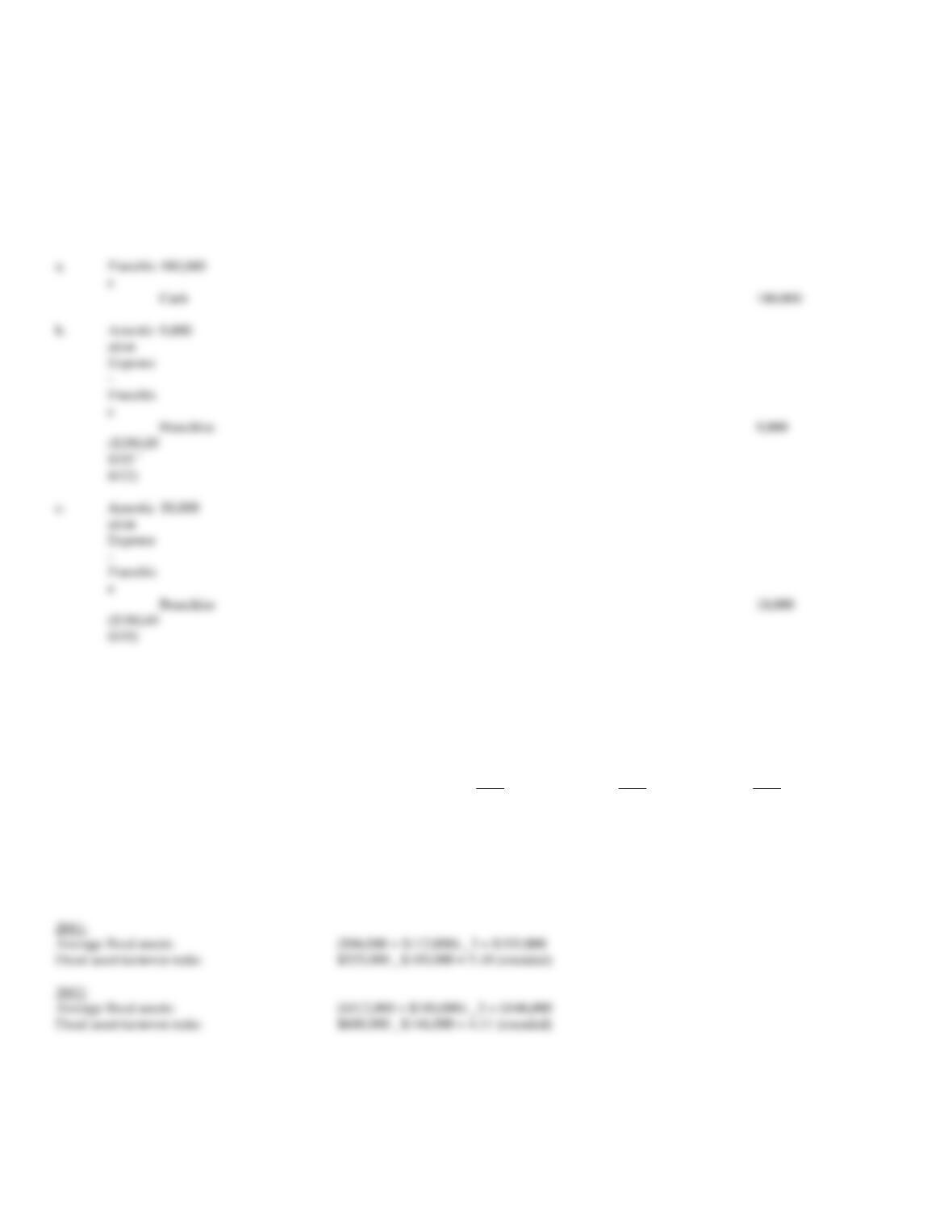
123. In 2002, Yates Company purchased land and a building at a cost of $2,000,000, with $600,000 allocated to
land and $1,400,000 to the building. On December 31, 2011, the accounting records showed the following:
Land
$600,000
Building
1,400,000
Accumulated Depreciation – Building
800,000
Land ($600,000 – $60,000)
Building ($1,400,000 – $140,000)
124. Mini Computers purchased a delivery truck 4 years ago for $30,000. Currently the accumulated
depreciation on the truck is $14,000. Prepare journal entries to show the sale of the truck assuming:
a.
The truck is sold for $17,000.
b.
The truck is sold for $14,000.
c.
The truck is scrapped.
a.
Cash
17,000
Accumulated Depreciation – Delivery Truck
14,000
Delivery Truck
30,000
Gain on Sale of Delivery Truck
1,000
b.
Cash
14,000
Accumulated Depreciation – Delivery Truck
14,000
Loss on Sale of Delivery Truck
2,000
Delivery Truck
30,000
c.
Accumulated Depreciation – Delivery Truck
14,000
Loss on Disposal of Delivery Truck
16,000
Delivery Truck
30,000
*
Depreciation expense per year prior to overhaul: $150,000 ¸ 10 = $15,000
Book value before overhaul: $150,000 – ($15,000 ´ 5) = $75,000
Depreciation expense in 2012: ($75,000 + $25,000) ¸ 10 = $10,000
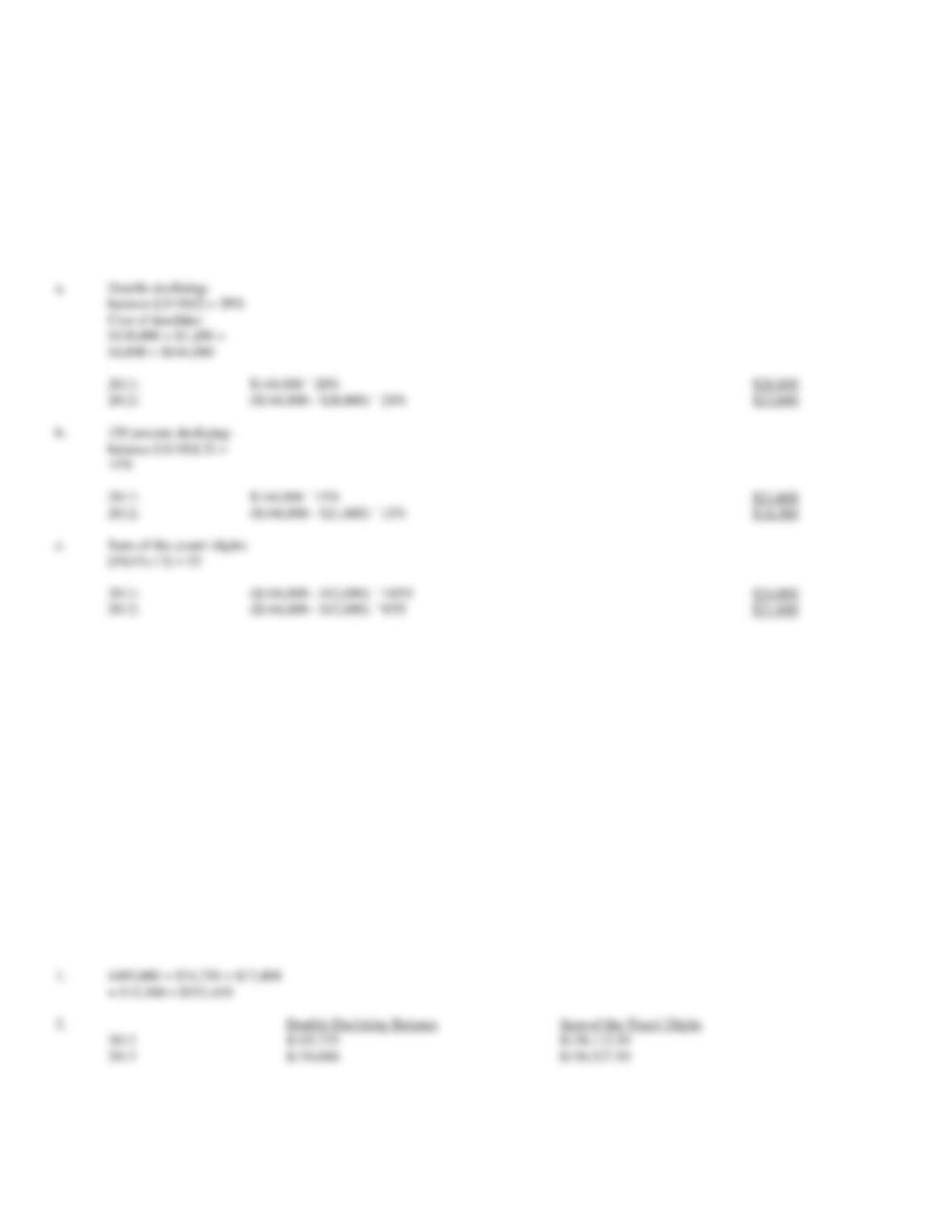
125. On July 1, 2011, Macro Inc. purchased a franchise to operate a Blended Coffee Corner at a cost of
$180,000. Assuming that Macro amortizes franchises over a 10-year period, prepare journal entries to record:
a.
The purchase of the franchise on July 1, 2011.
b.
The amortization of the franchise on December 31, 2011.
c.
The amortization of the franchise on December 31, 2012.
126. Thayer Company’s financial statements on December 31, 2012, showed the following:
2012
2011
2010
Sales
$600,000
$525,000
$430,000
Property, plant, and equipment
180,000
112,000
94,000
Total assets
220,000
201,000
230,000
Given this information, compute Thayer Company’s fixed asset turnover ratio for 2011 and 2012 (round to two decimal places).
2011:
Average fixed assets:
($94,000 + $112,000) ¸ 2 = $103,000
Fixed asset turnover ratio:
$525,000 ¸ $103,000 = 5.10 (rounded)
2012:
Average fixed assets:
($112,000 + $180,000) ¸ 2 = $146,000
Fixed asset turnover ratio:
$600,000 ¸ $146,000 = 4.11 (rounded)
Cash
180,000
Franchise
9,000
Franchise
18,000
127. On January 1, 2011, Milner Company purchased a machine for $138,000. The machine cost $1,200 to
deliver and $4,800 to install. At the end of 10 years, Milner expects to sell the machine for $12,000. Compute
depreciation expense for 2011 and 2012 using the following methods:
a.
Double-declining-balance
b.
150 percent declining-balance
c.
Sum-of-the-years’-digit’s
128. Sylvia Supply Company, a calendar-year corporation, purchased a new scale for $495,000 on April 1,
2012. Additional costs of the scale included sales tax of 5 percent, freight-in of $17,400, and installation costs
of $15,300. The scale has a useful life of 5 years with no salvage value.
1.
Compute the amount at which the scale should
be recorded as an asset.
2.
Compute the depreciation expense for 2012 and
2013 for each of the following depreciation
methods:
a.
Double-declining balance, and
b.
Sum-of-the-years’-digits.
2.
Double-Declining-Balance
Sum-of the-Years’-Digits
2013
$154,686
$156,527.50
balance [(1/10)2] = 20%
Cost of machine:
$138,000 + $1,200 +
2011:
$144,000 ´ 20%
$28,800
2011:
$144,000 ´ 15%
$21,600
2012:
($144,000 – $21,600) ´ 15%
$18,360
2011:
($144,000 – $12,000) ´ 10/55
$24,000
129. On May 1, 2011, Dominquez Inc. purchased equipment at a cost of $280,000. The equipment has an
estimated salvage value of $12,000 and is being depreciated over an estimated life of six years. The company’s
policy is to recognize depreciation to the nearest whole month.
Compute the depreciation expense (rounded to the nearest dollar) on this equipment for the years ended
December 31, 2011 and 2012, using
a.
Double-declining-balance
b.
Sum-of-the-years’-digits
c.
Straight line
2011:
$280,000 ´ 33 1/3% ´ 8/12
$62,222
2012:
($280,000 – $62,222) ´ 33 1/3%
$72,593
2011:
($280,000 – $12,000) ´ 6/21 ´ 8/12
$51,048
2012:
($280,000 – $12,000) ´ 6/21 ´ 4/12
$25,524
($280,000 – $12,000) ´ 5/21 ´ 8/12
42,540
$68,064
c.
Straight line
2011:
($280,000 – $12,000)/6 ´ 8/12
$29,778
2012:
($280,000 – $12,000)/6 =
$44,667
130. The following information is for Brown Company:
January 1, 2011
Purchased a mine for $100,000
January 1, 2011
Estimated that the mine contained 1,500 tons of ore
During 2011
Extracted 300 tons of ore
January 1, 2012
Spent $40,000 on capitalized mine improvements
During 2012
Extracted 1,200 tons of ore
December 31, 2012
Estimated that the mine still contained an additional 500 tons of ore
During 2013
Extracted 400 tons of ore
Calculations:
Double-declining-balance 2012:
1/5 ´ 2 ´ $552,450 ´ 9/12 = $165,735
Double-declining-balance 2013:
1/5 ´ 2 ´ ($552,450 – $165,735) = $154,686
Sum-of-the-years’-digits 2012:
5/15 ´ $552,450 ´ 9/12 = $138,112.50
(5/15 ´ $552,450 ´ 3/12) + (4/15 ´ $552,450 ´ 9/12)
= $156,527.50

Compute the depletion expense (rounded to the nearest dollar) on this mine for the years ended December 31, 2011, 2012, and 2013.