Chapter 9: Current Liabilities and Contingencies
107. The Captain Company began operations on January 1, 2016. In 2016, Captain’s sales were $400,000, and payments
arising out of warranty obligations were $18,000.
Required:
a.
Assume that this is an assurance-type warranty and $0.10 of warranty cost will be incurred
for each $1.00 of sales. Prepare the 2016 journal entry(ies) for warranty expense and
payments using the modified cash basis.
b.
Assume that this is an assurance-type warranty and $0.10 of warranty cost will be incurred
for each $1.00 of sales. Prepare the 2016 journal entry(ies) for warranty expense and
payments using the GAAP approach which requires that warranty expense (and the related
liability) be accrued in the period of the sale.
c.
Assume that this is a service-type warranty and $0.10 of each $1.00 of sales represents
warranty revenue. Prepare the 2016 journal entries related to product sales and warranty
activities.
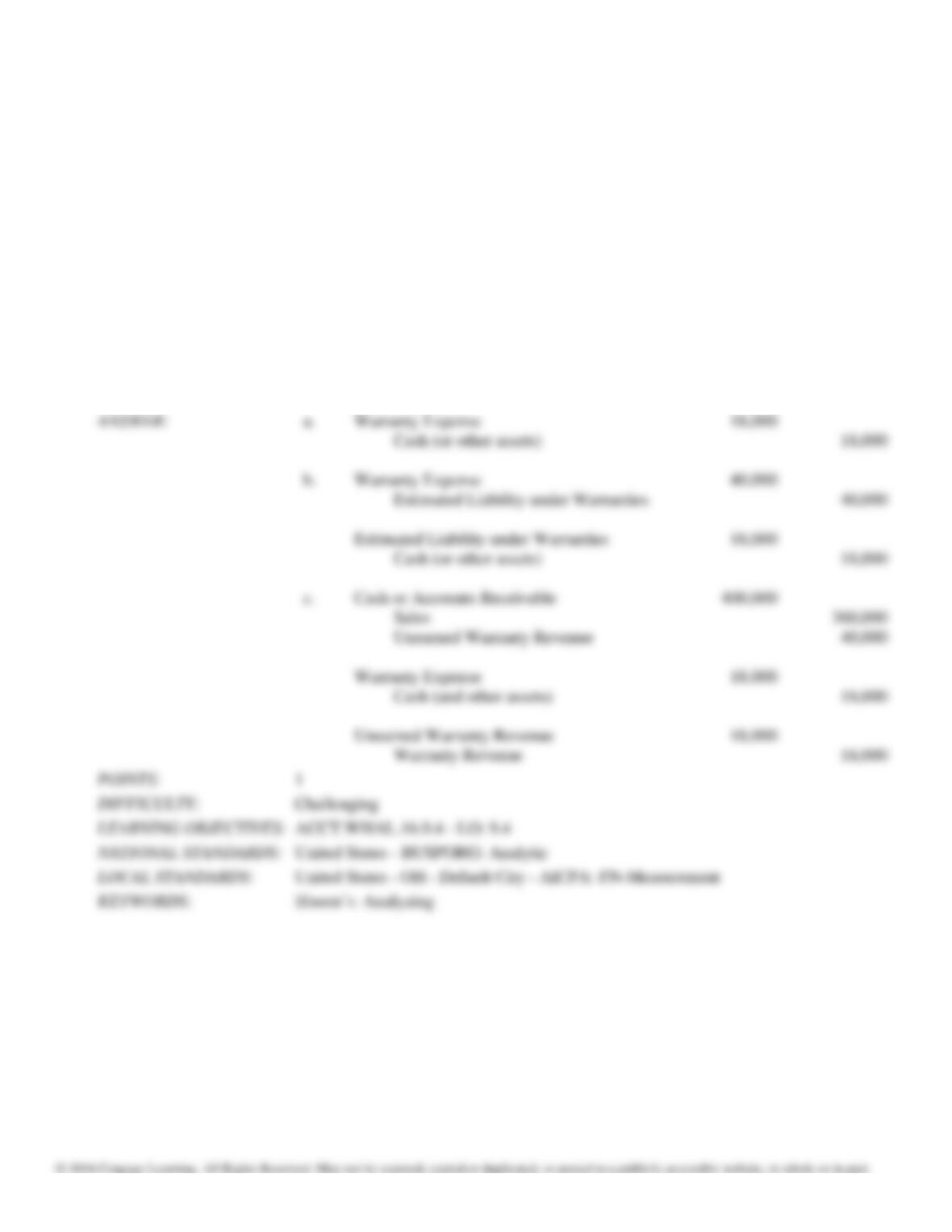
Warranty Expense
Cash (or other assets)
b.
Warranty Expense
Estimated Liability under Warranties
Estimated Liability under Warranties
Cash (or other assets)
Cash or Accounts Receivable
Sales
Unearned Warranty Revenue
Warranty Expense
Cash (and other assets)
Unearned Warranty Revenue
Warranty Revenue
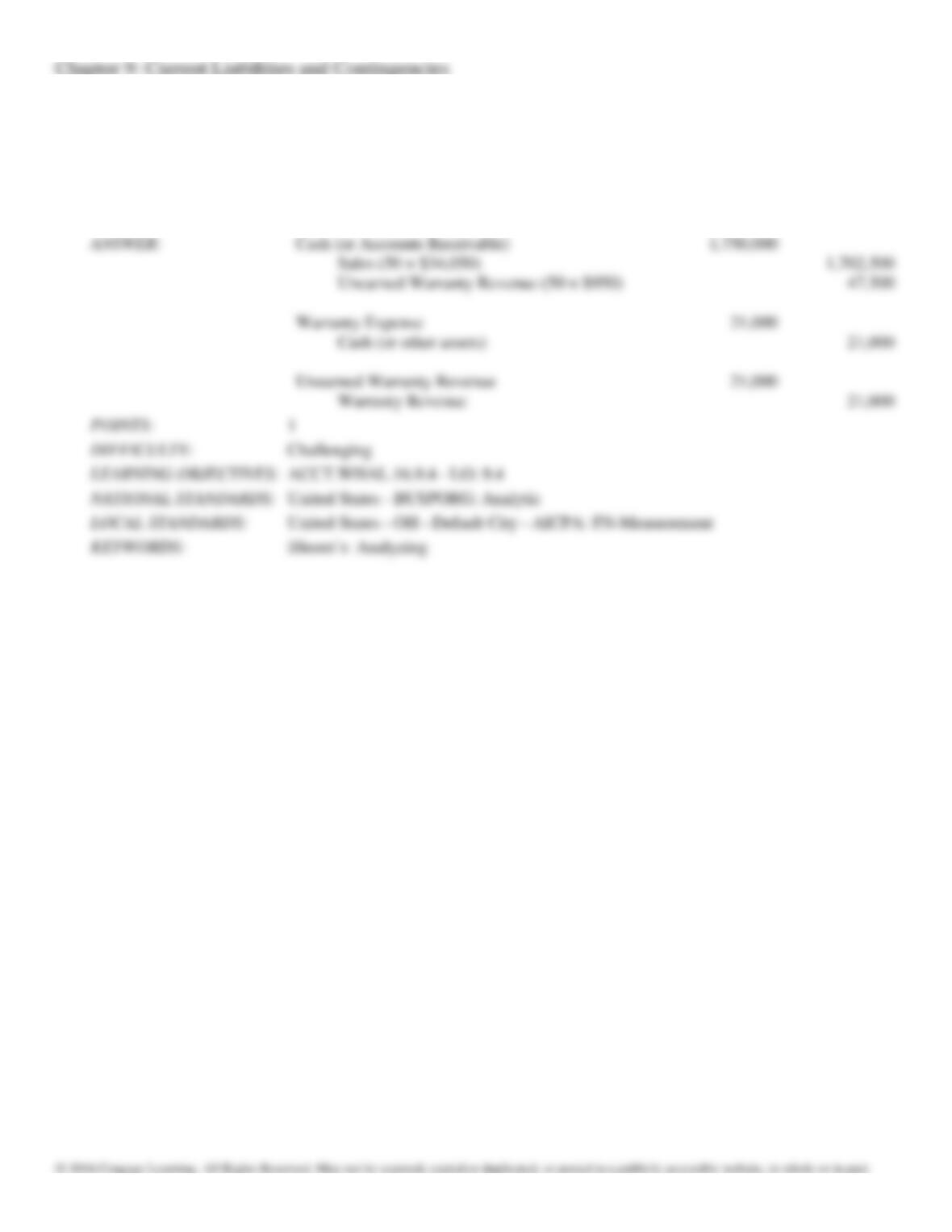
108. Feller, Inc. sells a certain machine for $35,000. Included in this price is an implied service-type warranty of $950.
Fifty machines were sold in 2016. Warranty claims incurred during 2016 amounted to $21,000.
Required:
Prepare all 2016 journal entries required by the information above.
109. Munster sells a product with a four-year warranty. Warranty costs are estimated as a percentage of sales as follows:
Year of sale
1%
Year after sale
1%
Two years after sale
1%
Three years after sale
4%
Additional data:
Warranty
Year
Sales
Expenditures
2015
$50,000
$ 600
2016
60,000
800
2017
40,000
900
2018
70,000
2,500
Required:
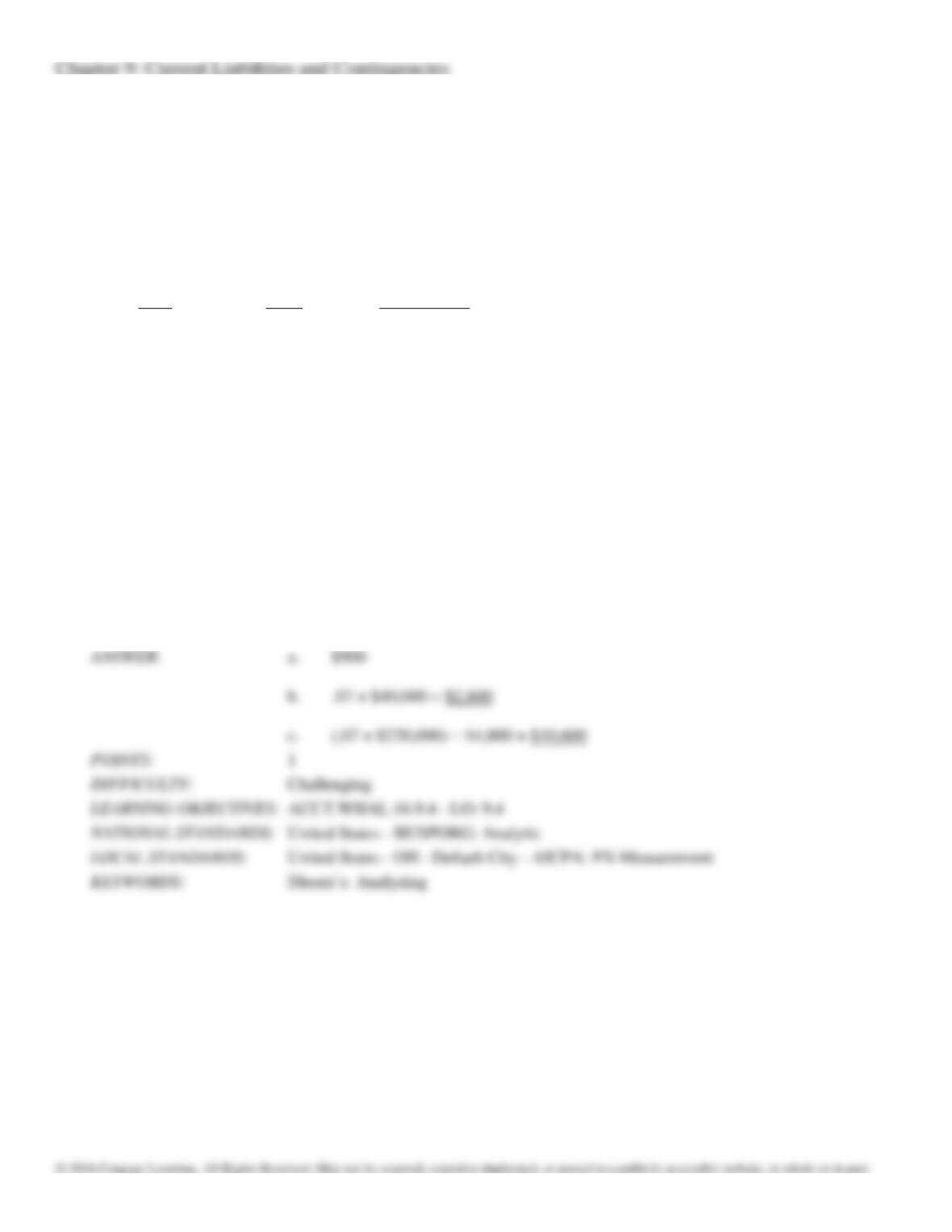
a.
If this is an assurance-type warranty and the company uses the modified cash method, what
would be warranty expense for 2017?
b.
If this is an assurance-type warranty and and the company uses the GAAP approach of
accruing warranty expense (and the related liability) in the year of the sale, what would be
warranty expense for 2017?
c.
If the company considers that 7% of the selling price of the produce represents payment for
an implied service-type warranty, what amount of unearned warranty revenue would be
disclosed on the balance sheet on December 31, 2018?
b.
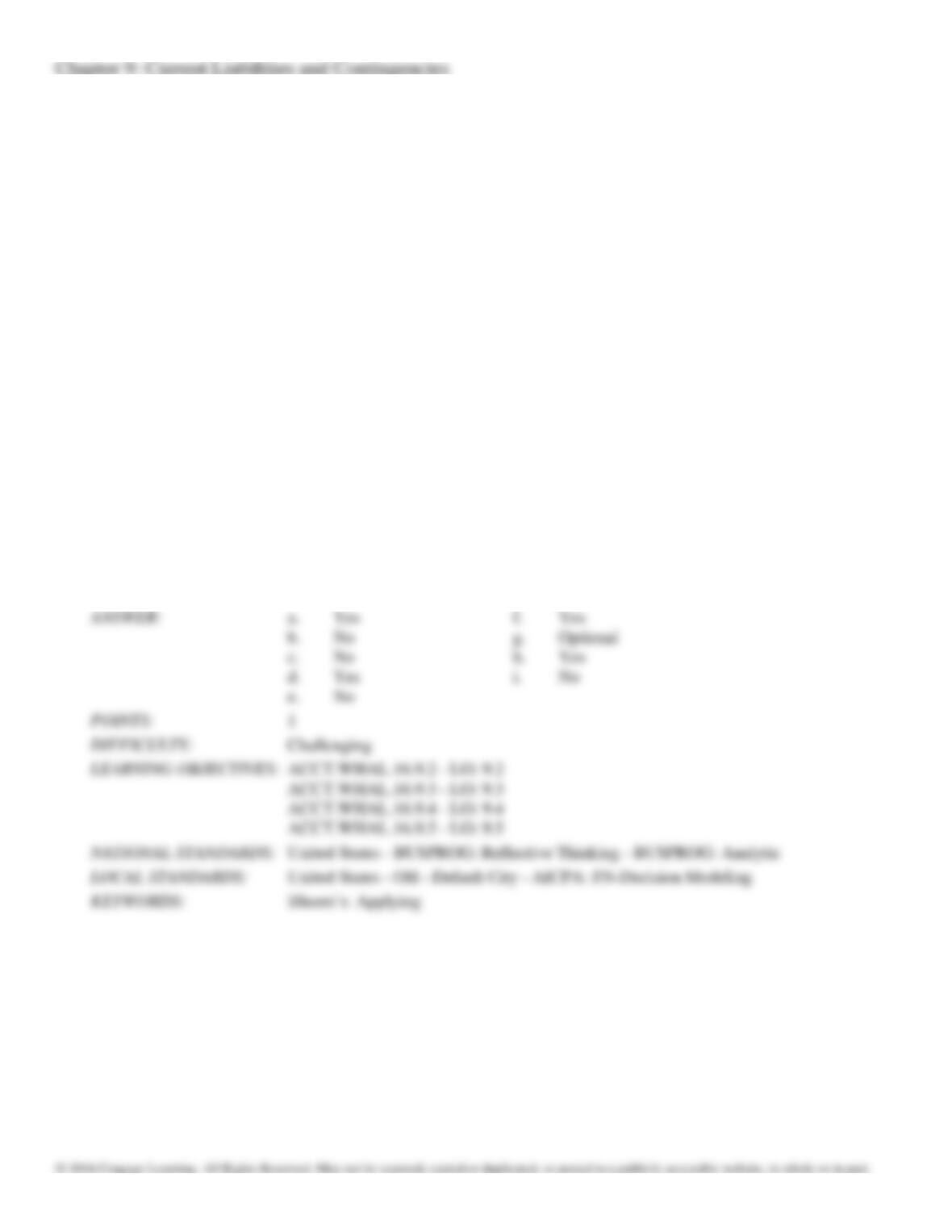
110. Assume that a company has the following situations existing at its year-end:
____
a.
Refundable deposits received from customers.
____
b.
Dividends in arrears on its cumulative preferred stock.
____
c.
Unearned interest included in the face amount of a note receivable.
____
d.
Estimated property taxes prior to receiving the tax bill.
____
e.
Future warranty costs, but the company uses the modified cash basis.
____
f.
A declared property dividend.
____
g.
Sick pay benefits that accumulate, but do not vest.
____
h.
Current portion of a long-term lease obligation that comes due next year.
____
i.
Short-term debt that is being refinanced on a long-term basis.
Required:
Use “yes,” “no,” or “optional” to indicate whether each situation should or should not be accrued as a current
liability, or if accrual is optional.
a.
Yes
f.
Yes
b.
g.
Optional
c.
h.
Yes
d.
Yes
i.
e.
1
Challenging
United States – BUSPROG: Reflective Thinking – BUSPROG: Analytic
United States – OH – Default City – AICPA: FN-Decision Modeling
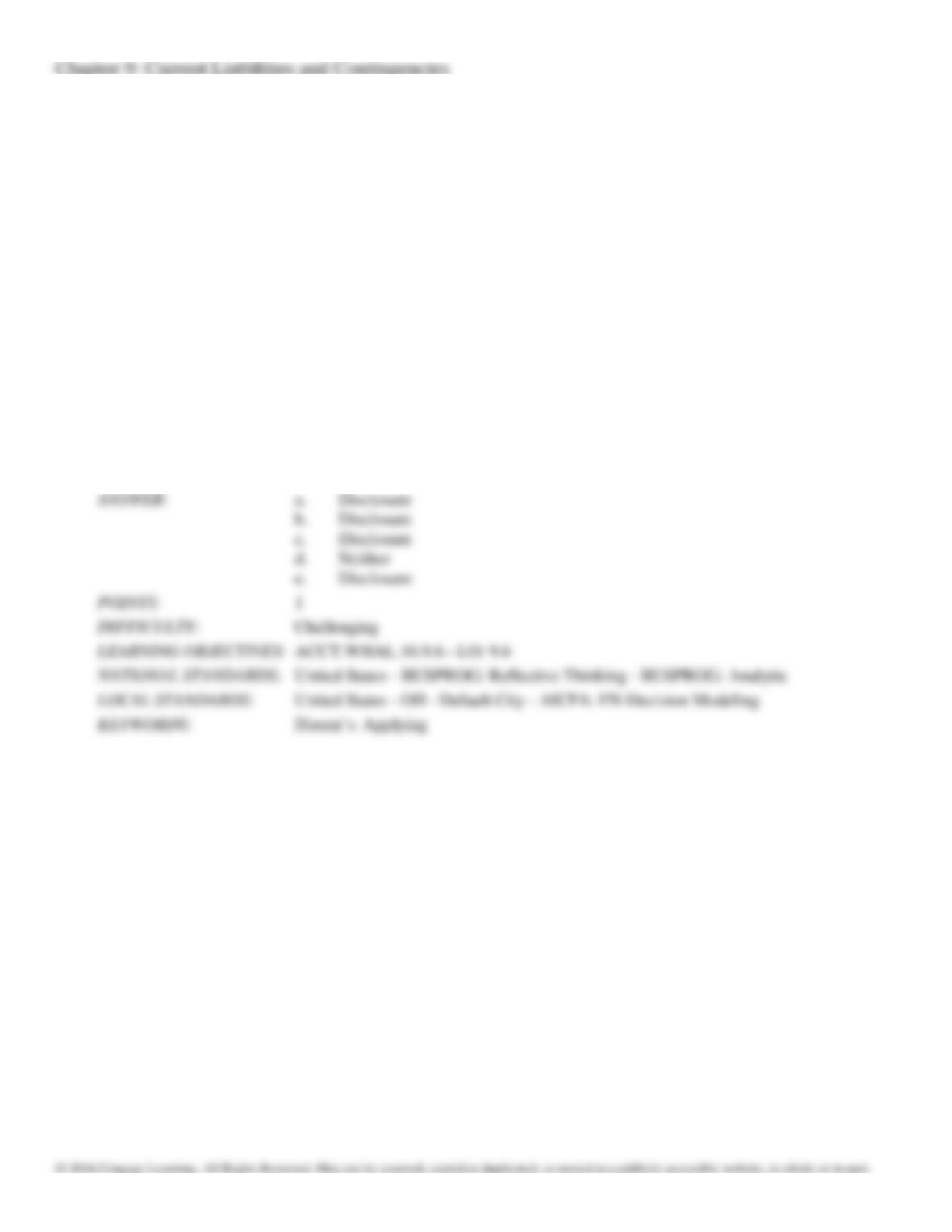
111. Listed below are several types of contingencies for the Kellher Company:
a.
The company has signed as a guarantor of a loan that one of its key suppliers has taken out
with a local bank. The probability of the supplier defaulting on the note is remote.
b.
The company is suing another firm for trademark infringement, and the probability of
winning the case is excellent. The amount of any award can be reasonably estimated.
c.
The company has a significant distribution center in another country where it is reasonably
possible that the warehouse will be expropriated. The amount of the loss can be reasonably
estimated.
d.
The company has a manufacturing plant in California near a major earthquake fault line.
The company has no earthquake insurance, and it is reasonably possible that a quake will
occur. The amount of any loss can be reasonably estimated.
e.
The company is involved in another lawsuit where it is reasonably possible that the
company will be found at fault, but the amount of the loss cannot be reasonably estimated.
Required:
Indicate whether the Kellher Company should make an accrual, a footnote disclosure, or neither of these for each
contingency.
112. The following information is given for Airflight Airlines:
·
As of December 31, 2015, Airflight had $10,000 of notes coming due on January 30, 2016.
Also as of December 31, 2015, Airflight was negotiating to issue long-term debt so that it
could use the proceeds to liquidate these short-term notes as they mature. On January 4,
2016, the company used $3,000 of excess cash to pay off part of the note. On January 29,
2016, a refinancing of the entire $10,000 was completed. The $3,000 was replaced and the
rest of the notes were extended for another two years.
·
Airflight has negotiated a long-term refinancing contract which permits Airflight to borrow
an up to 60% of accounts receivable balances to refinance debt. Accounts receivable are
expected to range between $12,000 and $16,000 next year.
·
Airflight also has negotiated a new long-term refinancing contract which permits Airflight
to borrow an amount up to 35% of inventory to refinance debt. Inventory is expected to
range between $75,000 and $85,000 next year.
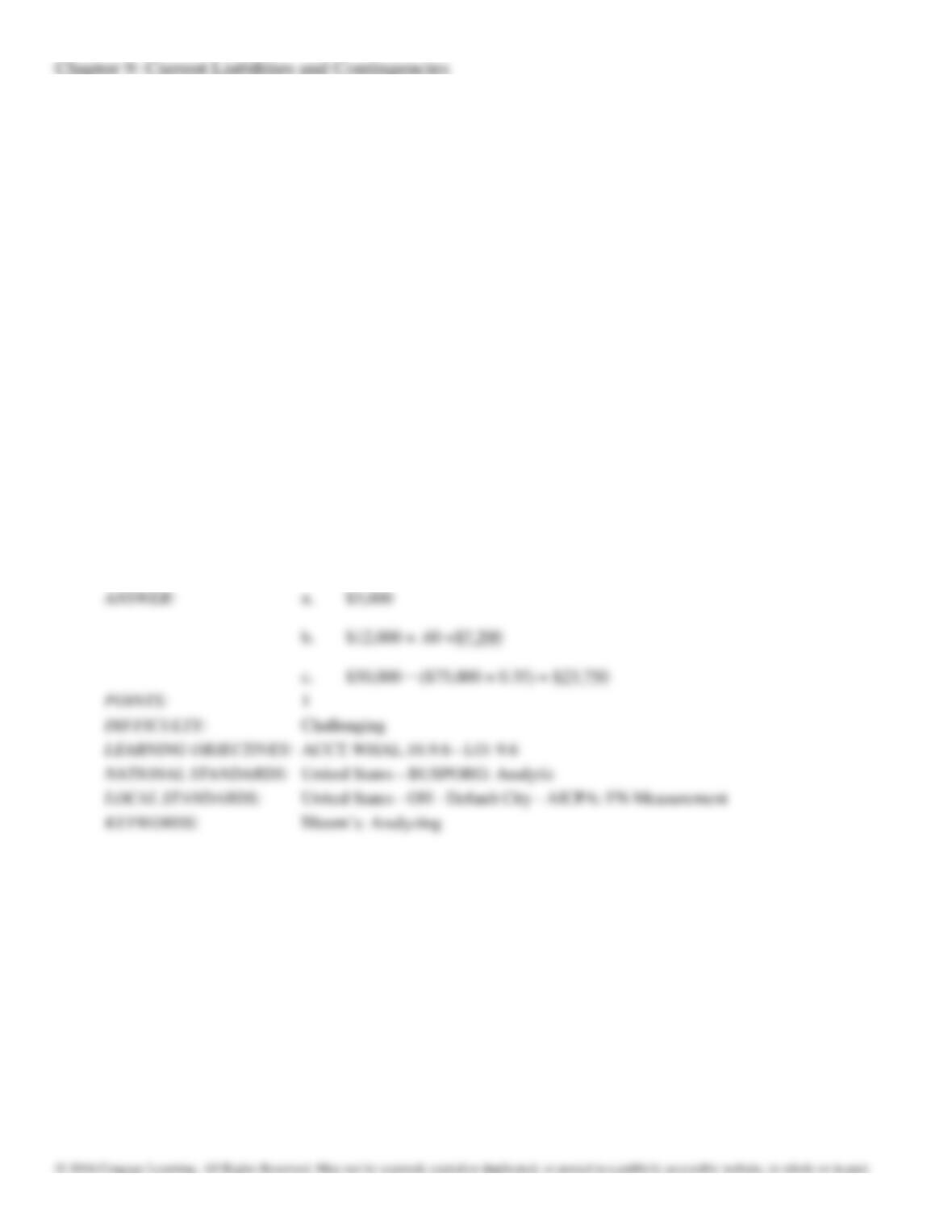
Required:
a.
On the December 31, 2015 balance sheet, how much of the $10,000 note should be shown
as short-term?
b.
Airflight has a currently maturing note payable of $20,000 related to the accounts
receivable refinancing contract. How much of the $20,000 note payable can be classified as
long-term debt at the end of 2015?
c.
Compute the amount of the company’s currently maturing note payable of $50,000 related
to refinancing inventory that must be classified as short-term debt on December 31, 2015.
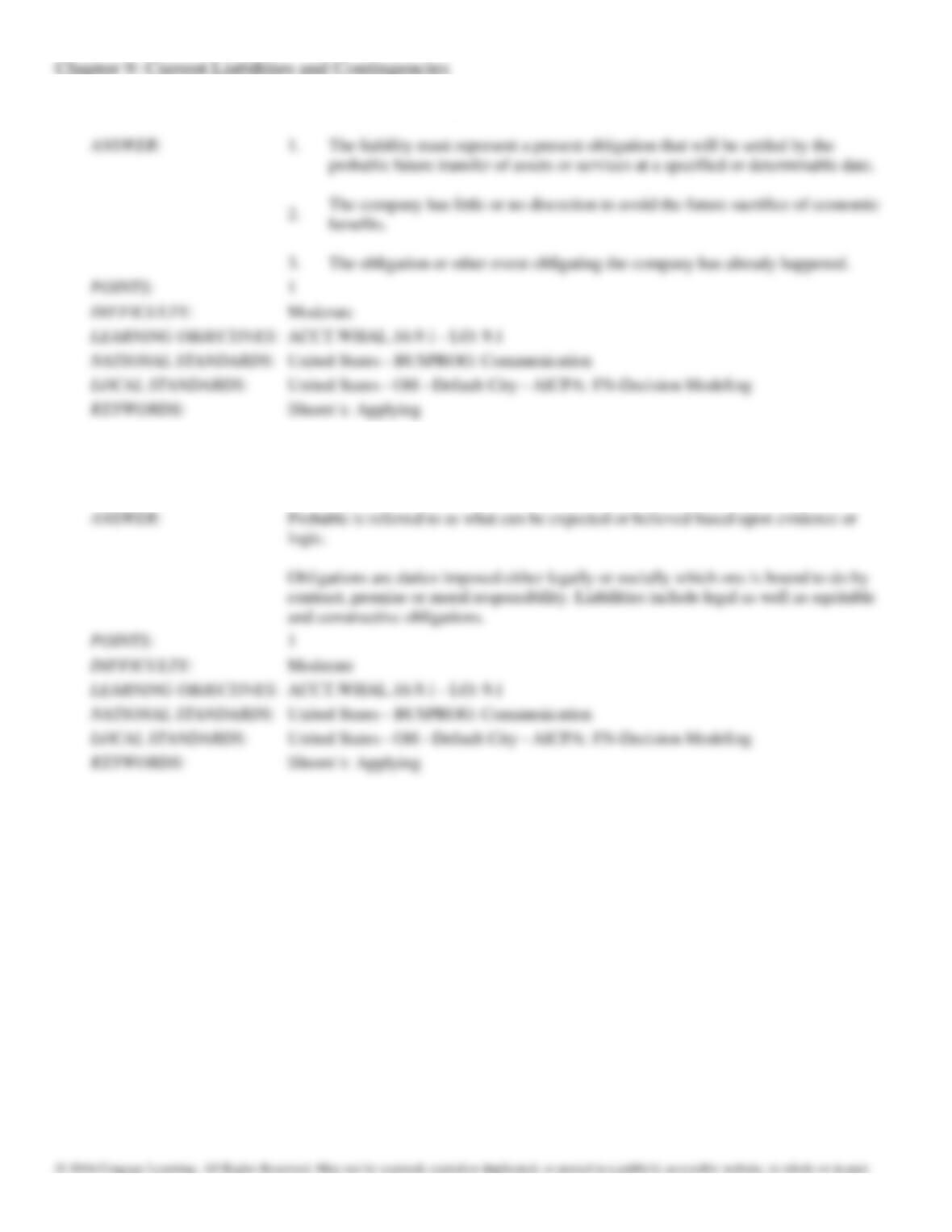
113. List and describe the three characteristics of a liability.
114. Liabilities are defined as probable future sacrifices of economic benefits arising from present obligations. Explain
what the FASB means by probable and by obligations.
115. How are current liabilities classified? Provide an example of each
.
116. Conceptually, how should current liabilities be valued? In practice, how are current liabilities valued? What
justification is there for allowing current practice not to follow the conceptual guidance
117. List five examples of liabilities whose amounts are determined based upon contractual amounts.
118. List five examples of liabilities whose amounts are determined by operating activities.
119. List five examples of liabilities that are based upon contingent obligations.
120. The uncertainty associated with a loss contingency can vary widely. GAAP requires companies to categorize the
likelihood of occurrences of the loss into three categories. Name those three categories and list three common
examples of loss contingencies.
121. What are the FASB’s broad guidelines for reporting assets, liabilities, and equity on the balance sheet?
122. Under what conditions can a short-term obligation be classified as a long-term liability?
123. As a tutor for beginning accounting students, you are reviewing the first balance sheet of one of your students. You
make the comment that current liabilities can be classified into three groups and your student does not believe you.
Required:
Write a brief note that identifies the three groups, including an explanation of the nature of the accounts included in
each group.
124. Discuss how current GAAP requirements concerning accounting for compensated absences vary for vacation pay
and sick pay.
125. Explain the deficiencies in accounting for warranty costs under the modified cash basis.
126. IFRS accounting for contingencies differs from U.S. GAAP in several details. Briefly describe three of those
differences.
provisions when the effect is material.
ACCT.WHAL.16.9.5 – LO: 9.5
United States – OH – Default City – AICPA: FN-Decision Modeling
127. A client is involved in several different lawsuits that are all pending at the end of its fiscal year. The controller wants
to know if the cases must be accrued in the accounts, disclosed in the footnotes, or neither of these.
Required:
Write an explanation of the criteria used to determine whether an accrual or a disclosure is required for loss and gain
contingencies.