
Exam
Name___________________________________
MULTIPLE CHOICE. Choose the one alternative that best completes the statement or answers the question.
1)
Which of the following is an advantage of using E. coli to make a human gene product?
1)
A)
Endotoxin may be in the product.
B)
It cannot process introns.
C)
Its genes are well known.
D)
It does not secrete most proteins.
E)
Endotoxin may be in the product and it does not secrete most proteins.
2)
Which of the following are used by the Centers for Disease Control and Prevention to track
outbreaks of foodborne disease?
2)
A)
DNA fingerprints
B)
restriction fragment length polymorphisms
C)
reverse–transcriptase PCR (rtPCR)
D)
DNA fingerprings and restriction fragment length polymorphisms
E)
DNA fingerprings, restriction fragment length polymorphisms, and reverse–transcriptase
PCR(rtPCR)
3)
Gene silencing blocks an undesirable product by
3)
A)
making double–stranded RNA.
B)
blocking transcription.
C)
blocking DNA replication.
D)
allosteric inhibition of an enzyme.
E)
end–product repression.

4)
PCR can be used to identify an unknown bacterium because
4)
A)
the RNA primer is specific.
B)
DNA polymerase will replicate DNA.
C)
DNA can be electrophoresed.
D)
all cells have DNA.
E)
all cells have RNA.
5)
A restriction fragment is
5)
A)
a segment of mRNA.
B)
a segment of DNA.
C)
cDNA.
D)
a gene.
E)
a segment of tRNA.
B
6)
If you have inserted a gene in the Ti plasmid, the next step in genetic engineering is
6)
A)
inserting the Ti plasmid into Agrobacterium.
B)
inserting the Ti plasmid into a plant cell.
C)
splicing T DNA into a plasmid.
D)
transformation of E. coli with Ti plasmid.
E)
transformation of an animal cell.
A
7)
The use of an antibiotic–resistance gene on a plasmid used in genetic engineering makes
7)
A)
the recombinant cell unable to survive.
B)
replica plating possible.
C)
the recombinant cell dangerous.
D)
direct selection possible.
E)
All of the answers are correct.
D
A

8)
The Pap test for cervical cancer involves microscopic examination of cervical cells for cancerous
cells. A new, rapid diagnostic test to detect human papilloma virus (HPV) DNA before cancer
develops is done without microscopic exam. The steps involved in this FastHPV test are listed
below. What is the second step?
8)
A)
Add an RNA probe for HPV DNA.
B)
Add enzyme–linked antibodies against DNA–RNA.
C)
Add enzyme substrate.
D)
Lyse human cells.
E)
The order is unimportant.
9)
Which of the following techniques is NOT used to introduce recombinant DNA into plants?
9)
A)
gene guns
B)
electroporation
C)
protoplast fusion
D)
Ti plasmids and Agrobacterium
E)
microinjection
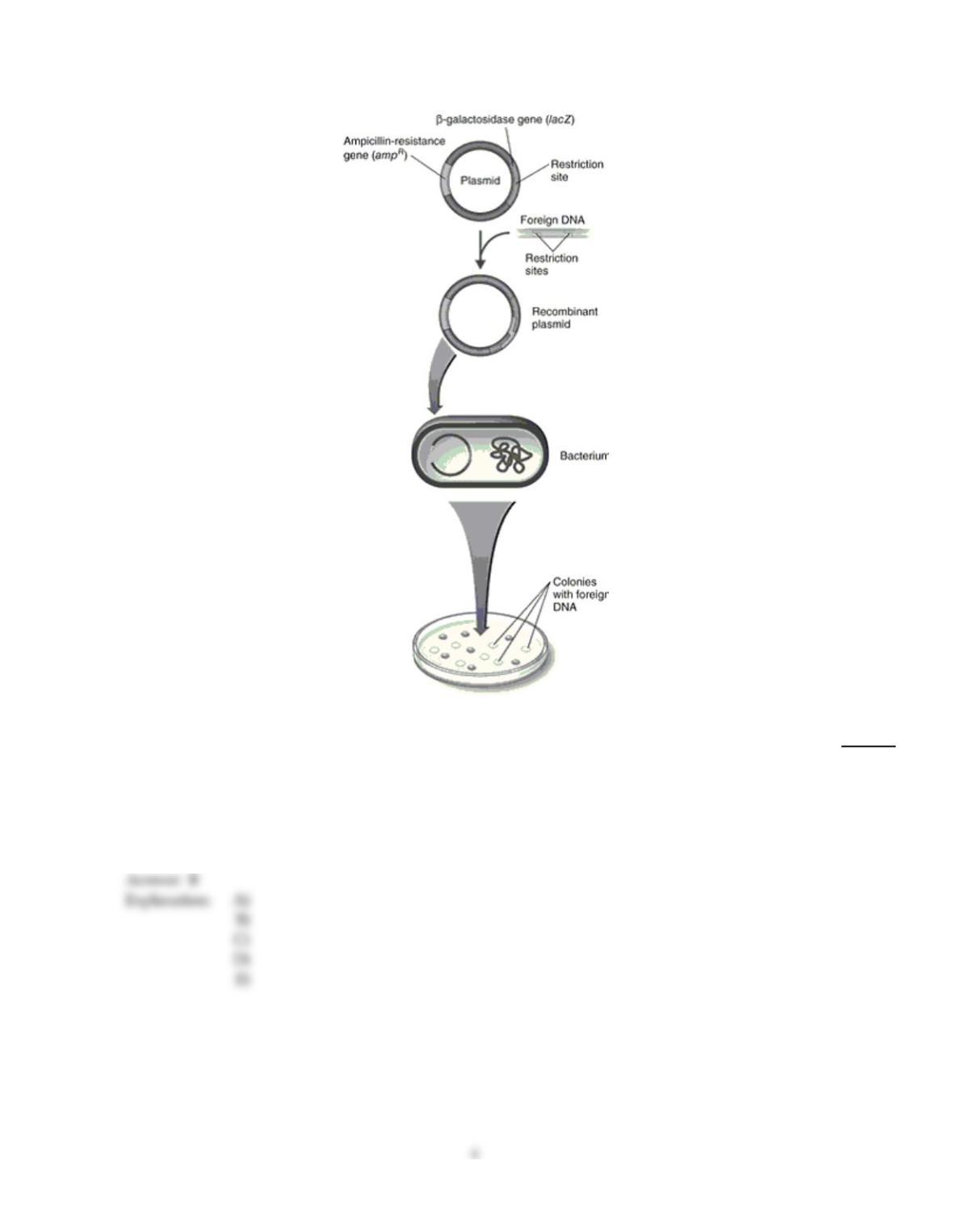
Figure 9.4
10)
In Figure 9.4, the bacteria transformed with the recombinant plasmid and plated on media
containing ampicillin and X–gal will
10)
A)
form blue, ampicillin–sensitive colonies.
B)
form white, ampicillin–resistant colonies.
C)
form white, ampicillin–sensitive colonies.
D)
form blue, ampicillin–resistant colonies.
E)
not grow.

11)
The following are steps used to make DNA fingerprints. What is the third step?
11)
A)
Digest with a restriction enzyme.
B)
Collect DNA.
C)
Lyse cells.
D)
Add stain.
E)
Perform electrophoresis.
12)
Restriction enzymes are
12)
A)
bacterial enzymes that destroy phage DNA.
B)
animal enzymes that splice RNA.
C)
bacterial enzymes that splice DNA.
D)
viral enzymes that destroy host DNA.
13)
The reaction catalyzed by reverse transcriptase is
13)
A)
tRNA
mRNA.
B)
DNA
DNA.
C)
DNA
mRNA.
D)
mRNA
protein.
E)
mRNA
cDNA.
14)
The use of “suicide” genes in genetically modified organisms is designed to
14)
A)
kill the modified organisms before they are released in the environment.
B)
delete genes necessary for modified organism’s growth.
C)
provide a means to eliminate non–modified organisms.
D)
provide for resistance of the modified organisms to pesticides.
E)
prevent the growth of the modified organisms in the environment.
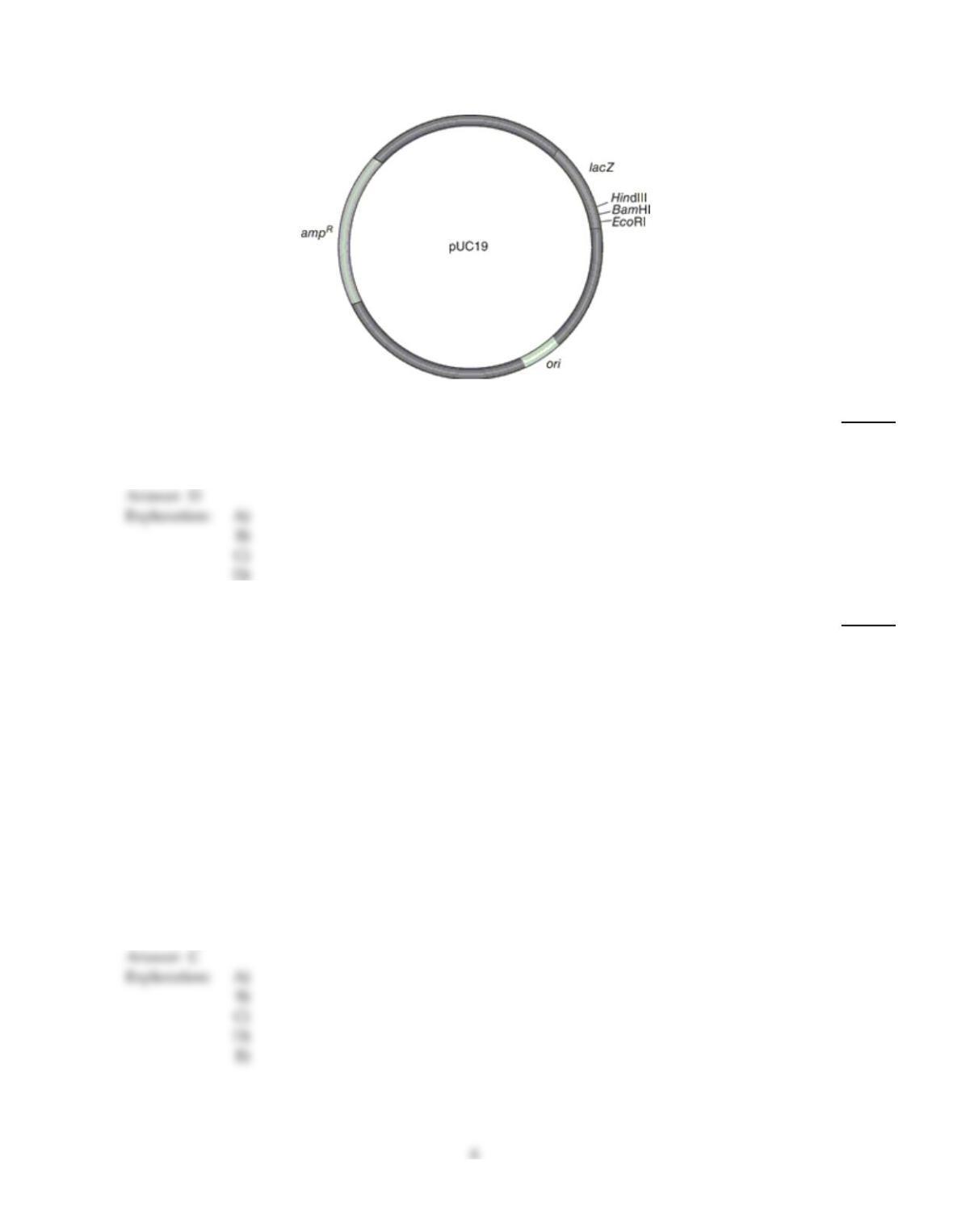
Figure 9.5
15)
Which of the following methods would be used to introduce the plasmid shown in Figure 9.5 into
E. coli?
15)
A)
microinjection
B)
Ti plasmids and Agrobacterium
C)
gene guns
D)
transformation
16)
Which enzyme would cut this strand of DN?
GCATGGATCCCAATGC
16)
A)
Enzyme Recognition
EcoRI GAATTC
CTTAAG
B)
Enzyme Recognition
HaeIII GGCC
CCGG
C)
Enzyme Recognition
BamHI GGATCC
CCCTAGG
D)
Enzyme Recognition
Pst ICTGCG
GACGTC
E)
Enzyme Recognition
HindIII AAGCTT
TTCGAA
17)
You have a small gene that you wish replicated by PCR. After 3 replication cycles, how many
double–stranded DNA molecules do you have?
17)
A)
2
B)
4
C)
8
D)
16
E)
thousands
18)
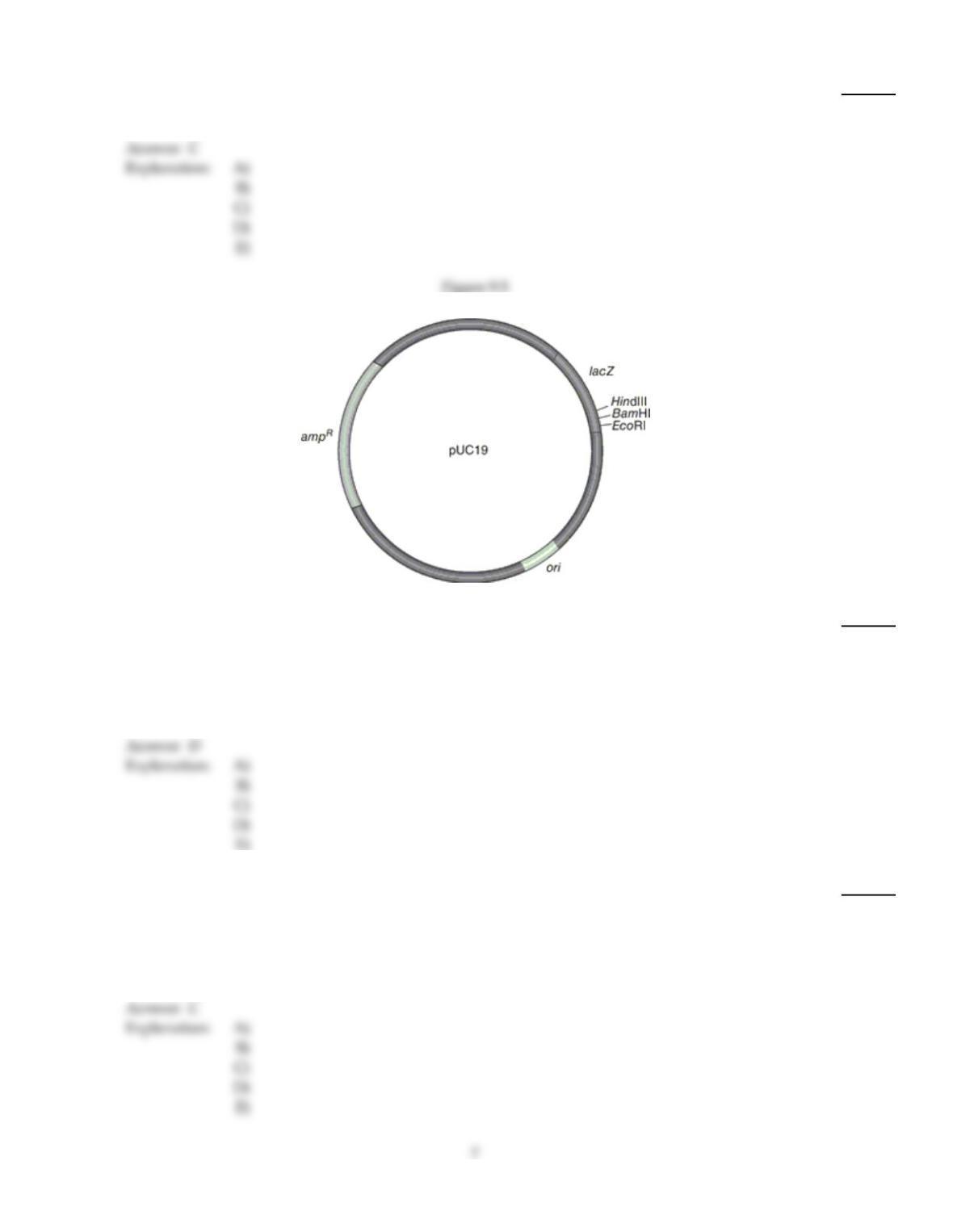
In Figure 9.5, the marker genes used for selecting recombinant DNA are
18)
A)
lacZ and ori.
B)
ampR and ori.
C)
ori.
D)
ampR and lacZ.
E)
HindIII, BamHI, and EcoRI.
19)
The study of genetic material taken directly from the environment is
19)
A)
bioinformatics.
B)
proteomics.
C)
metagenomics.
D)
forensic microbiology.
E)
reverse genetics.

20)
Which of the following are used to silence specific genes and hold promise for treating cancer or
viral diseases, such as hepatitis B?
20)
A)
RNA interference (RNAi)
B)
DNA fingerprinting
C)
complementary DNA (cDNA)
D)
reverse transcriptase PCR (rtPCR)
E)
tumor–inducing plasmids (Ti plasmids)
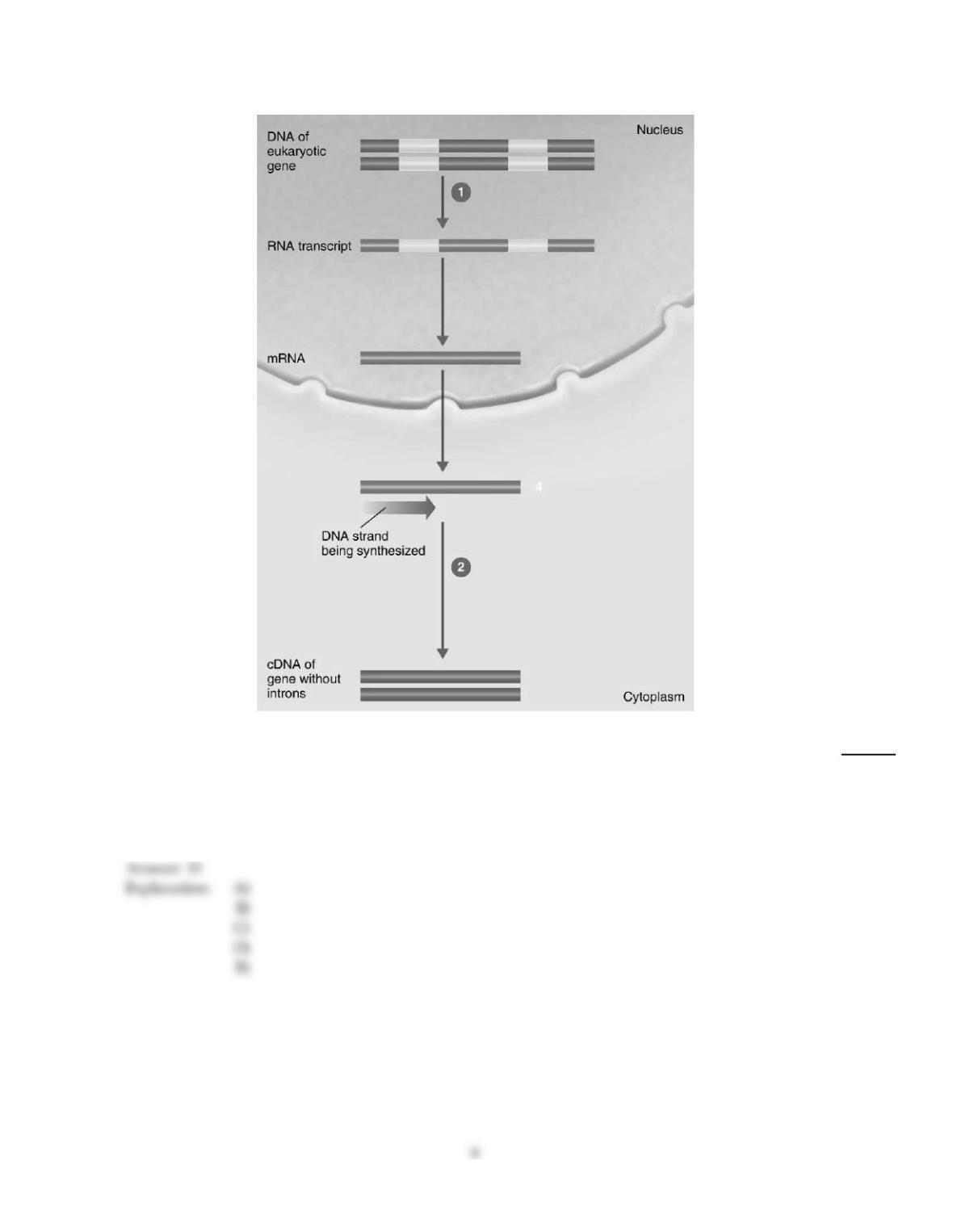
Figure 9.2
21)
In Figure 9.2, the enzyme in step 2 is
21)
A)
RNA polymerase.
B)
DNA polymerase.
C)
spliceosome.
D)
reverse transcriptase.
E)
DNA ligase.

22)
An advantage of cDNA over genomic DNA is that it
22)
A)
can form very large DNA segments.
B)
lacks exons.
C)
contains selectable markers.
D)
is very easy to isolate.
E)
lacks introns.
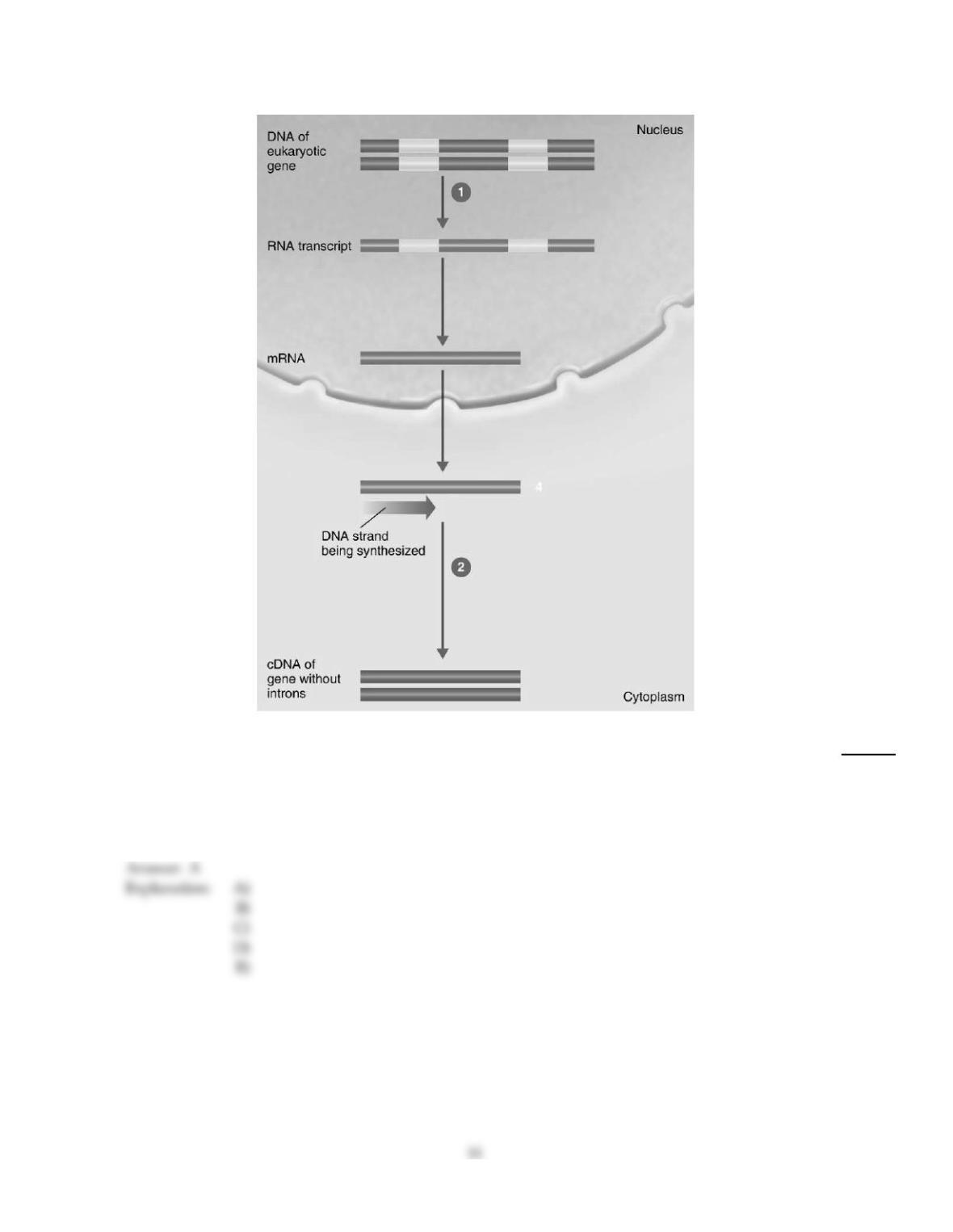
Figure 9.2
23)
In Figure 9.2, the enzyme in step 1 is
23)
A)
RNA polymerase.
B)
DNA ligase.
C)
reverse transcriptase.
D)
DNA polymerase.
E)
spliceosome.