
Chapter 9: Joint Product and By-Product Costing
Learning Questions
True /
False
Multiple Choice
Matching
Exercises
Short
Answer
Problems
1. What is a joint process, and
what is the difference
between a by-product and a
main product?
1-7, 9
19-21, 23, 24, 26-29,
47
S: 75, 80, 81
W: 99-101, 103, 105,
107, 108
1, 7
1, 4
2. How are joint costs
allocated?
8, 10,
12, 13,
16, 17
1-6, 30-37, 53, 63-70
S: 76, 85, 90-94
W: 95, 96, 104, 110-
113
1, 2
1, 3, 4
2, 3
3. What factors are considered
in choosing a joint cost
allocation method?
11, 14,
15,
18–20
18, 38-45
S: 77, 82
W: 97, 98, 106
8, 9
3, 4
4. What information is relevant
for deciding whether to
process a joint product
beyond the split-off point?
13, 16, 22, 25, 46, 62,
73, 74
S: 79
2, 3, 4
2, 5
2
5. What methods are used to
account for the sale of by-
products?
21
7-12, 48-52, 71, 72
S: 78, 83, 86-89
W: 109
5
4
6. How does a sales mix affect
joint cost allocation?
23
14, 15
2
7. What are the uses and
limitations of joint cost
information?
22
17, 61, 62
S: 84
W: 102
3, 4, 6,
10
1, 3
S: Questions from the study guide
W: Questions from web quizzes on the student web site
Level of Complexity*
True /
False
Multiple
Choice
Matching
Exercises
Short
Answer
Problems
Foundation: Repeat or paraphrase
information; Reason to single correct
solution; Perform computations; etc.
All
All
All
All
1
1-4
Step 1: Identify the problem, relevant
information, and uncertainties
2-5, 7-10
1-4
Step 2: Explore interpretations and
connections
6
1, 3, 4
Step 3: Prioritize alternatives and
implement conclusions
Step 4: Envision and direct strategic
innovation
*Based on level in Steps for Better Thinking (Exhibit 1.10, textbook p. 16):
Note: Step 1, 2, 3, and 4 questions in this test bank are intentionally open-ended and subjective, giving students the
opportunity to demonstrate skills such as judgment, reasoning, identification of uncertainties, identification or analysis of
pros and cons, and so on. Therefore, student answers may not exactly match those shown in the solutions.

9-2 Cost Management
True / False
1. Only companies in manufacturing industries produce joint products.
2. Managers normally differentiate main products from by-products based on their weight.
3. Managers normally differentiate main products from by-products based on their sales values.
4. Joint costs are always incurred before the split-off point.
5. Joint costs are common to all joint products.
6. Costs incurred after the split-off point are referred to as split-off costs.
7. Costs allocated to joint products are generally referred to as separable costs.
8. Separable costs generally must be allocated to joint products because they are difficult to trace
directly.
9. In the beef production industry, bones sold for dogs can generally be considered a by-product.
10. Managers choose from a variety of logical joint cost allocation methods, but the allocation process
itself is always arbitrary.
11. Managers who want to avoid arbitrary joint cost allocations should use the physical output method.
12. Different joint cost allocation methods cause products to show different contribution margins.
13. A company can increase or decrease its total gross margin by using different joint cost allocation
methods.
14. Managers should choose a joint cost allocation method to avoid giving the impression that one or
more products are sold at a loss when they actually contribute to profitability.
15. The sales value at split-off point method of joint cost allocation avoids the problem of negative
contribution margins for some products.
16. The constant gross margin NRV method of allocating joint costs results in all joint products having
equal gross margins (in dollars).
17. The constant gross margin NRV method of allocating joint costs results in all joint products having
equal gross profit percentages (gross profit / sales).
18. The physical output method of joint cost allocation is seldom used in practice because of its
measurement difficulties.
19. The physical output method is appropriate when products are sold in units of similar size and their net
realizable values are similar.
20. The choice of joint cost allocation method depends somewhat on the nature of the products’
characteristics.
21. By-products can only be recognized at the time of sale.
22. Joint product cost allocation information can be used for financial reporting and for short-term
decisions such as whether to process the product further.
23. When joint production processes include a sales mix, the sales mix should be incorporated into the
allocation method.

Chapter 9: Joint Product and By-Product Costing 9-3
Multiple Choice
Use the following information for the next 5 questions.
Jordan, Inc. produces 2 products from a joint process costing $24,000. The results from the most recent
period follow:
Sales Value Separable Sales Value After
Product Tons at Split-Off Costs Further Processing
Alpha-1 800 $10,000 $12,000 $24,000
Alpha-2 400 8,000 4,000 20,000
Waste 200 — — —
1. If Jordan uses the physical output method, the joint costs allocated to Alpha-1 were
a. $8,000
b. $6,400
c. $16,000
d. $9,600
2. If Jordan uses the sales value at split-off point method, the joint costs allocated to Alpha-2 would be
a. $8,889
b. $10,667
c. $8,727
d. $13,333
3. If Jordan uses the net realizable value method, the joint costs allocated to Alpha-1 would be
a. $8,571
b. $,9000
c. $10,909
d. $10,286
4. If Jordan uses the physical output method to allocate joint costs, the cost per ton for Alpha-2 would be
a. $27
b. $22
c. $30
d. $20
5. If Jordan uses the sales value at split-off point method to allocate joint costs, the cost per ton for
Alpha-1 would be
a. $15
b. $32
c. $28
d. $29
Use the following information for the next 2 questions.
Major Foods, Inc. produces a cereal from oat grain. The company buys unprocessed oats for $400 per ton. It
costs $60 per ton to send the oats through a processor, which produces 1,900 pounds of pure oats and 100
pounds of oat shells. The oat shells are ground and packaged at a cost of $100 per hundred pounds. They are
sold to a poultry feed company for $3 per pound. The pure oats are cooked and packaged into 4-pound
containers at a cost of $350. The packaged oats are sold for $2 per 4-pound container.
6. If Major uses the net realizable value method, the joint costs allocated to the oats is
a. $345
b. $110
c. $350
d. $115

9-4 Cost Management
7. If Major uses the net realizable value method, the gross profit from the oat shells is
a. $185
b. $200
c. $85
d. $215
Use the following information for the next 3 questions.
Recyclers, Inc. reprocesses paper and obtains 2 main products, a by-product, and waste. By-product revenues
are treated as a reduction in joint costs. During the period, 1,000 tons were processed at a cost of $12,000 for
materials and processing, resulting in the following:
Sales Value Separable Sales Value After
Product Tons at Split-Off Costs Further Processing
Main-1 200 $4,000 $2,000 $10,000
Main-2 400 5,000 6,000 12,000
By-product 300 2,000 -0- 2,000
Waste 100 -0- -0- -0-
8. If the firm allocates joint costs to the main products using the physical output method, how much will
be allocated to Main-1?
a. $2,000
b. $2,400
c. $2,222
d. $3,333
9. If the firm allocates joint costs to the main products using the sales value at split-off point method,
how much will be allocated to Main-2?
a. $5,556
b. $4,545
c. $5,333
d. $6,666
10. If the firm allocates joint costs to the main products using the net realizable value, how much will be
allocated to Main-1?
a. $5,000
b. $5,714
c. $6,857
d. $6,000
Use the following information for the next 2 questions.
A joint input costing $500 results in four distinct products at the point of split-off. Products J, K and L are
main products, and product M is a by-product. Relevant data follows:
Sales Value Separable Sales Value After
Product at Split-Off Cost Further Processing
J (main) $200 $100 $400
K (main) 300 200 600
L (main) 100 — —
M (by-product) 20 10 40
11. If the revenue from product M is recognized at the time of sale, what amount will be recorded as the
cost of product M inventory at the time of split-off?
a. $0
b. $10
c. $20
d. $30

Chapter 9: Joint Product and By-Product Costing 9-5
12. If the revenue from Product M is recognized at time of sale, at what cost will it be inventoried before
further processing?
a. $0
b. $10
c. $20
d. $30
Use the following information for the next 3 questions.
Balley, Inc. produces three milk products (all are main products) from a joint process costing $200,000. Data
from the current period’s operation follow:
Units Unit Sales Price Separable Total Revenue After
Produced at Split-Off Costs Further Processing
Regular 5,000 $5 $10,000 $ 40,000
Fat-free 15,000 7 16,000 120,000
2% 30,000 8 5,000 250,000
13. Which product(s) should be processed beyond the split-off point?
a. Regular and Fat-free only
b. Regular and 2% only
c. Fat-free only
d. 2% only
14. If Balley produces and sells the best mix, what is the total gross margin?
a. $195,000
b. $210,000
c. $180,000
d. $164,000
15. If Balley allocates joint costs using the physical output method instead of the net realizable value
method, income will be
a. higher
b. lower
c. unchanged
d. unable to determine from data given
Use the following information for the next 2 questions.
A joint input costing $500 results in four distinct products at the point of split-off. Relevant data follows:
Sales Value Separable Sales Value After
Product at Split-Off Cost Further Processing
J $200 $100 $400
K 300 200 600
L 100 50 140
M 20 10 40
16. Which of the four products should not be further processed?
a. J
b. K
c. L
d. M
9-6 Cost Management
17. Assume that K is processed further and that management is considering an alternative to the current
process. The new separable cost of processing would be $250. If the firm is to be no worse off, the
product must sell for at least
a. $550
b. $650
c. $750
d. $850
18. When the products emerging from a joint process are similar in size and in relative value per unit, the
most appealing joint cost allocation method is
a. Relative sales value
b. Net realizable value
c. Physical output method
d. Reciprocal method
19. When individual products/services become separately identifiable, this is called the
a. Break point
b. Split-off point
c. Breakeven point
d. Point of no return
20. Costs incurred beyond the split-off point that are traceable to individual products are
a. Joint costs
b. Common costs
c. Net realizable costs
d. Separable costs
21. Joint costs are
a. Easily traceable to individual product lines
b. Common costs that result in two or more unique products
c. Incurred by a particular product
d. Fixed costs incurred after the split-off point
22. Joint product costs
a. Are irrelevant in deciding whether or not to produce beyond the split-off point
b. Cannot be allocated using the physical output method
c. Are not included in the costs of ending inventory
d. Require use of the alternative cost method
23. When separable costs are deducted from the selling price that can be achieved after further
processing, the result is called the
a. Relative sales value
b. Net realizable value
c. Budgeted value
d. Inventory value
24. By-products are products that
a. Are chosen to measure profitability
b. Are immaterial in value relative to main products
c. Are intentionally produced
d. Share in the allocation of joint product costs

Chapter 9: Joint Product and By-Product Costing 9-7
25. If the incremental revenues for a joint product that has been processed further exceed the incremental
costs, the general decision is to
a. Process beyond the split-off point
b. Sell at the split-off point
c. Be indifferent about whether to process further
d. Allocate the separable costs using the net realizable value method
26. In which of the following industries would you be least likely to find a joint production process?
a. Oil and gas
b. Food
c. Chemicals
d. Textbook production
27. A main product is typically differentiated from other joint products by its
a. Allocated joint costs
b. Size or weight
c. Sales value
d. Cost
28. Which of the following are sub-categories of joint products?
a. Main products and by-products
b. Main products and split-off products
c. By-products and split-off products
d. Main products, by-products and split-off products
29. Joint processes can result in
I. Products
II. Services
III. Intangible assets
a. I only
b. II only
c. I and III only
d. I and II only
Use the following information for the next 8 questions.
RKH Corporation produces three joint products. During a recent accounting period, joint costs totaled $365
and RKH had no beginning inventories. Additional data appear below:
M1 M2 M3
Volume (pounds) 150 50 300
Sales value at the split-off point $375 $155 $600
Sales value after further processing $450 $200 $900
Separable costs $50 $35 $100
30. Which of the following methods will result in the greatest joint cost allocation to M1?
a. Physical output
b. Sales value at split-off point
c. Net realizable value
d. Constant gross margin NRV
31. Which of the following methods will result in the greatest joint cost allocation to M2?
a. Constant gross margin NRV
b. Net realizable value
c. Physical output
d. Sales value at split-off point
9-8 Cost Management
32. Which of the following methods will result in the smallest joint cost allocation to M3?
a. Net realizable value
b. Sales value at split-off point
c. Physical output
d. Constant gross margin NRV
33. Which of the following methods will result in the greatest total joint cost allocation among the three
products?
I. Net realizable value
II. Sales value at split-off point
III. Physical output
IV. Constant gross margin NRV
a. I and II only
b. II and III only
c. I and IV only
d. All methods will result in the same total joint cost allocated
34. Using the constant gross margin NRV method, the combined gross margin percentage (rounded to the
nearest whole percent) is:
a. 65%
b. 88%
c. 76%
d. None of the above
35. Using the constant gross margin NRV method, the joint costs allocated to M1 will be
a. $290
b. $160
c. $110
d. $50
36. Using the constant gross margin NRV method, the total separable costs allocated to the three products
will be
a. $0
b. $185
c. $365
d. $550
37. Using the constant gross margin NRV method, the total joint costs allocated to the three products will
be
a. $0
b. $185
c. $365
d. $550
38. Which method of allocating joint costs is most likely to develop a true cost per unit of product?
a. Physical output
b. Sales value at split-off point
c. Net realizable value
d. None of the above; all methods result in arbitrary allocations
39. The joint cost allocation method affects the
a. Apparent profitability of different products
b. Total profit of an organization
c. Revenue generated by an individual product
d. Total revenue of an organization
Chapter 9: Joint Product and By-Product Costing 9-9
40. Managers should choose a joint cost allocation method to
a. Justify dropping an unprofitable product
b. Minimize the total joint cost allocated to all products
c. Maximize the organization’s overall profitability
d. Avoid giving the mistaken impression that one or more products are sold at a loss
41. Cost distortions are likely when products have differential incremental contributions under which of
the following methods?
a. Sales value at split-off point
b. Constant gross margin NRV
c. Physical output
d. Net realizable value
42. Which of the following joint cost allocation methods is used in many industries because they have
units of similar size with similar net realizable values?
a. Physical output
b. Constant gross margin NRV
c. Net realizable value
d. Sales value at split-off
43. Which joint cost allocation methods are preferred because they are based on a product’s ability to pay
for its allocated cost?
I. Constant gross margin NRV
II. Physical output
III. Net realizable value
a. I and II only
b. I and III only
c. II and III only
d. III only
44. Which joint cost allocation method best reflects the idea that joint costs cannot be separated?
a. Net realizable value
b. Constant gross margin NRV
c. Physical output
d. Sales value at split–off
45. The sales value at split-off point method of joint cost allocation is most appropriate when
a. Products have roughly equal sales values
b. Products have roughly equal separable costs
c. Most products are sold at the split-off point
d. Few products are sold at the split-off point
46. When deciding whether to process a product beyond the split-off point
a. Joint costs are relevant
b. Joint costs are irrelevant
c. Separable costs are irrelevant
d. Revenue is irrelevant
47. Compared to other products, by-products have
a. Low sales values
b. High joint cost allocations
c. Low sales volumes
d. Low physical outputs

9-10 Cost Management
48. A by-product can become a main product when
a. Changes in technologies give it greater sales value
b. Markets contract, lessening demand
c. Its net costs increase
d. Its value decreases
49. DRY Corporation recently disposed of a by-product at a net cost of $500. Provided that amount is
considered material, the $500 should be accounted for as
a. Part of the separable cost of the by-product.
b. A decrease in by-product inventory on the balance sheet.
c. An increase in by-product inventory on the balance sheet.
d. Part of the joint costs of production.
50. Managers are most likely to select a method of by-product accounting depending upon
a. The effect of the method on overall profitability
b. The degree of desired control over the by-product
c. The physical quantity of the by-product
d. Their incentive compensation package
51. The value of a by-product can be recognized at the time
I. Of production
II. Of its sale
III. Joint products are sold
a. I and II only
b. I and III only
c. II and III only
d. I, II, and III
52. When by-product value is recognized at the time of sale, the journal entry can include a credit to
I. Sales revenue
II. Other income
III. Cost of goods sold
IV. Work in process
a. I, II, or IV only
b. II, III, or IV only
c. I, II, or III only
d. I, III, or IV only
Use the following information for the next 8 questions.
HGT Corporation produces four products from a common production process. Selected data from HGT’s
accounting system for the four products appears below:
Sofa Standard Floor Full-Body
Cushions Pillows Cushions Pillows
Quantity 100 150 50 200
Price per unit at split-off $10 $12 $18 $15
Price per unit after further processing $13 $15 $20 $18
Separable costs $100 $150 $150 $200
Joint costs for the accounting period totaled $5,000. Each product line has a different product manager, who
is evaluated based on product line profitability. Therefore, each manager is motivated to reduce his / her total
product line costs as much as possible. The managers have been given information about potential joint cost
allocations using the following three methods: physical output, sales at split-off point, and net realizable
value. The managers are comparing the joint cost allocations under each method so that they can give the
accountant input about their preferred method(s).
Chapter 9: Joint Product and By-Product Costing 9-11
53. Which product line would receive the least amount of joint cost under the net realizable value
method?
a. Floor cushions and full-body pillows
b. Full-body pillows
c. Sofa cushions
d. None of the above
54. Which product line would receive the least amount of joint cost under the physical output method?
a. Floor cushions and sofa cushions
b. Floor cushions and full-body pillows
c. Standard pillows and full-body pillows
d. None of the above
55. Which product line would receive the least amount of joint cost under the sales value at the split-off
point method?
a. Floor cushions
b. Full-body pillows
c. Sofa cushions and standard pillows
d. None of the above
56. If HGT allocates joint costs using the physical output method, the total joint cost allocated to standard
pillows will be
a. $1,500
b. $1,650
c. $1,250
d. None of the above
57. If HGT allocates joint costs using the sales value at split-off point method, the total joint cost
allocated to full-body pillows (rounded to the nearest dollar) will be
a. $2,439
b. $1,250
c. $2,039
d. $2,239
58. If HGT allocates joint costs using net realizable value method, the total joint cost allocated to floor
cushions will be
a. $570
b. $720
c. $420
d. $563
59. Assume HGT allocates joint costs using the physical output method. Which of the following
correctly orders the four product lines from greatest allocation to least allocation?
a. Sofa cushions, standard pillows, floor cushions, full-body pillows
b. Full-body pillows, standard pillows, floor cushions, sofa cushions
c. Full-body pillows, standard pillows, sofa cushions, floor cushions
d. Floor cushions, sofa cushions, standard pillows, full-body pillows
60. Assume HGT allocates joint costs using the net realizable value method. Which of the following
correctly orders the four product lines from greatest allocation to least allocation?
a. Full-body pillows, standard pillows, sofa cushions, floor cushions
b. Floor cushions, sofa cushions, standard pillows, full-body pillows
c. Full-body pillows, sofa cushions, standard pillows, floor cushions
d. Floor cushions, full-body pillows, standard pillows, sofa cushions

9-12 Cost Management
61. Joint costs are allocated to individual products primarily to meet requirements for:
a. Ethical decision making
b. Financial accounting
c. Variance analysis
d. Budgeting
62. Joint cost allocations are inappropriate when
I. Deciding whether to process a product beyond the split-off point
II. Preparing external financial reports
III. Evaluating the performance of individual project managers
a. I and II only
b. I and III only
c. II and III only
d. I, II, and III
More Difficult Multiple Choice
These multiple choice questions require more complex computations or present information differently than
in the textbook.
Use the following information for the next 6 questions.
J-M Company uses a joint process costing $15,000 to produce three main products. The company had no
beginning inventory. Its current period operation data follow:
Units Sales Value Separable Sales Value After Units
Product Produced at Split-Off Costs Further Processing Sold
S 500 $5,000 $500 $ 7,000 400
T 450 6,000 650 9,000 300
R 300 9,000 700 10,000 250
63. If J-M uses the physical output method to allocate joint costs and performs further processing after
the split-off point, what is the gross profit for product S?
a. $1,800
b. $500
c. $400
d. $(900)
64. If J-M uses the sales value at split-off point method and sells products at the split-off point, what is
the gross profit for product T?
a. $1,000
b. $(500)
c. $1,500
d. $3,000
65. If J-M uses the net realizable value method and performs further processing after the split-off point,
what is the gross profit for product R?
a. $4,603
b. $2,936
c. $3,224
d. $3,603
66. If J-M uses the net realizable value method and performs further processing after the split-off point,
what is the carrying value of the ending inventory for product S?
a. $803
b. $1,134
c. $907
d. $1,009

Chapter 9: Joint Product and By-Product Costing 9-13
67. If J-M sells products at the split-off point and uses the relative sales value at split-off point method to
allocate joint costs, what is the carrying value of ending inventory for product T?
a. $1,717
b. $2,575
c. $2,250
d. $1,500
68. If J-M uses the physical output method and and performs further processing after the split-off point,
what is the ending inventory value for product R?
a. $717
b. $600
c. $860
d. $720
Use the following information for the next 2 questions.
Jagger, Inc. production begins in Department A with 1,000 pounds of material, of which 40% goes to
Department B, 50% to Department C, and the rest evaporates. From Department C, 72% goes to Department
D, 24% to Department E, and the remainder is scrapped. There are no intermediate markets. By-product
sales are treated as miscellaneous income. The following occurred during the month:
Department Costs Sales Product Type
A $20,000 —
B 5,000 $10,000 By-product
C 30,000 —
D 20,000 60,000 Main-1
E 10,000 30,000 Main-2
69. If Jagger uses the physical output method, the total cost of Main-1 is
a. $40,455
b. $57,500
c. $42,500
d. $52,500
70. If Jagger uses the net realizable value method, the total cost of Main-2 is
a. $26,667
b. $22,500
c. $16,667
d. $33,333
Use the following information for the next 2 questions.
Heston, Inc. produces 2 main products and a by-product. During the current month it had no beginning
inventories. During the current month it incurred $185,000 of joint costs, which are allocated to main
products using the physical output method. Additional information follows:
Units Units Unit Sales
Product Produced Sold Price
Able (main) 8,000 6,000 $15
Baker (main) 12,000 8,000 22
Delta (by-product) 5,000 4,500 2
71. If Heston subtracts the NRV of by-product sales from joint costs at the time of by-product sales, what
is the total value of the ending inventory?
a. $123,200
b. $52,800
c. $122,500
d. $52,500

9-14 Cost Management
72. If Heston subtracts the NRV of by-product sales from joint costs at the time of by-product production,
what is the total cost of goods sold for the current month?
a. $123,200
b. $52,800
c. $122,500
d. $52,500
Use the following information for the next 2 questions.
A joint input costing $500 results in four distinct products at the point of split-off. Relevant data follows:
Sales Value Separable Sales Value After
Product at Split-Off Cost Further Processing
J $200 $100 $400
K 300 200 600
L 100 50 140
M 20 10 40
73. Assume that after the split-off point one unit of J can be processed directly into one unit of K, and
then processed further as shown for product K. For the purpose of making this decision, what is the
opportunity cost to be assigned to a unit of J?
a. $400
b. $300
c. $200
d. $100
74. If one unit of L is further processed as shown above, it can be processed again at an additional cost of
$160 to obtain product XX. If the firm is to be no worse off from producing product XX, then XX
must sell for at least
a. $250
b. $260
c. $290
d. $300
Multiple Choice from Study Guide
s75. Costs incurred to process joint products beyond a split-off point are called
a. By-products
b. Joint costs
c. Separable costs
d. Fixed costs
s76. Suppose 3 products, X, Y, and Z, are produced simultaneously in a joint process. If the sales value at
split-off method is used to allocate joint costs, then the joint cost allocated to product X will increase
when the
a. Sales value of Y increases
b. Sales value of Z decreases
c. Sales value of X decreases
d. Separable cost of Z increases
s77. Assume the total final sales value of a set of joint products exceeds the total joint costs, and that the
incremental revenue from processing each product further exceeds the separable costs. Which joint
cost allocation method could result in the reporting of a loss for some products and a profit for others?
a. Net realizable value method
b. Physical output method
c. Sales value at split-off method
d. Constant gross margin net realizable value method
Chapter 9: Joint Product and By-Product Costing 9-15
s78. Suppose a by-product is created continuously and sold for cash at the end of each day. If the
proceeds of the by-product sales are used to reduce the joint production costs, an increase in the by-
products sales value will
a. Increase the profit reported for by-product sales
b. Decrease the profit reported for by-product sales
c. Decrease the gross margin reported by the main products
d. Increase the gross margin reported by the main products
s79. To make the most profitable sell-or-process-further decisions, one should consider the
a. Increase in the cost of further processing
b. Increase in sales value due to further processing
c. Increase in sales value due to further processing less the joint costs of processing less the
separable costs of processing
d. Increase in sales value due to further processing less the separable costs of further processing
s80. Joint costs consist of
a. Direct materials costs only
b. Direct materials and direct labor costs only
c. Direct materials, direct labor, and variable manufacturing overhead costs only
d. Direct materials, direct labor, and all manufacturing overhead costs
s81. Items produced from a joint process with a small sales value or a negative value are called
a. Separate products
b. By-products
c. Waste
d. Garbage
s82. Which joint cost allocation method may show a loss for a product with a large separable cost?
a. Sales value at split-off method
b. Realized value method
c. Net realizable value method
d. None of the above
s83. Suppose a joint process yields 3 main products and one by-product that has no sales value and is
disposed of in the normal garbage. Which of the following is appropriate in accounting for the by-
product?
a. Describe it in a footnote to the financial statements
b. Allocate a portion of the joint cost to the by-product and show the amount in a loss account on the
income statement
c. Allocate a portion of the joint cost to the by-product and show the amount as a reduction of the
processing costs of the main products
d. None of the above; no accounting treatment is necessary
s84. Which of the following is the most important reason to allocate joint costs?
a. Accurate product costs are necessary to make product mix decisions
b. Accurate product costs are necessary to make product pricing decisions
c. Production costs must be allocated to inventory and cost of goods sold for financial statement and
tax reporting reasons
d. None of the above – joint cost allocation is arbitrary
s85. A company incurs joint costs of $700 to produce 100 units of product A, 300 units of product B, and
500 units of product C. The 3 products sell for $1, $2, and $3 each, respectively. What amount of
joint cost is allocated to product A if the sales value at split-off method is used?
a. $100.00
b. $77.78
c. $31.82
d. None of the above
9-16 Cost Management
Use the following information for the next 4 questions.
A joint process has total costs of $1,200 and yields 50 units each of two main products and 10 units of by-
product that can be sold for $2.50 each.
s86. Under the realized value approach to accounting for by-products, the $25 revenue is recognized in the
time period that the
a. By-product is sold
b. By-product is produced
c. Main products are produced
d. Main products are sold
s87. Under the net realizable value approach to accounting for by-products, the $25 revenue is recognized
in the time period that the
a. By-product is sold
b. By-product is produced
c. Main products are produced
d. Main products are sold
s88. Under the realized value approach to accounting for by-products, what is the per unit cost of a main
product if the physical output method of allocating joint costs is used?
a. $12.00
b. $24.00
c. $11.75
d. $23.50
s89. Under the net realizable value approach to accounting for by-products, what is the per unit cost of a
main product if the physical output method of allocating joint costs is used?
a. $12.00
b. $24.00
c. $11.75
d. $23.50
Use the following information for the next 5 questions.
The Great Foods Company processes milk into skim milk and butter. This year 70,000 gallons of will be
processed, costing $40,000. If processed to the split-off point, this will yield 40,000 gallons of skim milk and
10,000 pounds of butter. Skim milk is sold to distributors for $1 per gallon and butter is sold for $0.75 per
pound. Great Foods has the option of processing the two products further. Skim milk can be processed into
canned, sweetened, condensed skim milk and sold for $0.80 per can. One gallon of skim milk makes 2 cans of
condensed milk. To process 40,000 gallons of skim milk will cost $18,000. Butter can be processed into cake
frosting, sold in containers for $2 each. One pound of butter goes into each container of frosting. The cost of
processing 10,000 pounds of butter into frosting costs $15,000.
s90. What is the per-unit joint cost allocated to skim milk and butter if the sales value at split-off method is
used?
a. $0.8421 per gallon and $0.6316 per pound
b. $1 per gallon and $0.75 per pound
c. $0.381 per gallon and $0.9524 per pound
d. $0.7619 per gallon and $0.9524 per pound
s91. What is the per-unit joint cost allocated to condensed milk and frosting if the sales value at split-off
method is used?
a. $0.8421 per can and $0.6316 per container
b. $0.42105 per can and $0.6316 per container
c. $0.381 per can and $0.9524 per container
d. $0.7619 per can and $0.9524 per container

Chapter 9: Joint Product and By-Product Costing 9-17
s92. What is the per-unit joint cost allocated to condensed milk and frosting if the net realizable value
method is used?
a. $1.64608 per can and $0.7157 per container
b. $0.82304 per can and $0.7157 per container
c. $0.90196 per can and $0.3922 per container
d. $0.45098 per can and $0.3922 per container
s93. What is the per-unit joint cost allocated to condensed milk and frosting if the constant gross margin
net realizable value method is used?
a. $1.470248 per can and $0.2381 per container
b. $0.94048 per can and $0.2311 per container
c. $0.69524 per can and $1.7381 per container
d. None of the above
s94. What is the per-unit joint cost allocated to condensed milk and frosting under the physical output
method if the number of units of output after further processing is used to measure output?
a. $0.69524 per can and $1.7381 per container
b. $0.4444 per can and $0.4444 per container
c. $1.3905 per can and $1.7381 per container
d. None of the above
Multiple Choice from Web Quizzes (Available on Student Web Site)
w95. Which of the following is a joint cost allocation method?
a. Net realizable value method
b. Throughput method
c. Job costing method
d. Process costing method
w96. Under the constant gross margin NRV method
I. Only the joint costs are deducted from revenue to determine the gross margin
II. The gross margin percentage is allocated to all main products
III. The allocation is calculated by subtracting the gross margin percentage and separable
costs from revenue
a. I and II only
b. II and III only
c. I and III only
d. I, II, and III
w97. The physical output method of joint product cost allocation is
a. Useful for all product costing
b. Rarely useful
c. Useful when products are packaged and priced similarly
d. Useful when products vary widely in net realizable values
w98. Which of the following joint cost allocation methods should be used for decision making?
I. Physical output method
II. Net realizable value method
III. Sales value at split-off point method
a. I only
b. II and III only
c. I, II, and III only
d. None of the above; they should not be used for decision making
9-18 Cost Management
w99. Joint costs are all of the
a. Variable costs incurred to produce joint products
b. Fixed costs incurred to produce joint products
c. Costs incurred to produce joint products
d. Incremental costs incurred to produce joint products
w100. Separable costs are
a. The costs incurred after the split-off point to process products further
b. All of the costs incurred before the split-off point
c. All of the costs incurred before and after the split-off point
d. Only the cost to package and ship the product
w101. The split-off point is
a. The point at which the product is completed
b. The first point at which the joint products can be separately identified
c. The point at which joint production commences
d. None of the above
w102. Joint costs are allocated for
I. Financial statements
II. Inventory valuation
III. Government reporting, for example income tax reports or cost-based reimbursement
reports
a. I only
b. I and II only
c. III only
d. I, II, and III
w103. By-products are
I. Products of a joint process that are relatively immaterial compared to main products
II. Products of a joint process that are relatively material compared to main products
III. Not allocated joint costs
IV. Allocated joint costs
a. I and III only
b. II and IV only
c. II and III only
d. I and IV only
w104. An allocation method is a logical method
a. To trace variable costs to products
b. Used to price products
c. To assign indirect costs to products
d. To decide which products to produce
w105. Main products have a
a. Net realizable value similar to by-products
b. High net realizable value, relative to by-products
c. Low net realizable value, relative to by-products
d. None of the above
w106. When choosing a cost allocation method
a. Any method that does not distort cost is best
b. The most complex method is usually best
c. The simplest method with least distortion of cost is best
d. No method is better than any other method
Chapter 9: Joint Product and By-Product Costing 9-19
w107. Which of the following would be considered joint products?
a. Knitting needles and yarn
b. Cars and trucks
c. Yachts and their lifeboats
d. Gasoline and diesel
w108. The following are joint costs in the lumber industry
a. Cutting costs of logs
b. Cost of shipping a load of lumber to a specific customer
c. Costs incurred to turn sawdust and wood chips into chipboard
d. Wages of the person who sells the finished products to customers
w109. The revenue from by-products may be recognized
I. At the time of production
II. At the time of sale
III. Without having joint costs allocated to them
a. I only
b. II only
c. III only
d. I, II, and III
Use the following information for the next 4 questions.
(CPA) Johnson Manufacturing Company buys Fluron for $0.80 per gallon. At the end of processing in
Department 1, Fluron splits off into products Alphon, Cryon, and Runon. Alphon is sold at the split-off point,
with no further processing. Cryon and Runon require further processing before they can be sold; Cryon is
processed in Department 2 and Runon is processed in Department 3. Following is a summary of costs and
other related data for the year ended June 30, 20×5.
Department
1 2 3
Cost of Fluron $96,000
Direct labor $14,000 $45,000 $65,000
Manufacturing overhead $10,000 $21,000 $49,000
Product
Alphon Cryon Runon
Gallons sold 20,000 30,000 45,000
Gallons on hand at June 30, 20×5 10,000 – 15,000
Sales in dollars $30,000 $96,000 $141,750
There were no inventories on hand at July 1, 20×4, and there was no Fluron on hand at June 30, 20x5. All
gallons on hand at June 30, 20×5 were complete as to processing. Johnson uses the net realizable value
method of allocating joint costs.
w110. For allocating joint costs, the net realizable value of Alphon for the year ended June 30, 20x5 would
be
a. $30,000
b. $45,000
c. $21,000
d. $6,000

9-20 Cost Management
w111. The joint costs for the year ended June 30, 20×5, to be allocated are
a. $300,000
b. $95,000
c. $120,000
d. $96,000
w112. The cost of Cryon sold for the year ended June 30, 20×5, is
a. $90,000
b. $66,000
c. $88,857
d. $96,000
w113. The value of the ending inventory for Alphon is
a. $24,000
b. $12,000
c. $8,000
d. $13,333
Matching
1. BWZ Inc. produces four main products from a single process with joint costs of $8,000. BWZ had no
beginning inventories. Additional data on the four products appear below:
M1 M2 M3 M4
Quantity 200 150 150 500
Price per unit at split-off $25 $20 $15 $10
Price per unit after further processing $30 $50 $20 $25
Separable costs $1,000 $2,500 $800 $3,500
Assume BWZ allocates joint costs using the physical output method. Several terms are listed below
on the left and several numbers on the right. Match each term with the number it best describes.
Each numbered item has only one correct answer. Each lettered item may be used once, more than
once, or not at all.
____ 1. Total cost of M1
____ 2. Total cost of M2
____ 3. Total cost of M3
____ 4. Total cost of M4
____ 5. Total joint cost allocated to M1
____ 6. Total joint cost allocated to M3
____ 7. M2’s product gross margin
____ 8. M4’s product gross margin
____ 9. M3’s product gross margin
____ 10. M1’s product gross margin
A. $1,000
B. $1,600
C. $3,700
D. $1,200
E. $7,500
F. $2,600
G. $3,400
H. $3,800
I. $5,000
J. $2,000

Chapter 9: Joint Product and By-Product Costing 9-21
2. BWZ Inc. produces four main products from a single process with joint costs of $8,000. BWZ had no
beginning inventories. Additional data on the four products appear below:
M1 M2 M3 M4
Quantity 200 150 150 500
Price per unit at split-off $25 $20 $15 $10
Price per unit after further processing $30 $50 $20 $25
Separable costs $1,000 $2,500 $800 $3,500
Several items are listed below on the left and right. Match each item on the left with the best
response from the column on the right. Each numbered item has only one correct answer. Each
lettered item may be used once, more than once, or not at all.
____ 1. Joint costs allocated to M3 using the physical
output method
____ 2. Product with the smallest joint cost allocation
using the sales-value at split-off point method
____ 3. Product with 2nd highest joint cost allocation
using the sales-value at split-off point method
____ 4. Joint cost allocated to M3 using the net
realizable value method
____ 5. Joint cost allocated to M1 using the net
realizable value method
____ 6. Total cost of M1 using the constant gross
margin NRV method
____ 7. Joint costs allocated to M2 using the constant
gross margin NRV method
____ 8. Total cost of M3 using the constant gross
margin NRV method
____ 9. Joint costs allocated to M4 using the constant
gross margin NRV method
____ 10. Product with the highest product gross margin
using the constant gross margin NRV method
A. Less than $1,000
B. $1,000 to $1,500
C. $1,501 to $2,000
D. $2,001 to $2,500
E. $2,501 to $3,000
F. More than $3,000
G. Product M1
H. Product M2
I. Product M3
J. Product M4
Exercises
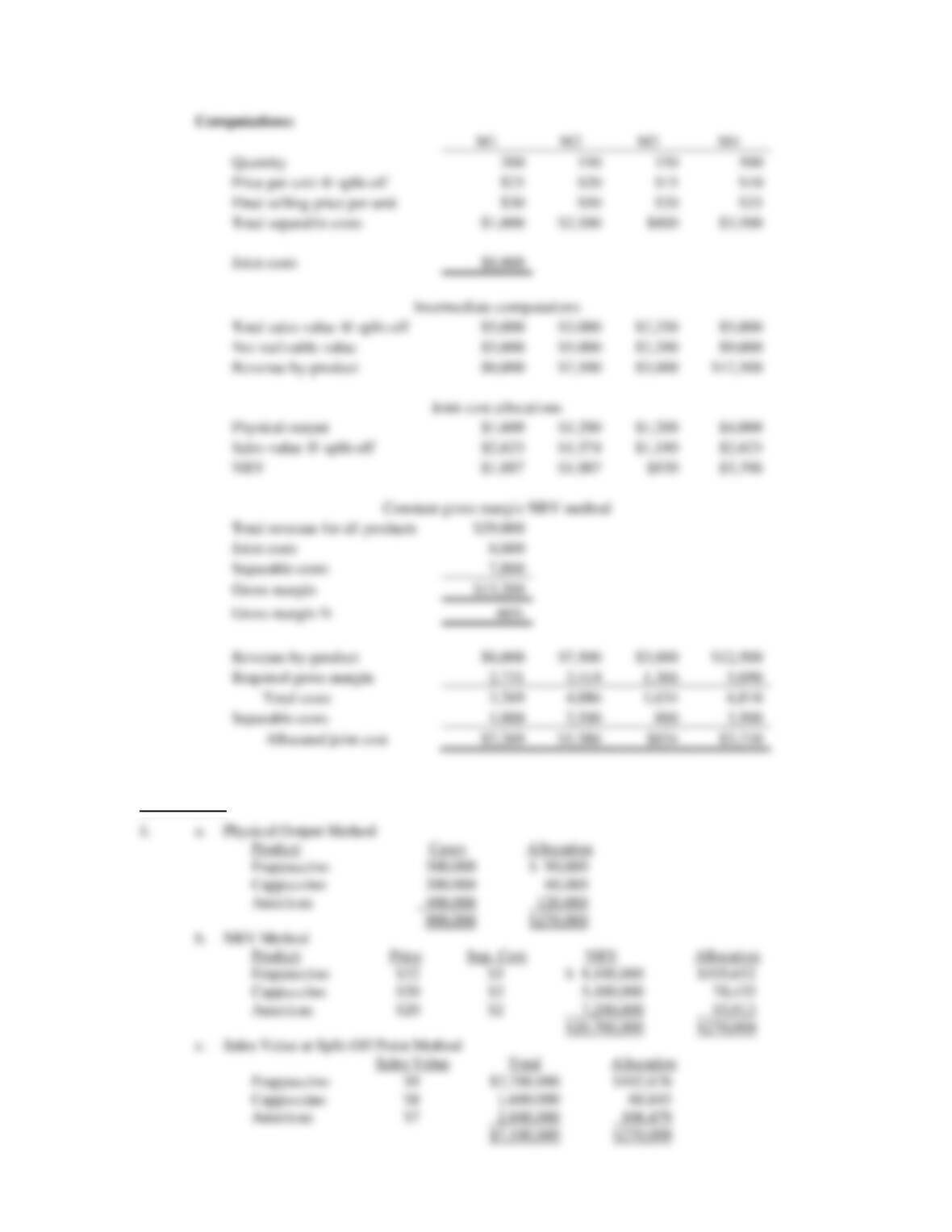
1. Coffee Beverages processes coffee and bottles it as Frappuccino, Cappuccino, and American. During
the year the joint costs of processing the coffee were $270,000. There were no beginning or ending
inventories. Production and sales value information were as follows:
Sales Value
Product Cases at Split-Off Separable Costs Selling Price
Frappuccino 300,000 $9 per case $5.00 per case $32 per case
Cappuccino 200,000 $8 per case $3.00 per case $30 per case
American 400,000 $7 per case $2.00 per case $20 per case
a. Allocate the joint costs using the physical output method.
b. Allocate the joint costs using the net realizable value method.
c. Allocate the joint costs using sales value at split-off point method.

9-22 Cost Management
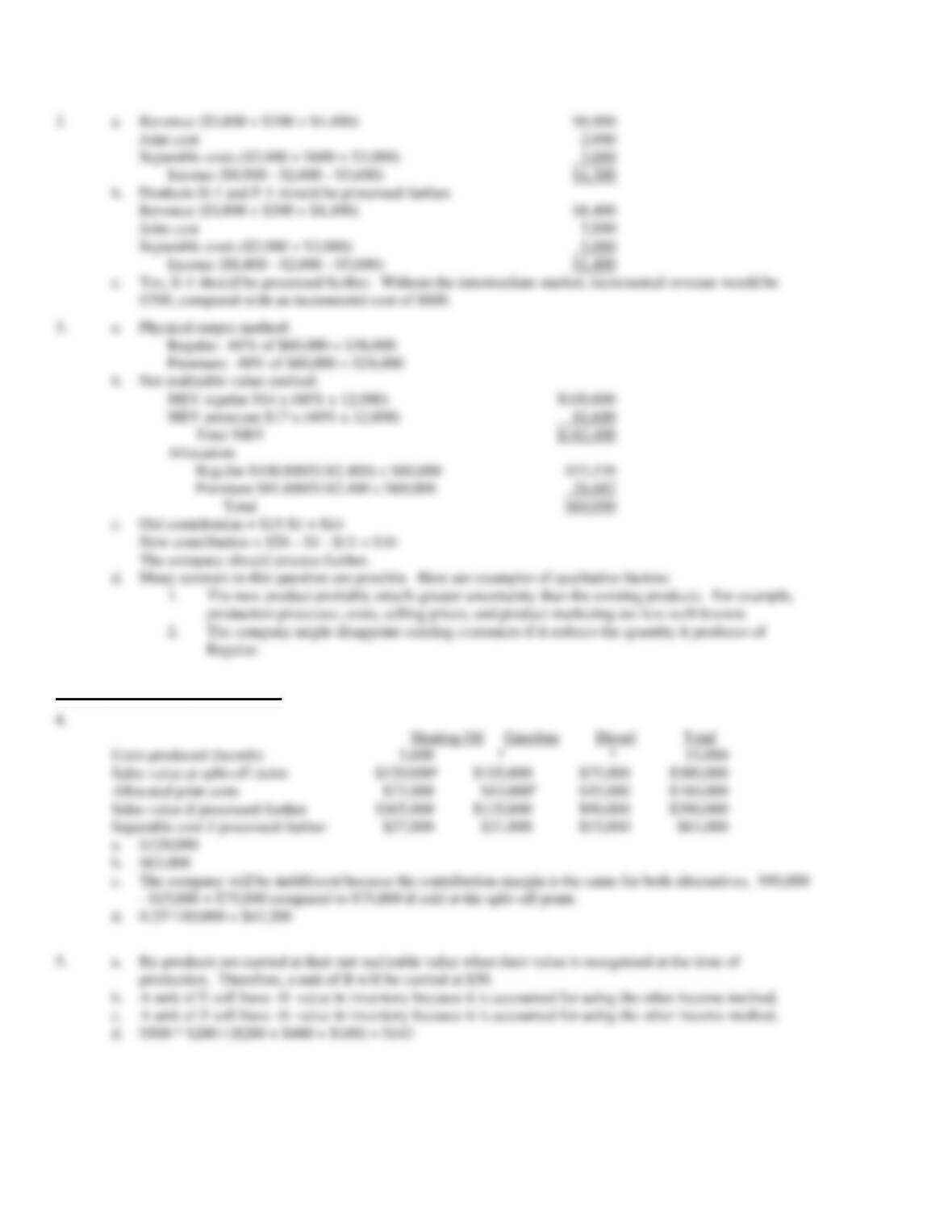
2. Variable Products Co. produces 3 products from a joint process costing $2,000. These products can
be processed further to form another set of 3 products. Markets exist for all of the products. Data for
the current period are:
At Split-Off Point
Separable
Costs
After Further Processing
Products
Sales Value
Products
Sales Value
D-1
$1,000
$2,000
D-2
$3,800
E-1
200
600
E-2
700
F-1
1,200
3,000
F-2
4,400
a. What is the gross margin if all products are sold after further processing?
b. What is the gross margin if the best product mix is chosen?
c. Assume that E-1 cannot be sold at the split-off point. Should this product be processed further?
Explain, and provide computations to support your answer.
3. Chemical Processors use a joint process to produce two types of base paint, Regular and Premium.
Joint costs amount to $60,000 per batch of output. Each batch totals 12,000 gallons, 60% Regular
and 40% Premium. Both products are processed further without gain or loss in volume. Data about
further processing are as follows:
Selling Price
Separable Costs After Further Processing
Regular $1.00 per gallon $15.00 per gallon
Premium $3.00 per gallon $20.00 per gallon
a. Allocate the joint costs according to the physical output method (number of gallons at the split-
off point).
b. Allocate the joint costs according to the net realizable value method.
c. The Company has discovered an additional process by which the Regular can be made into a high
quality stain and mildew-proof paint called Durable. This paint is especially suited for bathrooms
and kitchens. The new selling price would be $28 per gallon. Additional processing would
increase separable costs by $11.00 (in addition to the $1.00 separable cost required to produce
regular). Assuming no other changes in cost, should the company begin producing Durable?
Provide calculations to support your answer.
d. Identify a qualitative factor that could affect the decision in part (c).
More Difficult Exercises
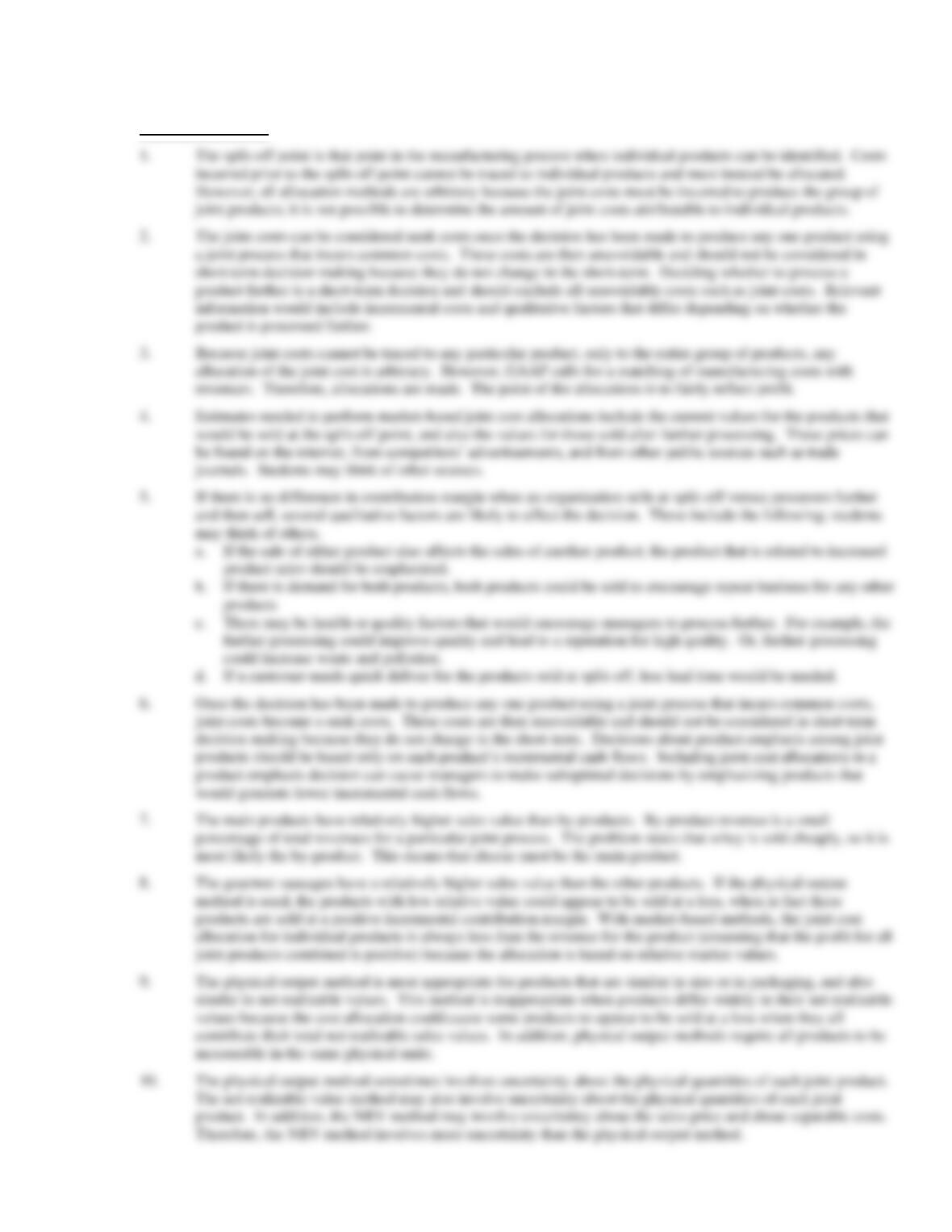
4. Crude Oil Processors produce three products from crude oil: Heating Oil, Gasoline, and Diesel. The
sales value at split-off point is used to allocate joint costs. The following information is available
about their processes:
Heating Oil Gasoline Diesel Total
Units produced (barrels) 3,600 ? ? 15,000
Sales value at split-off point ? ? $75,000 $300,000
Allocated joint costs $72,000 ? ? $180,000
Sales value if processed further $165,000 $135,000 $90,000 $390,000
Separable cost if processed further $27,000 $21,000 $15,000 $63,000
a. What is the sales value at split-off point for Heating Oil?
b. What are the allocated joint costs for Gasoline?
c. Should the company sell Diesel at the split-off point or process it further? Provide computations
to support your answer.
d. Assume the company allocates joint costs using a physical output method, with volume
measuring as number of units. How much joint cost would be allocated to Heating Oil?

Chapter 9: Joint Product and By-Product Costing 9-23
5. Alma, Inc. has joint process that produces five different products at the split-off point. The joint cost
of producing these products is $500. Three of these products are processed further (A, D, and E).
Two of these products are not processed further (B and C). Products A, C, and D are main products;
Products B and E are by-products.
For product costing purposes, the cost reduction method recognized at the time of production is used
for by-product B, and the other income method recognized at the time of sale is used for by-product E
(Z).
Product Product After Sales Price Separable Sales Price After
at Split-Off Further Processing at Split-Off Costs Further Processing
A W $200 $120 $400
B — 50 — —
C — 400 — —
D Y 100 80 320
E Z 10 20 50
a. At what cost will a unit of B be carried in inventory?
b. At what cost will a unit of E be carried in inventory?
c. At what cost will a unit of Z be carried in inventory?
d. How much joint cost will be allocated to product A, if the basis is sales value at split-off point?
Short Answer
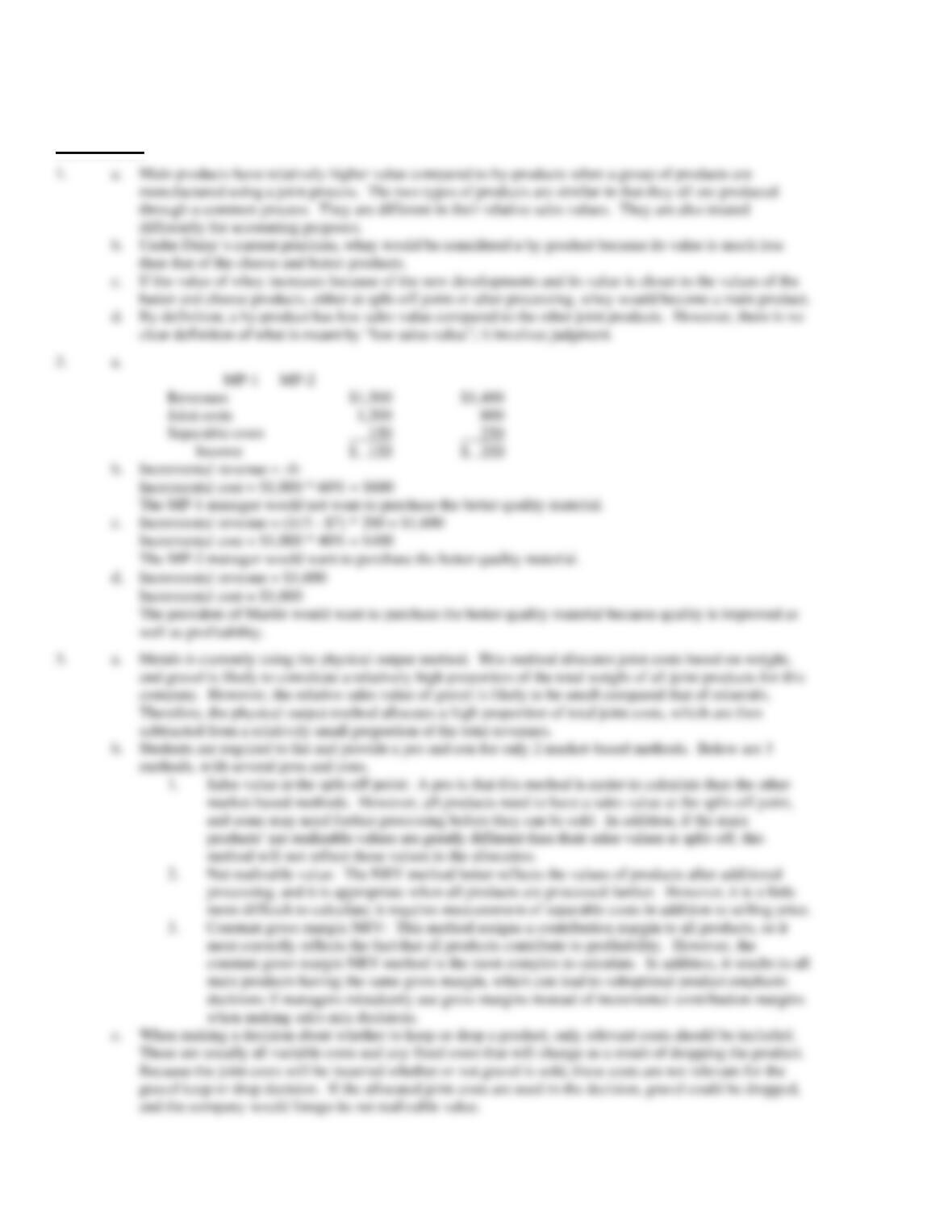
1. Describe the split-off point and explain its significance for joint product costing.
2. A decision about processing a product further should not be influenced by joint cost allocation, but
should be based on incremental costs and qualitative factors. Explain.
3. The allocation of a joint cost among joint products is essentially an arbitrary process. If this statement
is true, then why are joint costs allocated?
4. What estimates are required to perform market-based joint cost allocations, that is, the sales at split–
off point and the net realizable value methods? What sources of information would be used for these
estimates?
5. Sometimes managers might be indifferent about processing a product further because the incremental
contribution margin is about the same as the contribution margin without further processing. Provide
an example of one qualitative factor that might influence a decision to process a joint product beyond
the split-off point.
6. Managers sometimes erroneously include joint cost allocations in the information they use for short
term decision-making, such as product emphasis. Explain why this practice could lead to suboptimal
decisions.
7. Daisy Dairy produces cheese. The cheese manufacturing process yields whey, which is either
disposed of or sold cheaply as animal feed. Identify the main product and by-product at Daisy Dairy
and explain your reasoning.
8. Sal’s Frankfurters produces a variety of hot dogs and sausages. The accountant has used the physical
output method to allocate joint costs of the manufacturing process, but is reconsidering the
appropriateness of this method because new gourmet sausages are priced much higher per pound than
the old products. Explain why one of the market-based methods might be a better choice.
9. For what types of products is the physical output method appropriate? Explain.
10. Methods to allocate joint costs often require use of estimates. Which of the following two methods is
likely to involve the most uncertainty? Explain.
a. Physical output method
b. Net realizable value

9-24 Cost Management
Problems
1. Daisy Dairy produces butter and cheese products. The process yields whey, in addition to the butter
and cheese products. Years ago, whey was considered human food, but now the dairy sells it very
cheaply as animal feed to avoid disposal costs. Recently, University of California-Davis researchers
developed a process whereby whey can be used as a main ingredient in a plastic-like film that can be
used to coat foods to keep them fresh.
a. Describe main products and by-products. How are they similar, and how are they different?
b. Under Daisy’s current practices, would whey be considered a main product or a by-product?
Explain.
c. With the new developments for whey, would you expect any changes in your classification in part
(c)? Explain.
d. Describe several uncertainties that might arise when classifying products as main products versus
by-products.
2. Martin, Inc. produces products MP-1 and MP-2 from a joint process costing $2,000 per 1,000 pounds
of input. A 1,000-pound batch produces 300 units of MP-1 and 200 units of MP-2. MP-1 can be
processed further for $150, and MP-2 for $250. Sales prices after further processing are $5 and $7
per unit, respectively.
a. Determine the gross margin for each product, assuming Martin allocates joint costs using the
physical output method.
For parts (b) through (d), assume Martin could buy a higher grade of the input material for $3,000 per
1,000 pounds. The higher grade material would increase MP-1’s separable costs to $400, and MP–2’s
unit selling price would become $15.
b. Would the MP-1 manager want the better quality material to be purchased? Provide
computations to support your answer.
c. Would the MP-2 manager want the better quality material to be purchased? Provide
computations to support your answer.
d. Would the chief executive officer of Martin, Inc. want the better quality material to be purchased?
Provide computations to support your answer.
3. As an accountant for Metals Unlimited, a small mining firm, you are responsible for allocating the
joint costs for the minerals. The firm is using the weight of the material to allocate these costs. Some
of the tailings from the mining process are currently being sold as unprocessed gravel to landscape
material distributors, but the allocated costs are greater than the revenue. Therefore, several managers
would like to quit selling this product.
a. What joint product allocation method is Metals Unlimited using? Why, under this method, are
the joint cost allocations to gravel larger than the revenues?
b. List two market-based methods that could be used to allocate the joint costs. List the one pro and
one con of each method for this organization.
c. Write a brief paragraph to the managers explaining why they should not use any allocated joint
costs in their decisions about whether to keep or drop the gravel product.

Chapter 9: Joint Product and By-Product Costing 9-25
4. Benjamin and Lenny are partners in the Double-B Farm, where they grow corn. They process the
corn into four separate products. Double-B Farm’s joint costs typically total $8,000. Additional data
for the products are summarized in the table below:
Quantity Sales Price Separable
Produced Per Unit Costs
Corn oil 10,000 gallons $1.50 per gallon $3,000
Whole kernel corn 15,000 bushels $0.75 per bushel $2,250
Corn husks 6,000 husks $0.25 per husk -0-
Corn silk 12,000 pounds $0.50 per pound $600
a. Classify each of Double-B’s products as either a main product or a by-product, and justify your
classifications.
b. Describe in your own words two methods for allocating Double-B’s joint costs to its main
products. List a pro and a con for each method. Which would you recommend to Benjamin and
Lenny? Why?
c. Describe in your own words two methods of accounting for by-products. Which method is
generally considered better? Explain.
d. Benjamin and Lenny are considering whether to allocate joint costs to the main products using
the physical output method. Can this method be used to allocate joint costs given the data in the
table above? Explain.
9-26 Cost Management
Answers
True / False
Multiple Choice
Chapter 9: Joint Product and By-Product Costing 9-27
9-28 Cost Management
Matching
Chapter 9: Joint Product and By-Product Costing 9-29
Exercises
9-30 Cost Management
More Difficult Exercises
Chapter 9: Joint Product and By-Product Costing 9-31
Short Answer
9-32 Cost Management
Problems
Chapter 9: Joint Product and By-Product Costing 9-33