
The Essential Cosmic Perspective, 8e (Bennett et al.)
Chapter 9 Asteroids, Comets, and Dwarf Planets: Their Nature, Orbits, and Impacts
9.1 Multiple Choice Questions
1) Which of the following statements about comets and asteroids is true?
A) Only asteroids collide with Earth.
B) Comets are frozen balls of ice and dust.
C) Most of the trillions of comets in our solar system have tails.
D) All asteroids lie in the asteroid belt between Mars and Jupiter.
E) There are about 1 million known asteroids in the solar system.
2) What do asteroids and comets have in common?
A) Most are unchanged since their formation in the solar nebula.
B) They have similar densities.
C) They have similar orbital radii.
D) They have a similar range of orbital inclinations.
E) They have nothing in common with each other.
3) How do asteroids differ from comets?
A) Asteroids are made mostly of rocky and/or metallic material. Comets are made mostly of icy
material.
B) Asteroids are made mostly of icy material. Comets are made of mostly rocky material.
C) Asteroids and comets are both made of rocky and icy material, but asteroids are larger in size
than comets.
D) Asteroids and comets are both made of rocky and icy material, but asteroids are smaller in
size than comets.
4) A rocky leftover planetesimal orbiting the Sun is
A) a comet.
B) a meteor.
C) an asteroid.
D) a meteorite.
E) possibly any of the above
5) An icy leftover planetesimal orbiting the Sun is
A) a comet.
B) a meteor.
C) an asteroid.
D) a meteorite.
E) possibly any of the above

6) Why do asteroids and comets differ in composition?
A) Asteroids formed inside the frost line, while comets formed outside.
B) Asteroids and comets formed at different times.
C) Comets formed from the jovian nebula, while asteroids did not.
D) Comets are much larger than asteroids.
E) Asteroids are much larger than comets.
7) What is the approximate diameter of the largest asteroid?
A) 1 km
B) 10 km
C) 100 km
D) 1,000 km
E) 10,000 km
8) What causes the “gaps” observed in the asteroid belt between Mars and Jupiter?
A) There are very few asteroids with diameters between 1 and 100 kilometers, creating a gap in
the size distribution.
B) Asteroids cluster together due to their mutual gravity and this creates gaps in their
distribution.
C) Jupiter’s gravity causes orbital resonances that nudge asteroids out of these areas.
D) There is a large population of asteroids too faint to see called the “gap” asteroids.
E) There are either pure metal or pure rock asteroids, but no mixtures. Thus there is a “gap” in
the composition of asteroids.
9) Where are the Trojan asteroids located?
A) in orbits around Jupiter
B) along Jupiter’s orbit, 60° ahead of and behind Jupiter
C) in the center of the asteroid belt
D) in orbits that cross Earth’s orbit
E) in orbits that cross Mars’s orbit
10) Kirkwood gaps in the asteroid belt occur at distances where
A) the density of asteroids is high enough for a large collision to pulverize a number of asteroids.
B) the period of an orbiting asteroid would be a simple fraction (like 1/3 or 1/4) of Jupiter’s
orbital period.
C) the period of an orbiting asteroid would be the same as Jupiter’s orbital period.
D) the period of an orbiting asteroid would be the same as Mars’s orbital period.
E) the orbit would take the asteroid beyond the “frost line” in the solar system.

11) Why do we sometimes observe asteroids in the gaps in the asteroid belt?
A) A gap is located at an average orbital distance, and asteroid orbits often have large
eccentricities.
B) Jupiter’s gravitational tugs keep them there.
C) They are held in place by resonances with other asteroids.
D) They are kept in place by shepherding asteroids.
E) Actually, we never see asteroids in the gaps.
12) Why aren’t small asteroids spherical in shape?
A) The force of gravity in small asteroids is less than the resistance of the rock to deform.
B) Small asteroids have odd shapes because they were all chipped off larger objects.
C) Large asteroids were once molten and therefore became spherical, but small asteroids were
never molten.
D) Large asteroids became spherical because many small collisions chipped off pieces until only
a sphere was left; this did not occur with small asteroids.
13) What is a meteorite?
A) a streak of light caused by a star moving across the sky
B) a streak of light caused by a small particle from space burning up in Earth’s atmosphere
C) a fragment of material from the solar system that has fallen to Earth’s surface
D) a small moon that orbits one of the giant planets
E) a comet that burns up in Earth’s atmosphere
14) Which of the following are relatively unchanged fragments from the early period of planet
building in the solar system?
A) meteorites
B) asteroids
C) Kuiper belt comets
D) Oort cloud comets
E) all the above
15) What characteristic distinguishes a meteorite from a terrestrial rock?
A) A meteorite is usually covered with a dark crust from burning in Earth’s atmosphere.
B) A meteorite usually has a high metal content.
C) Meteorites have different isotope ratios of particular elements when compared to terrestrial
rocks.
D) Meteorites often contain rare elements that terrestrial rocks do not.
E) All of the above are true.

16) How can primitive meteorites be distinguished from processed meteorites?
A) Radiometric dating shows that primitive meteorites are slightly older.
B) Radiometric dating shows that primitive meteorites are slightly younger.
C) Primitive meteorites always contain iron and processed meteorites do not.
D) Primitive meteorites always contain rocky material and processed meteorites do not.
E) Primitive meteorites always contain carbon compounds and processed meteorites do not.
17) Processed meteorites with high metal content probably are
A) leftover chunks of rock from the earliest period in the formation of the solar system.
B) pieces of comets rather than of asteroids.
C) chunks of the core of a larger asteroid that was shattered by a collision.
D) chunks of rock chipped off the planet Mercury.
E) chunks of rock chipped off the planet Mars.
18) Meteorites can come from
A) the cores of asteroids.
B) the crusts and mantles of asteroids.
C) the Moon.
D) Mars.
E) all of the above
19) When a comet enters the inner solar system, what part of the comet always points most
directly away from the Sun?
A) the nucleus
B) the coma
C) the jets of gas
D) the plasma tail
E) the dust tail
20) Why does the plasma tail of a comet always point away from the Sun?
A) The solar wind pushes the plasma ions directly away from the Sun.
B) Radiation pressure from the Sun’s light pushes the ions away.
C) The conservation of the angular momentum of the tail keeps it always pointing away from the
Sun.
D) Gases from the comet, heated by the Sun, push the tail away from the Sun.
E) The particles in the plasma tail are more massive than those in the dust tail.

21) What was observed in the plume of material knocked off Comet Tempel 1 during the Deep
Impact mission?
A) heavy metals such as uranium and lead
B) complex organic molecules
C) only water vapor
D) radioactive elements created in the collision
E) nothing; the dust in the plume prevented astronomers from analyzing its content
22) Where did comets that are now in the Oort cloud originally form?
A) near the jovian planets
B) outside Neptune’s orbit
C) inside Jupiter’s orbit
D) within the solar nebula, but far outside the orbit of Pluto
E) all of the above
23) Where did comets that are now in the Kuiper belt originally form?
A) in the asteroid belt
B) inside Jupiter’s orbit
C) between the orbits of Jupiter and Neptune
D) in the same region where they are found today
E) in the Oort cloud
24) Comets with very long orbital periods, like Hyakutake and Hale-Bopp,
A) come from the asteroid belt.
B) come from the Kuiper belt.
C) come from the Oort cloud.
D) are Trojan comets.
E) are captured by Jupiter.
25) What is the typical size of a comet’s nucleus?
A) 1 meter
B) 10 km
C) 100 km
D) 1000 km
E) Sizes are unknown because the nucleus is obscured by the coma.

26) According to the nebular theory, how did the Kuiper belt form?
A) It is material left over from the interstellar cloud that never contracted with the rest of the
gases to form the solar nebula.
B) It is made of planetesimals that formed beyond Neptune’s orbit and never accreted to form a
planet.
C) It consists of objects that fragmented from the protosun during a catastrophic collision early
in the formation of the solar system.
D) It is made of planetesimals between the orbits of Mars and Jupiter that never formed into a
planet.
E) It is made of planetesimals formed in the outer solar system that were flung into distant orbits
by encounters with the jovian planets.
27) According to the nebular theory, how did the Oort cloud form?
A) It is material left over from the interstellar cloud that never contracted with the rest of the
gases to form the solar nebula.
B) It is made of planetesimals that formed beyond Neptune’s orbit and never accreted to form a
planet.
C) It consists of objects that fragmented from the protosun during a catastrophic collision early
in the formation of the solar system.
D) It is made of planetesimals between the orbits of Mars and Jupiter that never formed into a
planet.
E) It is made of planetesimals formed in the outer solar system that were flung into distant orbits
by encounters with the jovian planets.
28) If you could stand on the surface on the side of Pluto that faces its moon Charon, what would
you see?
A) Charon would appear almost 10 times larger than the Moon appears in Earth’s sky.
B) Charon would not rise or set in your sky.
C) Charon would go through a cycle of phases every 6.4 Earth days.
D) You would only ever see one side of Charon.
E) all the above
29) Rather than being a planet, Pluto is now considered to be a large member of
A) the asteroid belt.
B) the Kuiper belt.
C) the Oort cloud.
D) the moon system around Neptune.
E) an extrasolar planetary system.

30) Which of the following is furthest from the Sun?
A) Pluto
B) Neptune
C) an asteroid in the asteroid belt
D) a comet in the Kuiper belt
E) a comet in the Oort cloud
31) Pluto is different from the Jovian planets in all of the following ways except which one?
A) It formed outside of the frost line in the solar nebula.
B) It is made mostly of ices.
C) Its orbit is not very close to being circular.
D) It has a solid surface.
E) It doesn’t have rings.
32) Will Pluto eventually collide with Neptune?
A) No, because Pluto’s orbit is completely outside Neptune’s orbit.
B) No, because Pluto’s orbit is completely inside Neptune’s orbit.
C) No, because Pluto’s orbit never comes anywhere close to Neptune’s orbit.
D) No, because the two planets have an orbital resonance that prevents them from colliding.
E) Yes.
33) How is Pluto’s moon system thought to have formed?
A) from a giant impact
B) from accretion in a disk surrounding Pluto
C) by gravitational capture of passing asteroids
D) by gravitational capture of passing comets
E) by stealing them during a close encounter with Neptune
34) How many moons is Pluto currently known to have?
A) one
B) two
C) three
D) four
E) five

35) What surprising discovery did the New Horizons spacecraft make during its recent flyby of
Pluto?
A) Pluto has the largest known volcano in the solar system.
B) Pluto’s surface consists mostly of rocky material.
C) Pluto’s surface shows signs of very recent geological activity.
D) Pluto really is a lost moon of Neptune.
E) all of the above
36) How was Pluto’s surface first roughly mapped?
A) by imaging with powerful ground based telescopes
B) by imaging with the Hubble Space Telescope
C) by mapping with the New Horizons spacecraft
D) by measuring the change in brightness as Charon eclipsed Pluto
E) Pluto is too far away for its surface to be mapped.
37) Based on the height of Pluto’s mountains photographed during the New Horizons flyby, what
must be true about their composition?
A) They are made of rock.
B) They are made of water ice.
C) They are made of nitrogen ice.
D) They are made of metal.
E) They are volcanoes so they must be made of solidified lava.
38) What is the likely cause of the haze seen in photographs of Pluto’s atmosphere taken by the
New Horizons spacecraft?
A) ice particles that erupt from geysers on Pluto’s surface
B) hydrocarbon molecules captured from passing comets
C) dust particles suspended in Pluto’s atmosphere
D) condensation on the camera lens
E) ultraviolet solar radiation breaking down methane and nitrogen molecules, which then form
haze particles
39) What is true about the impacts of the pieces of Comet Shoemaker-Levy 9 with Jupiter?
A) Each impact released more energy than is tied up in all the nuclear weapons ever produced by
humans.
B) Some of the impacts created scars on Jupiter larger than Earth.
C) Each impactor was less than a few kilometers in diameter.
D) Jupiter’s strong winds erased all evidence of the impacts.
E) all of the above
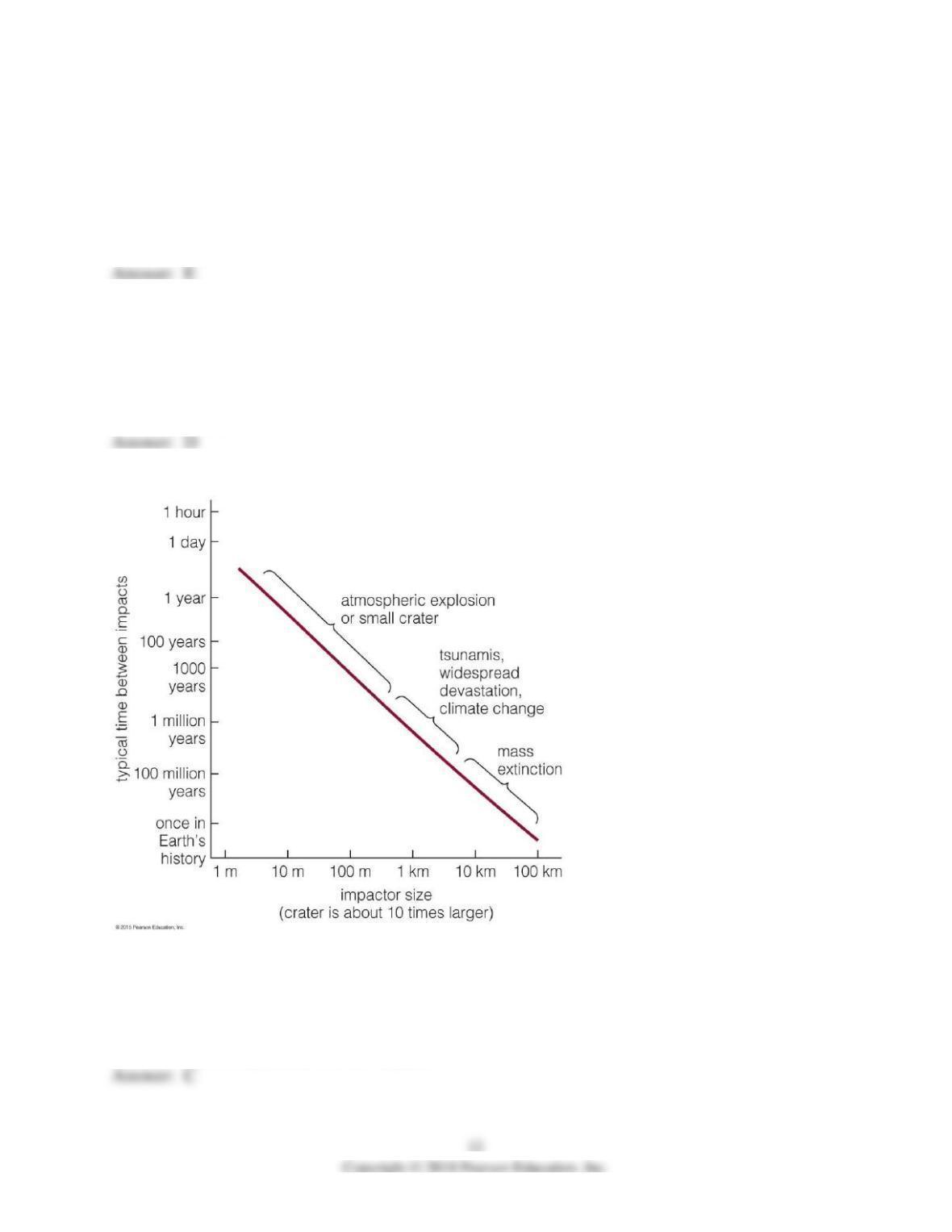
40) On average, approximately how often do impacts large enough to produce mass extinctions
on Earth occur?
A) once every thousand years
B) once every million years
C) once every hundred million years
D) once every billion years
E) once in Earth’s history
41) What is thought to have caused the Tunguska event in 1908?
A) a small asteroid striking the ground
B) a small comet striking the ground
C) a small asteroid exploding above the ground
D) an atomic bomb
E) a meteorite striking the ground
42)
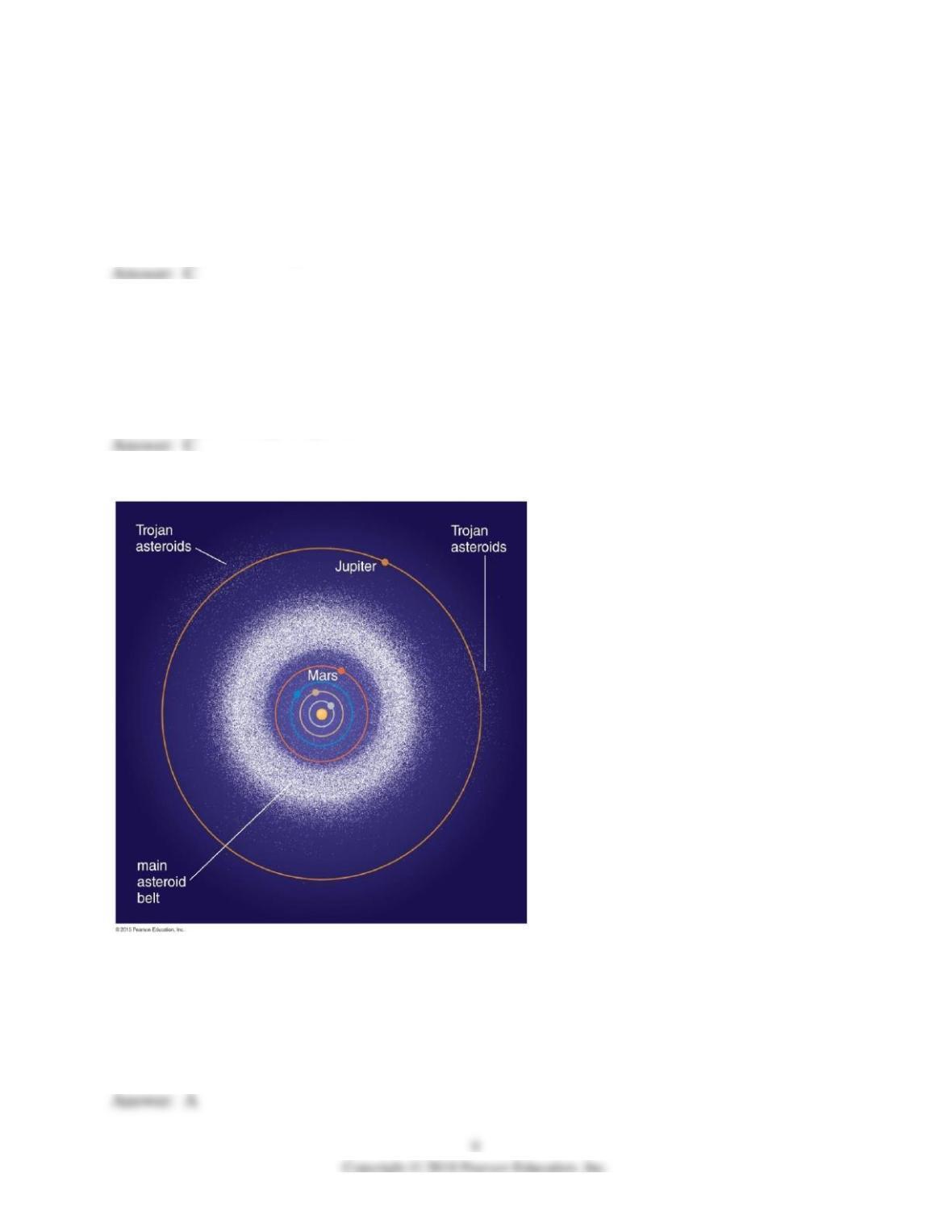
In what way does this figure give a poor representation of the asteroid belt?
A) For a correct scale, the asteroids should be drawn much smaller. This image gives the
impression that the asteroid belt is very crowded.
B) The image does not show where most of the asteroids are located in the solar system.
C) It shows the positions of the asteroids at a mix of times.
D) all of the above
43) If all of the asteroids in the solar system were gathered into a single object, it would make an
object
A) about half the diameter of Earth’s Moon.
B) about the size of Earth’s Moon.
C) about the size of the Earth.
D) with enough mass to gather hydrogen and helium and become a gas giant.
44) How do asteroids appear in long exposure images?
A) as points of light, like the stars
B) as resolved disks, like the planets
C) as straight lines across a background of stars
D) as complex curving and looping lines
45)
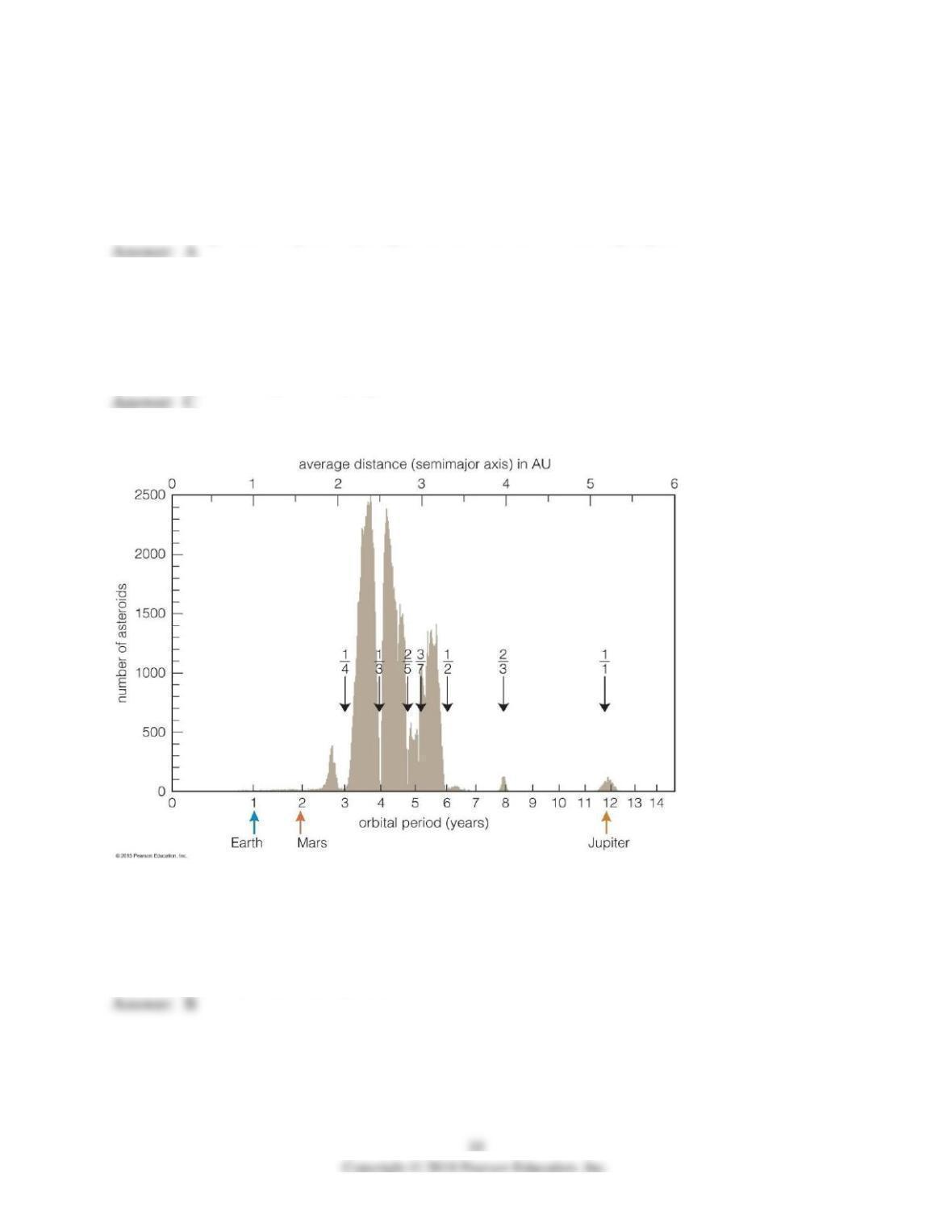
The greatest number of asteroids are found
A) between 1 and 2 AU from the sun.
B) between 2 and 3 AU from the sun.
C) between 3 and 4 AU from the sun.
D) between 4 and 5 AU from the sun.

46) What would be the consequence(s) of more frequent collisions between planets and
asteroids?
A) We would find more Martian meteorites on Earth.
B) We would observe more meteor showers.
C) Another planet might form in the asteroid belt.
D) all of the above
47) According to the nebular theory, how did the asteroid belt form?
A) It is material left over from the interstellar cloud that never contracted with the rest of the
gases to form the solar nebula.
B) It is made of planetesimals that formed beyond Neptune’s orbit and never accreted to form a
planet.
C) It consists of objects that fragmented from the protosun during a catastrophic collision early
in the formation of the solar system.
D) It is made of planetesimals between the orbits of Mars and Jupiter that never formed into a
planet.
E) It is made of planetesimals formed in the outer solar system that were flung into distant orbits
by encounters with the jovian planets.
48) If a major asteroid collision in the asteroid belt occurs, on average, 1 time in 100,000 years,
then how many major collisions have occurred over the approximately 4 billion year history of
the solar system?
A) about 40,000
B) about 4 million
C) about 4 billion
D) about 4,000
49) What was the Stardust mission?
A) a mission to study the composition of an asteroid by hitting it with a massive object and
observing the material thrown into space
B) a mission to study the composition of a comet by collecting material from its tail and return
that material to Earth
C) a mission to study the outer planets of the solar system by sending a probe from one to the
next with a wide variety of instruments
D) a mission to study the surface structure of a comet by dropping a lander onto its surface
50) What evidence led astronomers to conclude that the Oort cloud is a spherical distribution of
comets?
A) the observation that comets enter the solar system from random directions
B) direct observation of comets orbiting the sun in the Oort cloud
C) Astronomers did not draw that conclusion; the Oort cloud is shaped like a flat ring in the same
plane as the planets.
51) In what way(s) has Pluto long been known to be different from the planets?
A) It has a highly eccentric orbit.
B) Its orbit is more inclined to the ecliptic plane.
C) It is far smaller than the terrestrial planets.
D) It is composed primarily of ices.
E) all of the above
52) Which of the following are evidence for an asteroid impact being the cause of the extinction
of the dinosaurs 65 million years ago (as well as 75% of all species alive at the time)?
A) a worldwide layer of the element iridium in 65 million year old rocks
B) a buried crater more than 100 km across in the Gulf of Mexico
C) no dinosaur fossils being present in rocks younger than 65 million years old
D) all of the above
53)
How frequently do objects that cause widespread devastation hit the Earth?
A) about once every year
B) about once every thousand years
C) about once every million years
D) about once every hundred million years

54) What lucky factor prevented the Chelyabinsk object from causing much damage at ground
level?
A) It hit Earth at an oblique angle and thus exploded high in the air.
B) It was made entirely of ices and thus exploded high in the air.
C) A prototype asteroid defense system was being tested nearby.
9.2 True/False Questions
1) A spacecraft traveling through the asteroid belt has a high risk of being destroyed through a
collision.
2) All meteorites collected on Earth come from asteroids or comets.
3) No spacecraft has ever visited an asteroid or comet.
4) A spacecraft has captured and brought material to Earth from a comet.
5) All comets orbit the Sun in the same direction as the planets.
6) Oort-cloud comets are so far from the Sun that the gravity of neighboring stars can alter their
orbits.
7) A comet that has an orbit around the Sun inclined to the ecliptic plane by 65° probably
originated in the Kuiper belt.
8) Viewed from Pluto, the Sun would appear more than a thousand times fainter than on Earth.
9) Pluto has 5 known moons.
10) Pluto’s moons are captured asteroids or comets.
11) Aside from Pluto, no Kuiper belt objects are known to have moons.
12) The discovery of Charon allowed astronomers to determine Pluto’s mass.