
1. An effort to diversify into nonrelated markets is most likely to be undertaken when firms undergo:
a.
Horizontal integration
b.
Vertical integration
c.
Conglomerate integration
d.
None of the above
2. The source (home) location of most of the world’s leading multinational enterprises is:
a.
North America and Europe
b.
North America and Asia
c.
Europe and South America
d.
Europe and Asia
United States – BPROG: Reflective Thinking – BPROG: Analysis
The Multinational Enterprise
3. Which type of multinational diversification occurs when the parent firm establishes foreign subsidiaries to produce
intermediate goods going into the production of finished goods?
a.
Forward vertical integration
b.
Backward vertical integration
c.
Forward horizontal integration
d.
Backward horizontal integration
United States – BPROG: Reflective Thinking – BPROG: Analysis
The Multinational Enterprise
4. Suppose that an American automobile manufacturer establishes foreign subsidiaries to market the automobiles. This
practice is referred to as:
a.
Forward vertical integration
b.
Forward conglomerate integration
United States – BPROG: Reflective Thinking – BPROG: Analysis
The Multinational Enterprise

c.
Backward vertical integration
d.
Backward conglomerate integration
5. Suppose that a steel manufacturer headquartered in Japan sets up a subsidiary in Canada to produce steel. This practice
is referred to as:
a.
Conglomerate integration
b.
Forward vertical integration
c.
Backward vertical integration
d.
Horizontal integration
United States – BPROG: Reflective Thinking – BPROG: Analysis
The Multinational Enterprise
6. During the 1970s, American oil companies acquired nonenergy companies (e.g., copper, auto components) in response
to anticipated decreases in investment opportunities in oil. This type of diversification is referred to as:
a.
Horizontal integration
b.
Conglomerate integration
c.
Forward vertical integration
d.
Backward vertical integration
United States – BPROG: Reflective Thinking – BPROG: Analysis
The Multinational Enterprise
7. Which of the following best refers to the outright construction or purchase abroad of productive facilities, such as
manufacturing plants, by domestic residents?
a.
Direct investment
b.
Portfolio investment
c.
Short-term capital investment
d.
Long-term capital investment
United States – BPROG: Reflective Thinking – BPROG: Analysis
The Multinational Enterprise

8. In recent years, most foreign direct investment in the United States has come from:
a.
Western Europe
b.
Central America
c.
South America
d.
Asia
a
Easy
United States – BPROG: Reflective Thinking – BPROG: Analysis
Motives for Foreign Direct Investment
9. In recent years, the largest amount of U.S. direct investment abroad has occurred in:
a.
Central America
b.
South America
c.
Europe
d.
Japan
c
Easy
United States – BPROG: Reflective Thinking – BPROG: Analysis
Motives for Foreign Direct Investment
10. Most U.S. direct investment abroad occurs in:
a.
Communications
b.
Petroleum
c.
Finance and insurance
d.
Manufacturing
Easy
United States – BPROG: Reflective Thinking – BPROG: Analysis
a
Moderate
United States – BPROG: Reflective Thinking – BPROG: Analysis

11. Most foreign direct investment in the United States occurs in:
a.
Public utilities
b.
Communications
c.
Manufacturing
d.
Mining and smelting
c
Easy
United States – BPROG: Reflective Thinking – BPROG: Analysis
Motives for Foreign Direct Investment
12. Which of the following is not a significant motive for the formation of multinational enterprises?
a.
Avoiding tariffs by obtaining foreign manufacturing facilities
b.
Obtaining the benefits from overseas comparative advantages
c.
The acquisition of natural resource supply sources
d.
Subsidies granted by the home government to overseas corporations
Moderate
United States – BPROG: Reflective Thinking – BPROG: Analysis
The Multinational Enterprise
13. Suppose General Motors charges its Mexican subsidiary $1 million for auto assembly equipment that could be
purchased on the open market for $800,000. This practice is best referred to as:
a.
International dumping
b.
Cost-plus pricing
c.
Transfer pricing
d.
Technological transfer
c
Moderate
Finance
Motives for Foreign Direct Investment
Motives for Foreign Direct Investment

14. Multinational enterprises may provide benefits to their source (home) countries because they may:
a.
Secure raw materials for the source country
b.
Shift source country technology overseas via licensing
c.
Export products which reflect source-country comparative disadvantage
d.
Result in lower wages for source-country workers
15. Trade analysis involving multinational enterprises differs from our conventional trade analysis in that multinational
enterprise analysis emphasizes:
a.
Absolute cost differentials rather than comparative cost differentials
b.
The international movement of factor inputs rather than finished goods
c.
Purely competitive markets rather than imperfectly competitive markets
d.
Portfolio investments rather than direct foreign investments
United States – BPROG: Reflective Thinking – BPROG: Analysis
Motives for Foreign Direct Investment
16. Direct foreign investment has taken all of the following forms except:
a.
Investors buying bonds of an existing firm overseas
b.
The creation of a wholly owned business enterprise overseas
c.
The takeover of an existing company overseas
d.
The construction of a manufacturing plant overseas
United States – BPROG: Reflective Thinking – BPROG: Analysis
Motives for Foreign Direct Investment
17. Which of the following would best explain why foreign direct investment might be attracted to the United States?
a.
U.S. price ceilings that hold down the price of energy
b.
U.S. wage rates exceeding the productivity of U.S. labor
United States – BPROG: Reflective Thinking – BPROG: Analysis
Motives for Foreign Direct Investment

c.
Artificially high prices being charged for the stock of U.S. firms
d.
Anticipations of future reductions in U.S. tariff levels
18. Both Coca-Cola Co. and Pepsi-Cola Co. are multinational firms in that their soft drinks are bottled throughout the
world. This practice illustrates:
a.
Backward vertical integration
b.
Forward vertical integration
c.
Horizontal integration
d.
Conglomerate integration
United States – BPROG: Reflective Thinking – BPROG: Analysis
The Multinational Enterprise
19. The market power effect of an international joint venture can lead to welfare losses for the domestic economy unless
offset by cost reductions. Which type of cost reduction would not lead to offsetting welfare gains for the overall
economy?
a.
R&D generating improved technology
b.
Development of more productive machinery
c.
New work rules promoting worker efficiency
d.
Lower wages extracted from workers
United States – BPROG: Reflective Thinking – BPROG: Analysis
The Multinational Enterprise
20. All of the following are potential advantages of an international joint venture except:
a.
Sharing research and development costs among corporations
b.
Forestalling protectionism against imports
c.
Establishing work rules promoting higher labor productivity
d.
Operating at diseconomy-of-scale output levels
United States – BPROG: Reflective Thinking – BPROG: Analysis
Motives for Foreign Direct Investment

21. Which term best describes the Iran Oil Investment Co.?
a.
Multinational enterprise
b.
International joint venture
c.
Multilateral contract
d.
International commodity agreement
United States – BPROG: Reflective Thinking – BPROG: Analysis
International Trade Theory and Multinational Enterprise
22. Multinational enterprises:
a.
Increase the transfer of technology between nations
b.
Make it harder for nations to foster activities of comparative advantage
c.
Always enjoy political harmony in nations where their subsidiaries operate
d.
Require governmental subsidies in order to conduct worldwide operations
United States – BPROG: Reflective Thinking – BPROG: Analysis
The Multinational Enterprise
23. Firms undertake multinational operations in order to:
a.
Hire low-wage workers
b.
Manufacture in nations they have difficulty exporting to
c.
Obtain necessary factor inputs
d.
All of the above
United States – BPROG: Reflective Thinking – BPROG: Analysis
United States – BPROG: Reflective Thinking – BPROG: Analysis

24. Multinational enterprises face problems since they:
a.
Cannot benefit from the advantages of comparative advantage
b.
May raise political problems in countries where their subsidiaries operate
c.
Can invest only at home, but not overseas
d.
Can invest only overseas, but not at home
United States – BPROG: Reflective Thinking – BPROG: Analysis
The Multinational Enterprise
25. American labor unions have recently maintained that U.S. multinational enterprises have been:
a.
Exporting American jobs by investing overseas
b.
Exporting American jobs by keeping investment in the United States
c.
Importing cheap foreign workers by shifting U.S. investment overseas
d.
Importing cheap foreign workers by keeping U.S. investment at home
United States – BPROG: Reflective Thinking – BPROG: Analysis
Multinational Enterprises as a Source of Conflict
26. American labor unions accuse U.S. multinational firms of all of the following except: that such firms
a.
Enjoy unfair advantages in taxation
b.
Export jobs by shifting technology overseas
c.
Export jobs by shifting investment overseas
d.
Operate at output levels where scale economies occur
United States – BPROG: Reflective Thinking – BPROG: Analysis
Multinational Enterprises as a Source of Conflict
The Multinational Enterprise

27. Which of the following refers to the price charged for products sold to a subsidiary of a multinational enterprise by
another subsidiary in another nation?
a.
Transfer pricing
b.
International dumping
c.
Price discrimination
d.
Full-cost pricing
28. Which business device involves the creation of a new business by two or more companies, often for a limited period
of time?
a.
Multinational enterprise
b.
International joint venture
c.
Horizontal merger
d.
Vertical merger
United States – BPROG: Reflective Thinking – BPROG: Analysis
The Multinational Enterprise
29. International joint ventures can lead to welfare losses when the newly established firm:
a.
Adds to the preexistent productive capacity
b.
Enters markets neither parent could have entered individually
c.
Yields cost reductions unavailable to parent firms
d.
Gives rise to increased amounts of market power
United States – BPROG: Reflective Thinking – BPROG: Analysis
International Trade Theory and Multinational Enterprise
30. Multinational enterprises:
a.
Always produce primary goods
b.
Always produce manufactured goods
United States – BPROG: Reflective Thinking – BPROG: Analysis
Multinational Enterprises as a Source of Conflict
c.
Produce primary goods or manufactured goods
d.
None of the above
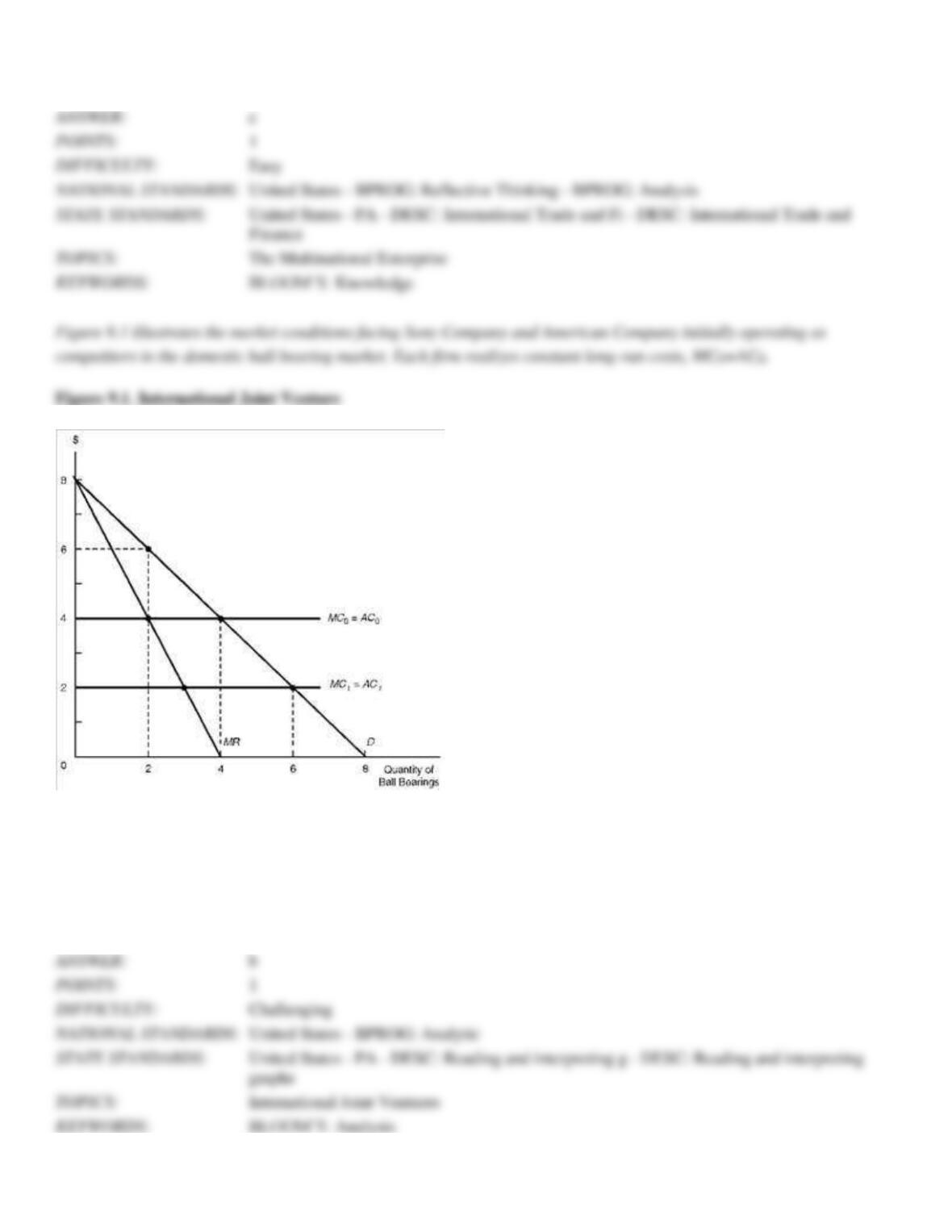
31. Consider Figure 9.1. With Sony Company and American Company behaving as competitors, the equilibrium price and
output respectively equal:
a.
$4 and 2 units
b.
$4 and 4 units
c.
$6 and 2 units
d.
$6 and 4 units
United States – BPROG: Analytic
International Joint Ventures
United States – BPROG: Reflective Thinking – BPROG: Analysis
The Multinational Enterprise

32. Consider Figure 9.1. At the equilibrium price, domestic households attain ____ of consumer surplus:
a.
$4
b.
$8
c.
$12
d.
$16
33. Consider Figure 9.1. Suppose that Sony Company and American Company jointly form a new firm, Venture
Company, whose ball bearings replace the output sold by the parents in the domestic market. Assuming that Venture
Company operates as a monopoly and that its costs equal MC0=AC0, the firm’s price, output, and total profit would
respectively equal:
a.
$6, 2 units, $4
b.
$4, 2 units, $2
c.
$6, 4 units, $4
d.
$4, 4 units, $2
34. Consider Figure 9.1. Compared to the market equilibrium position achieved by Sony Company and American
Company as competitors, Venture Company as a monopoly leads to a deadweight loss of consumer surplus of:
a.
$2
b.
$4
c.
$6
d.
$8
35. Consider Figure 9.1. Assume Venture Company’s formation yields new cost reductions, indicated by MC1=AC1,

which result from technological advances. Realizing that Venture Company results in a deadweight loss of consumer
surplus, the net effect of Venture Company‘s formation on the welfare of the domestic economy is:
a.
No change
b.
Gain of $2
c.
Gain of $4
d.
Loss of $2
36. Consider Figure 9.1. Assume Venture Company’s formation yields new cost reductions, indicated by MC1=AC1,
which result from wage concessions accepted by Venture Company employees. The net effect of Venture Company’s
formation on the welfare of the domestic economy is:
a.
No change
b.
Gain of $2
c.
Loss of $2
d.
Loss of $4
United States – BPROG: Analytic
International Joint Ventures
37. Consider Figure 9.1. Assume Venture Company’s formation yields new cost reductions, indicated by MC1=AC1,
which result from changes in work rules by Venture Company employees that led to higher worker productivity. The net
effect of Venture Company’s formation on the welfare of the domestic economy is:
a.
No change
b.
Gain of $2
c.
Gain of $4
d.
Loss of $2
United States – BPROG: Analytic
International Joint Ventures
United States – BPROG: Analytic
International Joint Ventures
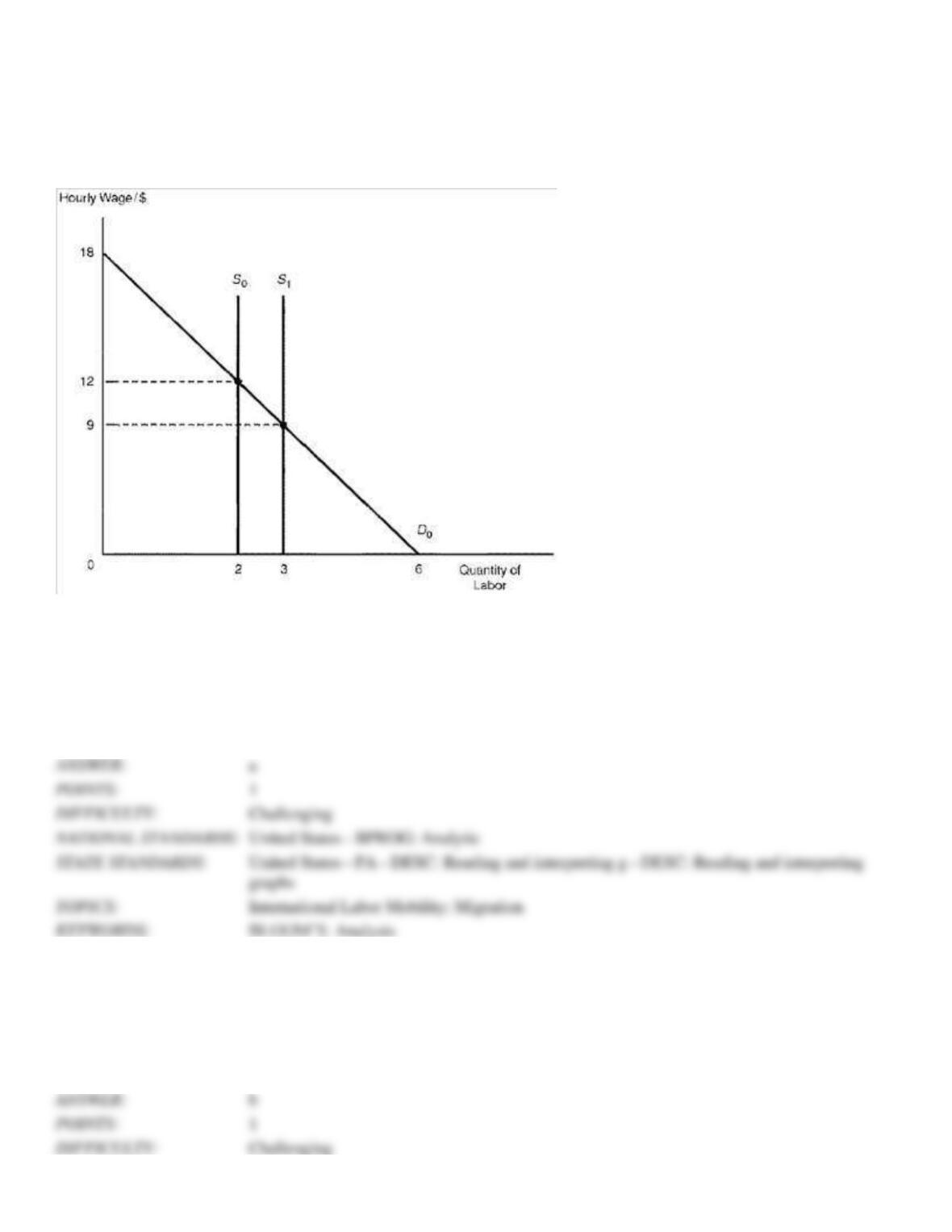
Figure 9.2 represents the U.S. labor market. Assume that labor and capital are the only factors of production. Also
assume the initial supply schedule of labor is denoted by S0 and consists entirely of native U.S. workers. The demand
schedule of labor is denoted by D0.
Figure 9.2. U.S. Labor Market
38. Consider Figure 9.2, at labor market equilibrium, _____ workers are hired at a wage rate of $____ per hour, while
total wages equal ____.
a.
2, $12, $24
b.
2, $12, $36
c.
3, $9, $27
d.
3, $9, $36
39. Consider Figure 9.2. At labor market equilibrium, the payment to U.S. capital owners equals:
a.
$3
b.
$6
c.
$9
d.
$12
40. Consider Figure 9.2. As the result of the Mexican migration to the United States:
a.
U.S. capital owners lose
b.
Native U.S. workers lose
c.
U.S. capital owners and native U.S. workers lose
d.
U.S. capital owners and native U.S. workers gain
United States – BPROG: Analytic
International Labor Mobility: Migration
41. Consider Figure 9.2. Policies that permit Mexican workers to freely migrate to the United States would likely be
resisted by:
a.
U.S. capital owners
b.
Native U.S. workers
c.
U.S. capital owners and native U.S. workers
d.
Neither U.S. capital owners nor native U.S. workers
United States – BPROG: Analytic
International Labor Mobility: Migration
42. ____ refers to highly educated and skilled people who migrate from poor developing countries to wealthy industrial
countries.
a.
Direct investment
b.
Portfolio investment
c.
Transfer pricing
d.
Brain drain
United States – BPROG: Analytic
United States – BPROG: Analytic
International Labor Mobility: Migration

43. “Guest worker” programs generally result in temporary migration of workers from:
a.
Wealthy nations to wealthy nations
b.
Wealthy nations to impoverished nations
c.
Impoverished nations to wealthy nations
d.
Impoverished nations to impoverished nations
c
Moderate
United States – BPROG: Analytic
International Labor Mobility: Migration
44. Canada views immigrants as:
a.
friends
b.
foes
c.
necessary to the Canadian economy
d.
both a and c
United States – BPROG: Reflective Thinking – BPROG: Analysis
International Labor Mobility: Migration
45. Critics of U.S. trade and immigration policy maintain that
a.
It has depressed wages for many Americans
b.
It has increased the supply of less educated workers in the United States
c.
It has an adverse impact on the employment opportunities of less-skilled, American workers
d.
All of the above
Moderate
United States – BPROG: Reflective Thinking – BPROG: Analysis
Multinat. Ent. as a Source of Conflict
46. American critics of U.S. multinational enterprises contend that they promote
International Labor Mobility: Migration