Chapter 9
1.
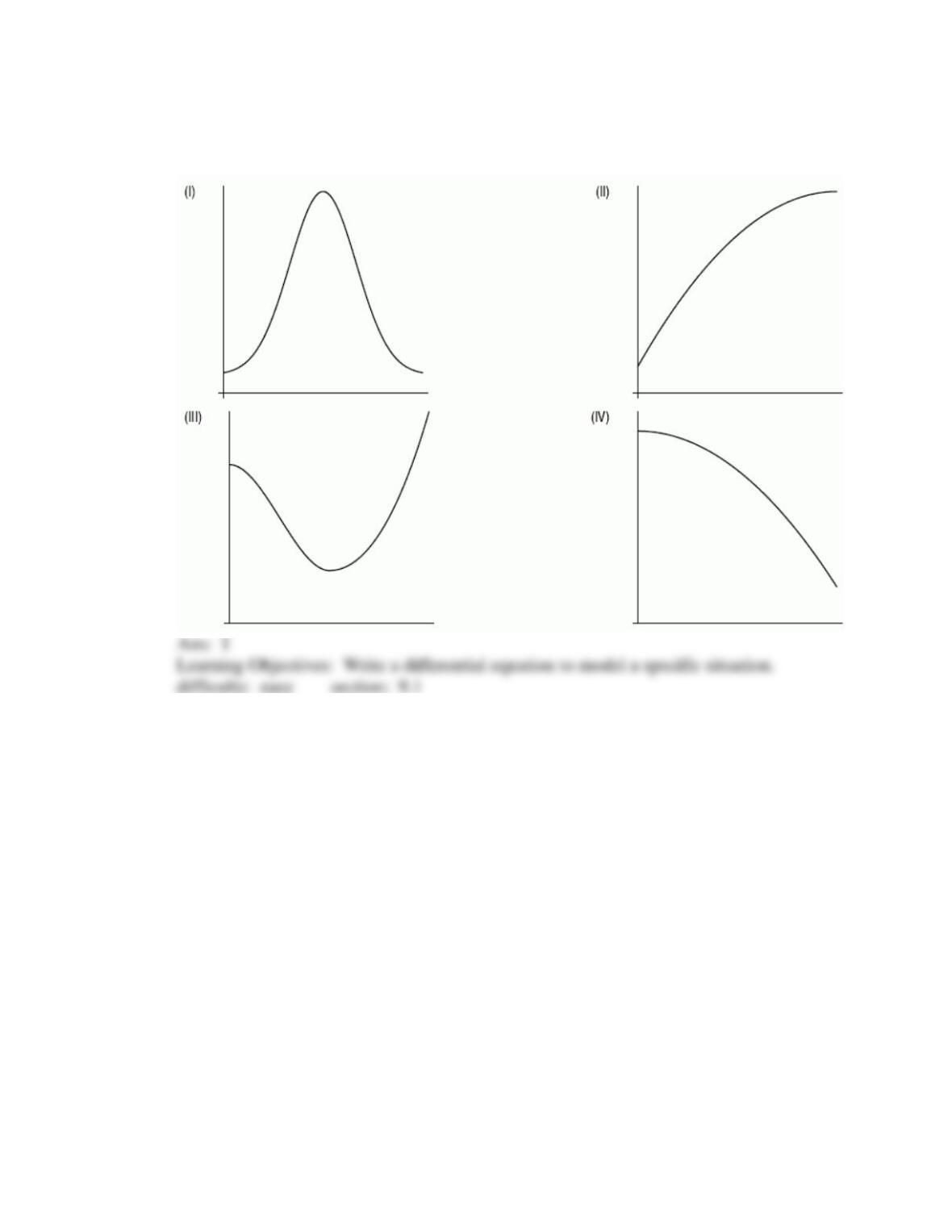
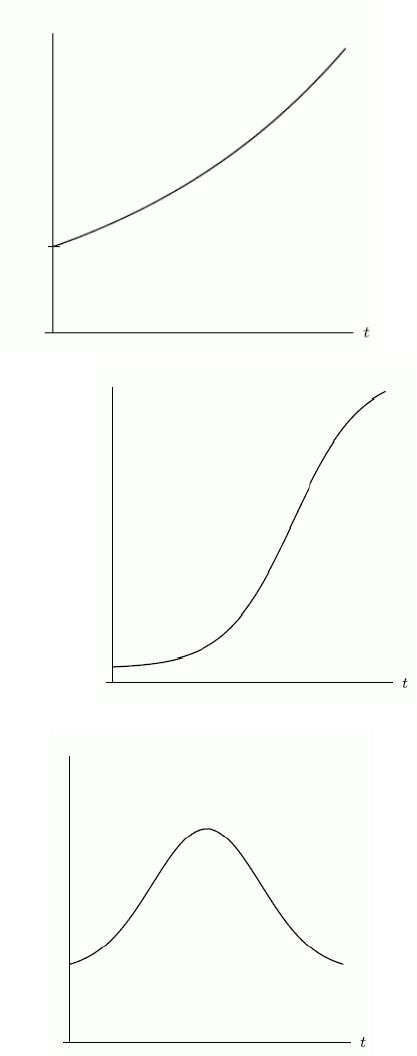
Which of the following graphs best describes the temperature in a large North American
city over the course of a year?
Chapter 9
Page 2
2.
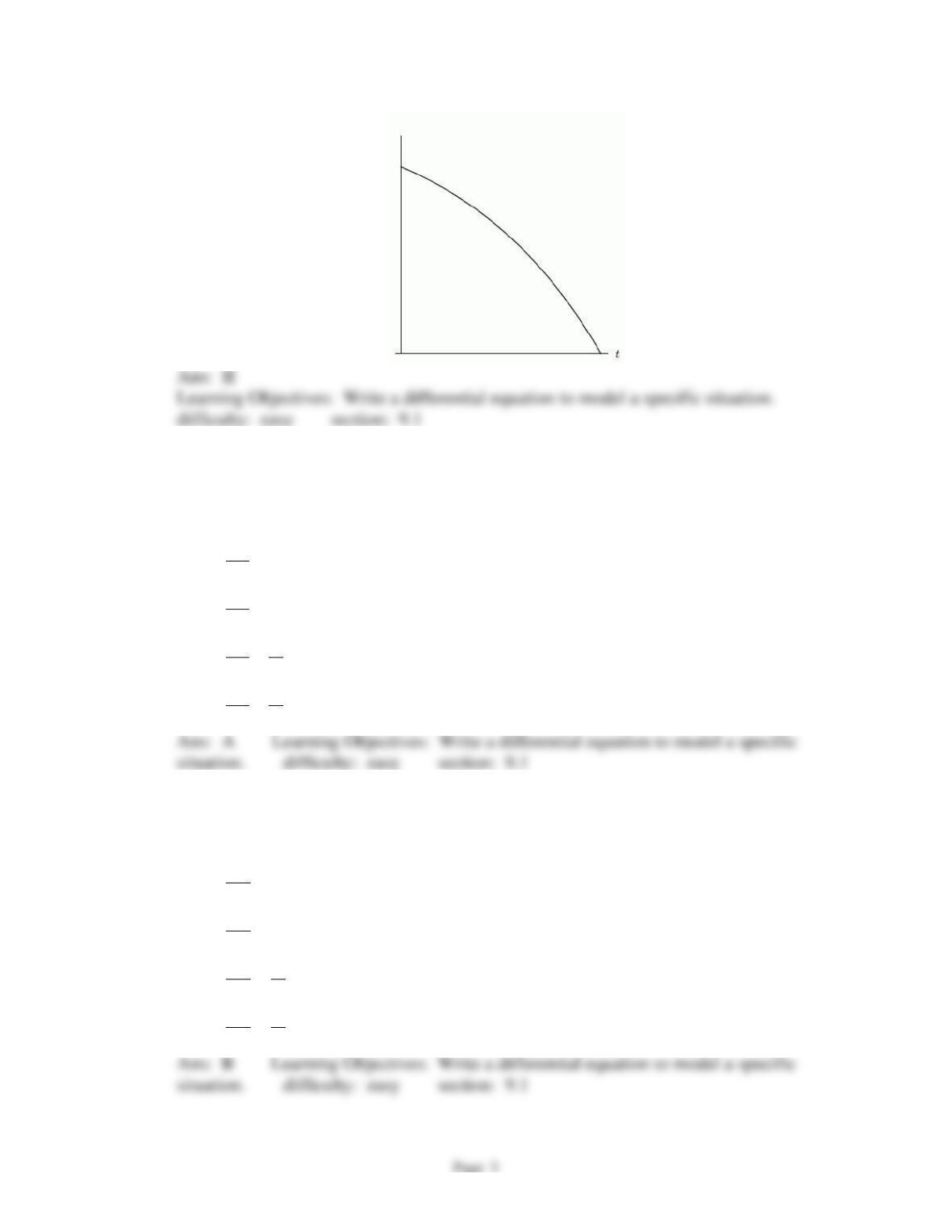
Which of the following graphs best describes the population of a species that is
introduced to a confined space?
I. II.
III. IV.
Chapter 9
Ans:
Learning Objectives: Write a differential equation to model a specific situation.
difficulty: easy section: 9.1
3.
A population of rodents grows at a rate proportional to the size of the population.
Which of the following is the the differential equation for the size of the population, P,
as a function of time, t?
A)
dP kP
dt
=
, with k positive
B)
dP kP
dt
=
, with k negative
C)
dP k
dt P
=
, with k positive
D)
dP k
dt P
=
, with k negative
Ans: A Learning Objectives: Write a differential equation to model a specific
situation. difficulty: easy section: 9.1
4.
Carbon-14 decays at a rate proportional to the amount present. Which of the following
is the differential equation for the amount, C, of carbon-14 present at time t?
A)
dC kC
dt
=
, with k positive
B)
dC kC
dt
=
, with k negative
C)
dC k
dt C
=
, with k positive
D)
dC k
dt C
=
, with k negative
Chapter 9
5.
The deer population, P, in an area is increasing at a rate of 25% per year due to
breeding. At the same time, about 200 deer are shot by hunters each year. Which is
the differential equation for the population of deer as a function of time t, in years?
A)
1.25 200
dP P
dt
=−
B)
200 0.25
dP P
dt
=−
C)
0.25 200
dP P
dt
=−
D)
200 1.25
dP P
dt
=−
Ans: C Learning Objectives: Write a differential equation to model a specific
situation. difficulty: easy section: 9.1
6.
Water is being pumped into a pool at a rate of 150 gallons per day, and is evaporating at
a rate of 0.2% per day. Which is the differential equation for the amount, A, of gallons
of water in the pool as a function of time, t, in days?
A)
150 1.002
dA A
dt
=−
B)
0.2 150
dA A
dt
=−
C)
150 0.2
dA A
dt
=−
D)
150 0.002
dA A
dt
=−
Ans: D Learning Objectives: Write a differential equation to model a specific
situation. difficulty: easy section: 9.1
7.
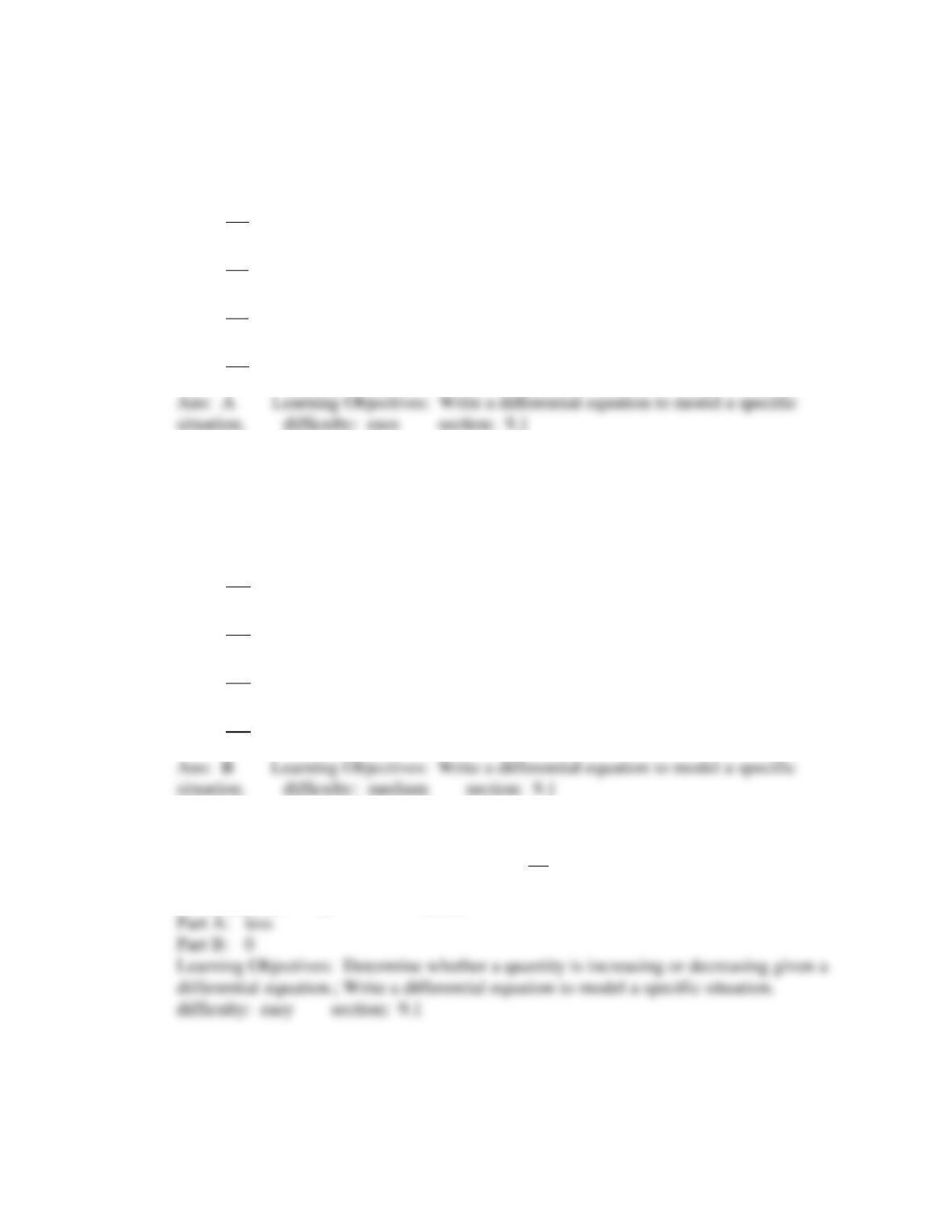
A person withdraws money from a trust fund at a rate of $12,000 per year, and the
account is earning interest at a rate of 5% per year, compounded continuously. Write a
differential equation for the balance, B, in the account as a function of time, t, in years
and use it to calculate
/dB dt
if B=$100,000.
Ans:
Learning Objectives: Write a differential equation to model a specific situation.
difficulty: easy section: 9.1
Chapter 9
Page 5
8.
A bank account initially containing $4000 earns interest at a continuous rate of 6% per
year. Deposits are made into the account at a constant rate of $500 per year. Which is
the differential equation for the balance, B, in the account as a function of time, t, in
years?
A)
0.06 500
dB B
dt
=+
B)
6 500
dB B
dt
=+
C)
0.06 4500
dB B
dt
=+
D)
(4000)0.06 500
dB B
dt
=+
9.
A drug is administered intravenously to a patient at a rate of 12 mg per day. About
40% of the drug in the patient’s body is metabolized and leaves the body each day.
Which is the differential equation for the amount of the drug, D, in the body as a
function of time, t, in days?
A)
12 40
dD D
dt
=−
B)
12 0.4
dD D
dt
=−
C)
40 12
dD D
dt
=−
D)
0.4 12
dD D
dt
=−
Ans: B Learning Objectives: Write a differential equation to model a specific
situation. difficulty: medium section: 9.1
10.
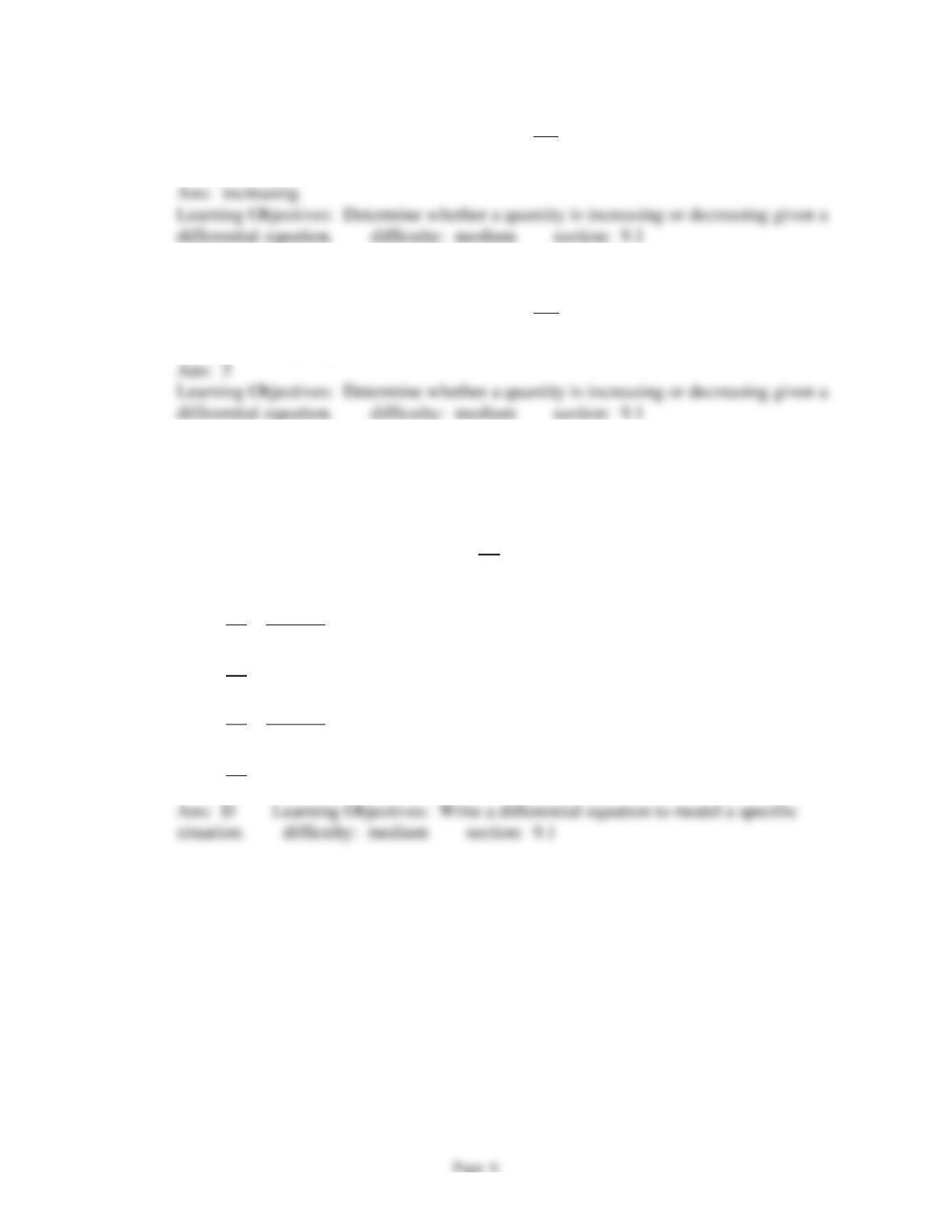
A quantity y satisfies the differential equation
0.02
dy y
dt
=
. Thus, y is decreasing when
y is ________(less/greater) than _____.
Part A:
less
Part B:
0
differential equation.; Write a differential equation to model a specific situation.
difficulty: easy section: 9.1
Ans: A Learning Objectives: Write a differential equation to model a specific
situation. difficulty: easy section: 9.1
Chapter 9
11.
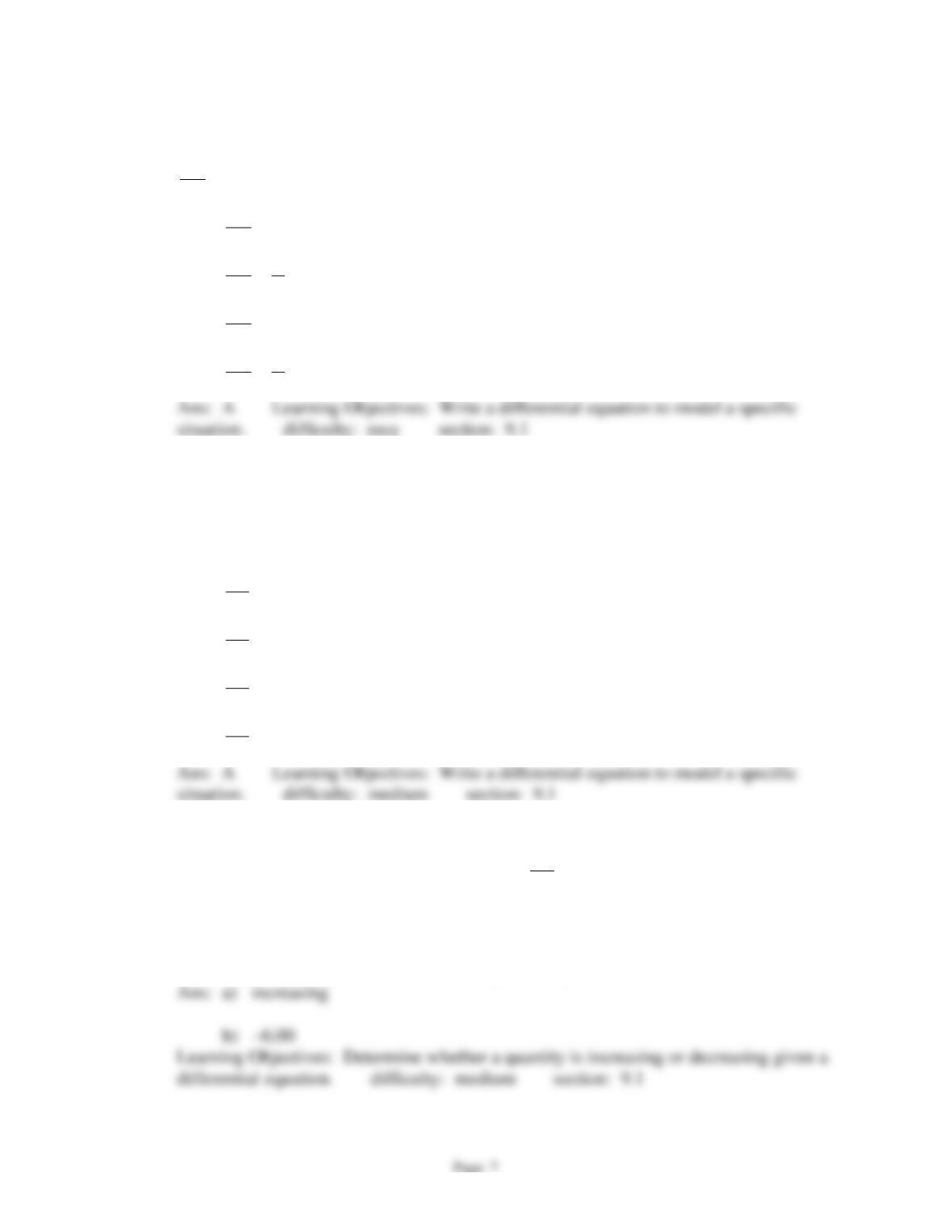
A quantity Q satisfies the differential equation
10 3
dQ Q
dt
=−
. Is Q increasing or
decreasing at Q = 3?
12.
A quantity Q satisfies the differential equation
10 2
dQ Q
dt
=−
. For what value of Q is
the rate of change equal to 0?
13.
There is a theory that says the rate at which information spreads by word of mouth is
proportional to the product of the number of people who have heard the information and
the number who have not. Suppose the total population is N. Which of the following
differential equations describe the rate,
dp
dt
, at which the information spreads by word
of mouth?
A)
()
dp kp
dt p N
=
−
B)
()
dp kp N p
dt
=+
C)
()
dp kp
dt N p
=
−
D)
()
dp kp N p
dt
=−
Chapter 9
14.
A spherical raindrop evaporates at a rate proportional to its surface area. If V = volume
of the raindrop and S = surface area, which of the following is a differential equation for
dV
dt
?
A)
dV kS
dt
=
with k a negative constant
B)
dV k
dt S
=
with k a negative constant
C)
dV kS
dt
=
with k a positive constant
D)
dV k
dt S
=
with k a positive constant
Ans: A Learning Objectives: Write a differential equation to model a specific
situation. difficulty: easy section: 9.1
15.
A population of birds introduced onto an island without predators grows at a rate
proportional to the size of the population. Write a differential equation for the size of
the population, P, as a function of time. Is the constant of proportionality positive or
negative?
A)
dP kP
dt
=
, positive
B)
dP kP
dt
=
, negative
C)
dP kt
dt
=
, negative
D)
dP kt
dt
=
, positive
Ans: A Learning Objectives: Write a differential equation to model a specific
situation. difficulty: medium section: 9.1
16.
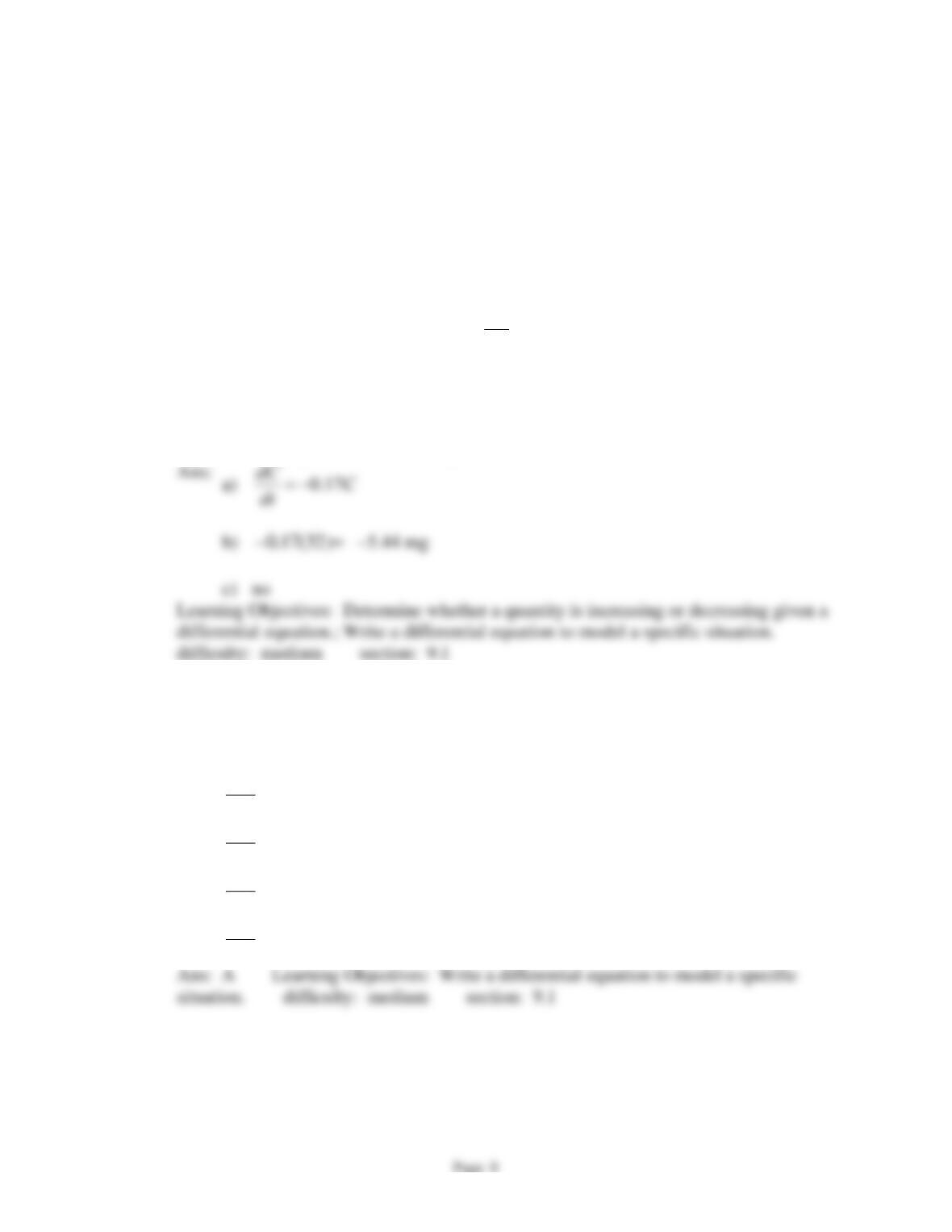
A quantity T satisfies the differential equation
3 18
dT T
dt
=+
.
a) Is T increasing or decreasing when T = –5?
b) For what value of T is the rate of change of T equal to zero?
Ans:
a) increasing
b) –6.00
Chapter 9
17.
A cup of green tea contains 32 mg of caffeine when you are using the tea leaves for the
first time. A cup from the second brew contains 12 mg of caffeine, while a cup from
the third brew contains only 4 mg of caffeine. Caffeine leaves the body at a continuous
rate of about 17% per hour.
a) Write a differential equation for the amount, C, of caffeine in the body at time t
hours after drinking the green tea.
b) Use the differential equation to find
dC
dt
at the start of the first hour (right after
drinking the tea) for a cup from the first brew, and use your answer to estimate the
change in caffeine in the body during the first hour.
c) Does the initial amount of caffeine in the body (whether from the first, second or
third brew) change the differential equation?
18.
Water runs down a certain type of drainpipe at a rate proportional to the amount of
water on the roof after a rainfall. Write a differential equation for the amount of water,
W, on the roof at time t minutes after the rain stops.
A)
dW kW
dt
=−
B)
dW W kt
dt
=−
C)
()
dW k W A
dt
=−
D)
dW kt
dt
=−
Ans: A Learning Objectives: Write a differential equation to model a specific
Chapter 9
19.
Consider the differential equation for the logistic model representing a population of
tarantulas introduced into a new habitat:
(200 )
dP kP P
dt
=−
. What is the carrying
capacity?
A)
200 tarantulas
B)
k tarantulas
C)
200 – P tarantulas
D)
1000 tarantulas
20.
Which one(s) of the following are solutions to the differential equation
dy y
dx
=
?
A)
3yx=
B)
3x
ye=
C)
yx=
D)
3x
ye=
E)
3
yx=
differential equation. difficulty: easy section: 9.2
21.
Which one(s) of the following are solutions to the differential equation
3
dy x
dx
=
?
A)
3yx=
B)
3x
ye=
C)
yx=
D)
3x
ye=
E)
3
yx=
F)
none of the above
of a differential equation. difficulty: easy section: 9.2
Chapter 9
22.
Which one(s) of the following are solutions to the differential equation
3
dy y
dx
=
?
A)
3yx=
B)
3x
ye=
C)
yx=
D)
3x
ye=
E)
3
yx=
23.
Which one(s) of the following are solutions to the differential equation
dy y
dx x
=
?
A)
3yx=
B)
3x
ye=
C)
yx=
D)
3x
ye=
E)
3
yx=
24.
Which one(s) of the following are solutions to the differential equation
3
dy y
dx x
=
?
A)
3yx=
B)
3x
ye=
C)
yx=
D)
3x
ye=
E)
3
yx=
25.
Is
3
yx=
a solution to the differential equation
30
dy
xy
dx
−=
?
Chapter 9
26.
Find the solution of the differential equation
43
dy x
dx
= − +
satisfying
(1) 2y=
.
27.
What is the solution of
5 cos 4
dK t
dt
=−
when
(0) 8K=−
?
A)
sin 4
58
4
t
Kt= − −
B)
sin 4
58
4
t
Kt= + −
C)
sin 4
58
4
t
Kt= − +
D)
sin 4
58
4
t
Kt= + +
28.
What is the solution of
12 t
dP e
dt
−
=−
when
(0) 20P=
?
A)
12 8
t
Pe
−
=−
B)
12 8
t
Pe
−
=+
C)
12 32
t
Pe
−
= − +
D)
12 32
t
Pe
−
= − −
29.
Given that
/ 0.3dy dt y=−
and that
(0) 12y=
, estimate
(2)y
to 2 decimal places by
first estimating y(1). Assume that the rate of growth given by
/dy dt
is approximately
constant over each unit time interval.
Chapter 9
30.
Given that
/ 3 0.2dy dt y=+
and that
(0) 18y=
, estimate
(2)y
to 1 decimal place by
first estimating y(1). Assume that the rate of growth given by
/dy dt
is approximately
constant over each unit time interval.
solution. difficulty: easy section: 9.2
31.
Is
k
yx=
a solution to the differential equation
3
dy
x ky
dx
=
?
32.
If
kt
y Ce=
is a solution to the differential equation
6
dy y
dt
=
and y = 20 when t = 0,
then k = _____ and C = _____.
33.
Does
25cos5yt=
satisfy
2
225 0
dy y
dt
+=
?
34.
If
2
y x k=+
is a solution to the differential equation
2 12
dy
yx
dx
−=
, then k = _____.
Chapter 9
Page 13
35.
In Kenya, the population P for the recent past has obeyed the growth model
dP ktP
dt
=
,
with t the number of years since 1990. The solution to the differential equation is of
the form
2/2kt
P Ae=
. If the population in 1990 was 24.64 million and in 1992 was
26.16 million, then A = _____ and k = _____. Thus, in the year 1997, the population
was approximately _____ million. Round all answers to 2 decimal places.
36.
Suppose
kt
P Ce=
satisfies the differential equation
0.09
dP P
dt
=
. Then k = _____ and
C = _____. If either cannot be determined from the information given, enter “cannot
tell”.
37.
Is
bt
a
y Ce
b
−
=+
the general solution to the differential equation
dy a by
dt
=−
?
38.
Fill in the missing values in the table, given that
/9dy dt y=+
. Assume the growth
rate, given by
/dy dt
, is approximately constant over each time interval.
t
0
1
2
3
4
y
14
t
0
1
2
3
4
y
14
37
83
175
359
Chapter 9
39.
Consider the differential equation
1
dy y
dt
=−
. Is
1
t
y Ce−
=−
the general solution to
the differential equation? If it is not, answer “not the solution”. If it is the general
solution and if y(3) = 5, what is the constant C?
A)
yes, C = 121
B)
yes, 0.30
C)
yes, 12.23
D)
not the solution
40.
For
23y kx x=−
to be a solution to the differential equation
43
dy x
dx
=−
, what must be
the constant k?
A)
2
B)
0
C)
4
D)
k can be any number
values of a solution. difficulty: medium section: 9.2
41.
Find the particular solution to the differential equation
11
dP P
dt
=
when
(0) 13P=
.
A)
11
( ) 13 t
P t e=
B)
(1/13)
( ) 11 t
P t e=
C)
(1/11)
( ) 13 t
P t e=
D)
13
( ) 11 t
P t e=
values of a solution. difficulty: easy section: 9.2
42.
Find a solution to the differential equation
8
dQ Q
dt
=−
subject to the initial condition Q
= 60 when t = 0.
solution. difficulty: medium section: 9.2
Chapter 9
43.
Which of the following give a solution to the differential equation
23
dy
x xy
dx
−=
?
Select all that apply.
first one:
3
2
yx
=−
second one:
2
3yx=
A)
first one
B)
second one
C)
neither
values of a solution. difficulty: medium section: 9.2
44.
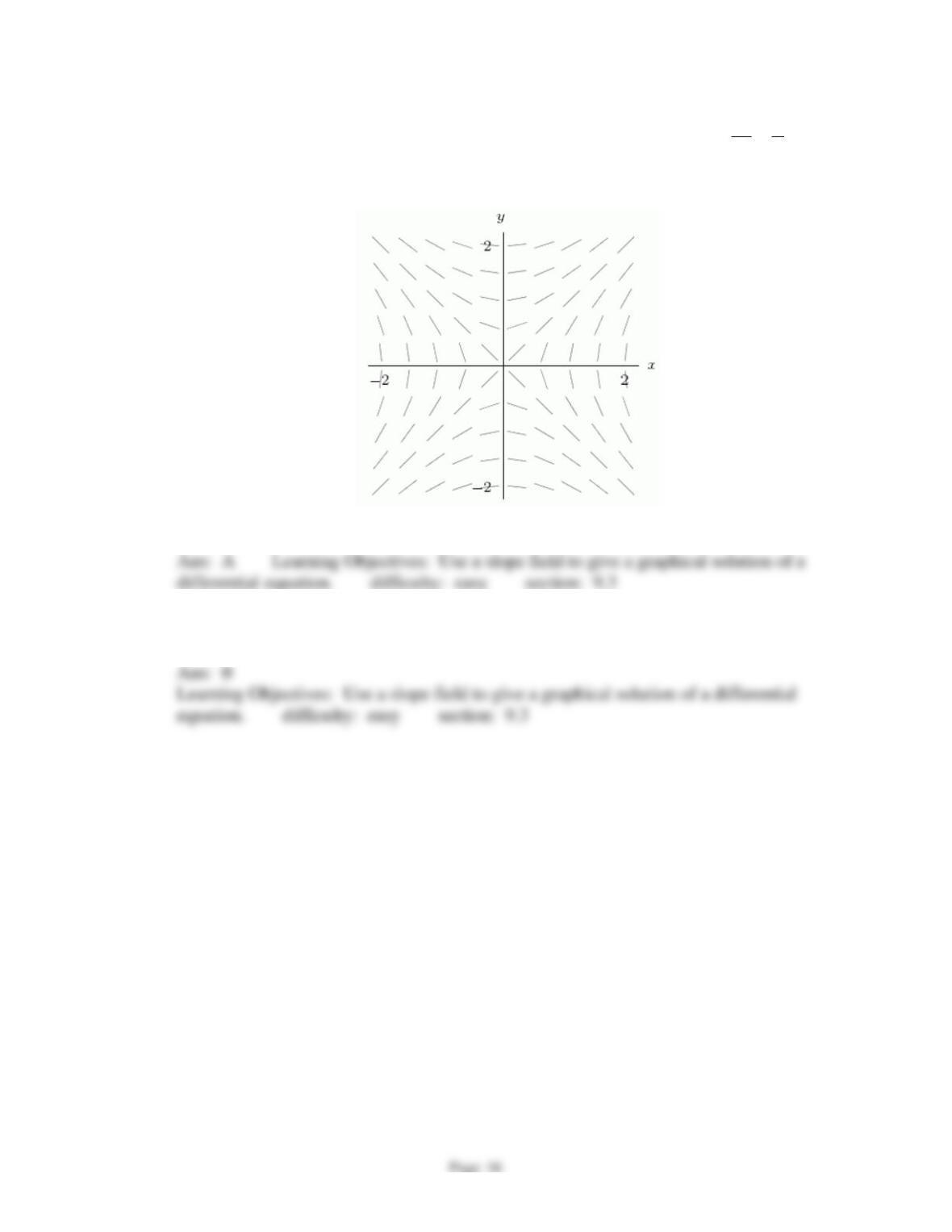
The following figure shows the slope field for the differential equation
‘/y x y=−
.
Guess the equation of the solution curve that goes through the point (0,2).
slope field. difficulty: easy section: 9.3
Chapter 9
45.
The following figure could be the slope field for the differential equation
dy x
dx y
=
for
22x−
and
22y−
.
A)
True
B)
False
46.
Consider the slope field for
/dy dx y x=−
. What is the slope at the point (0,0)?
Ans:
0
equation. difficulty: easy section: 9.3
Chapter 9
47.
Which of the following differential equations goes with the slope field in the figure?
A)
dy y
dx
=
B)
dy x
dx y
=
C)
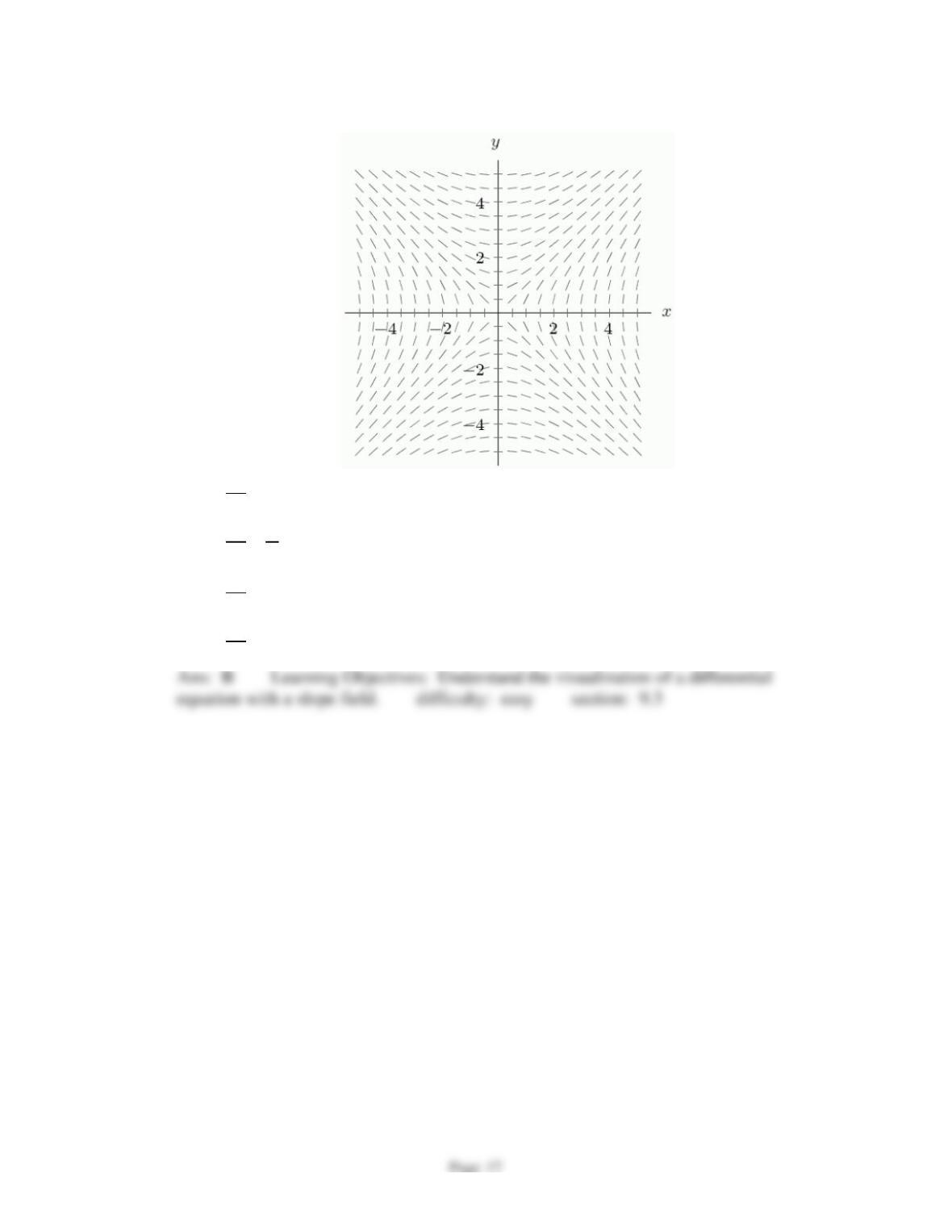
22
dy xy
dx
=+
D)
dy xy
dx
=−
Chapter 9
48.
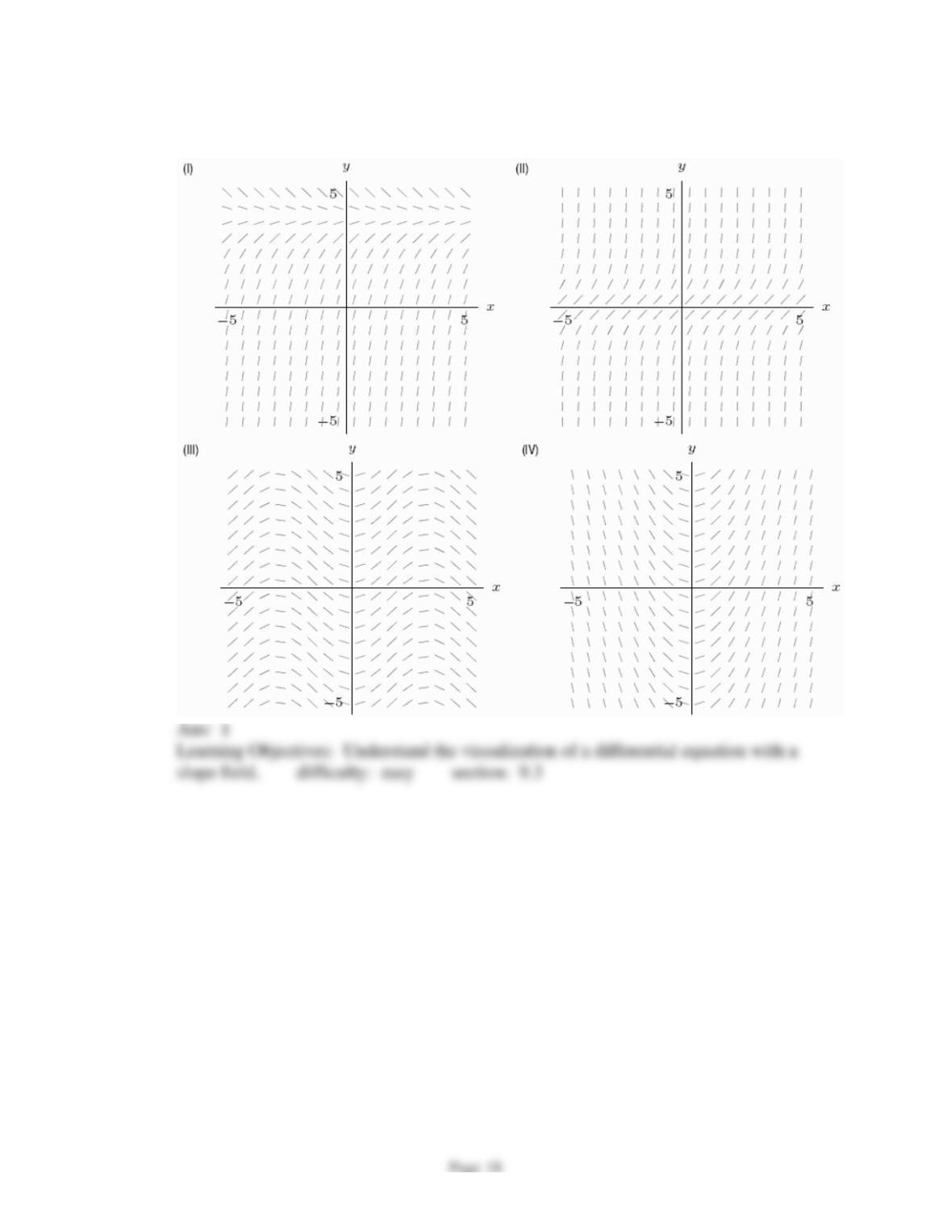
Which of the following slope fields goes with the differential equation
‘ 4 –y=
y?
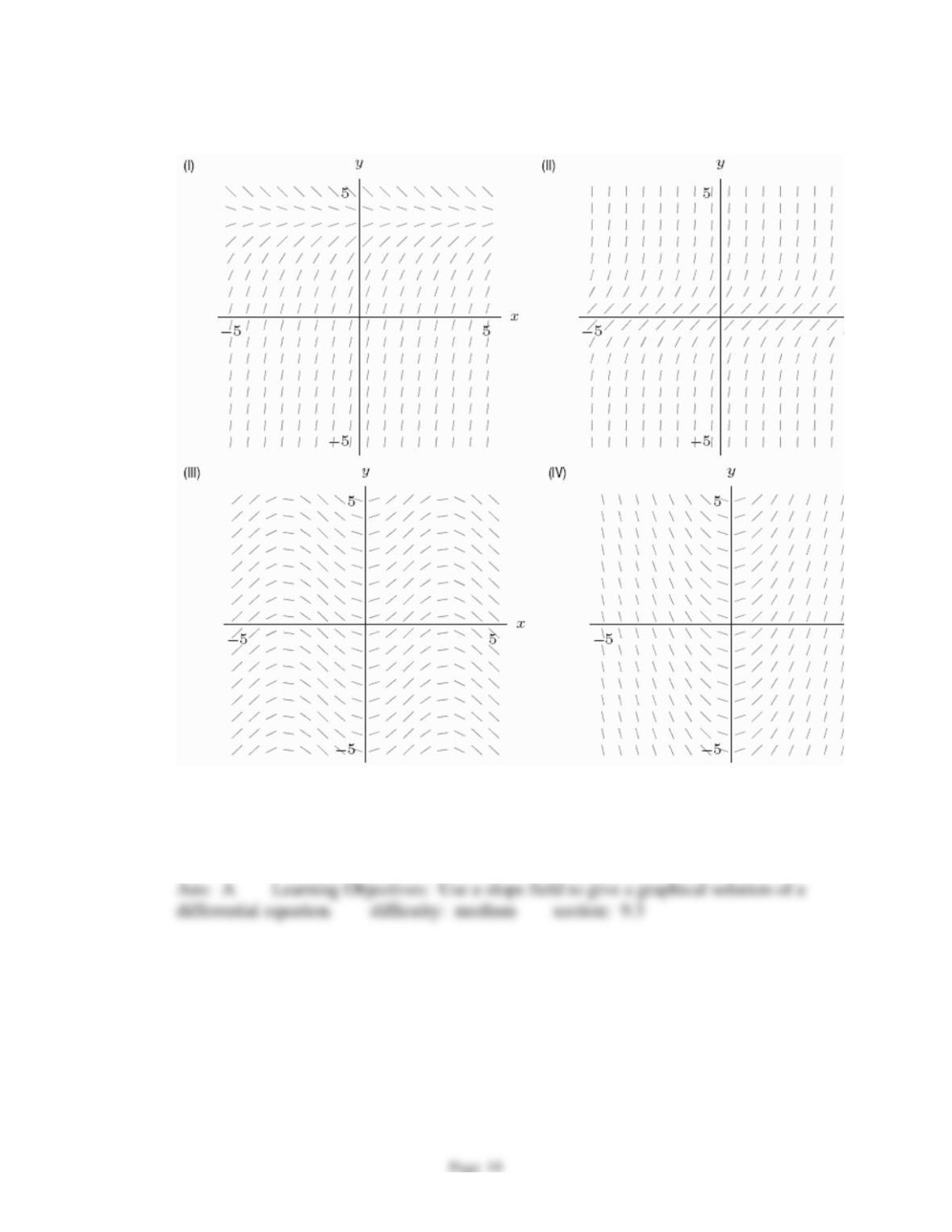
Chapter 9
49.
Look at the slope field labeled I. Consider a solution curve for slope field (I). Which
of the answer choices describes the long-run behavior of y at various starting points?
A)
No matter what the starting point, as
x→
, y approaches the value 4.
B)
No matter what the starting point, as
x→
, y oscillates within a certain finite
range.
C)
Depending on the starting point, as
x→
, y approaches
.
D)
Depending on the starting point, as
x→
, y approaches
or 0.
differential equation. difficulty: medium section: 9.3

Chapter 9
50.
If the slope field for
dy
dx
has constant slopes where x is fixed, what do we know about
dy
dx
?
A)
dy
dx
depends only on y.
B)
dy
dx
depends only on x.
C)
dy
dx
must be a constant.
D)
We can’t determine anything about
dy
dx
.
51.
Which of the following equations corresponds with the slope field shown below?
I.
2
()
dy xy
dx
=−
II.
2
()
dy xy
dx
=+
III.
22
dy xy
dx
=−
IV. None of them