Chapter 9: Receivables
153.
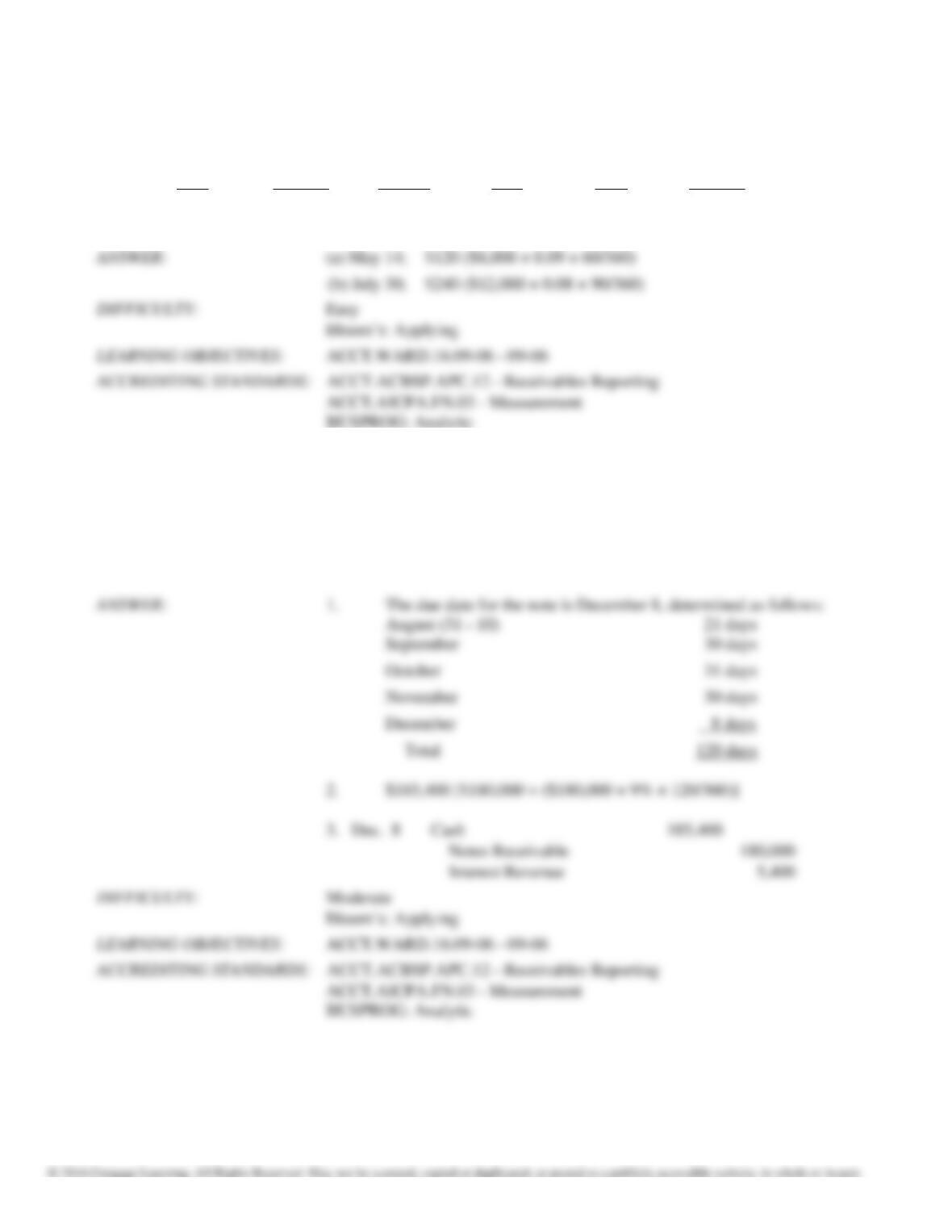
Determine the due date and amount of interest due at maturity on the following notes:
Origination
Face
Term
Interest
Maturity
Interest
Date
Amount
of Note
Rate
Date
Amount
(a)
Mar. 15
$8,000
60 days
9%
_______
_______
(b)
May 1
$12,000
90 days
8%
_______
_______
154.
Blackwell Industries received a 120-day, 9% note for $180,000, dated August 10 from a customer on account.
Required:
1.
Determine the due date of the note.
2.
Determine the maturity value of the note.
3.
Journalize the entry to record the receipt of the payment of the note at maturity.
Chapter 9: Receivables
155.
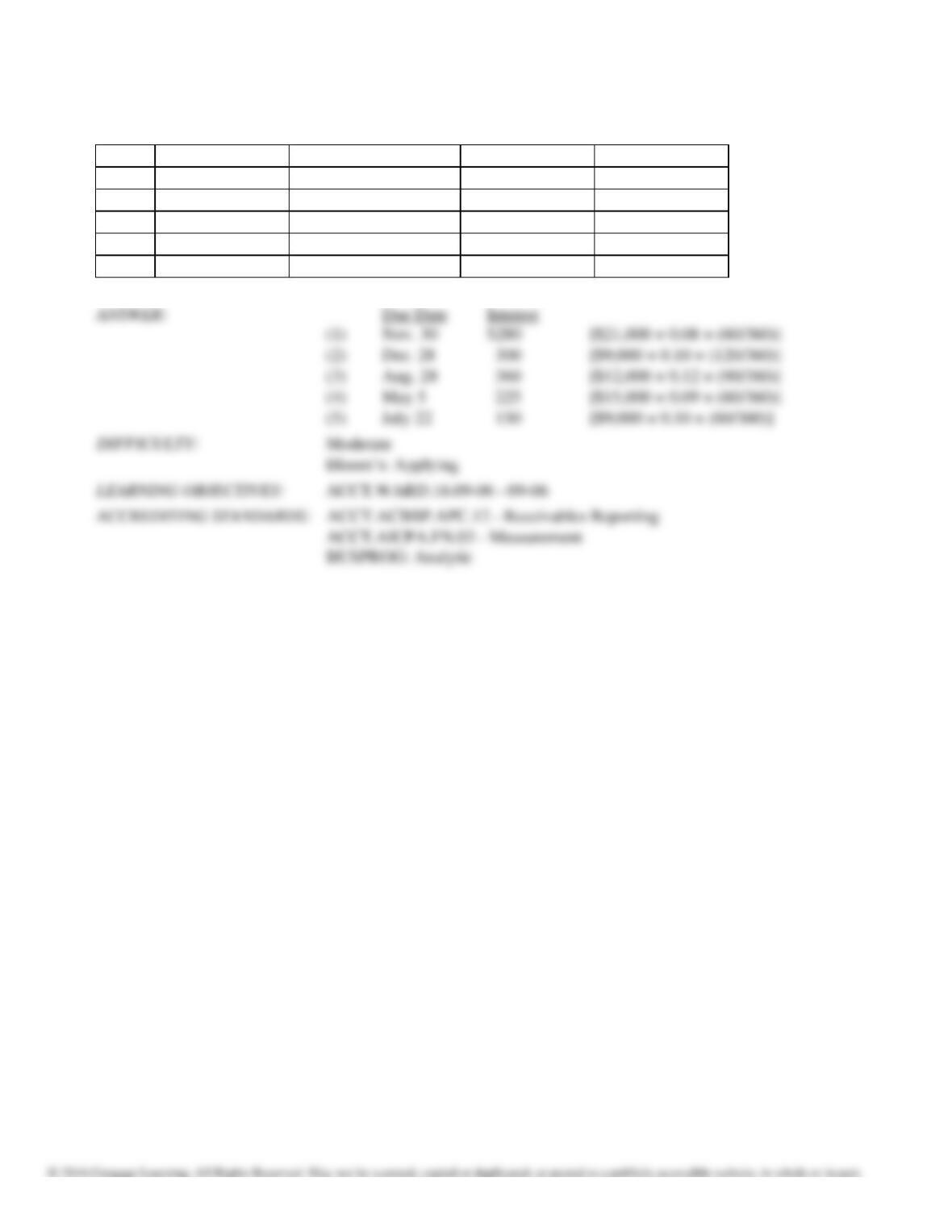
Determine the due date and the amount of interest due at maturity on the following notes:
Date of Note
Face Amount
Interest Rate
Term of Note
(1)
October 1
$21,000
8%
60 days
(2)
August 30
9,000
10%
120 days
(3)
May 30
12,000
12%
90 days
(4)
March 6
15,000
9%
60 days
(5)
May 23
9,000
10%
60 days
Chapter 9: Receivables
156.
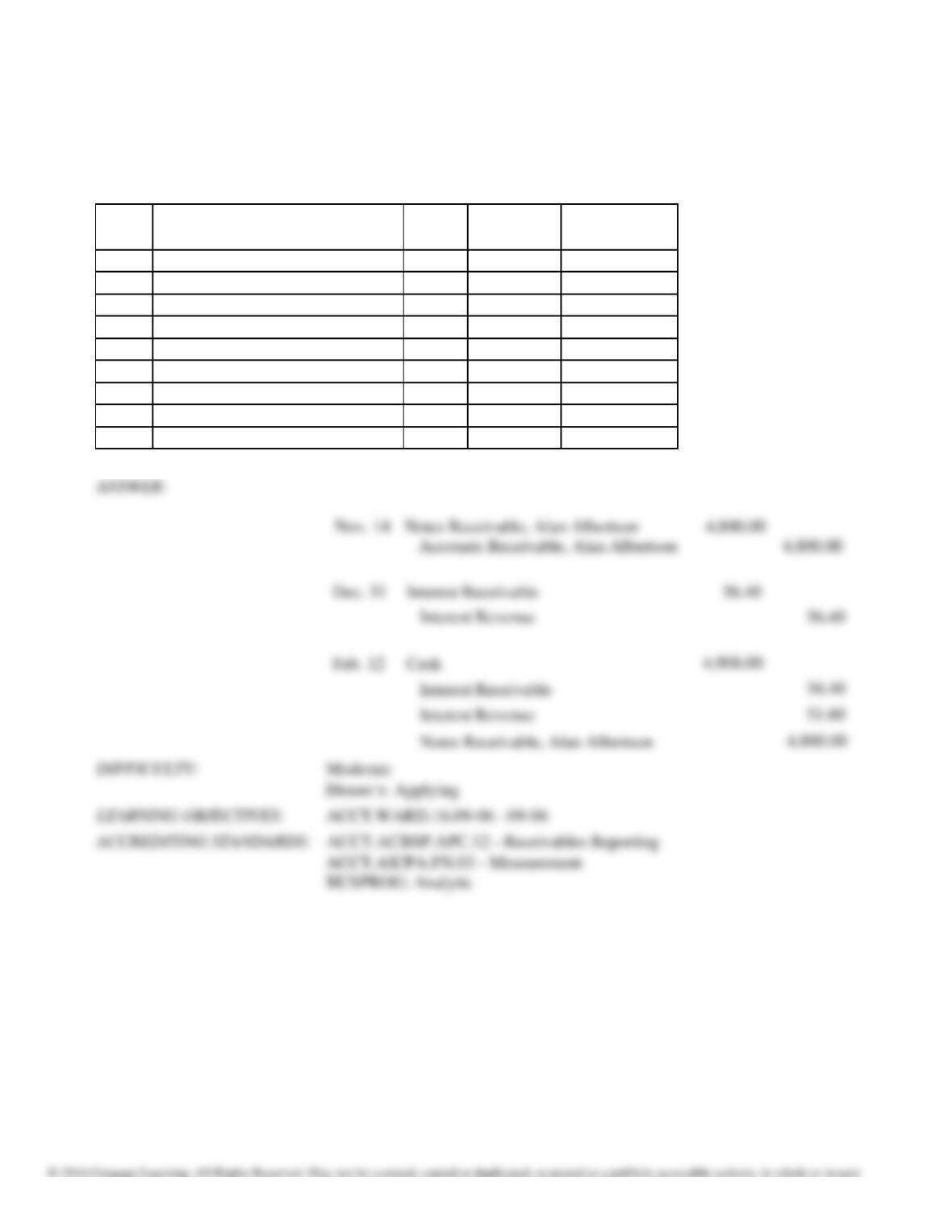
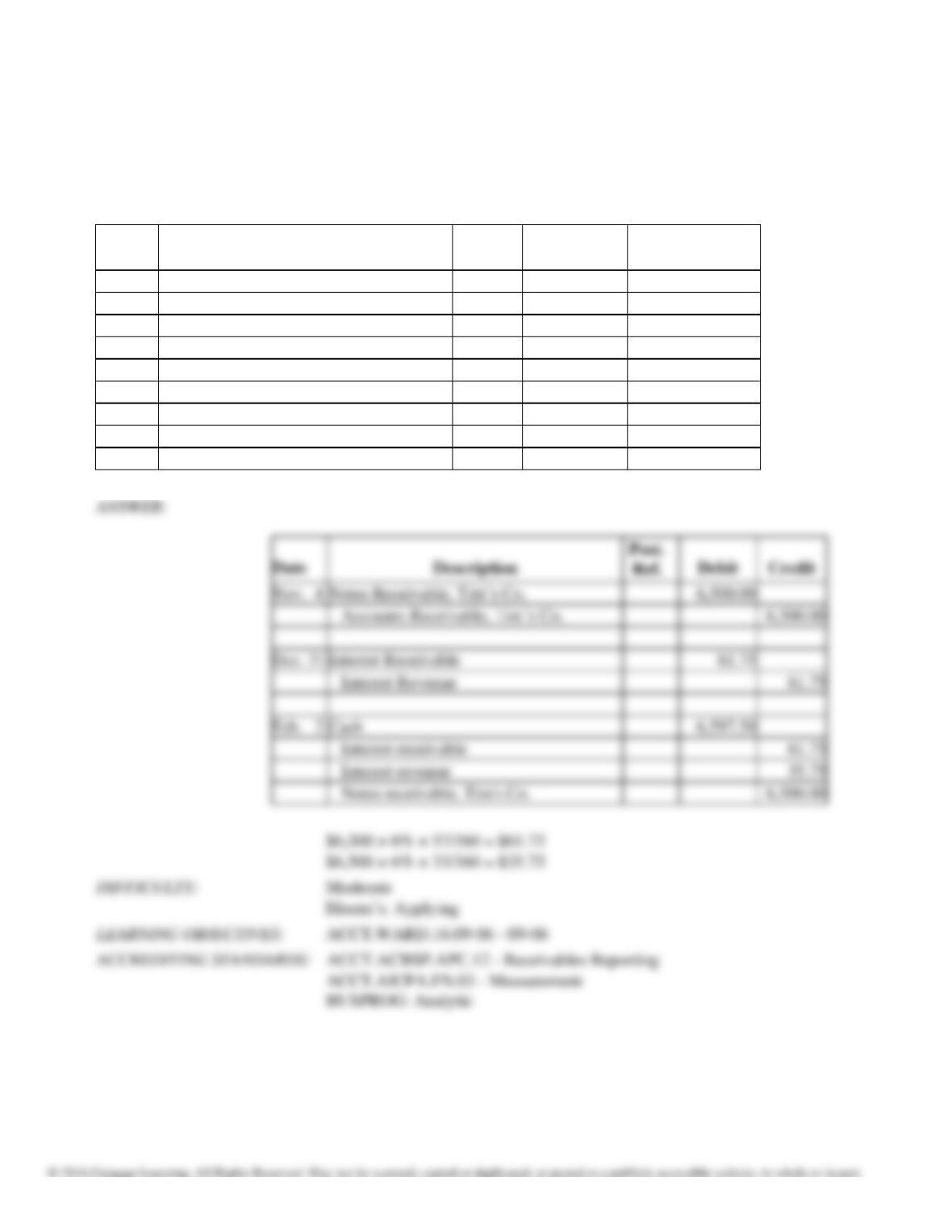
Journalize the following transactions for Lucite Company.
November 14 Received a $4,800.00, 90-day, 9% note from Alan Albertson in payment of his account.
December 31 Accrued interest on the Albertson note.
February 12 Received the amount due from Albertson on his note.
Date
Description
Post.
Ref.
Debit
Credit
Chapter 9: Receivables
157.
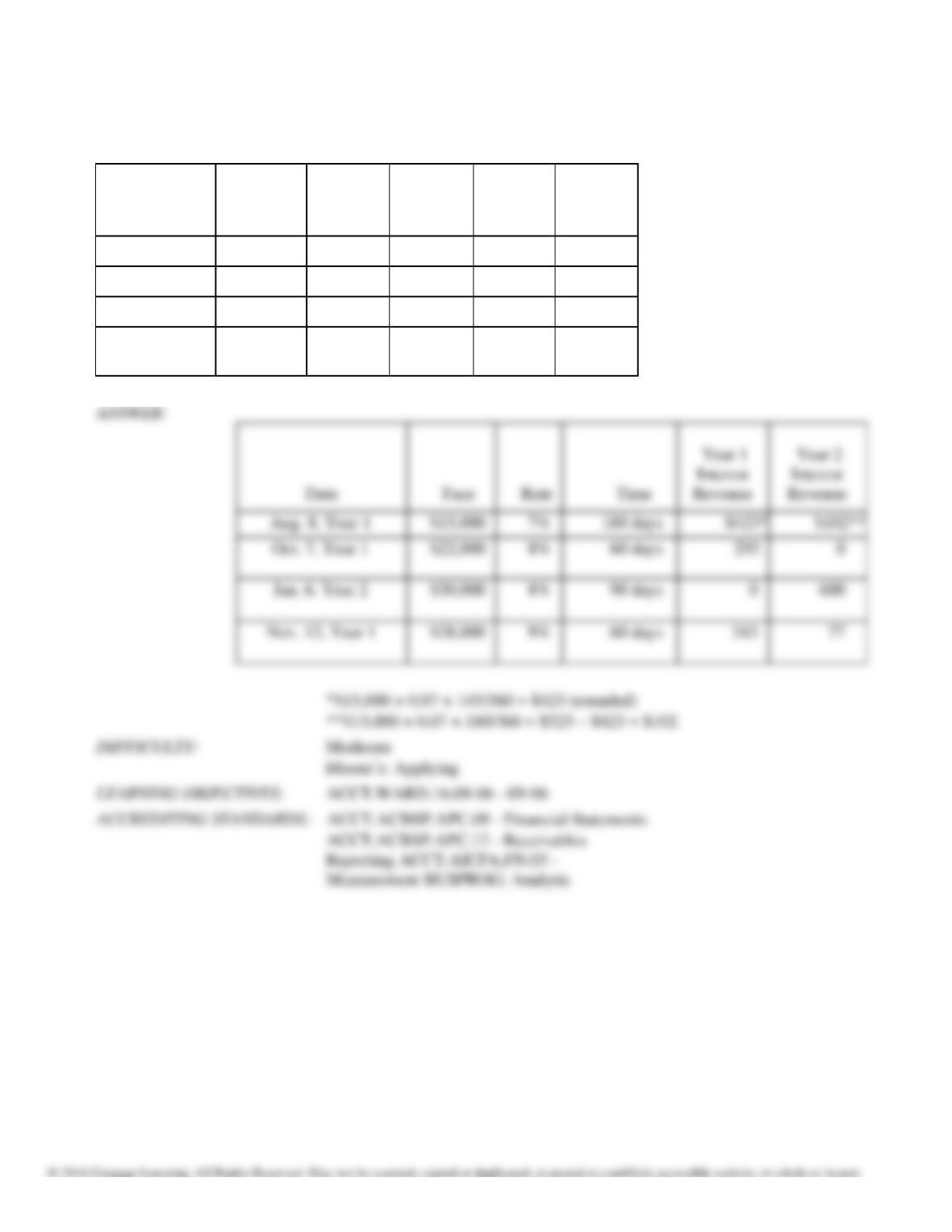
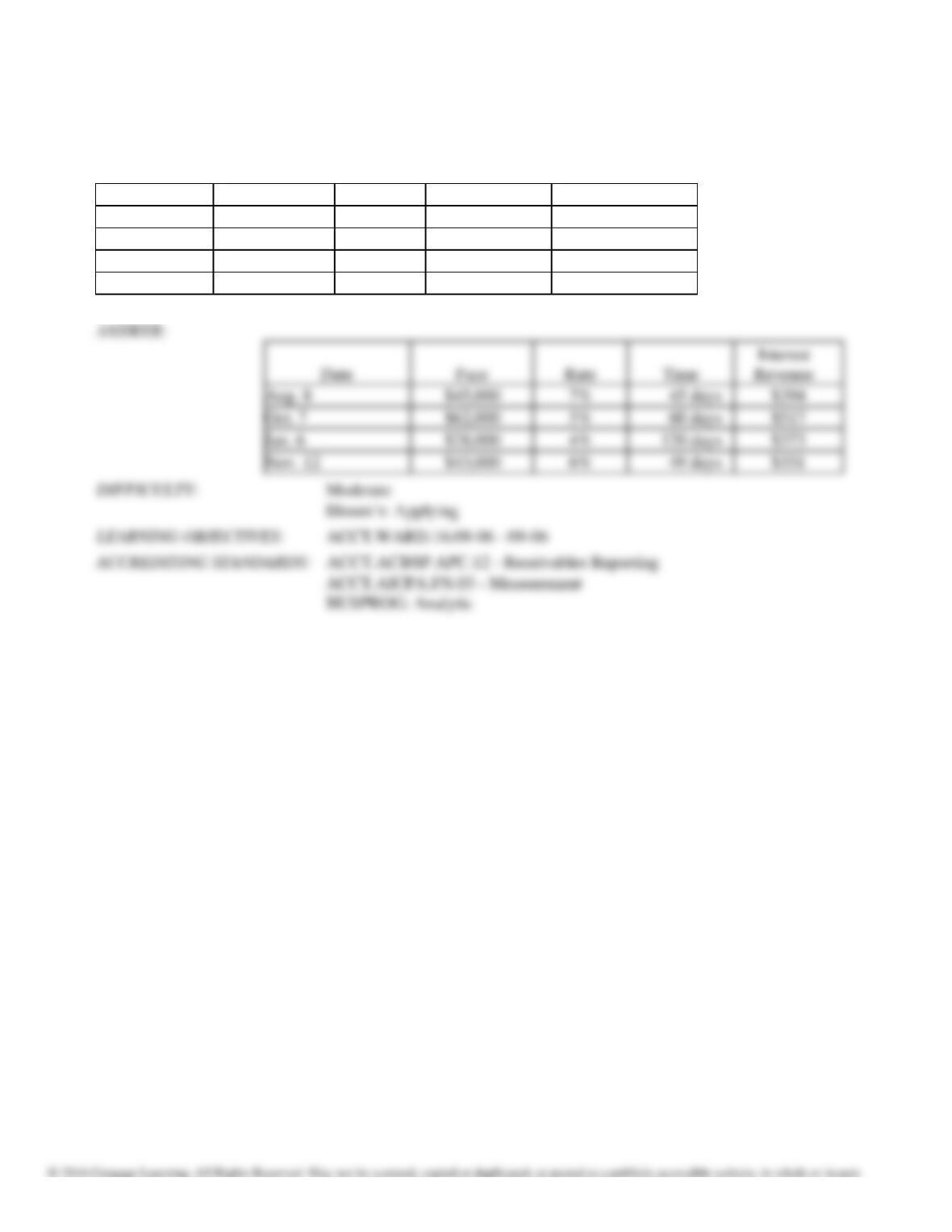
For each of the following notes receivables held by Winter Company, determine the interest revenue to be
reported
on the income statements. Round answers to nearest whole dollar.
Date
Face
Rate
Time
Year 1
Interest
Revenue
Year 2
Interest
Revenue
Aug. 8, Year 1
$15,000
7%
180 days
Oct. 7, Year 1
$22,000
8%
60 days
Jan. 6, Year 2
$30,000
8%
90 days
Nov. 12, Year 1
$28,000
9%
60 days
Chapter 9: Receivables
158.
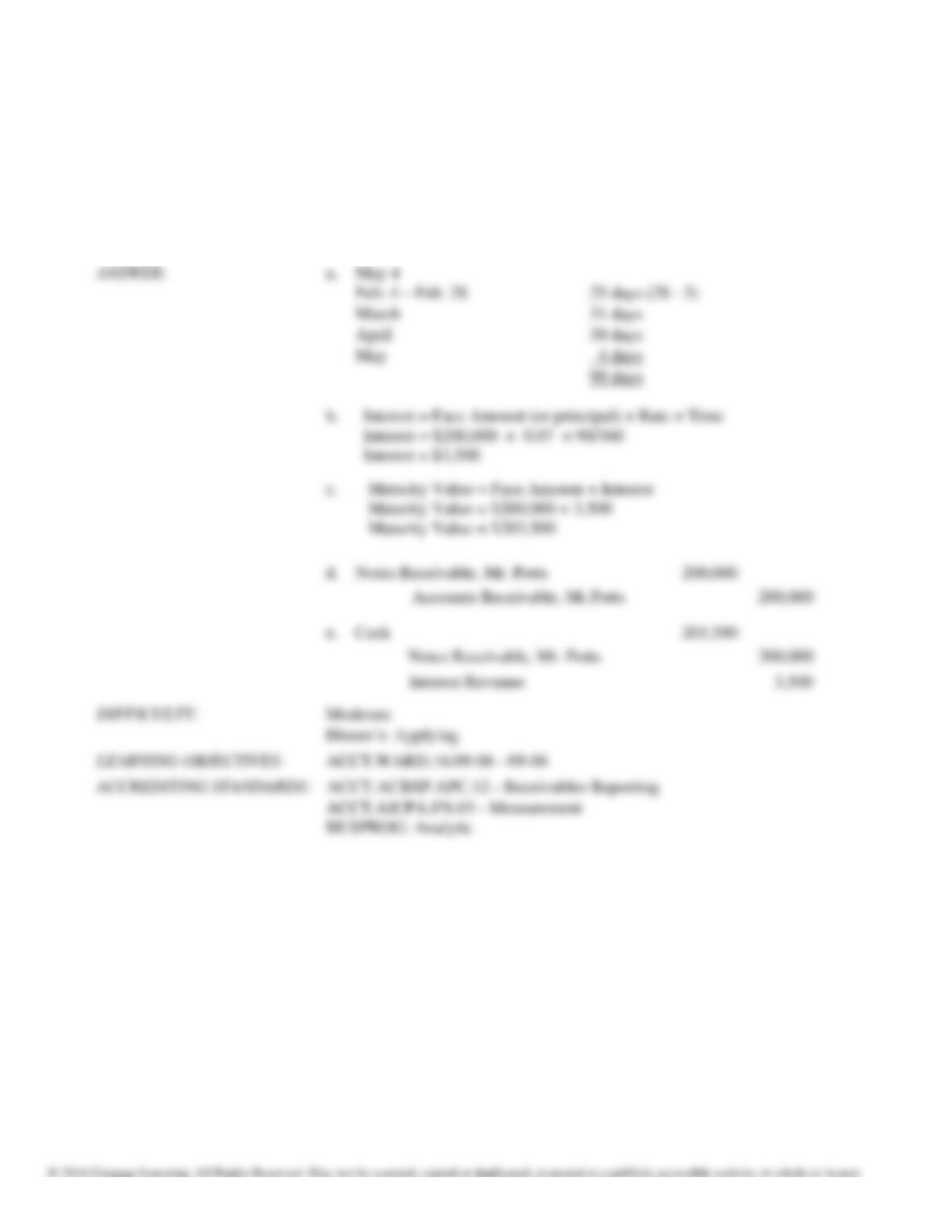
Mr. Potts issued a 90-day, 7% note for $200,000, dated February 3 to Valley Co. on account. (Assume a
360-day
year when calculating interest.)
a.
Determine the due date of the note.
b.
Determine the interest.
c.
Determine the maturity value of the note.
d.
Journalize the entry to record the receipt of the note from Potts on Feb. 3.
e.
Journalize the entry to record the receipt of payment of the note at maturity by Valley Co.
Chapter 9: Receivables
159.
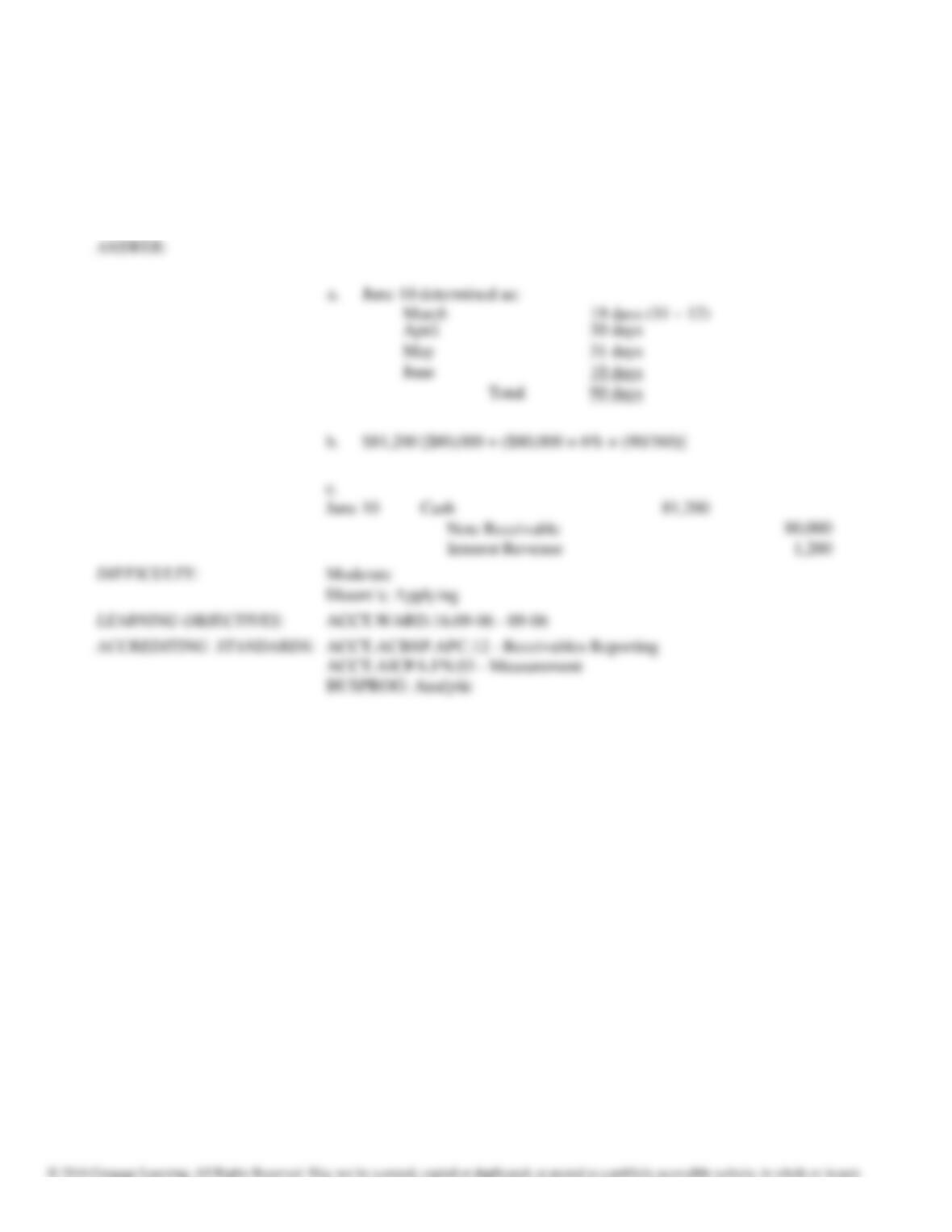
Lone Star Company received a 90-day, 6% note for $80,000, dated March 12 from a customer on
account.
(Assume a 360-day year when calculating interest.)
a.
Determine the due date of the note.
b.
Determine the maturity value of the note.
c.
Journalize the entry to record the receipt of the payment of the note at maturity.
Chapter 9: Receivables
160.
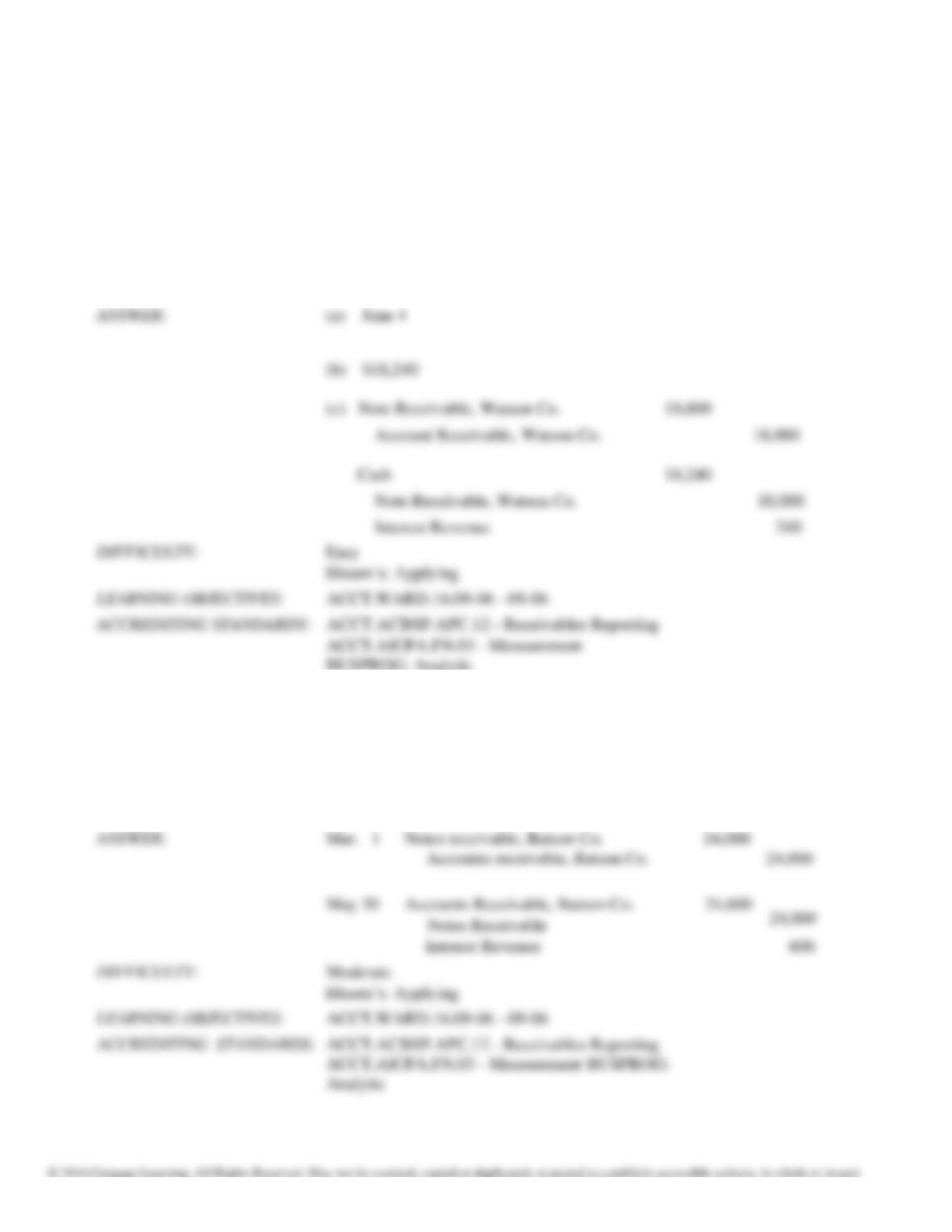
Watson Company issued a 60-day, 8% note for $18,000, dated April 5, to Laker Company on account.
Assume a
360-day year when calculating interest.
(a)
Determine the due date of the note.
(b)
Determine the maturity value of the note.
(c)
Journalize the entries to record the following:
(1)
Receipt of the note by the payee
(2)
Receipt by the payee of the amount due on the note at maturity. Round answers to the nearest $1.
161.
Journalize the following transactions (assume a 360-day year when calculating interest):
Mar. 1 Received a 90-day, 10% note for $24,000, dated March 1, from Batson Co.
on
account.
May 30 The note of March 1 was dishonored.
Chapter 9: Receivables
162.
Journalize the following transactions of Upton Drugs:
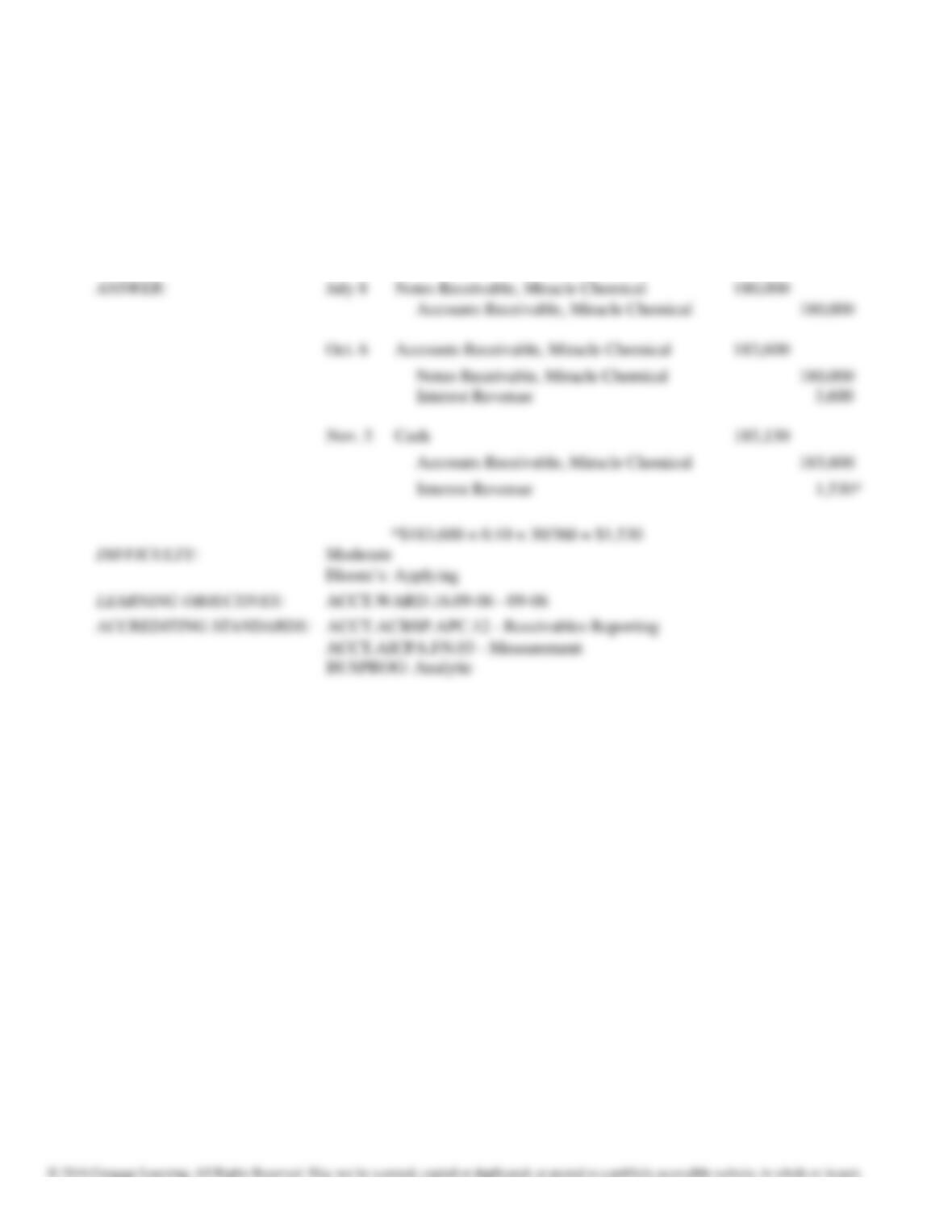
July 8 Received a $180,000, 90-day, 8% note dated July 8 from Miracle Chemical on
account.
Oct. 6 The note is dishonored by Miracle Chemical.
Nov. 5 Received the amount due on the dishonored note plus interest for 30 days at 10%
on the total
amount charged to Miracle Chemical on Oct. 6.
Chapter 9: Receivables
163.
Journalize the following transactions for the Scott Company:
November 4 Received a $6,500, 90-day, 6% note from Michael Tim’s in payment of his account.
December 31 Accrued interest on the Tim’s note.
February 2 Received the amount due from Tim’s on his note.
Date
Description
Post.
Ref.
Debit
Credit
Interest Receivable
Chapter 9: Receivables
164.
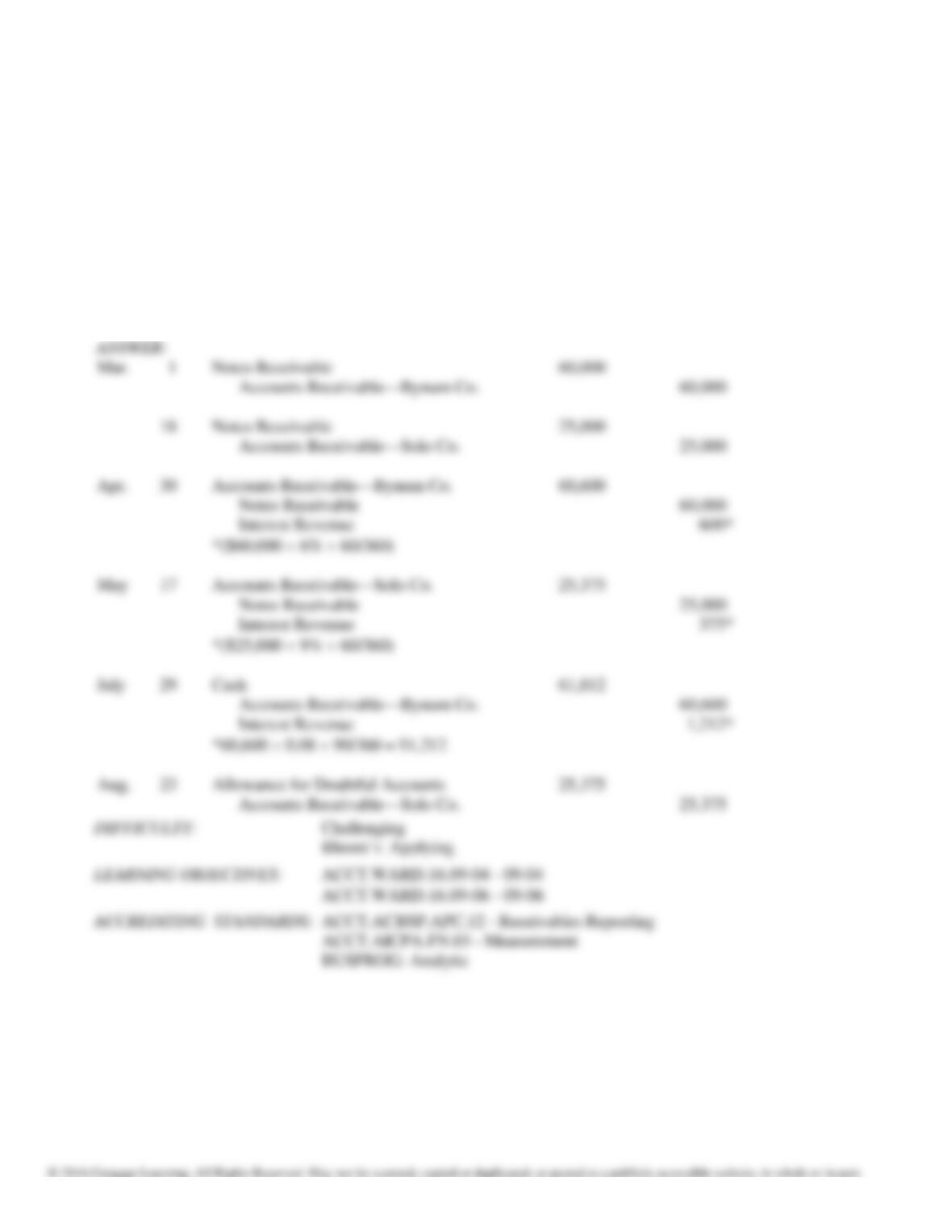
For each of the following notes receivables held by Christensen Company determine the interest
revenue to be
reported on the income statements for the year ended December 31. Round answers to
nearest whole dollar.
Date
Face
Rate
Time
Interest Revenue
Aug. 8
$45,000
7%
45 days
Oct. 7
$62,000
5%
60 days
Jan. 6
$28,000
4%
120 days
Nov. 12
$43,000
6%
60 days
Aug. 8
Oct. 7
Jan. 6
Nov. 12
Chapter 9: Receivables
165.
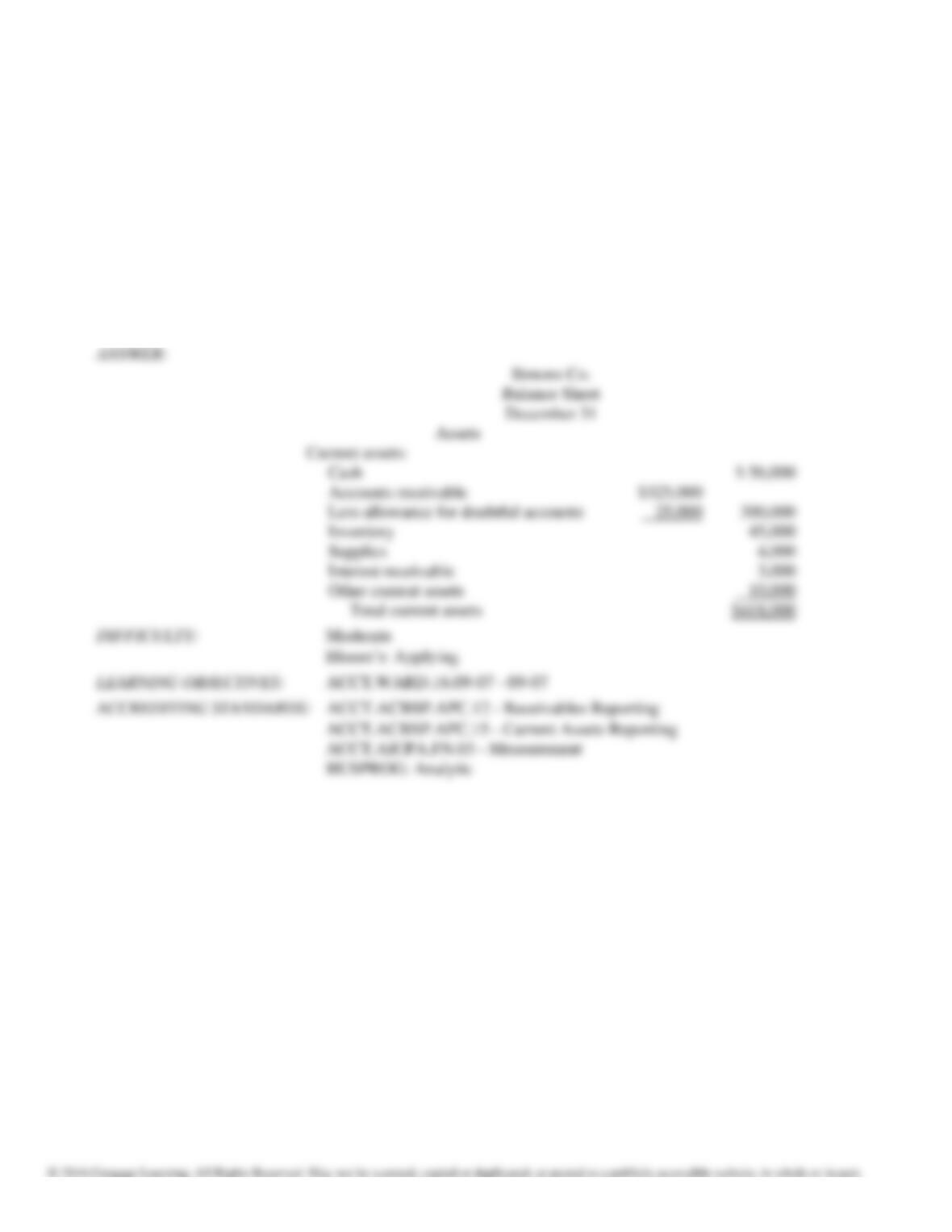
Journalize the following transactions in the accounts of Simmons Company:
Mar. 1 Received a $60,000, 60-day, 6% note dated March 1 from Bynum Company on account.
Mar. 18 Received a $25,000, 60-day, 9% note dated March 18 from Solo Company on account.
Apr. 30 The note dated March 1 from Bynum Company is dishonored, and the customer’s account is charged
for the note, including interest.
May 17 The note dated March 18 from Solo Company is dishonored, and the customer’s account is charged
for the note, including interest.
July 29 Cash is received for the amount due on the dishonored note dated March 1 plus interest for 90 days
at 8%
on the total amount debited to Bynum Company on April 30.
Aug. 23 Wrote off against the allowance account the amount charged to Solo Company on May 17 for
the
dishonored note dated March 18.
Chapter 9: Receivables
166.
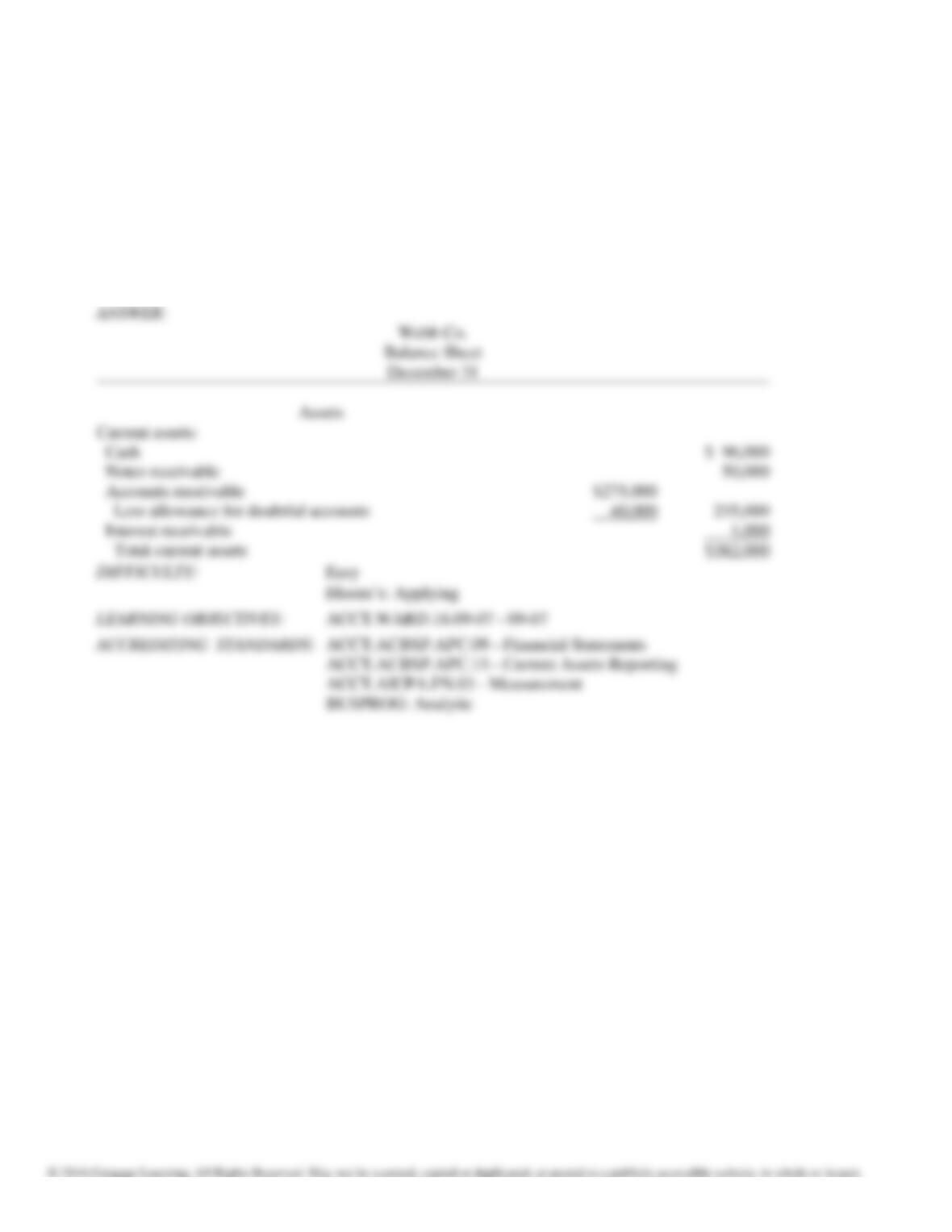
On the basis of the following data related to assets due within one year for Simons Co., prepare a partial
balance
sheet in good form at December 31. Show total current assets.
Cash $ 56,000
Accounts receivable 325,000
Allowance for doubtful accounts 25,000
Interest receivable 3,000
Supplies 4,000
Inventory 45,000
Other current assets 10,000
Chapter 9: Receivables
167.
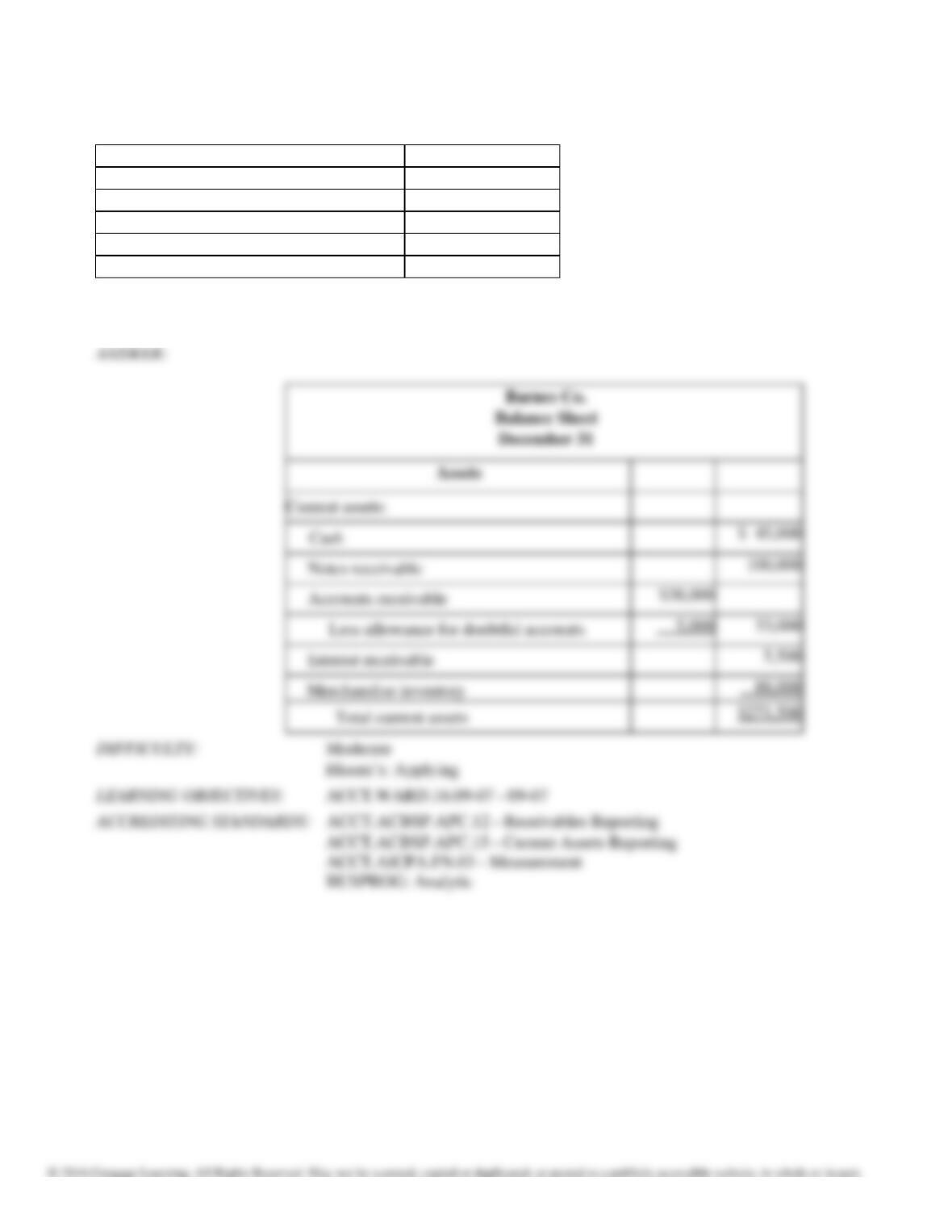
On the basis of the following data related to assets due within one year for Webb Co., prepare a partial
balance
sheet in good form at December 31. Show total current assets.
Cash $ 96,000
Notes receivable 50,000
Accounts receivable 275,000
Allowance for doubtful accounts 40,000
Interest receivable 1,000
Chapter 9: Receivables
168.
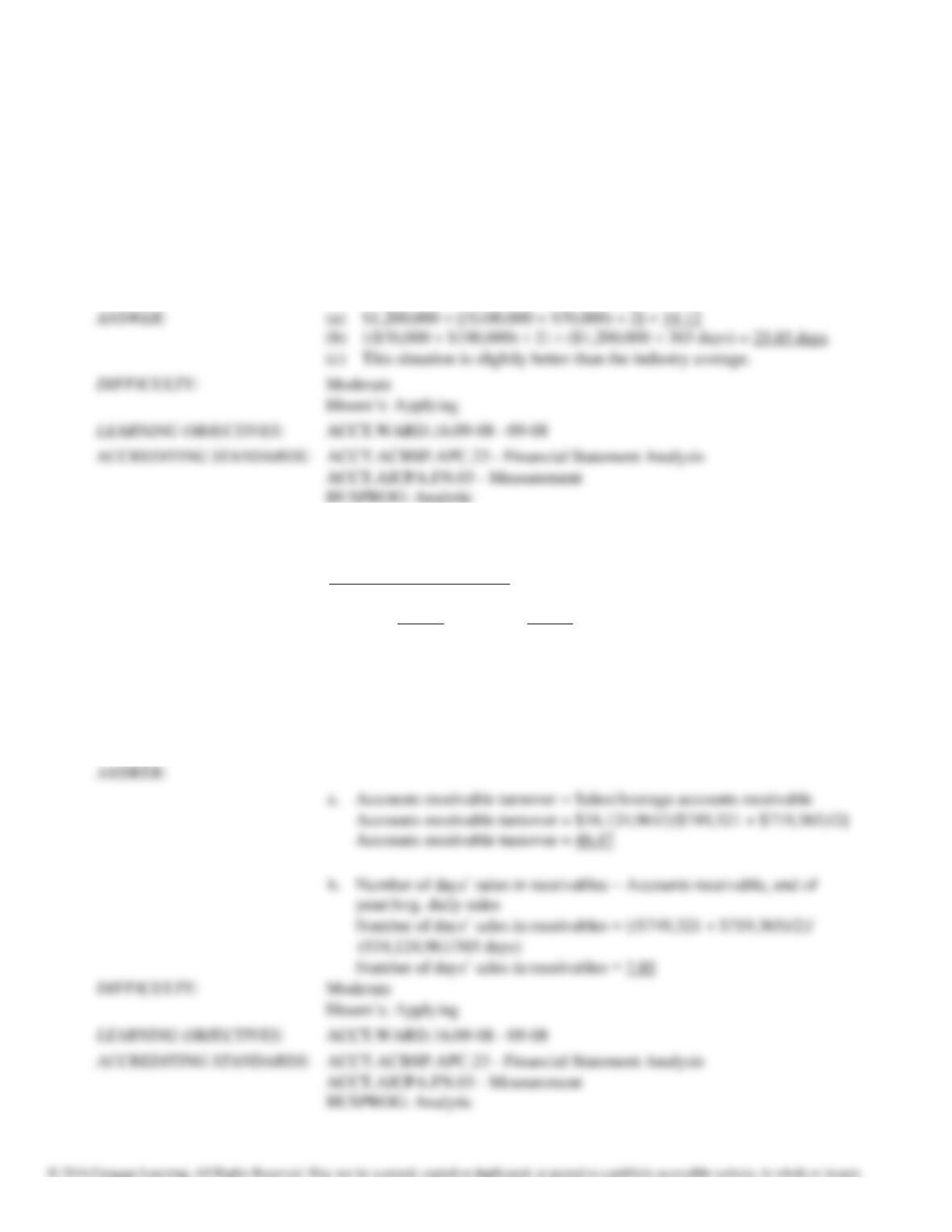
The following are the current assets of Barnes Co. as of December 31:
Accounts Receivable
$ 38,000
Allowance for Doubtful Accounts
5,000
Cash
45,000
Interest Receivable
5,500
Merchandise Inventory
88,000
Notes Receivable
100,000
Prepare the current assets section of the balance sheet.
Chapter 9: Receivables
169.
Based on the following data and using a 365-day year, compute (a) the accounts receivable turnover and
(b) the
number of days’ sales in receivables for year 2 to 2 decimal places. The industry average turnover
is 20 times
during the year, and the number of days’ sales in receivables averages 25. (c) Comment on this
situation.
12/31/Year 1 accounts receivable
$ 100,000
12/31/Year 2 accounts receivable
70,000
For the year ended 12/31/Year 1, sales
1,050,000
For the year ended 12/31/Year 2, sales
1,200,000
170.
For the fiscal years 1 and 2, Grange Co. reported the following:
Year Ended December 31,
Year 1
Year 2
Sales
$44,123,486
$34,124,961
Accounts receivable
749,321
719,365
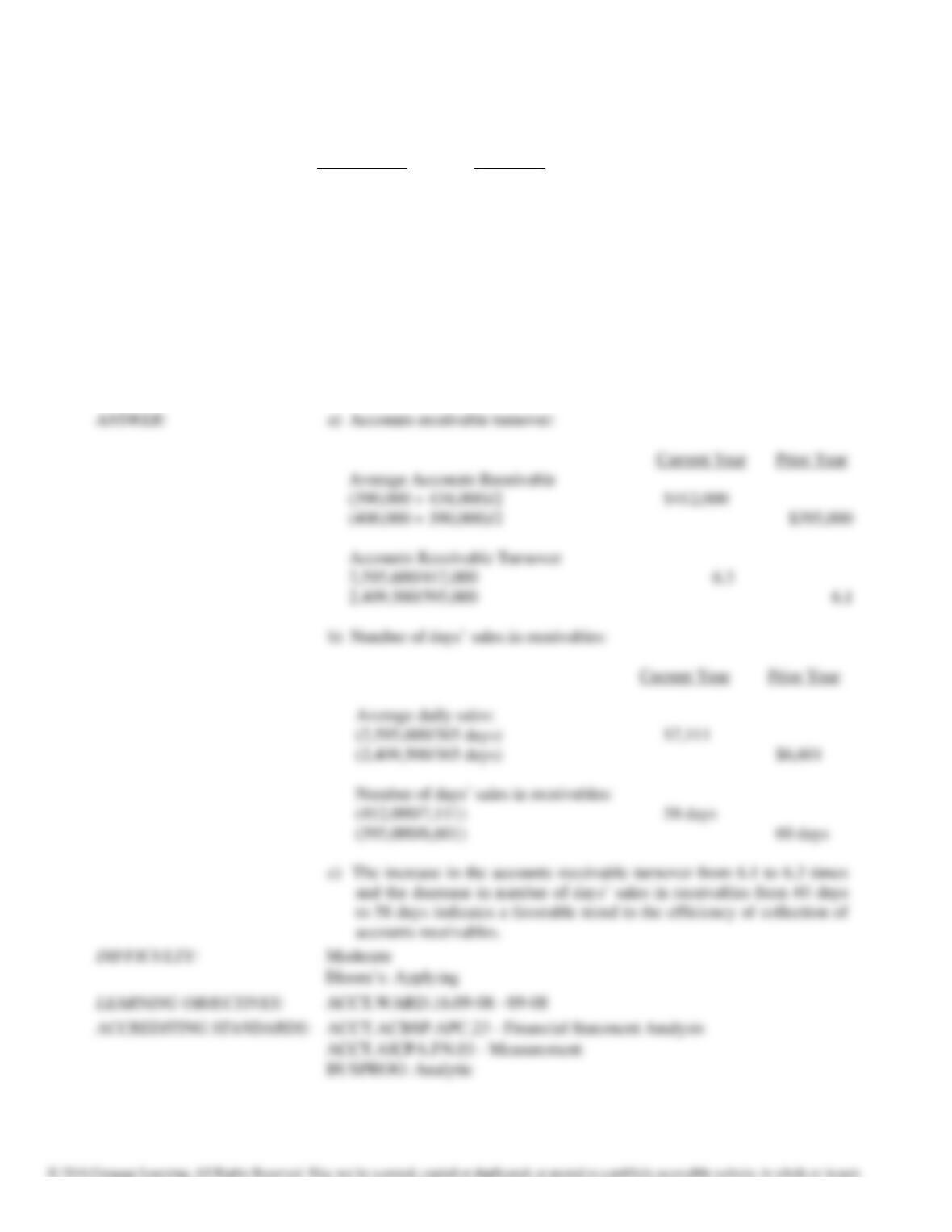
a.
Compute the accounts receivable turnover for Year 2. Round to two decimals.
b.
Compute the number of days’ sales in receivable at the end of Year 2. Round to two decimals.
Chapter 9: Receivables
171.
Financial statement data for the years ended December 31 for Parker Corporation are as follows:
Current Year Prior Year
Sales
$2,595,600
$2,409,500
Accounts receivable:
Beginning of the year
$390,000
$400,000
End of the year
434,000
390,000
a) Determine the accounts receivable turnover for each year. Round to one decimal place.
b) Determine the number of days’ sales in receivables for each year. Round to whole days.
c) Does the change in accounts receivable turnover and number of days’ sales in receivables from the first year
to the second year indicate a favorable or unfavorable trend?
Chapter 9: Receivables
Match each description to the appropriate term (a-i).
a.
Accounts receivable turnover
b.
Net realizable value
c.
Accounts receivable
d.
Aging report
e.
Receivables
f.
Direct write-off method
g.
Allowance for doubtful accounts
h.
Bad debt expense
i.
Factoring
DIFFICULTY: Easy
Bloom’s: Remembering
LEARNING OBJECTIVES: ACCT.WARD.16.09-01 – 09–01
ACCT.WARD.16.09-02 – 09–02
ACCT.WARD.16.09-03 – 09–03
ACCT.WARD.16.09-04 – 09–04
ACCT.WARD.16.09-08 – 09–08
ACCREDITING STANDARDS: ACCT.ACBSP.APC.12 – Receivables Reporting
ACCT.AICPA.FN.03 – Measurement
BUSPROG: Analytic
172.
A receivable created from selling merchandise or services on account
173.
A list of customer accounts sorted by age classes
174.
A contra asset that represents the amount of estimated uncollectible receivables
175.
Records bad debt expense only when a specific customer’s account is deemed worthless
176.
Operating expense recorded as a result of receivables becoming uncollectible
Chapter 9: Receivables
177.
The difference between accounts receivable and allowance for doubtful accounts
178.
Term for selling receivables
179.
All money claims against other entities
180.
Measures how frequently during the year accounts receivables are being turned into cash
Match each description to the appropriate term (a-d). Each term may be used more than once.
a.
Direct write-off method
b.
Aging of receivables method
c.
Percent of sales method
d.
Allowance method
DIFFICULTY: Easy
LEARNING OBJECTIVES: ACCT.WARD.16.09-03 – 09–03
ACCT.WARD.16.09-04 – 09–04
ACCT.WARD.16.09-05 – 09–05
ACCREDITING STANDARDS: ACCT.ACBSP.APC.12 – Receivables Reporting
ACCT.AICPA.FN.03 – Measurement
BUSPROG: Analytic
181.
This method records bad debts when specific accounts are deemed uncollectible.
182.
When using this method, estimated bad debts are added to the existing allowance balance.
183.
This method is most often used by small companies with few receivables.
184.
This method is based on the theory that older accounts are less likely to be collected.

Chapter 9: Receivables
185.
This method focuses on the balance sheet.
186.
Offers two methods of estimating uncollectible accounts.
187.
With this method, there is no allowance account.
188.
This method focuses on the income statement.
Match each description to the appropriate term (a-h).
a.
Face amount
b.
Term
c.
Interest
d.
Maturity value
e.
Dishonored note
f.
Maker
g.
Notes receivable
h.
Interest rate
DIFFICULTY: Easy
Bloom’s: Remembering
LEARNING OBJECTIVES: ACCT.WARD.16.09-06 – 09–06
ACCREDITING STANDARDS: ACCT.ACBSP.APC.12 – Receivables Reporting
ACCT.AICPA.FN.03 – Measurement
BUSPROG: Analytic
189.
A formal, written instrument of credit that represents amounts due from customers
190.
The amount due that must be paid at the due date of a note receivable
191.
The amount charged for using the money of another party
Chapter 9: Receivables
192.
The stated rate charged for using the money of another party
193.
A note that is not paid when it is due
194.
The dollar amount stated on a promissory note
195.
The party promising to pay a note
196.
The time between the date a note is issued and the due date of the note