CHAPTER 9: CURRENT LIABILITIES, CONTINGENCIES, AND THE TIME
VALUE OF MONEY
1. All of the following are characteristics of current liabilities except:
a. they may involve estimated amounts.
b. they are due within one year or within the operating cycle, whichever is longer.
c. they may be replaced with a new short–term liability rather than being paid in cash.
d. all three of the above are characteristic of current liabilities.
2. Which of the following is an example of a contingent liability?
a. A corporate long–term employment contract with the chief executive officer.
b. A lawsuit pending against a restaurant chain for improper preparation of food.
c. A liability for notes payable with interest included in the face amount.
d. The liability for future warranty repairs on computers sold during the current period.
3. You just purchased an automobile for $19,450 and must decide how to pay for it. Your local bank has granted you
a five-year loan. Annual payments on the loan will be made at the end of each year and the amount of the loan
payments, which include principal and interest, is $5,000 per year. What is the interest rate that is being charged
on the loan?
4. Tyson Trucking won a settlement in a lawsuit and was offered four different payment alternatives by the
defendant‘s insurance company. The interest rate is 6%. Ignoring tax considerations, which of the following four
alternatives has the highest present value? Support your answer with the appropriate calculations.
I) $150,000 now
II) $45,000 per year for the next 4 years (payment made at the end of the year)
$5,000 now and then $20,000 per year for the next 10 years (payment made at the end of
III) the year)
IV) $5,000 now and then $5,000 per year for the next 10 years (payment made at the end of the year) plus a
lump–sum payment of $200,000 at the end of the eleventh year
Chapter 9: Current Liabilities, Contingencies, and the Time Value of Money
5. In the statement of cash flows, an increase in a current liability will appear as an increase in the Financing
category.
a. True
b. False
6. The landlord records the security deposit she collects from the tenant as a(n)
a. asset
b. contra liability
c. contingent liability
d. liability
7. The solution to this problem requires time value of money calculations. Reference to Tables 9-1 through
9-4 in the text is necessary to complete the calculations.
A company will have to pay a $50,000 liability in 4 years. How much must be deposited now into a bank account
earning 8% compounded semiannually to fully fund the future payment?
a. $35,500
b. $36,550
c. $36,523
d. $34,000
8. Ashley Wilson’s grandparents want to give her some money when she graduates from high school. They have
offered Ashley the following three choices:
a. Receive $25,000 immediately. Assume that interest is compounded annually.
b. Receive $3,200 at the end of each six months for four years. Ashley will receive the first check in six months.
c. Receive $7,000 at the end of each year for four years. Assume that interest is compounded annually.
REQUIRED:
Ashley wants to have money for a new car when she graduates from college in four years. Assuming an interest
rate of 8%, what option should she choose to have the most money in four years? (Round your answers to the
nearest dollar.)
9. Almost all current liabilities appear within the Activities category of the Statement of
Cash Flows.
Chapter 9: Current Liabilities, Contingencies, and the Time Value of Money
10. A company has $200 in cash, $500 in accounts receivable, and $700 in inventory. If current liabilities are $400,
then the current ratio would be
a. 1.75 to 1
b. 3.50 to 1
c. 2.25 to 1
d. 3.00 to 1
11. What is meant by the term “current maturities of long-term debt” in the current liabilities section of the balance
sheet?
12. On October 1, Lawrence Company borrowed $60,000 from Fourth National Bank on a 1-year, 7% note. If the
company’s fiscal year ends as of December 31, Lawrence should make an entry to increase
a. interest payable, $1,050.
b. prepaid interest, $3,150.
c. notes payable, $1,050.
d. interest expense, $4,200.
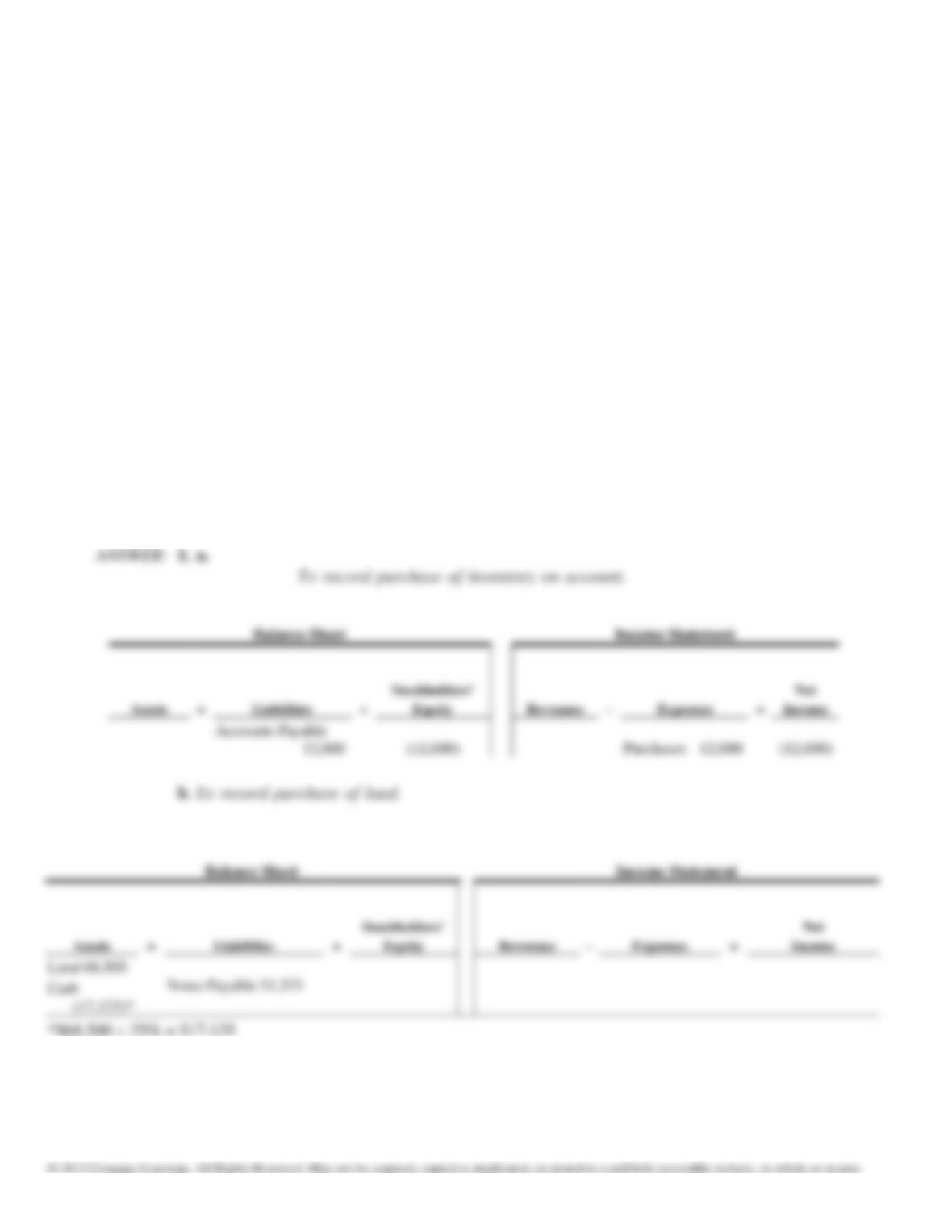
13. At December 31, 2014, an amount due on December 31, 2015, would be classified as a(n)
_______________________ liability.
14. The of a single sum represents the value today of a single amount to be
received or paid at a future time.
15. Warranty expenses are the result of the selling company’s estimate of the number of units sold during the current
year that may become defective and need repair or replacement during the warranty period.
a. True
b. False
Chapter 9: Current Liabilities, Contingencies, and the Time Value of Money
16. If a company purchases $3,000 worth of inventory with terms of 1/15, n30 and pays within 15 days, then the
amount paid to the seller would be
a. $3,030
b. $2,550
c. $2,970
d. $3,000
17. What is the purpose of the current ratio? How does the quick ratio differ from the current ratio?
18. An obligation that involves an existing condition for which the outcome is not known with certainty and depends
on some event that will occur in the future is call a(n) .
19. Cole Company had the following accounts and balances on December 31, 2015:
Income Taxes Payable
$51,250
Cash
20,000
Notes Payable, 10%, due June 2, 2016
1,000
Accounts Receivable
267,500
Equipment
950,000
Accounts Payable
104,400
Inventory
85,000
Land
600,000
Allowance for Doubtful Accounts
12,000
Discount on Notes Payable
150
Notes Receivable, maturity 2/1/2022
5,000
Current Maturities of Long-Term Debt
6,900
Unearned Revenue
4,320
Interest Payable
1,010
Wages Payable
6,000
Marketable Securities
40,000
Capital Stock
900,000
Chapter 9: Current Liabilities, Contingencies, and the Time Value of Money
REQUIRED:
1. Compute Cole’s working capital.
2. Compute Cole’s current ratio. What does this ratio indicate about Cole’s condition?
20. The interest earned on the principal amount only is referred to as .
21. The current maturity of long–term debt is a current liability.
a. True
b. False
22. An amount that has been incurred as an expense, but has not yet been paid should be considered an accrued
liability.
a. True
b. False
Chapter 9: Current Liabilities, Contingencies, and the Time Value of Money
23. All of the following statements are true except:
a. Under U.S. GAAP, a contingent item should be recorded as a liability if the loss or outflow is probable and can
be reasonably estimated.
b. IFRS requires a liability to be recorded as a present value amount.
c. The threshold for recording items as liabilities is a lower under U.S. GAAP than under IFRS.
d. The threshold for recording items as liabilities is a lower under IFRS than under U.S. GAAP.
24. The solution to this problem requires time value of money calculations. Reference to Tables 9-1 through
9-4 in the text is necessary to complete the calculations.
The future value of equal semi-annual payments of $500 at 8% compounded semiannually for 4 years is
a. $ 868
b. $9,320
c. $2,000
d. $4,607
25. Using the indirect method, an increase in accounts payable would be shown as a(n) in the
Activities section of the statement of cash flows.
26. If a company purchases $3,200 worth of inventory with terms of 2/10, n/30 on March 3 and pays March 12, then
the amount paid to the seller would be
a. $3,136
b. $3,168
c. $3,150
d. $3,200
27. Curtain Corp. stands to receive a sufficient cash settlement from a law suit. Curtain needs to record this on its
accounting records.
a. True
b. False
28. What are examples of accounts that might be classified as accrued liabilities in the current liabilities section of the
balance sheet?

Chapter 9: Current Liabilities, Contingencies, and the Time Value of Money
29. Marsh Corporation borrowed $90,000 by issuing a 12%, six–month note payable, all due at the maturity date.
After one month, the company‘s total liability for this loan amounts to:
a. $90,450
b. $90,000
c. $90,900
d. $91,800
30. What is the correct classification of the account: Discount on Notes Payable?
a. a revenue
b. a contra liability
c. an asset
d. an expense
31. If the annual interest is 12%, but the compounding is done quarterly, then the interest rate is 4% per period.
a. True
b. False
32. The solution to this problem requires time value of money calculations. Reference to Tables 9-1 through
9-4 in the text is necessary to complete the calculations.
Pablos wants to save some money so that he can make a down payment of $3,000 on a car when he graduates
from college 4 years from now. If he opens a savings account and earns 3% on his money, compounded annually,
how much will he have to invest now?
a. $2,664
b. $3,000
c. $2,520
d. $2,910
33. Which of the following statements is true of liabilities?
a. Classification of current liabilities is important because of the liquidity concept.
b. The accounting principles followed in the U.S. differ from those of other countries; this is especially true for
current liabilities.
c. Current liabilities are listed in order of decreasing amounts in the current liability section of the balance sheet.
d. Accounts payable are listed in the current liabilities section in alphabetical order by vendor.
Chapter 9: Current Liabilities, Contingencies, and the Time Value of Money
34. Long–term assets are $800, current liabilities are $500, and long–term liabilities are $600. If the current ratio is 2.5
to 1, then current assets are
a. $ 625
b. $1,250
c. $2,000
d. $ 200
35. Estimated liability for product warranties to be paid in the future is a current liability.
a. True
b. False
36. Below are three notes payable:
Note Face Value (Principal)
Rate
Term
1
$30,000
4%
6 years
2
30,000
6%
4 years
3
30,000
8%
3 years
REQUIRED:
Part 1. For each of the notes, calculate the simple interest due at the end of the term.
Part 2. Now assume that the interest on the notes is compounded annually. Calculate the amount of interest due
at the end of the term for each note.
Part 3. Finally, assume that the interest on the notes is compounded semiannually. Calculate the amount of
interest due at the end of the term for each note.
Part 4. What conclusion can you draw from a comparison of your results of each of the three scenarios?
Chapter 9: Current Liabilities, Contingencies, and the Time Value of Money
37. If the present and future values are known along with the number of periods, then the
_________________________ can be determined.

Chapter 9: Current Liabilities, Contingencies, and the Time Value of Money
38. The solution to this problem requires time value of money calculations. Reference to Tables 9-1 through
9-4 in the text is necessary to complete the calculations.
To calculate the future value of an amount that is invested at 12%, compounded quarterly, at the end of three
years, the interest factor used would be
a. 1% for 12 periods
b. 12% for three periods
c. 3% for 12 periods
d. 3% for four periods
39. The solution to this problem requires time value of money calculations. Reference to Tables 9-1 through
9-4 in the text is necessary to complete the calculations.
For a given single sum invested at 8% for 4 years, how will the future value be affected if the compounding
period is changed from annual to quarterly?
a. The future value will decrease.
b. The future value will stay the same.
c. There is not enough information to determine the impact.
d. The future value will increase.
40. The solution to this problem requires time value of money calculations. Reference to Tables 9-1 through
9-4 in the text is necessary to complete the calculations.
The table factor for the future value of an annuity for 4 annual deposits at 8% is
a. the cumulative total of the future value of $1 factors for 4 deposits at 8%.
b. the reciprocal of the future value of $1 factor for n = 4 and 8%.
c. the same as for the future value of $1 multiplied by 4.
d. the same as using the future value of $1 factors at 8% for 3, 2, 1 and 0 periods.
Match each of the following terms related to interest and time value of money calculations to their
appropriate definition.
a. Time value of money
b. Simple interest
c. Compound interest
d. Future value of a single amount
e. Present value of a single amount
f. Annuity
g. Future value of an annuity
h. Present value of an annuity
Chapter 9: Current Liabilities, Contingencies, and the Time Value of Money
41. Interest calculated on the principal plus previous amounts of interest accumulated.
42. The concept that indicates that people should prefer to receive an immediate amount at the present time over an
equal amount in the future.
43. The amount that will be accumulated in the future when one amount is invested at the present time and accrues
interest until the future time.
44. The present amount that is equivalent to an amount at a future time.
45. A series of payments of equal amount.
46. The amount that will be accumulated in the future when a series of payments is invested and accrues interest until
the future time.
47. The amount needed at the present time to be equivalent to a series of payments and interest in the future.
48. Interest that is earned or paid on the principal amount only.

Chapter 9: Current Liabilities, Contingencies, and the Time Value of Money
Valance & Company
Use the selected data from the balance sheet and cash flow statements for Valance & Company to answer the
questions that follow.
Valance & Company
Balance Sheet
(Selected Information)
(in millions)
December 31,
2016 2015
Cash and cash equivalents
$ 76.9
$ 81.6
Current Liabilities:
Loans payable
$ 656.7
$ 634.7
Accounts payable and accrued expenses
1,964.9
1,609.8
Income taxes payable
298.6
319.4
Current portion of long-term debt
14.5
26.5
Total current liabilities
$2,934.7
$2,590.4
Long-term debt
$1,490.4
$1,048.4
Deferred income taxes
298.9
303.3
Other long-term liabilities
1,190.5
1076.1
Chapter 9: Current Liabilities, Contingencies, and the Time Value of Money
Valance & Company
Statements of Cash Flow
(Selected Information)
(in millions)
Year ended Dec. 31,
2016
2015
Operating activities
Net income
$ 948.7
$1,069.1
Adjustments to reconcile net income to net cash
provided from operating activities:
Depreciation and amortization
664.1
343.5
Other
-0-
(2.8)
Changes in operating assets and liabilities:
Accounts receivable
(459.1)
(387.2)
Inventories
(104.8)
(118.9)
Accounts payable and accrued expenses
355.1
91.2
Other working capital items
(141.6)
20.6
Other noncurrent assets and liabilities
34.2
31.6
Net cash provided by operating activities
$1,296.6
$1,047.1
Financing activities
Purchase of treasury stock
$ (11.4)
$ (28.9)
Proceeds from exercise of stock options
149.5
-0-
Decrease in long-term debt
(149.5)
(8.7)
Increase in loans payable
577.7
123.3
Dividends paid
(450.8)
(382.3)
Net cash provided (used in) financing activities
$1,005.0
$ (296.5)
49. Refer to the data for Valance & Company.
REQUIRED:
(1) What current liabilities appearing on the balance sheet do not appear in the operating activities section of the
statement of cash flows? Why?
(2) What current liabilities appear in the operating activities category of Valance’s statement of cash flows?
How
does the change for each year affect the cash flows from operating activities for that year?
Chapter 9: Current Liabilities, Contingencies, and the Time Value of Money
50. Refer to the data for Valance & Company.
REQUIRED:
(1) Give a possible explanation for each change in the liabilities listed in the cash flow statement. Do you think
these changes are beneficial for Valance? Why or why not?
(2) If there were a balance in the dividends payable account at the end of the year, would this appear in the
operating activities category of the cash flow statement? Why or why not?
51. Which of the following accounts is not classified as a current liability?
a. Accounts payable
b. Note payable, due in three (3) years
c. Taxes payable
d. Salaries payable
52. The solution to this problem requires time value of money calculations. Reference to Tables 9-1 through
9-4 in the text is necessary to complete the calculations.
Barton Company has just purchased a machine with a cost of $100,000, and signed a note agreeing to pay the
manufacturer equal annual amounts of $17,400. If the current rate of interest is 8%, how many equal annual
payments will be made?
a. 6
b. 12
c. 10
d. 8
53. The solution to this problem requires time value of money calculations. Reference to Tables 9-1 through
9-4 in the text is necessary to complete the calculations.
If the interest factor used to calculate the future value of $1 at 6% for 5 periods is 1.338, then the present value
of $1 at 6% for 5 periods is
a. 1/(1.338 x 1.338).
b. 0.338.
c. 1.338 × 1.338.
d. 1/1.338.
54. The solution to this problem requires time value of money calculations. Reference to Tables 9-1 through
9-4 in the text is necessary to complete the calculations.
If Shidan has $5,000 to invest and wants to have $10,000 at the end of 9 years, what compounded interest rate
must she get on her money (assume annual compounding)?
a. 5%
b. 7%
c. 8%
d. 6%
55. A bank loaned Darden Company $10,000 on a 1-year, 6% note, but deducted the interest in advance. The journal
entry made by Darden to record receipt of the cash would include a
a. a decrease in Notes Payable for $9,400.
b. a decrease in Notes Payable for $10,600.
c. an increase in Cash for $600.
d. an increase in Cash for $9,400.
56. Income taxes payable are recognized as an expense once they are paid to the respective government or taxing
authority.
a. True
b. False
Chapter 9: Current Liabilities, Contingencies, and the Time Value of Money
57. Below are several independent items listed for which the outcome of events is unknown at year-end, December
31, 2015.
a. Maldova Company had a barge that leaked oil into the waters surrounding Alaska. The company’s legal
counsel believes that the outcome may be unfavorable but has not been able to estimate the costs of the
possible loss.
b. It is alleged by Maldova Company that Argo Company has infringed on its trademark, during a recent
advertising campaign. Maldova is suing Argo and its legal experts believe that the suit will result in an award of
$750,000 in Maldova’s favor.
c. Maldova offers 2-year warranties on the equipment it sells and believes that 5% of its equipment will require
warranty repairs.
d. A $35 coupon, good for one year is offered by Maldova during December. At December 31, approximately
10% of the coupons have been redeemed and it is estimated that there will be a total redemption rate of 45%.
e. Maldova Company has been sued by the federal government for EPA violations. The company’s legal counsel
believes that there will be an unfavorable verdict and has made an estimate of the probable loss
REQUIRED:
1. Identify which of the items (a) through (e) should be recorded at year-end.
2. Identify which of the items (a) through (e) should not be recorded but should be disclosed in the year-end
financial statements.
58. Accrued wages is not a current liability.
a. True
b. False
Chapter 9: Current Liabilities, Contingencies, and the Time Value of Money
59. Grain Company sells a product for $760. When the customer buys it, Grain provides a one-year warranty. Grain
sold 1,500 products during 2015. Based on analysis of past warranty records, Grain estimates that repairs will
average 6% of total sales.
REQUIRED:
1. Identify the accounting equation effects for the transaction of the estimated liability.
2. Assume that during 2015, products under warranty must be repaired using repair parts from inventory costing
$49,600. Identify the accounting equation effects for the transaction to repair products.
3. Assume that the balance of the Estimated Liabilities for Warranties account as of the beginning of 2015 was
$1,700. Calculate the balance of the account as of the end of 2015.
Chapter 9: Current Liabilities, Contingencies, and the Time Value of Money
60. A company has $200 in cash, $500 in accounts receivable, and $700 in inventory. If current liabilities are $400, then
the quick ratio would be
a. 2.25 to 1
b. 1.75 to 1
c. 3.50 to 1
d. 3.00 to 1
61. Dallas Company uses the indirect method of preparing the statement of cash flows and has the following current
liabilities at the beginning of the period: Accounts Payable, $35,000; Taxes Payable, $15,000. At the end of the period,
the balances of the account are as follows: Accounts Payable, $25,000; Taxes Payable, $20,000. What amounts will
appear in the cash flow statement? In what category of the statement will they appear?
62. A firm’s year ends on December 31. Its tax is computed and submitted to the U.S. Treasury on March 15 of the
following year. When should the taxes be reported as a liability?
63. If you plan to invest $10,000 and want to determine how much will be accumulated in six years if you earn interest at
7% per year, you would calculate this using the future value of an annuity.
a. True
b. False
64. Employees earn $5,000 per day, work five days per week, Monday through Friday, and get paid every Friday. If the
previous payday was January 26 and the accounting period ends on January 31, what amount is the ending balance in
the wages payable account?
a. $25,000
b. $15,000
c. $10,000
d. $ 9,000
Chapter 9: Current Liabilities, Contingencies, and the Time Value of Money
65. A company has $8,000 in cash, $9,250 in accounts receivable, and $19,500 in inventory. If current liabilities are
$14,350, then the quick ratio would be
a. 2.6 to 1
b. 2.0 to 1
c. 1.2 to 1
d. 5.0 to 1
66. A company gives a two-year warranty for its product. The estimated liability for product warranties is a current
liability.
a. True
b. False
67. The payment of accounts payable results in a(n)
a. decrease in liabilities and a decrease in assets.
b. decrease in liabilities and an increase in owners’ equity.
c. decrease in liabilities and an increase in assets.
d. increase in liabilities and a decrease in owners’ equity.
68. On May 1, the Chris Company borrowed $30,000 from the Third Street Bank on a 1-year, 6% note. If the
company keeps its records on a calendar year, an adjustment is needed on December 31 to increase
a. Interest Payable, $900.
b. Interest Expense, $600.
c. Interest Payable, $1,200.
d. Interest Expense, $1,800.
Chapter 9: Current Liabilities, Contingencies, and the Time Value of Money
69. Newton Industries had the following transactions during the year:
a. Newton purchased inventory on account from a supplier for $12,000. Assume that Appleton uses a periodic
inventory system.
b. On May 1, land was purchased for $68,500. A 25% down payment was made, and an 18-month, 9% note was
signed for the remainder.
c. Newton returned $545 worth of inventory purchased in (a), which was found broken when the inventory was
received.
d. Newton paid the balance due on the purchase of inventory.
e. On June 1, Newton signed a one-year, $14,000 note to Plains State Bank and received $12,750.
f. Newton sold 350 gift certificates for $30 each for cash. Sales of gift certificates are recorded as a liability. At
year-end, 40% of the gift certificates had been redeemed.
g. Sales for the year were $100,000, of which 85% were for cash. State sales tax of 7% applied to all sales must
be remitted to the state by January 31.
REQUIRED:
1. Identify the accounting equation effects relating to these transactions.
2. Assume that Newton’s accounting year ends on December 31. Identify the accounting equation effects of any
necessary adjustments.
3. What is the total of the current liabilities at the end of the year?