Fundamentals of Derivatives Markets (McDonald)
Chapter 9 Parity and Other Option Relationships
9.1 Multiple Choice Questions
1) Jafee Corp. common stock is priced at $36.50 per share. The company just paid its $0.50
quarterly dividend. Interest rates are 6.0%. A $35.00 strike European call, maturing in 6
months, sells for $3.20. What is the price of a 6–month, $35.00 strike put option?
A) $1.20
B) $1.64
C) $2.04
D) $2.38
2) Rankin Corp. common stock is priced at $74.20 per share. The company just paid its $1.10
quarterly dividend. Interest rates are 6.0%. A $70.00 strike European call, maturing in 6
months, sells for $6.50. How much arbitrage profit/loss is made by shorting the European
call, which is priced at $2.50?
A) $0.12 loss
B) $0.12 gain
C) $0.36 loss
D) $0.36 gain
3) A company is forecasted to pay dividends of $0.90, $1.20, and $1.45 in 3, 6, and 9 months,
respectively. Given interest rates of 5.5%, how much dollar impact will dividends have on
option prices? (Assume a 9–month option.)
A) $3.45
B) $3.90
C) $4.22
D) $4.50
4) The price of a stock is $52.00. Lacking additional information, what is your forecasted
difference between a put option and a call option on this stock? Assume 38 days to
expiration and 6.0% interest.
A) $0.16
B) $0.32
C) $0.48
D) $0.64
5) Jillo, Inc. stock is selling for $54.70 per share. Calls and puts with a $55 strike and 40 days
until expiration are selling for $1.65 and $1.23, respectively. What potential arbitrage profit
exists?
A) $0.12
B) $0.24
C) $0.36
D) $0.48
6) The spot exchange rate of dollars per euro is 0.95. Dollar and euro interest rates are 7.0% and
6.0%, respectively. The price of a $0.93 strike 6–month call option is $0.08. What is the price
of the put?
A) $0.016
B) $0.032
C) $0.056
D) $0.078
7) The 6–month call and put premiums are $0.114 and $0.098, respectively, with a $0.94 strike.
Dollar and euro interest rates are 7.0% and 6.0%, respectively. What spot exchange rate is
implied by this data?
A) $0.98 dollars per euro
B) $1.02 dollars per euro
C) $1.05 dollars per euro
D) $1.09 dollars per euro
8) Which of the following options will NOT be exercised early?
A) Put on a dividend paying stock
B) Call on a dividend paying stock
C) Put on a non–dividend paying stock
D) Call on a non–dividend paying stock
9) Call options with strikes of $30, $35, and $40 have option premiums of $1.50, $1.70, and
$2.00, respectively. Using strike price convexity, which option premium, if any, is not
possible?
A) C (30)
B) C (35)
C) C (40)
D) All are possible.
10) Put options with strikes of $70, $75, and $85 have option premiums of $6.00, $8.50, and
$11.00, respectively. Using strike price convexity, which option premium, if any, is not
possible?
A) P (70)
B) P (75)
C) P (85)
D) All are possible.
11) Consider the case of an exchange option in which the underlying stock is Eli Lilly and
Company with a current price of $56.00 per share. The strike asset is Merck, with a per share
price of $52.00. Interest rates are 5% and the 3–month call option is trading for $7.00. What is
the price of the put?
A) $3.00
B) $4.00
C) $7.00
D) $11.00
12) The spot exchange rate in dollars per euro is $1.31. Dollar denominated interest rates are
4.0% and euro denominated interest rates are 3.0%. What is the difference in call and put
option prices given a 2–year option and a $1.34 strike price?
A) –$0.1041
B) –$0.0652
C) $0.1233
D) $0.1546
13) The price of a non–dividend paying stock is $55 per share. A 6–month, at the money call
option is trading for $1.89. If the interest rate is 6.5%, what is the likely price of a European
put at the same strike and expiration?
A) $0.05
B) $0.13
C) $0.56
D) $0.88
14) An arbitrage investor shorts a stock at $76, longs a $75 strike call at $1.50, and shorts a $75
strike put at $0.80. What is the arbitrage profit on the strategy, per share?
A) $ 0.30
B) $ 0.80
C) $ 1.00
D) $ 1.50
15) An investor longs a $65 strike call at $1.20, and shorts a $65 strike put at $0.90. If at
expiration of the options, the investor wishes to own the security, what is the net cost of the
position?
A) $65.00
B) $65.30
C) $65.90
D) $66.20
16) How is the price of a European call option impacted by a $2.00 dividend being paid
immediately before expiration of a 6 month option if interest rates are 5.0%?
A) Decreased by $1.95
B) Decreased by $2.00
C) Increased by $1.95
D) Increased by $2.00
17) A European call option with a strike price of $30.00 expires in 3 months. In put–call parity,
what impact does the interest on the strike price have given 6.0% interest rates?
A) Causes the call price to be $0.45 lower than the put price
B) Causes the call price to be $0.90 lower than the put price
C) Causes the call price to be $0.45 higher than the put price
D) Causes the call price to be $0.90 higher than the put price
18) What term is used to describe the creation of a synthetic T–bill by buying the stock, buying a
put and selling a call?
A) Put–Call parity
B) Leveraged position
C) Draw strategy
D) Conversion
19) Which option has the highest probability of being exercised early?
A) Non–dividend paying European option
B) Dividend paying European option
C) Non–dividend paying American option
D) Dividend paying American option
20) If today is March 10th, and four options are eligible for early exercise, which ex–dividend
date is most likely to produce the highest potential profit?
A) March 16
B) March 23
C) March 30
D) April 6
9.2
Short Answer Essay Questions
1) Using the synthetic long stock strategy, explain the difference in call and put prices.
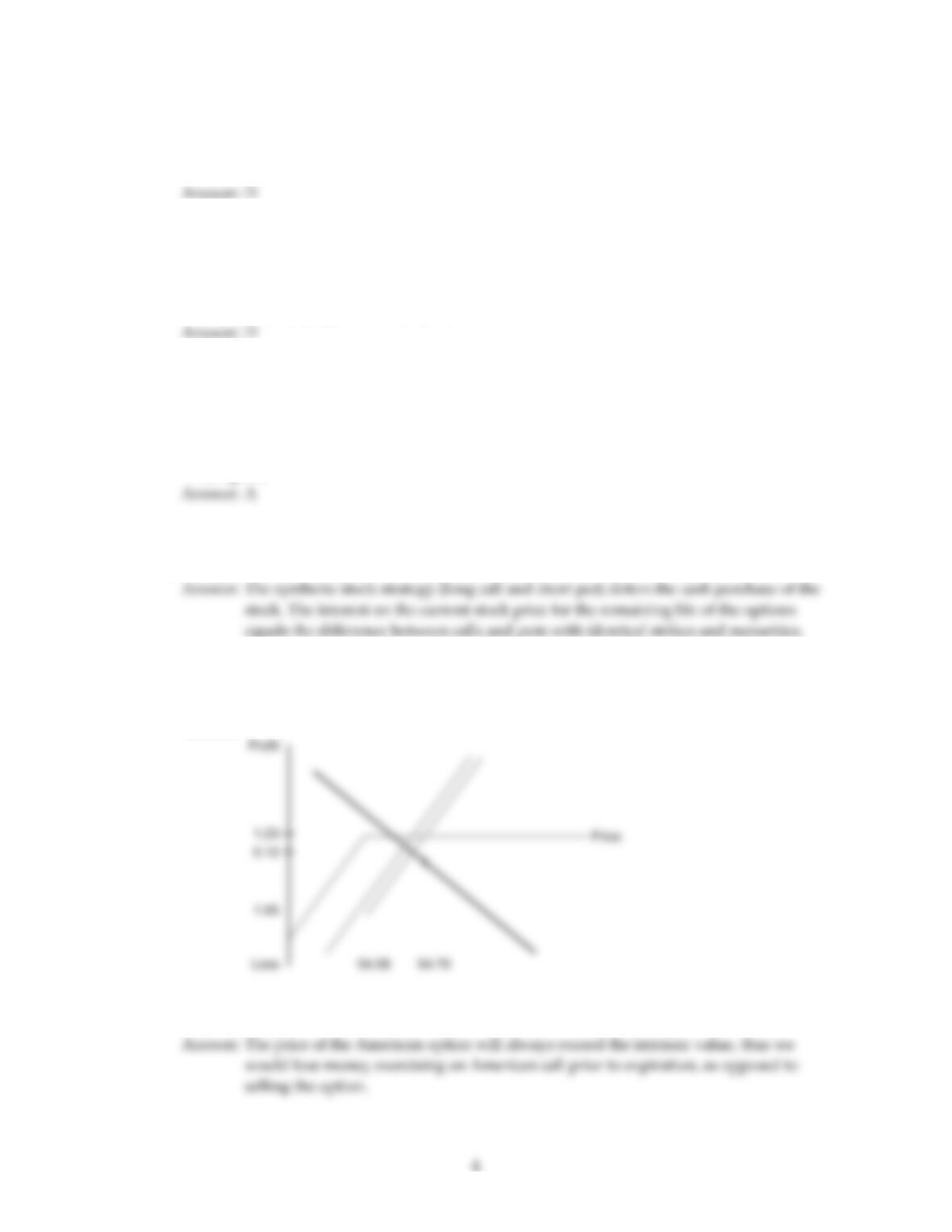
2) Jillo, Inc. stock is selling for $54.70 per share. Calls and puts with a $55.00 strike and 40 days
until expiration are selling for $1.65 and $1.23, respectively. Draw a profit and loss graph
illustrating the arbitrage.
Answer:
3) Explain in simple terms why a call option on a non–dividend paying stock should never be
exercised early.

5
4) The necessary condition for early exercise is that we prefer to receive something sooner
rather than later. With a dividend paying call and a non–dividend paying put, what do we
receive?
5) All else being equal, explain why American options are at least as valuable as European
options.
9.3 Class Discussion Question
1) Put–call parity allows a discussion of option pricing relationships without actually pricing an
option. Have the class list all the possible pricing relationships they can recall. Add to the list
until reasonably complete. Follow up this exercise by listing puts and calls, while asking
students to state if certain premiums are possible.