40. Image height divided by object height gives
a.
image distance
b.
object distance
c.
magnification
d.
real image size
e.
virtual image size
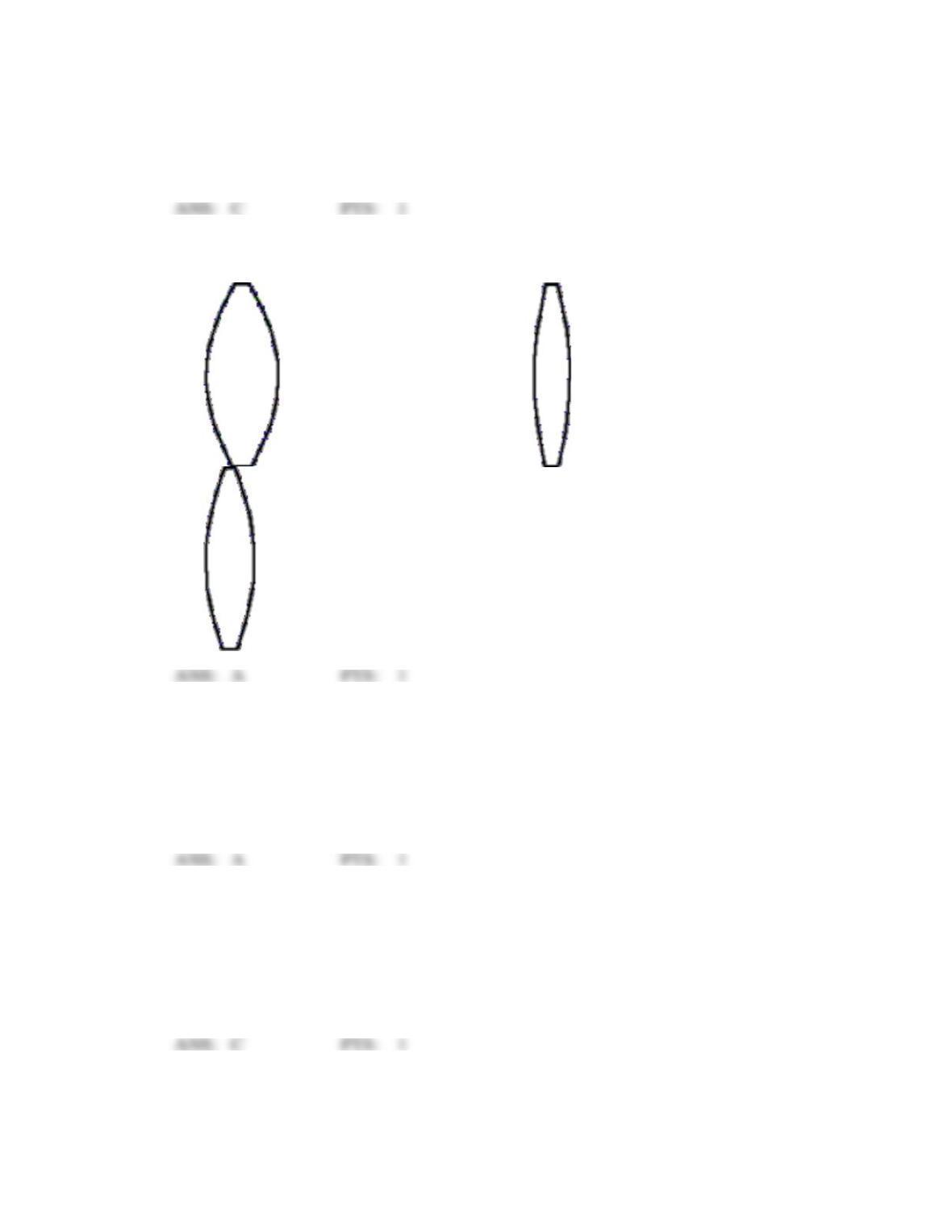
41. Choose the lens having the shortest focal length.
a.
c.
b.
42. A lens that is thicker at the center than the edges
a.
is a converging lens
b.
is a diverging lens
c.
always forms a real image
d.
always forms a virtual image
e.
none of the above
43. A nanometer is
a.
one thousandth of a meter
b.
one millionth of a meter
c.
one billionth of a meter
d.
one trillionth of a meter
e.
none of the above
44. Of EM waves having these wavelengths, which would be visible?
a.
100 nm
b.
500 nm
c.
1000 nm
d.
1 nm
e.
none of the above
45. Two otherwise identical light waves arriving at the same point with peak matching valley
undergo
a.
constructive interference
b.
destructive interference
c.
polarization
d.
none of the above
46. The fact that light can be polarized shows that light is
a.
polar
c.
an electromagnetic wave
b.
monochromatic
d.
a transverse wave
47. A movie projector is equipped with a 0.5 m focal length lens that is positioned 0.505 m in
front of the film. The distance in front of the lens that a screen must be placed for an image
to be in focus is
a.
0.5 m
b.
0.505 m
c.
50.5 m
d.
500 m
e.
505 m
48. For the projector in the previous problem, the image is ____________ times as large as the
object.
a.
0.001
b.
1.01
c.
50

d.
100
e.
101
49. A magnifying glass with focal length 15 cm is placed 10 cm above a stamp. The image of
the stamp is located
a.
30 cm above the magnifying glass
b.
30 cm below the magnifying glass
c.
30 cm above the stamp
d.
30 cm below the stamp
e.
15 cm from the magnifying glass
50. The magnification of the magnifying glass in the previous problem is
a.
+3
b.
–3
c.
+15
d.
–15
e.
+30
51. The mirror on the passenger side of modern automobiles is a ___________ mirror
a.
convex
c.
plane
b.
concave
d.
spherical
52. The advantage of a convex mirror is that it has a __________ field of view
a.
narrow
c.
wide
b.
linear
d.
open
53. The light directly from the sun is
a.
polarized
c.
horizontally polarized
b.
unpolarized
d.
vertically polarized
54. In an astronomical telescope the secondary mirror is
a.
concave
c.
spherical
b.
convex
d.
plane
55. Halos are most often observed in the ____________ time of the year
a.
spring
c.
fall
b.
summer
d.
winter

MULTIPLE RESPONSE
1. When a light ray traveling in air meets the surface of a piece of glass, which of the
following occur at the interface?
a.
The light is totally reflected.
b.
Some of the light is reflected back into the air.
c.
Some light enters the glass and is refracted toward the normal.
d.
Some light enters the glass and is refracted away from the normal..
e.
All of the light enters the glass.
2. When light enters glass from air, which of these properties of the light change?
a.
frequency
c.
speed
b.
wavelength
d.
all of the above
3. Fresnel lenses are
a.
made of mirror segments
b.
made of the surface portions of a regular lens
c.
found in some auto headlamps and theater lights and rear windows of RVs
d.
all of the above
4. You look at yourself in a plane mirror. If you move away from the mirror and look at
yourself again, you now see
a.
more of yourself
b.
less of yourself
c.
the same amount of yourself
d.
a larger image of yourself
e.
a smaller image of yourself
5. The Hubble Space Telescope
a.
has a flawed primary mirror
b.
has been repaired
c.
has failed
d.
none of the above
6. If the magnification produced by an optical system is negative, the image is
a.
smaller than the object
b.
inverted
c.
upside down
d.
all of the above

7. A person looking through eyeglasses sees
a.
real images
b.
virtual images
c.
erect images
d.
inverted images
e.
polarized images
8. A lens that is thinner at the center than the edges
a.
is a converging lens
b.
is a diverging lens
c.
always forms a real image
d.
always forms a virtual image
e.
none of the above
9. An image seen projected on a screen by a single lens
a.
is always erect
b.
is always inverted
c.
is a real image
d.
is a virtual image
e.
none of the above
10. In the case of magnification, if image distance (p) is positive, the image is to the ______ of
the lens and ______.
a.
right
d.
imaginary
b.
left
e.
virtual
c.
real
COMPLETION
1. You do not see your image when you look at a flat rough aluminum surface because of
__________.
2. Liquid crystal displays make use of __________.

3. Light spreads out when it passes through a narrow slit because of __________.
4. When light passes through two or more narrow slits, an alternating dark and bright pattern is
observed on a screen because of __________.
5. Certain types of sunglasses are very effective at diminishing light reflected from surfaces
because of __________.
6. Light is totally absorbed when sent through two polaroid filters if their transmission axes are
__________.
7. Optical fibers work because of __________.
8. You see colors in a rainbow because of __________.
9. A ________ lens is used to compensate for hyperopia.
10. When myopia is corrected surgically, the shape of the ________ is changed.

11. A light ray bends when it goes from one medium to another because of __________.
12. The critical angle is that angle of incidence for which the angle of refraction equals ______.
13. When you look into a pool of water, the depth looks less than it actually is because of
__________.
14. __________ results because the speed of light in a transparent medium varies with
frequency.
15. The colors you see with a prism result because of __________.
16. A one-way mirror works because __________.
17. The ideal shape for the primary mirror of a telescope is __________.
18. The two types of reflection are ______________ and ___________.

19. The type of mirror that will allow you to see large areas normally hidden from your view is
__________.
20. Image height divided by object height gives __________.
21. A person looking through eyeglasses sees __________ images.
22. A __________ lens is thicker at the center than the edges.
23. A __________ lens is thinner at the center than the edges.
24. The orientation of an image seen projected on a screen by a single lens is always
__________.

25. A movie projector is equipped with a 0.5 m focal length lens that is positioned 0.505 m in
front of the film. The distance in front of the lens that a screen must be placed for an image
to be in focus is __________.
26. For the projector in the previous problem, the image is __________ times as large as the
object.
27. A magnifying glass with focal length 15 cm is placed 10 cm above a stamp. The image of
the stamp is located __________ the magnifying glass.
28. The magnification of the magnifying glass in the previous problem is __________.
29. The sky is blue because of ____________.
30. In order to see a rainbow, the sun must be _______________ you

31. The two most common types of poor eyesight are the resulet of improper ______________.
32. If the object distance (s) is less than the focal length (f) then the image is ____________.
MATCHING
Match each item with the correct statement below.
a.
constructive interference
i.
liquid crystal display
b.
converging
j.
magnification
c.
convex mirror
k.
one-way mirror
d.
destructive interference
l.
parabolic
e.
diffuse reflection
m.
real
f.
diffraction
n.
specular reflection
g.
dispersion
o.
total internal reflection
h.
diverging
p.
virtual
1. ideal shape for a telescope’s primary mirror
2. mirrors use this
3. makes use of crossed polaroids
4. what keeps a light ray inside an optical fiber
5. occurs when light passes through a very narrow slit
6. occurs when two light waves arrive at a point out of phase
7. it is half-silvered
8. lens that is thicker at the center
9. the image height divided by the object height
10. occurs because the speed of light in a transparent substance is frequency dependent
11. type of image seen projected onto a screen
12. the type of mirror on the passenger side of modern automobiles

PROBLEM
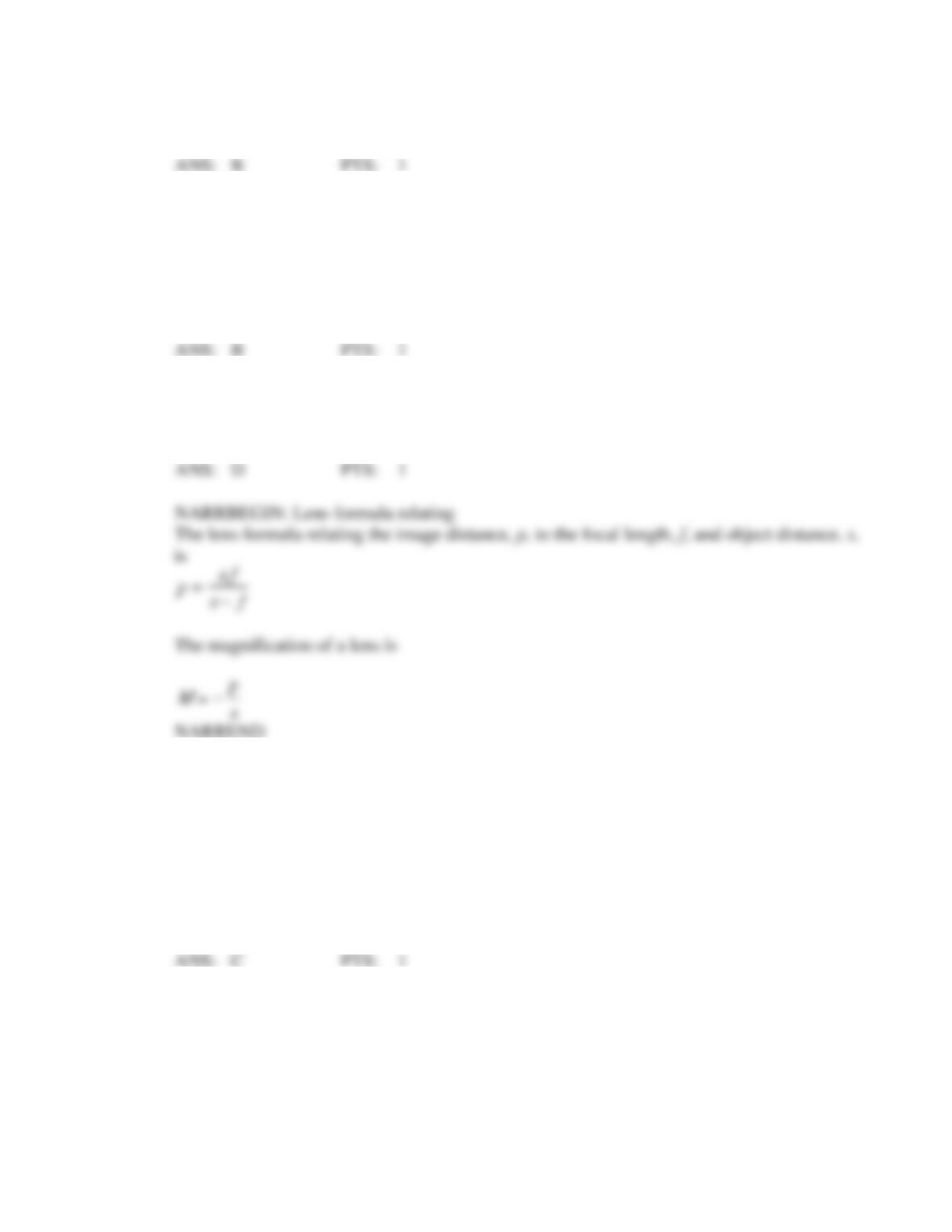
1. A movie projector is equipped with a 0.5-meter focal length lens that is positioned 0.506
meters from the film.
(a) How far from the lens must the screen be if the image on it is to be in focus?
(b) How many times larger is the image than the object?
(c) Is the image produced a real or a virtual image?
2. A magnifying glass with focal length 15 centimeters is placed 12 centimeters above a stamp.
(a) Where is the image?
(b) What is the magnification?
(c) Is the image produced a real or a virtual image?
3. When an object is viewed through a magnifying glass, an object 20 cm high appears as an
upright image 100 cm high. What is the magnification?