
CHAPTER 9—CAPITAL BUDGETING TECHNIQUES
TRUE/FALSE
1. Beyond some point, a further increase in the size of the firm’s total capital budget may lead to a
decrease in the NPVs of all the investments being considered.
2. The primary function of the capital budget is to forecast the funds required for future investments
that must be raised through external funding, that is, by selling stock or bonds.
3. One advantage of the payback period method of evaluating fixed asset investment possibilities is
that it provides a rough measure of a project’s liquidity and risk.
4. The modified IRR (MIRR) method has wide appeal to professors, but most business executives
prefer the NPV method to either the regular or modified IRR.
5. The internal rate of return is that discount rate which equates the present value of the cash
outflows (or costs) with the present value of the cash inflows.
6. Under certain conditions, a particular project may have more than one IRR. One condition under
which this situation can occur is if, in addition to the initial investment at time = 0, a negative
cash flow occurs at the end of the project’s life.
7. Other things held constant, an increase in the required rate of return will result in a decrease of a
project’s IRR.
8. The IRR of a project whose cash flows accrue relatively rapidly is more sensitive to changes in
the discount rate than is the IRR of a project whose cash flows come in more slowly.
9. If a project’s NPV exceeds the project’s IRR, then the project should be accepted.
10. Conflicts between two mutually exclusive projects, where the NPV method chooses one project
but the IRR method chooses the other, should generally be resolved in favor of the project with
the higher NPV.
11. Although the payback method ignores the time value of money, relying solely on this capital
budgeting method will always lead to value maximizing decision.

Chapter 9 Capital Budgeting Techniques 179
12. Using the discounted payback method, a project should be accepted when the discounted payback
is greater than the projects expected life.
13. A capital budgeting project is acceptable if the rate of return required for such a project is greater
than the project’s internal rate of return.
14. The post-audit two main purposes are to improve forecasts and to improve operations.
15. Any capital budgeting investment rule should depend solely on forecasted cash flows and the
opportunity rate of return. The rule itself should not be affected by managers’ tastes, the choice of
accounting method, or the profitability of other independent projects.
16. Project S has a pattern of high cash flows in its early life, while Project L has a longer life, with
large cash flows late in its life. At the current required rate of return, normal Projects S and L
have identical NPVs. Now suppose interest rates and money costs generally decline. Other things
held constant, this change will cause L to become preferred to S.
17. When considering two mutually exclusive projects, the financial manager should always select
that project whose internal rate of return is the highest provided the projects have the same initial
cost.
18. If the IRR of normal Project X is greater than the IRR of mutually exclusive Project Y (also
normal), we can conclude that the firm will select X rather than Y if X has a NPV > 0.
19. The main reason that the NPV method is regarded as being conceptually superior to IRR method
for evaluating mutually exclusive investments is that multiple IRRs may exist.
20. The IRR of normal Project X is greater than the IRR of normal Project Y, and both IRRs are
greater than zero. Also, the NPV of X is greater than the NPV of Y at the required rate of return.
If the two projects are mutually exclusive, Project X should definitely be selected, and the
investment made, provided we have confidence in the data. Put another way, it is impossible to
draw NPV profiles that would suggest not accepting Project X.

180 Chapter 9 Capital Budgeting Techniques
21. In capital budgeting analyses, it is possible that NPV and IRR will both involve assuming
reinvestment of the project’s cash flows at the same rate.
22. Small businesses probably make less use of the DCF capital budgeting techniques than large
businesses. This may reflect a lack of knowledge on the part of small firms’ managers, but it may
also reflect a rational conclusion that the costs of using DCF analysis outweigh the benefits of
these methods for those firms.
23. Effective capital budgeting can improve the timing of asset acquisition and the quality of assets
purchased, thereby providing an opportunity to purchase and install assets before they are needed.
24. An increase in the discount rate used in computing the NPV of a project will lower the value of
the NPV for that project.
25. NPV and IRR will always lead to the same accept/reject decision for mutually exclusive projects.
26. The NPV method implicitly assumes that the rate at which cash flows can be reinvested is the
required rate of return, whereas the IRR method implies that the firm has the opportunity to
reinvest at the project’s IRR.
27. There exists an IRR solution for each time the direction of cash flows associated with project is
interrupted.
28. The post-audit is a simple process in which actual results are compared to forecasted results and
any discrepancy indicates a change factors that are completely under management’s control.
MULTIPLE CHOICE
1. Which of the following capital budgeting methods might not consider the salvage value of a
machine being considered for purchase?
a.
Internal rate of return.
b.
Net present value.
c.
Payback.
d.
Discounted payback.
e.
Answers c and d are both correct.

Chapter 9 Capital Budgeting Techniques 181
2. Assume a project has normal cash flows (i.e., initial cash flow is negative, and all other cash
flows are positive). Which of the following statements is most correct?
a.
All else equal, a project’s IRR increases as the required rate of return declines.
b.
All else equal, a project’s NPV increases as the required rate of return declines.
c.
All else equal, a project’s IRR is unaffected by changes in the required rate of return.
d.
Answers a and b are both correct.
e.
Answers b and c are both correct.
3. A major disadvantage of the payback period method is it
a.
Is useless as a risk indicator.
b.
Ignores cash flows beyond the payback period.
c.
Does not directly account for the time value of money.
d.
All of the above are correct.
e.
Only answers b and c are correct.
4. If the calculated NPV is negative, then which of the following must be true? The discount rate
used is
a.
Equal to the internal rate of return.
b.
Too high.
c.
Greater than the internal rate of return.
d.
Too low.
e.
Less than the internal rate of return.
5. Projects A and B have the same expected lives and initial cash outflows. However, one project’s
cash flows are larger in the early years, while the other project has larger cash flows in the later
years. The two NPV profiles are given below:

182 Chapter 9 Capital Budgeting Techniques
Which of the following statements is correct?
a.
Project A has the smaller cash flows in the later years.
b.
Project A has the larger cash flows in the later years.
c.
We require information on the required rate of return in order to determine which project
has larger early cash flows.
d.
The NPV profile graph is inconsistent with the statement made in the problem.
e.
None of the above statements is correct.
6. Which of the following statements is correct?
a.
The NPV method assumes that cash flows will be reinvested at the required rate of return
while the IRR method assumes reinvestment at the IRR.
b.
The NPV method assumes that cash flows will be reinvested at the risk-free rate while the
IRR method assumes reinvestment at the IRR.
c.
The NPV method assumes that cash flows will be reinvested at the required rate of return
while the IRR method assumes reinvestment at the risk-free rate.
d.
The NPV method does not consider the inflation premium.
e.
The IRR method does not consider all relevant cash flows, and particularly cash flows
beyond the payback period.
7. Which of the following is not a rationale for using the NPV method in capital budgeting?
a.
An NPV of zero signifies that the project’s cash flows are just sufficient to repay the
invested capital and to provide the required rate of return on that capital.
b.
A project whose NPV is positive will increase the value of the firm if that project is
accepted.
c.
A project is considered acceptable if it has a positive NPV.
d.
A project is not considered acceptable if it has a negative NPV.
e.
All of the above are true.
8. The __________ involves comparing the actual results with those predicted by the project’s
sponsors and explaining why any differences occur.
a.
discounted payback
b.
internal rate of return
c.
post-audit
d.
net present value
e.
economic value added
9. The present value of the expected net cash inflows for a project will most likely exceed the
present value of the expected net profit after tax for the same project because
a.
Income is reduced by taxes paid, but cash flow is not.
b.
There is a greater probability of realizing the projected cash flow than the forecasted
income.
c.
Income is reduced by dividends paid, but cash flow is not.
d.
Income is reduced by depreciation charges, but cash flow is not.
e.
Cash flow reflects any change in net working capital, but sales do not.

Chapter 9 Capital Budgeting Techniques 183
10. Which of the following statements is correct?
a.
Because discounted payback takes account of the required rate of return, a project’s
discounted payback is normally shorter than its regular payback.
b.
The NPV and IRR methods use the same basic equation, but in the NPV method the
discount rate is specified and the equation is solved for NPV, while in the IRR method the
NPV is set equal to zero and the discount rate is found.
c.
If the required rate of return is less than the crossover rate for two mutually exclusive
projects’ NPV profiles, a NPV/IRR conflict will not occur.
d.
If you are choosing between two projects which have the same life, and if their NPV
profiles cross, then the smaller project will probably be the one with the steeper NPV
profile.
e.
If the required rate of return is relatively high, this will favor larger, longer-term projects
over smaller, shorter-term alternatives because it is good to earn high rates on larger
amounts over longer periods.
11. Which of the following statements is correct?
a.
The discounted payback is generally shorter than the regular payback.
b.
Any type of project might have multiple rates of return if the IRR is sufficiently high.
c.
The NPV and IRR methods can lead to conflicting and accept/reject decisions only if (1)
mutually exclusive projects are being evaluated and (2) if the projects’ NPV profiles cross
at a rate less than the firm’s cost of capital.
d.
The NPV and IRR methods can lead to conflicting accept/reject decisions only if (1)
mutually exclusive projects are being evaluated and (2) if the projects’ NPV profiles cross
at a rate greater than the firm’s cost of capital.
e.
None of the above is a correct statement.
12. Which of the following statements is false?
a.
The NPV will be positive if the IRR is less than the required rate of return.
b.
If the multiple IRR problem does not exist, any independent project acceptable by the
NPV method will also be acceptable by the IRR method.
c.
When IRR = k (the required rate of return), NPV = 0.
d.
The IRR can be positive even if the NPV is negative.
e.
The NPV method is not affected by the multiple IRR problem.
13. Assume that you are comparing two mutually exclusive projects. Which of the following
statements is most correct?
a.
The NPV and IRR rules will always lead to the same decision unless one or both of the
projects are “non-conventional” in the sense of having only one change of sign in the cash
flow stream, i.e., one or more initial cash outflows (the investment) followed by a series of
cash inflows.

184 Chapter 9 Capital Budgeting Techniques
b.
If a conflict exists between the NPV and the IRR, the conflict can always be eliminated by
dropping the IRR and replacing it with the payback period.
c.
There will be a meaningful (as opposed to irrelevant) conflict only if the projects’ NPV
profiles cross, and even then, only if the required rate of return is to the left of (or lower
than) the discount rate at which the crossover occurs.
d.
Statements a, b, and c are all true.
e.
None of the above is a correct statement.
14. Two mutually exclusive projects each have a cost of $10,000. The total, undiscounted cash flows
from Project L are $15,000, while the undiscounted cash flows from Project S total $13,000.
Their NPV profiles cross at a discount rate of 10 percent. Which of the following statements best
describes this situation?
a.
The NPV and IRR methods will select the same project if the required rate of return is
greater than 10 percent; for example, 18 percent.
b.
The NPV and IRR methods will select the same project if the cost of capital is less than 10
percent; for example, 8 percent.
c.
To determine if a ranking conflict will occur between the two projects the required rate of
return is needed as well as an additional piece of information.
d.
Project L should be selected at any required rate of return, because it has a higher IRR.
e.
Project S should be selected at any required rate of return, because it has a higher IRR.
15. The internal rate of return of a capital investment
a.
Changes when the required rate of return changes.
b.
Is equal to the annual net cash flows divided by one half of the project’s cost when the
cash flows are an annuity.
c.
Must exceed the required rate of return in order for the firm to accept the investment.
d.
Is similar to the yield to maturity bond.
e.
Answers c and d are both correct.
16. Which of the following statements is correct?
a.
In general, the NPVs of riskier cash flows should be found using relatively high discount
rates. However, if a cash flow is negative, it should be evaluated using a low discount rate.
b.
If a project has only costs (no revenues) as would certain environmental projects, then the
project is likely to have two regular IRRs.
c.
If the NPV and IRR methods give conflicting rankings for two mutually exclusive
projects, the payback period should be used to choose the project that should be
purchased.
d.
It is better to use the NPV method to evaluate independent projects, but for mutually
exclusive projects, especially if projects vary greatly in size, the IRR method is better.
e.
None of the above is a correct statement.

Chapter 9 Capital Budgeting Techniques 185
17. Two firms evaluated the same capital budgeting project to determine whether to purchase it. The
CFO of Anchor Weights Corporation (AWC) reported that she determined that the project’s
internal rate of return equals 9 percent, and she recommended that the project be purchased. The
CFO of Sectional Spas Incorporated (SSI) simply reported that the project was unacceptable to
his firm when he evaluated it using one of the capital budgeting techniques that considers the time
value of money. Given this information, which of the following statements is correct?
a.
The net present value of the project must be positive for both firms.
b.
If the SSI’s CFO computes the IRR for the project, he will find that it is less than 9 percent
for his company.
c.
AWC’s CFO must have used the traditional payback period method to evaluate the project.
d.
If the project is acceptable (unacceptable) to one firm, it must be acceptable
(unacceptable) to both firms. As a result, one of the CFOs made a mistake when
evaluating the project.
e.
SSI’s must have a required rate of return that is greater than 9 percent.
18. When Richard evaluated a capital budgeting project—a new machine needed to manufacture
inventory—using his firm’s required rate of return, he discovered that the project’s net present
value (NPV) is negative. Based on this information, which of the following must be correct?
a.
The project’s internal rate of return is also negative.
b.
The project’s discounted payback period is greater than its economic life.
c.
As long as the new machine’s initial investment outlay is fairly low, the firm should
purchase if it is used to replace an older machine that is required to produce inventory.
d.
The project’s traditional payback period must be greater than the maximum payback
period that the firm has established.
e.
Two or more of these scenarios must be correct.
19. Tara is evaluating two mutually exclusive capital budgeting projects that have the following
characteristics:
Cash Flows
Year
Project Q
Project R
0
$(4,000)
$(4,000)
1
0
3,500
2
5,000
1,100
IRR
11.8%
12.0%
If the firm’s required rate of return (k) is 10 percent, which project should be purchased?
a.
Both projects should be purchased, because the IRRs for both projects exceed the firm’s
required rate of return.
b.
Neither project should be accepted, because the IRRs for both projects exceed the firm’s
required rate of return.
c.
Project Q should be accepted, because its net present value (NPV) is higher than Project
R’s NPV.
d.
Project R should be accepted, because its net present value (NPV) is higher than Project
Q’s NPV.
e.
None of the above is a correct answer.

186 Chapter 9 Capital Budgeting Techniques
20. Union Atlantic Corporation, which has a required rate of return equal to 14 percent, is evaluating
a capital budgeting project that has the following characteristics:
Year
Cash Flows
0
$(170,000)
1
60,750
2
60,750
3
60,750
4
60,750
Union Atlantic’s capital budgeting manager has determined that the project’s net present value is
$7,008. According to this information, which of the following statements is correct?
a.
The project’s internal rate of return (IRR) must be greater than 14 percent.
b.
The project’s discounted payback must be less that its economic life.
c.
The project should be purchased by Union Atlantic.
d.
All of these statements are correct.
e.
None of these statements is correct.
21. The importance of capital budgeting decisions is due to all of the following factors except for:
a.
the impact of a capital budgeting decision is long term; the firm looses some decision-
making flexibility when capital projects are purchased.
b.
effective capital budgeting can improve the timing of asset acquisition and the quality of
assets purchased.
c.
the acquisition of fixed assets typically involves substantial expenditures, and before a
firm spends a large amount of money, it must have the funds available.
d.
capital budgeting techniques overcome the problems with error in forecasts for asset
requirements and projected sales, we will still be able to determine if we should fund the
project.
e.
all of the above are factors that make capital budgeting important.
22. The advantage of the payback period over other capital budgeting techniques is that
a.
it is the simplest and oldest formal model to evaluate capital budgeting model.
b.
it directly accounts for the time value of money.
c.
it ignores cash flows beyond the payback period.
d.
it always leads to decisions that maximize the value of the firm.
e.
it incorporates risk into the discount rate used to solve the payback period.
23. If the NPV form a project is positive it must be that
a.
the discounted payback period is longer than the useful life of the project.
b.
the internal rate of return is lower than the discount used.
c.
the project is not acceptable on a risk adjusted basis.
d.
this project is preferred to any other mutually exclusive project.
e.
accepting the project increases the value of the firm.

Chapter 9 Capital Budgeting Techniques 187
24. Discounted payback’s primary advantage over traditional payback is that
a.
discounted payback considers cash flows that occur after the discounted payback period.
b.
discounted payback is always shorter than traditional payback making more projects
acceptable.
c.
discounted payback does consider the time value of money.
d.
discounted payback will let you accept projects whose discounted payback period is
longer than the useful of the project.
e.
all of the above are true.
25. Which of the following statements concerning the internal rate of return is false?
a.
The internal rate of return for a capital budgeting project is the same for all firms
regardless of their cost of capital.
b.
A project is acceptable long as the project’s internal rate of return is greater than the hurdle
rate for the project.
c.
The internal rate of return is dependent on the timing of the cash flows.
d.
A project with a positive internal rate of return will always increase the value of the firm if
the project is accepted.
e.
You do not need to know the required rate of return to solve for the internal rate of return.
26. Net present value is preferred to internal rate of return for capital budgeting decisions because
a.
the internal rate of return does not allow you to determine if the project is acceptable.
b.
the net present value is the only method that allows you to determine which independent
project is acceptable.
c.
the net present value allows you to compare mutually exclusive projects.
d.
the internal rate of return for a project is different for each firm.
e.
NPV contains information about a projects “safety margin” which is not inherent in
IRR.
27. All of the following factors can complicate the post-audit process except
a.
each element of the cash flow forecast is subject to uncertainty.
b.
projects sometimes fail to meet expectations for reasons beyond the control of operating
executives.
c.
it is often difficult to separate the operating results of one investment from those of a
larger system.
d.
executives who where responsible for a given decision might have moved on by the time
the time the results of the long term project are known.
e.
the most successful firms, on average, are the ones that put the least emphasis on the post-
audit.
28. Benefits of the post-audit include all of the following except
a.
when decision makers are forced to compare their projections to actual outcomes, there is
a tendency to improve.
b.
conscious or unconscious biases are removed.
c.
negative NPV projects are identified before they begin.
d.
forecasts are improved.
e.
all of the above are benefits of the post-audit.

188 Chapter 9 Capital Budgeting Techniques
29. Your assistant has just completed an analysis of two mutually exclusive projects. You must now
take her report to a board of directors meeting and present the alternatives for the board’s
consideration. To help you with your presentation, your assistant also constructed a graph with
NPV profiles for the two projects. However, she forgot to label the profiles, so you do not know
which line applies to which project. Of the following statements regarding the profiles, which one
is most reasonable?
a.
If the two projects have the same investment cost, and if their NPV profiles cross once in
the upper right quadrant, at a discount rate of 40 percent, this suggests that a NPV versus
IRR conflict is not likely to exist.
b.
If the two projects’ NPV profiles cross once, in the upper left quadrant, at a discount rate
of minus 10 percent, then there will probably not be a NPV versus IRR conflict,
irrespective of the relative sizes of the two projects, in any meaningful, practical sense
(that is, a conflict which will affect the actual investment decision).
c.
If one of the projects has a NPV profile which crosses the X-axis twice, hence the project
appears to have two IRRs, your assistant must have made a mistake.
d.
Whenever a conflict between NPV and IRR exist, then, if the two projects have the same
initial cost, the one with the steeper NPV profile probably has less rapid cash flows.
However, if they have identical cash flow patterns, then the one with the steeper profile
probably has the lower initial cost.
e.
If the two projects both have a single outlay at t = 0, followed by a series of positive cash
inflows, and if their NPV profiles cross in the lower left quadrant, then one of the projects
should be accepted, and both would be accepted if they were not mutually exclusive.
30. A college intern working at Anderson Paints evaluated potential investments—that is, capital
budgeting projects—using the firm’s average required rate of return (WACC), and he produced
the following report for the capital budgeting manager:
Project
NPV
IRR
Risk
LOM
$1,500
12.5%
High
QUE
0
11.0
Low
YUP
800
9.5
Average
DOG
(450)
10.0
Low
The capital budgeting manager usually considers the risks associated with capital budgeting
projects before making her final decision. If a project has a risk that is different from average, she
adjusts the average required rate of return by adding or subtracting 2 percentage points. If the four
projected listed above are independent, which one(s) should the capital budgeting manager
recommend be purchased?
a.
Project LOM only, because it has both the highest NPV and the higher IRR.
b.
Projects LOM, QUE, and YUP, because they all have positive NPVs and their IRRs.
c.
Projects DOG and QUE, because their IRRs are greater than their risk-adjusted discount
he projects returns are higher than the rates of return that capital budgeting manager uses
to evaluate them.
d.
Projects QUE, YUP, and DOG, because their IRRs are greater than their risk-adjusted
discount rates—that is, the projects returns are higher than the rates of return that capital
budgeting manager uses to evaluate them.
e.
There is not enough information to answer this question, because the firm’s average
required rate of return cannot be determined.

Chapter 9 Capital Budgeting Techniques 189
31. The Seattle Corporation has been presented with an investment opportunity which will yield cash
flows of $30,000 per year in Years 1 through 4, $35,000 per year in Years 5 through 9, and
$40,000 in Year10. This investment will cost the firm $150,000 today, and the firm’s required rate
of return is 10 percent. Assume cash flows occur evenly during the year, 1/365th each day. What
is the payback period for this investment?
a.
5.23 years
b.
4.86 years
c.
4.00 years
d.
6.12 years
e.
4.35 years
32. You have recently accepted a one-year employment term by a firm. The firm has given you the
option of receiving your salary as a lump sum value of $30,000 at the end of the year or as 12
monthly payments of $2,400 starting one month after you start work. If your relevant discount
rate is 2 percent per month, then which salary options would you prefer? (Ignore taxes, risk, and
consumption needs.) Choose the best answer.
a.
The lump sum payment, since it has the larger future value.
b.
Monthly payments, since you do not have to wait so long to receive your money.
c.
Either one, since they have the same present value.
d.
The lump sum payment, since it has the larger present value.
e.
Monthly payments, since it has the larger present value.

190 Chapter 9 Capital Budgeting Techniques
33. Two projects being considered are mutually exclusive and have the following cash flows:
Year
Project A
Project B
0
-$50,000
-$50,000
1
15,625
0
2
15,625
0
3
15,625
0
4
15,625
0
5
15,625
99,500
If the required rate of return on these projects is 10 percent, which would be chosen and why?
a.
Project B because of higher NPV.
b.
Project B because of higher IRR.
c.
Project A because of higher NPV.
d.
Project A because of higher IRR.
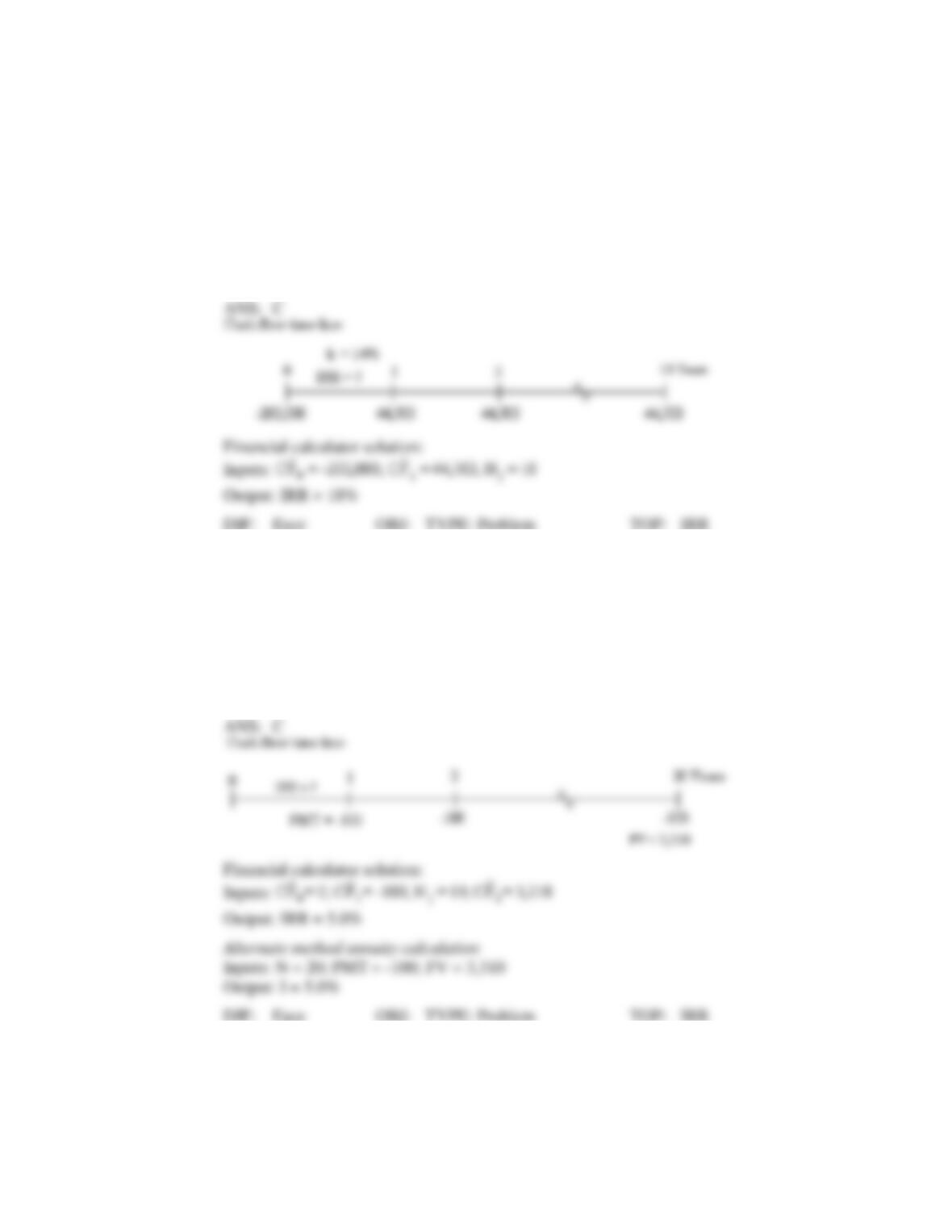
e.
Neither, because both have IRRs less than the cost of capital.
Chapter 9 Capital Budgeting Techniques 191
34. The capital budgeting director of Sparrow Corporation is evaluating a project which costs
$200,000, is expected to last for 10 years and produce after-tax cash flows, including
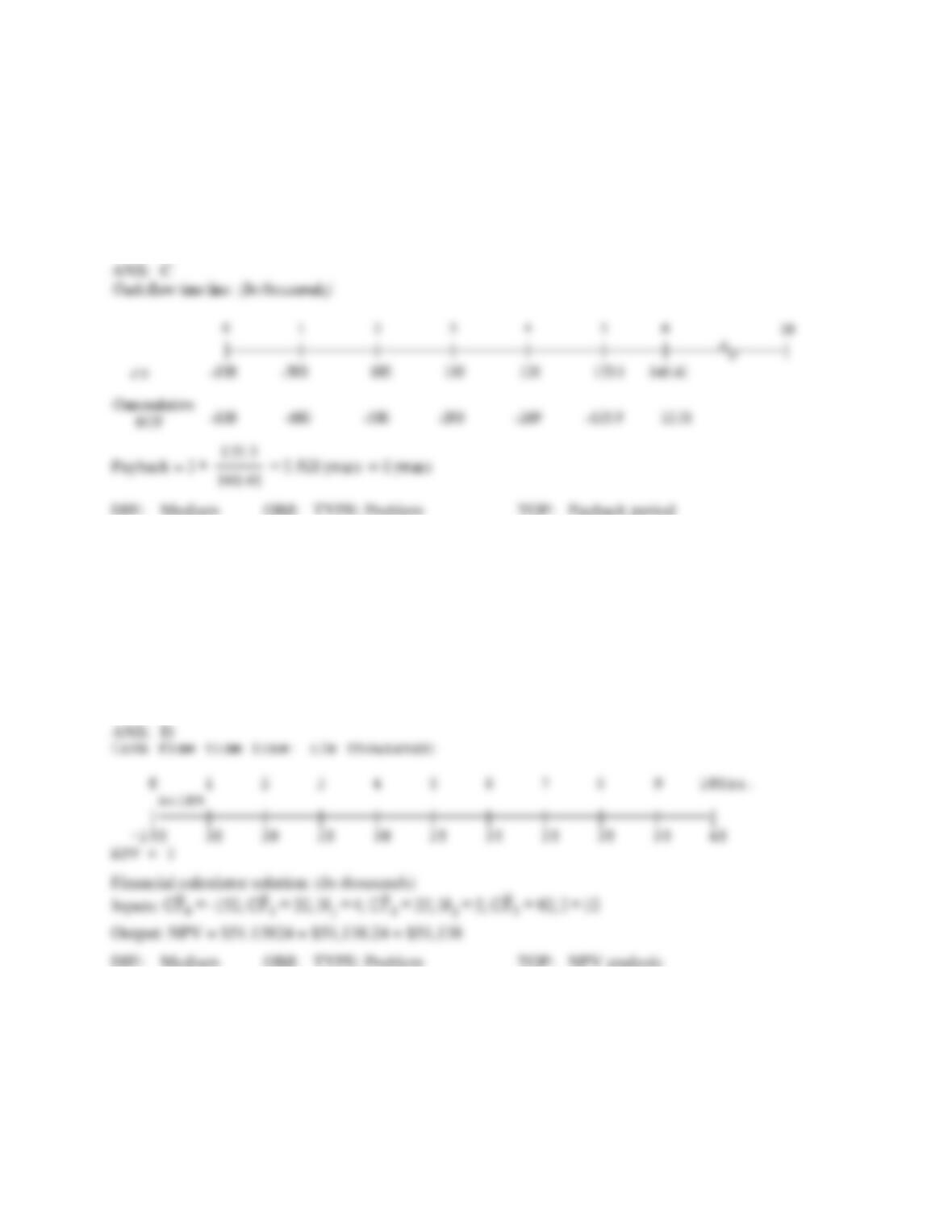
depreciation, of $44,503 per year. If the firm’s required rate of return is 14 percent and its tax rate
is 40 percent, what is the project’s IRR?
a.
8%
b.
14%
c.
18%
d.
-5%
e.
12%
35. An insurance firm agrees to pay you $3,310 at the end of 20 years if you pay premiums of $100
per year at the end of each year of the 20 years. Find the internal rate of return to the nearest
whole percentage point.
a.
9%
b.
7%
c.
5%
d.
3%
e.
11%
36. Michigan Mattress Company is considering the purchase of land and the construction of a new
plant. The land, which would be bought immediately (at t = 0), has a cost of $100,000 and the
building, which would be erected at the end of the first year (t = 1), would cost $500,000. It is
estimated that the firm’s after-tax cash flow will be increased by $100,000 starting at the end of
192 Chapter 9 Capital Budgeting Techniques
the second year, and that this incremental flow would increase at a 10 percent rate annually over
the next 10 years. What is the approximate payback period?
a.
2 years
b.
4 years
c.
6 years
d.
8 years
e.
10 years
37. The Seattle Corporation has been presented with an investment opportunity which will yield end
of year cash flows of $30,000 per year in Years 1 through 4, $35,000 per year in Years 5 through
9, and $40,000 in Year10. This investment will cost the firm $150,000 today, and the firm’s
required rate of return is 10 percent. What is the NPV for this investment?
a.
$135,984
b.
$18,023
c.
$219,045
d.
$51,138
e.
$92,146
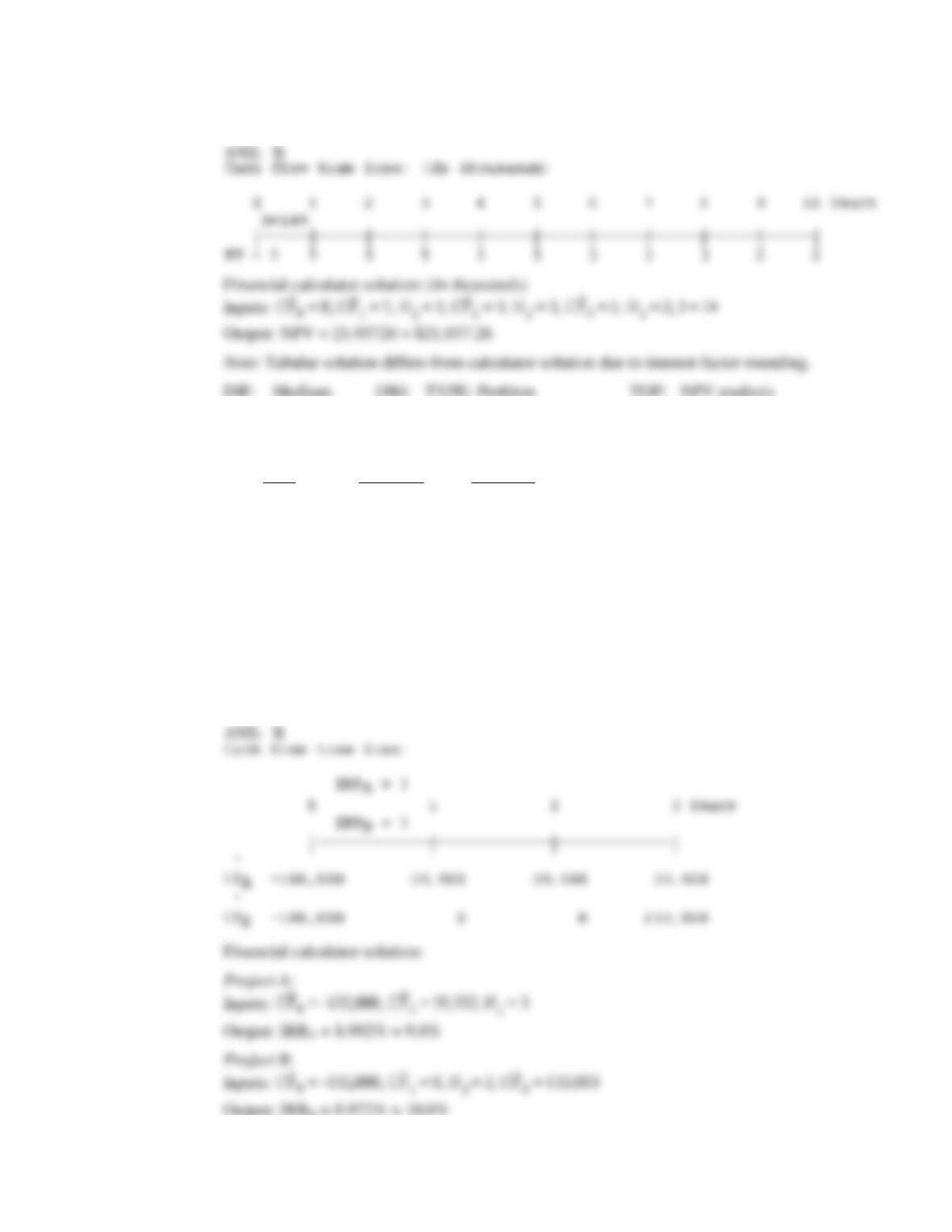
38. You are considering the purchase of an investment that would pay you $5,000 per year for Years
1-5, $3,000 per year for Years 6-8, and $2,000 per year for Years 9 and10. If you require a 14
percent rate of return, and the cash flows occur at the end of each year, then how much should
you be willing to pay for this investment?
a.
$15,819.27
b.
$21,937.26
c.
$32,415.85
d.
$38,000.00
Chapter 9 Capital Budgeting Techniques 193
e.
$52,815.71
39. Two projects being considered by a firm are mutually exclusive and have the following projected
cash flows:
Year
Project A
Project B
0
($100,00)
($100,000)
1
39,500
0
2
39,500
0
3
39,500
133,000
Based only on the information given, which of the two projects would be preferred, and why?
a.
Project A, because it has a shorter payback period.
b.
Project B, because it has a higher IRR.
c.
Indifferent, because the projects have equal IRRs.
d.
Include both in the capital budget, since the sum of the cash inflows exceeds the initial
investment in both cases.
e.
Choose neither, since their NPVs are negative.

194 Chapter 9 Capital Budgeting Techniques
40. Two fellow financial analysts are evaluating a project with the following net cash flows:
Year
Cash Flow
0
$-10,000
1
100,000
2
-100,000
One analyst says that the project has an IRR of between 12 and 13%. The other analyst calculates
an IRR of just under 800%, but fears his calculator’s battery is low and may have caused an error.
You agree to settle the dispute by analyzing the project cash flows. Which statement best
describes the IRR for this project?
a.
There is a single IRR of approximately 12.7 percent.
b.
This project has no IRR, because the NPV profile does not cross the X axis.
c.
There are multiple IRRs of approximately 12.7 percent and 787 percent.
d.
This project has two imaginary IRRs.
e.
There are an infinite number of IRRs between 12.5 percent and 790 percent that can define
the IRR for this project.

Chapter 9 Capital Budgeting Techniques 195
41. Two projects being considered are mutually exclusive and have the following projected cash
flows:
Year
Project A
Project B
0
-$50,000
-$ 50,000
1
15,990
0
2
15,990
0
3
15,990
0
4
15,990
0
5
15,990
100,560
At what rate (approximately) do the NPV profiles of Projects A and B cross?
a.
6.5%
b.
11.5%
c.
16.5%
d.
20.0%
e.
The NPV profiles of these two projects do not cross.
180.91
6,000.00
6,000.00