Stewart – Calculus ET 8e Chapter 9 Form D
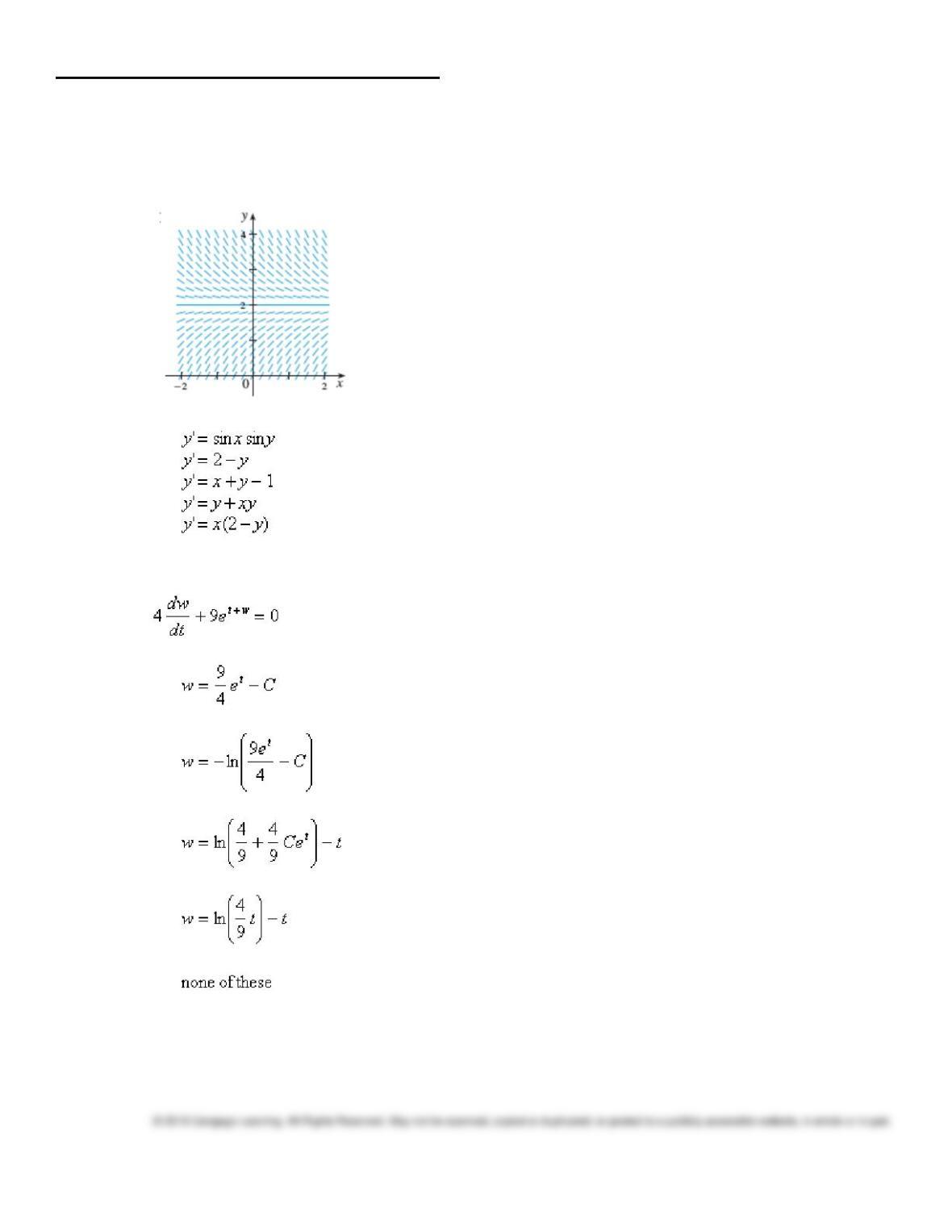
____ 4. Choose the differential equation corresponding to this direction field.
a.
b.
c.
d.
e.
____ 5. Solve the differential equation.
a.
b.
c.
d.
e.
Stewart – Calculus ET 8e Chapter 9 Form D
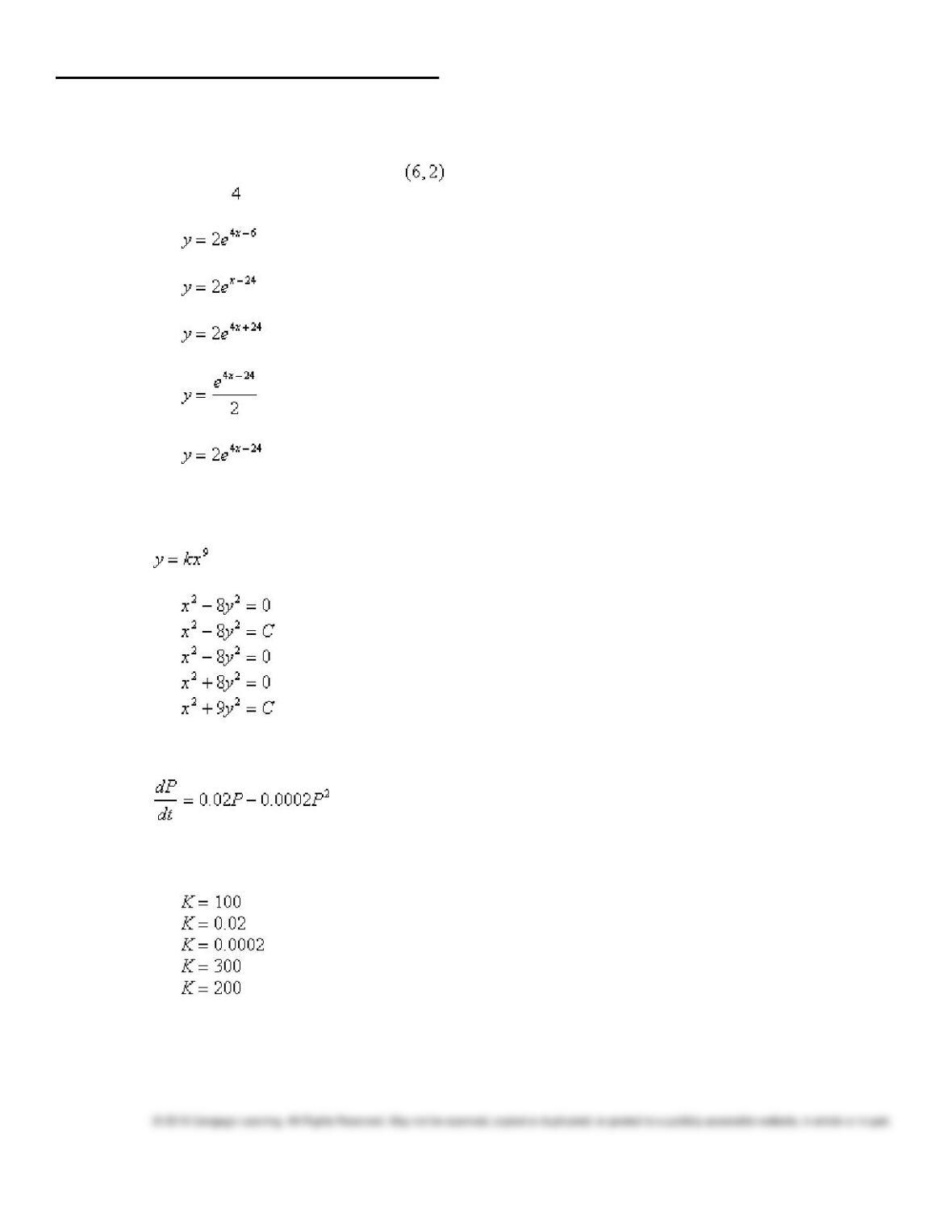
____ 6. A curve passes through the point and has the property that the slope of the curve at every
point P is times the y-coordinate P. What is the equation of the curve?
a.
b.
c.
d.
e.
____ 7. Find the orthogonal trajectories of the family of curves.
a.
b.
c.
d.
e.
____ 8. Suppose that a population develops according to the logistic equation
,
where t is measured in weeks. What is the carrying capacity?
a.
b.
c.
d.
e.
Stewart – Calculus ET 8e Chapter 9 Form D
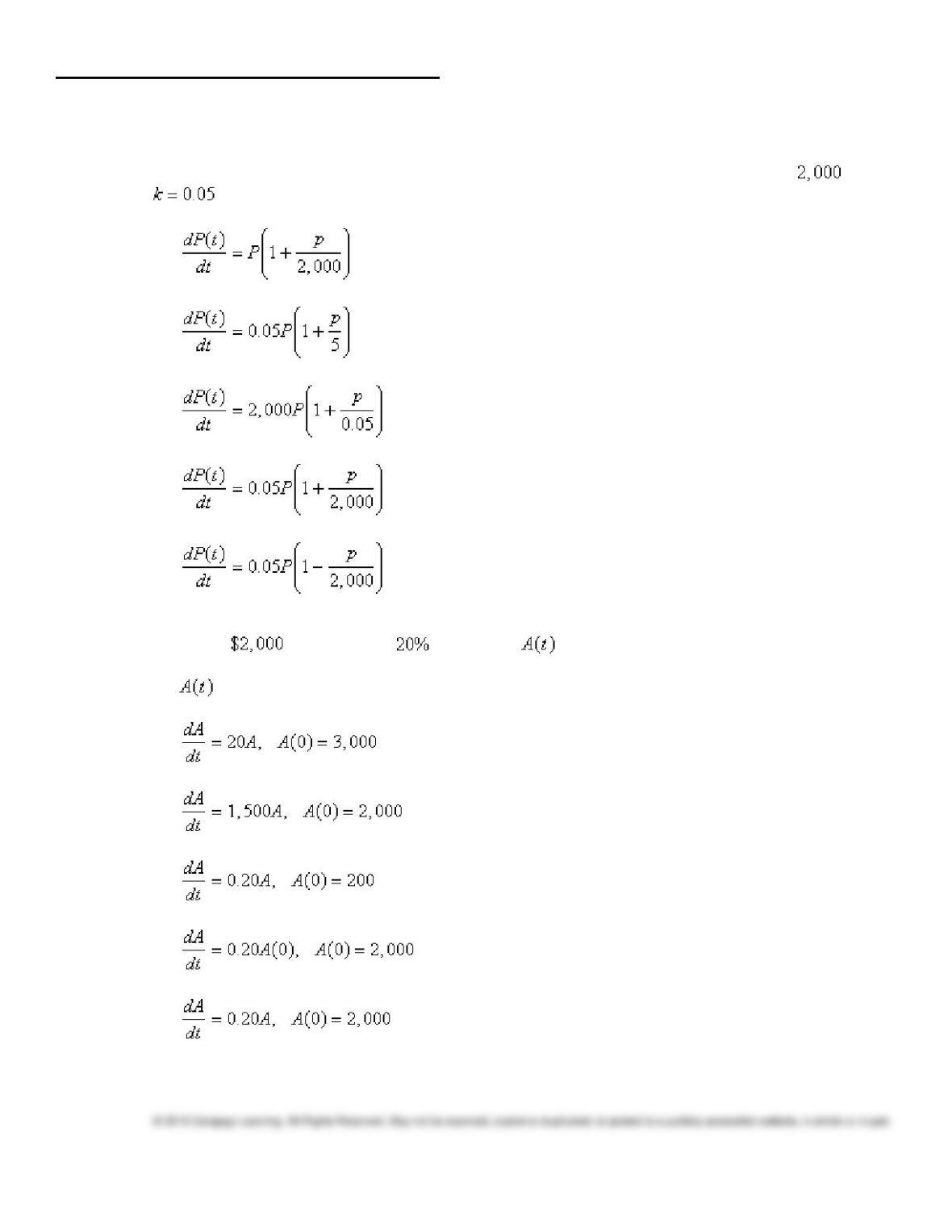
____ 9. Suppose that a population grows according to a logistic model with carrying capacity and
per year. Choose the logistic differential equation for these data.
a.
b.
c.
d.
e.
____ 10. A sum of is invested at interest. If is the amount of the investment at time t for
the case of continuous compounding, write a differential equation and an initial condition satisfied
by .
a.
b.
c.
d.
e.
Stewart – Calculus ET 8e Chapter 9 Form D
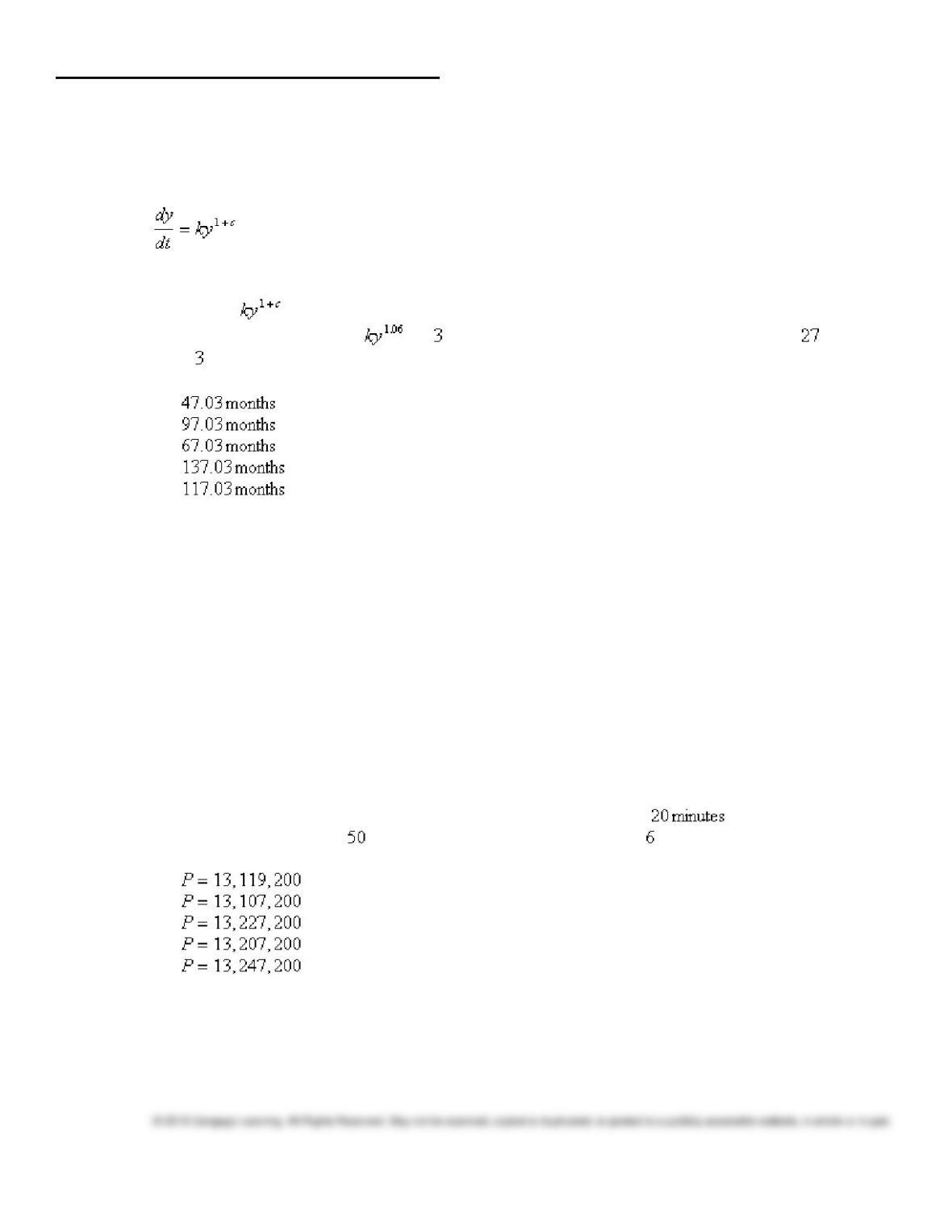
____ 11. Let c be a positive number. A differential equation of the form
where k is a positive constant is called a doomsday equation because the exponent in the
expression is larger than the exponent 1 for natural growth. An especially prolific breed of
rabbits has the growth term . If such rabbits breed initially and the warren has rabbits
after months, then when is doomsday?
a.
b.
c.
d.
e.
____ 12. The population of the world was about 5.3 billion in 1990. Birth rates in the 1990s range from 35
to 40 million per year and death rates range from 15 to 20 million per year. Let’s assume that the
carrying capacity for world population is 100 billion. Use the logistic model to predict the world
population in the 2,450 year. Calculate your answer in billions to one decimal place. (Because the
initial population is small compared to the carrying capacity, you can take k to be an estimate of
the initial relative growth rate.)
a. 78.3 billion
b. 27.0 billion
c. 17.1 billion
d. 59.2 billion
e. 32.9 billion
____ 13. A common inhabitant of human intestines is the bacterium Escherichia coli. A cell of this
bacterium in a nutrient-broth medium divides into two cells every . The initial
population of a culture is cells. Find the number of cells after hours.
a.
b.
c.
d.
e.
Stewart – Calculus ET 8e Chapter 9 Form D
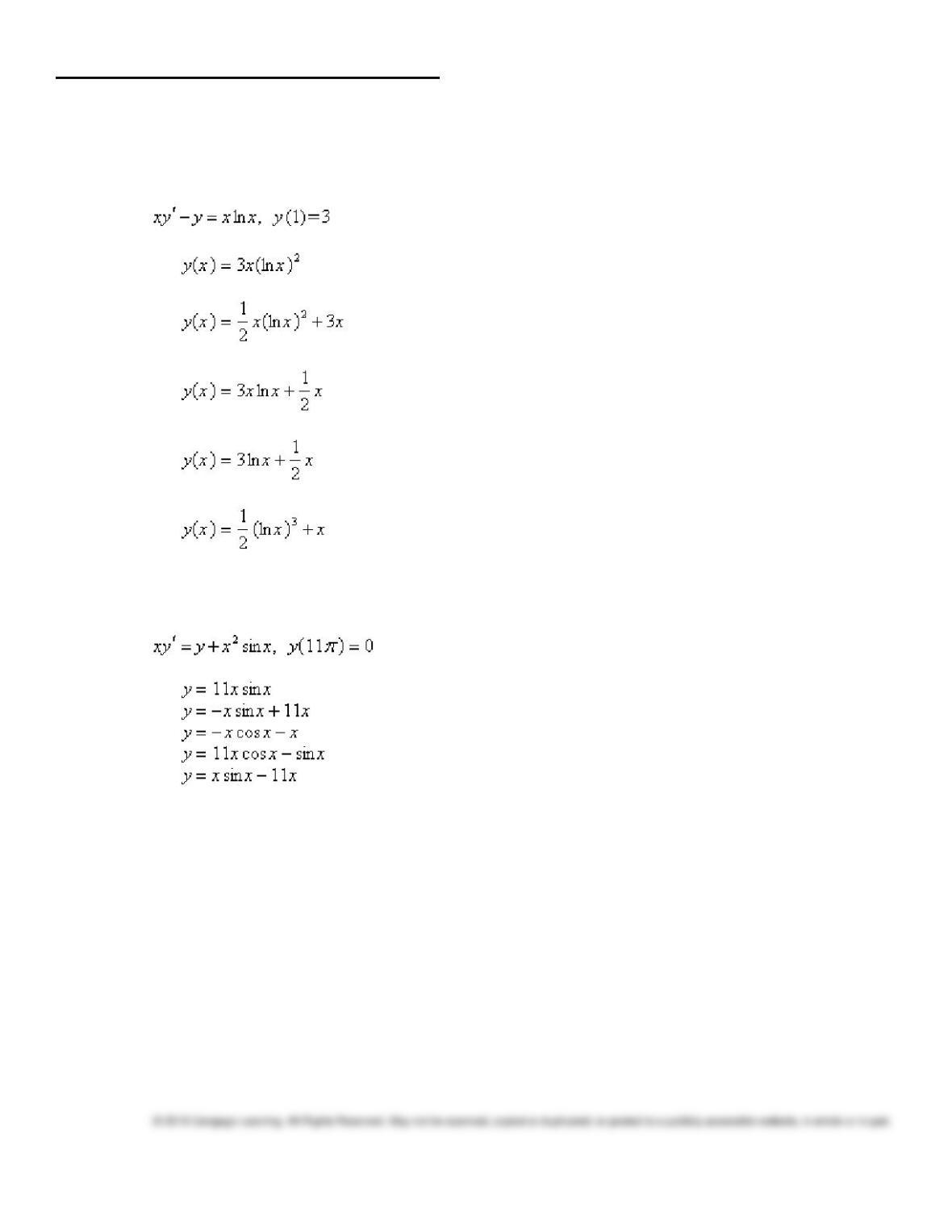
____ 14. Solve the initial-value problem.
a.
b.
c.
d.
e.
____ 15. Solve the initial-value problem.
a.
b.
c.
d.
e.
Stewart – Calculus ET 8e Chapter 9 Form D
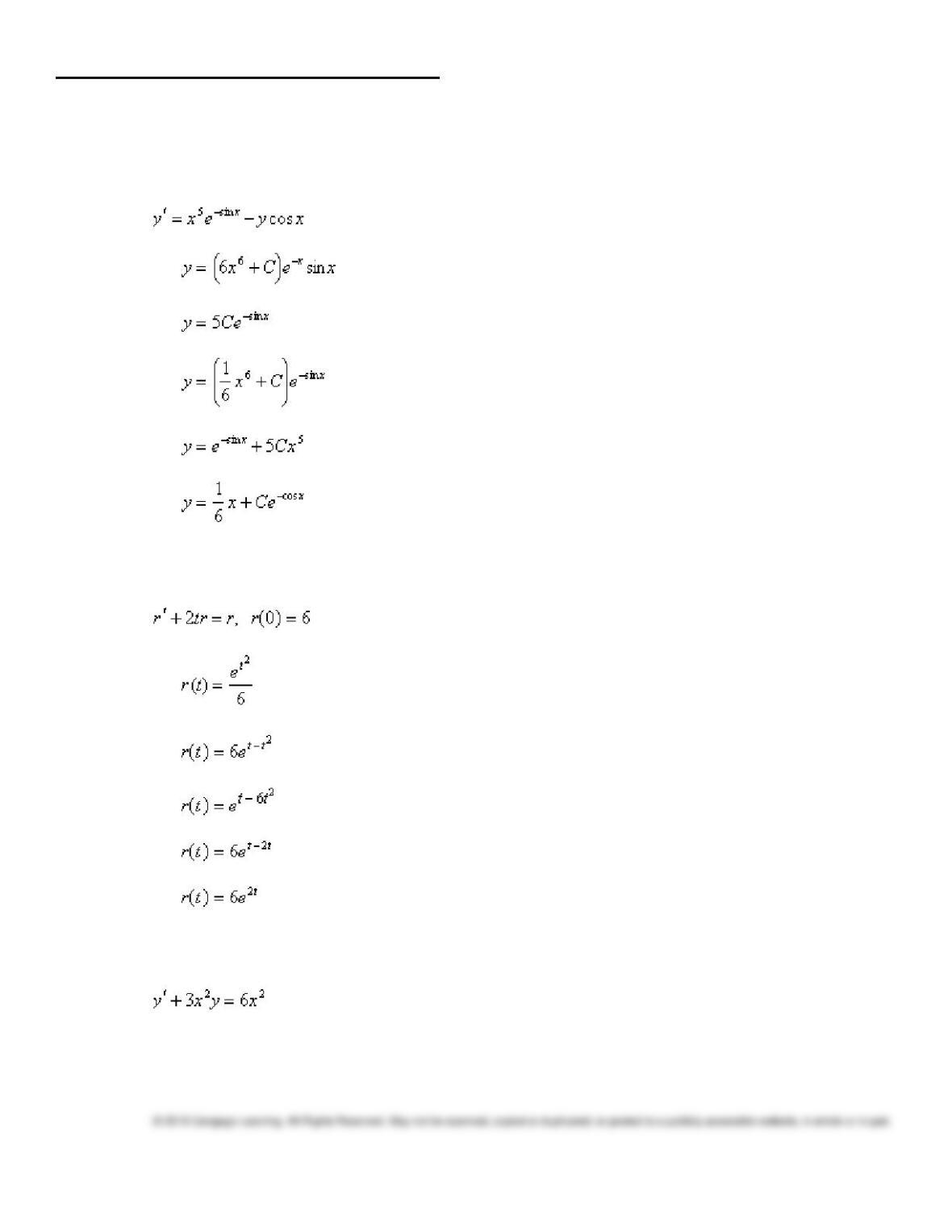
____ 16. Solve the differential equation.
a.
b.
c.
d.
e.
____ 17. Solve the initial-value problem.
a.
b.
c.
d.
e.
____ 18. Determine whether the differential equation is linear.
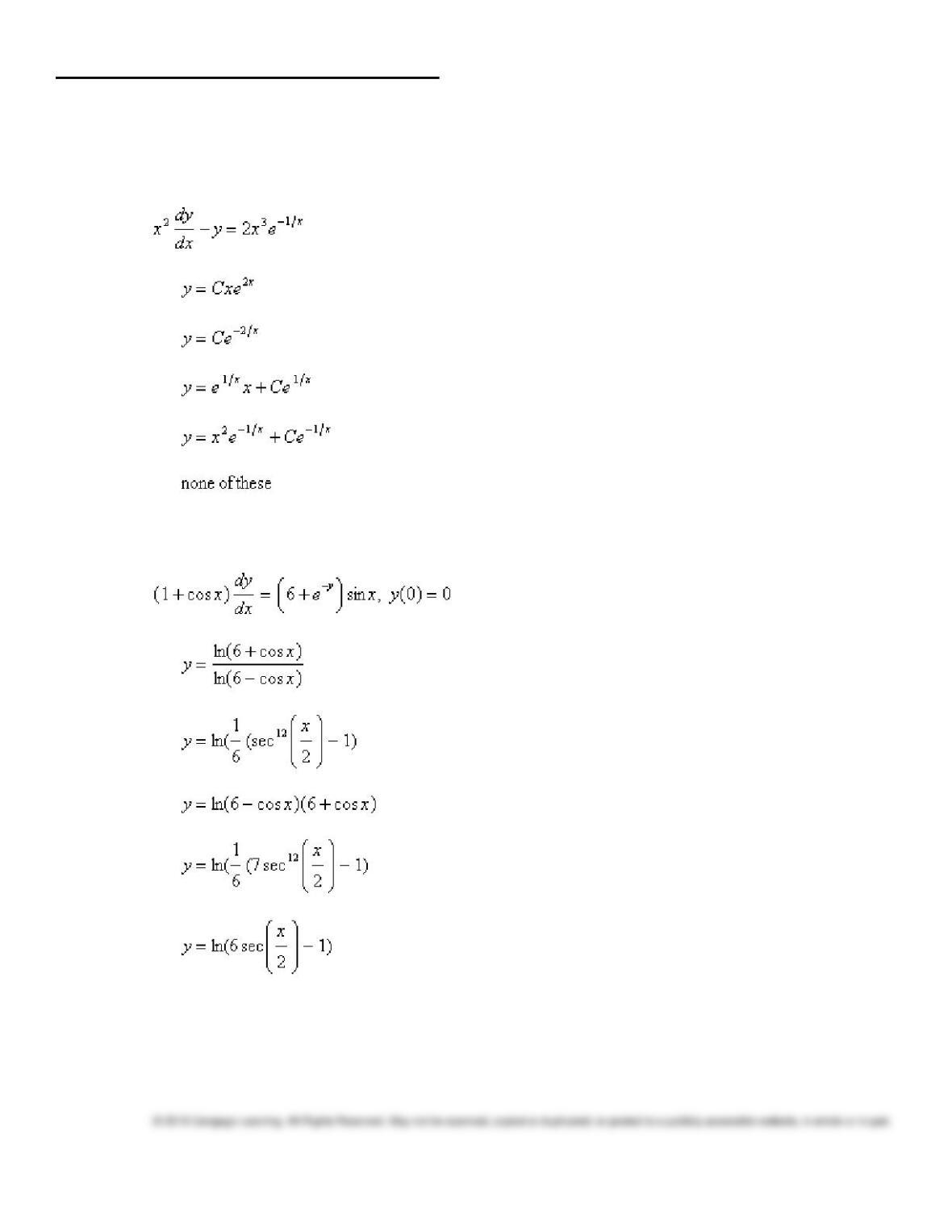
a. the equation is not linear
b. the equation is linear
Stewart – Calculus ET 8e Chapter 9 Form D
____ 19. Solve the differential equation.
a.
b.
c.
d.
e.
____ 20. Solve the initial-value problem.
a.
b.
c.
d.
e.
Stewart – Calculus ET 8e Chapter 9 Form D
Answer Key
Stewart – Calculus ET 8e Chapter 9 Form E
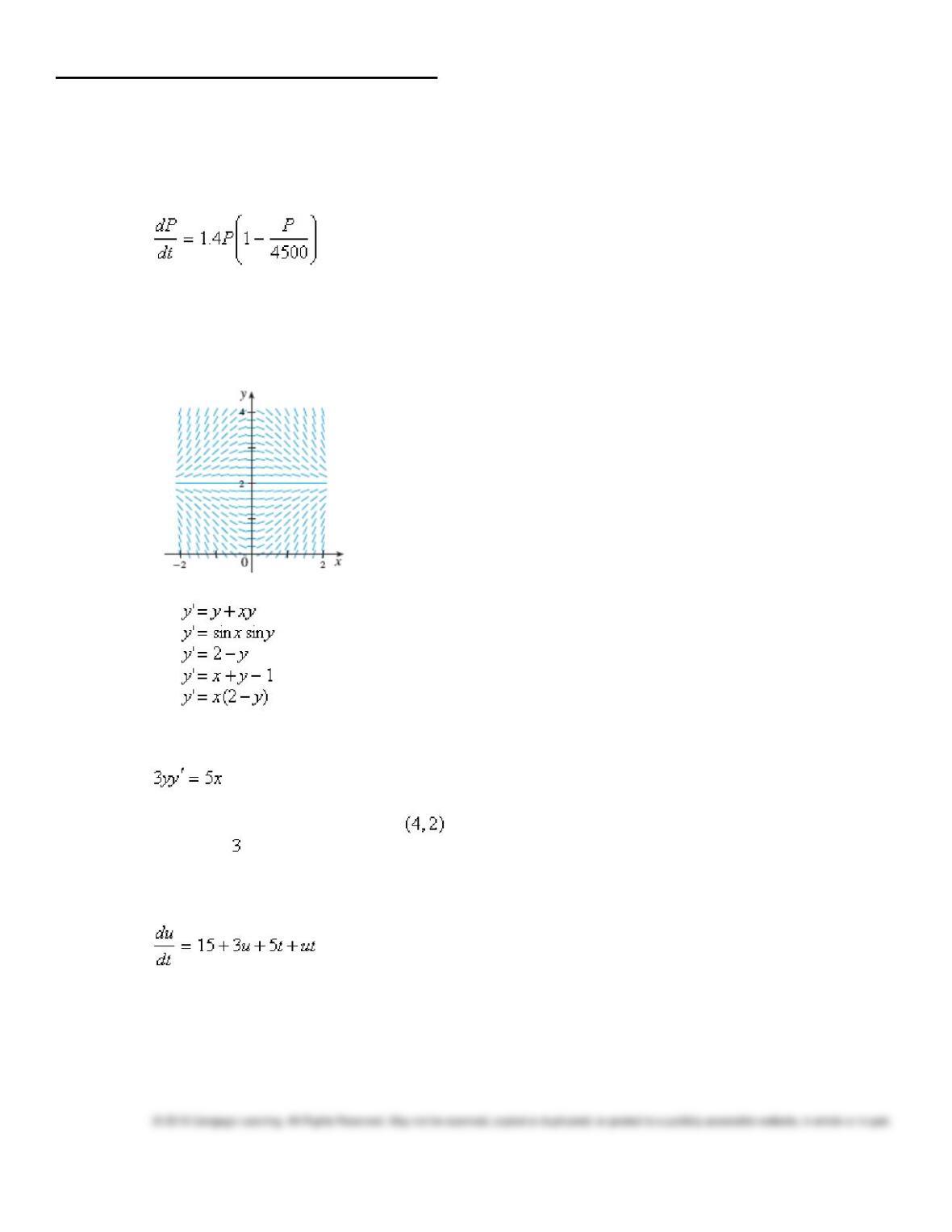
1. A population is modeled by the differential equation.
For what values of P is the population increasing?
____ 2. Choose the differential equation corresponding to this direction field. Select the correct answer.
a.
b.
c.
d.
e.
3. Solve the differential equation.
4. A curve passes through the point and has the property that the slope of the curve at every
point P is times the y-coordinate P. What is the equation of the curve?
5. Solve the differential equation.
Stewart – Calculus ET 8e Chapter 9 Form E
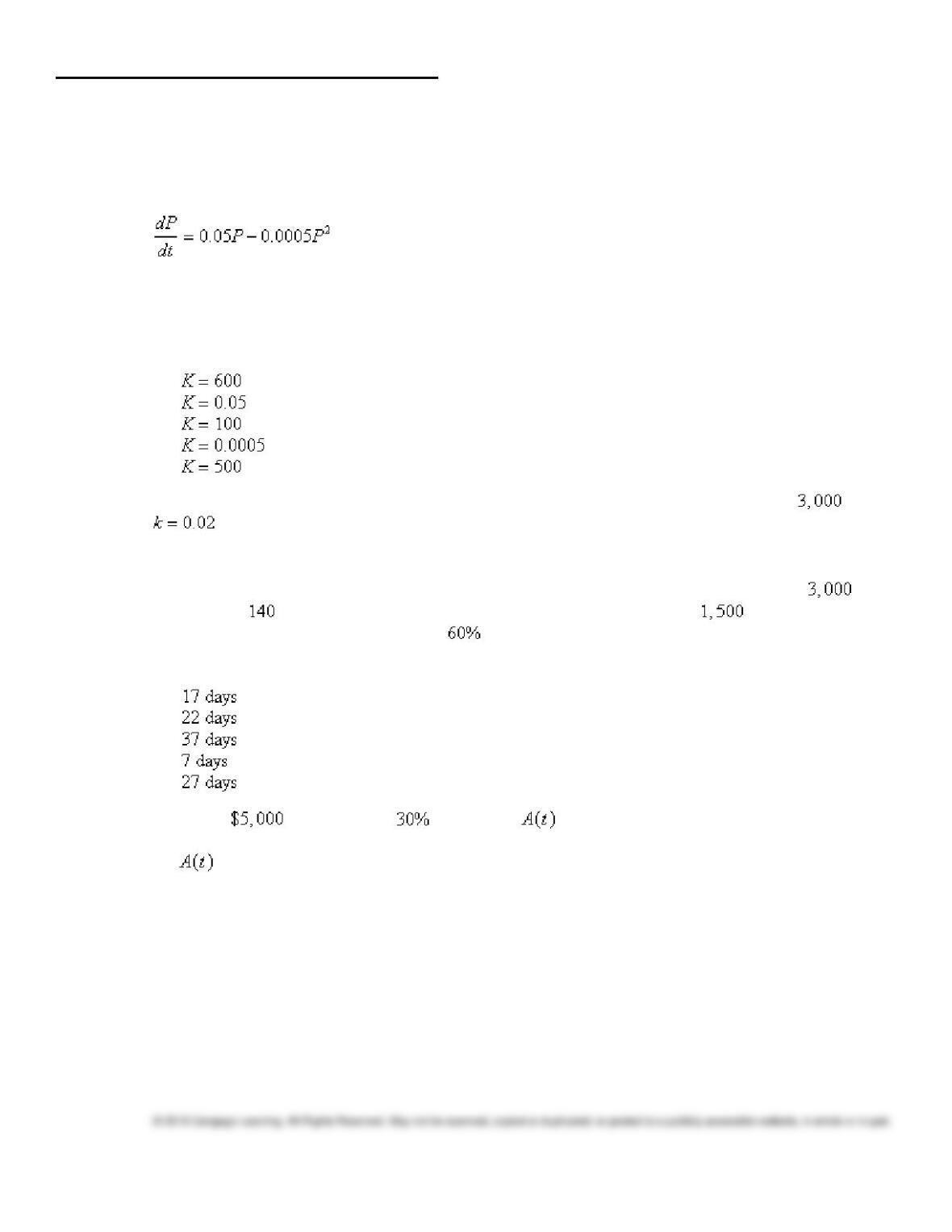
____ 6. Suppose that a population develops according to the logistic equation
,
where t is measured in weeks. What is the carrying capacity?
Select the correct answer.
a.
b.
c.
d.
e.
7. Suppose that a population grows according to a logistic model with carrying capacity and
per year. Choose the logistic differential equation for these data.
____ 8. One model for the spread of an epidemic is that the rate of spread is jointly proportional to the
number of infected people and the number of uninfected people. In an isolated town of
inhabitants, people have a disease at the beginning of the week and have it at the end
of the week. How long does it take for of the population to be infected?
Select the correct answer.
a.
b.
c.
d.
e.
9. A sum of is invested at interest. If is the amount of the investment at time t for
the case of continuous compounding, write a differential equation and an initial condition satisfied
by .
Stewart – Calculus ET 8e Chapter 9 Form E
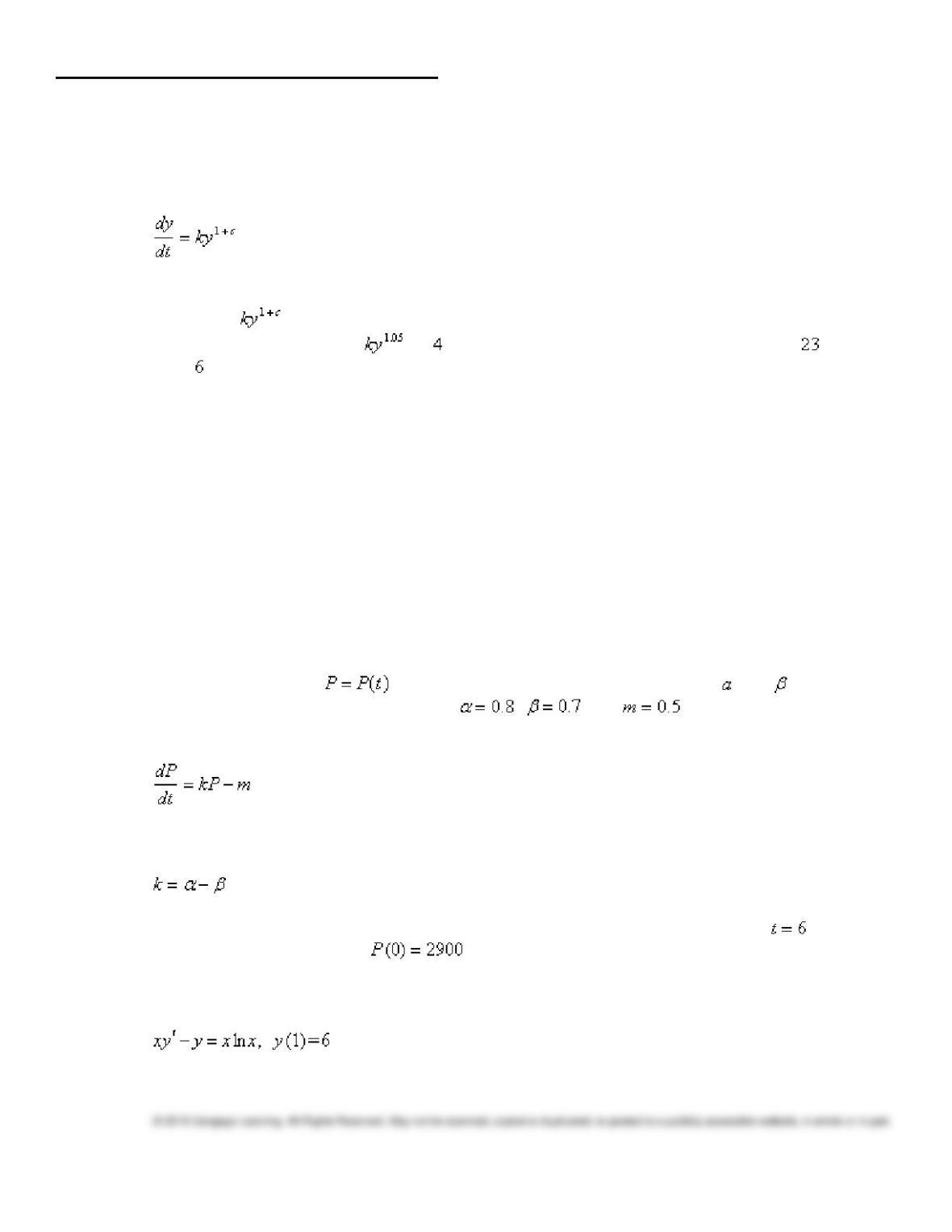
10. Let c be a positive number. A differential equation of the form
where k is a positive constant is called a doomsday equation because the exponent in the
expression is larger than the exponent 1 for natural growth. An especially prolific breed of
rabbits has the growth term . If such rabbits breed initially and the warren has rabbits
after months, then when is doomsday?
____ 11. The population of the world was about 5.3 billion in 1990. Birth rates in the 1990s range from 35
to 40 million per year and death rates range from 15 to 20 million per year. Let’s assume that the
carrying capacity for world population is 100 billion. Use the logistic model to predict the world
population in the 2,450 year. Calculate your answer in billions to one decimal place. (Because the
initial population is small compared to the carrying capacity, you can take k to be an estimate of
the initial relative growth rate.) Select the correct answer.
a. 78.3 billion
b. 27.0 billion
c. 17.1 billion
d. 59.2 billion
e. 32.9 billion
12. Consider a population with constant relative birth and death rates and , respectively,
and a constant emigration rate m, where , and . Then the rate of change of
the population at time t is modeled by the differential equation
where
.
Find the solution of this equation with the rate of change of the population at time that
satisfies the initial condition .
13. Solve the initial-value problem.
Stewart – Calculus ET 8e Chapter 9 Form E
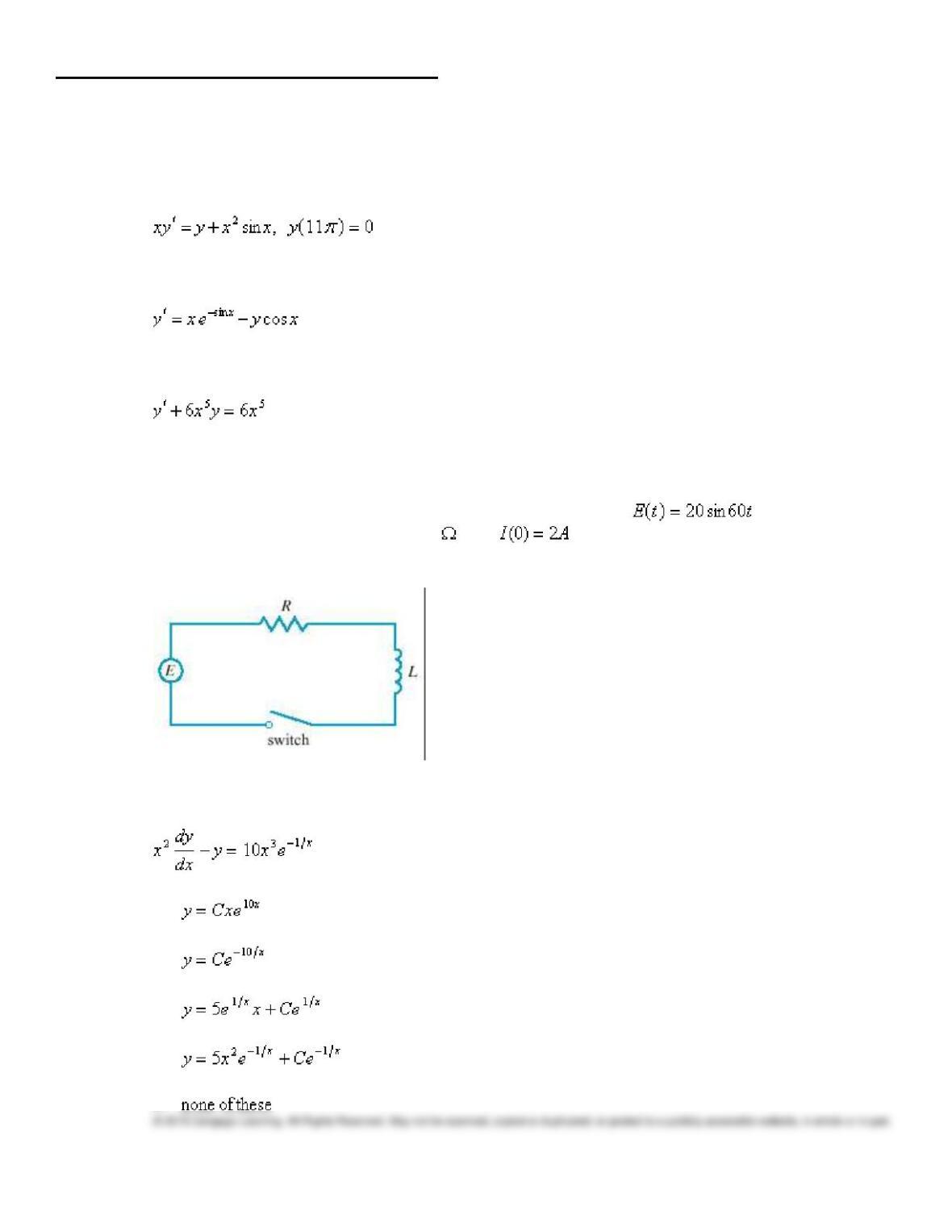
14. Solve the initial-value problem.
15. Solve the differential equation.
____ 16. Determine whether the differential equation is linear. Select the correct answer.
a. the equation is linear
b. the equation is not linear
17. In the circuit shown in Figure, a generator supplies a voltage of volts, the
inductance is 2 H, the resistance is 40 , and . Find the current 0.2 s after the switch is
closed. Round your answer to two decimal places.
____ 18. Solve the differential equation. Select the correct answer.
a.
b.
c.
d.
e.
Stewart – Calculus ET 8e Chapter 9 Form E
19. Let
be the performance level of someone learning a skill as a function of the training time t.
The graph of P is called a learning curve. We propose the differential equation
as a reasonable model for learning, where r is a positive constant. Solve it as a linear differential
equation.
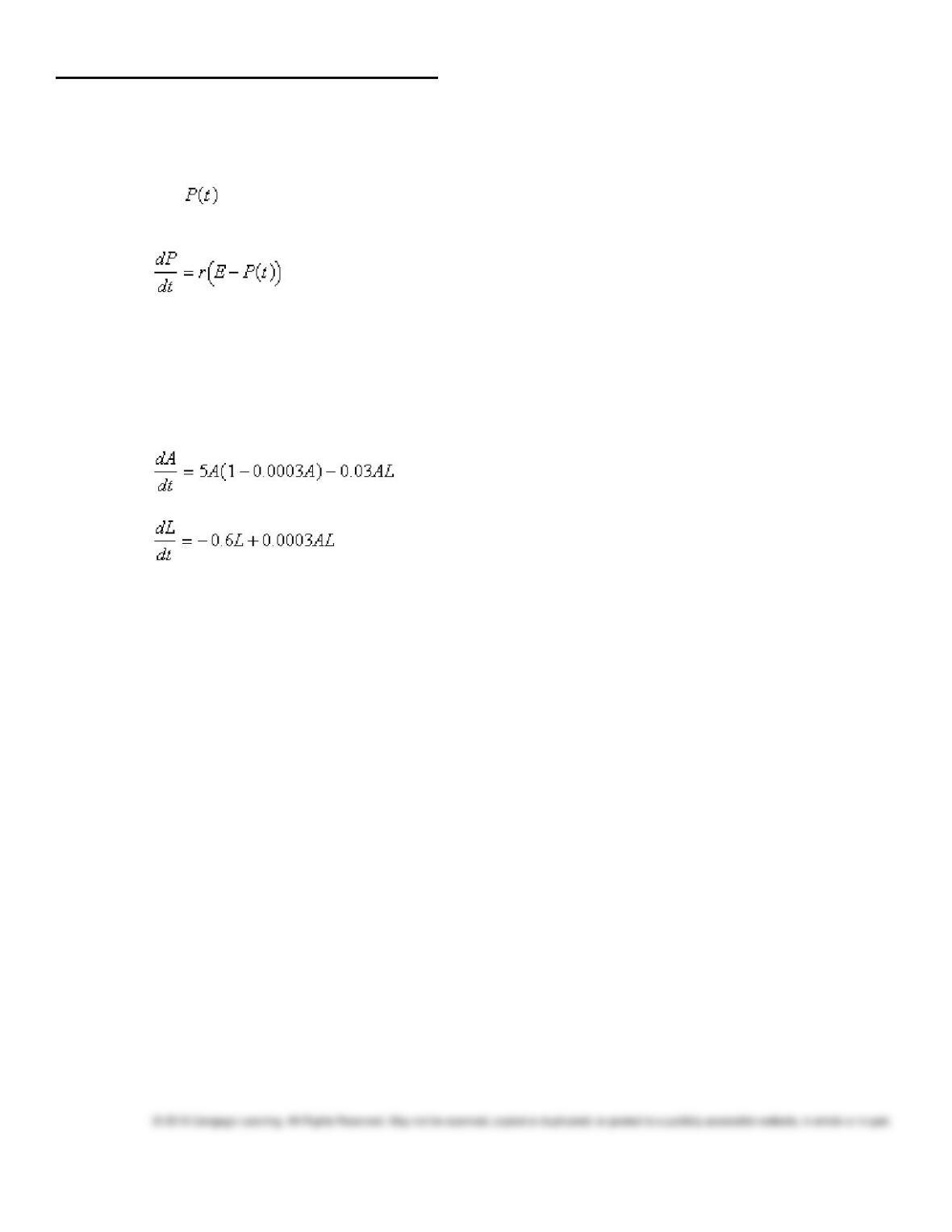
20. We modeled populations of aphids and ladybugs with a Lotka-Volterra system. Suppose we
modify those equations as follows:
,
Find the equilibrium solution.
Stewart – Calculus ET 8e Chapter 9 Form E
Answer Key
Stewart – Calculus ET 8e Chapter 9 Form F
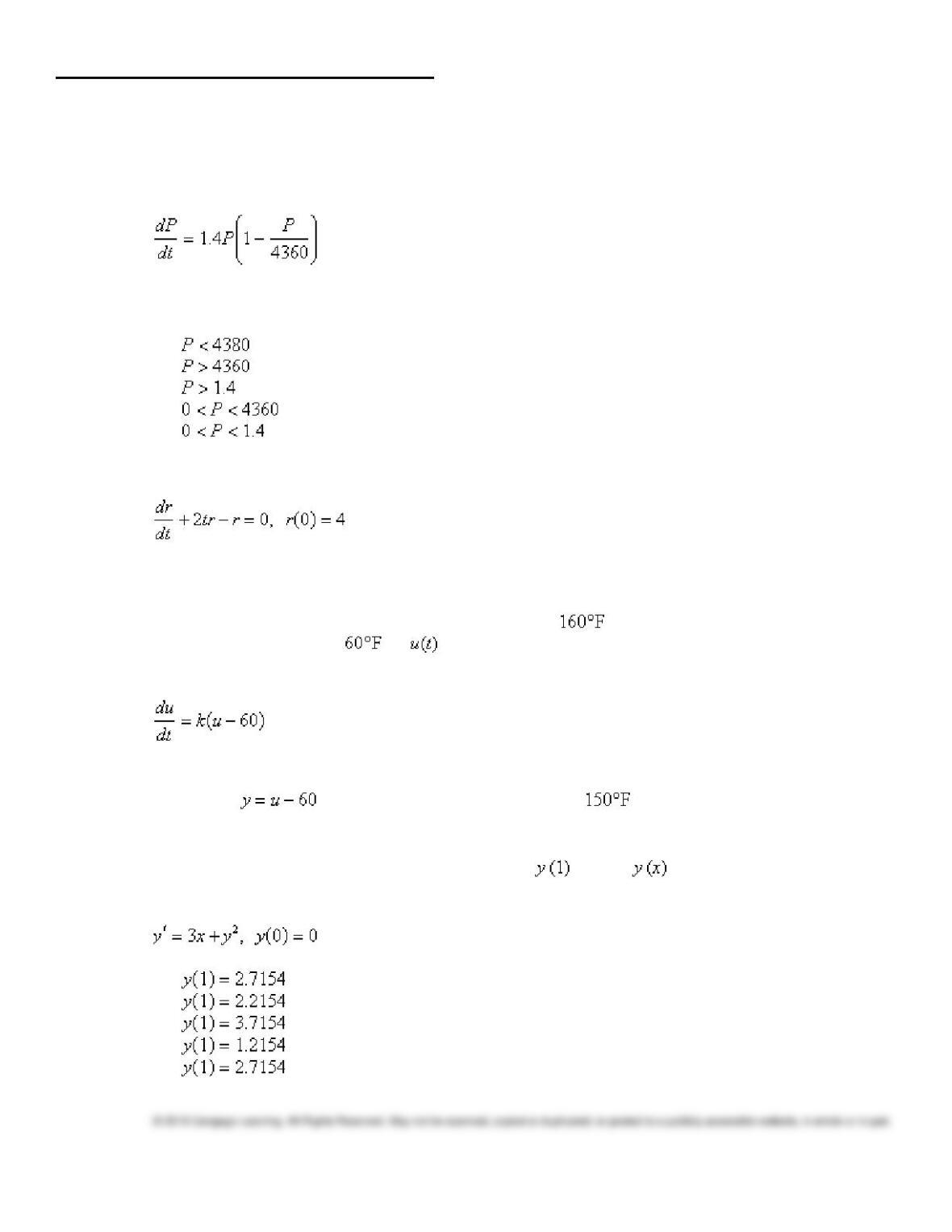
____ 1. A population is modeled by the differential equation.
For what values of P is the population increasing? Select the correct answer.
a.
b.
c.
d.
e.
2. Solve the initial-value problem.
3. Newton’s Law of Cooling states that the rate of cooling of an object is proportional to the
temperature difference between the object and its surroundings. Suppose that a roast turkey is
taken from an oven when its temperature has reached and is placed on a table in a room
where the temperature is . If is the temperature of the turkey after t minutes, then
Newton’s Law of Cooling implies that
.
This could be solved as a separable differential equation. Another method is to make the change
of variable . If the temperature of the turkey is after half an hour, what is the
temperature after 35 min?
____ 4. Use Euler’s method with step size 0.25 to estimate , where is the solution of the
initial-value problem. Round your answer to four decimal places. Select the correct answer.
a.
b.
c.
d.
e.
Stewart – Calculus ET 8e Chapter 9 Form F
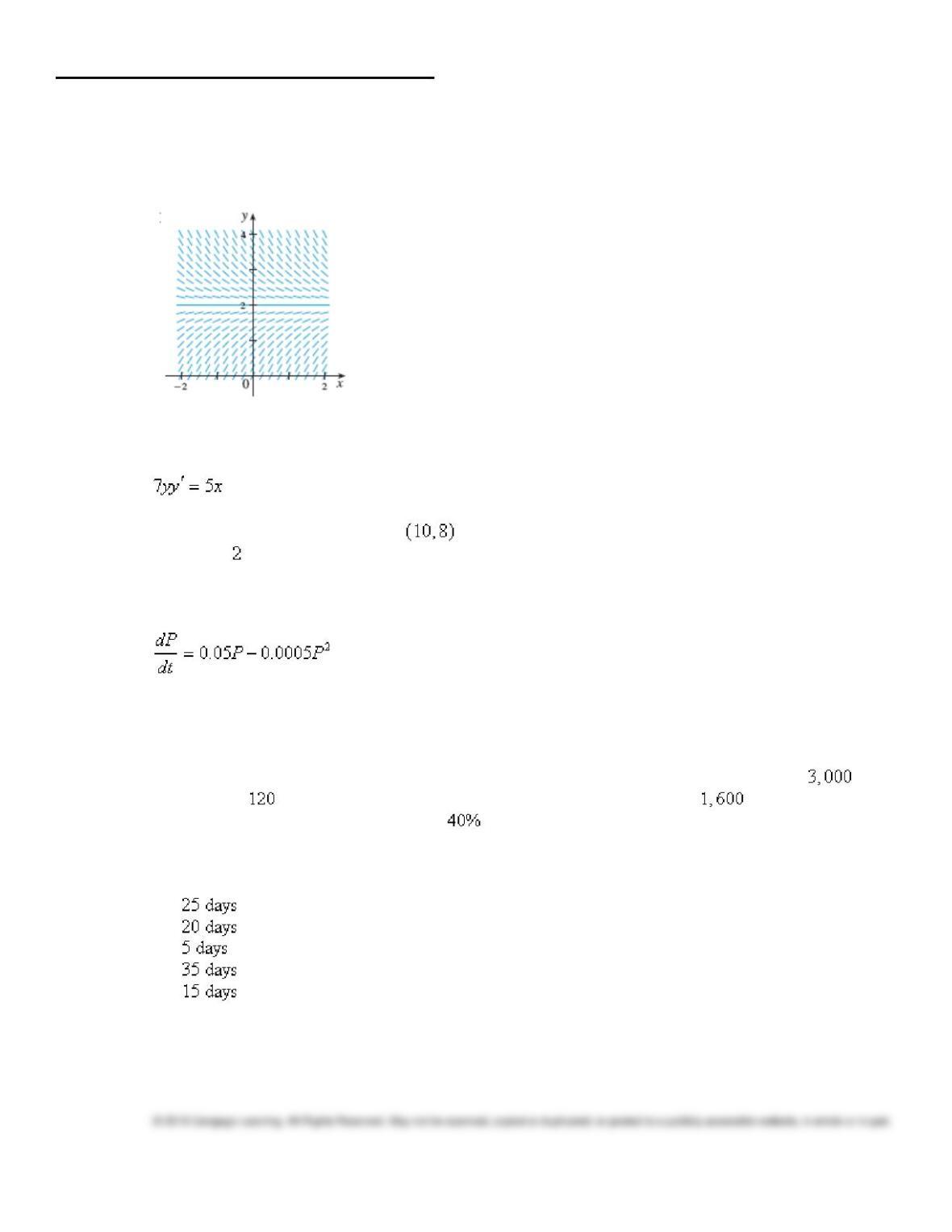
5. Choose the differential equation corresponding to this direction field.
6. Solve the differential equation.
7. A curve passes through the point and has the property that the slope of the curve at every
point P is times the y-coordinate P. What is the equation of the curve?
8. Suppose that a population develops according to the logistic equation
,
where t is measured in weeks. What is the carrying capacity?
____ 9. One model for the spread of an epidemic is that the rate of spread is jointly proportional to the
number of infected people and the number of uninfected people. In an isolated town of
inhabitants, people have a disease at the beginning of the week and have it at the end
of the week. How long does it take for of the population to be infected?
Select the correct answer.
a.
b.
c.
d.
e.