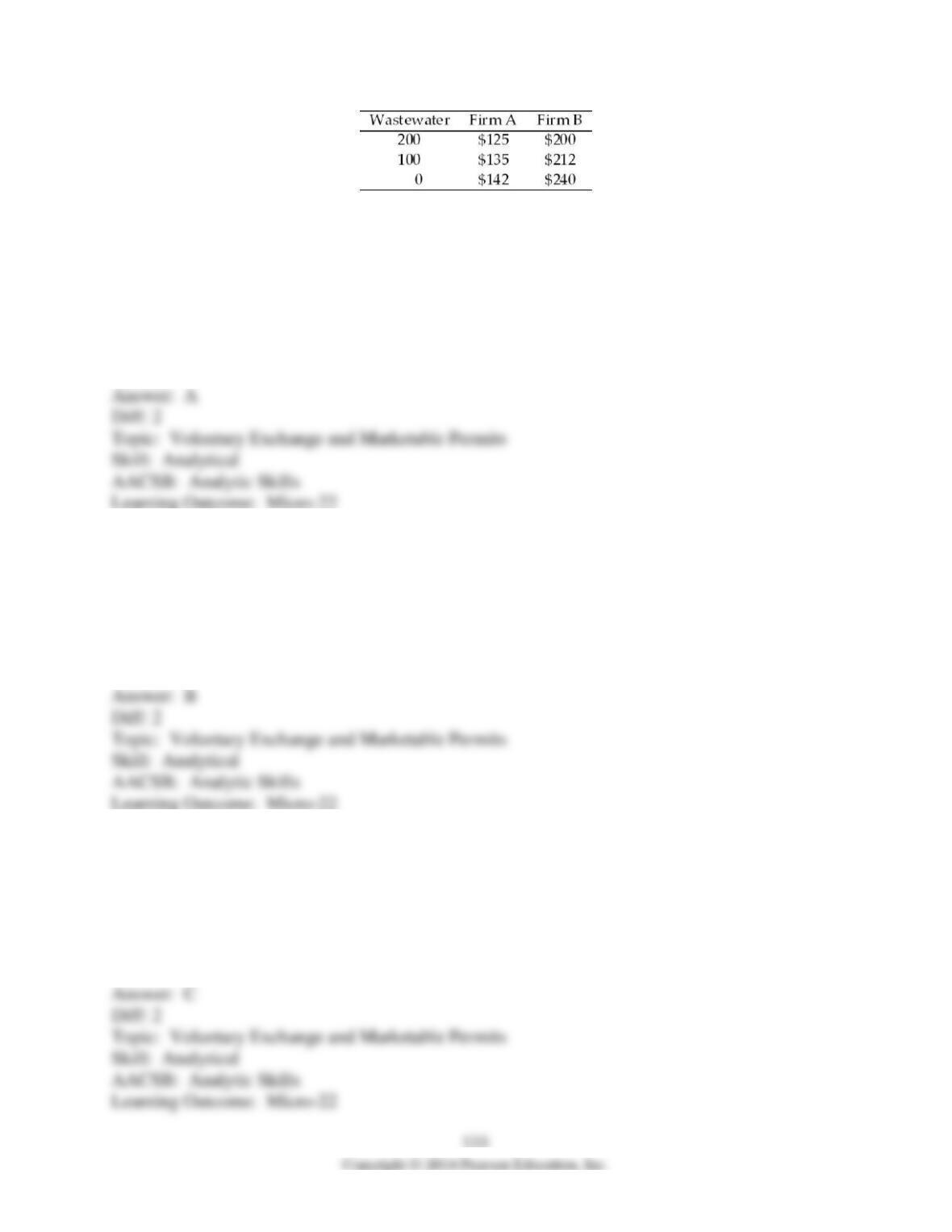
Table 9.6
16) Given the data in Table 9.6, if Firm A were to reduce pollution from 100 gallons of
wastewater per day to 0 gallons per day, production costs
A) would increase by $7.
B) would decrease by $7.
C) would not change.
D) cannot be calculated from the information above.
17) Consider the data in Table 9.6. If each firm is currently generating 100 gallons of wastewater
per day, Firm B would be willing to pay up to ________ to Firm A to be able to generate 200
gallons of wastewater per day.
A) $10
B) $12
C) $28
D) $200
18) Consider the data in Table 9.6. If each firm is currently generating 100 gallons of wastewater
per day, Firm A would need to be paid at least ________ from Firm B to reduce wastewater
production to 0 gallons per day.
A) $12
B) $10
C) $7
D) $5
19) Consider the data in Table 9.6. Both firms can benefit if Firm A sells its pollution permit
allowing it to generate 100 gallons of wastewater to Firm B for
A) a price between $7 and $12.
B) a price between $0 and $7.
C) a price between $12 and $18.
D) Both firms cannot benefit if A sells permits to B.
Sulfur Dioxide
Discharged (Tons)
Firm A
Firm B
10
$8,000
$9,000
9
10,000
12,000
8
15,000
18,000
7
20,000
27,000
6
28,000
37,000
Table 9.7
20) Table 9.7 shows the production cost for two utilities at different levels of sulfur dioxide
emissions. Assume that the government issued 8 marketable pollution permits to each firm. If
Firm B would like to purchase one permit to be able to discharge nine tons of sulfur dioxide,
what is Firm B’s willingness to pay?
A) $2,000
B) $5,000
C) $6,000
D) $9,000
21) Table 9.7 shows the production cost for two utilities at different levels of sulfur dioxide
emissions. Assume that the government issued 8 marketable pollution permits to each firm. If
Firm A contemplates selling one permit to Firm B, what is Firm A’s willingness to accept?
A) $3,000
B) $5,000
C) $6,000
D) $7,000
22) Table 9.7 shows the production cost for two utilities at different levels of sulfur dioxide
emissions. Assume that the government issued 8 marketable pollution permits to each firm. If the
two firms agree to swap one permit and split the difference between the willingness to pay and
willingness to accept, what is the price of a permit?
A) $4,500
B) $5,500
C) $7,250
D) $9,750
23) Table 9.7 shows the production cost for two utilities at different levels of sulfur dioxide
emissions. Assume that the government issued 8 marketable pollution permits to each firm and
that Firm A has sold one permit to Firm B. If Firm B wants to purchase a second permit to be
able to discharge 10 tons of sulfur dioxide, what is Firm B’s willingness to pay?
A) $2,000
B) $3,000
C) $5,000
D) $9,000
24) Table 9.7 shows the production cost for two utilities at different levels of sulfur dioxide
emissions. Assume that the government issued 8 marketable pollution permits to each firm.
Suppose that Firm A has already sold a permit to Firm B. If Firm A contemplates selling a
second permit to Firm B, what is Firm A’s willingness to accept?
A) $5,000
B) $6,000
C) $7,000
D) $8,000
25) Table 9.7 shows the production cost for two utilities at different levels of sulfur dioxide
emissions. Assume that the government issued 8 marketable pollution permits to each firm. If the
two firms were to voluntarily trade pollution permits, how many permits would be swapped?
A) 1
B) 2
C) 3
D) 4
Sulfur Dioxide
Discharged (Tons)
Firm A
Firm B
10
$10,000
$12,000
9
11,000
17,000
8
13,000
22,000
7
16,000
26,000
6
20,000
33,000
Table 9.8
26) Table 9.8 shows the production cost for two utilities at different levels of sulfur dioxide
emissions. Assume that the government issued 8 marketable pollution permits to each firm. If
Firm B would like to purchase one permit to be able to discharge 9 tons of sulfur dioxide, what is
Firm B’s willingness to pay?
A) $2,000
B) $3,000
C) $4,000
D) $5,000
27) Table 9.8 shows the production cost for two utilities at different levels of sulfur dioxide
emissions. Assume that the government issued 8 marketable pollution permits to each firm. If
Firm A contemplates selling one permit to Firm B, what is Firm A’s willingness to accept?
A) $2,000
B) $3,000
C) $4,000
D) $5,000
28) Table 9.8 shows the production cost for two utilities at different levels of sulfur dioxide
emissions. Assume that the government issued 8 marketable pollution permits to each firm. If
Firm B wants to purchase a second permit to be able to discharge 10 tons of sulfur dioxide, what
is Firm B’s willingness to pay?
A) $2,000
B) $3,000
C) $4,000
D) $5,000
29) Table 9.8 shows the production cost for two utilities at different levels of sulfur dioxide
emissions. Assume that the government issued 8 marketable pollution permits to each firm. If
Firm A contemplates selling a second permit to Firm B, what is Firm A’s willingness to accept?
A) $2,000
B) $3,000
C) $4,000
D) $5,000
30) Table 9.8 shows the production cost for two utilities at different levels of sulfur dioxide
emissions. Assume that the government issued 8 marketable pollution permits to each firm. If the
two firms were to voluntarily trade pollution permits, how many permits would be swapped?
A) 0
B) 1
C) 2
D) 3
31) Suppose two firms operate under a system of marketable pollution permits. If it costs Firm A
$25 to reduce pollution by 1,000 units per day, and Firm B can reduce costs by $35 by increasing
pollution by 1,000 units per day
A) the firms cannot gain by trading the right to pollute.
B) both firms can benefit if Firm A trades the right to pollute 1,000 units to Firm B for $30.
C) both firms can benefit if Firm A trades the right to pollute 1,000 units to Firm B for $40.
D) both firms can benefit if Firm B trades the right to pollute 1,000 units to Firm A for $30.
32) Suppose Smith’s oil refinery and Jones’ paper mill both pollute a river and both firms operate
under a system of marketable pollution permits. If it costs Smith $45 to reduce pollution by 500
gallons per day, and Jones can reduce costs by $65 by increasing pollution by 500 units per day
A) the firms cannot gain by trading the right to pollute.
B) both firms can benefit if Smith trades the right to increase pollution by 500 gallons to Jones
for $30.
C) both firms can benefit if Smith trades the right to increase pollution by 500 gallons to Jones
for $50.
D) both firms can benefit if Jones trades the right to increase pollution by 500 gallons to Smith
for $30.
33) Suppose two power plants pollute a river and both firms operate under a system of
marketable pollution permits. If it costs Firm A $90 to reduce pollution by 800 units per day, and
Firm B can reduce costs by $115 by increasing pollution by 800 units per day
A) the firms cannot gain by trading the right to pollute.
B) both firms can benefit if Firm A trades the right to increase pollution by 800 units to Firm B
for $70.
C) both firms can benefit if Firm B trades the right to increase pollution by 800 units to Firm A
for $120.
D) both firms can benefit if Firm A trades the right to increase pollution by 800 units to Firm B
for $100.
34) If two firms pollute, and the increase in costs to Firm A from decreasing pollution is less
than the decrease in costs to Firm B from increasing pollution
A) the firms will not trade the right to pollute.
B) the firms can benefit by trading the right to pollute.
C) while both firms can benefit from trading, there is no way for them to determine an agreeable
price.
D) both firms will stop polluting.
35) If two firms pollute, and the increase in costs to Firm A from decreasing pollution is equal to
the decrease in costs to Firm B from increasing pollution
A) the firms cannot benefit from trading the right to pollute.
B) the firms can benefit by trading the right to pollute.
C) while both firms can benefit from trading, there is no way for them to determine an agreeable
price.
D) both firms will stop polluting.
36) We expect firms with ________ to sell marketable pollution permits to firms with ________.
A) low abatement costs; high abatement costs
B) high abatement costs; low abatement costs
C) high price goods; low price goods
D) high production capacity; low production capacity
37) While marketable pollution permits may ________ the total amount of pollution, they may
________ pollution in local areas.
A) increase; decrease
B) decrease; increase
C) decrease; not change
D) not change; increase
38) In the market for pollution permits, the total supply of permits is
A) inelastic.
B) elastic.
C) determined by the Chicago Board of Trade.
D) always equal to the demand for permits.
39) In the market for pollution permits, the demand for permits comes from
A) firms that would prefer to use permits rather than incur abatement costs.
B) the Chicago Board of Trade.
C) firms with low abatement costs.
D) the Environmental Protection Agency.
40) Suppose that next year the government fixes the number of pollution permits at a quantity
less than the number sold this year. If nothing else changes, next year the price of a pollution
permit will be
A) greater than the price of a permit this year.
B) less than the price of a permit this year.
C) equal to the price of a permit this year.
D) equal to the price set by the government.
41) If technological advancements reduce the cost of pollution abatement, all else equal
A) the price of a pollution permit will fall.
B) the price of a pollution permit will increase.
C) the government will be forced to issue more permits.
D) the government will be forced to issue fewer permits.
42) Technological advances in pollution reduction
A) reduce the demand for pollution permits.
B) increase the demand for pollution permits.
C) reduce the supply of pollution permits.
D) increase the supply of pollution permits.
Recall the Application about how the price of pollution permits is determined to answer the
following question(s).
43) Recall the Application. The ________ is a market for carbon dioxide allowances issued to
EU countries under the EU cap-and-trade system.
A) Eurozone
B) Continental Pollution Abatement League
C) European Climate Exchange
D) Paris Emissions Agency
44) Recall the Application. Which of the following factors is used in determining the demand for
CO2 allowances in the EU?
A) the level of economic activity
B) fuel prices
C) weather
D) all of the above
45) Under a system of marketable pollution permits, a firm with relatively low abatement costs
will buy permits from a firm with relatively high abatement costs.
46) A switch to marketable pollution permits will decrease abatement costs because high-cost
firms do most of the abating.

47) Marketable pollution permits increase the amount of pollution generated because firms that
don’t want to reduce pollution can buy the right to pollute.
48) The price at which marketable pollution permits are sold is set by the government.
49) A nationwide system of marketable pollution permits will reduce pollution overall, but might
increase pollution in some high abatement cost areas.
50) Why should a system of marketable pollution permits lead to less costly pollution abatement
than a command-and-control system?
51) Why might a system of marketable pollution permits lead to a higher concentration of
polluted areas than would a command-and-control system?