12) Under a Coase bargaining solution, deal making between the two parties continues until the
marginal ________ to the harmed party equals the marginal ________ to the other party.
A) benefit; benefit
B) benefit; cost
C) cost; benefit
D) cost; cost
Recall the Application about determining the optimal level of methane abatement to
answer the following question(s).
13) Recall the Application. Applying the marginal principle to methane reduction suggests that
efforts at reduction should
A) target the sources of methane that are cheapest to abate, or recover, first.
B) target the most costly to recover sources of methane first.
C) continue until methane is reduced to zero metric tons because the harm from methane is so
high.
D) not be undertaken because livestock is one of the major sources of methane, and livestock is
not an industrial source of pollution.
14) Recall the Application. The EPA has estimated the cost of methane recovery at different
recovery levels. Given those costs, the optimal level of methane recovery
A) depends on the estimate of the marginal benefit of methane recovery.
B) is zero because the costs exceed the benefits.
C) will increase if scientists determine that methane is not as harmful as it is currently thought to
be.
D) will include only recovery from landfills and coal mines, but not from natural gas
distribution.
15) It is efficient to reduce pollution to zero.
16) It is efficient not to alter the amount of pollution produced by the market.
17) It is efficient to reduce pollution up until the marginal benefit from reducing the pollution
equals the marginal cost of abatement.
18) Pollution imposes costs on people and firms other than those involved in producing or
consuming the product that produces pollution.
19) If the marginal costs of water pollution abatement is increased, then the optimal amount of
water pollution increases.
20) Coase bargaining works best in a situation with a large number of affected parties and the
transactions costs of bargaining are relatively low.
21) What is the economic rule for the optimal amount of pollution?
22) Why does it usually NOT make sense to reduce pollution to zero?
9.6 Taxing Pollution
1) A pollution tax
A) is a method used to internalize external costs.
B) will not affect the price of the good being produced.
C) does not affect the quantity of a good demanded.
D) is a method used to externalize internal costs.
2) Producers will take external costs into account when
A) they actually have to pay those costs.
B) environmental groups apply sufficient pressure and generate negative press coverage.
C) those costs are less than the benefits.
D) those costs are less than the private costs.
3) The social cost of production is
A) the private cost of production plus the external cost generated by production.
B) the external cost generated by production.
C) the private cost of production that is greater than the benefit of production.
D) the external cost of production that is greater than the benefit of production.
4) A pollution tax
A) decreases the price of the good taxed.
B) increases the price of the good taxed.
C) does not affect the quantity demanded of the good taxed.
D) does not affect the price of the good taxed.
5) If a pollution tax imposed on a firm is smaller than external cost,
A) the externality is completely internalized.
B) the social production cost increases by the amount of the pollution tax.
C) the pollution tax transfers the full cost borne by people outside the firm back to the firm itself.
D) the firm is producing too much from a society’s point of view.
6) If a pollution tax imposed on a firm is greater than its external cost,
A) the externality will be fully internalized.
B) the social production cost will increase by the amount of the pollution tax.
C) the pollution tax will be efficient.
D) the firm will be producing too little from a society’s point of view.
7) In order to achieve an efficient result a pollution tax must
A) be equal to the external cost generated.
B) not be passed through to the consumers of the produced good.
C) be equal to the social cost of production.
D) be shared equally by the producer and the consumer of the produced good.
8) Because pollution taxes raise the costs of production for firms, firms
A) will lower prices to consumers.
B) must receive a higher price at every level of output.
C) will increase the quantity produced at every price.
D) will quit producing goods that generate pollution.
9) A pollution tax will
A) always be paid entirely by producers.
B) not change the price buyers pay for a good.
C) be shared between buyers and sellers.
D) always be paid entirely by buyers in the form of a price increase equal to the amount of the
tax.
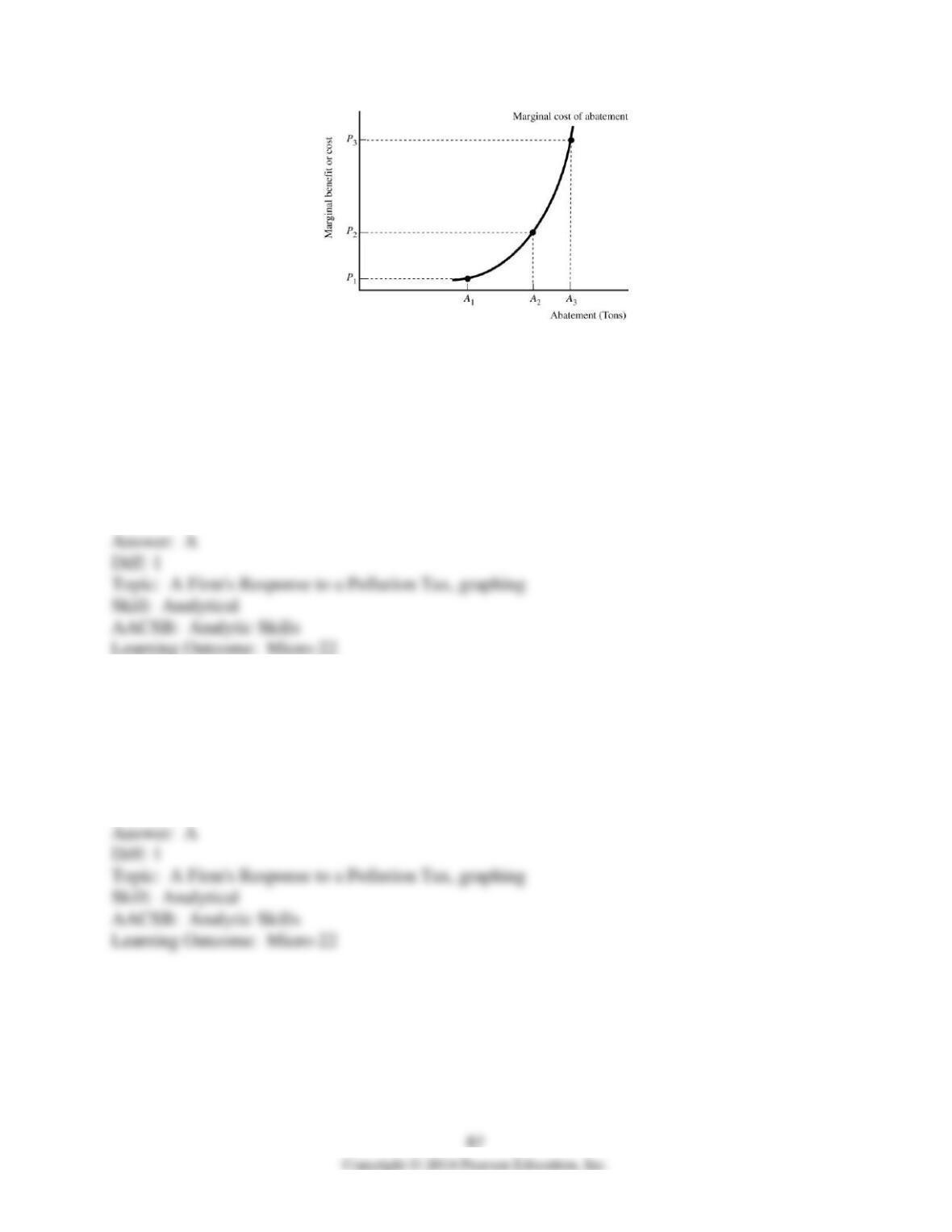
Figure 9.6
10) A firm that generates pollution is illustrated in Figure 9.6. If the government would like to
induce this firm to abate, or reduce, its pollution by A1 tons, it will impose a pollution tax equal
to
A) P3.
B) P1 minus P3.
C) P2.
D) P2 minus P3.
11) A firm that generates pollution is illustrated in Figure 9.6. If the government imposes a
pollution tax equal to P3 the firm’s abatement choice will be
A) A1.
B) A2.
C) A3.
D) less than A1.
12) A firm that generates pollution is illustrated in Figure 9.6. If the government imposes a
pollution tax equal to P2 and the firm’s abatement level is A3 the firm is
A) abating more than is optimal for the firm.
B) abating less than is optimal for the firm.
C) choosing an abatement level that is optimal.
D) violating the environmental protection laws.
13) A firm that generates pollution is illustrated in Figure 9.6. If the government imposes a
pollution tax equal to P1 the marginal benefit to the firm of abating A2 is
A) P1.
B) P2.
C) P1 – P2.
D) P2 – P3.
14) A firm that generates pollution is illustrated in Figure 9.6. If the government imposes a
pollution tax equal to P2 and the firm chooses abatement level A3
A) the marginal cost of abating is greater than the marginal benefit of abating.
B) the marginal benefit of abating is greater than the marginal cost of abating.
C) the firm is choosing optimally.
D) the firm is in violation of environmental protection laws.
15) A firm that generates pollution is illustrated in Figure 9.6. The government has chosen to
impose a pollution tax equal to P2. From the firm’s point of view, the marginal benefit of
abatement is
A) avoiding the pollution tax imposed by the government.
B) the positive publicity the firm will receive by having a “green” production plant.
C) the reciprocal of the marginal cost of abatement.
D) zero because abatement benefits the general public, not the firm.
16) A firm that generates pollution is illustrated in Figure 9.6. Suppose the government is
considering changing the pollution tax from P3 to P2. That new policy would
A) increase the marginal benefit to firms of abating, and thus encourage greater abatement.
B) increase the marginal benefit to firms of abating, causing them to generate more pollution.
C) reduce the marginal benefit to firms of abating, causing them to generate more pollution.
D) reduce the marginal benefit to firms of abating, and thus encourage greater abatement.
17) Because pollution taxes raise production costs, the ________ curve ________.
A) supply; shifts to the right
B) supply; shifts to the left
C) supply; does not change
D) demand; shifts to the right
18) Suppose Johnson’s Rubber Factory belches black smoke into the air over the city of
Bellowsville. If the city of Bellowsville attempts to internalize the external costs associated with
the production of rubber with a pollution tax, we can expect
A) the price of rubber not to change.
B) the price of rubber to increase.
C) the quantity of rubber demanded to increase.
D) no change in the quantity of rubber demanded.
19) Suppose Johnson’s Rubber Factory belches black smoke into the air over the city of
Bellowsville. If the city of Bellowsville attempts to internalize the external costs associated with
the production of rubber with a pollution tax, then we expect
A) at each price, a smaller quantity of rubber will be supplied by Johnson’s Rubber Factory.
B) at each price, a larger quantity of rubber will be supplied Johnson’s Rubber Factory.
C) Johnson’s Rubber Factory will not change the amount of rubber supplied at each price.
D) Johnson’s production costs not to change.
20) Suppose Johnson’s Rubber Factory belches black smoke into the air over the city of
Bellowsville. If the city of Bellowsville attempts to internalize the external costs associated with
the production of rubber with a pollution tax, then we expect
A) a leftward shift of Johnson’s supply curve.
B) a rightward shift of Johnson’s supply curve.
C) no change in Johnson’s supply curve.
D) a leftward shift in the demand curve for Johnson’s rubber.
21) Pollution taxes reduce pollution by
A) decreasing the amount sold of the good that causes the pollution.
B) causing firms to produce less of the good that generates the pollution.
C) encouraging firms to modify their production process to reduce emissions.
D) all of the above
Figure 9.7
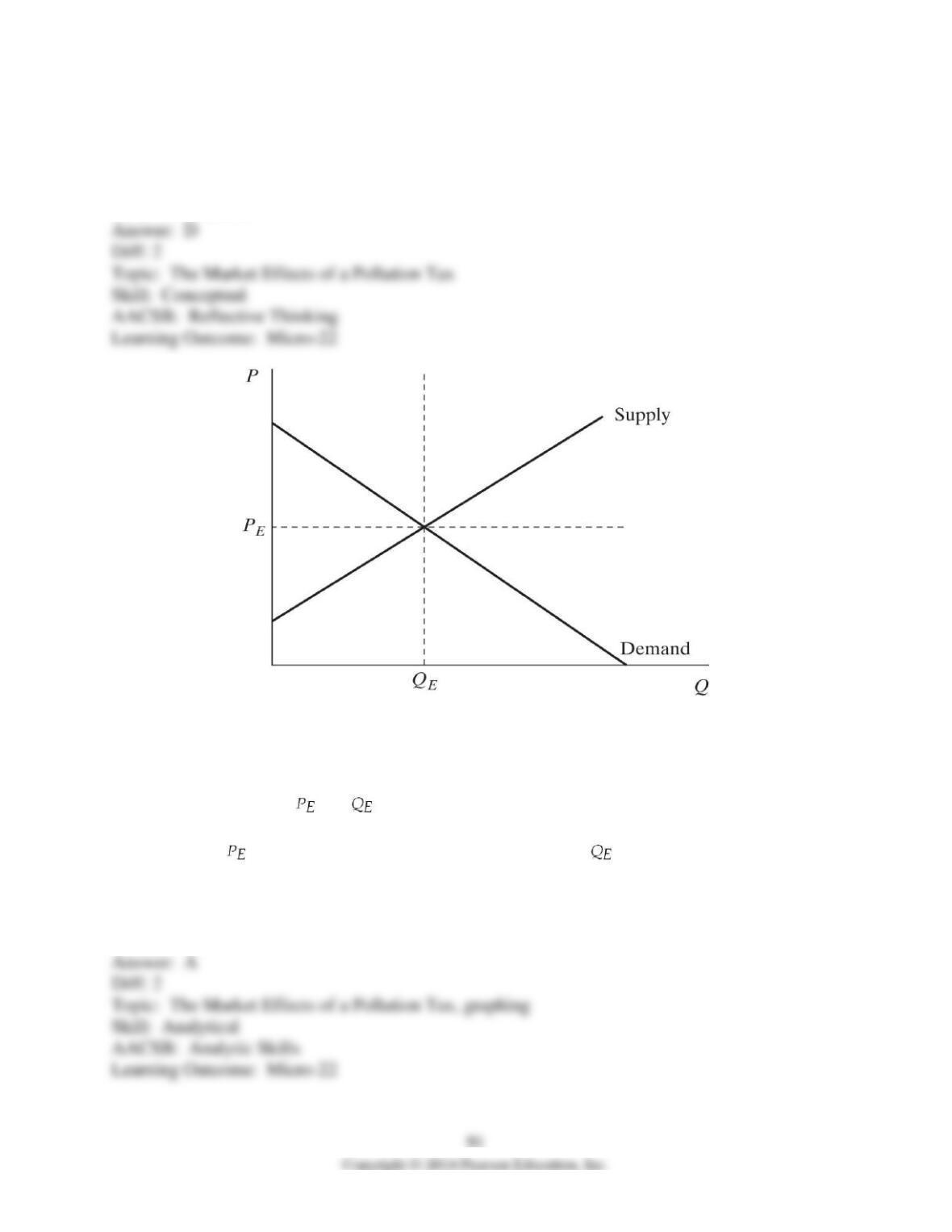
22) Consider Figure 9.7, which depicts the supply and demand for coal. Assume coal production
creates external costs. If and are the equilibrium price and quantity of coal without
government regulation, a pollution tax on the production of coal would ________ the price of
coal relative to and ________ the quantity of coal relative to .
A) increase; decrease
B) increase; not change
C) decrease; not change
D) decrease; decrease
23) Consider Figure 9.7, which depicts the supply and demand for coal. Assume coal production
creates external costs. If the government imposes a pollution tax on coal production the
A) supply curve of coal would shift to the left.
B) supply curve of coal would shift to the right.
C) demand curve for coal would shift to the left.
D) demand and supply curves for coal would shift to the left.
24) If a firm is taxed for each unit of waste it produces, the firm will decrease the amount of
waste produced until
A) there is no waste produced.
B) the marginal cost from decreasing waste is zero.
C) the marginal cost of decreasing waste is equal to the marginal benefit from decreasing waste.
D) the marginal benefit from decreasing waste is equal to zero.
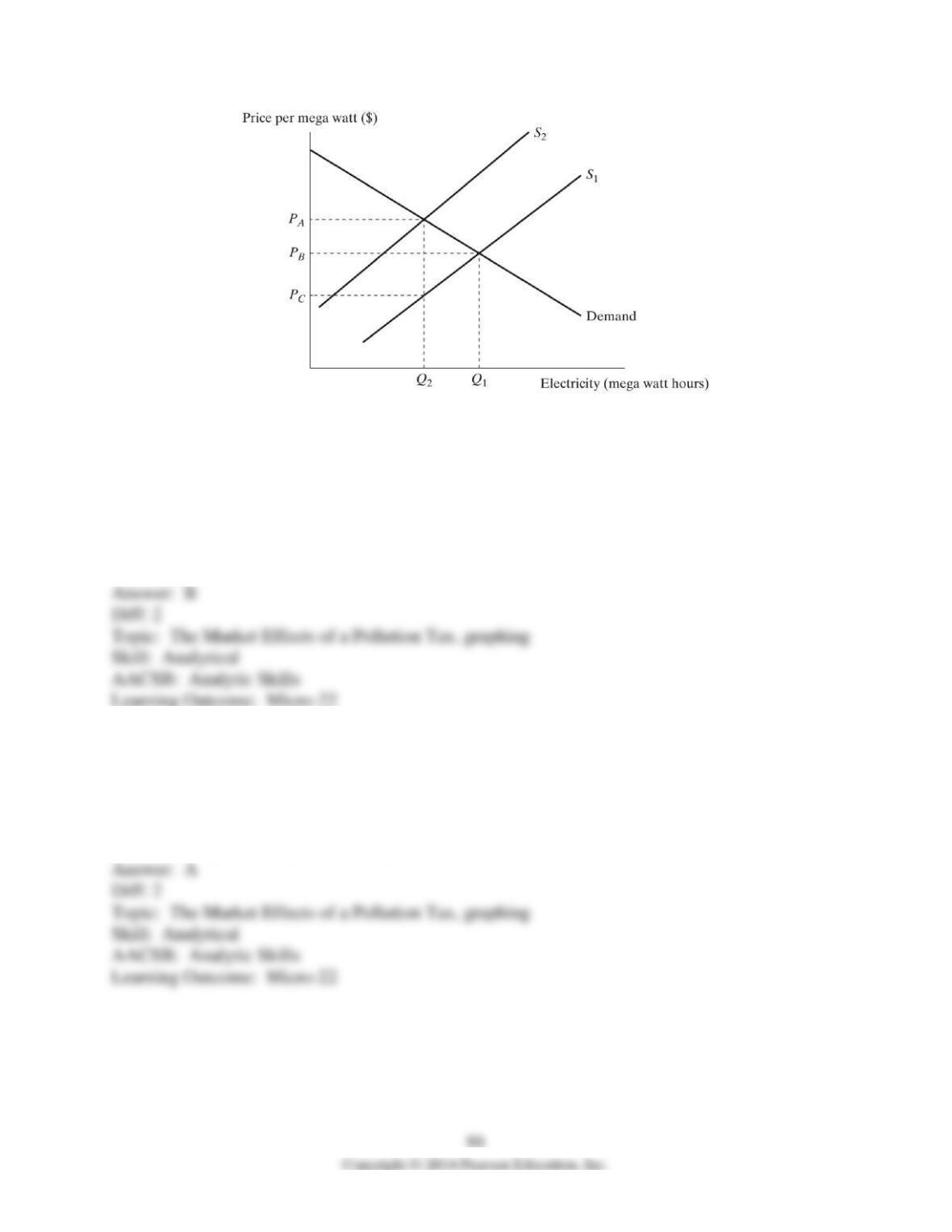
Figure 9.8
25) Figure 9.8 depicts a market for electricity. Assume electricity production incurs external
costs. If the government imposes a pollution tax $T per mega kilowatt,
A) the supply curve will shift to the right.
B) the supply curve will shift to the left.
C) demand curve will shift to the right.
D) demand curve will shift to the left.
26) Figure 9.8 depicts a market for electricity. Assume electricity production incurs external
costs. If the government imposes a pollution tax $T per mega kilowatt,
A) the equilibrium price of electricity increases but the equilibrium output decreases.
B) the equilibrium price of electricity decreases but the equilibrium output increases.
C) both the equilibrium price and output increase.
D) both the equilibrium price and output decrease.
27) Figure 9.8 depicts a market for electricity. Assume electricity production incurs external
costs. If the government imposes the pollution tax in the amount illustrated, the amount of the
pollution tax shifted forward on to consumers is
A) – .
B) – .
C) – .
D) (1/2)∙ – ).
28) Figure 9.8 depicts a market for electricity. Assume electricity production incurs external
costs. If the government imposes a pollution tax in the amount illustrated, the amount of the
pollution tax borne by the electricity producers is
A) – .
B) – .
C) – .
D) (1/2)∙( – ).
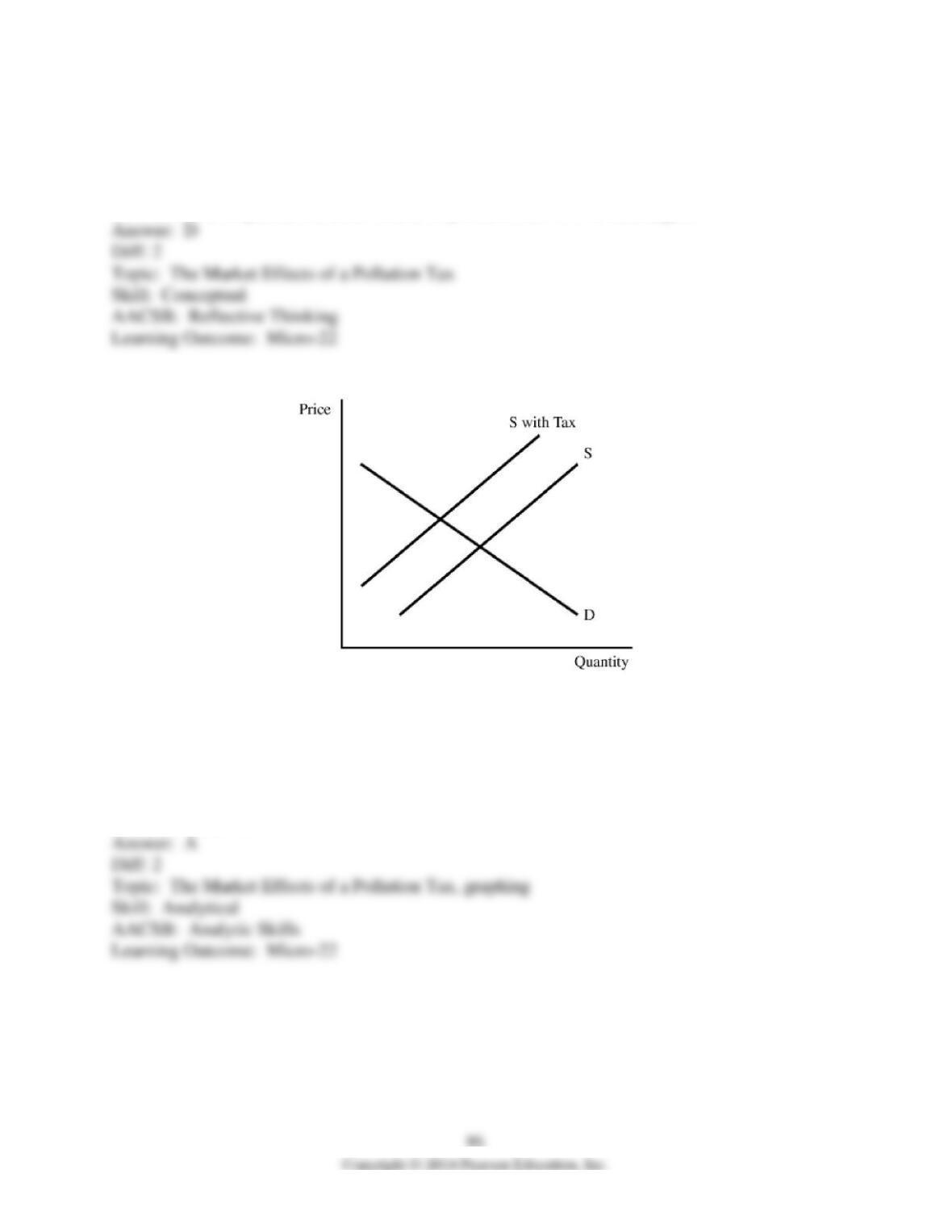
29) Figure 9.8 depicts a market for electricity. Assume electricity production incurs external
costs. If the government imposes a pollution tax in the amount illustrated, the price of a mega-
watt of electricity will increase by
A) PA – PB.
B) PA -PC.
C) PB – PC.
D) 1/2 (PA -PC).
30) Which of the following is NOT an advantage of a pollution tax?
A) It allows firms to equate its marginal abatement cost and the marginal benefit (tax savings).
B) It allows a low-cost firm to abate more.
C) It provides firms an incentive to invest in pollution abatement technologies.
D) It allows us to predict the total volume of pollution that will be discharged.
Figure 9.9
31) The pollution tax in Figure 9.9
A) reduces equilibrium output.
B) reduces equilibrium price.
C) increases supply.
D) all of the above
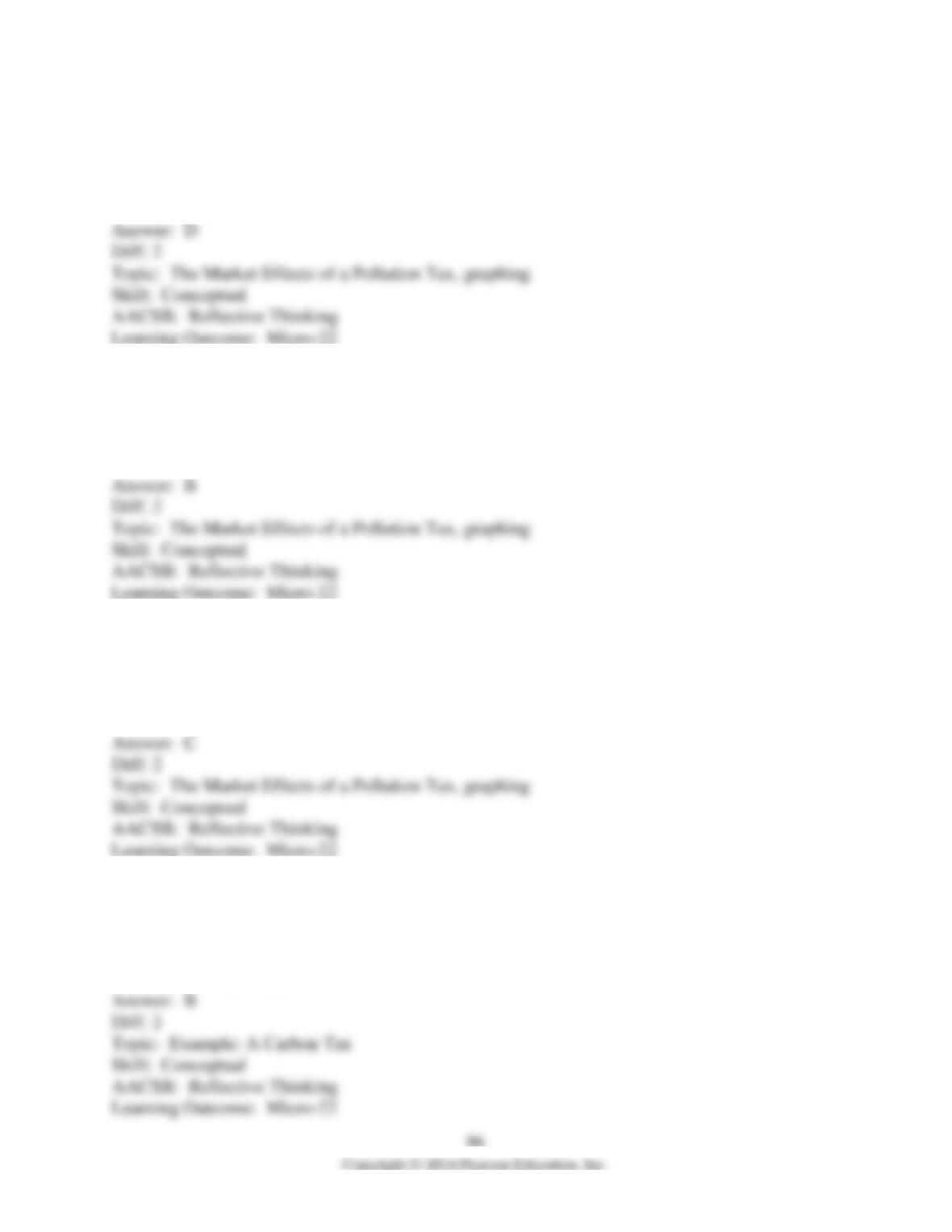
32) The pollution tax in Figure 9.9
A) reduces equilibrium output.
B) reduces pollution associated with the production of the good.
C) raises equilibrium price.
D) all of the above
33) The pollution tax in Figure 9.9
A) increases equilibrium output.
B) internalizes the pollution externality.
C) increases supply.
D) all of the above
34) The pollution tax in Figure 9.9
A) increases equilibrium output.
B) decreases equilibrium price.
C) gives the firm an incentive to switch to a cleaner production process.
D) all of the above
35) If the U.S. were to place a carbon tax on fossil fuels, we can expect
A) the price of fuel oil to decrease.
B) the price of fuel oil to increase.
C) no change in the price of fuel oil.
D) an increase in demand for fuel oil.
36) A carbon tax on fossil fuels is likely to cause the price of goods produced by firms that use
fossil fuels to
A) decrease.
B) not change.
C) increase.
D) change, but in a way that cannot be determined.
37) A carbon tax placed on a fossil fuel
A) is a pollution tax based on the carbon content of the fuel.
B) is a form of marketable pollution permit.
C) is often used in conjunction with command-and-control carbon policies.
D) will not change the price of the fossil fuel taxed.
38) A carbon tax placed on coal will ________ the price of coal and ________ the quantity sold
of coal.
A) raise; decrease
B) raise; increase
C) lower; decrease
D) lower; increase
39) A carbon tax placed on coal will
A) shift the supply curve for coal to the right.
B) shift the supply curve for coal to the left.
C) not affect the supply curve for coal.
D) decrease the demand for coal.
40) A carbon tax placed on coal would
A) raise the costs of goods produced using coal, raising their price, and thus decreasing the
quantity demanded of these goods.
B) not affect emissions of greenhouse gases.
C) shift the demand curve for coal to the right.
D) make coal a more attractive form of energy.
41) A carbon tax placed on coal
A) would decrease the price of coal.
B) would cause some producers to switch to other forms of energy.
C) is unlikely to affect the demand for alternative forms of energy.
D) would increase the quantity of coal demanded at every price.
42) A carbon tax could reduce greenhouse emissions by
A) raising the price of gasoline and reducing driving.
B) raising the price reducing of electricity, the quantity of electricity demanded and reducing the
fossil fuels burned.
C) cause electricity producers to switch to lower carbon fuels.
D) all of the above
Recall the Application about pollution tax variations in rural and urban areas to answer
the following question(s).
43) Recall the Application. Appropriate pollution taxes are equal to the marginal damage from
pollution, so the tax on a polluter in a rural area should be ________ a tax on a polluter in an
urban area.
A) higher than
B) equal to
C) less than
D) unrelated to
44) Recall the Application. A 2009 study on air pollution found that the damage from pollution
in rural areas is ________ the damage from pollution in urban areas.
A) greater than
B) equal to
C) less than
D) the primary cause of
45) A pollution tax internalizes the costs of pollution a firm is imposing on others.
46) A pollution tax allows a firm to externalize some of its internal costs.
47) As the volume of waste decreases (holding the amount of paper produced constant), the
production cost per ton of paper increases at a decreasing rate because the firm must use
increasingly sophisticated abatement equipment to decrease the volume of waste.
48) Under a system of pollution taxes we expect firms to cut pollution until the marginal benefit
from tax savings equals the marginal increase in production costs due to decreasing pollution.
49) In a competitive market, a pollution tax increases the equilibrium price of the polluting good,
decreases the equilibrium quantity, and decreases the volume of waste.