Find the inverse of the one–to–one function.
225)
f(x) = x + 6
225)
A)
f–1(x) = x – 6
B)
f–1(x) = – 6x
C)
f–1(x) =6x
D)
f–1(x) =x
6
Use common logarithms or natural logarithms and a calculator to evaluate to four decimal places
226)
log418
226)
A)
1.8573
B)
0.6532
C)
2.0850
D)
0.4796
Use properties of logarithms to expand the logarithmic expression as much as possible. Where possible, evaluate
logarithmic expressions without using a calculator.
227)
log3(2 ·11)
227)
A)
log32–log311
B)
log32+log311
C)
(log32)(log311)
D)
log322
Graph the function.
228)
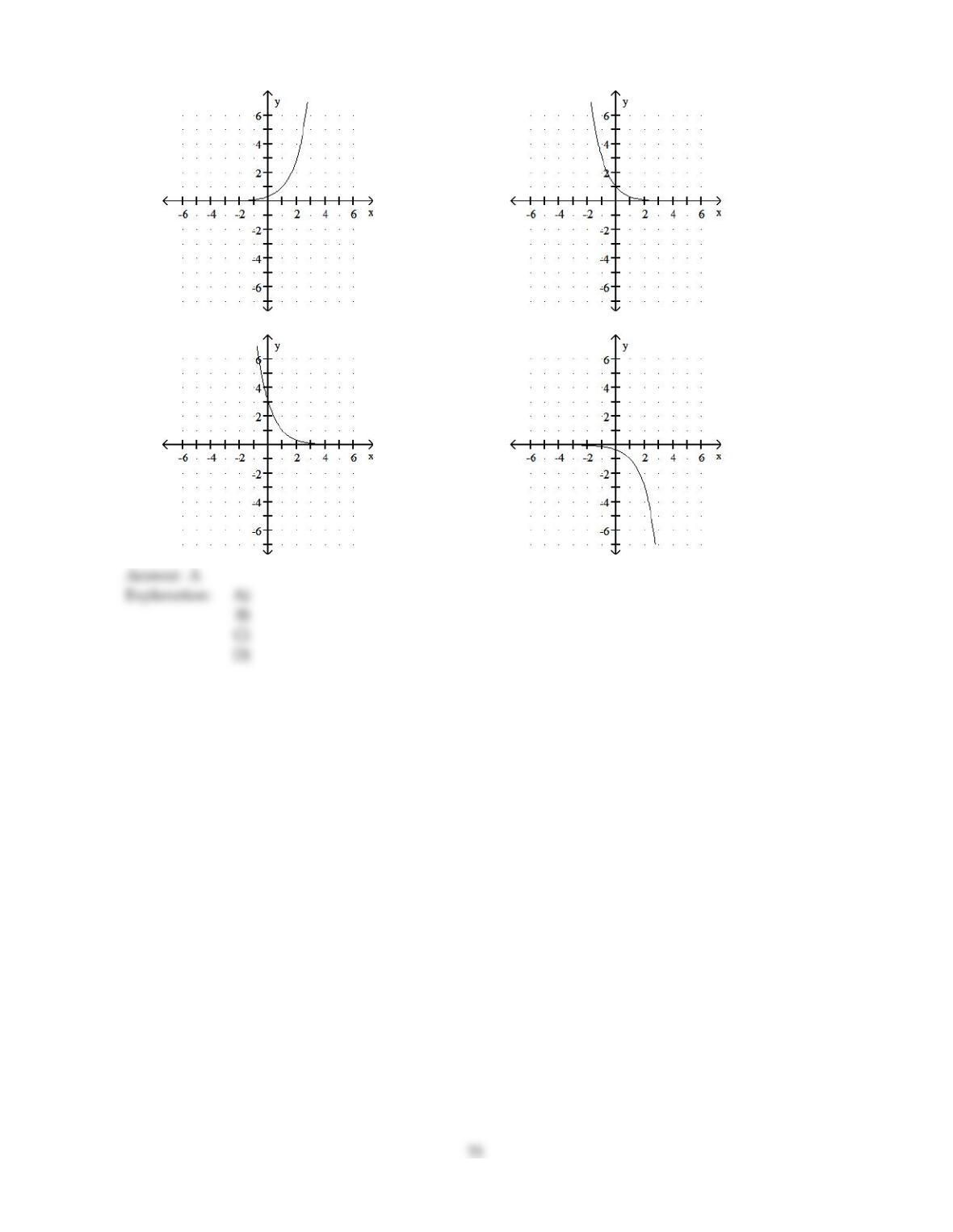
Use the graph of f(x) =3x to obtain the graph of g(x) =1
3·3x.
228)
72
A)
B)
C)
D)
Solve the problem.
229)
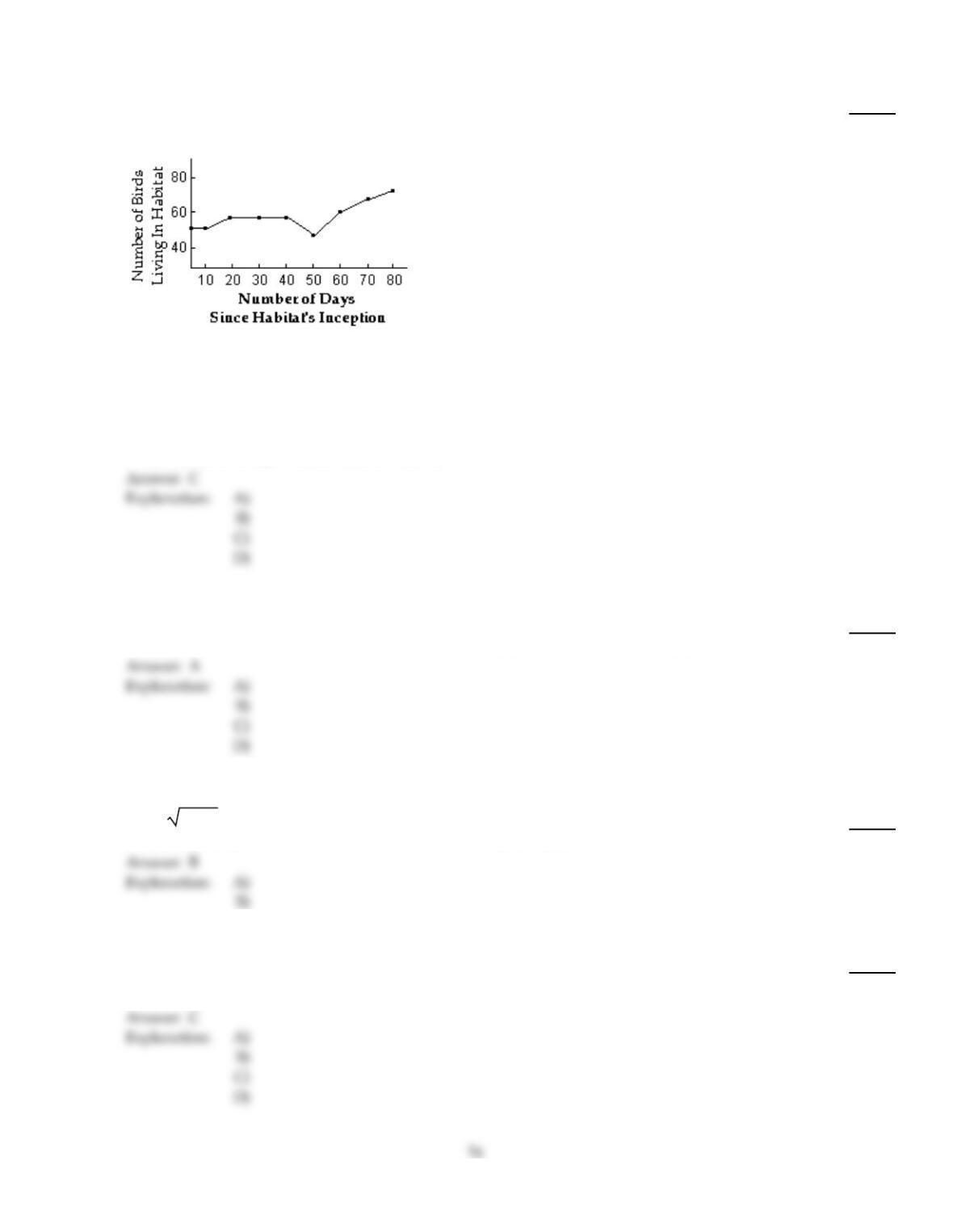
A research team collected data concerning a local habitat for an endangered species of bird. The
data are summarized in the graph below. Call the function f.
Does f have an inverse? Why or why not?
229)
A)
No, because it fails the vertical line test.
B)
Yes, because it passes the horizontal line test.
C)
No, because it fails the horizontal line test.
D)
Yes, because it passes the vertical line test.
Solve the equation by expressing each side as a power of the same base and then equating exponents.
230)
4(1 + 2x) =1024
230)
A)
{2}
B)
{–2}
C)
{8}
D)
{256}
Find f(g(x)) and g(f(x)) and determine whether the pair of functions f and g are inverses of each other.
231)
f(x) =
3x –18 and g(x) =x3+18
231)
A)
not inverses
B)
inverses
Write the equation in its equivalent exponential form.
232)
log464 =3
232)
A)
643=4
B)
464 =3
C)
43=64
D)
34=64
Use properties of logarithms to expand the logarithmic expression as much as possible. Where possible, evaluate
logarithmic expressions without using a calculator.
233)
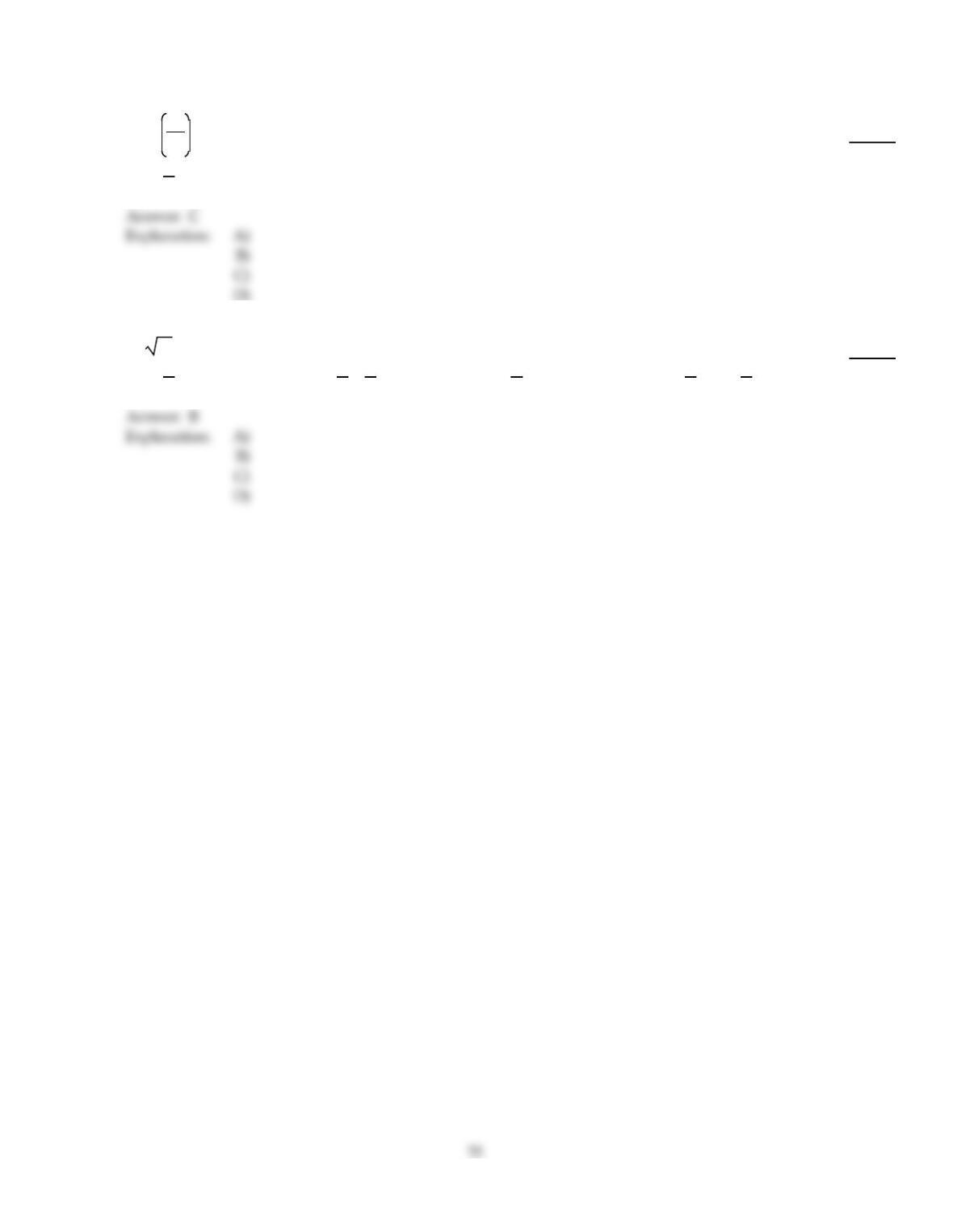
log11
11
x
233)
A)
1
x
B)
–log11 x
C)
1 –log11 x
D)
11
234)
ln 3ex
234)
A)
1
3 ln(ex)
B)
1
3+1
3 ln x
C)
1
3+ ln x
D)
1
3 ln e +1
3 ln x
Answer Key
Testname: C9
76
Answer Key
Testname: C9
Answer Key
Testname: C9
78
Answer Key
Testname: C9
Answer Key
Testname: C9
Answer Key
Testname: C9