3) The H-C-H bond angle in the CH4 ion is approximately ________.
A) 180
B) 120
C) 109.5
D) 60
E) 90
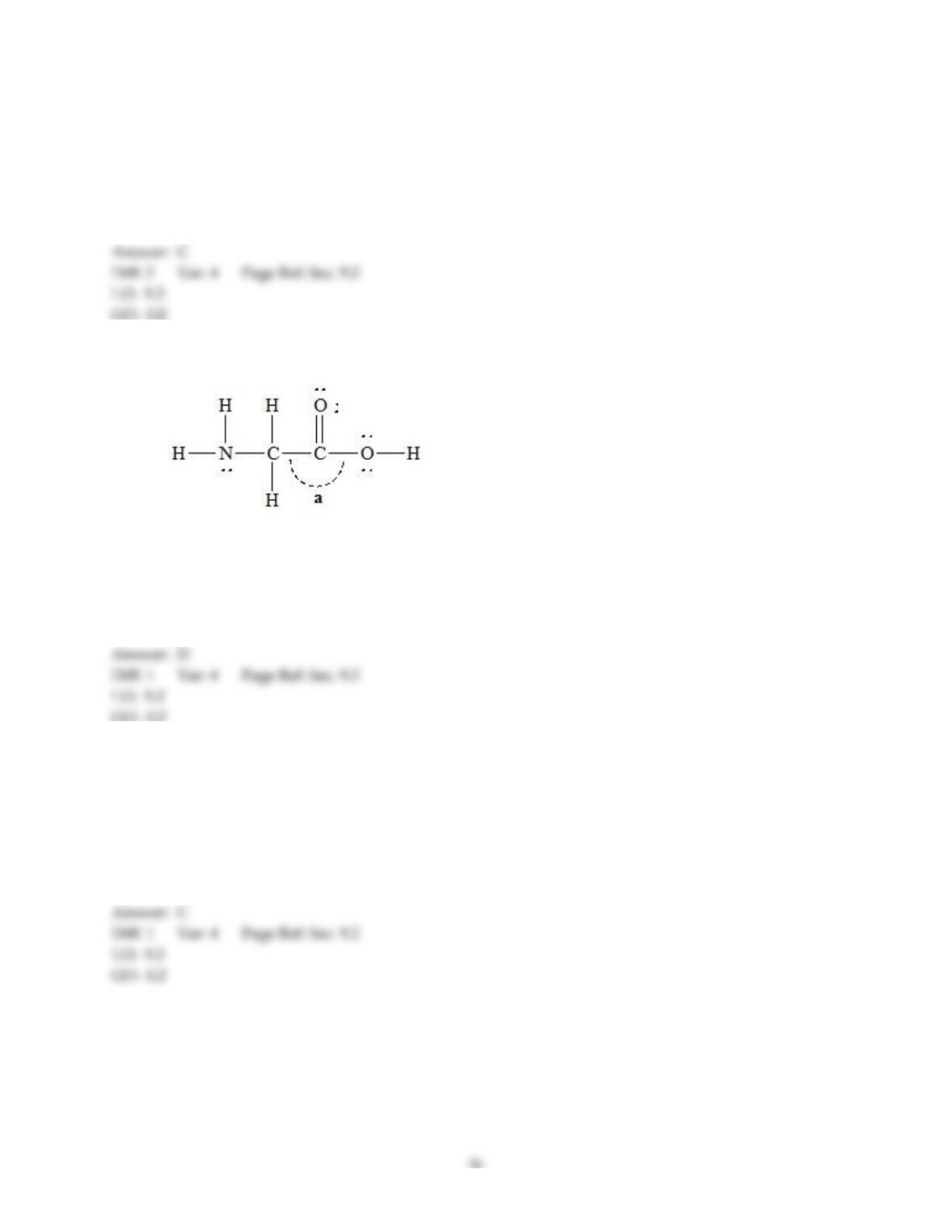
4) The bond angle marked a in the following molecule is about ________.
A) 109.5
B) 60
C) 180
D) 120
E) 90
5) The central atom in the ICl4– ion has ________ nonbonded electron pair(s) and ________ bonded
electron pair(s) in its valence shell.
A) 4, 2
B) 0, 4
C) 2, 4
D) 2, 2
E) 6, 0
37
6) The central atom in a certain molecule has 1 nonbonded electron pairs and 2 bonded electron pairs in
its valence shell. The molecular geometry of this molecule is ________.
A) tetrahedral
B) bent
C) seesaw
D) trigonal bipyrimidal
E) trigonal pyramidal
7) The central atom in a certain molecule has 4 nonbonded electron pairs and 2 bonded electron pairs in
its valence shell. The molecular geometry of this molecule is ________.
A) seesaw
B) square planar
C) linear
D) trigonal bipyramidal
E) T-shaped
8) The central atom in the O3 molecule has ________ nonbonded electron pair(s) and ________ bonded
electron pair(s) in its valence shell.
A) 6, 2
B) 1, 3
C) 2, 2
D) 3, 1
E) 3, 2
9) According to VSEPR theory, if there are three electron domains in the valence shell of an atom, they
will be arranged in a(n) ________ geometry.
A) tetrahedral
B) octahedral
C) linear
D) square planar
E) bent
10) The electron-domain geometry and molecular geometry of iodine trichloride are ________ and
________, respectively.
A) trigonal bipyramidal, trigonal planar
B) tetrahedral, trigonal pyramidal
C) trigonal bipyramidal, T-shaped
D) octahedral, trigonal planar
E) T-shaped, trigonal planar
11) The electron-domain geometry and molecular geometry of the nitrite ion are ________ and ________,
respectively.
A) trigonal bipyramidal, trigonal planar
B) tetrahedral, trigonal pyramidal
C) trigonal bipyramidal,T-shaped
D) trigonal planar, bent
E) T-shaped, trigonal planar
12) Using the VSEPR model, the electron-domain geometry of the central atom in O3 is ________.
A) linear
B) trigonal planar
C) tetrahedral
D) trigonal bipyramidal
E) octahedral
13) Using the VSEPR model, the electron-domain geometry of the central atom in ClO3– is ________.
A) linear
B) trigonal planar
C) tetrahedral
D) trigonal bipyramidal
E) octahedral
14) Using the VSEPR model, the electron-domain geometry of the central atom in ClF3 is ________.
A) linear
B) trigonal planar
C) tetrahedral
D) trigonal bipyramidal
E) octahedral
15) Using the VSEPR model, the electron-domain geometry of the central atom in XeF4 is ________.
A) linear
B) trigonal planar
C) tetrahedral
D) trigonal bipyramidal
E) octahedral
16) Using the VSEPR model, the molecular geometry of the central atom in KrF2 is ________.
A) linear
B) trigonal planar
C) tetrahedral
D) bent
E) trigonal pyramidal
17) Using the VSEPR model, the molecular geometry of the central atom in SO3 is ________.
A) linear
B) trigonal planar
C) tetrahedral
D) bent
E) trigonal pyramidal
18) Using the VSEPR model, the molecular geometry of the central atom in CH4 is ________.
A) linear
B) trigonal planar
C) tetrahedral
D) bent
E) trigonal pyramidal
19) Using the VSEPR model, the molecular geometry of the central atom in ClO2– is ________.
A) linear
B) trigonal planar
C) tetrahedral
D) bent
E) trigonal pyramidal
20) Using the VSEPR model, the molecular geometry of the central atom in PCl3 is ________.
A) linear
B) trigonal planar
C) tetrahedral
D) bent
E) trigonal pyramidal
21) Using the VSEPR model, the molecular geometry of the central atom in IF5 is ________.
A) tetrahedral
B) square planar
C) square pyramidal
D) seesaw
E) trigonal bipyramidal
22) The bond angles in a tetrahedral molecule are ________ degrees.
A) 109.5
B) 120
C) 90
D) 45
E) <45
23) Of the molecules below, only ________ is polar.
A) CO2
B) CH4
C) PF5
D) SnF3
E) H2
24) Of the molecules below, only ________ is nonpolar.
A) PF3
B) Br2S
C) TeCl2
D) HCl
E) BeH2
25) The molecular geometry of the BeCl2 molecule is ________, and this molecule is ________.
A) bent, nonpolar
B) linear, polar
C) bent, polar
D) seesaw, polar
E) linear, nonpolar
26) The molecular geometry of the IF5 molecule is ________, and this molecule is ________.
A) trigonal bipyramidal, polar
B) trigonal bipyramidal, nonpolar
C) trigonal planar, polar
D) square pyramidal, polar
E) square pyramidal, nonpolar
27) According to valence bond theory, which orbitals overlap in the formation of the bond in HCl?
A) 1s on H and 2p on Cl
B) 2s on H and 3p on Cl
C) 1s on H and 3s on Cl
D) 1s on H and 3p on Cl
E) 1s on H and 4p on Cl
28) According to valence bond theory, which orbitals overlap in the formation of the bond in Cl2?
A) 4p on Cl and 4p on Cl
B) 3p on Cl and 3p on Cl
C) sp on Cl and sp on Cl
D) 3s on Cl and 3s on Cl
E) 2p on Cl and 2p on Cl
29) According to valence bond theory, which orbitals overlap in the formation of the bond in Br2?
A) 3s
B) 3p
C) 4s
D) 4p
E) 3d
43
30) The hybrid orbital set used by the central atom in SO3 is ________.
A) sp
B) sp2
C) sp3
D) sp3d
E) sp3d2
31) The hybrid orbital set used by the central atom in ClO2– is ________.
A) sp
B) sp2
C) sp3
D) sp3d
E) sp3d2
32) The hybrid orbital set used by the central atom in PCl5 is ________.
A) sp
B) sp2
C) sp3
D) sp3d
E) sp3d2
33) The electron-domain geometry of a boron-centered compound BH3 is trigonal planar. The
hybridization of the central boron atom is ________.
A) sp2
B) sp3d2
C) sp3
D) sp3d
E) sp
34) Of the following, only ________ has sp2 hybridization of the central atom.
A) NF3
B) HCN
C) BF3
D) ICl3
E) CH4
35) There is/are ________ hybridized s atomic orbital(s) in an sp-hybridized carbon atom.
A) 4
B) 0
C) 3
D) 1
E) 2
36) There is/are ________ hybridized s atomic orbital(s) in ansp2–hybridized carbon atom.
A) 1
B) 3
C) 2
D) 4
E) 0
37) When three atomic orbitals are mixed to form hybrid orbitals, how many hybrid orbitals are formed?
A) six
B) four
C) five
D) three
E) one
38) The blending of one s atomic orbital and one p atomic orbital produces ________.
A) two sp hybrid orbitals
B) two sp2 hybrid orbitals
C) two sp3 hybrid orbitals
D) three sp hybrid orbitals
E) three sp2 hybrid orbitals
39) A typical triple bond consists of ________ sigma bond(s) and ______ pi bond(s).
A) 1, 2
B) 2, 2
C) 1, 3
D) 0, 3
E) 1, 4
40) In molecular orbital theory, the σ1s orbital is ________ and the σ1s* orbital is ________ in the He2+
molecule.
A) half-filled, filled
B) half-filled, half-filled
C) filled, half-filled
D) filled, empty
E) filled, filled
41) Based on molecular orbital theory, the bond order of the N—N bond in the N2 molecule is ________.
A) 0
B) 1/2
C) 3
D) 2
E) 1
46
42) Based on molecular orbital theory, the bond order of the N—N– bond in the N2– molecule is
________.
A) 2 1/2
B) 1
C) 1/2
D) 2
E) 3
43) In molecular orbital theory, the bond order of the He—He bond in He2 is ________.
A) 0
B) 2
C) He—He
D) 1
E) 1/2
44) The highest energy occupied molecular orbital in the F—F bond of the F2 molecule is _____.
A) π*2s
B) π2s
C) σ*1p
D) π*2p
E) π2p
45) The highest energy occupied molecular orbital in the C—C bond of the C2 molecule is _____.
A) σ2p
B) σ*1p
C) π2p
D) π2s
E) π*2p
9.4 Short Answer Questions
1) What is the molecular geometry of a molecule that has three bonding and two non-bonding domains?
2) In the valence shell of an atom there are six electron domains. They will be arranged in a(n) ________
geometry.
3) What are the three bond angles in the trigonal bipyramidal structure?
4) Three molecules have similar electron domains, but different molecular shapes. Why?
5) The 1s hydrogen orbital overlaps with the ________ iodine orbital in HI.
6) A covalent bond in which overlap regions lie above and below an internuclear axis is called a(n)
________.
7) The sensation of vision results from a nerve impulse that is triggered by the separation of retinal from
________.
48
8) In molecular orbital theory, the stability of a covalent body is related to its ________.
9) Each molecular orbital can accommodate, at most, two electrons with their spins paired. This is called
the ________.
10) The more unpaired electrons in a species, the stronger is the force of magnetic attraction. This is called
________.
9.5 True/False Questions
1) Possible shapes of AB3 molecules are linear, trigonal planar, and T-shaped.
2) Boron trifluoride has three bonding domains, and its electron domain geometry is trigonal planar.
3) Electron domains for single bonds exert greater force on adjacent domains than the electron domains
for multiple bonds.
4) The quantitative amount of charge separation in a diatomic molecule contributes to the dipole moment
of that molecule.
5) XeF4 is a polar molecule.
6) Hybridization is the process of mixing atomic orbitals as atoms approach each other to form a bond.
7) Electrons in core orbitals contribute to atom bonding.
8) Nitrogen is colorless because the minimum energy to excite an electron is in the ultraviolet section of
the spectrum.