33) Under trade agreements signed with other countries, the United States is allowed to impose
tariffs on imports if foreign firms are selling products in the United States at below their
production cost. This is exactly what occurred when the United States raised the tariff on wire
hangers imported from China. This tariff
A) increased wages in the Chinese wire hanger industry and increased imports of Chinese wire
hangers to the United States.
B) decreased imports of chinese wire hangers to the United States and increased exports of U.S.
wire hangers to China.
C) saved some jobs in the U.S. wire hanger industry, but increased costs and possibly cost jobs in
the U.S. dry cleaning industry.
D) increased costs in the Chinese wire hanger industry and decreased costs in the U.S. wire
hanger industry.
34) A tariff is a numerical limit on the quantity of a good that can be imported.
35) The U.S. economy would gain from the elimination of tariffs and quotas even if other
countries do not reduce their tariffs and quotas.
36) Distinguish between a voluntary export restraint and a quota.
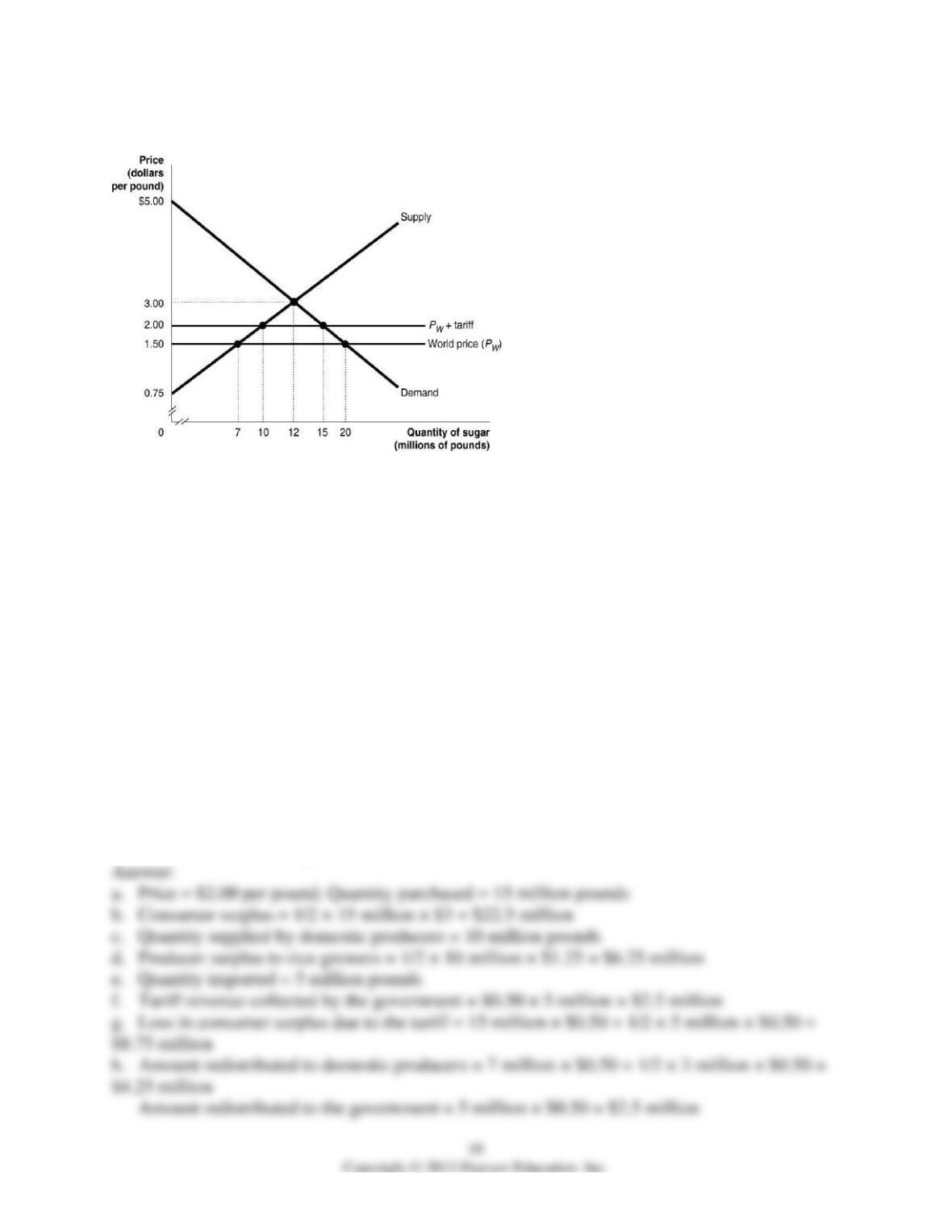
Figure 9-4
Suppose the U.S. government imposes a $0.50 per pound tariff on sugar imports. Figure 9-4
shows the demand and supply curves for sugar and the impact of this tariff.
37) Use Figure 9-4 to answer questions a-i.
a. Following the imposition of the tariff, what is the price that domestic consumers must now
pay and what is the quantity purchased?
b. Calculate the value of consumer surplus with the tariff in place.
c. What is the quantity supplied by domestic sugar producers with the tariff in place?
d. Calculate the value of producer surplus received by U.S. sugar producers with the tariff in
place.
e. What is the quantity of sugar imported with the tariff in place?
f. What is the amount of tariff revenue collected by the government?
g. The tariff has reduced consumer surplus. Calculate the loss in consumer surplus due to the
tariff.
h. What portion of the consumer surplus loss is redistributed to domestic producers? To the
government?
i. Calculate the deadweight loss due to the tariff.
41
Figure 9-5
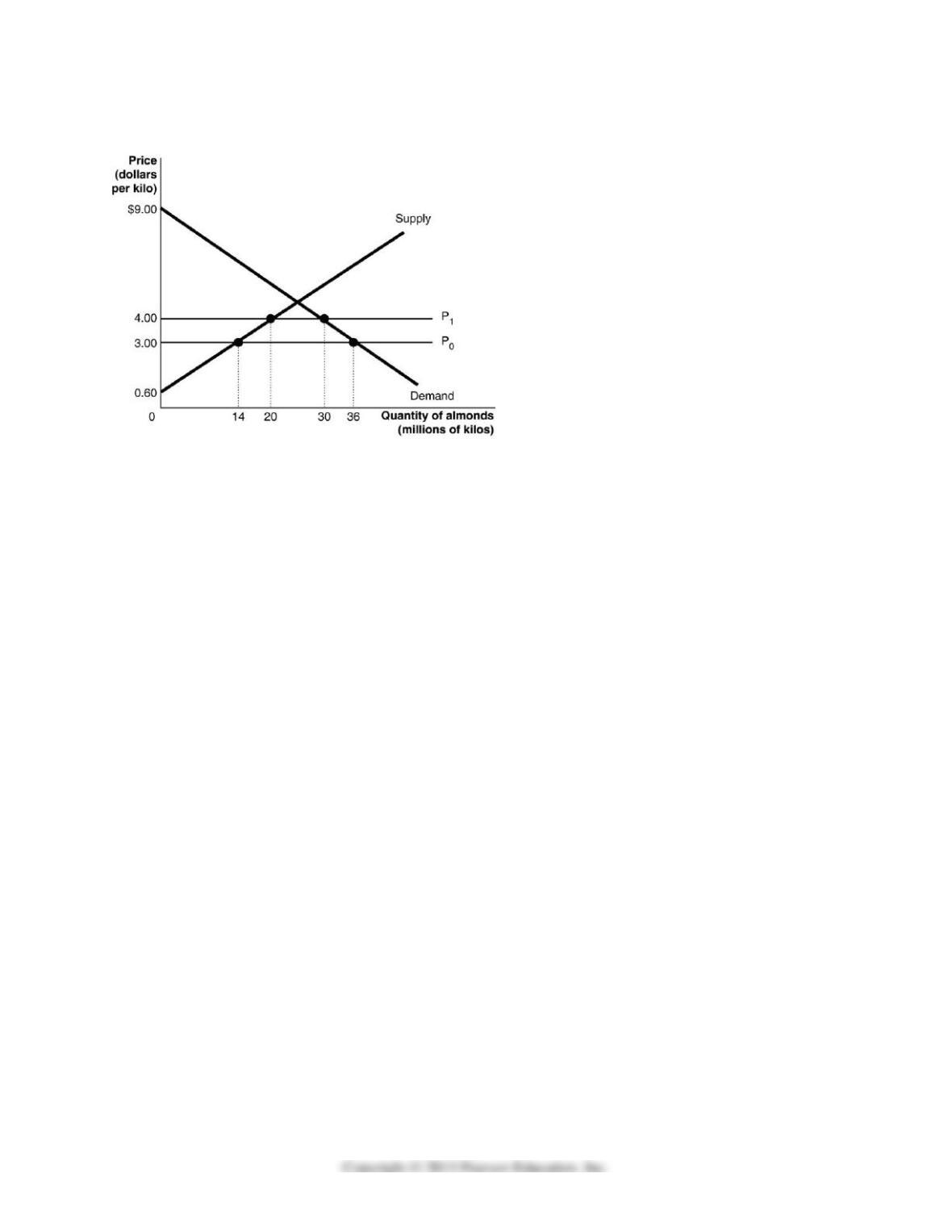
Bragabong currently both produces and imports almonds. The government of Bragabong decides
to restrict international trade in almonds by imposing a quota that allows imports of only 10
million kilos each year. Figure 9-5 shows the estimated demand and supply curves for almonds
in Bragabong and the results of imposing the quota.
38) Use Figure 9-5 to answer questions a-j .
a. If there is no quota what is the domestic price of almonds and what is the quantity of
almonds demanded by consumers?
b. If there is no quota how many kilos of almonds would domestic producers supply and what
quantity would be imported?
c. If there is no quota what is the dollar value of consumer surplus?
d. If there is no quota what is the dollar value of producer surplus received by producers in
Bragabong?
e. If there is no quota what is the revenue received by foreign producers who supply almonds to
Bragabong?
f. With a quota in place what is the price that consumers of Bragabong must now pay and what
is the quantity demanded?
g. With a quota in place what is the dollar value of consumer surplus? Are consumers better
off?
h. With a quota in place what is the dollar value of producer surplus received by producers in
Bragabong? Are domestic producers better off?
i. Calculate the revenue to foreign producers who are granted permission to sell in Bragabong
after the imposition of the quota.
j. Calculate the deadweight loss as a result of the quota.
9.5 The Arguments over Trade Policies and Globalization
1) Disagreements about whether the U.S. government should regulate international trade
A) began during the Great Depression.
B) began after World War I when government officials no longer believed in isolationism.
C) date back to the beginning of the country.
D) did not occur until the end of the Mexican War in 1848.
2) ________ raised average tariff rates by over 50 percent in the United States in 1930.
A) The GATT
B) The WTO
C) NAFTA
D) The Smoot-Hawley Tariff
3) In 1930, the U.S. government attempted to help domestic firms that were harmed by the Great
Depression by
A) establishing the General Agreement on Tariffs and Trade (GATT).
B) passing the Smoot-Hawley Tariff.
C) establishing the World Trade Organization (WTO).
D) passing the North American Free Trade Agreement (NAFTA).
4) In 1995 ________, which was established in 1948, was replaced by ________.
A) the GATT; the WTO
B) the WTO; NAFTA
C) the Smoot-Hawley Tariff; the GATT
D) NAFTA; the Smoot-Hawley Tariff
5) The World Trade Organization (WTO) promotes foreign trade and investment, or
globalization. In recent years opposition to globalization has led to violent protests at meetings
of the WTO. One reason for these anti-globalization protests is
A) foreign trade and investment are examples of zero-sum games.
B) protesters believe that globalization will result in a return to communism in developing
countries.
C) protesters believe that free trade destroys the distinctive cultures of many countries.
D) protesters object to the loss of intellectual property (such as software programs and movies)
that results from foreign trade and investment.
6) Many people assume that if child workers in developing countries weren’t working in
factories, they would be in school. In fact, children in developing countries
A) split their time evenly between work and school.
B) usually have few good alternatives to work.
C) are only allowed to work if they have attended school up to age 15.
D) who work are relatively rare, as most do attend school full time.
7) Protectionism
A) is the use of cheap labor to protect firms from paying high wages.
B) is the use of trade barriers to protect domestic firms from foreign competition.
C) refers to reductions in tariffs and other barriers that protect consumers from paying high
prices.
D) refers to the use of copyright and trademark laws to protect inventors and artists from losing
the rights to their creative efforts.
8) Free trade ________ living standards by ________ economic efficiency.
A) raises; increasing
B) lowers; decreasing
C) raises; equalizing
D) lowers; eliminating
9) Many economists criticize protectionism because it causes losses to consumers and eliminates
jobs in domestic industries that use protected products. Why, then, do some people support
protectionism?
A) The criticisms of economists are based on theory. In fact, protectionism increases consumer
and producer surplus as well as employment.
B) Supporters of protectionism in high-income countries believe that wages will fall as a result
of competition with firms from developing countries.
C) Supporters of protectionism believe free trade will cause their countries to lose their
comparative advantage.
D) Supporters of protectionism believe that free trade will lead to inflation.
10) Which of the following statements is used to justify protectionism?
A) Free trade leads to higher prices for imported goods.
B) Free trade increases employment by protecting domestic firms.
C) A country should not rely on other countries for goods that are critical to its national defense.
D) Trade restrictions are not necessary to protect new firms since they can gain experience and
become more productive without protection.
11) Which of the following describes the infant industry argument for protectionism?
A) An industry must be protected in its early stages of development so that firms can compete
with government-subsidized foreign competition.
B) Some strategic industries must be protected to ensure adequate supplies of resources needed
for national defense in emergencies.
C) Domestic producers in high-wage countries must be protected from foreign producers in low-
wage countries to produce a level playing field.
D) Domestic producers require time to gain experience and lower their unit costs; this will allow
these producers to compete successfully in international markets.
12) The process of countries becoming more open to foreign trade and investment is known as
A) autarky.
B) foreign exchange.
C) globalization.
D) protectionism.
13) Economists believe the most persuasive argument for protectionism is to protect infant
industries. But the argument has a drawback. What is this drawback?
A) Governments always make the level of protection for infant industries too high.
B) Governments are usually too impatient and do not allow protection to remain in place long
enough to allow industries to be competitive in international markets.
C) Governments usually use tariffs, rather than quotas, to protect infant industries in order to
collect tariff revenue. (Quotas do not result in government revenue).
D) Protection lessens the need for firms to become productive enough to compete with foreign
firms; this often results in infant industries never “growing up.”
14) Suppose that American firms claim that protectionism in Canada is on the rise as the
Canadian government attempts to protect its infant industries. This protectionism will cause the
greatest harm to
A) Canadian manufacturers.
B) the Canadian government.
C) manufacturers who export to Canada.
D) Canadian consumers.
15) Suppose that American firms claim that protectionism in Canada is on the rise as the
Canadian government attempts to protect its infant industries with a “Buy Canadian” provision.
This policy, similar to the original “Buy American” provision in the 2009 U.S. stimulus bill, is
likely to cause
A) exporting countries to retaliate by placing trade barriers on Canadian imports.
B) Canadian manufacturers to become more efficient.
C) Canadian companies to pay lower prices for protected products.
D) most countries to reduce their own trade barriers to be able to better compete with Canadian
imports at home.
16) The selling of a product for a price below its cost of production is called
A) fair competition.
B) dumping.
C) unfair competition.
D) operating at a loss.
17) Imposing tariffs in cases of dumping
A) is allowed under the WTO agreement.
B) is not allowed under the WTO agreement.
C) is not addressed by the WTO agreement.
D) has never occurred, even though it is allowed under the WTO agreement.
18) Measuring the impact of a quota or tariff on the U.S. economy is an example of ________.
Stating that a quota or tariff should be eliminated is an example of ________.
A) statistical analysis; economic analysis
B) positive analysis; normative analysis
C) econometric analysis; protectionism
D) trade analysis; an opinion
19) One reason for the success that firms have in getting the government to erect barriers to
foreign competition is that jobs lost to foreign competition are easy to identify but jobs created
by foreign trade are often hard to identify. Which of the following is a second reason?
A) The costs that tariffs and quotas impose on consumers are large in total but relatively small
per person.
B) People who benefit from foreign trade tend not to vote in elections; people who are harmed
by foreign trade are much more likely to vote.
C) Firms that benefit from trade barriers have more money to lobby government officials to
support the barriers than do firms that are harmed by trade barriers.
D) The benefits from free trade are less than the costs.
20) The “Buy American” provision in the 2009 stimulus package would require that stimulus
money be spent only on U.S.-made goods. In the market for steel, the “Buy American” provision
would ________ the price of steel in the United States and ________ the quantity of steel
demanded in the United States.
A) increase; increase
B) increase; decrease
C) decrease; increase
D) decrease; decrease
21) In the U.S. steel market, a “Buy American” provision in the 2009 stimulus package would
A) convert some consumer surplus to deadweight loss.
B) transfer some deadweight loss to producer surplus.
C) transfer some producer surplus to consumer surplus.
D) reduce the producer surplus received by foreign manufacturers.
22) Selling a product at a price below its cost is known as dumping.
23) Protectionism refers to the use of trade barriers to shield domestic firms from foreign
competition.
24) a. What is the World Trade Organization?
b. When was it established?
c. How many countries are members of the World Trade Organization?
25) Dalton, Georgia, a town with a population less than 35,000, has developed into a leading
producer of carpets, despite its small size. Some government officials argue that the success
achieved by firms in Dalton in developing a comparative advantage in carpet making because of
external economies can be used to justify trade barriers as a means to protect an “infant
industry.” After an infant industry gains experience it can compete in international markets and
the trade barriers can be removed. What objections do economists make to this argument in
favor of trade barriers?
26) Anti-globalization and protectionism are both arguments against free trade. How do these
two arguments differ?