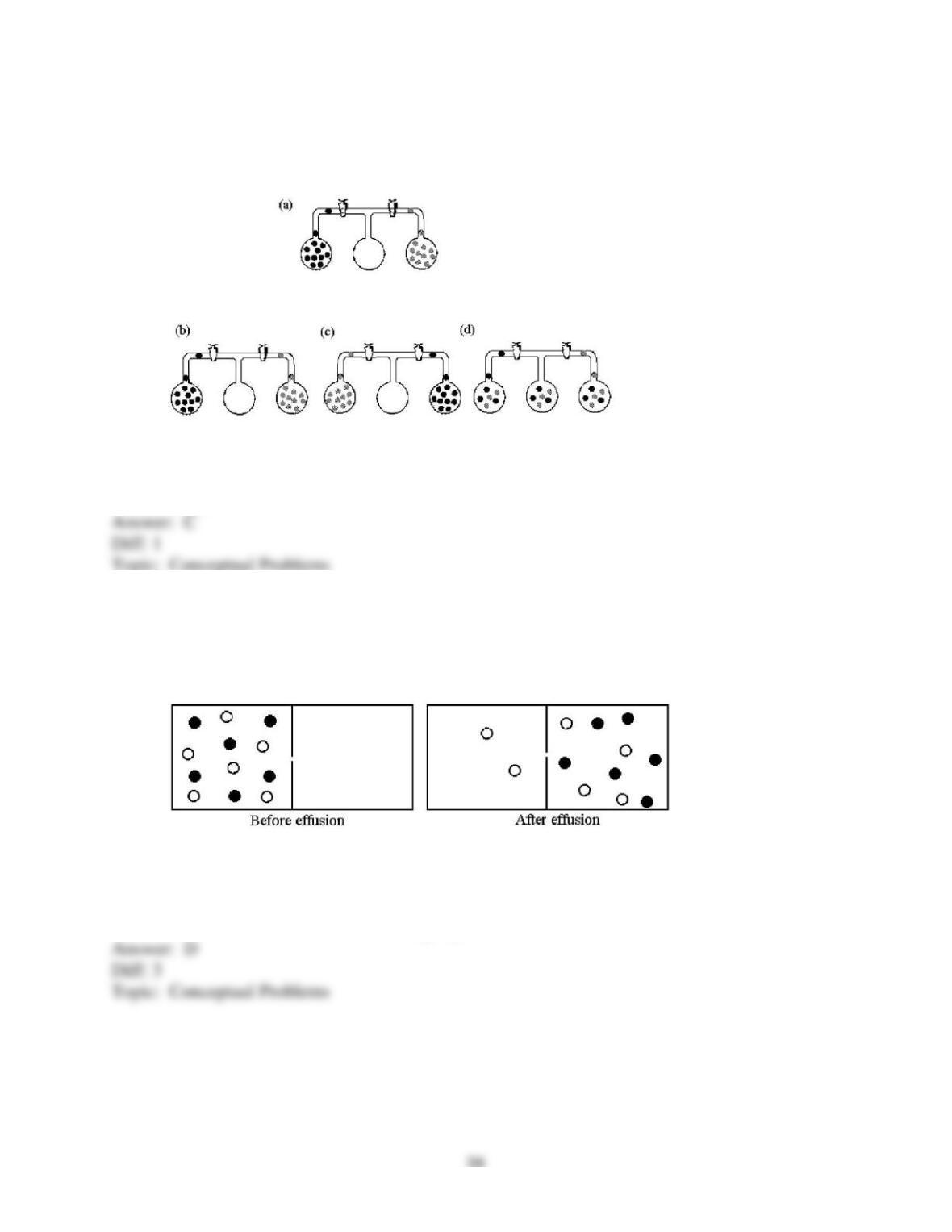
114) Three bulbs, two of which contain different gases and one of which is empty, are connected
as shown in drawing (a). Which drawing (b) – (d) best represents the system after the stopcocks
are opened and the system is allowed to come to equilibrium?
A) drawing (b)
B) drawing (c)
C) drawing (d)
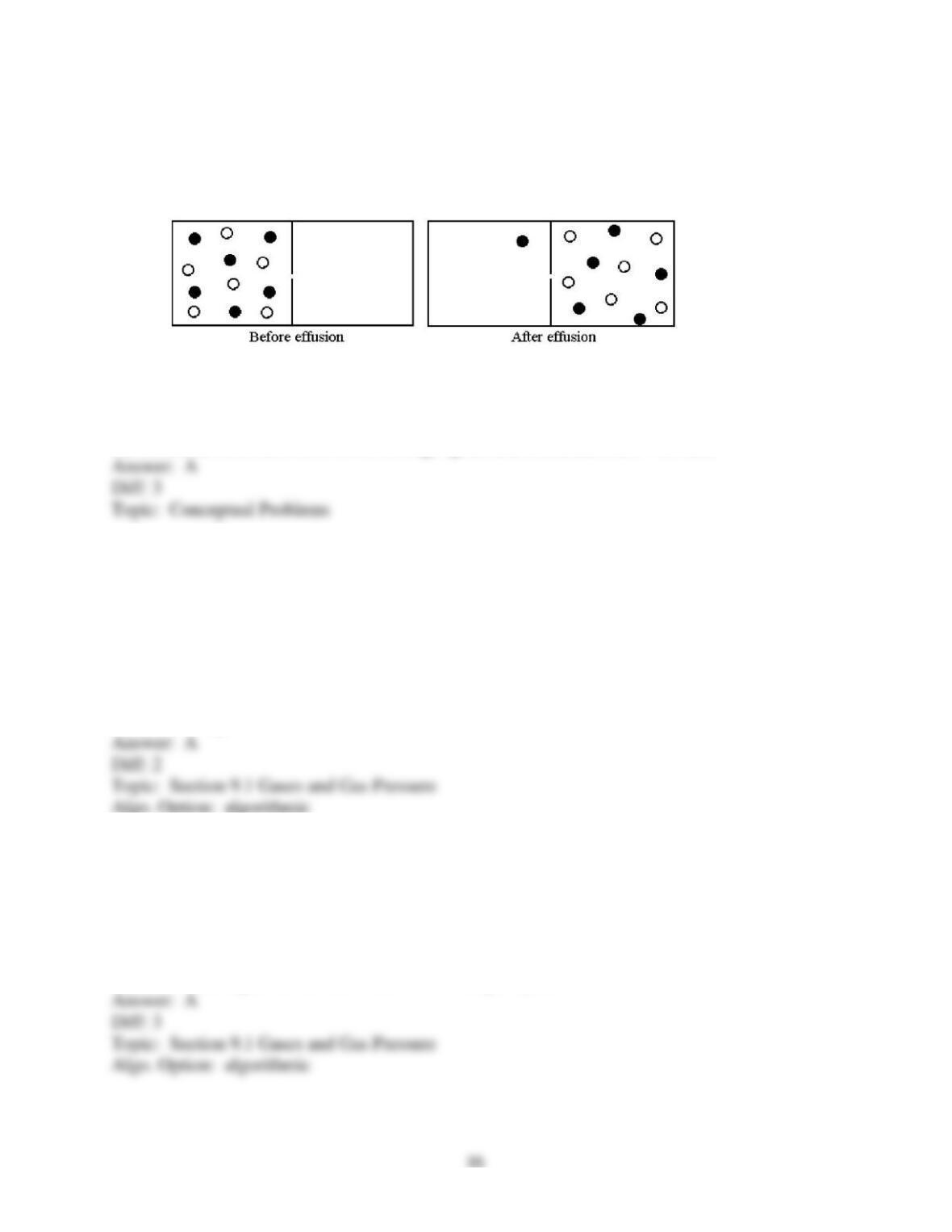
115) Effusion of a 1:1 mixture of two gases, represented by unshaded and shaded spheres in the
diagram below, through a small pinhole produces the result shown below. The shaded spheres
have a molecular mass of 32 amu. Which gas molecules have the higher average speed and what
is the molecular mass of the unshaded molecules?
A) Unshaded molecules have higher average speed and molecular mass = 14 amu
B) Unshaded molecules have higher average speed and molecular mass = 21 amu
C) Unshaded molecules have lower average speed and molecular mass = 48 amu
D) Unshaded molecules have lower average speed and molecular mass = 72 amu
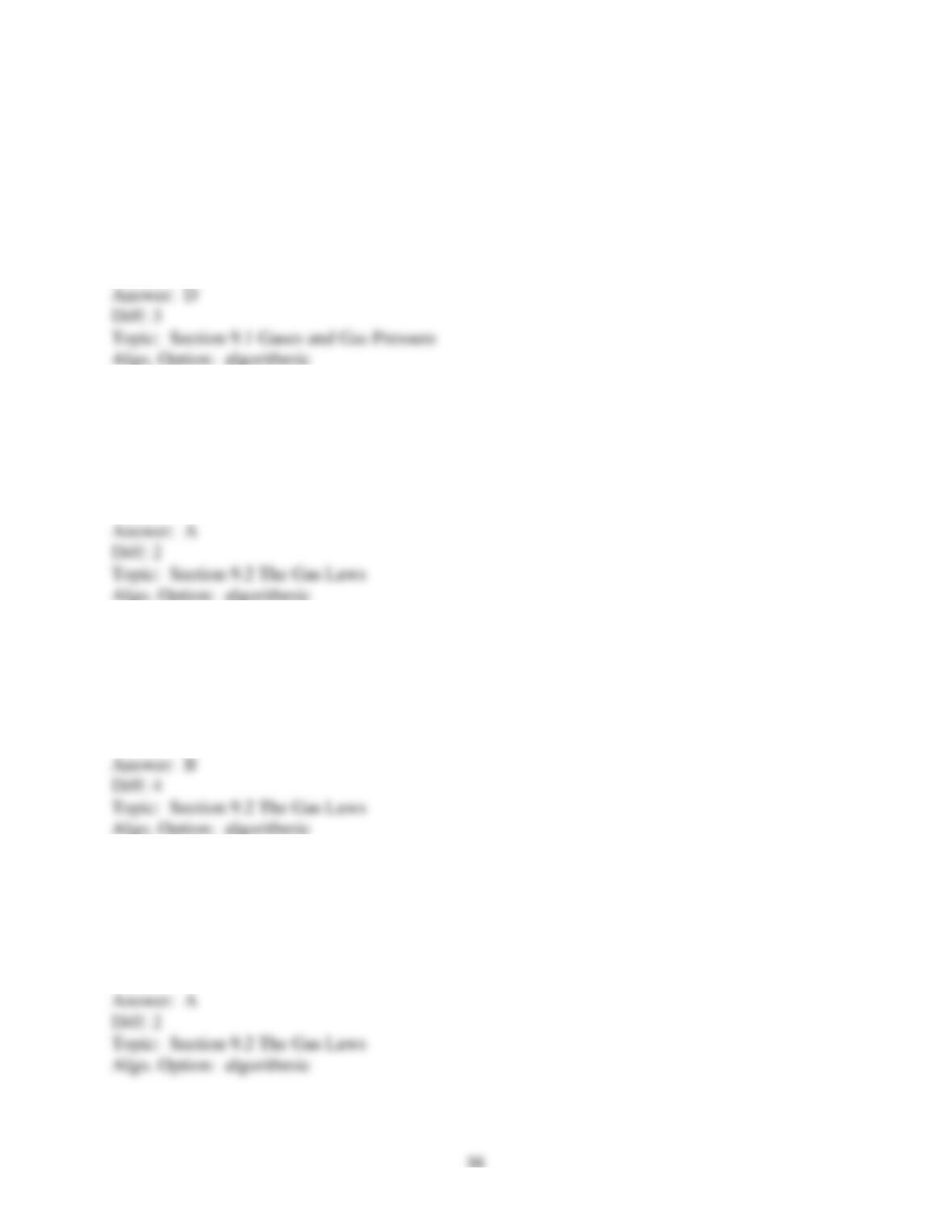
116) Effusion of a 1:1 mixture of two gases, represented by unshaded and shaded spheres in the
diagram below, through a small pinhole produces the result shown below. The shaded spheres
have a molecular mass of 20 amu. Which gas molecules have the higher average speed and what
is the molecular mass of the unshaded molecules?
A) Unshaded molecules have higher average speed and molecular mass = 14 amu
B) Unshaded molecules have higher average speed and molecular mass = 17 amu
C) Unshaded molecules have lower average speed and molecular mass = 24 amu
D) Unshaded molecules have lower average speed and molecular mass = 29 amu
9.2 Algorithmic Questions
1) What is the pressure in a gas container that is connected to an open-end U-tube manometer if
the pressure of the atmosphere is 742 torr and the level of mercury in the arm connected to the
container is 8.60 cm higher than the level of mercury open to the atmosphere?
A) 656 mm Hg
B) 733 mm Hg
C) 751 mm Hg
D) 828 mm Hg
2) If the pressure in a gas container that is connected to an open-end U-tube manometer is 116
kPa and the pressure of the atmosphere at the open end of the tube is 752 mm Hg, the level of
mercury in the tube will
A) be 118 mm higher in the arm open to the atmosphere.
B) be 118 mm higher in the arm connected to the gas cylinder.
C) be 870 mm higher in the arm open to the atmosphere.
D) be 870 mm higher in the arm connected to the gas cylinder.
3) A container filled with gas is connected to an open-end manometer that is filled with mineral
oil. The pressure in the gas container is 753 mm Hg and atmospheric pressure is 724 mm. How
high will the level rise in the manometer if the densities of Hg and mineral oil are 13.6 g/mL and
0.822 g/mL respectively?
A) 1.75 mm
B) 23.8 mm
C) 29.0 mm
D) 480 mm
4) A basketball is inflated to a pressure of 1.90 atm in a 24.0°C garage. What is the pressure of
the basketball outside where the temperature is -1.00°C?
A) 1.74 atm
B) 1.80 atm
C) 2.00 atm
D) 2.08 atm
5) A gas bottle contains 0.250 mol of gas at 730 mm Hg pressure. If the final pressure is 1.15
atm, how many moles of gas were added to the bottle?
A) 0.0262 mol
B) 0.0493 mol
C) 0.276 mol
D) 0.299 mol
6) The volume of 350. mL of gas at 25°C is decreased to 135 mL at constant pressure. What is
the final temperature of the gas?
A) -158°C
B) 9.6°C
C) 65°C
D) 500°C
37
7) A balloon filled with helium gas at 20 °C occupies 4.91 L at 1.00 atm. The balloon is
immersed in liquid nitrogen at -196°C, raising the pressure to 5.20 atm. What is the volume of
the balloon in the liquid nitrogen?
A) 0.25 L
B) 3.6 L
C) 6.7 L
D) 97 L
8) Three identical flasks contain three different gases at standard temperature and pressure. Flask
A contains flask B contains O3, and flask C contains F2. Which flask contains the largest
number of molecules?
A) flask A
B) flask B
C) flask C
D) All contain same number of molecules.
9) How many molecules of N2 are in a 400.0 mL container at 780 mm Hg and 135°C?
A) 7.01 × 10²¹ molecules
B) 7.38 × 10²¹ molecules
C) 2.12 × 10²² molecules
D) 2.23 × 10²² molecules
10) A 2.75-L container filled with CO2 gas at 25°C and 225 kPa pressure springs a leak. When
the container is re-sealed, the pressure is 185 kPA and the temperature is 10°C. How many moles
of gas were lost?
A) 0.0335 mol
B) 0.728 mol
C) 0.882 mol
D) 3.39 mol
11) A 45.0-L steel tank at 20.0°C contains acetylene gas, C2H2, at a pressure of 1.39 atm.
Assuming ideal behavior, how many grams of acetylene are in the tank?
A) 2.60 g
B) 10.0 g
C) 67.8 g
D) 990 g
12) A 4.00-L flask contains nitrogen gas at 25°C and 1.00 atm pressure. What is the final
pressure in the flask if an additional 2.00 g of N2 gas is added to the flask and the flask cooled to
-55°C?
A) 0.319 atm
B) 1.05 atm
C) 1.44 atm
D) 1.96 atm
13) A steel bottle contains argon gas at STP. What is the final pressure if the temperature is
changed to 145°C?
A) 0.653 atm
B) 0.713 atm
C) 1.40 atm
D) 1.53 atm
14) A gas occupies 22.4 L at STP and 19.0 L at 100°C and 1.50 atm pressure. How many moles
of gas did the system gain or lose?
A) 0.08 moles gained
B) 0.01 moles gained
C) 0.01 moles lost
D) 0.07 moles lost
15) How many grams of NO gas are there in a 5.00-L cylinder at 4.00 × 103 mm Hg and 23°C?
A) 13.9 g
B) 32.1 g
C) 417 g
D) 2.47 × 10⁴ g
16) What is the volume of 30.0 g of argon gas at 157°C and 2.50 kPa pressure?
A) 3.87 L
B) 10.6 L
C) 393 L
D) 1070 L
17) What is the Celsius temperature of 100.0 g of chlorine gas in a 55.0-L container at 800 mm
Hg?
A) -23°C
B) 228°C
C) 250°C
D) 500°C
18) A 0.286-g sample of gas occupies 125 mL at 60. cm of Hg and 25°C. What is the molar mass
of the gas?
A) 5.9 g/mol
B) 44 g/mol
C) 59 g/mol
D) 71 g/mol
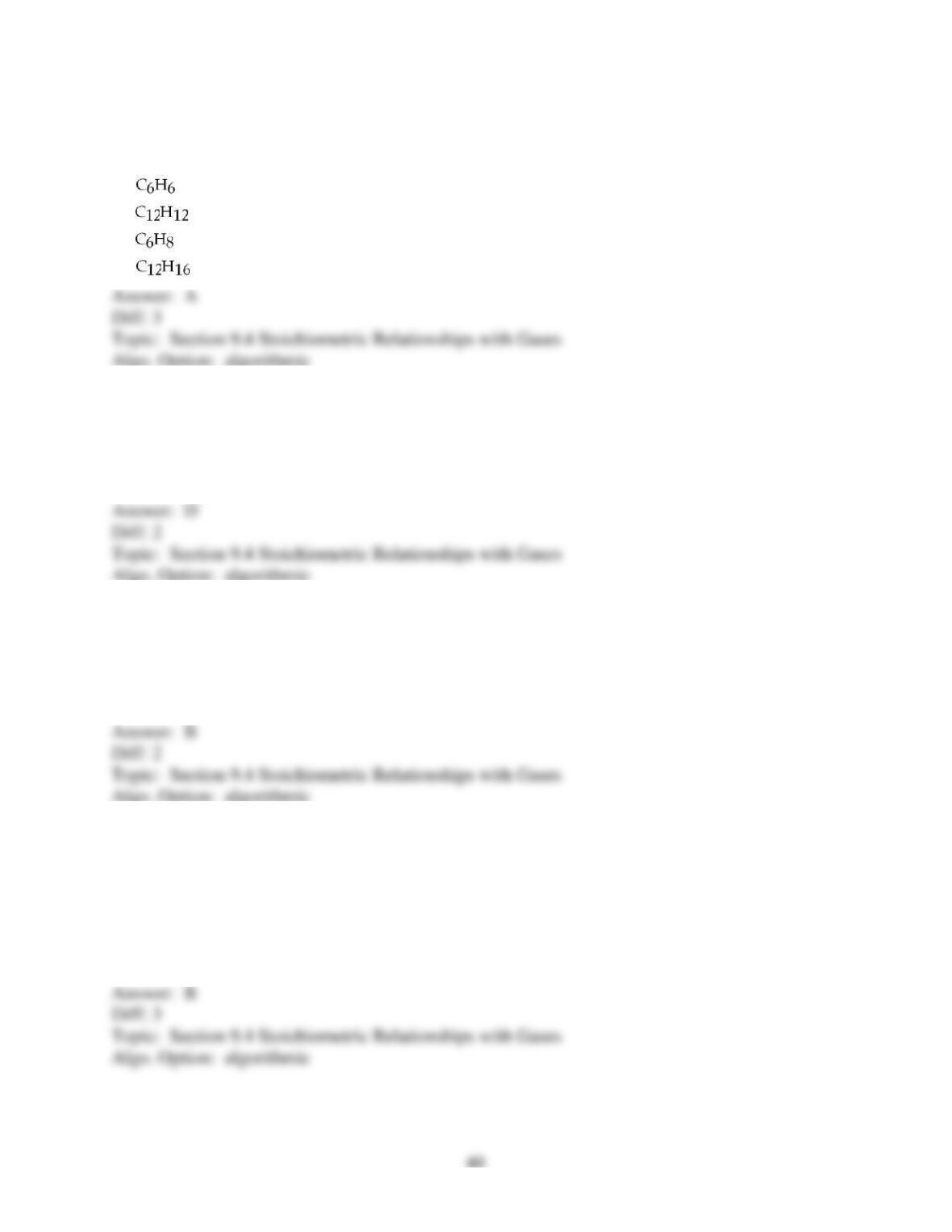
19) A compound is 7.74% hydrogen and 92.26% carbon by mass. At 100°C a 0.6883 g sample
of the gas occupies 250 mL when the presssure is 820 torr. What is the molecular formula for
this compound?
A)
B)
C)
D)
20) What is the density of hydrogen gas at STP?
A) 11.1 g/L
B) 0.0450 g/L
C) 0.0823 g/L
D) 0.0899 g/L
21) Which of the following would have a density of 1.37 g/L at 7.0°C and 0.987 atm?
A) N2
B) O2
C) Kr
D) Rn
22) Given three cylinders containing O2 gas at the same volume and pressure. Cylinder A is at –
15°C, cylinder B is at -5°F, cylinder C is at 255 K. Which cylinder contains the largest mass of
oxygen?
A) cylinder A
B) cylinder B
C) cylinder C
D) All cylinders contain the same mass of O2.
41
23) The action of some commercial drain cleaners is based on the following reaction:
2 NaOH(s) + 2 Al(s) + 6 H2O(l) → 2 NaAl(OH)4(s) + 3 H2(g)
What is the volume of H2 gas formed at STP when 6.32 g of Al reacts with excess NaOH?
A) 3.50 L
B) 5.25 L
C) 7.87 L
D) 8.59 L
24) How many liters of oxygen are needed to exactly react with 19.8 g of methane at STP?
CH4(g) + 2 O2(g) → CO2(g) + 2 H2O(l)
A) 13.9 L
B) 27.8 L
C) 55.5 L
D) 60.5 L
25) When 14.0 g of zinc metal reacts with excess HCl, how many liters of H2 gas are produced
at STP?
A) 0.208 L
B) 0.416 L
C) 4.80 L
D) 9.60 L
26) How many grams of XeF6 are required to react with 0.579 L of hydrogen gas at 6.46 atm
and 45°C in the reaction shown below?
XeF6(s) + 3 H2(g) → Xe(g) + 6 HF(g)
A) 9.58 g
B) 11.7 g
C) 35.2 g
D) 106 g
27) A balloon contains 0.76 mol N2, 0.18 mol O2, 0.031 mol He and 0.026 mol H2 at 749 mm
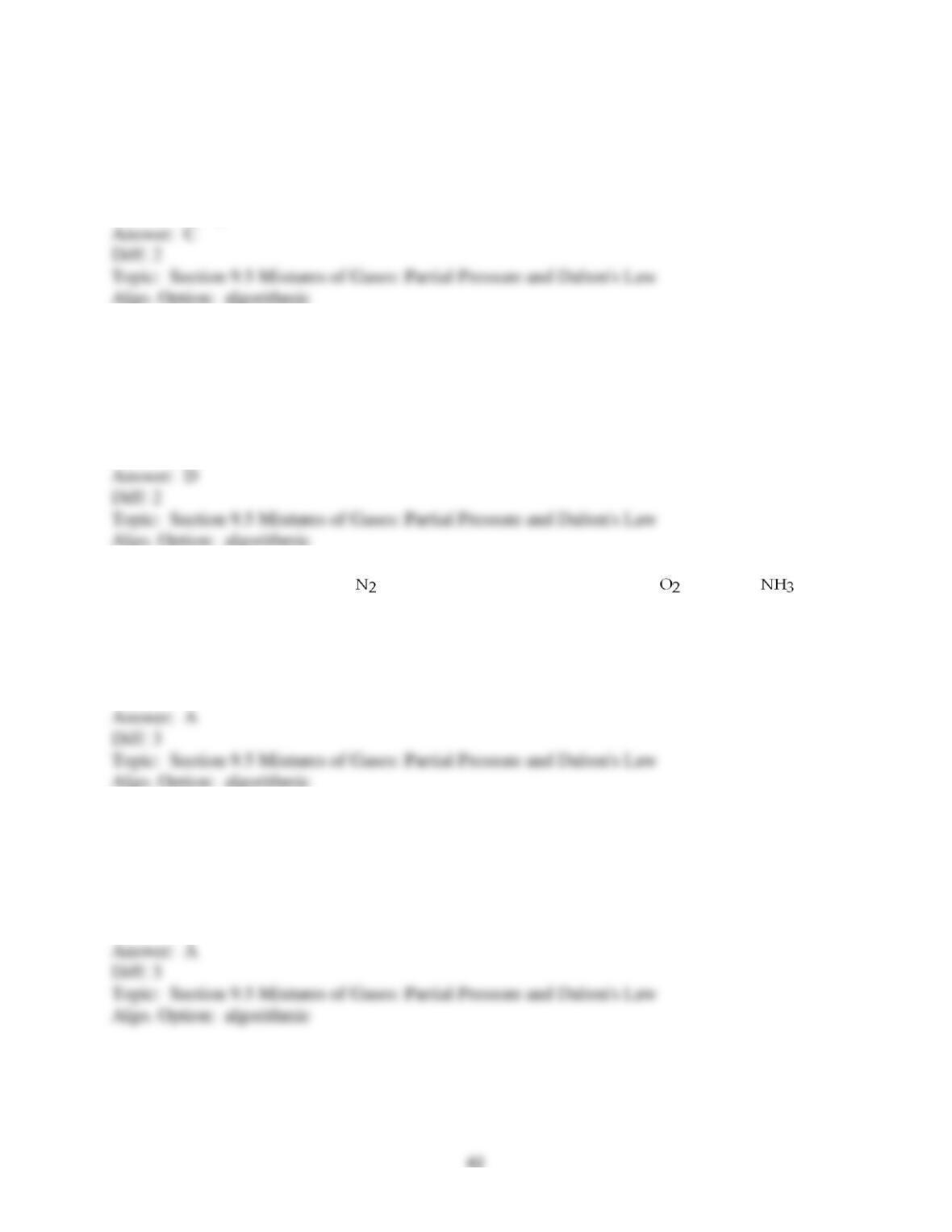
Hg. What is the partial pressure of O2?
A) 20 mm Hg
B) 23 mm Hg
C) 140 mm Hg
D) 570 mm Hg
28) What is the total pressure in a 6.00-L flask which contains 0.127 mol of H2(g) and 0.288 mol
of N2(g) at 20.0°C?
A) 0.510 atm
B) 0.681 atm
C) 1.16 atm
D) 1.66 atm
29) What is the mole fraction of in a gas mixture containing 22.3 g of , 15.9 g of , and
whose volume at STP is 80.0L?
A) 0.544
B) 0.456
C) 0.928
D) 0.995
30) The mole fraction of carbon dioxide in a gas mixture is 0.200. There are 0.251 g of nitrogen
and 0.322 g of oxygen in this gas mixture. What is the mass of carbon dioxide in this mixture?
A) 0.216g
B) 0.373g
C) 0.838g
D) 0.0191g
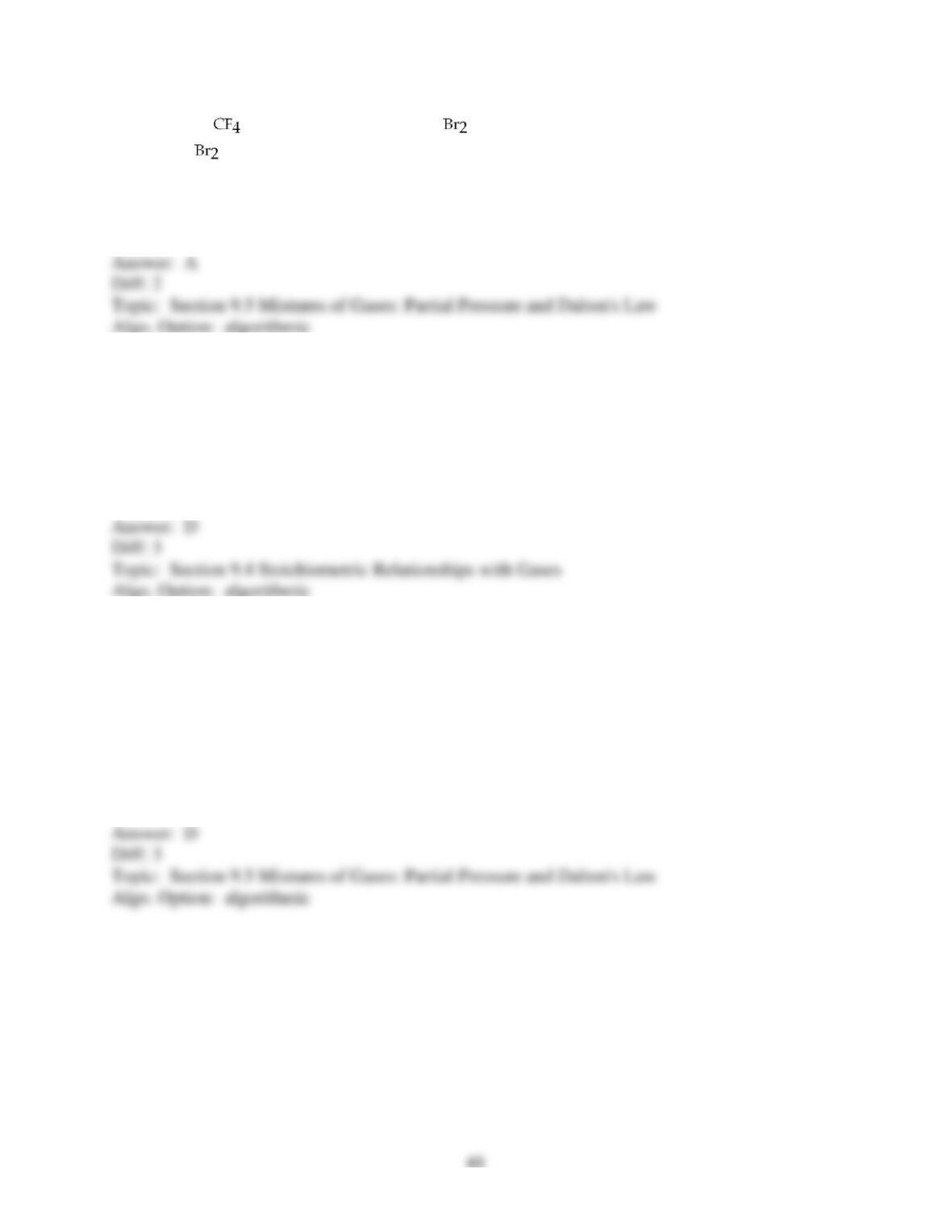
31) 2.13 g of (g) is mixed with 15.0 g of (g) in a 2.35 L container. What is the mole
fraction of (g) present in the mixture?
A) 0.205
B) 0.876
C) 0.118
D) 0.414
32) A 1.000 kg sample of nitroglycerine, C3H5N3O9, explodes and releases gases with a
temperature of 1985°C at 1.100 atm. What is the volume of gas produced?
4 C3H5N3O9(s) → 12 CO2(g) + 10 H2O(g) + 6 N2(g) + O2(g)
A) 742.2 L
B) 3525 L
C) 4730 L
D) 5378 L
33) In the laboratory, hydrogen gas is usually made by the following reaction:
Zn(s) + 2 HCl(aq) → H2(g) + ZnCl2(aq)
How many liters of H2 gas, collected over water at an atmospheric pressure of 752 mm Hg and a
temperature of 21.0°C, can be made from 3.566 g of Zn and excess HCl? The partial pressure of
water vapor is 18.65 mm Hg at 21.0°C.
A) 0.0975 L
B) 1.30 L
C) 1.33 L
D) 1.36 L
34) A 0.600 g sample containing Ag2O and inert material is heated, causing the silver oxide to
decompose according to the following equation:
2 Ag2O(s) → 4 Ag(s) + O2(g)
If 13.8 mL of gas are collected over water at 27°C and 1.00 atm external pressure, what is the
percentage of silver oxide in the sample? The partial pressure of water is 26.7 mm Hg at 27°C.
A) 10.4%
B) 20.9%
C) 41.8%
D) 44.8%
35) What is the average speed (actually the root-mean-square speed) of a neon atom at 27°C?
A) 5.78 m/s
B) 19.3 m/s
C) 183 m/s
D) 609 m/s
36) Which of the following gases has the highest average speed at 400K?
A) N2
B) O2
C) F2
D) Cl2
37) Which of the following gases has the lowest average speed at 25°C?
A) C3H8
B) Kr
C) CH3NH2
D) SO2
38) What is the temperature of NO2 gas if the average speed (actually the root-mean-square
speed) of the molecules is 750 m/s?
A) 1.38 K
B) 1.04 × 10³ K
C) 1.38 × 10³ K
D) 1.04 × 10⁶ K
39) If NO and NH3 are allowed to effuse through a porous membrane under identical
conditions, the rate of effusion for NH3 will be ________ times that of NO .
A) 0.57
B) 0.75
C) 1.3
D) 1.8
9.3 Short Answer Questions
1) Under the same pressure and temperature conditions, the level of water inside a barometer will
be ________ than the level of mercury inside the barometer by a factor equal to the ratio of the
density of ________ over the density of ________.
2) At an atmospheric pressure of 745 mm Hg, what is the pressure of He gas inside a cylinder
that is attached to an open-end manometer in which the level of mercury in the open side of the
manometer is 25 mm Hg higher than the side that is attached to the gas cylinder?
3) One mole of gas at 25°C in a 1.0-L flask has a ________ pressure than one mole of gas at
25°C in a 5.0-L flask.
4) One mole of gas at 25°C has a ________ volume than one mole of gas at standard
temperature.
5) At STP if 1.00 mole of gas occupies 22.4 L then 0.200 mole of gas would occupy ________ L
under the same conditions.
6) If one mole of gas occupies 22.4 L at STP the same gas would occupy ________ than 22.4 L
at 25°C and 738 mm Hg.
7) If 0.40 mol of NaN3 reacts completely in the reaction shown below, then ________ L of N2
will be produced at STP.
2 NaN3(s) → 2 Na(s) + 3 N2(g)
8) If 1.0 mol of N2 and 3.0 mol of H2 in a closed container initially at STP react completely in
the reaction shown below, then the final pressure in the flask will be ________ atm at 273 K.
N2(g) + 3 H2(g) → 2 NH3(g)
9) In a flask containing 2.00 mol of He, 3.00 mol of Ne, and 5.00 mol of Ar at STP the partial
pressure of He is ________ mm Hg.
10) Gases do not behave ideally under conditions of ________ pressure and ________
temperature.