149. The following data relates to Rose Industries during Year 8.
January 1, Year 8
December 31, Year 8
Raw Materials Inventory
$ 47,570
$ 58,640
Work-in-Process Inventory
128,910
117,390
Finished Goods Inventory
36,250
47,220
It incurred factory costs for the year as follows:
Raw Materials Purchased
$475,900
Labor Services Used
287,600
Other Factory Costs Incurred
129,200
Other data relating to the year are as follows:
Sales
$1,360,000
Selling and Administrative Expenses
$ 289,400
The income tax rate is 40 percent.
Required:
a.
Compute the cost of raw materials used during Year 8.
b.
Compute the cost of units completed during Year 8 and transferred to the finished goods storeroom.
c.
Compute net income for Year 8.
a.
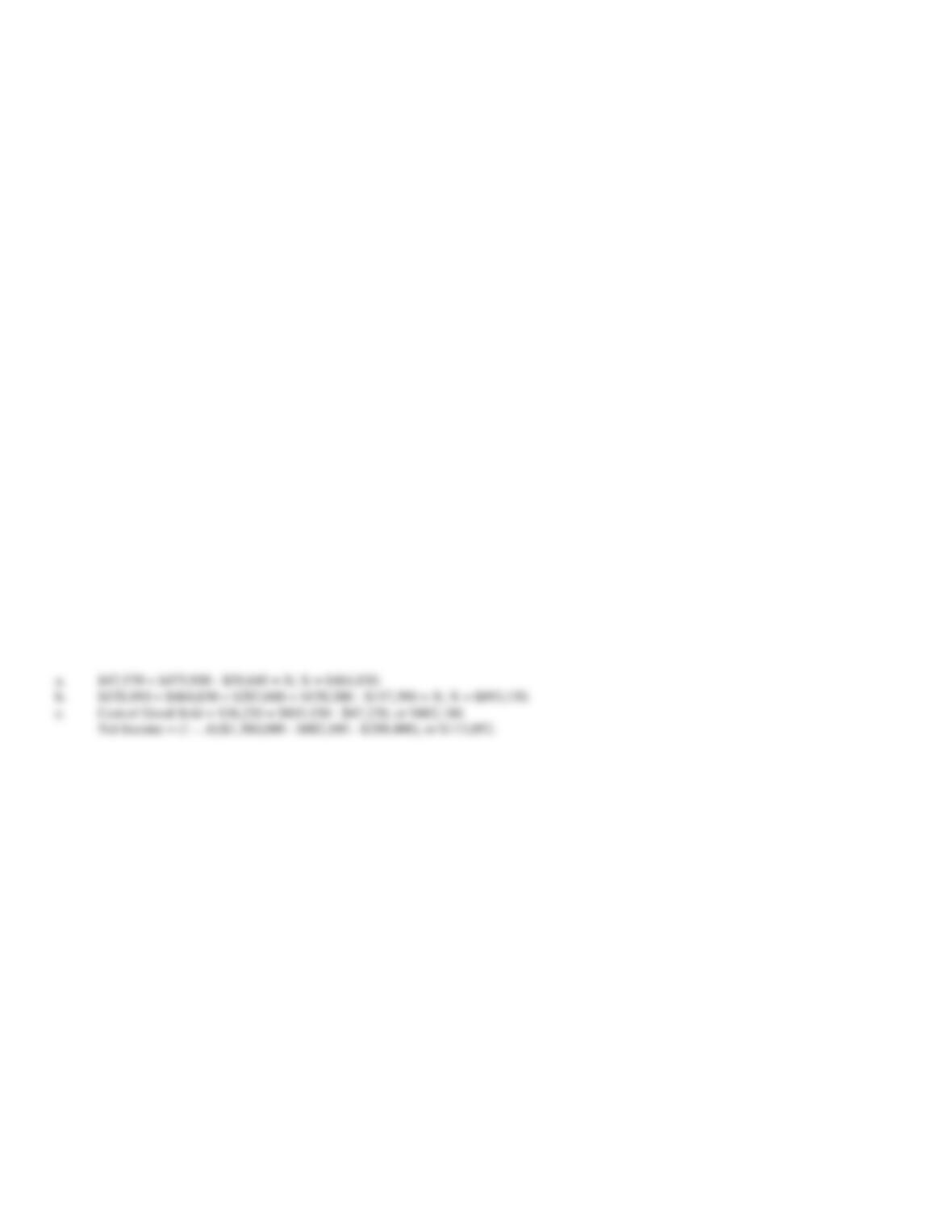
$47,570 + $475,900 – $58,640 = X; X = $464,830.
$128,910 + $464,830 + $287,600 + $129,200 – $117,390 = X; X = $893,150.
c.
Cost of Good Sold = $36,250 + $893,150 – $47,220, or $882,180.
Net Income = (1 – .4)($1,360,000 – $882,180 – $289,400), or $113,052.
150. Layman’s Fine Jewelry uses the LIFO cost flow assumption and has a beginning inventory which includes
four LIFO layers as follows:
Beginning inventory
# of units
Unit cost
Year 1 layer
150
$50.00
Year 2 layer
100
60.00
Year 3 layer
50
65.00
Year 4 layer
200
75.00
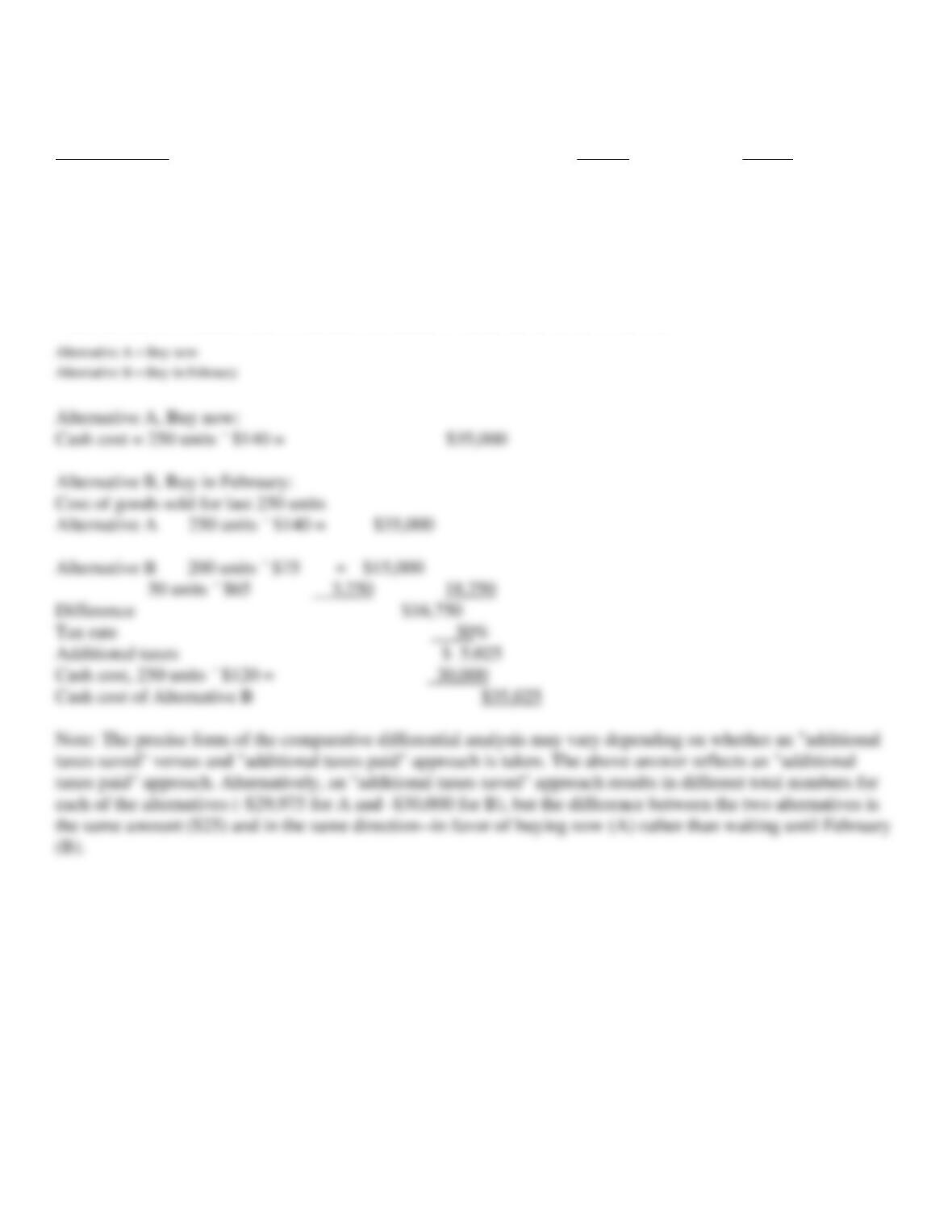
During Year 5, Layman purchased 4,000 units and sold 4,250. Layman has to decide whether to purchase 250 additional units now at a price of $140
per unit or wait until February and pay $120 per unit due to an off-season discount promotion by the supplier.
What is the cash cost to Layman’s Fine Jewelry under each alternative? Assume that the tax rate is a flat 30%.

151. Given the following inventory and inventory related accounts, solve for the unknown amounts.
Case A
Case
B
Beginning raw materials
(a)
$50
Raw materials purchases
$100
(f)
Ending raw materials
20
30
Raw materials transfers
80
90
Beginning work-in-process
(b)
40
Direct labor
30
(g)
Direct material
(c)
90
Manufacturing overhead
40
20
Ending work-in-process
50
40
Work-in-process transfers
160
130
Beginning finished goods
40
(h)
Transfers in
(d)
(i)
Ending finished goods
30
20
Cost of goods sold
(e)
120
$ 0
$ 70
b.
60
g.
20
80
h.
10
d.
160
130
170
152. Terrace Inc. uses the periodic LIFO cost flow assumption. During the period 23 units were sold at a price
of $30 per unit. Transportation costs on the purchases totaled $252.
# of units
Unit cost
Beginning balance
10
$25
Purchase 1
15
22
Purchase 2
9
20
Purchase 3
12
25
Required:
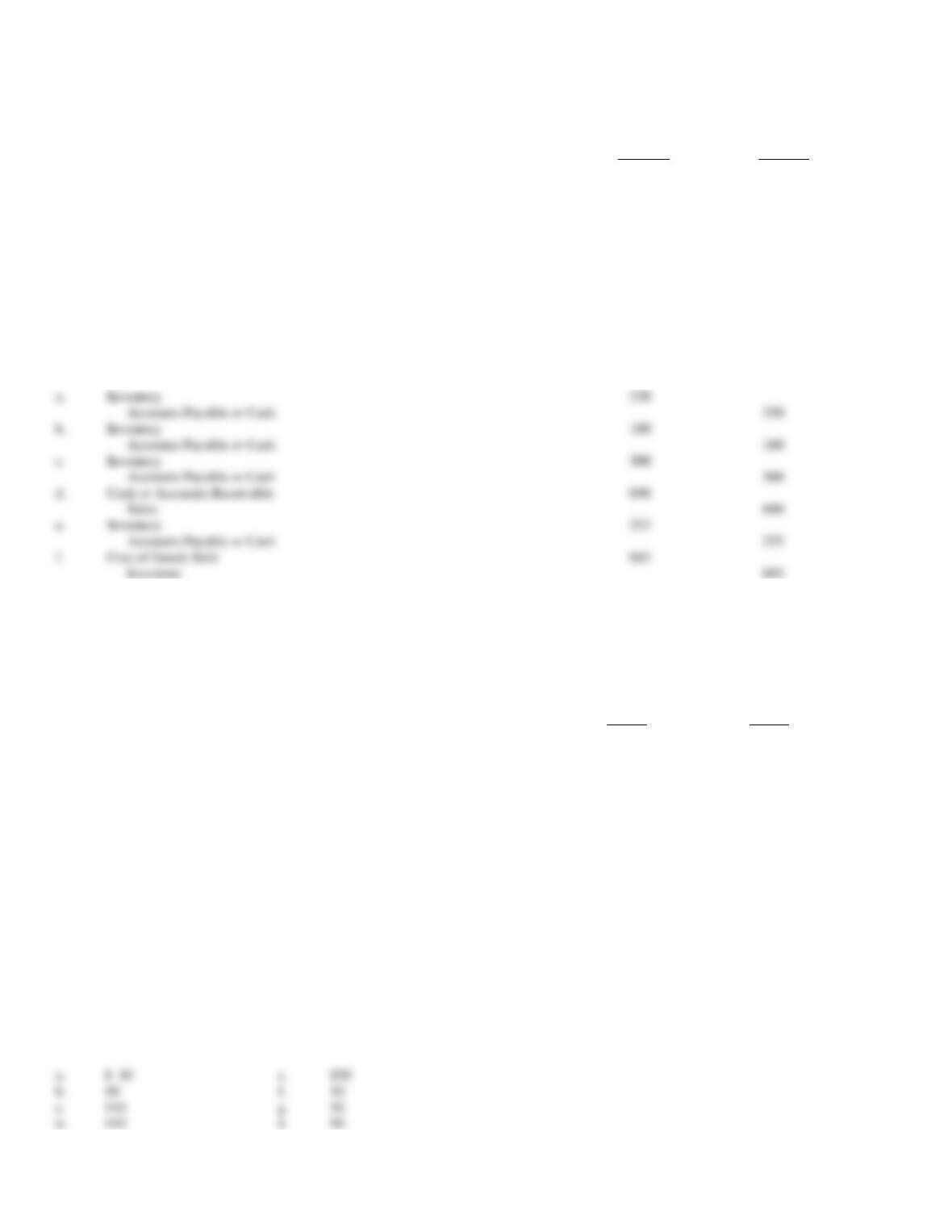
Prepare the journal entries to record the purchases and any adjusting entries for the end of the period.
153. Given the following inventory and inventory-related accounts, solve for the unknown amounts:
Case A
Case B
Beginning raw materials
$ 10
$ 30
Raw materials purchases
100
70
Ending raw materials
70
50
Raw materials transfers
(a)
(e)
Beginning work-in-process
50
(f)
Direct labor
50
40
Direct material
(b)
(g)
Manufacturing overhead
10
10
Ending work-in-process
40
10
Work-in-process transfers
(c)
100
Beginning finished goods
10
20
Transfers in
(d)
100
Ending finished goods
20
30
Cost of goods sold
100
(h)
Inventory
330
Accounts Payable or Cash
330
b.
Inventory
180
Accounts Payable or Cash
180
Inventory
300
Accounts Payable or Cash
300
d.
Cash or Accounts Receivable
690
Sales
690
Inventory
252
Accounts Payable or Cash
252
Cost of Goods Sold
685
Inventory
685

154. Given the following information, compute cost of goods sold and ending inventory for months 1 through 4
using both the FIFO and LIFO cost flow assumptions. Assume that a periodic inventory method is used and that
the books are closed monthly.
# of units
Unit cost
Beginning inventory
0
Purchases:
Month 1
5
$1.00
Month 1
15
1.10
Month 1
3
1.05
Withdrawals:
Month 1
13
Purchases:
Month 2
10
1.10
Month 2
15
1.05
Withdrawals:
Month 2
20
Purchases:
Month 3
10
1.05
Month 3
5
1.10
Month 3
2
1.15
Withdrawals:
Month 3
25
Purchases:
Month 4
15
1.05
Month 4
5
1.10
Withdrawals:
Month 4
20
FIFO
LIFO
Cost of goods sold – month 1
$13.80
$14.15
Ending inventory – month 1
10.85
10.50
Cost of goods sold – month 2
$21.85
$21.25
Ending inventory – month 2
15.75
16.00
FIFO
LIFO
Cost of goods sold – month 3
$26.25
$27.10
Ending inventory – month 3
7.80
7.20
Cost of goods sold – month 4
$21.45
$21.25
Ending inventory – month 4
7.60
7.20
155. The following items appear in the post-closing trial balance for March 1 and on the adjusted, preclosing
trial balance at March 31 of Parker Company. Parker Company prepares financial statements monthly.
March 1
March 31
Raw materials
$10,000
$ 8,000
Work in process
15,000
25,000
Finished goods inventory
10,000
14,000
Sales (Cr balance)
–
600,000
Allowance for uncollectible accounts (Cr balance)
6,000
10,000
During the month of March, Parker Company incurred the following costs:
Raw materials used in production
$130,000
Labor costs used in production
80,000
Labor costs used in administration and marketing
10,000
Factory overhead costs for production
60,000
Office administration costs, other than labor
12,000
Accounts receivable written off as uncollectible
9,000
Required:
a.
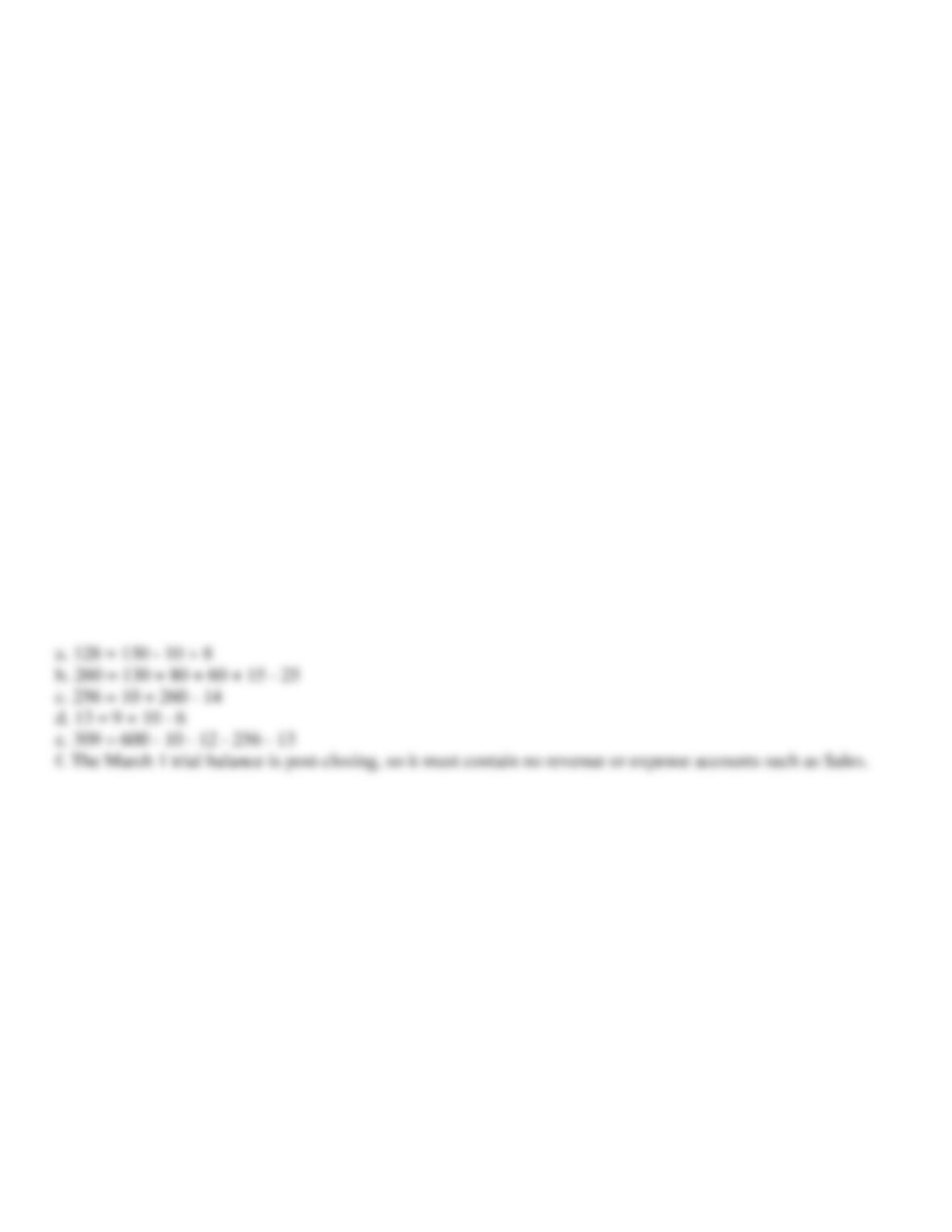
What was the acquisition cost of raw materials purchased during the month of March?
b.
What was the total cost of goods completed during the month of March?
c.
What was the Cost of Goods Sold during the month of March?
d.
What was the Uncollectible account expense for the month of March?
e.
What was the Income (before taxes) for the month of March?
f.
Explain briefly why no amount for sales appears in the March 1 trial balance.

156. For the following six items, assume that Green Company, a growing profitable company, has large and
growing inventories. Assume that Green Company has been using a FIFO cost flow assumption and plans to
switch to LIFO for both financial reporting and tax reporting. Assume that Green pays all income taxes
currently, as accrued, in cash.
Required:
Fill in each of the blanks below with one of these: larger, smaller, unchanged, or insufficient (information given
to answer question). Several years after the switch from FIFO to LIFO:
1.
Working capital will be __________.
2.
Accounts payable will be __________.
3.
On the statement of cash flows, cash provided by operating activities will be __________.
4.
Total shareholders’ equity will be __________.
5.
Deferred tax balance on the balance sheet will be __________.
6.
Inventory turnover will be __________.
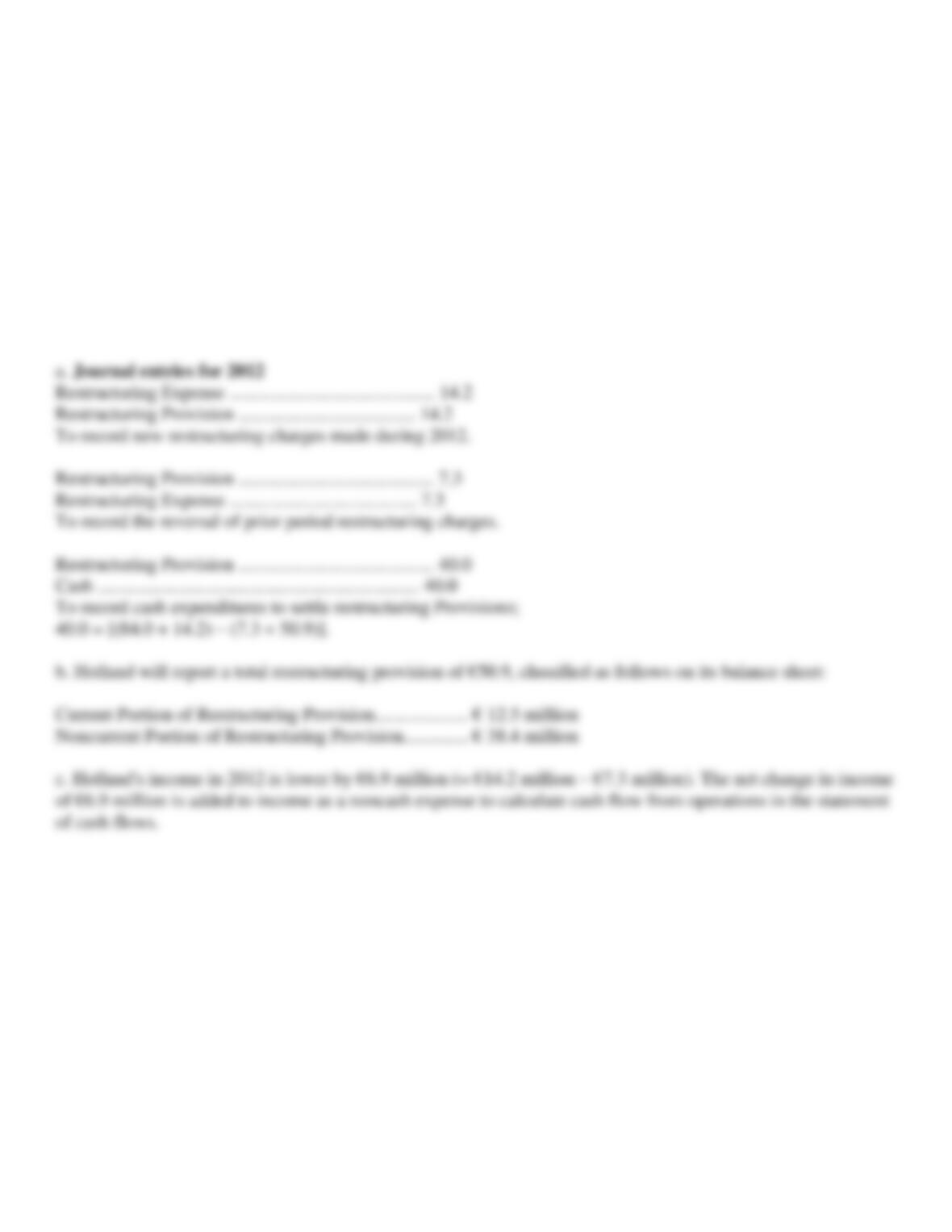
157. On December 31, 2012, Holland Group reported a balance in Restructuring Provisions of €50.9 million, of
which €12.5 million was expected to be paid in 2013, with the remainder to be settled during 2014–2015. The
balance in this account at the start of the year was €84.0 million. During 2012, assume that Holland accrued
restructuring charges of €14.2 million, and
reversed €7.3 million of previous charges.
REQUIRED:
a. Prepare all journal entries Holland made during 2012 related to its restructuring
activities.
b. How will Holland report its Restructuring Provision on its balance sheet for the year
ended December 31, 2012?
c. What is the effect of Holland’s 2012 restructuring activities on its income statement?
How are these activities displayed on the statement of cash flows? Ignore tax effects.
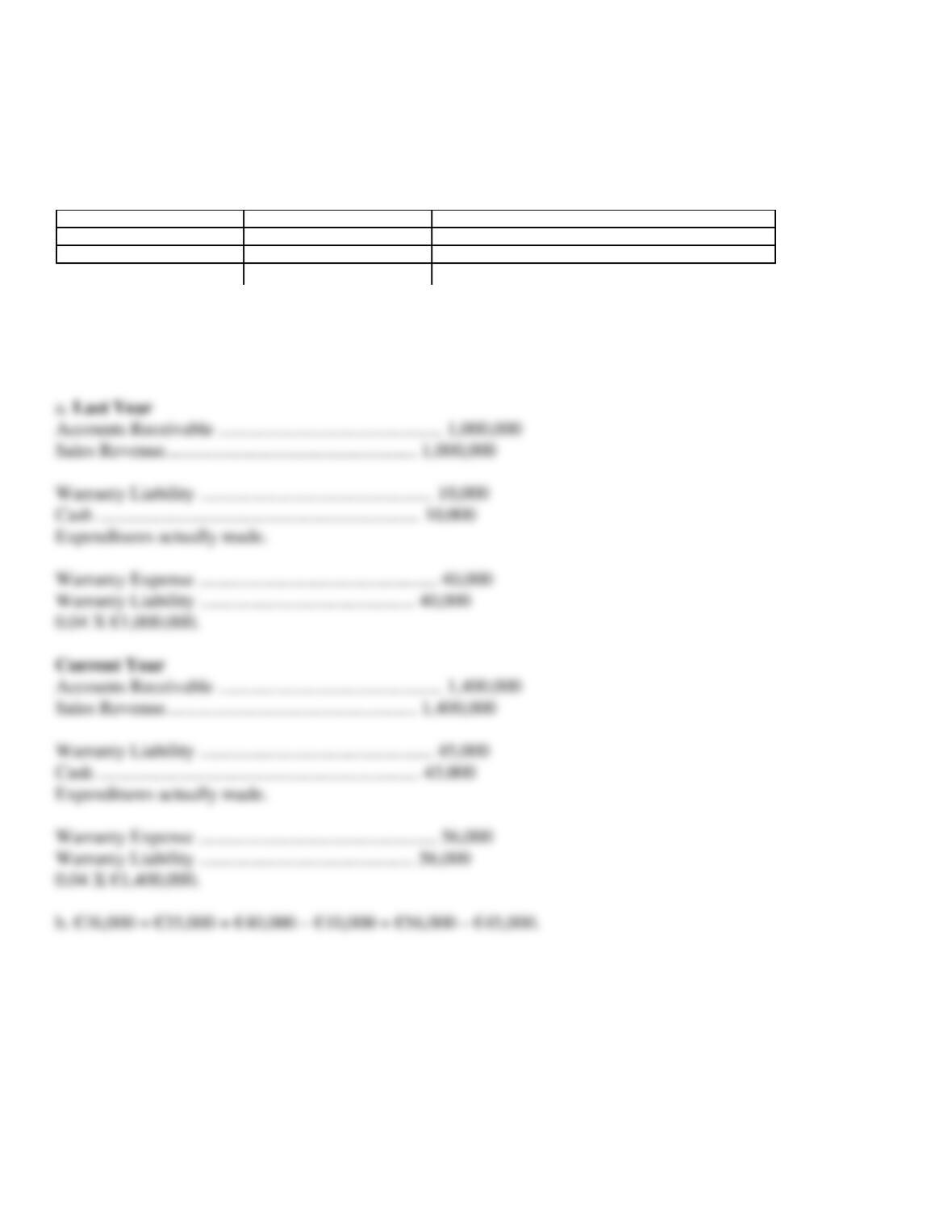
158. March Company is a European family-owned equipment business. Assume that March provides a two-year
warranty on its products and that March estimates current year warranty costs to be 4% of sales revenues. At the
end of last year, March’s balance sheet carrying value of estimated warranty liabilities was €35,000. March will
incur actual warranty costs over the two years following the time of sale. Assume that sales (all on account) and
actual warranty expenditures (all paid in cash) were as follows:
Sales
Actual Warranty Expenditures
Last Year
€1,000,000
€10,000
Current Year
1,400,000
45,000
REQUIRED:
a. Prepare journal entries to recognize sales revenues, warranty costs, and warranty expenditures in for the two years. Closing entries are not
required.
b. What is the balance in the Warranty Liability account at the end of the current year?
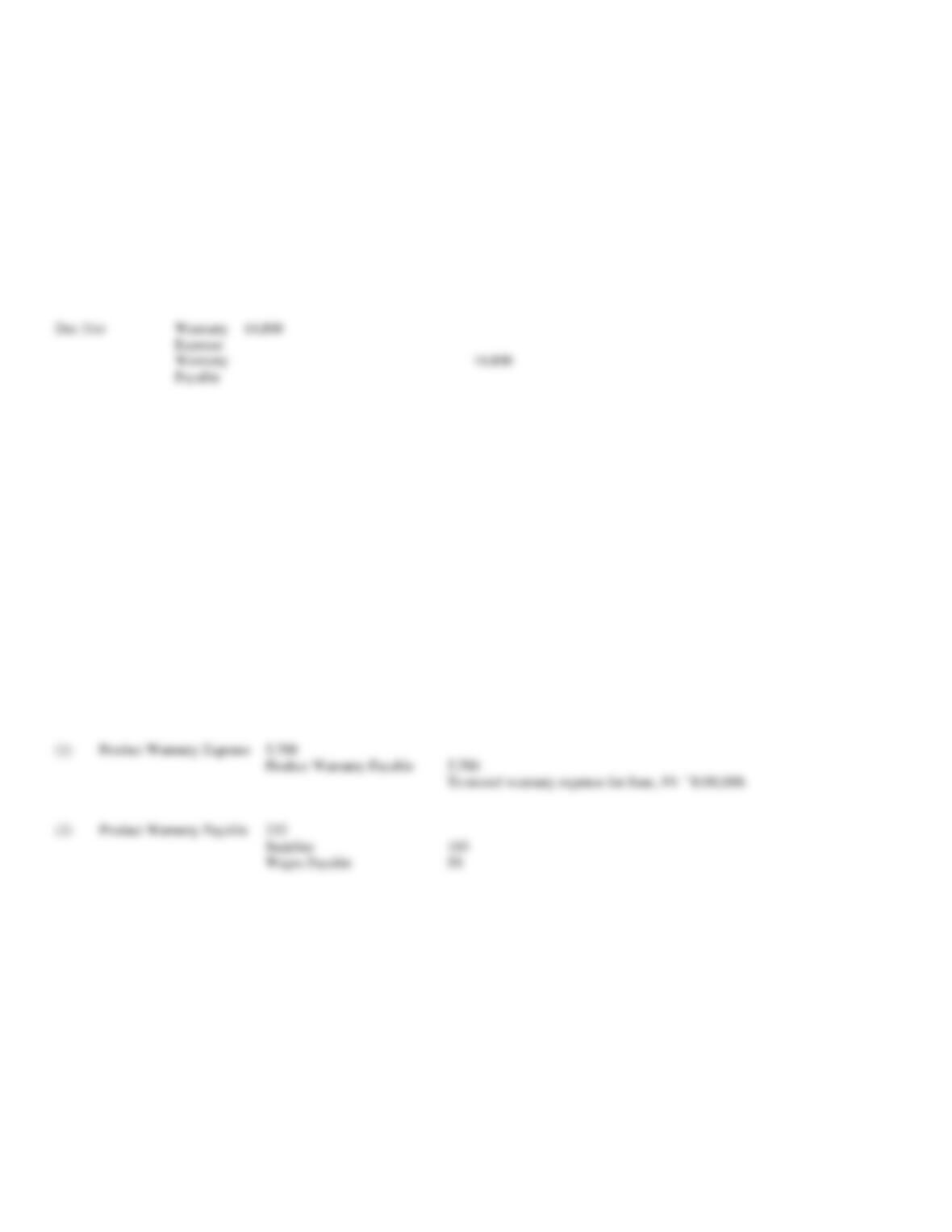
159. Cool Pools Construction installs swimming pools. They calculate that warranty obligations are 3% of gross
sales. For the year just ending Cool Pools’ gross sales were $1,450,000. Due to previous quarter recognitions,
the Warranty Liability account has a credit balance of $28,700.
REQUIRED:
Determine the year’s total warranty liability and journalize any necessary value to establish the year’s liability
at December 31st.
Due to sales, $1,450,000, warranty liability is ($1,450,000 ´ 3%) $43,500. Since $28,700 has already been
recognized, $14,800 (or $43,500 minus $28,700) must still be recognized.
160. Forrest Industries warrants its products for one year. The estimated product warranty is 3% of
sales. Assume that sales were $190,000 for June. In July, a customer received warranty repairs requiring $185
of parts and $50 of labor.
Required:
(1)
Journalize the adjusting entry required at June 30, the end of the first month of the current year, to record the accrued product
warranty.
(2)
Journalize the entry to record the warranty work provided in July.
(1)
Product Warranty Expense
5,700
To record warranty expense for June, 3% ´ $190,000.
Supplies
Wages Payable
Dec 31st
Warranty
Expense
14,800
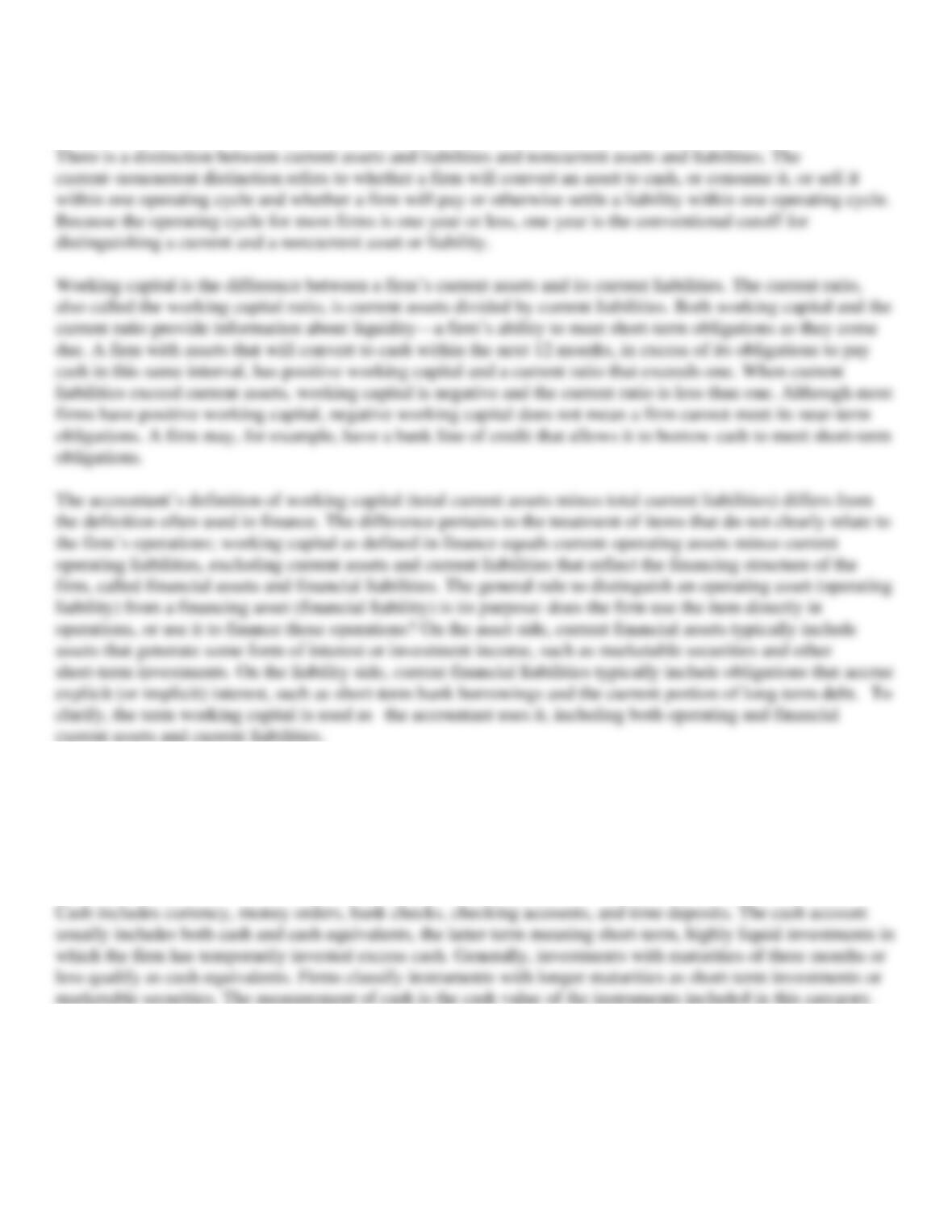
161. Describe the concept of working capital.
UNDERLYING CONCEPTS AND TERMINOLOGY
162. Describe cash and cash equivalents.
CASH AND CASH EQUIVALENTS