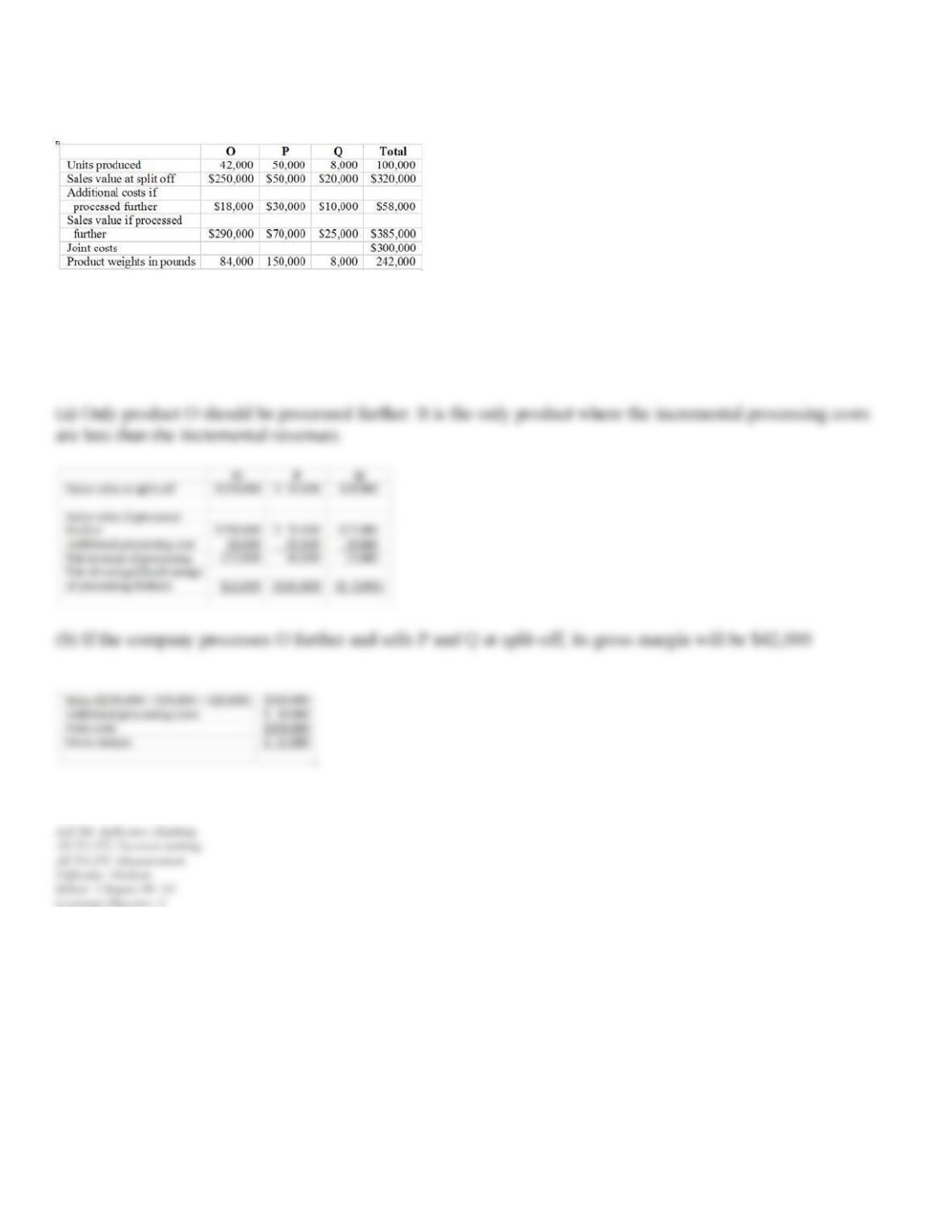
91. Reading Corporation produces three products in a joint process.
Additional information is as follows:
Required:
a) Determine which products should be sold at split-off and which should be processed further.
b) Assuming the company makes decisions that are in its best interests for overall profitability, what would be
the company’s gross margin?
92. Summerfield Foods produces three supplemental food products simultaneously through a refining process
costing $186,000. The joint products, Bulkup and Bodybuilder, have a final selling price of $8 per pound and
$10 per pound, respectively, after additional processing costs of $2 per pound for each product incurred after
the split-off point. Quicksnack, a by-product, is sold at the split–off point for $6 per pound. The production of
Bulkup results in 20,000 pounds with a caloric value of 6,000 calories per pound. The production of
Bodybuilder, which is very high in carbohydrates, has a caloric value of 12,500 calories per pound. 10,000
pounds of Bodybuilder are produced. Quicksnack has a caloric value of 2,000 calories a pound and 2,000
pounds are produced. (C. M. A. AdapteD.
Required:
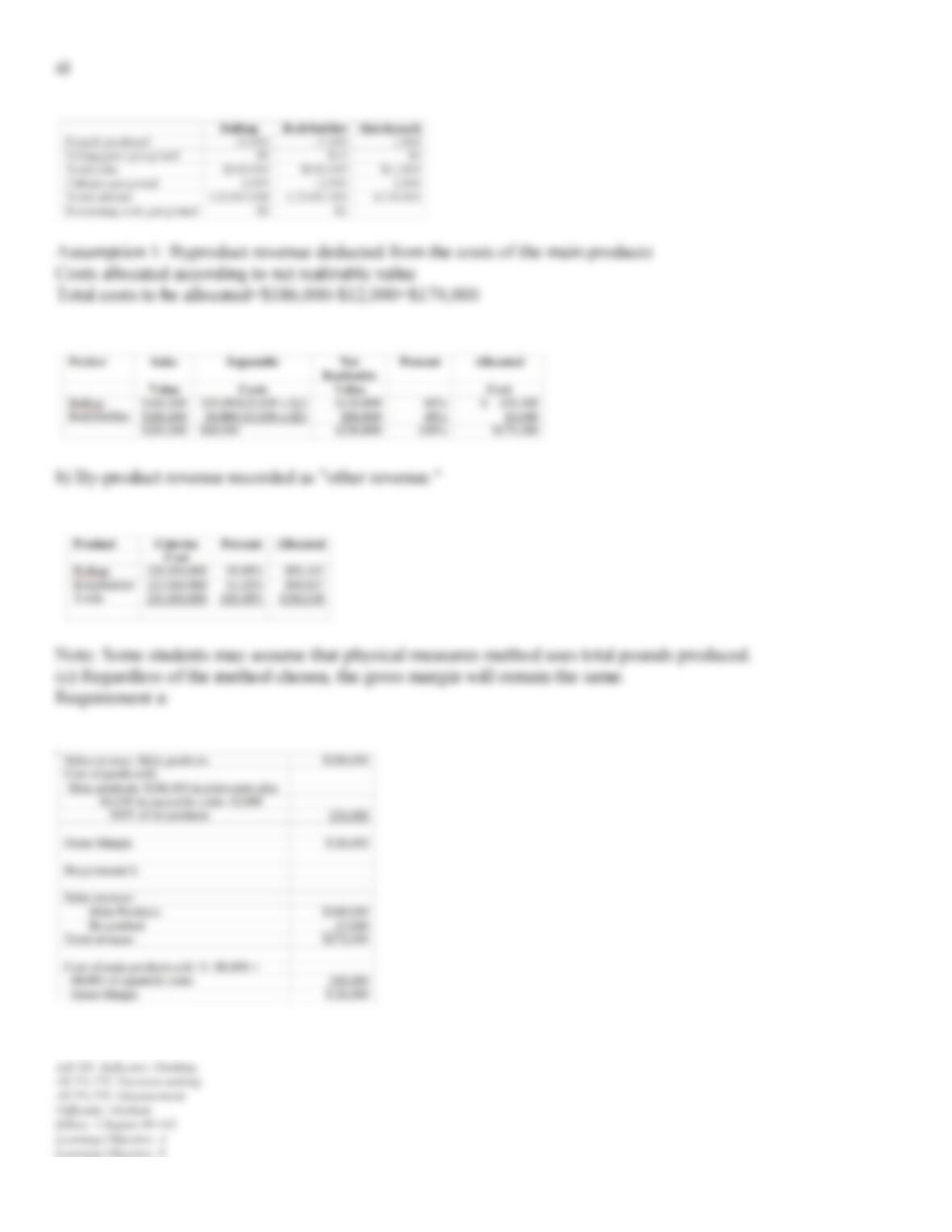
(a) Allocate the joint-product costs using the net-realizable-value method, assuming that Quicksnack is
accounted for as a by-product, with its net–realizable value deducted from the cost of the main products.
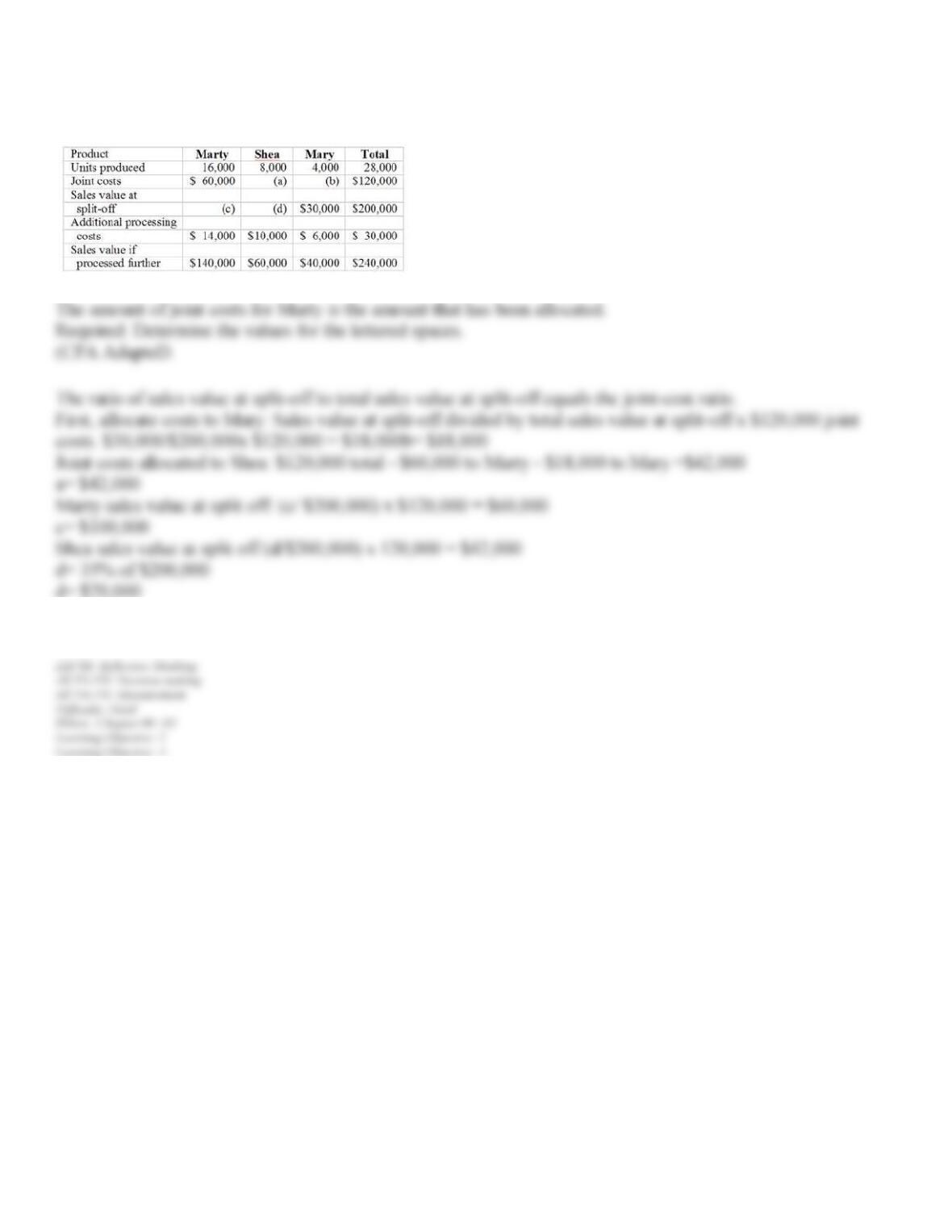
(b) Allocate the joint-product costs using the physical measures method, assuming that Quicksnackis accounted
for as a by-product, with its sales revenue accounted for as “other revenue. “
(c) Compute Summerfield Food‘s gross margin under requirements a and b.
93. Covehead Corporation produces three products from a joint process: Marty, Shea and Mary. Each product
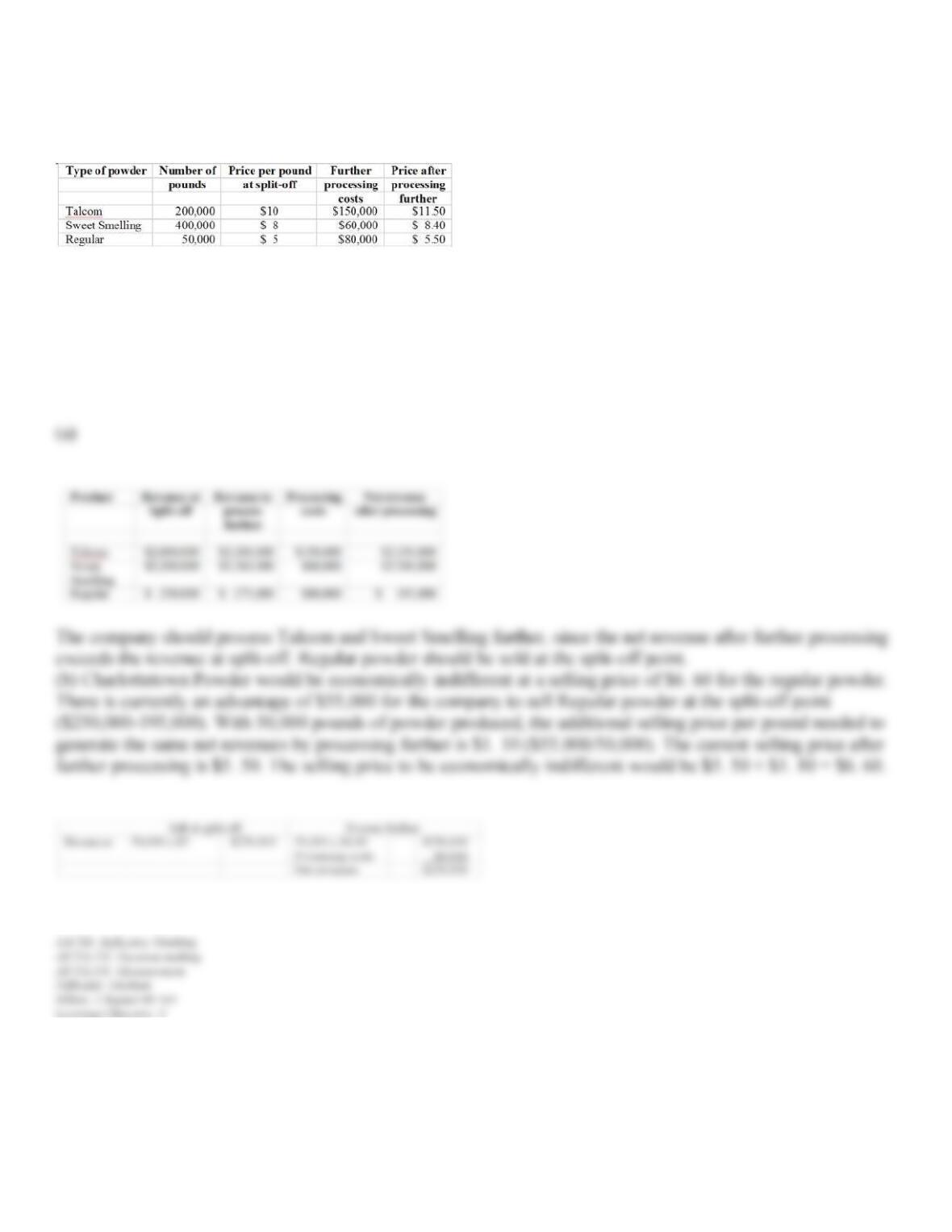
can be processed further and sold for more. Data on the processes are as follows:
94. Charlottetown Powder Company produces powder in batches. Each powder can be sold in its current
condition or processed further and specialized for high priced department stores. Data concerning the various
products appear below. Joint processing costs are $200,000.
Required:
(a) Determine which products should be sold at split-off and which should be processed further.
(b) Charlottetown Powder is approached by the Brudnelle Department Store chain. Brudnelle would like
Charlottetown Powder to process regular powder into a special powder for its cosmetics department. At what
price per pound would Charlottetown Powder be economically indifferent between selling the powder at the
split–off point and processing it further for Brudnelle?
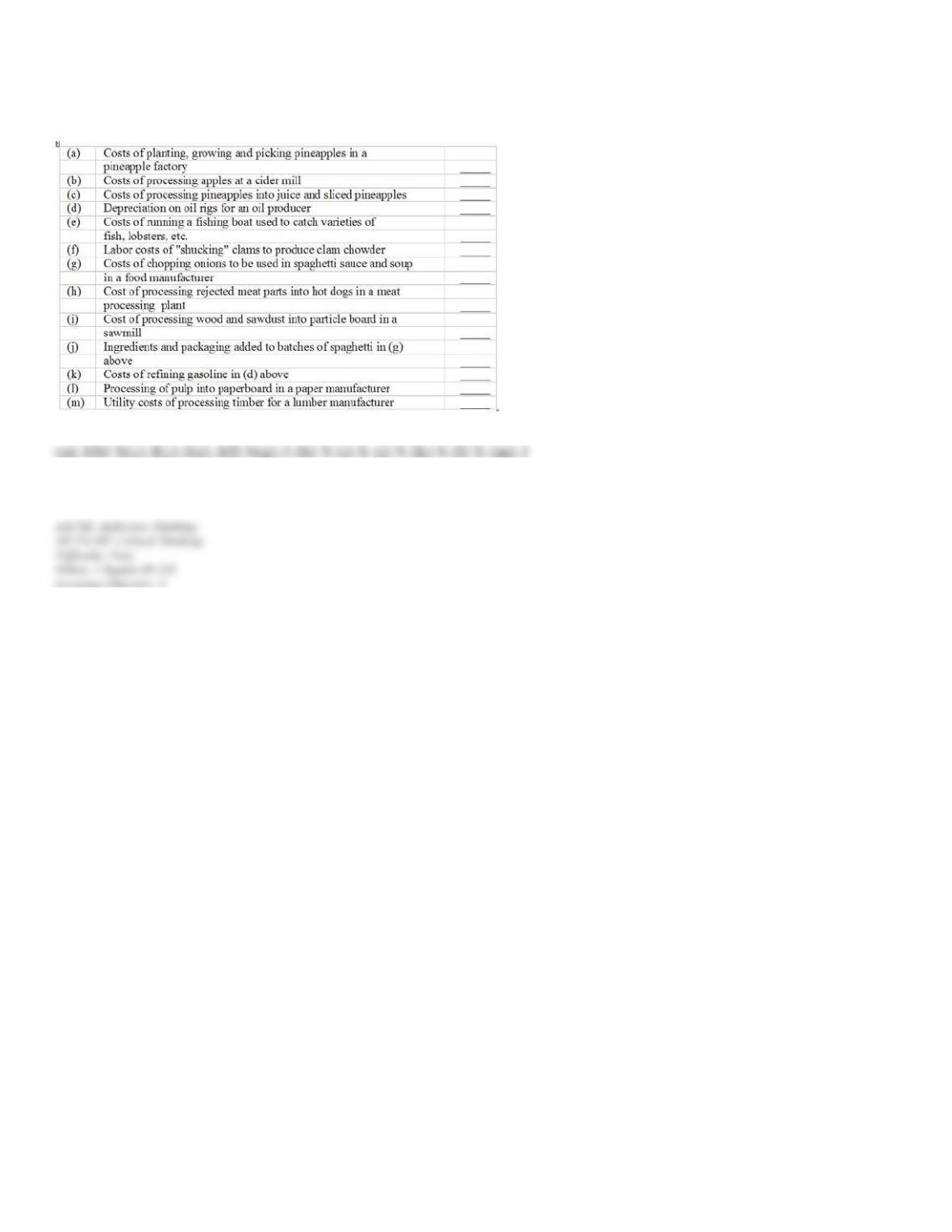
95. Indicate whether the following costs would be treated as joint–product costs or costs incurred after the
split-off point. Use J for joint product costs and S for costs incurred after the split-off point.

96. Peters Pineapples is a pineapple grower. After cultivating, fertilizing, growing and picking pineapples, the
company sells whole pineapples to food processors. The company is considering adding a processing line where
sliced pineapples and pineapple juice, along with a “mash” used for animal feed will be the final products.
Projected information about the costs follows:
Joint product costs of cultivating, fertilizing and picking pineapples total $1,000,000.
Required:
(a) Determine the amount of separable costs allocated to each product using the net-realizable-value method.
(b) Determine the final cost per unit for each product
(c) Determine the gross margin for each product.
(d) A fertilizer manufacturer approaches Peter Good, the President of the company, and asks to buy the rinds
and other excess materials currently used to produce Mash. He would be willing to pay $0. 30 per pound for
these materials. What advice would you give Peter?
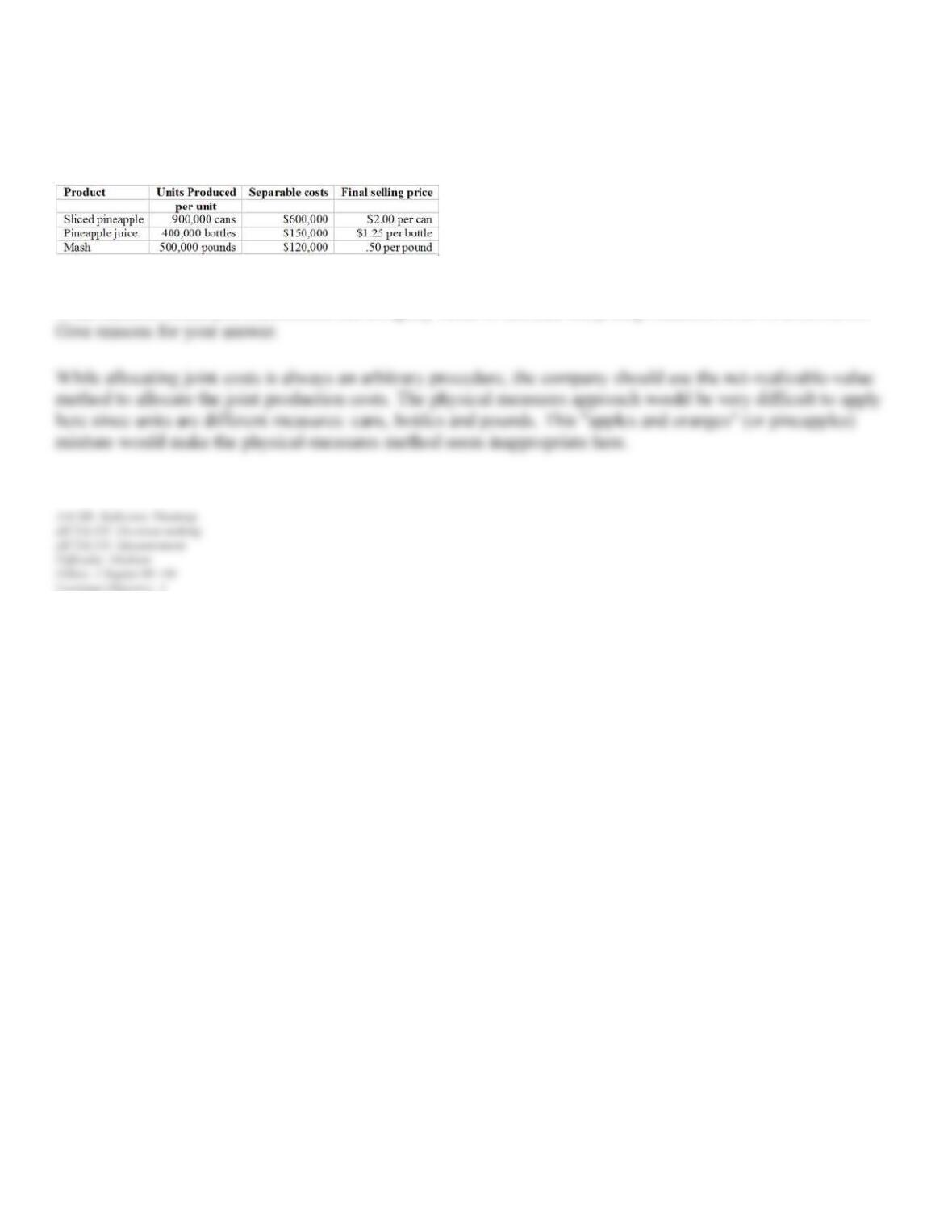
97. JarvisManufacturing produces three products in a joint operation. Information regarding the products
appears below:
Required: (Appendix)
(a) Allocate the joint costs using the relative sales value at split-off method.
(b) Allocate the joint costs using the constant gross margin percentage method.
98. Peters Pineapples is a pineapple grower. After cultivating, fertilizing, growing and picking pineapples, the
company sells whole pineapples to food processors. The company is considering adding a processing line where
sliced pineapples and pineapple juice, along with a “mash” used for animal feed will be the final products.
Projected information about the costs follows:
Joint processing costs totaled $1,000,000.
What method would you recommend the company select to allocate the joint production costs of $1,000,000?
99. Frank Purdue was successful at “branding” the product of chickens by marketing his chickens to be superior
to other brands. The company had complete control over the production process from the feed to the final
processing. Since some chickens did not pass final inspection because they were not the size or color desired for
a “Purdue” chicken, the company sold those chickens as feed to local pig producers. Frank came across the idea
of using the extra meat and byproducts of those chickens in a “chicken hot dog” which essentially required
adding spices to a mixture until the final product tasted like a hot dog. Identify the quantitative and qualitative
aspects of the decision to process the extra chicken meat into chicken hot dogs. What specific additional costs
can you identify that would be considered separable costs of producing the hot dogs? (Educational video on
Purdue chickens)