7) In computing the weighted average cost of capital, from a strictly theoretical point of view, the
preferred weighing scheme is target market value proportions.
8) Weights that use accounting values to measure the proportion of each type of capital in a
firm’s financial structure are called market value weights.
9) Weights that use accounting values to measure the proportion of each type of capital in a
firm’s financial structure are called book value weights.
10) Historical weights are the present value of market price based on the actual historical capital
structure proportions.
11) Target weights are either book value or market value weights based on a firm’s desired
capital structure proportions.
12) Target weights are either book value or market value weights based on actual historical
capital structure proportions.
13) The weights used in weighted average cost of capital must be ________.
A) greater than 50%
B) nonnegative
C) less than zero
D) zero
14) The preferred capital structure weights to be used in the weighted average cost of capital are
________.
A) book value weights
B) nominal weights
C) historic weights
D) target weights
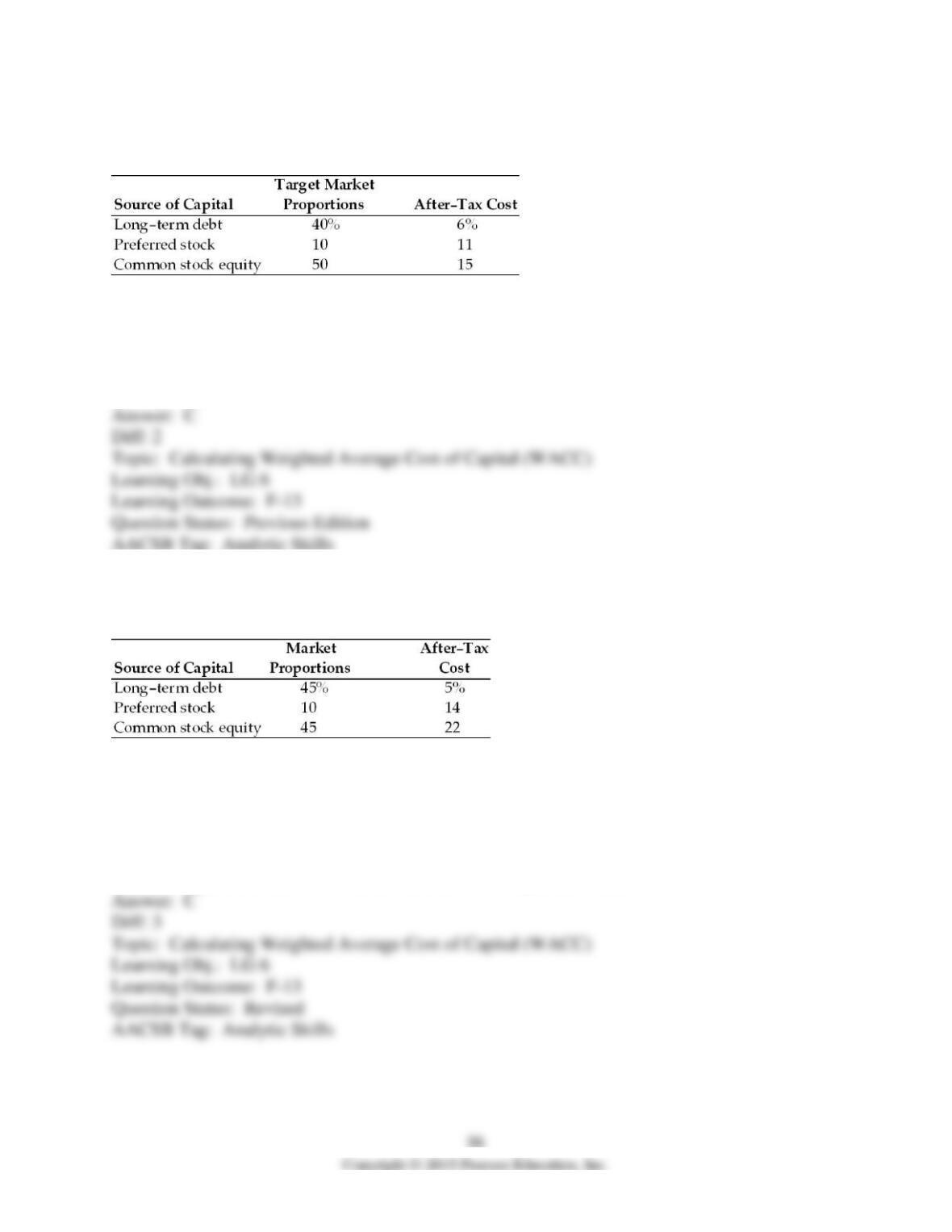
15) A firm has determined its cost of each source of capital and optimal capital structure, which
is composed of the following sources and target market value proportions:
The weighted average cost of capital is ________.
A) 6 percent
B) 10.7 percent
C) 11 percent
D) 15 percent
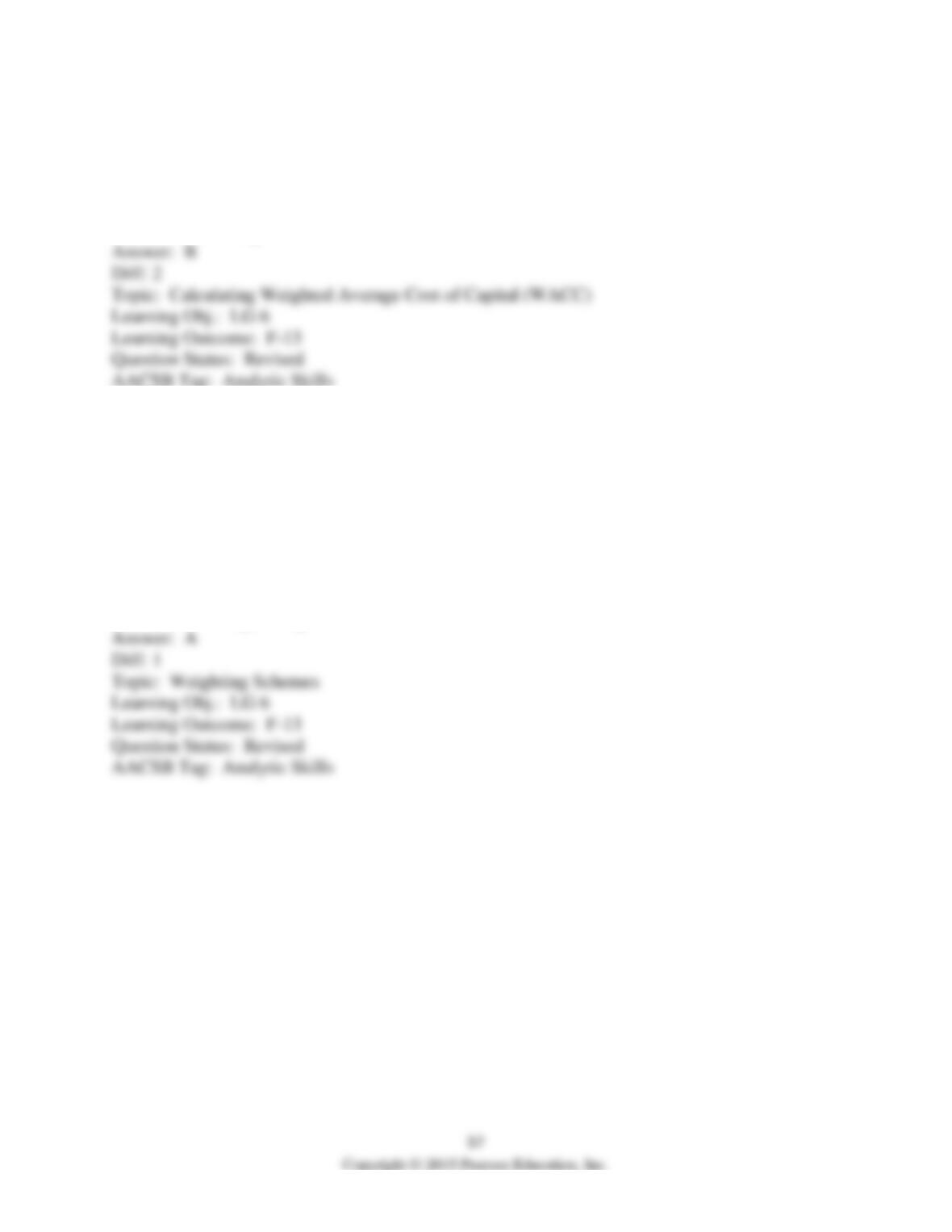
16) A firm has determined its cost of each source of capital and optimal capital structure, which
is composed of the following sources and current market value proportions:
Other things remaining constant, if the firm were to shift toward a capital structure with
________ the weighted average cost of capital will be higher.
A) 45% long-term debt, 40% common stock, and 15% preferred stock
B) 60% long-term debt, 20% common stock, and 20% preferred stock
C) 20% long-term debt, 60% common stock, and 20% preferred stock
D) 60% long-term debt, 30% common stock, and 10% preferred stock
17) As the need for capital increases beyond the optimum capital structure, the cost of debt
financing will ________, ________ the firm’s weighted average cost of capital.
A) increase; lowering
B) increase; raising
C) decrease; lowering
D) decrease; raising
18) When discussing weighing schemes for calculating the weighted average cost of capital,
________.
A) market value weights are preferred over book value weights and target weights are preferred
over historical weights
B) book value weights are preferred over market value weights and target weights are preferred
over historical weights
C) book value weights are preferred over market value weights and historical weights are
preferred over target weights
D) market value weights are preferred over book value weights and historical weights are
preferred over target weights
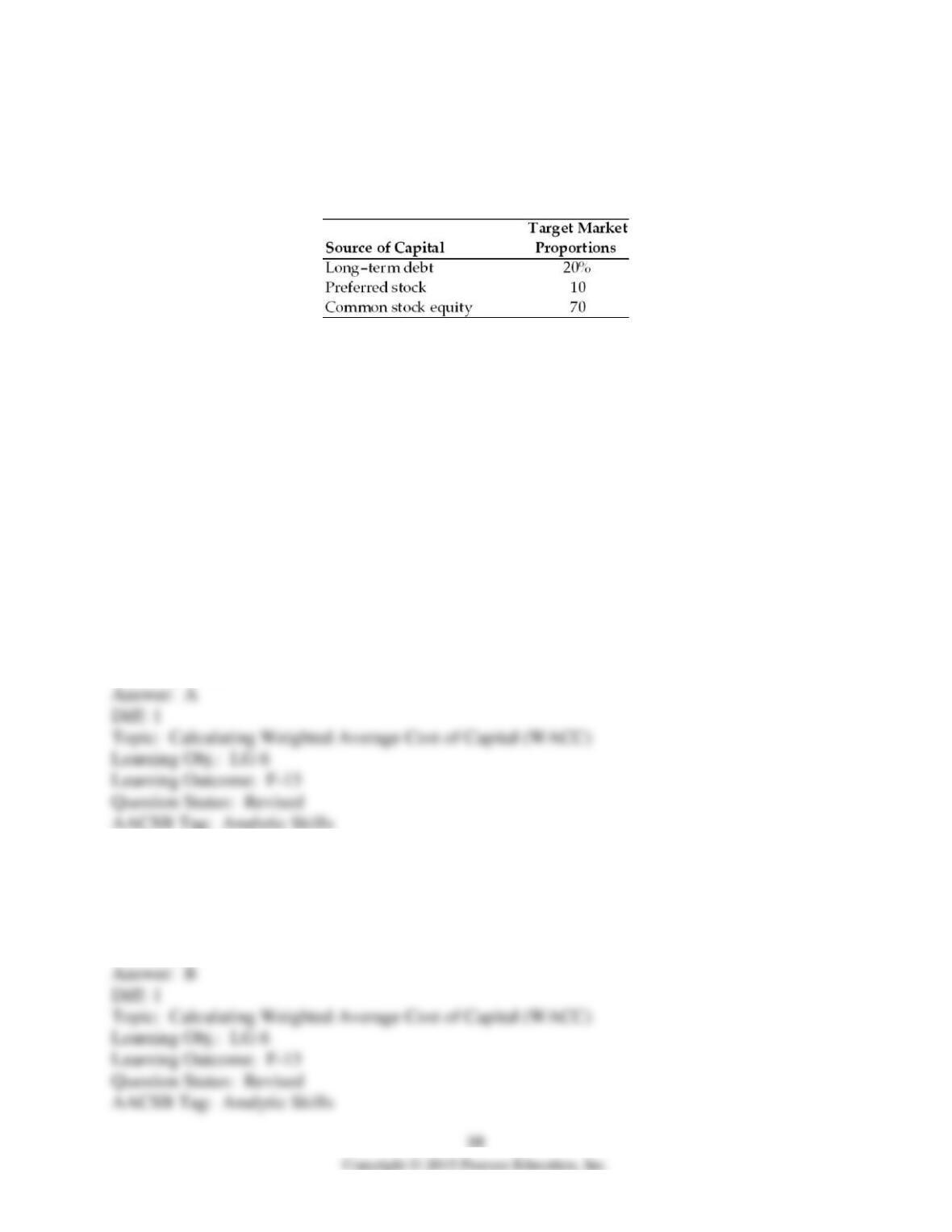
Table 9.1
A firm has determined its optimal capital structure which is composed of the following sources
and target market value proportions.
Debt: The firm can sell a 12-year, $1,000 par value, 7 percent bond for $960. A flotation cost of
2 percent of the face value would be required in addition to the discount of $40.
Preferred Stock: The firm has determined it can issue preferred stock at $75 per share par
value. The stock will pay a $10 annual dividend. The cost of issuing and selling the stock is $3
per share.
Common Stock: A firm’s common stock is currently selling for $18 per share. The dividend
expected to be paid at the end of the coming year is $1.74. Its dividend payments have been
growing at a constant rate for the last four years. Four years ago, the dividend was $1.50. It is
expected that to sell, a new common stock issue must be underpriced $1 per share in floatation
costs. Additionally, the firm’s marginal tax rate is 40 percent.
19) The firm’s before-tax cost of debt is ________. (See Table 9.1)
A) 7.8 percent
B) 10.6 percent
C) 11.2 percent
D) 12.7 percent
20) The firm’s after-tax cost of debt is ________. (See Table 9.1)
A) 3.25 percent
B) 4.67 percent
C) 8 percent
D) 8.13 percent
21) The firm’s cost of preferred stock is ________. (See Table 9.1)
A) 7.2 percent
B) 8.3 percent
C) 13.3 percent
D) 13.9 percent
22) The firm’s cost of a new issue of common stock is ________. (See Table 9.1)
A) 7 percent
B) 9.08 percent
C) 14.2 percent
D) 13.4 percent
23) The firm’s cost of retained earnings is ________. (See Table 9.1)
A) 10.2 percent
B) 13.9 percent
C) 13.7 percent
D) 13.6 percent
24) The weighted average cost of capital up to the point when retained earnings are exhausted is
________. (See Table 9.1)
A) 7.5 percent
B) 8.65 percent
C) 10.4 percent
D) 11.9 percent
25) If the target market proportion is reduced to 15 percent, what will be the revised weighted
average cost of capital? (See Table 9.1)
A) 13.6 percent
B) 11.0 percent
C) 12.34 percent
D) 10.4 percent
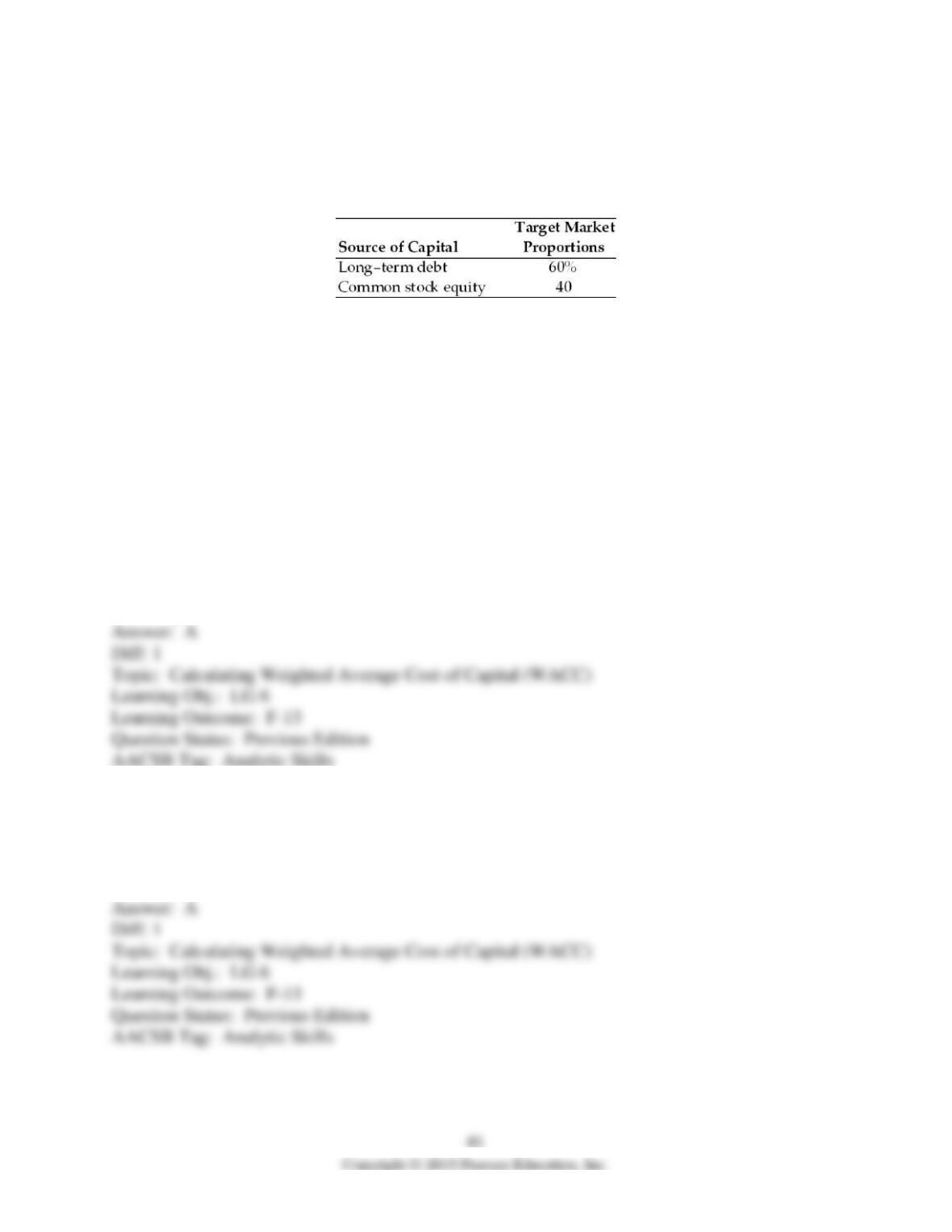
Table 9.2
A firm has determined its optimal structure which is composed of the following sources and
target market value proportions.
Debt: The firm can sell a 15-year, $1,000 par value, 8 percent bond for $1,050. A flotation cost
of 2 percent of the face value would be required in addition to the premium of $50.
Common Stock: A firm’s common stock is currently selling for $75 per share. The dividend
expected to be paid at the end of the coming year is $5. Its dividend payments have been
growing at a constant rate for the last five years. Five years ago, the dividend was $3.10. It is
expected that to sell, a new common stock issue must be underpriced $2 per share and the firm
must pay $1 per share in flotation costs. Additionally, the firm has a marginal tax rate of 40
percent.
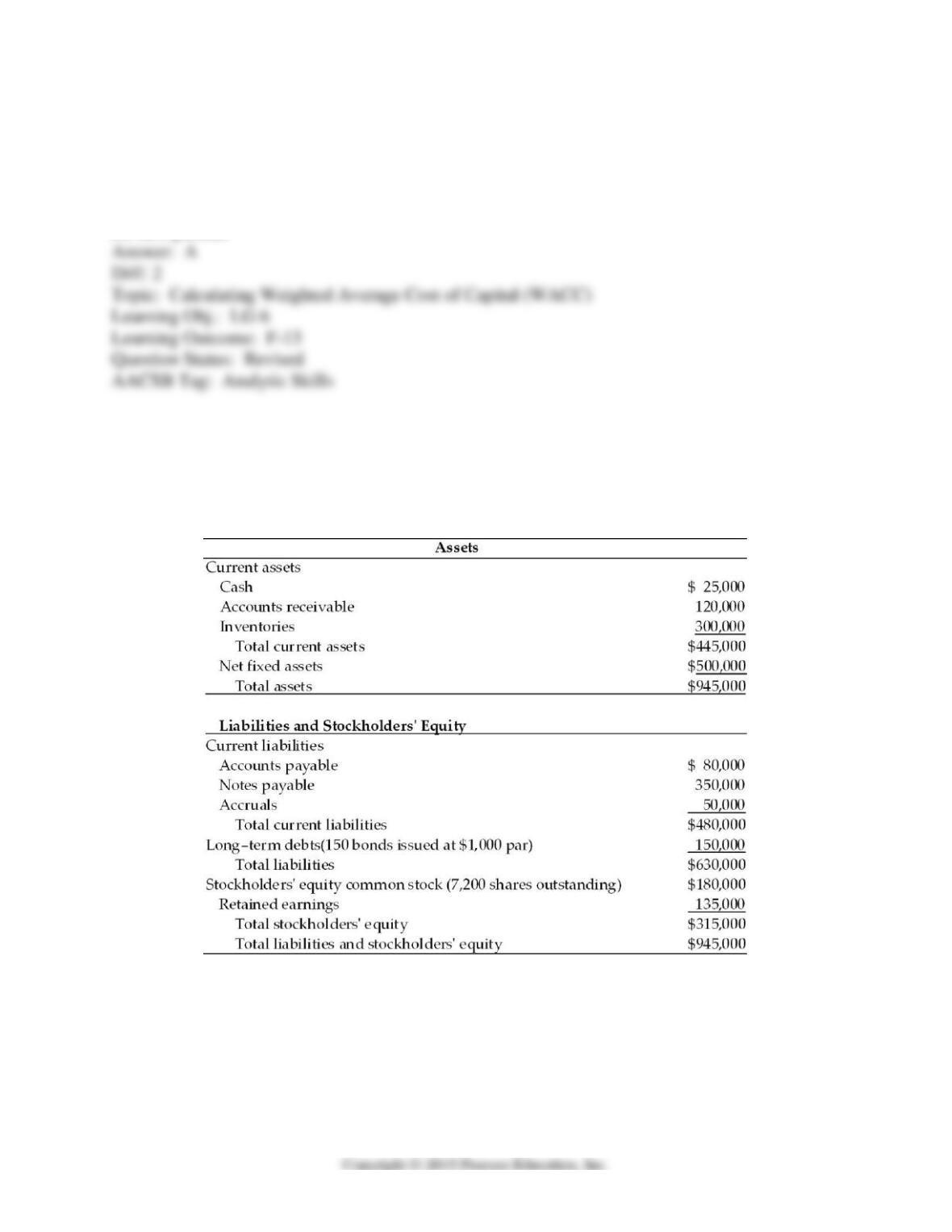
26) The firm’s before-tax cost of debt is ________. (See Table 9.2)
A) 7.7 percent
B) 10.6 percent
C) 11.2 percent
D) 12.7 percent
27) The firm’s after-tax cost of debt is ________. (See Table 9.2)
A) 4.6 percent
B) 6 percent
C) 7 percent
D) 7.7 percent
28) The firm’s cost of a new issue of common stock is ________. (See Table 9.2)
A) 10.2 percent
B) 14.3 percent
C) 16.7 percent
D) 19.2 percent
29) The firm’s cost of retained earnings is ________. (See Table 9.2)
A) 10.2 percent
B) 14.3 percent
C) 18.9 percent
D) 17.0 percent
30) The weighted average cost of capital up to the point when retained earnings are exhausted is
________. (See Table 9.2)
A) 6.8 percent
B) 7.7 percent
C) 9.44 percent
D) 11.29 percent
43
31) Assuming the firm plans to pay out all of its earnings as dividends, the weighted average cost
of capital is ________. (See Table 9.2)
A) 10.44 percent
B) 10.9 percent
C) 11.6 percent
D) 12.1 percent
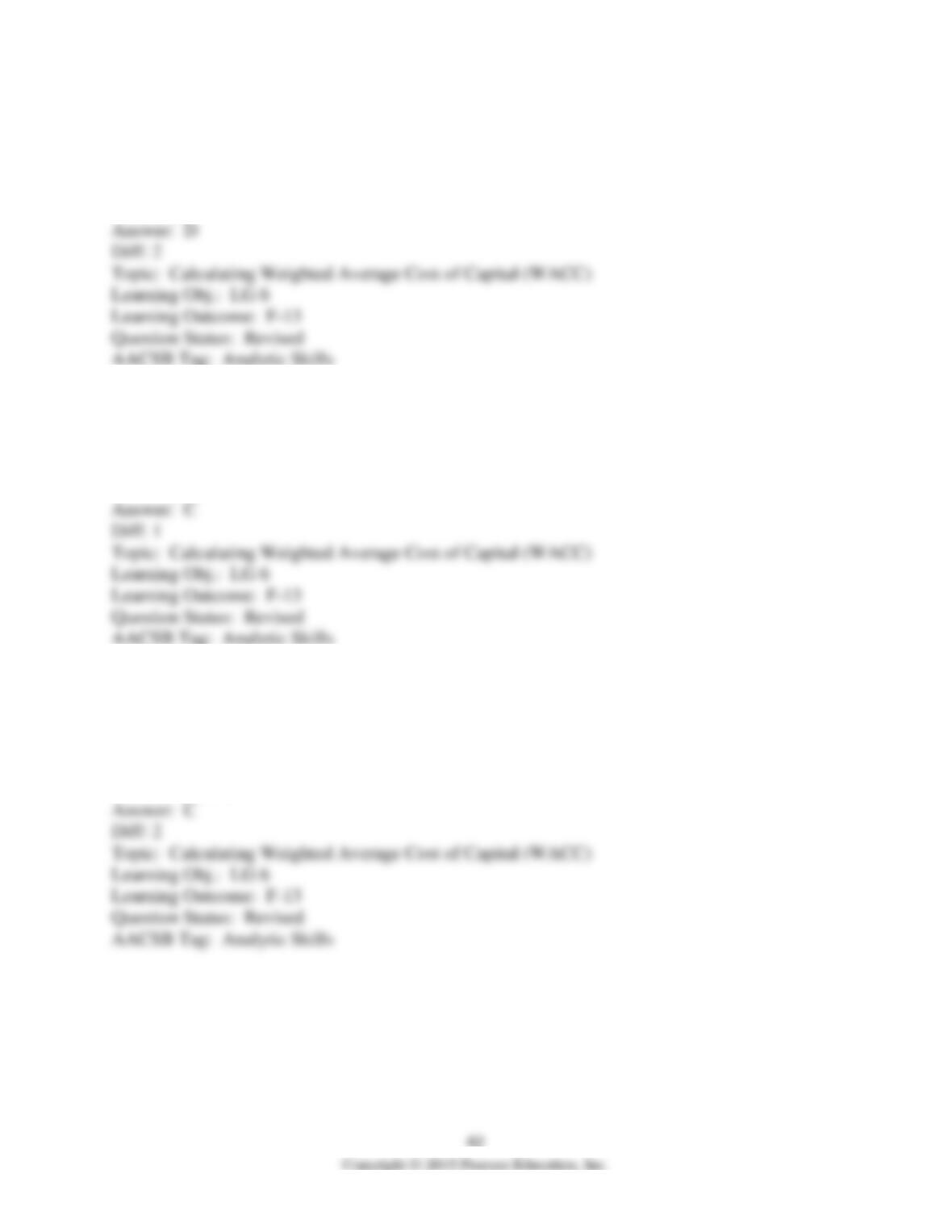
Table 9.3
Balance Sheet
General Talc Mines
December 31, 2014
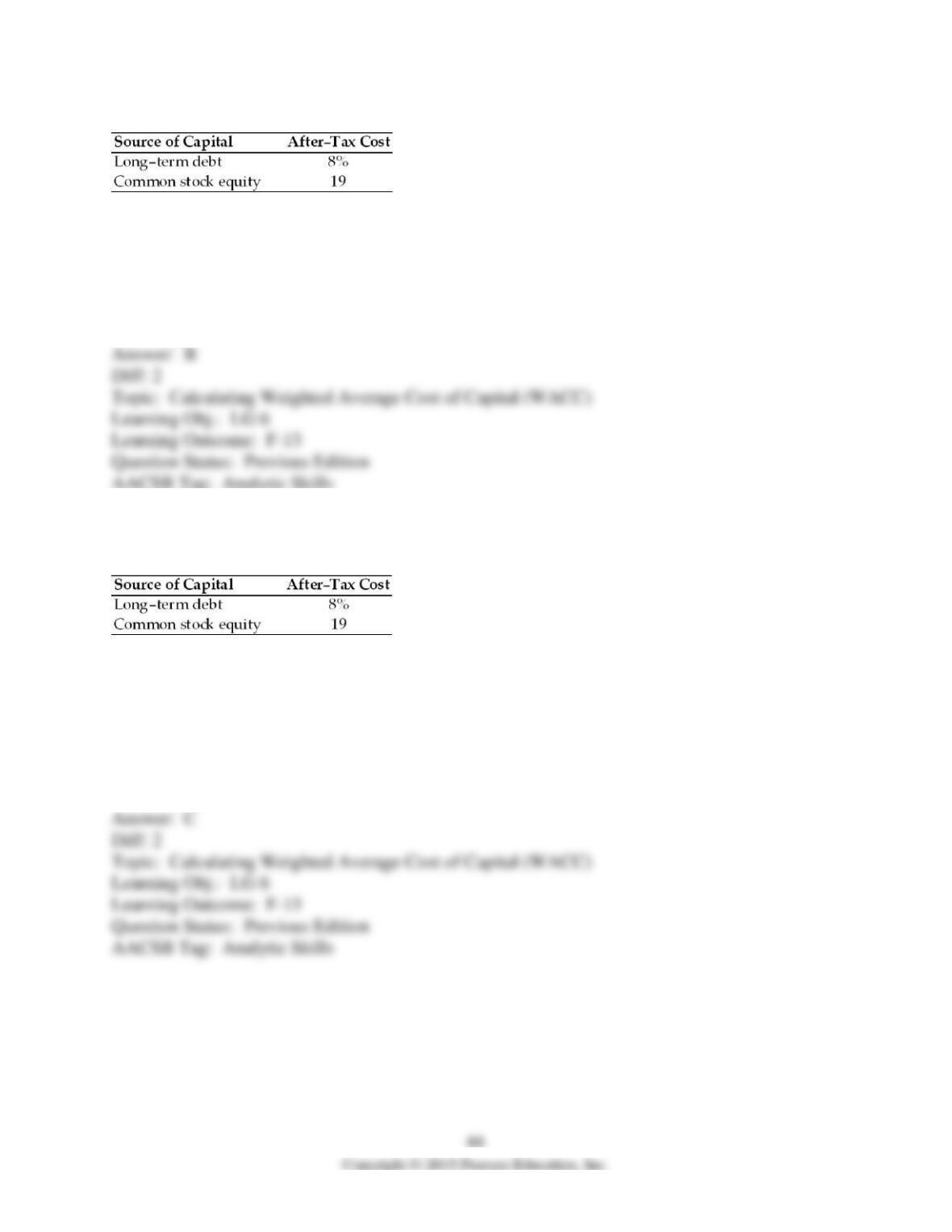
32)
Given this after-tax cost of each source of capital, the weighted average cost of capital using
book weights for General Talc Mines is ________. (See Table 9.3)
A) 11.6 percent
B) 15.5 percent
C) 16.6 percent
D) 17.5 percent
33) General Talc Mines has compiled the following data regarding the market value and cost of
the specific sources of capital.
Market price per share of common stock $50
Market value of long-term debt $980 per bond
The weighted average cost of capital using market value weights is ________.(See Table 9.3)
A) 11.7 percent
B) 13.5 percent
C) 15.8 percent
D) 17.5 percent
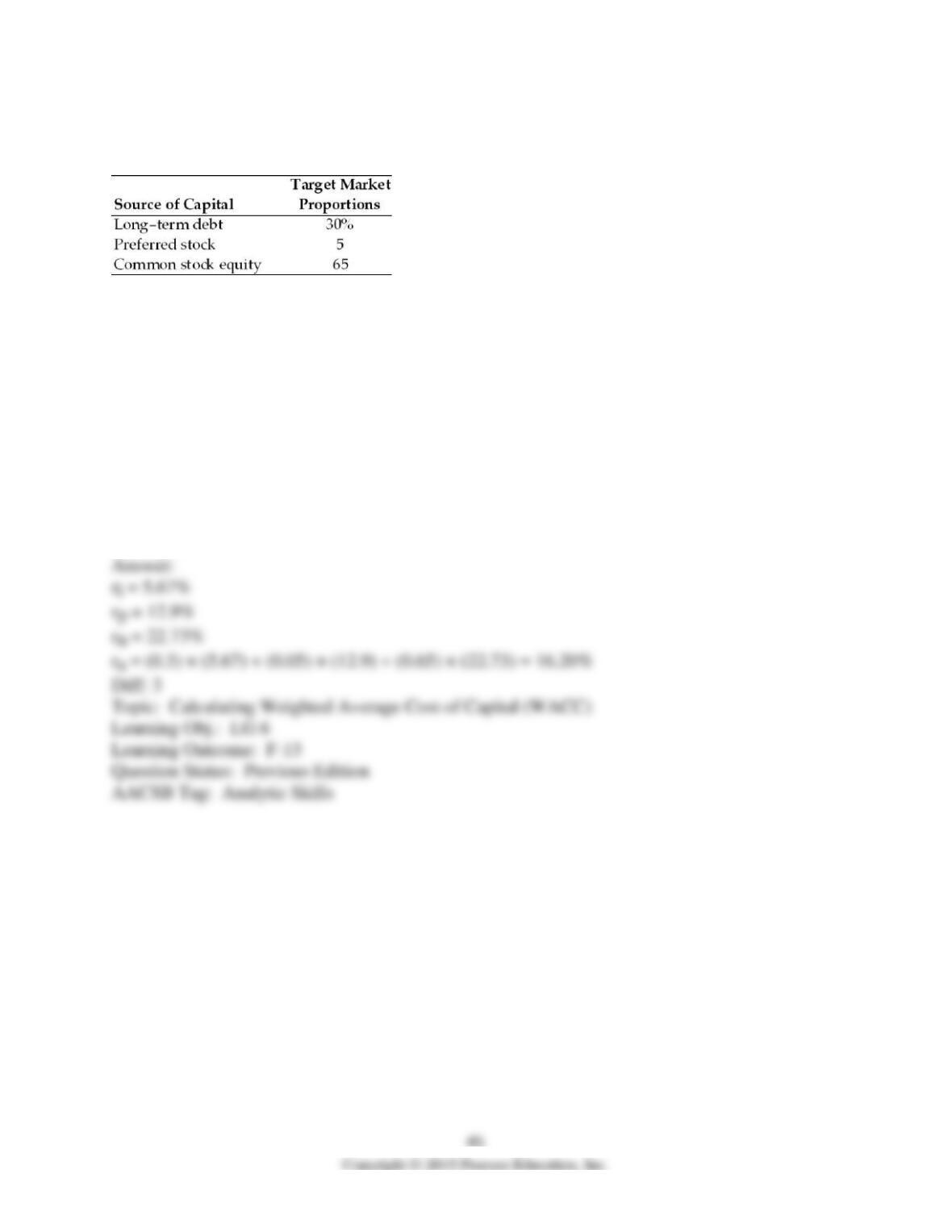
34) A firm has determined its optimal capital structure, which is composed of the following
sources and target market value proportions:
Debt: The firm can sell a 20-year, $1,000 par value, 9 percent bond for $980. A flotation cost of
2 percent of the face value would be required in addition to the discount of $20.
Preferred Stock: The firm has determined it can issue preferred stock at $65 per share par
value. The stock will pay an $8.00 annual dividend. The cost of issuing and selling the stock is
$3 per share.
Common Stock: The firm’s common stock is currently selling for $40 per share. The dividend
expected to be paid at the end of the coming year is $5.07. Its dividend payments have been
growing at a constant rate for the last five years. Five years ago, the dividend was $3.45. It is
expected that to sell, a new common stock issue must be underpriced at $1 per share and the firm
must pay $1 per share in flotation costs. Additionally, the firm’s marginal tax rate is 40 percent.
Calculate the firm’s weighted average cost of capital assuming the firm has exhausted all retained
earnings.
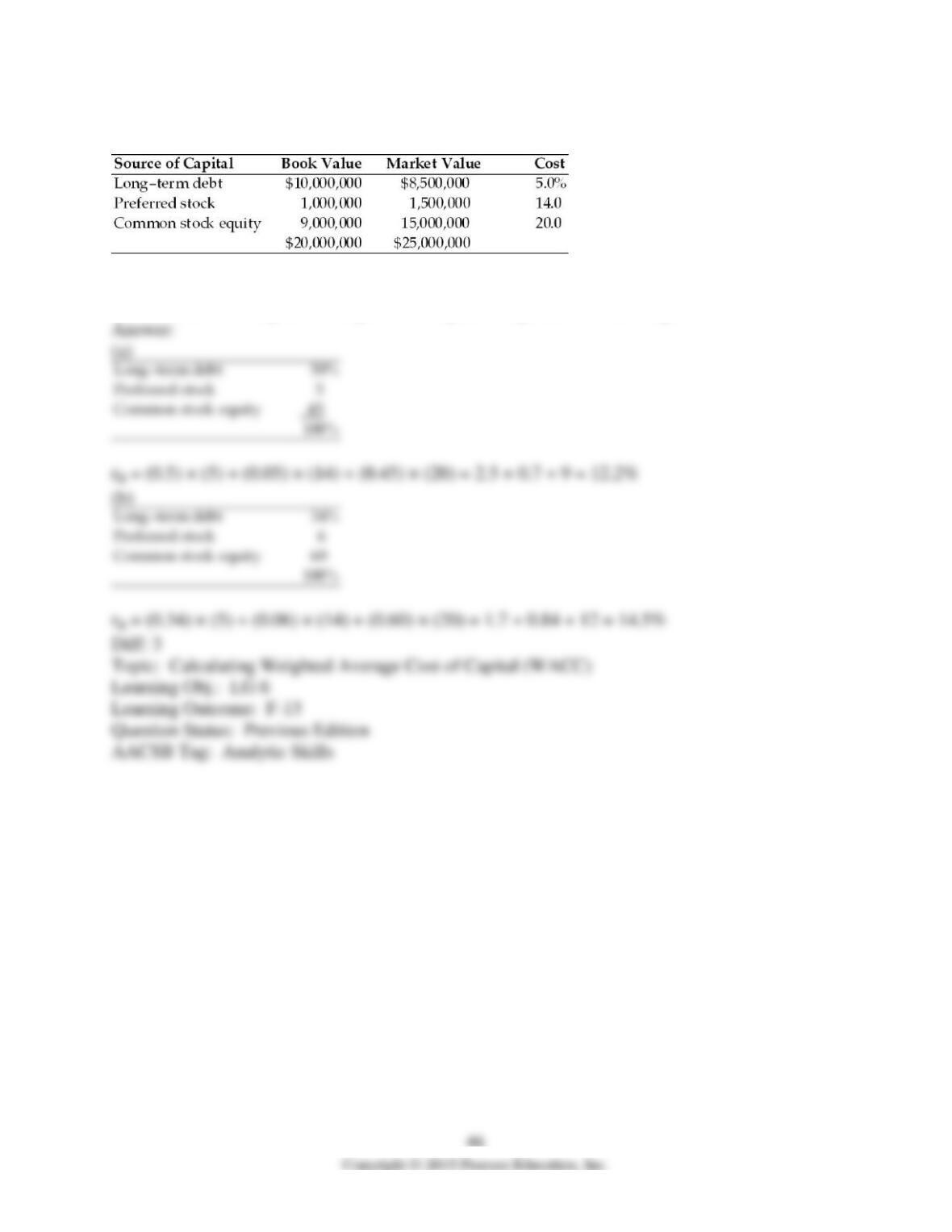
35) Promo Pak has compiled the following financial data:
(a) Calculate the weighted average cost of capital using book value weights.
(b) Calculate the weighted average cost of capital using market value weights.