Solve the problem.
104)
The production function z for an industrial country was estimated as z = x4y8, where x is the
amount of labor and y the amount of capital. Find the marginal productivity of labor.
104)
A)
8x4y7
B)
8x3y8
C)
4x3y8
D)
16x4y7
Find the average value of the function f over the region R.
105)
f(x, y) =3x +6y; 0 x 9, 0 y 7
105)
A)
27
2
B)
33
2
C)
17
D)
69
2
Find the partial derivative.
106)
f(x, y) =7x –9y2–1. Find fx(x, y).
106)
A)
–18y
B)
6
C)
7x
D)
7
Find all points where the function has any relative extrema or saddle points and identify the type of relative extremum.
107)
f(x,y) =1
x+ xy –8
y
107)
A)
Relative minimum at 1
2, –4
B)
Relative minimum at –1
2, 4
C)
Relative maximum at –1
2, 4
D)
Relative maximum at 1
2, –4
Solve the problem.
108)
Find the dimensions of the right circular cylinder with maximum surface area, if its volume is
64 ft3.
108)
A)
r =2 ft, h =32
ft
B)
r = 8 ft, h =
16 ft
C)
r = 3 ft, h = 2 ft
D)
r = 6 ft, h = 1 ft
109)
Let f(x, y) =2x –10y2–8
Find lim
h
0
f(x + h, y) – f(x, y)
h
109)
A)
2
B)
2–20y
C)
2x
D)
2–10y2–8
Find the partial derivative.
110)
Find fx(9, –8) when f(x,y) = 7x2– 9xy.
110)
A)
54
B)
198
C)
–81
D)
–54
Solve the problem.
111)
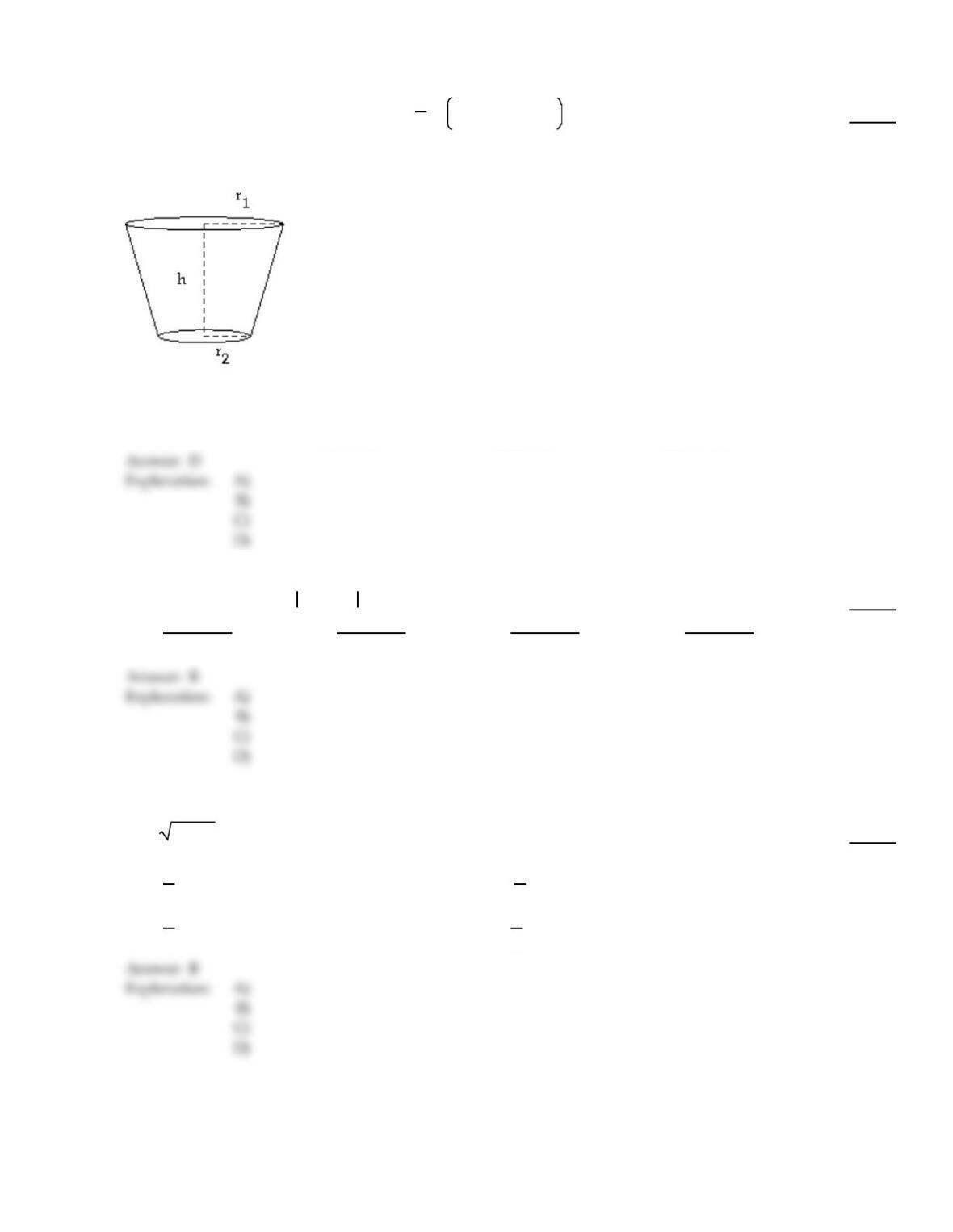
The volume of a flower pot is given by V =1
3h r12+r22+r1r2 where r1 is the major radius and
r2 is the minor radius and h is the height of the pot (see figure below).
If the dimensions of the pot are r1=5 inches, r2=4 inches and h =7 inches, find the volume of
potting soil required to fill the pot to the top. Round to the nearest cubic inch.
111)
A)
874 in.3
B)
458 in.3
C)
213 in.3
D)
447 in.3
Find the second–order partial derivative.
112)
Find fyx when f(x, y) = ln 2x + 9y .
112)
A)
18
(2x + 9y)2
B)
–18
(2x + 9y)2
C)
9
(2x + 9y)2
D)
–9
(2x + 9y)2
Evaluate the integral.
113)
4
2
4x + y dy
113)
A)
1
4[(16 +y)3/2 –(8 + y)3/2 ]
B)
2
3[(4x +4)3/2 –(4x +2)3/2 ]
C)
1
4[(4x +4)3/2 –(4x +2)3/2 ]
D)
2
3[(16 +y)3/2 –(8 + y)3/2 ]
43
Find the second–order partial derivative.
114)
Find fxy when f(x, y) = 8xexy.
114)
A)
8(2xyexy +exy)
B)
8(2xexy +x2yexy)
C)
8(2xexy + xy2exy)
D)
8x2y2exy
Solve the problem.
115)
Under certain conditions the wind speed S, in miles per hour, of a tornado at a distance d from its
center can be approximated by the function S =aV
0.51d6, where a is an atmospheric constant, and V
is the approximate volume of the tornado, in cubic feet. Assume that a is 0.78, and find SV.
115)
A)
a
1.02d6
B)
0.78
d6
C)
1.53
d6
D)
1
d6
116)
A company’s monthly sales, in thousands, is given by S(x, y) =9x0.8y0.5, where x is the amount
spent on newspaper advertising per month in thousands of dollars and y is the amount spent on
radio advertising per month in thousands of dollars. Suppose the company currently spends $5000
on newspaper advertising per month and $3000 on radio advertising per month. What would be
the effect on sales if the company increases the amount spent on newspaper advertising to $6000,
while the amount spent on radio advertising remains constant?
116)
A)
Sales would decrease by $871.49.
B)
Sales would increase by $70,463.55.
C)
Sales would increase by $9415.16.
D)
Sales would increase by $8714.91.
Find the partial derivative.
117)
Let z = f(x, y) =x3– 4x2y + 7xy3. Find z
x.
117)
A)
–4x2+ 7xy2
B)
3x2– 8xy + 21xy2
C)
3x2– 8xy + 7y3
D)
3x2– 8x + 7
44
Use the region R to evaluate the double integral.
118)
x2+y4 dx dy
R
R bounded by x = 0, y =4, y =x2
118)
A)
62,144
165
B)
16,064
165
C)
31,424
165
D)
8384
165
Find all points where the function has any relative extrema or saddle points and identify the type of relative extremum.
119)
(x –3) ln(xy)
119)
A)
Relative minimum at 3, 1
3.
B)
Saddle point at 3, 1
3
C)
Relative maximum at 3, 1
3.
D)
There are no relative extrema or saddle points
Solve the problem.
120)
Suppose that the labor cost for a building is approximated by
C(x,y) =10x2+ 6y2– 400x – 240y + 20,000, where x is the number of days of skilled labor and y is
the number of days of semiskilled labor required. Find the x and y that minimize cost C.
120)
A)
x =20, y =24
B)
x =20, y =20
C)
x =40, y =40
D)
x =24, y =60
Find the indicated derivative.
121)
Find fy for f(x, y, z) =10x4y5+ 4x9z9+ 7y10.
121)
A)
200x3y4+ 324x8z8+ 70y9
B)
50y4+ 70y9
C)
40x3y5+ 36x8z9
D)
50x4y4+ 70y9
45
122)
Find fzy for f(x, y, z) = ln 9xy –xz –y2 .
122)
A)
9x –2y
(9xy –xz –y2)2
B)
9x2–x2y + xy
(9xy –xz –y2)2
C)
9x2–2xy
(9xy –xz –y2)2
D)
9x2
(9xy –xz –y2)2
Find fx(x, y).
123)
f(x, y) = (x + y) ln (xy)
123)
A)
fx(x, y) = x ln (xy) +(x + y)
x
B)
fx(x, y) = ln (xy) +(x + y)
xy
C)
fx(x, y) = ln (xy) +(x + y)
x
D)
fx(x, y) = y ln (xy) +(x + y)
x
Answer the question.
124)
True or false? Consider the double integral
2
0
6
3
x2+ y dy dx.
The first step in calculating this integral involves integrating with respect to x.
124)
A)
True
B)
False
Solve the problem.
125)
The multiplier function M =(1 + i)n(1 – t) + t
1 + (1 – t)i n compares the growth of an Individual Retirement
Account (IRA) with the growth of the same deposit in a regular savings account. The function M
depends on the three variables n, i, and t, where n represents the number of years an amount is left
at interest, i represents the interest rate in both types of accounts, and t represents the income tax
rate. Values of M > 1 indicate that the IRA grows faster than the savings account. Find the
multiplier when funds are left for 11 years at 5% interest and the income tax rate is 25%.
125)
A)
1.117
B)
1.374
C)
7.543
D)
1.022
Evaluate dz.
126)
z = ln (4x + 12y);
x =4, y =11, dx = – 0.03, dy =0.02
126)
A)
–0.001
B)
0.001
C)
0.002
D)
–0.002
Find the double integral over the rectangular region R with the given boundaries.
127)
(x2+y2) dx dy
R
0 x 3, –3 y 1
127)
A)
64
B)
120
C)
136
3
D)
55
3
Solve the problem.
128)
A company’s cost for operating two warehouses is C(x, y) = 6x2+ 4x + 12y2+ 8y + 9, where x is the
number of units in warehouse A and y is the number in B. Find the average cost to store a unit if A
has 20 to 60 units, and B has 32 to 80 units.
128)
A)
$98,650
B)
$89,560
C)
$47,034
D)
$62,375
47
Evaluate the iterated integral.
129)
2
0
10
0
(5x2y + 3xy) dy dx
129)
A)
145
3
B)
290
3
C)
1450
3
D)
2900
3
Solve the problem.
130)
The yield of a stock is given by Y(D, P) =D
P, where D is the dividends per share of a stock, and P is
the price per share of the stock. If the price per share of a stock is $110, and the dividends per share
of the same stock are $4.65, then what is the yield of the stock to the nearest tenth of a percent?
130)
A)
2.1%
B)
23.7%
C)
4.2%
D)
511.5%
Find values of x and y such that both fx(x, y) = 0 and fy(x, y) = 0.
131)
f(x,y) = x3– 4xy + 8y
131)
A)
x = 0, y = 0
B)
x =4
3 , y = 2
C)
x = 2, y = 2
D)
x = 2, y = 3
Solve the problem.
132)
The sum of all the forces acting on an object can be described mathematically by F(m, a) = ma,
where m is the mass of the object (in kg) and a is the acceleration felt by the object (in m/s2) as a
result of the forces (in newtons, N) acting on it. What is the force required to accelerate a 4 kg object
at 12 m/s2?
132)
A)
144 N
B)
4 N
C)
16 N
D)
48 N
Find the partial derivative.
133)
Find fy(3, –1) when f(x, y) =8xy –6y.
133)
A)
18
B)
–8
C)
24
D)
0
Solve the problem.
134)
Determine if the graph of the equation f(x, y) =5x2+ 4y2+ 3 is a sphere, a hemisphere, a
paraboloid, or none of these.
134)
A)
Sphere
B)
Paraboloid
C)
Hemisphere
D)
None of these
135)
A farmer has 220 m of fencing. Find the area of the largest rectangular field that he can enclose with
his fencing. Assume that no fencing is needed along one edge of the field.
135)
A)
6050 m2
B)
8000 m2
C)
12,100 m2
D)
19,550 m2
Evaluate the integral.
136)
3
1
yex +y2dy
136)
A)
y[e(3 +y2)–e(1 +y2) ]
B)
3e(x +9) –e(x + 1)
C)
1
2[e(x +9) –e(x + 1)]
D)
1
2[e(3 +y2)–e(1 +y2) ]
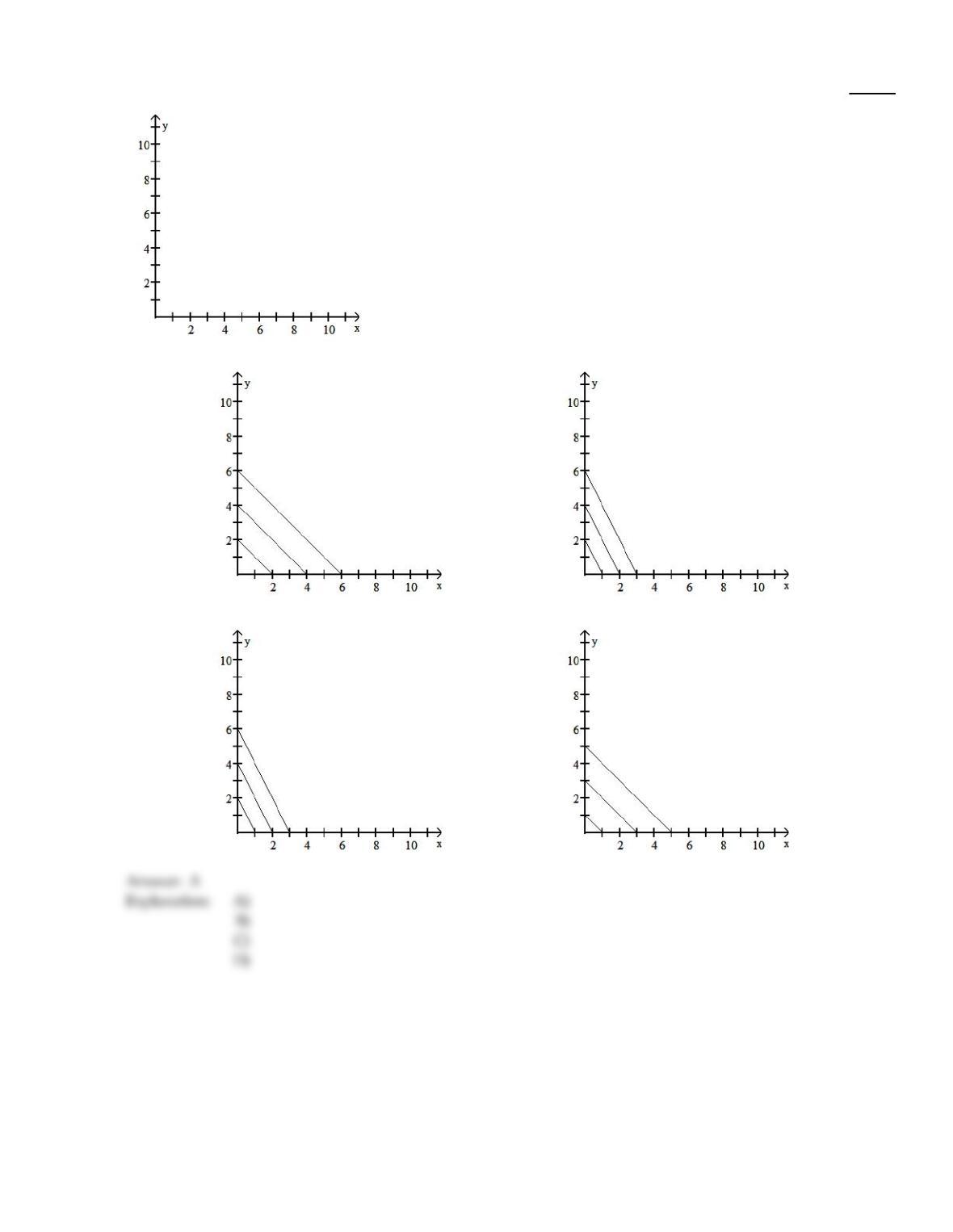
Graph the level curves in the first quadrant of the xy–plane for the given function at heights of z = 0, z = 2, and z = 4.
49
137)
2x + 2y – 2z = 4
137)
A)
z = 4
z = 2
z = 0
B)
z = 0
z = 4
z = 2
C)
z = 4
z = 2
z = 0
D)
z = 4
z = 2
z = 0
50
Find the partial derivative.
138)
Find fx(–4, 2) when f(x, y) =e8x – 5y. Leave your answer in terms of e.
138)
A)
e–42
B)
8e–42
C)
–5e–42
D)
8e–22
Evaluate the double integral.
139)
1
0
y
y2
(xy + 1) dx dy
139)
A)
5
24
B)
9
24
C)
25
24
D)
7
24
Find the volume under the surface z = f(x,y) and above the rectangle with the given boundaries.
140)
z = 8x + 4y + 7; 0 x 1, 1 y 3
140)
A)
28
B)
36
C)
38
D)
26
141)
z = 6x2y; 0 x 4, 0 y 3
141)
A)
2256
B)
576
C)
676
D)
1256
Find all points where the function has any relative extrema or saddle points and identify the type of relative extremum.
142)
f(x,y) = x2– y2
142)
A)
Relative maximum at (0, 0)
B)
Relative minimum at (0, 0)
C)
Saddle point at (0, 0) and relative maximum at (1, –1)
D)
Saddle point at (0, 0)
Find the partial derivative.
143)
Let z = f(x, y) =(x + y)4. Find z
x.
143)
A)
4(x + y)
B)
4(x + y)3
C)
4y(x + y)3
D)
4x(x + y)3
Find the second–order partial derivative.
144)
Find fyx when f(x, y) =x5y5–2 x6y8+ 17x – y.
144)
A)
20x3y3–56 2 x5y6
B)
25x4y3–48 2 x5y6
C)
25x4y4–48 2 x5y7
D)
20x3y5–30 2 x4y8
Use the region R to evaluate the double integral.
145)
(2xy –y2+ 1) dy dx
R
R bounded by x = 2y + 2, x = 3 – 3y, y = 0
145)
A)
125
33
B)
31
14
C)
33
250
D)
33
50
Evaluate the iterated integral.
146)
4
0
3
0
5xy dx dy
146)
A)
360
B)
180
C)
720
D)
36