80) If CO2 and NH3 are allowed to effuse through a porous membrane under identical
conditions, the rate of effusion for NH3 will be ________ times that of CO2.
A) 0.39
B) 0.62
C) 1.6
D) 2.6
81) An unknown gas contains 83% C and 17% H by mass. If effuses at 0.87 times the rate of
CO2 gas under the same conditions. What is the molecular formula of the unknown gas?
A) C2H5
B) C3H3
C) C4H10
D) C7H17
82) Which of the noble gases should show the greatest deviation from the ideal gas law at high
pressures?
A) He
B) Ar
C) Rn
D) All deviate equally.
83) Which statement about real gases is true?
A) The volume of the gas particles is zero.
B) The mass of the gas particles is zero.
C) Forces of attraction and repulsion exist between gas particles at close range.
D) The behavior of real gases can be exactly predicted using the ideal gas law.
84) Which of the following regions of the earth’s atmosphere is farthest from the surface of the
earth?
A) mesosphere
B) stratosphere
C) thermosphere
D) troposphere
85) The lowest atmospheric temperatures are found at the
A) earth’s surface.
B) troposphere/stratosphere junction.
C) stratosphere/mesosphere junction.
D) mesosphere/thermosphere junction.
86) Which of the following regions of the earth’s atmosphere is closest to the surface of the
earth?
A) mesosphere
B) stratosphere
C) thermosphere
D) troposphere
87) Which of the following regions of the earth’s atmosphere contains the ozone layer?
A) mesosphere
B) stratosphere
C) thermosphere
D) troposphere
88) One reaction that contributes to photochemical smog is shown below. Which of the species
involved contains one or more unpaired electrons?
NO2(g) + hυ →NO(g) + O(g)
A) only NO2(g)
B) only NO2(g) and NO(g)
C) only O(g)
D) All of the above contain unpaired electrons.
89) The principal cause of man-made ozone depletion in the stratosphere is due to
A) NO2.
B) CH4.
C) CO2.
D) Cl.
90) The major source of Cl atoms in the stratosphere is from
A) CFC’s.
B) NaCl.
C) Cl2.
D) HCl.
91) An unusual correlation exists between the potency of an inhaled anesthetic and its ability to
A) dissolve in olive oil.
B) effuse through a porous membrane.
C) expand and compress.
D) react with ozone.
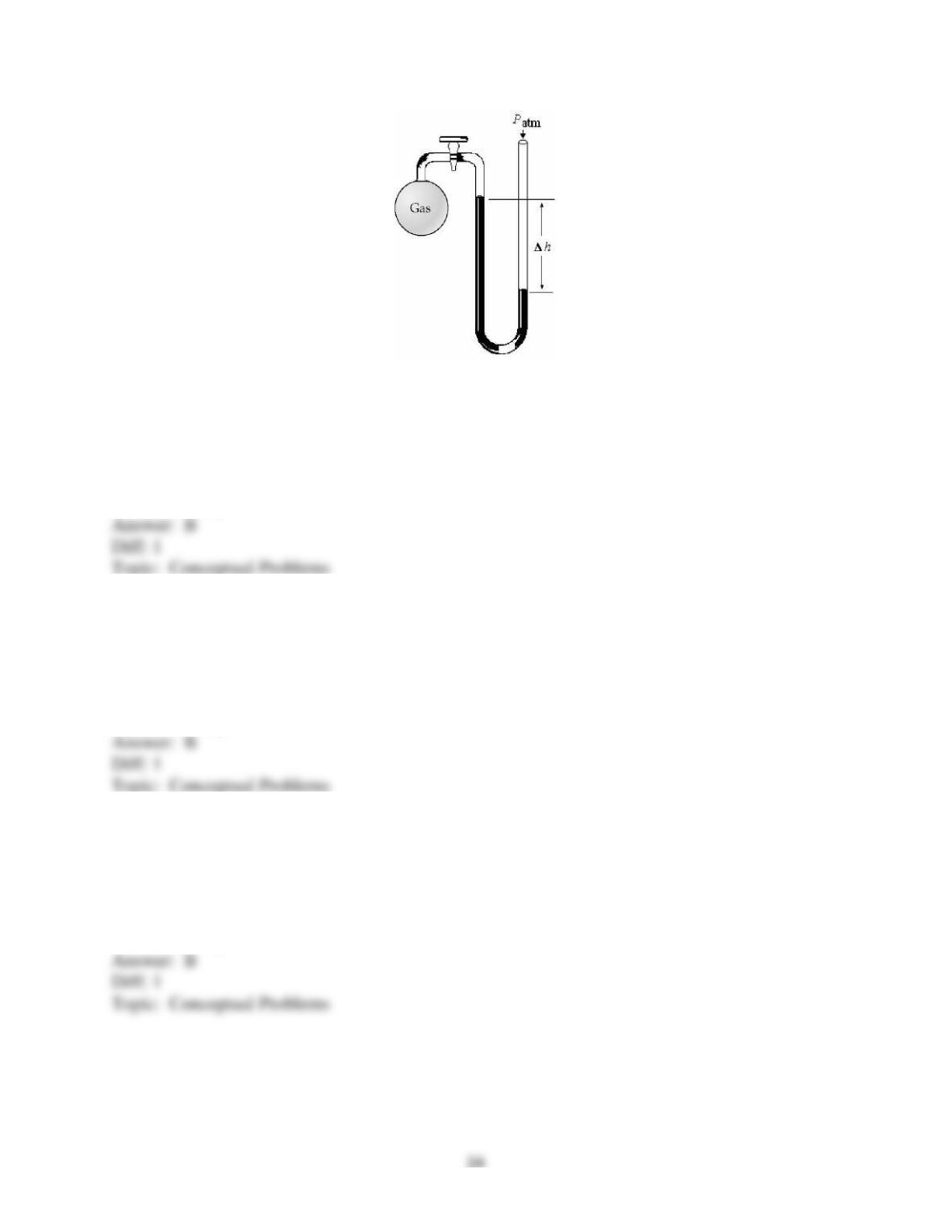
92) What is the pressure (in mm Hg) of the gas inside the above apparatus if the outside pressure,
Patm, is 740 mm Hg and the difference in mercury levels, Δh, is 30 mm Hg?
A) 30 mm Hg
B) 710 mm Hg
C) 740 mm Hg
D) 770 mm Hg
93) What is the pressure (in mm Hg) of the gas inside the above apparatus if the outside pressure,
Patm, is 750 mm Hg and the difference in mercury levels, Δh, is 50 mm Hg?
A) 50 mm Hg
B) 700 mm Hg
C) 750 mm Hg
D) 800 mm Hg
94) What is the pressure (in mm Hg) of the gas inside the above apparatus if the outside pressure,
Patm, is 736 mm Hg and the difference in mercury levels, Δh, is 18 mm Hg?
A) 18 mm Hg
B) 718 mm Hg
C) 736 mm Hg
D) 754 mm Hg
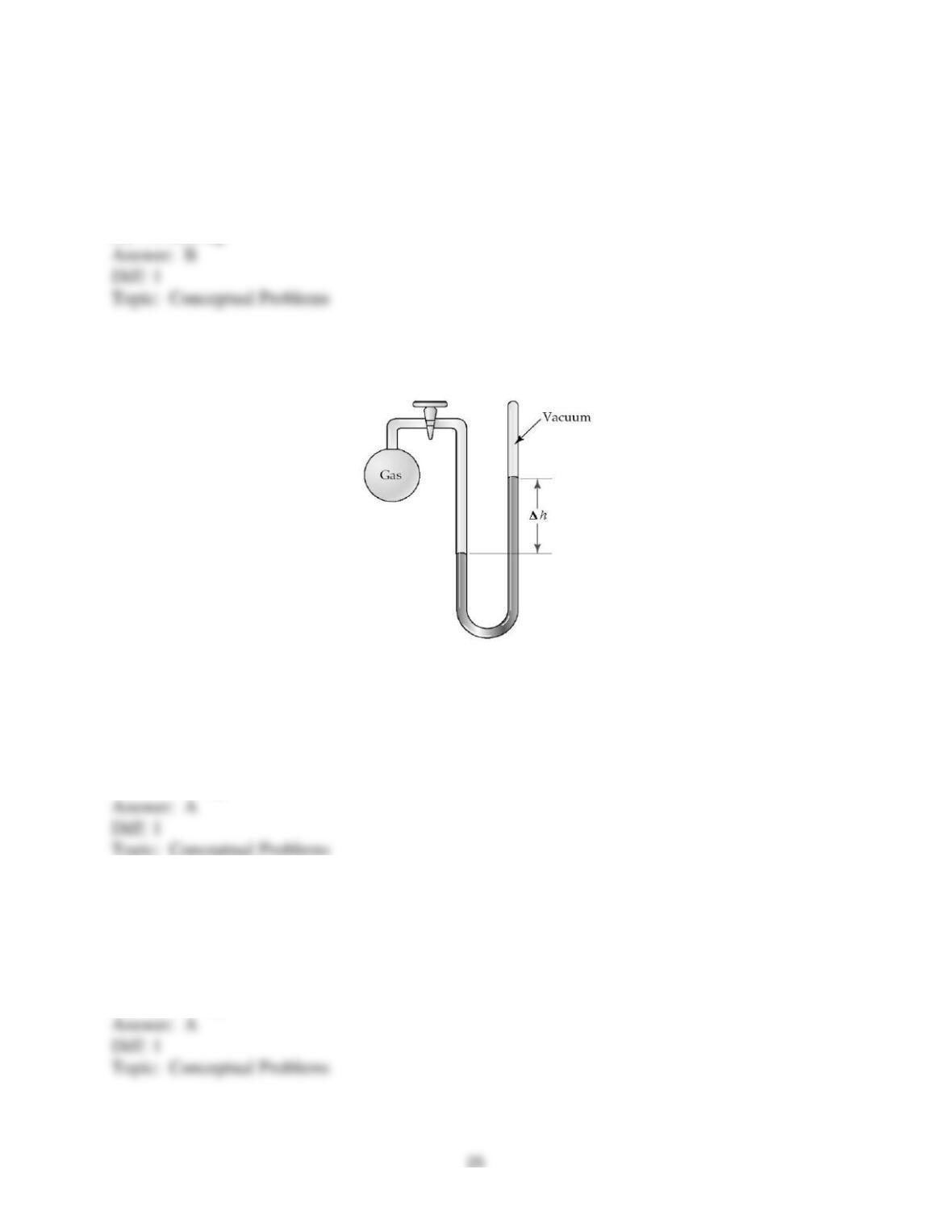
95) What is the pressure (in mm Hg) of the gas inside the above apparatus if the outside pressure,
Patm, is 745 mm Hg and the difference in mercury levels, Δh, is 25 mm Hg?
A) 25 mm Hg
B) 720 mm Hg
C) 745 mm Hg
D) 770 mm Hg
The apparatus shown is called a closed-end manometer because the arm not connected to the gas
sample is closed to the atmosphere and is under vacuum.
96) What is the pressure (in mm Hg) of the gas inside the above apparatus if the outside pressure,
Patm, is 745 mm Hg and the difference in mercury levels, Δh, is 25 mm Hg?
A) 25 mm Hg
B) 720 mm Hg
C) 745 mm Hg
D) 770 mm Hg
97) What is the pressure (in mm Hg) of the gas inside the above apparatus if the outside pressure,
Patm, is 750 mm Hg and the difference in mercury levels, Δh, is 25 mm Hg?
A) 25 mm Hg
B) 725 mm Hg
C) 750 mm Hg
D) 775 mm Hg
26
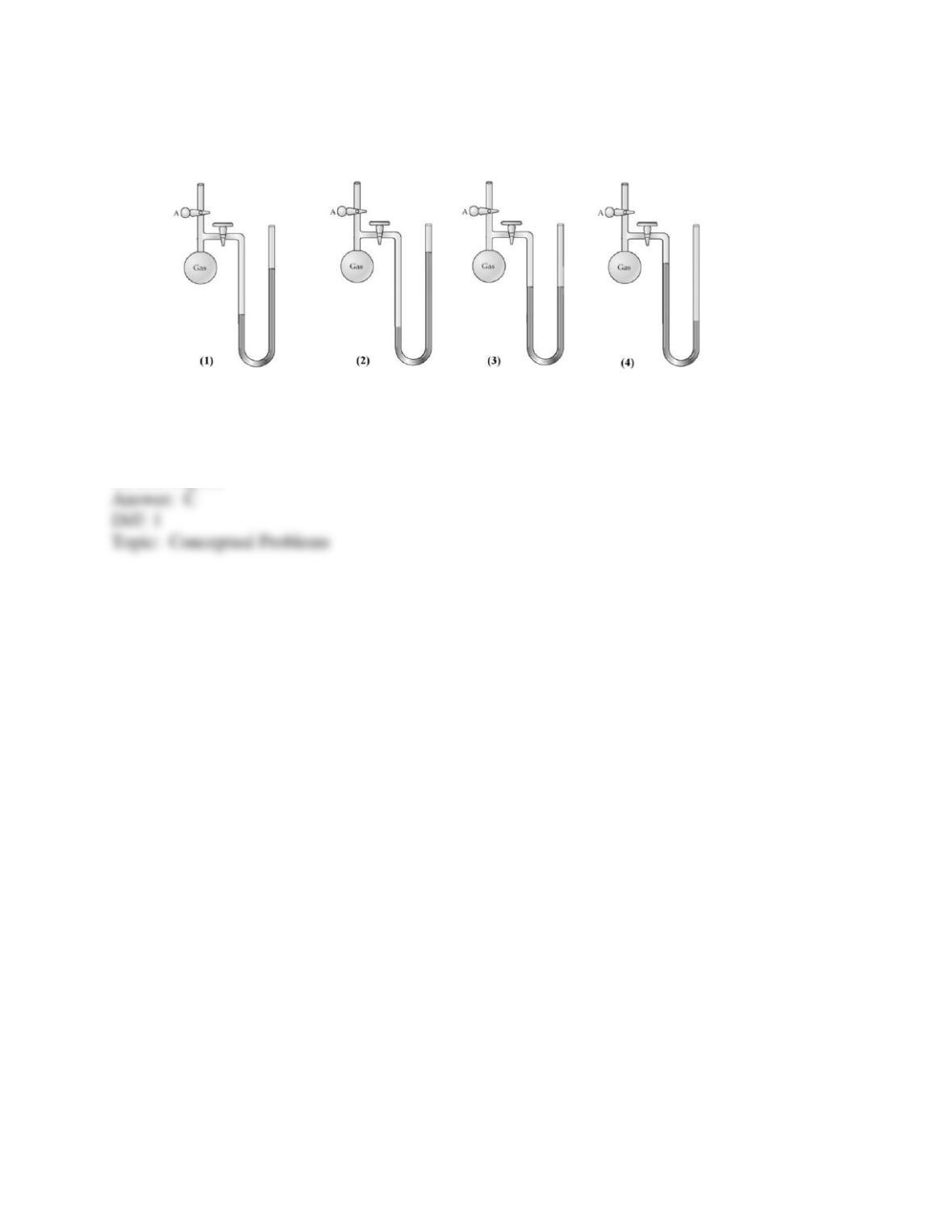
98) When stopcock A of the open-end manometer shown below is opened, which drawing best
represents the result?
A) drawing (1)
B) drawing (2)
C) drawing (3)
D) drawing (4)
A glass tube has one end in a dish of mercury and the other end closed by a stopcock. The
distance from the surface of the mercury to the bottom of the stopcock is 800 mm, as indicated
by the meter stick shown in the drawing below. The apparatus is at 20°C, and the mercury level
in the tube is the same as that in the dish.
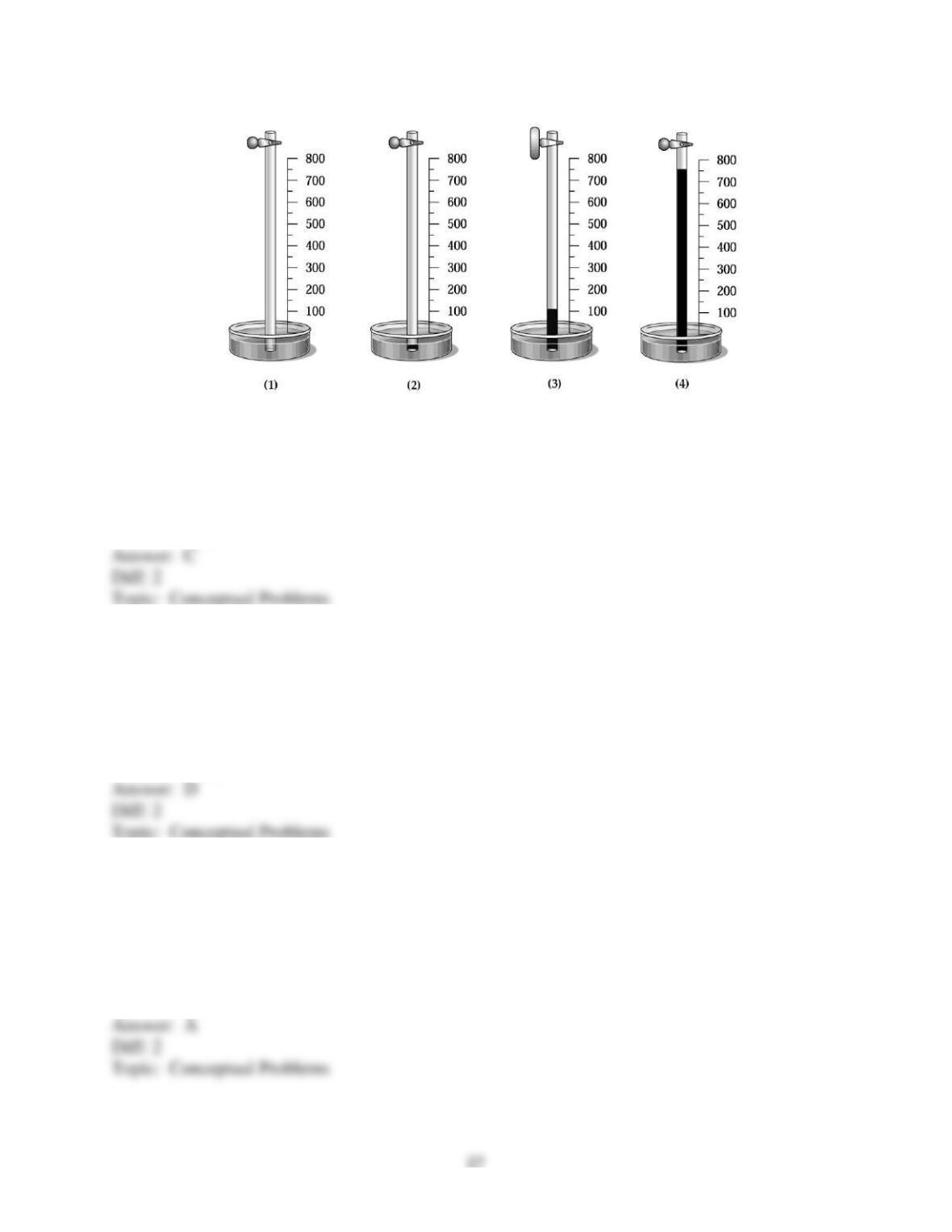
99) Which drawing best shows the approximate level of the mercury in the tube when the
temperature of the entire apparatus is lowered from +20°C to -20°C?
A) drawing (1)
B) drawing (2)
C) drawing (3)
D) drawing (4)
100) Which drawing best shows the approximate level of the mercury in the tube when a vacuum
pump is connected to the top of the tube, the stopcock opened, the tube is evacuated, the
stopcock is closed, and the pump is removed?
A) drawing (1)
B) drawing (2)
C) drawing (3)
D) drawing (4)
101) Which drawing best shows the approximate level of the mercury in the tube when a vacuum
pump is connected to the top of the tube, the stopcock opened, the tube is evacuated, the
stopcock is closed, and the pump is removed, and the stopcock is reopened?
A) drawing (1)
B) drawing (2)
C) drawing (3)
D) drawing (4)
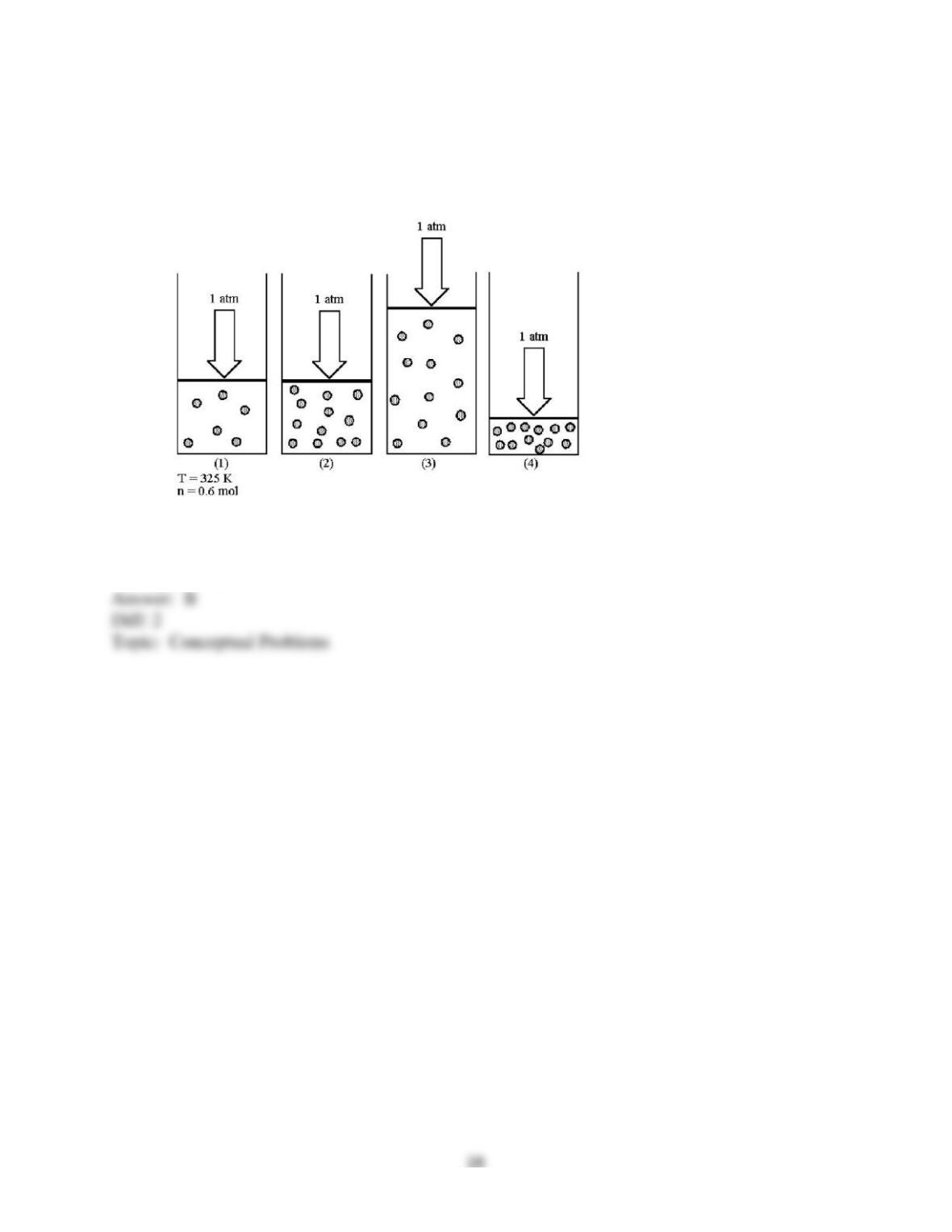
102) Assume that you have a sample of gas in a cylinder with a moveable piston, as shown in
diagram (1). The initial pressure, number of moles, and temperature of the gas are noted on the
diagram. Which diagram (2)-(4) most closely represents the result of doubling the number of
moles of gas while keeping the pressure and temperature constant?
A) diagram (2)
B) diagram (3)
C) diagram (4)
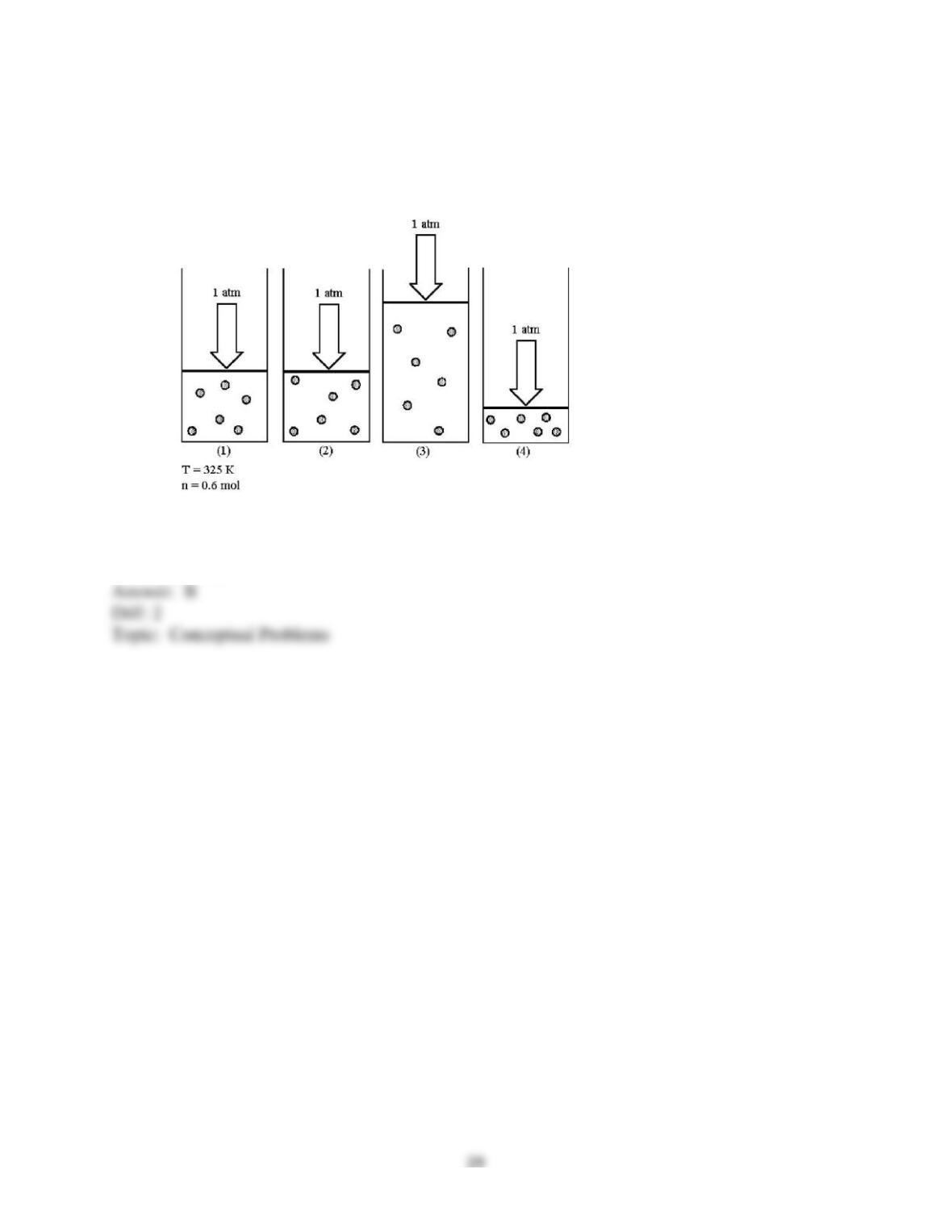
103) Assume that you have a sample of gas in a cylinder with a moveable piston, as shown in
diagram (1). The initial pressure, number of moles, and temperature of the gas are noted on the
diagram. Which diagram (2)-(4) most closely represents the result of doubling the temperature
while keeping the pressure and number of moles of gas constant?
A) diagram (2)
B) diagram (3)
C) diagram (4)
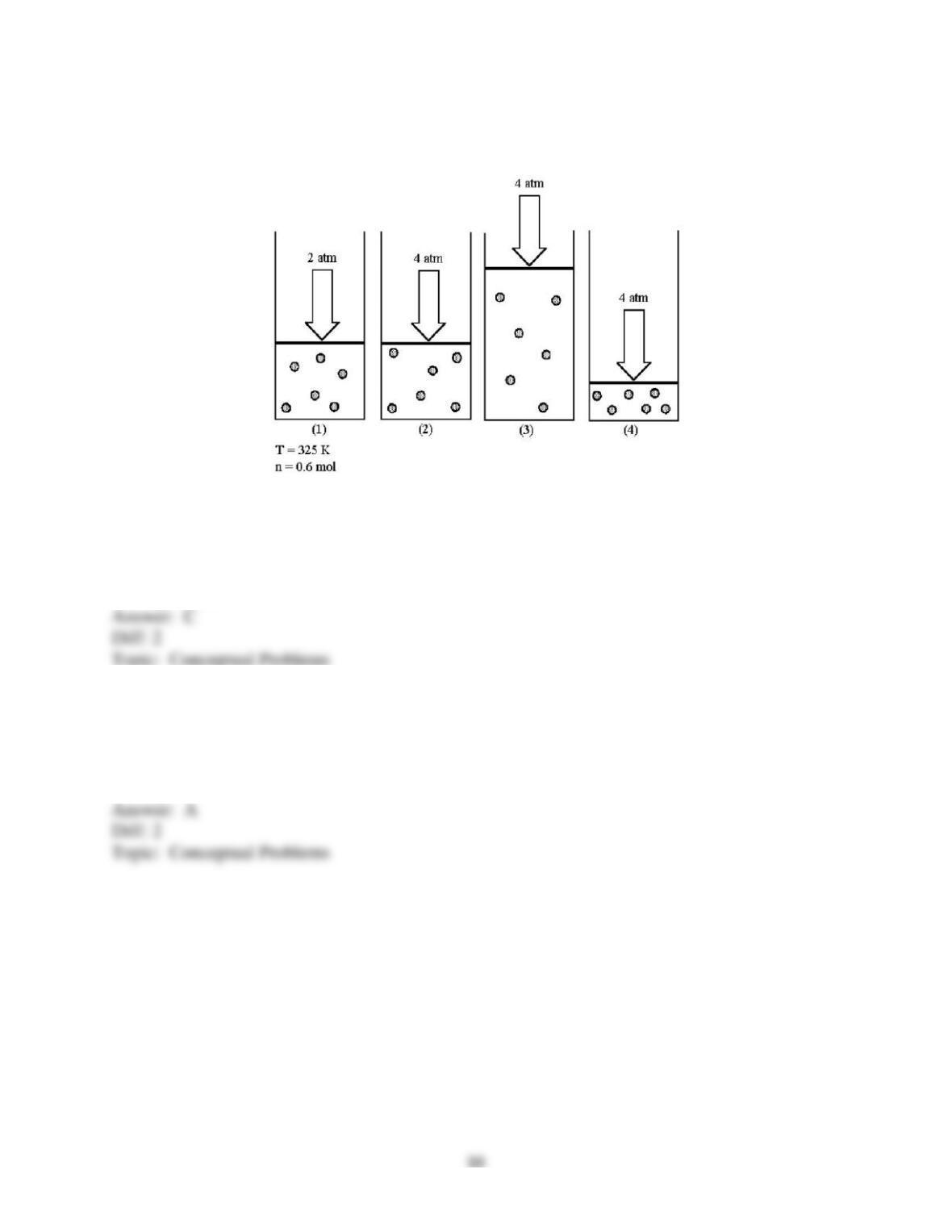
Assume that you have a sample of gas in a cylinder with a moveable piston, as shown in diagram
(1). The initial pressure, number of moles, and temperature of the gas are noted on the diagram.
104) Which diagram (2)-(4) most closely represents the result of doubling the pressure while
keeping the temperature and number of moles of gas constant?
A) diagram (2)
B) diagram (3)
C) diagram (4)
105) Which diagram (2)-(4) most closely represents the result of doubling the pressure and
doubling the temperature while keeping the number of moles of gas constant?
A) diagram (2)
B) diagram (3)
C) diagram (4)
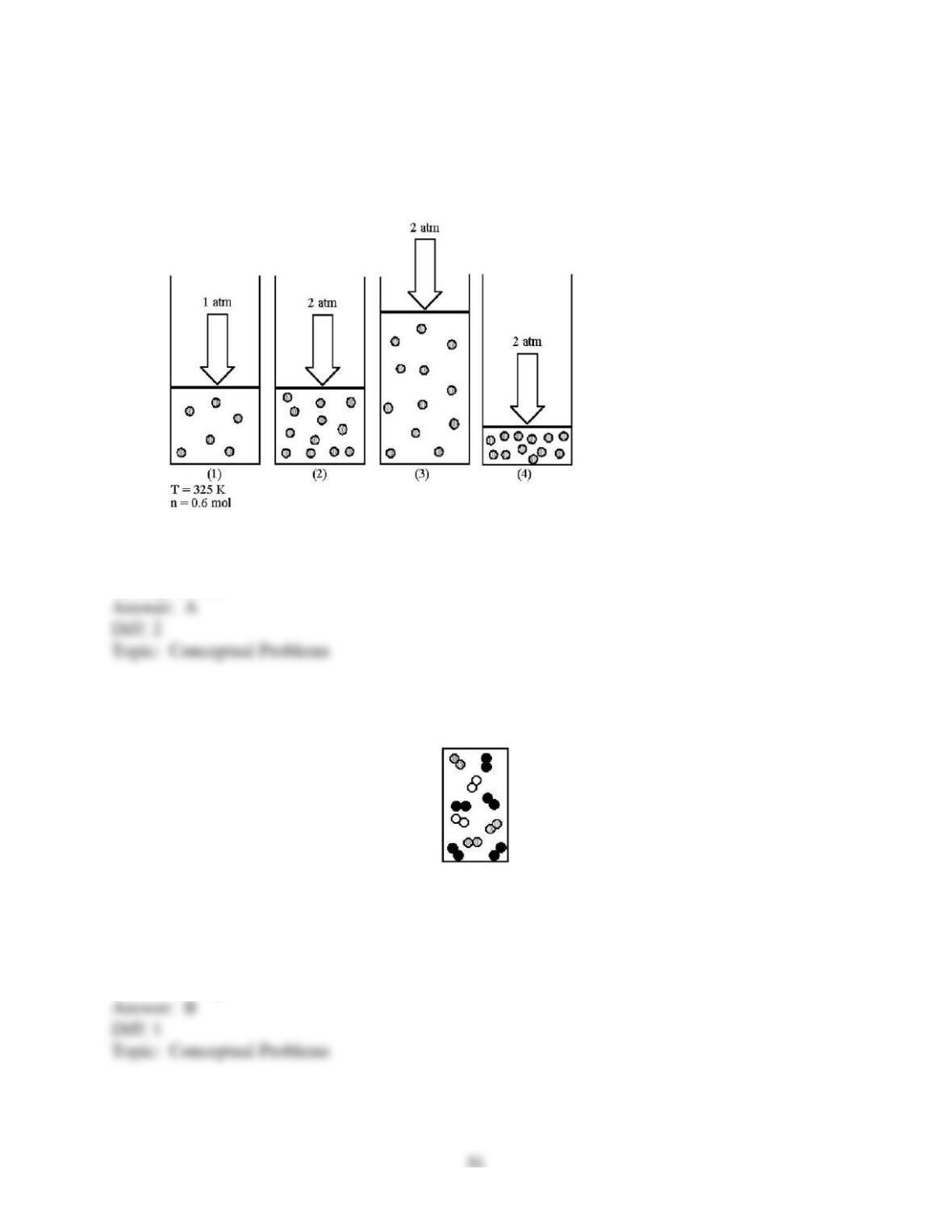
106) Assume that you have a sample of gas in a cylinder with a moveable piston, as shown in
diagram (1). The initial pressure, number of moles, and temperature of the gas are noted on the
diagram. Which diagram (2)-(4) most closely represents the result of doubling the pressure and
number of moles of gas while keeping the temperature constant?
A) diagram (2)
B) diagram (3)
C) diagram (4)
In the diagram below, nitrogen molecules are represented by unshaded spheres, oxygen
molecules by gray spheres, and chlorine molecules by black spheres.
107) If the total pressure in the container is 900 mm Hg, what is the partial pressure of nitrogen?
A) 90 mm Hg
B) 180 mm Hg
C) 270 mm Hg
D) 450 mm Hg
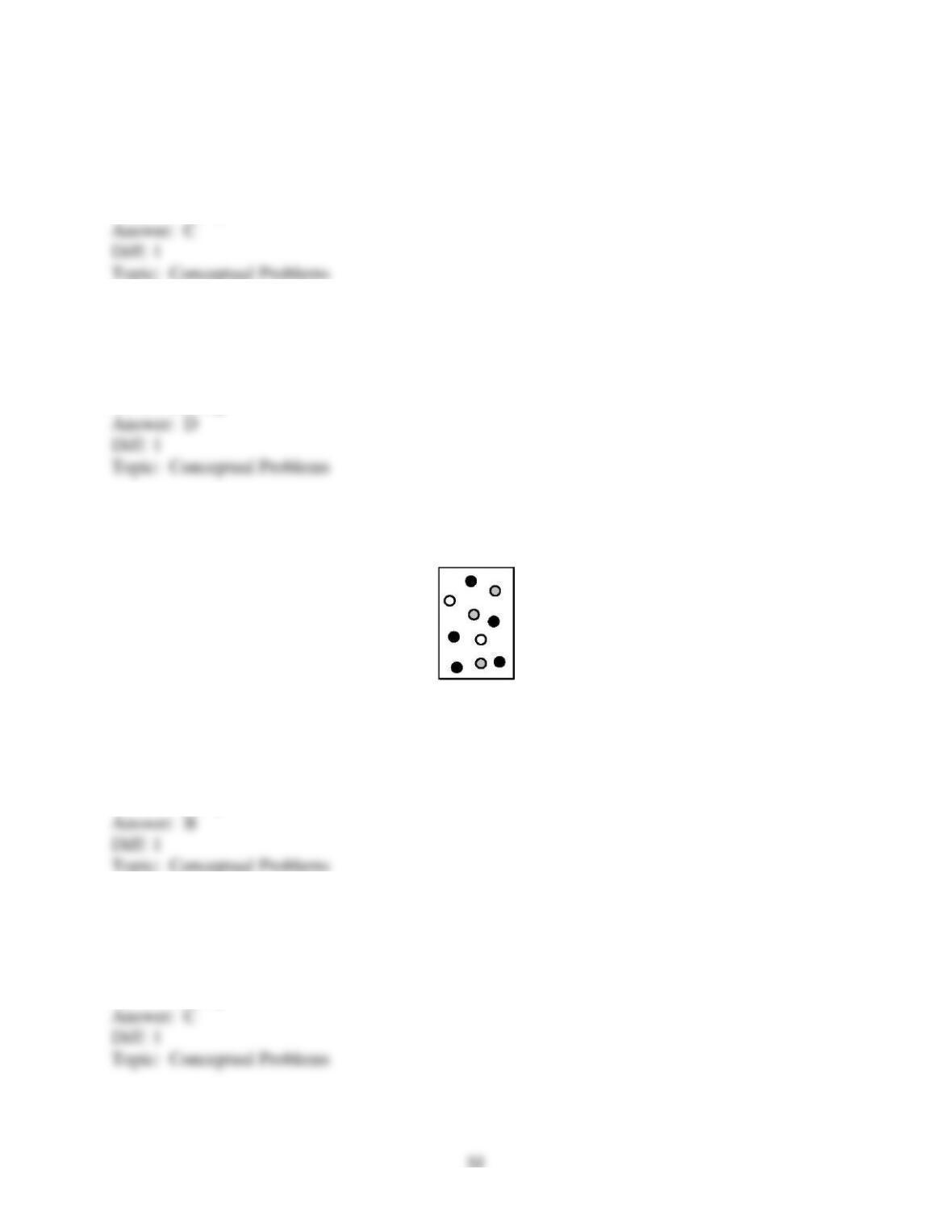
108) If the total pressure in the container is 900 mm Hg, what is the partial pressure of oxygen?
A) 90 mm Hg
B) 180 mm Hg
C) 270 mm Hg
D) 450 mm Hg
109) If the total pressure in the container is 900 mm Hg, what is the partial pressure of chlorine?
A) 90 mm Hg
B) 180 mm Hg
C) 270 mm Hg
D) 450 mm Hg
In the diagram below, helium atoms are represented by unshaded spheres, neon atoms by gray
spheres, and argon atoms by black spheres.
110) If the total pressure in the container is 900 mm Hg, what is the partial pressure of helium?
A) 90 mm Hg
B) 180 mm Hg
C) 270 mm Hg
D) 450 mm Hg
111) If the total pressure in the container is 900 mm Hg, what is the partial pressure of neon?
A) 90 mm Hg
B) 180 mm Hg
C) 270 mm Hg
D) 450 mm Hg
112) If the total pressure in the container is 900 mm Hg, what is the partial pressure of argon?
A) 90 mm Hg
B) 180 mm Hg
C) 270 mm Hg
D) 450 mm Hg
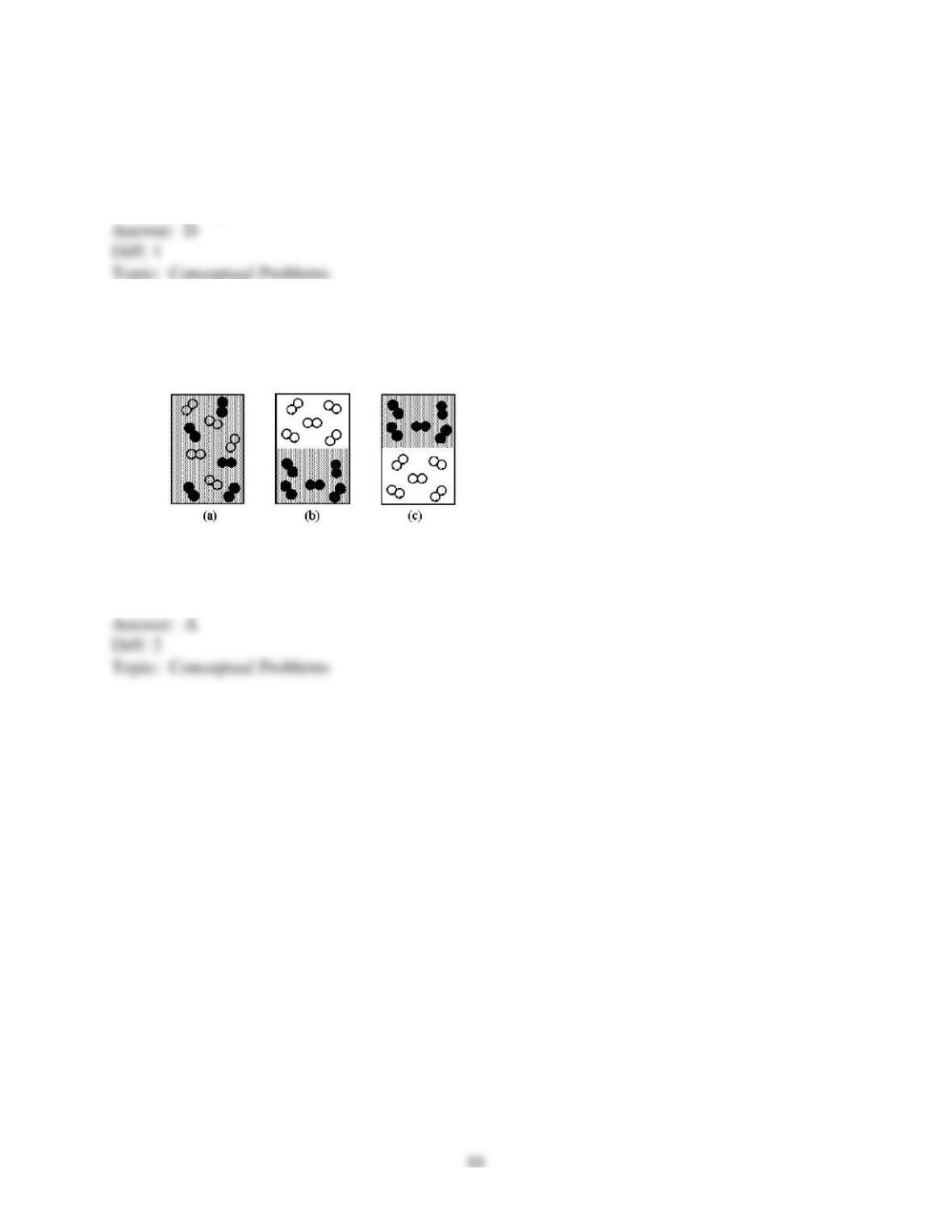
113) Assume that you have a mixture of nitrogen (molecular mass = 28 amu), represented by
unshaded spheres, and chlorine (molecular mass = 71 amu), represented by shaded spheres at
300 K. Which of the drawings best represents the mixture?
A) drawing (a)
B) drawing (b)
C) drawing (c)