86. Shorts, Inc. produces small engines. For last year’s operations, the following data were gathered:
Units produced: 100,000
Direct labor: 160,000 hours @ $12.00
Actual variable overhead: $1,300,000
Shorts, Inc. employs a standard costing system. During the year, a variable overhead rate of $8.00 was used.
The labor standard requires 1.5 hours per unit produced. The variable overhead spending and efficiency
variances are, respectively:
87. During the year, Hawkings produced 10,000 units, used 20,000 direct labor hours, and incurred variable
overhead of $90,000. Budgeted variable overhead for the year was $88,000. The hours allowed per unit are 2.1.
The standard variable overhead rate is $4.00 per direct labor hour. The variable overhead spending variance is:
88. Budgeted variable overhead for the year is $120,000. Expected activity is 20,000 standard direct labor
hours. The actual hours worked were 18,000 and the standard hours allowed for actual production were 19,500.
The variable overhead efficiency variance is:
89. Folson Company is planning to produce 4,250,000 speakers for the coming year. Actual production was
4,000,000 speakers. Each speaker requires 0.80 direct labor hours per unit. Predetermined overhead rates are
calculated using expected production, measured in direct labor hours. The budgeted variable overhead for the
coming year is $680,000. The actual variable overhead incurred was $714,000. The applied variable overhead
for the year is:
90. Figure 9-4.
Lewis Company calculates its predetermined rates using practical volume, which is 288,000 units. The standard
cost system allows 2 direct labor hours per unit produced. Overhead is applied using direct labor hours. The
total budgeted overhead is $3,168,000, of which $864,000 is fixed overhead. The actual results for the year are
as follows:
Units produced: 280,000
Direct labor: 570,000 hours @ $9
Variable overhead: $2,320,000
Fixed overhead: $872,000
Refer to Figure 9-4. The predetermined fixed overhead rate is:
91. Figure 9-4.
Lewis Company calculates its predetermined rates using practical volume, which is 288,000 units. The standard
cost system allows 2 direct labor hours per unit produced. Overhead is applied using direct labor hours. The
total budgeted overhead is $3,168,000, of which $864,000 is fixed overhead. The actual results for the year are
as follows:
Units produced: 280,000
Direct labor: 570,000 hours @ $9
Variable overhead: $2,320,000
Fixed overhead: $872,000
Refer to Figure 9-4. The predetermined variable overhead rate is:
92. Figure 9-4.
Lewis Company calculates its predetermined rates using practical volume, which is 288,000 units. The standard
cost system allows 2 direct labor hours per unit produced. Overhead is applied using direct labor hours. The
total budgeted overhead is $3,168,000, of which $864,000 is fixed overhead. The actual results for the year are
as follows:
Units produced: 280,000
Direct labor: 570,000 hours @ $9
Variable overhead: $2,320,000
Fixed overhead: $872,000
Refer to Figure 9-4. Calculate the applied fixed overhead.
93. Figure 9-4.
Lewis Company calculates its predetermined rates using practical volume, which is 288,000 units. The standard
cost system allows 2 direct labor hours per unit produced. Overhead is applied using direct labor hours. The
total budgeted overhead is $3,168,000, of which $864,000 is fixed overhead. The actual results for the year are
as follows:
Units produced: 280,000
Direct labor: 570,000 hours @ $9
Variable overhead: $2,320,000
Fixed overhead: $872,000
Refer to Figure 9-4. Calculate the fixed overhead spending variance.
94. Figure 9-4.
Lewis Company calculates its predetermined rates using practical volume, which is 288,000 units. The standard
cost system allows 2 direct labor hours per unit produced. Overhead is applied using direct labor hours. The
total budgeted overhead is $3,168,000, of which $864,000 is fixed overhead. The actual results for the year are
as follows:
Units produced: 280,000
Direct labor: 570,000 hours @ $9
Variable overhead: $2,320,000
Fixed overhead: $872,000
Refer to Figure 9-4. Calculate the fixed overhead volume variance.
95. Figure 9-4.
Lewis Company calculates its predetermined rates using practical volume, which is 288,000 units. The standard
cost system allows 2 direct labor hours per unit produced. Overhead is applied using direct labor hours. The
total budgeted overhead is $3,168,000, of which $864,000 is fixed overhead. The actual results for the year are
as follows:
Units produced: 280,000
Direct labor: 570,000 hours @ $9
Variable overhead: $2,320,000
Fixed overhead: $872,000
Refer to Figure 9-4. Calculate the variable overhead spending variance.
96. Figure 9-4.
Lewis Company calculates its predetermined rates using practical volume, which is 288,000 units. The standard
cost system allows 2 direct labor hours per unit produced. Overhead is applied using direct labor hours. The
total budgeted overhead is $3,168,000, of which $864,000 is fixed overhead. The actual results for the year are
as follows:
Units produced: 280,000
Direct labor: 570,000 hours @ $9
Variable overhead: $2,320,000
Fixed overhead: $872,000
Refer to Figure 9-4. Calculate the variable overhead efficiency variance.
97. If actual fixed overhead was $98,400 and there was a $2,880 favorable spending variance and a $600
unfavorable volume variance, budgeted fixed overhead must have been
98. Fixed overhead was budgeted at $84,000 and 10,000 direct labor hours were budgeted. If the fixed overhead
volume variance was $3,200 unfavorable and the fixed overhead spending variance was $1,200 favorable, fixed
overhead applied must be
99. Figure 9-5.
Merric Company uses an activity-based costing system. Four activities have been identified. The setup activity
uses the number of setups as its cost driver. The following budget information is available for this activity:
Fixed costs per month
$240,000
Variable cost per setup
$5,400
The company expects to perform 25 setups in May.
Refer to Figure 9-5. If the company expects 25 setups in the month of May, what would be the total budgeted costs of the setup activity?
100. Figure 9-5.
Merric Company uses an activity-based costing system. Four activities have been identified. The setup activity
uses the number of setups as its cost driver. The following budget information is available for this activity:
Fixed costs per month
$240,000
Variable cost per setup
$5,400
The company expects to perform 25 setups in May.
Refer to Figure 9-5. Actual costs incurred were $246,000 fixed and $144,000 variable. If the actual number of setups in May was 30, what is the
activity-based flexible budget variance?
101. Figure 9-6.
Kendall Company uses forklifts to move materials from the stores area to the production floor. There are four
forklifts. They are fully used 16 hours per day (making five moves per hour). The company works 300 days per
year, running two eight-hour shifts per day. Fork lift operators work 2,000 hours per year and are paid an annual
salary of $45,000.
Based on a recent study each forklift uses 0.25 gallons of fuel per move. The cost of fuel is $2.00 per gallon.
Refer to Figure 9-6. Prepare a salary budget for the activity, moving materials. Assume that the labor market
does not permit the hiring of part-time forklift operators.
102. Figure 9-6.
Kendall Company uses forklifts to move materials from the stores area to the production floor. There are four
forklifts. They are fully used 16 hours per day (making five moves per hour). The company works 300 days per
year, running two eight-hour shifts per day. Fork lift operators work 2,000 hours per year and are paid an annual
salary of $45,000.
Based on a recent study each forklift uses 0.25 gallons of fuel per move. The cost of fuel is $2.00 per gallon.
Refer to Figure 9-6. Calculate the fuel budget for the year for moving materials.
103. Figure 9-6.
Kendall Company uses forklifts to move materials from the stores area to the production floor. There are four
forklifts. They are fully used 16 hours per day (making five moves per hour). The company works 300 days per
year, running two eight-hour shifts per day. Fork lift operators work 2,000 hours per year and are paid an annual
salary of $45,000.
Based on a recent study each forklift uses 0.25 gallons of fuel per move. The cost of fuel is $2.00 per gallon.
Refer to Figure 9-6. Prepare a flexible budget formula for the moving materials activity.
104. Figure 9-6.
Kendall Company uses forklifts to move materials from the stores area to the production floor. There are four
forklifts. They are fully used 16 hours per day (making five moves per hour). The company works 300 days per
year, running two eight-hour shifts per day. Fork lift operators work 2,000 hours per year and are paid an annual
salary of $45,000.
Based on a recent study each forklift uses 0.25 gallons of fuel per move. The cost of fuel is $2.00 per gallon.
Refer to Figure 9-6. Suppose that the actual moves made are 80% of the forklifts’ capacity. What is the after–
the-fact budgeted fuel cost?
105. Building an activity-based budget requires:
106. If an organization has implemented an ABC or ABM system, they will already have accomplished which
of the following?
107. The major differences between functional and activity-based budgeting are found within which of the
following categories?
108. Activity-based budgeting:
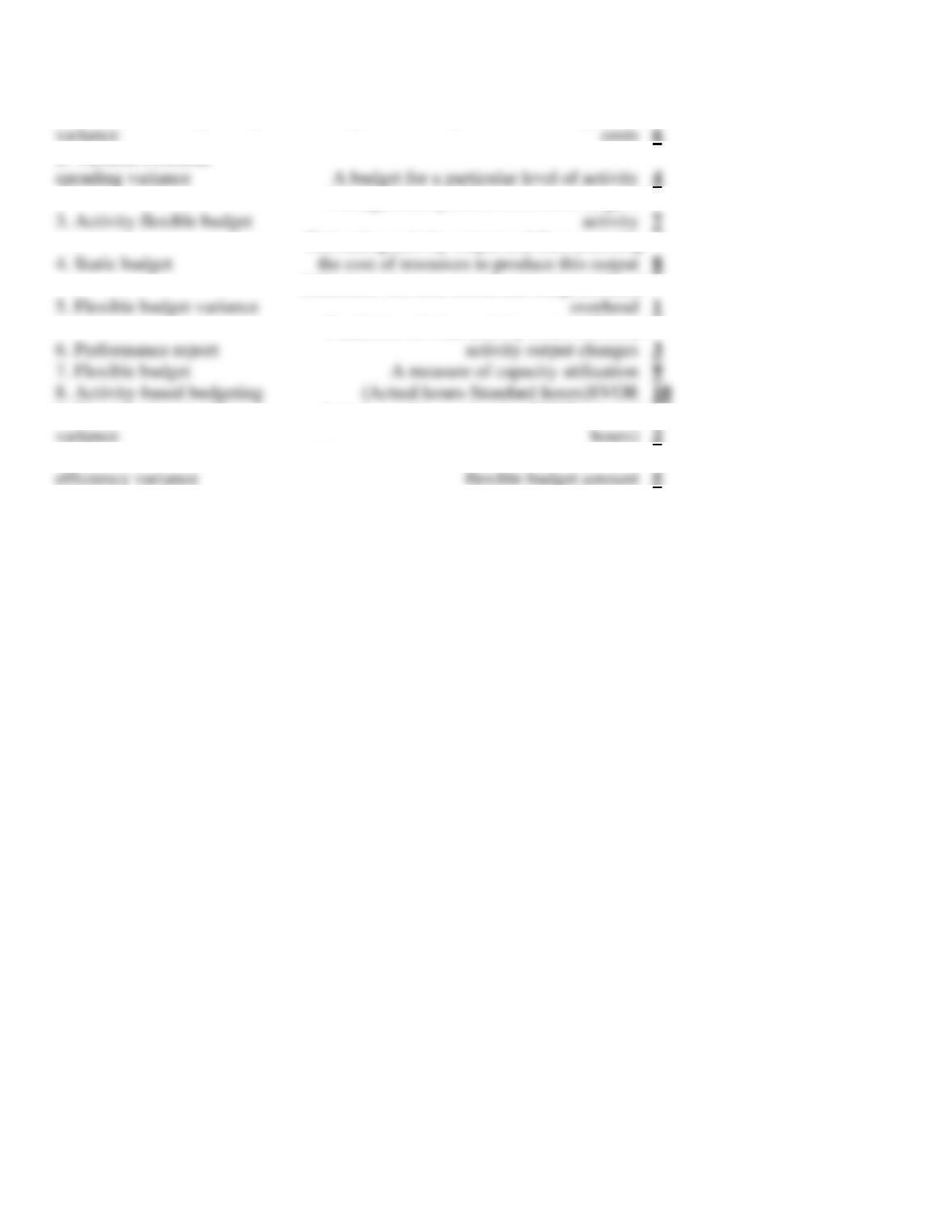
109. Match the following terms with the items below:
1. Fixed overhead spending
A report that compares actual with planned
2. Variable overhead
A budget that specifies costs for a range of
Estimating activity output and then assessing
Difference between actual and budgeted fixed
Prediction of what activity costs will be as
9. Fixed overhead volume
Actual variable overhead – (SVOR ´ Actual
10. Variable overhead
Difference between the actual amount and the
110. Figure 9-7.
Larry Miller, controller for Kipling Company, has been instructed to develop a flexible budget for overhead
costs. The company produces two types of frozen desserts: Icey and Tasty. The two desserts use common raw
materials in different proportions. The company expects to produce 200,000 gallons of each product during the
coming year. Icey requires 0.25 direct labor hour per gallon and Tasty requires 0.30. Larry has developed the
following fixed and variable costs for each of the four overhead items:
Overhead Item
Fixed Cost
Variable Rate per DLH
Maintenance
$52,000
$1.20
Power
1.50
Indirect labor
79,500
4.80
Rent
54,000
Refer to Figure 9-7. Required:
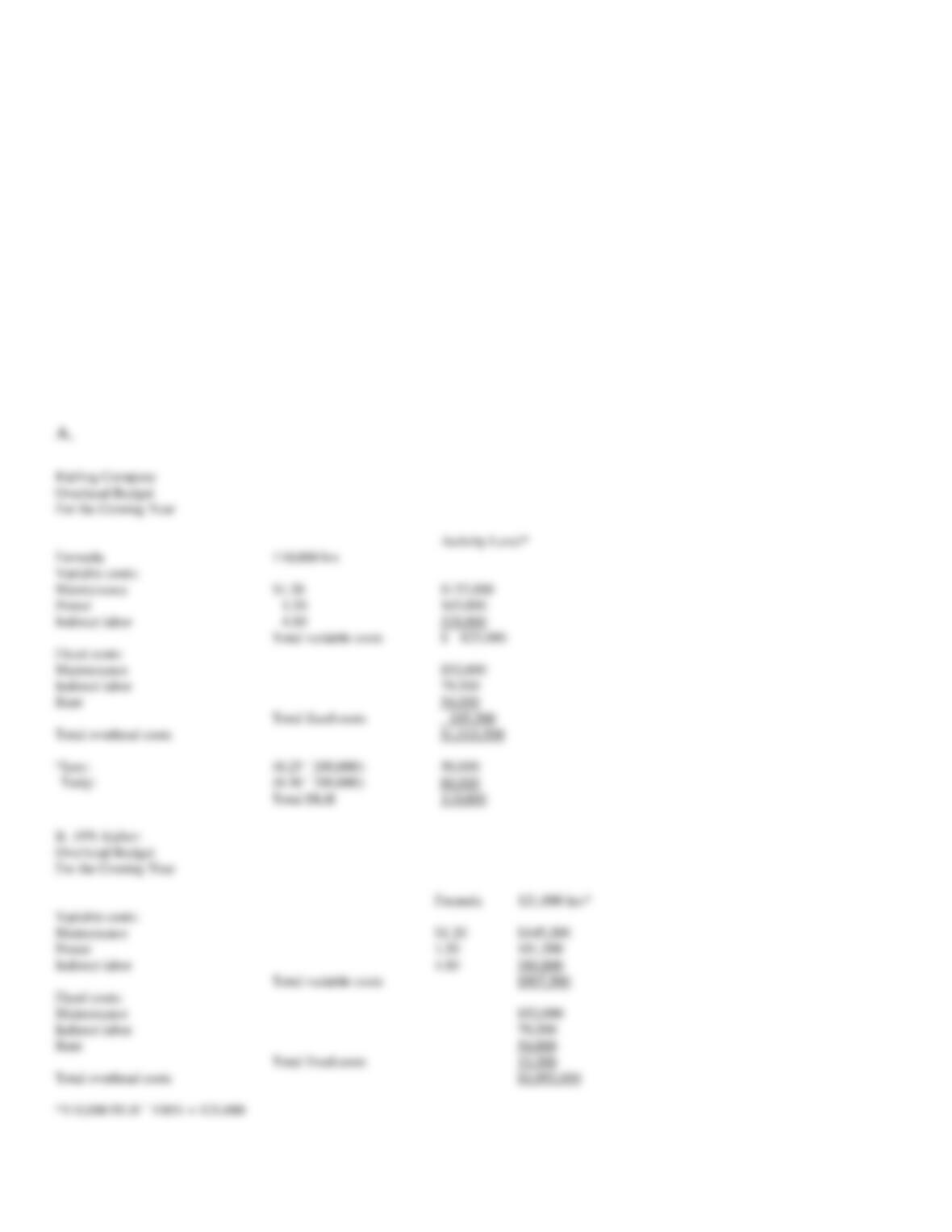
A. Prepare an overhead budget for the expected activity level for the coming year.
B. Prepare an overhead budget that reflects production that is 10 percent higher than expected (for both products).
Kipling Company
Overhead Budget
For the Coming Year
Activity Level*
Formula
110,000 hrs
Variable costs:
Maintenance
$1.20
$132,000
Power
1.50
165,000
Indirect labor
4.80
528,000
Total variable costs
$ 825,000
Fixed costs:
Maintenance
$52,000
Indirect labor
79,500
Rent
54,000
Total fixed costs
185,500
Total overhead costs
$1,010,500
*Icey:
(0.25 ´ 200,000)
50,000
Tasty:
(0.30 ´ 200,000)
60,000
Total DLH
110,000
Overhead Budget
For the Coming Year
Formula
121,000 hrs*
Variable costs:
Maintenance
$1.20
$145,200
Power
1.50
181,500
Indirect labor
4.80
580,800
Total variable costs
$907,500
Fixed costs:
Maintenance
$52,000
Indirect labor
79,500
Rent
54,000
Total fixed costs
15,500
*110,000 DLH ´ 110% = 121,000
111. Figure 9-7.
Larry Miller, controller for Kipling Company, has been instructed to develop a flexible budget for overhead
costs. The company produces two types of frozen desserts: Icey and Tasty. The two desserts use common raw
materials in different proportions. The company expects to produce 200,000 gallons of each product during the
coming year. Icey requires 0.25 direct labor hour per gallon and Tasty requires 0.30. Larry has developed the
following fixed and variable costs for each of the four overhead items:
Overhead Item
Fixed Cost
Variable Rate per DLH
Maintenance
$52,000
$1.20
Power
1.50
Indirect labor
79,500
4.80
Rent
54,000
Refer to Figure 9-7. Assume that Kipling actually produced 240,000 gallons of Icey and 200,000 of Tasty. The actual overhead costs incurred were:
Maintenance
$ 192,000
Power
181,700
Indirect labor
649,500
Rent
54,000
Required:
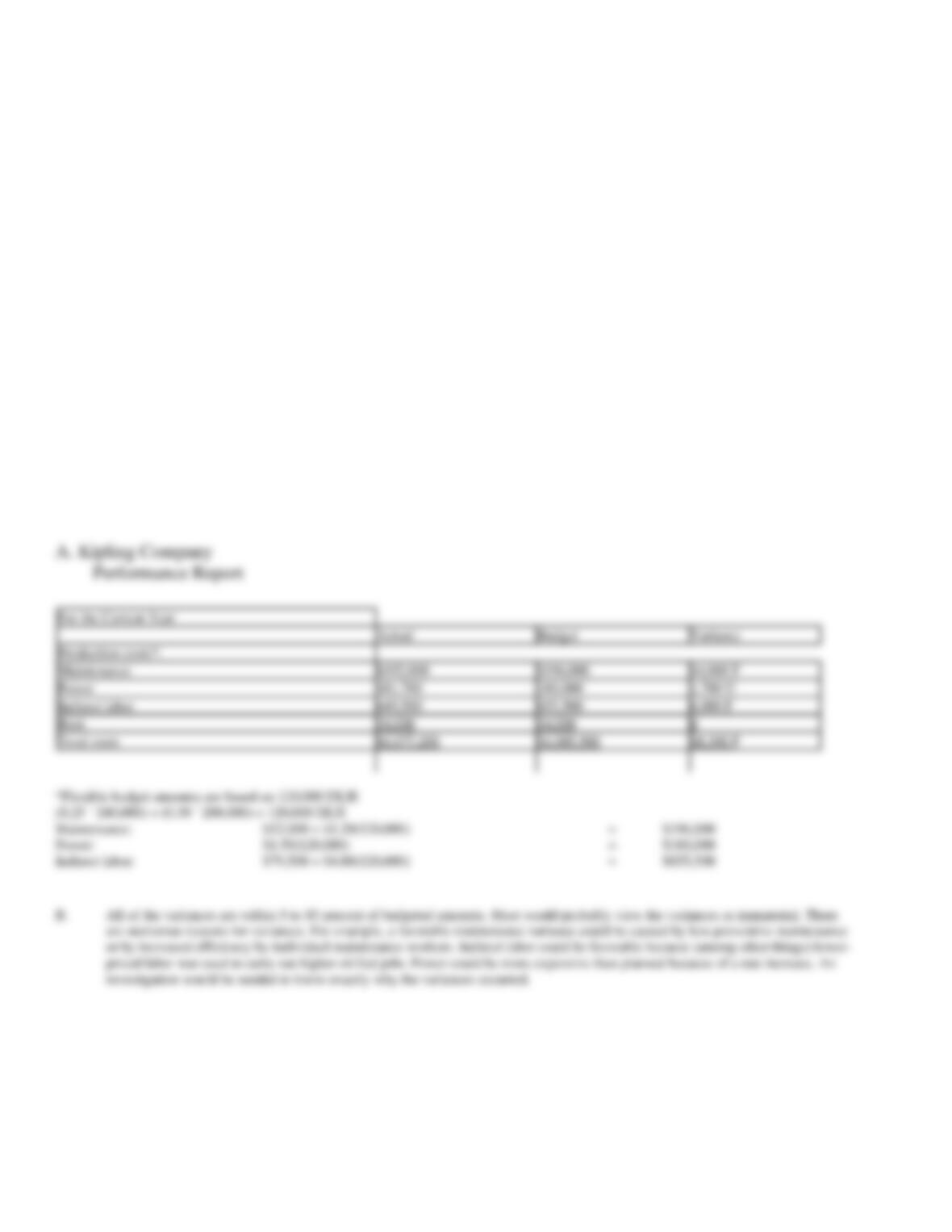
A. Prepare a performance report for the period.
B. Based on the report, would you judge any of the variances to be significant? Discuss some possible reasons for the variances.
For the Current Year
Actual
Budget
Variance
Production costs*:
Maintenance
$192,000
$196,000
$4,000 F
Power
181,700
180,000
1,700 U
Indirect labor
649,500
655,500
6,000 F
Rent
54,000
54,000
0
Total costs
$1,077,200
$1,085,500
$8,300 F
Maintenance:
$52,000 + $1.20(120,000)
=
$196,000
Power:
$1.50(120,000)
=
$180,000
Indirect labor:
$79,500 + $4.80(120,000)
=
$655,500