22) The simple trade model demonstrates that countries can expand consumption by specializing
in the production of goods and services in which they have a comparative advantage. In reality
we do not see complete specialization in production. State three reasons why this is case.
23) Suppose in Finland a worker can produce either 32 cell phones or 4 kayaks while in Canada
a worker can produce either 40 cell phones or 10 kayaks.
a. Which country has an absolute advantage in cell phone production? In kayak production?
b. What is the opportunity cost of 1 cell phone in Finland? In Canada?
c. What is the opportunity cost of 1 kayak in Finland? In Canada?
d. Which country has a comparative advantage in cell phone production? In kayak production?
e. Suppose each country has 1,000 workers. Currently, each country devotes 40 percent of its
labor force to cell phone production and 60 percent to kayak production. What is the output of
cell phones and kayaks for each country and what is the total output of cell phones and kayaks
between the two countries?
f. Suppose each country specializes in the production of the good in which it has a comparative
advantage. What is the total output of cell phones and kayaks in the two countries?
g. Provide a numerical example to show how Finland and Canada can both gain from trade.
Assume that the terms of trade are established at 6 cell phones for 1 kayak.
23
24
24) What are the four main sources of comparative advantage? Briefly explain each source and
provide examples.
9.4 Government Policies That Restrict International Trade
1) Trade between countries that is without restrictions is called
A) unobstructed commerce.
B) unabated trade.
C) free trade.
D) unencumbered trade.
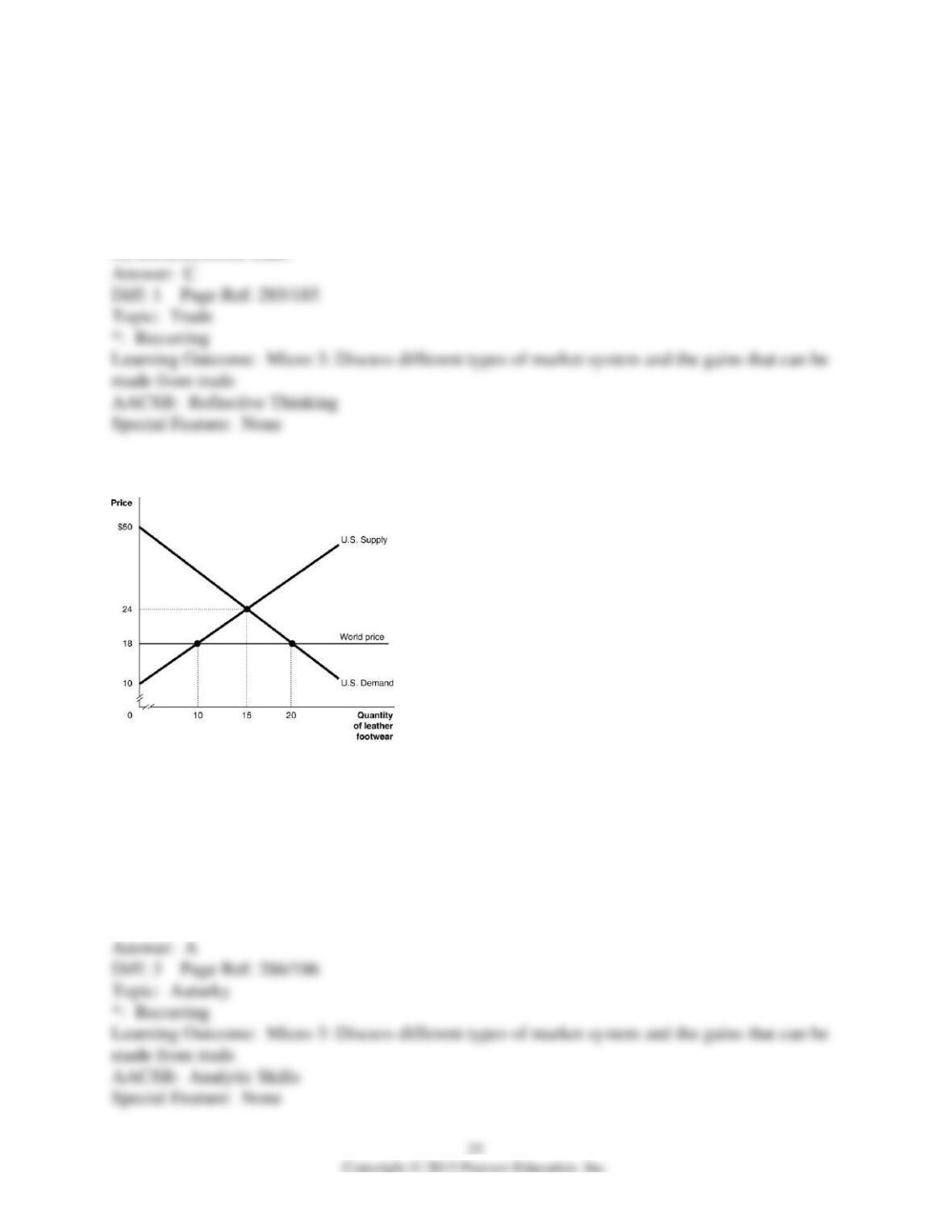
Figure 9-1
Figure 9-1 shows the U.S. demand and supply for leather footwear.
2) Refer to Figure 9-1. Under autarky, the consumer surplus is ________ and the producer
surplus is ________.
A) $195; $105
B) $300; $285
C) $260; $40
D) $555; $105
3) Refer to Figure 9-1. Under autarky, the deadweight loss is
A) $0.
B) $15.
C) $30.
D) $40.
4) Refer to Figure 9-1. Suppose the government allows imports of leather footwear into the
United States. What happens to the market price and what is the quantity of imports?
A) The price equals $24 and imports equal 20 units.
B) The price falls to $24 and imports equal 5 units.
C) The price falls to $18 and imports equal 15 units.
D) The price equals $18 and imports equals 10 units.
5) Refer to Figure 9-1. Suppose the government allows imports of leather footwear into the
United States. The market price falls to $18. What are the values of consumer surplus and
domestic producer surplus?
A) Consumer surplus = $270; producer surplus = $40.
B) Consumer surplus = $320; producer surplus = $40.
C) Consumer surplus = $320; producer surplus = $360..
D) Consumer surplus = $305; producer surplus = $320.
6) Which of the following is not an example of a trade restriction?
A) tariffs
B) quotas and voluntary export restraints
C) legislation requiring that cars sold in a country have a 50 percent domestic content
D) consumer preferences for goods produced domestically
7) Under autarky, consumer surplus is represented by the area
A) above the supply curve and below the equilibrium price.
B) above the supply curve and below the demand curve.
C) below the demand curve and above the equilibrium price.
D) above the demand curve and below the supply curve.
8) A tariff is
A) a limit placed on the quantity of goods that can be imported into a country.
B) a tax imposed by a government on goods imported into a country.
C) a subsidy granted to importers of a vital input.
D) a health and safety restriction imposed on an imported product.
9) A numerical limit imposed by a government on the quantity of a good that can be imported
into the country is called a
A) tariff.
B) quota.
C) quantity floor.
D) barricade.
10) Which of the following is the best example of a tariff?
A) a subsidy from the U.S. government to domestic manufacturers of residential air conditioners
to enable them to compete more effectively with foreign producers
B) a limit on the quantity of residential air conditioners that can be imported from a foreign
country
C) a $150 fee imposed on all imported residential air conditioners
D) a tax placed on all residential air conditioners sold in the domestic market to help offset the
impact of emissions on the environment
11) A tariff
A) makes domestic consumers worse off.
B) makes both domestic producers and consumers worse off.
C) makes everyone better off.
D) makes domestic producers worse off.
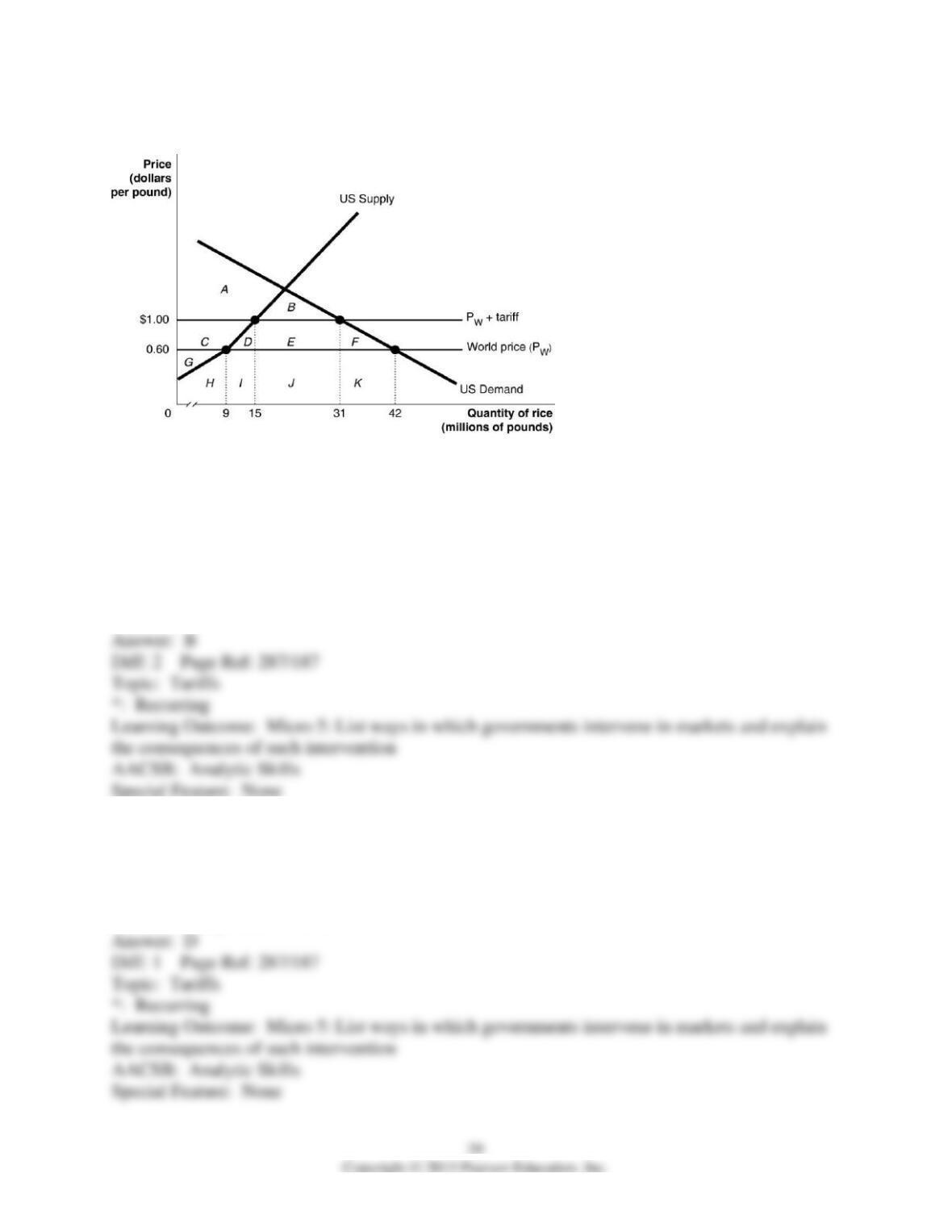
Figure 9-2
Suppose the U.S. government imposes a $0.40 per pound tariff on rice imports. Figure 9-2 shows
the impact of this tariff.
12) Refer to Figure 9-2. The tariff revenue collected by the government equals the area
A) D + E + F.
B) E.
C) B + D + E + F.
D) C + D + E + F.
13) Refer to Figure 9-2. Without the tariff in place, the United States consumes
A) 9 million pounds of rice.
B) 15 million pounds of rice.
C) 31 million pounds of rice.
D) 42 million pounds of rice.
14) Refer to Figure 9-2. Without the tariff in place, the United States produces
A) 9 million pounds of rice.
B) 15 million pounds of rice.
C) 31 million pounds of rice.
D) 42 million pounds of rice.
15) Refer to Figure 9-2. With the tariff in place, the United States
A) imports 16 million pounds of rice.
B) imports 9 million pounds of rice.
C) imports 15 million pounds of rice.
D) exports 31 million pounds of rice.
16) Refer to Figure 9-2. As a result of the tariff, domestic producers increase their quantity
supplied by
A) 31 million pounds of rice.
B) 22 million pounds of rice.
C) 15 million pounds or rice.
D) 6 million pounds of rice.
17) Refer to Figure 9-2. The increase in domestic producer surplus as a result of the tariff is
equal to the area
A) C.
B) C + G.
C) A + C + G.
D) C + D + G + H + I.
18) Refer to Figure 9-2. The tariff causes domestic consumption of rice
A) to fall by 27 million pounds.
B) to fall by 11 million pounds.
C) to rise by 6 million pounds.
D) to rise by 16 million pounds.
19) Refer to Figure 9-2. The loss in domestic consumer surplus as a result of the tariff is equal to
the area
A) B + D + E + F.
B) D + E + F.
C) C + D + E + F.
D) B.
20) Refer to Figure 9-2. If the tariff was replaced by a quota which limited rice imports to 16
million pounds, the amount of revenue received by rice importers would equal
A) $6.4 million.
B) $9.6 million.
C) $16 million.
D) $19.8 million.
21) An agreement negotiated by two countries that places a numerical limit on the quantity of a
good that can be imported by one country from another country is called
A) a non-tariff trade barrier.
B) an export quota.
C) an import quota.
D) a voluntary export restraint.
22) The main purpose of most tariffs and quotas is to
A) raise revenue for the government.
B) reduce the prices consumers pay for goods and services.
C) reduce the foreign competition that domestic firms face.
D) improve the quality of goods and services imported into the country.
23) Which of the following is the best example of a quota?
A) a limit imposed on the number of sport utility vehicles that the United States can import from
Japan
B) a subsidy granted by the U.S. government to domestic garment manufacturers so they can
compete more effectively with foreign garment manufacturers
C) a tax placed on all sport utility vehicles sold in the domestic market
D) a $5,000 per-car fee imposed on all sport utility vehicles imported into the United States
24) In order to avoid the imposition of other types of trade barriers, foreign producers will
sometimes agree to voluntary export restraints. With voluntary export restraints, foreign
producers
A) agree to meet specific quality standards required by the importing country.
B) limit their exports to a country.
C) pay a tax on all products they export.
D) must agree to import an equal quantity of products that they export.
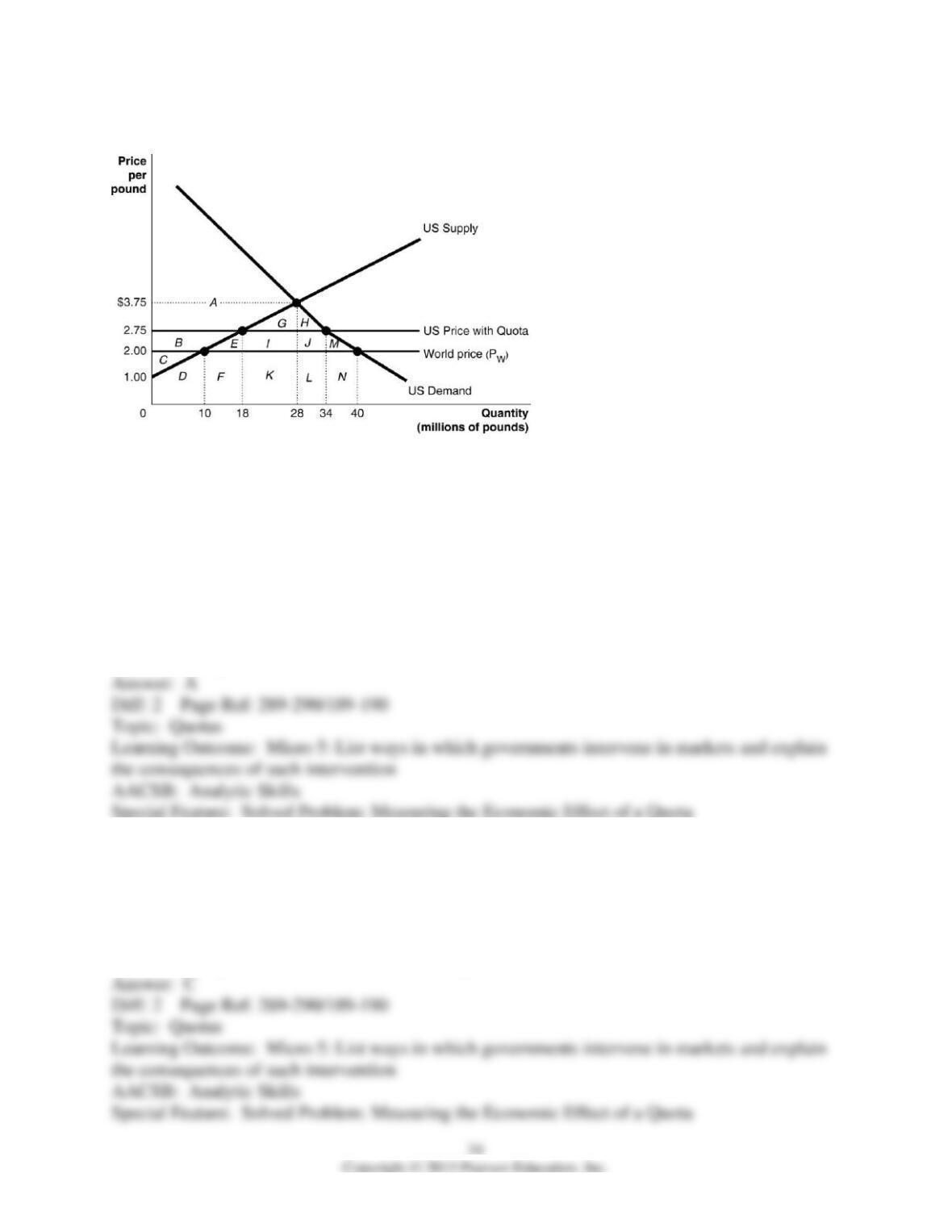
Figure 9-3
Since 1953 the United States has imposed a quota to limit the imports of peanuts. Figure 9-3
illustrates the impact of the quota.
25) Refer to Figure 9-3. Without the quota, the domestic price of peanuts equals the world price
which is $2.00 per pound. What is the quantity of peanuts supplied by domestic producers in the
absence of a quota?
A) 10 million pounds
B) 28 million pounds
C) 30 million pounds
D) 40 million pounds
26) Refer to Figure 9-3. If there was no quota, how many pounds of peanuts would domestic
consumers purchase and what quantity would be imported?
A) 28 million pounds of which 18 million pounds would be imported
B) 40 million pounds of which 12 million pounds would be imported
C) 40 million pounds of which 30 million pounds would be imported
D) 40 million pounds all of which would be imported
27) Refer to Figure 9-3. What is the area of domestic producer surplus without a quota?
A) C
B) C + B
C) A + B + C
D) A + B + C + D
28) Refer to Figure 9-3. With a quota in place, what is the quantity consumed in the domestic
market and what portion of this is supplied by domestic producers?
A) Domestic consumption equals 28 million pounds of which 18 million pounds are produced by
domestic producers.
B) Domestic consumption equals 40 million pounds of which 22 million pounds are produced by
domestic producers.
C) Domestic consumption equals 34 million pounds of which 16 million pounds are produced by
domestic producers.
D) Domestic consumption equals 34 million pounds of which 18 million pounds are produced by
domestic producers.
29) Refer to Figure 9-3. What is the area of consumer surplus after the imposition of the quota?
A) A + G + H
B) G + H + E + I+ J + M
C) G + H
D) A
30) Refer to Figure 9-3. What is the area of domestic producer surplus after the imposition of a
quota?
A) B
B) B + C
C) B + E + I + J + M
D) E + I + J + M
31) Refer to Figure 9-3. What is the area that represents revenue to foreign producers who are
granted permission to sell in the U.S. market when there is a quota?
A) I + J
B) E + I + J + M
C) I + J + K+ L
D) G + H + I + J
32) Refer to Figure 9-3. What is the area that represents the deadweight loss as a result of the
quota?
A) G + H
B) G + H + I + J
C) E + I + J + M
D) E + M