8) One measure of the cost of common stock equity is the rate at which investors discount the
expected common stock dividends of the firm to determine its share value.
9) Since the net proceeds from sale of new common stock will be less than the current market
price, the cost of new issues will always be less than the cost of existing issues.
10) The Gordon model is based on the premise that the value of a share of stock is equal to sum
of all future dividends it is expected to provide over an infinite time horizon.
11) Using the Capital Asset Pricing Model (CAPM), the cost of common stock equity is the
return required by investors as compensation for a firm’s nondiversifiable risk.
12) Use of the capital asset pricing model (CAPM) in measuring the cost of common stock
equity differs from the constant-growth valuation model in that it directly considers the firm’s
risk as reflected by beta.
13) When the constant-growth valuation model is used to find the cost of common stock equity
capital, it can easily be adjusted for flotation costs to find the cost of new common stock; the
capital asset pricing model (CAPM) does not provide a simple adjustment mechanism.
14) The cost of new common stock is normally greater than any other long-term financing cost.
15) The capital asset pricing model describes the relationship between the required return, or the
cost of common stock equity capital, and the nonsystematic risk of a firm as measured by the
beta coefficient.
16) The capital asset pricing model is used to calculate the effect of increase in prices of capital
assets due to inflation.
17) The Gordon model assumes that the value of a share of stock equals the future value of the
current price of share that it is expected to remain constant over an infinite time horizon.
18) According to the CAPM, the required return of an asset is the sum of risk-free rate of return
and beta times the risk premium.
19) The cost of equity for Tangshan Mining would be 18.00 percent if the expected return on
U.S. Treasury Bills is 5.00 percent, the market risk premium is 10.00 percent, and the firm’s beta
is 1.3.
20) The cost of retained earnings will always equal the cost of preferred stock.
21) The cost of common stock equity is ________.
A) the cost of the guaranteed stated dividend expected by the stockholders
B) the rate at which investors discount the expected dividends of the firm to determine its share
value
C) the after-tax cost of the interest obligations
D) the historical cost of floating the stock issue
22) The cost of common stock equity may be estimated by using the ________.
A) yield curve
B) break-even analysis
C) Gordon model
D) DuPont analysis
23) The cost of common stock equity may be estimated by using the ________.
A) yield curve
B) capital asset pricing model
C) break-even analysis
D) DuPont analysis
24) The cost of retained earnings is ________.
A) less than the cost of debt
B) equal to the cost of a new issue of common stock
C) equal to the cost of common stock equity
D) irrelevant to the investment/financing decision
25) A corporation has concluded that its financial risk premium is too high. In order to decrease
this, the firm can ________.
A) increase the proportion of long-term debt to decrease the cost of capital
B) increase the proportion of short-term debt to decrease the cost of capital
C) decrease the proportion of common stock equity to decrease financial risk
D) increase the proportion of common stock equity to decrease financial risk
26) The constant-growth valuation model is based on the premise that the value of a share of
common stock is ________.
A) the sum of the dividends and expected capital appreciation
B) determined based on an industry standard P/E multiple
C) determined by using a measure of relative risk called correlation coefficient
D) equal to the present value of all expected future dividends
27) In calculating the cost of common stock equity, the model which describes the relationship
between the required return and the nondiversifiable risk of the firm is ________.
A) the constant-growth model
B) the NPV model
C) the variable growth model
D) the capital asset pricing model
28) A firm has a beta of 1.2. The market return equals 14 percent and the risk-free rate of return
equals 6 percent. The estimated cost of common stock equity is ________.
A) 6 percent
B) 7.2 percent
C) 14 percent
D) 15.6 percent
29) One major expense associated with issuing new shares of common stock is ________.
A) coupon payment
B) sunk cost
C) overvaluation
D) underpricing
30) One of the circumstances in which the Gordon growth valuation model for estimating the
value of a share of stock should be used is ________.
A) declining dividends
B) an erratic dividend stream
C) the lack of data on dividend payments
D) a steady growth rate in dividends
31) A firm has common stock with a market price of $25 per share and an expected dividend of
$2 per share at the end of the coming year. The growth rate in dividends has been 5 percent. The
cost of the firm’s common stock equity is ________.
A) 5 percent
B) 8 percent
C) 10 percent
D) 13 percent
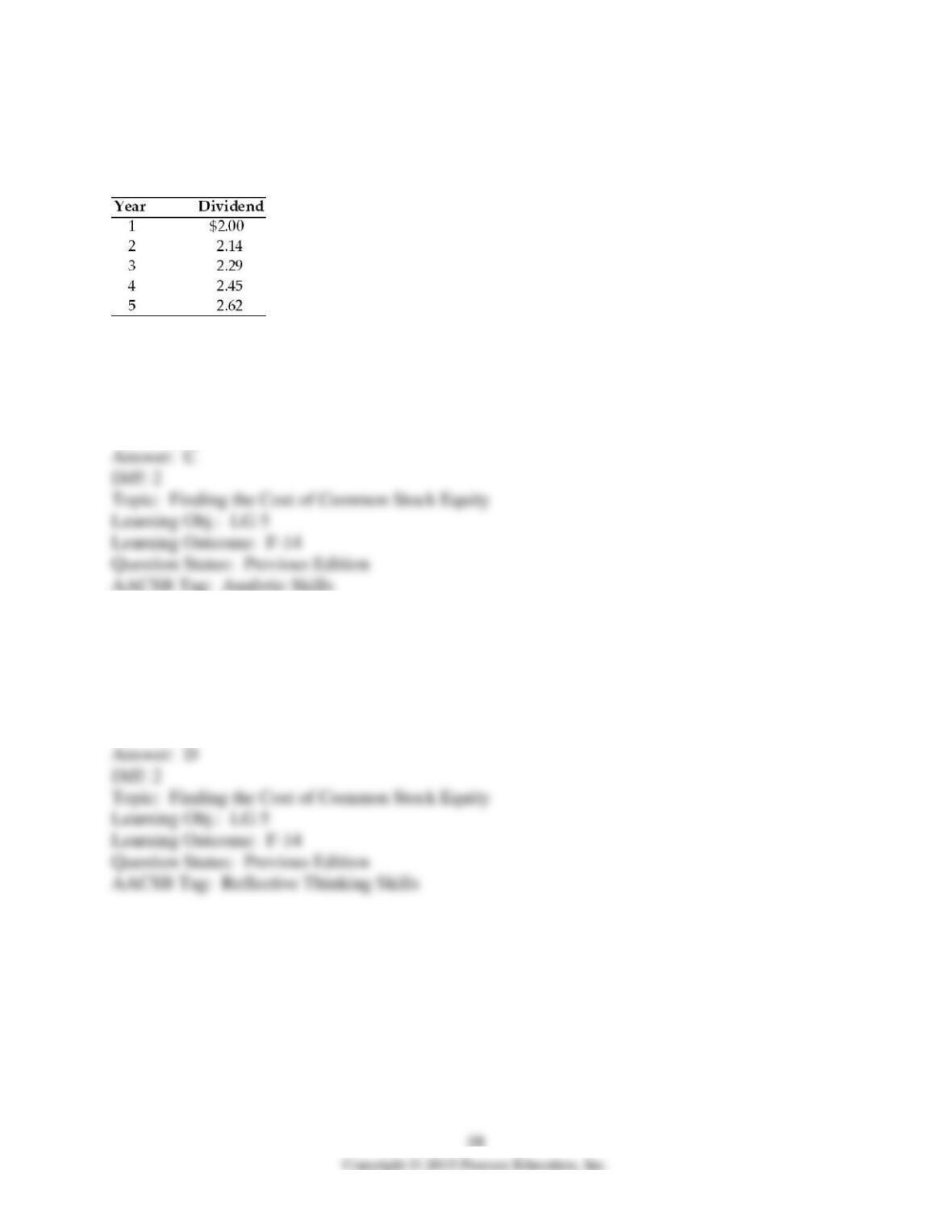
32) A firm has common stock with a market price of $55 per share and an expected dividend of
$2.81 per share at the end of the coming year. The dividends paid on the outstanding stock over
the past five years are as follows:
The cost of the firm’s common stock equity is ________.
A) 4.1 percent
B) 5.1 percent
C) 12.1 percent
D) 15.4 percent
33) Using the capital asset pricing model, the cost of common stock equity is the return required
by investors as compensation for ________.
A) the specific risk of a firm
B) a firm’s unsystematic risk
C) price volatility of the stock
D) a firm’s nondiversifiable risk
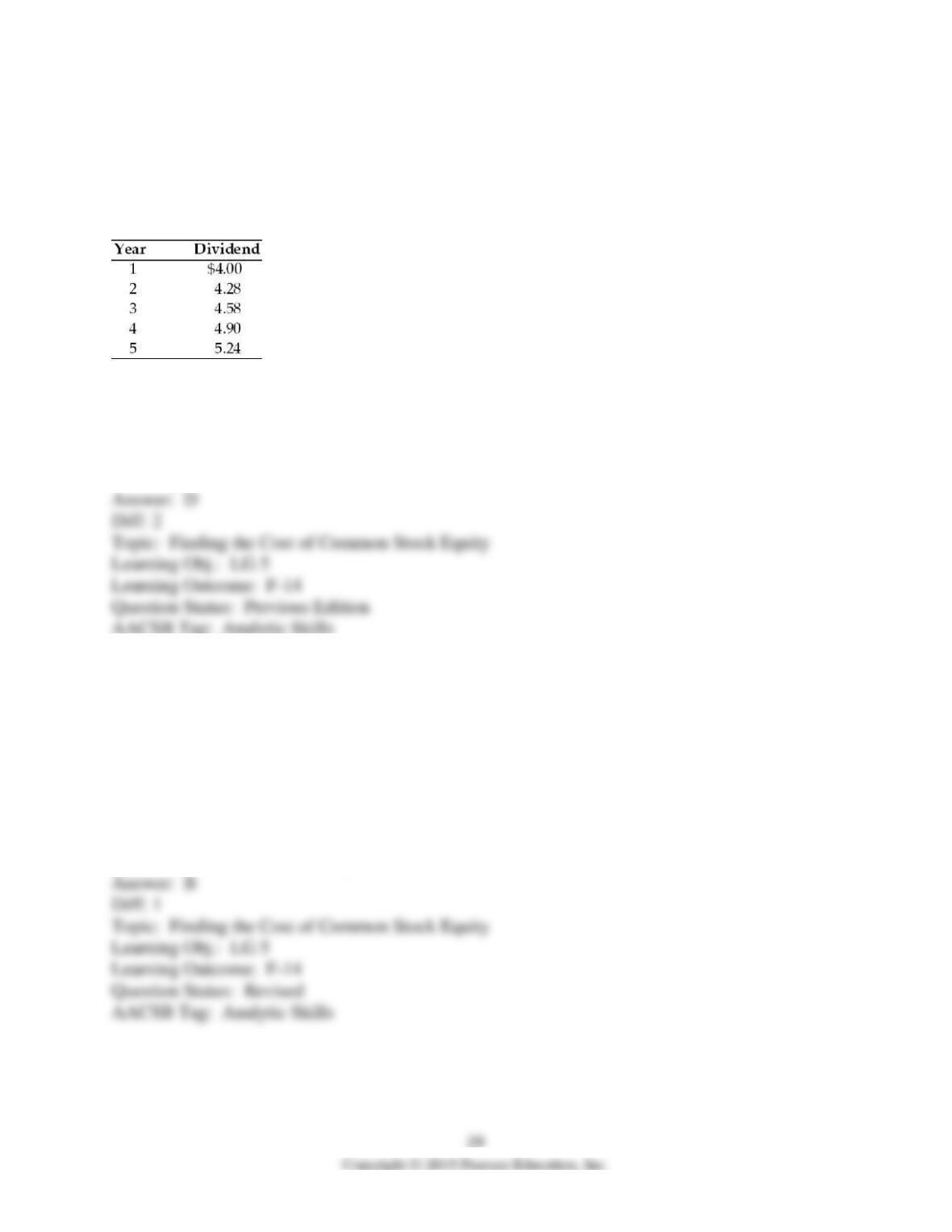
34) A firm has common stock with a market price of $100 per share and an expected dividend of
$5.61 per share at the end of the coming year. A new issue of stock is expected to be sold for
$98, with $2 per share representing the underpricing necessary in the competitive capital market.
Flotation costs are expected to total $1 per share. The dividends paid on the outstanding stock
over the past five years are as follows:
The cost of this new issue of common stock is ________.
A) 5.8 percent
B) 7.7 percent
C) 10.8 percent
D) 12.8 percent
35) In comparing the constant-growth model and the capital asset pricing model (CAPM) to
calculate the cost of common stock equity, ________.
A) the CAPM ignores risk, while the constant-growth model directly considers risk as reflected
in the beta
B) the CAPM directly considers risk as reflected in the beta, while the constant-growth model
uses the market price as a reflection of the expected risk-return preference of investors
C) the CAPM directly considers risk as reflected in the beta, while the constant growth model
uses dividend expectations as a reflection of risk
D) the CAPM indirectly considers risk as reflected in the market return, while the constant
growth model uses dividend expectations as a reflection of risk
36) In calculating the cost of common stock equity, ________.
A) the use of the capital asset pricing model (CAPM) is often preferred, because the data
required are more readily available
B) the use of the CAPM is preferred, because it directly considers risk and the effect of inflation
on the stock prices
C) the use of the constant-growth valuation model is often preferred, because the data required
are more readily available
D) the use of the constant-growth valuation model is often preferred, because it has a stronger
theoretical foundation
37) Given that the cost of common stock is 18 percent, dividends are $1.50 per share and the
price of the stock is $12.50 per share, what is the annual growth rate of dividends?
A) 4 percent
B) 5 percent
C) 6 percent
D) 8 percent
38) What would be the cost of new common stock equity for Tangshan Mining if the firm just
paid a dividend of $4.25, the stock price is $55.00, dividends are expected to grow at 8.5 percent
indefinitely, and flotation costs are $6.25 per share?
A) 17.22%
B) 16.88%
C) 9.46%
D) 12.57%
39) What would be the cost of retained earnings equity for Tangshan Mining if the expected
return on U.S. Treasury Bills is 5.00%, the market risk premium is 10.00 percent, and the firm’s
beta is 1.3?
A) 11.5%
B) 18.0%
C) 10.0%
D) 19.5%
40) The cost of new common stock financing is higher than the cost of retained earnings due to
________.
A) flotation costs and underpricing
B) flotation costs and overpricing
C) flotation costs and commission costs
D) commission costs and overpricing
41) Since retained earnings are viewed as a fully subscribed issue of additional common stock,
the cost of retained earnings is ________.
A) less than the cost of new common stock equity
B) equal to the cost of new common stock equity
C) greater than the cost of new common stock equity
D) not related to the cost of new common stock equity
42) Which of the following is a reason for a firm to underprice new issues?
A) When the market is in equilibrium, additional demand for shares can be achieved only at a
higher price.
B) When additional shares are issued, each share’s percent of ownership in a firm is diluted,
thereby justifying a higher share value.
C) When additional shares are issued, each share’s percent of ownership in a firm is
concentrated, thereby justifying a lower share value.
D) When the market is in equilibrium, additional demand for shares can be achieved only at a
lower price.
9.6 Calculate the weighted average cost of capital (WACC) and discuss alternative weighting
schemes.
1) The weighted average cost that reflects the interrelationship of financing decisions can be
obtained by weighing the cost of each source of financing by the target proportion in a firm’s
capital structure.
2) The weighted average cost of capital (WACC) reflects the expected average future cost of
capital over the long-run.
3) Since retained earnings is a more expensive source of financing than debt and preferred stock,
the weighted average cost of capital will fall once retained earnings have been exhausted.
4) A firm may face increase in the weighted average cost of capital either when retained earnings
have been exhausted or due to increases in debt, preferred stock, and common equity costs as
additional new funds are required.
5) In computing the weighted average cost of capital, the historical weights are either book value
or market value weights based on actual capital structure proportions.
6) In computing the weighted average cost of capital, the target weights are either book value or
historical value weights based on actual capital structure proportions.