Write the equation in its equivalent exponential form.
61)
log464 = x
61)
A)
64x=4
B)
4x=64
C)
x4=64
D)
644= x
Provide an appropriate response.
62)
On the decibel scale, the loudness of a sound, in decibels, is given by D = 10 log I
I0, where I is the
intensity of the sound, in watts per meter2, and I0 is the intensity of a sound barely audible to the
human ear. If the intensity of a sound is 106I0, what is its loudness in decibels?
62)
A)
60 decibels
B)
6 decibels
C)
3 decibels
D)
10 decibels
Solve the problem.
63)
A sample of 400 g of lead–210 decays to polonium–210 according to the function given by
A(t) =400e–0.032t, where t is time in years. What is the amount of the sample after 30 years? Round
the answer to the nearest gram.
63)
A)
1045 g
B)
111 g
C)
83 g
D)
153 g
Find the composition.
64)
If f(x) = – 7
x and g(x) =4
x, find (f
g)(x).
64)
A)
–7
4x
B)
–4
7x
C)
–7x
4
D)
–4x
7
Evaluate the expression without using a calculator.
65)
log9912
65)
A)
9
B)
12
C)
log912
D)
21
Find f(g(x)) and g(f(x)) and determine whether the pair of functions f and g are inverses of each other.
66)
f(x) =x – 2
2 and g(x) =2x – 2
66)
A)
not inverses
B)
inverses
Solve the logarithmic equation. Give an exact answer.
67)
log8(x2– 7x) = 1
67)
A)
{8, –1}
B)
{1}
C)
{8}
D)
{–8, 1}
Find f(g(x)) and g(f(x)) and determine whether the pair of functions f and g are inverses of each other.
68)
f(x) =2x and g(x) =x
2
68)
A)
inverses
B)
not inverses
Evaluate the expression without using a calculator.
69)
log10 10
69)
A)
1
10
B)
1
C)
1
2
D)
10
70)
log 100
70)
A)
1
5
B)
2
C)
20
D)
1
2
Use the compound interest formulas A = P 1 +r
n
nt and A = Pert to solve.
71)
Suppose that you have $7000 to invest. Which investment yields the greater return over 4 years:
6.25% compounded continuously or 6.3% compounded semiannually?
71)
A)
$7000 invested at 6.25% compounded continuously over 4 years yields the greater return.
B)
Both investment plans yield the same return.
C)
$7000 invested at 6.3% compounded semiannually over 4 years yields the greater return.
Find the inverse of the one–to–one function.
72)
f(x) = – 8x – 8
72)
A)
f–1(x) =x – 8
–8
B)
f–1(x) =
–8x + 8
–8
C)
f–1(x) =x + 8
–8
D)
f–1(x) =y + 8
–8
73)
f(x) =x2+ 7, for x
0
73)
A)
f–1(x) =x+49
B)
f–1(x) = x –7
C)
f–1(x) =x– 7
D)
f–1(x) =x – 7
23
Write the equation in its equivalent logarithmic form.
74)
4x=16
74)
A)
log164= x
B)
log16x =4
C)
log416 = x
D)
logx16 =4
Rewrite the equation in terms of base e. Express the answer in terms of a natural logarithm.
75)
y =2.2(0.1)x
75)
A)
y =2.2e(ln 0.1)x
B)
y =0.1 ln e2.2x
C)
y =0.1e(ln 2.2)x
D)
y =2.2 ln e0.1x
Find the inverse of the one–to–one function.
76)
f(x) =x3+ 7
76)
A)
f–1(x) =
3x– 7
B)
f–1(x) =
3x+ 7
C)
f–1(x) =
3x – 7
D)
f–1(x) =
3x + 7
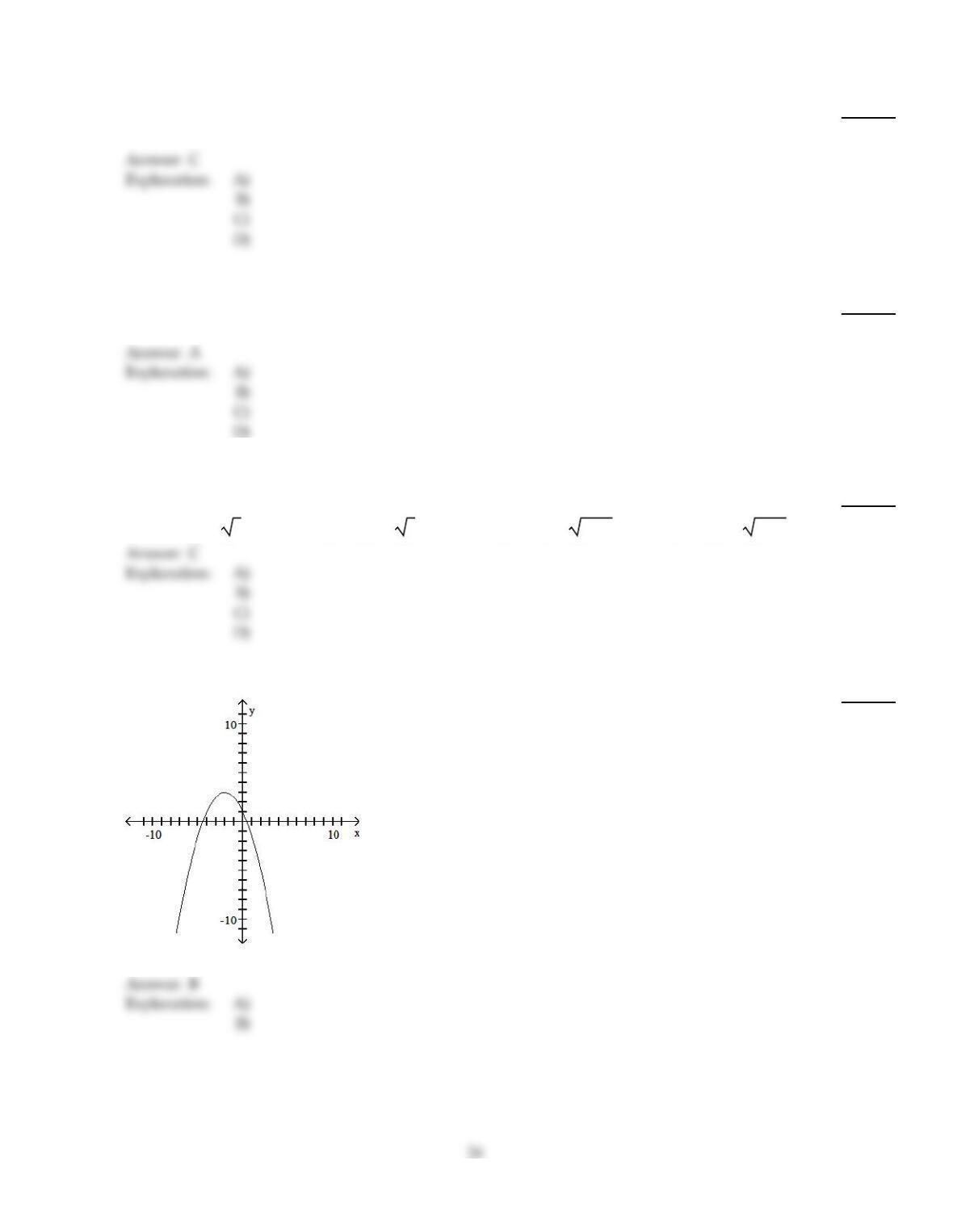
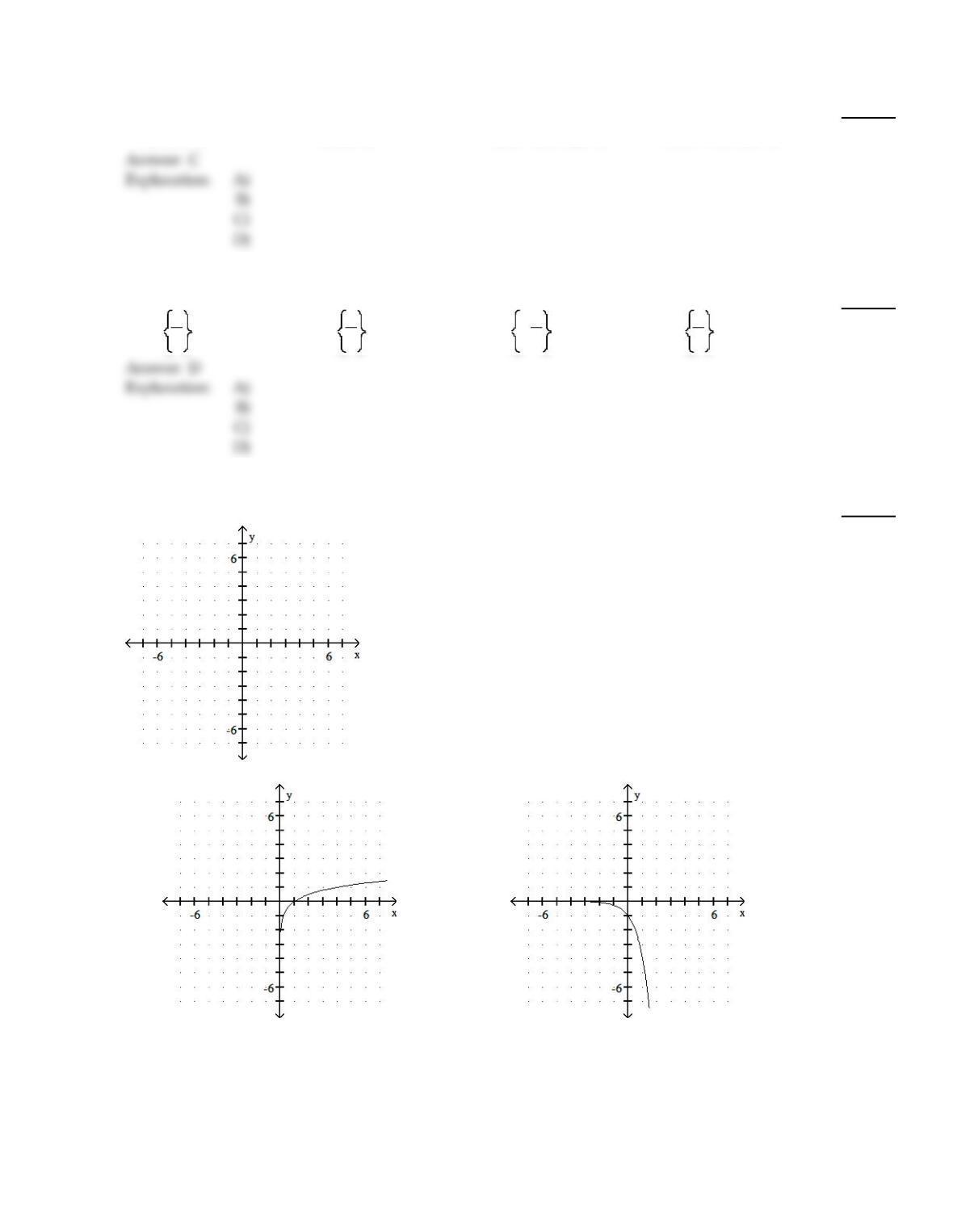
Determine if the graph represents a function that has an inverse function.
77)
77)
A)
has an inverse
B)
does not have an inverse
Find the domain of the logarithmic function. Write your answer in interval notation.
78)
f(x) =log2(x – 2)2
78)
A)
(–2, )
B)
(2, )
C)
(–, 2) (2, )
D)
(–, 0) (0, )
Solve the logarithmic equation. Give an exact answer.
79)
log(x + 5) = log(5x – 4)
79)
A)
3
2
B)
1
4
C)
–9
4
D)
9
4
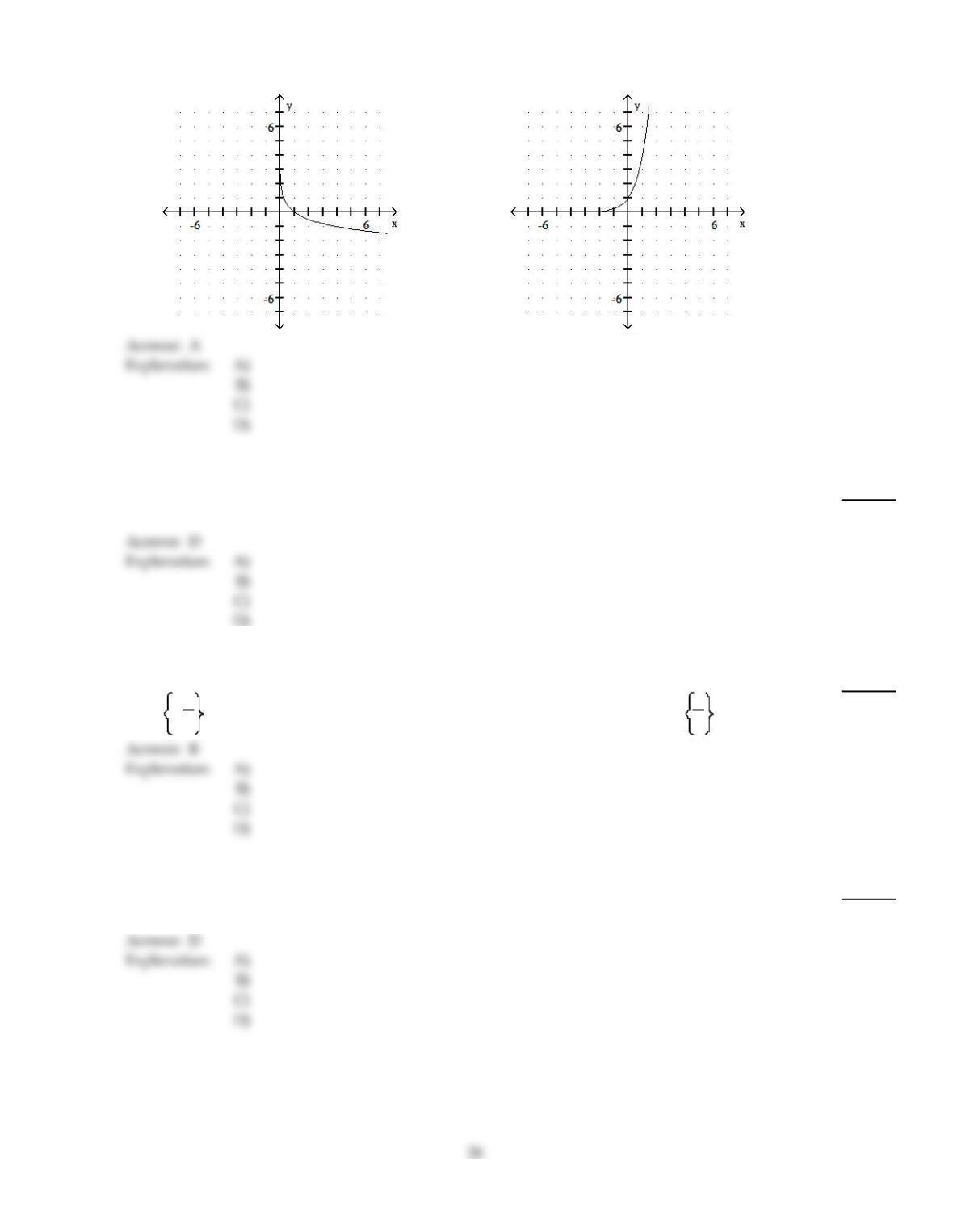
Graph the function.
80)
f(x) =log4x
80)
A)
B)
25
C)
D)
Write the equation in its equivalent logarithmic form.
81)
4x=197
81)
A)
log4x =197
B)
log1974= x
C)
log197x =4
D)
log4197 = x
Solve the logarithmic equation. Give an exact answer.
82)
log(4x) = log 5+ log(x – 3)
82)
A)
–5
3
B)
{15}
C)
{–15}
D)
2
3
Use common logarithms or natural logarithms and a calculator to evaluate to four decimal places
83)
log16 81.4
83)
A)
0.7065
B)
3.1147
C)
0.6302
D)
1.5867
Solve the logarithmic equation. Give an exact answer.
84)
ln 4+ ln(x – 1) = 0
84)
A)
{1}
B)
1
4
C)
5
4
D)
4
5
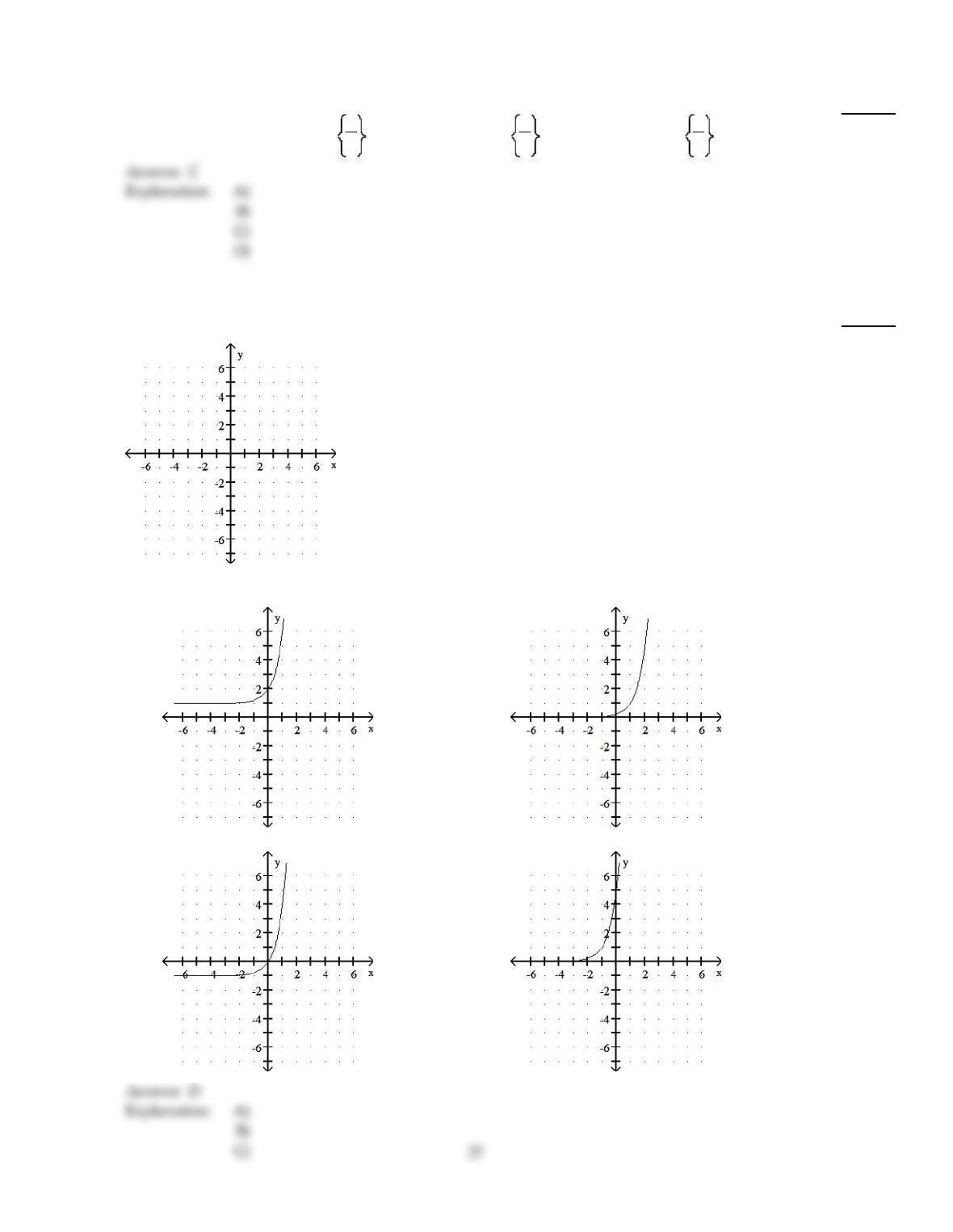
Graph the function.
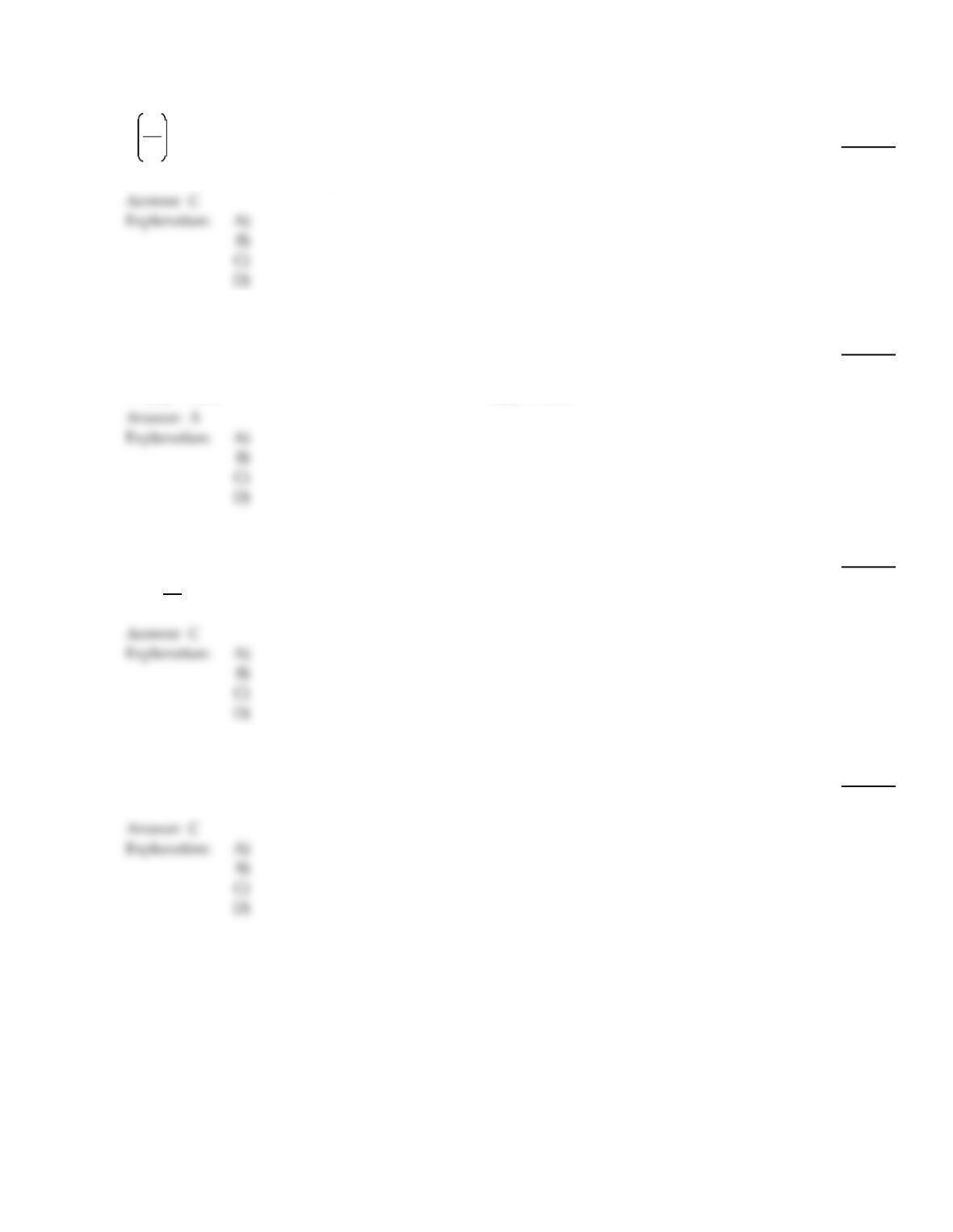
85)
Use the graph of f(x) =5x to obtain the graph of g(x) =5x +1.
85)
A)
B)
C)
D)
Use properties of logarithms to expand the logarithmic expression as much as possible. Where possible, evaluate
logarithmic expressions without using a calculator.
86)
log3
27
x
86)
A)
9–log3 x
B)
3
x
C)
3–log3 x
D)
–3log3 x
Solve the equation.
87)
log81 x =1
4
87)
A)
{4}
B)
{3}
C)
1
324
D)
1
3
Use properties of logarithms to expand the logarithmic expression as much as possible. Where possible, evaluate
logarithmic expressions without using a calculator.
88)
log4(4x)
88)
A)
4
B)
x
C)
1
D)
1 +log4 x
Solve the logarithmic equation. Give an exact answer.
89)
ln 3+ ln x = 0
89)
A)
{ 3}
B)
C)
1
3
D)
{3}
28
Use properties of logarithms to expand the logarithmic expression as much as possible. Where possible, evaluate
logarithmic expressions without using a calculator.
90)
ln e6
11
90)
A)
ln e6+ ln 11
B)
6+ ln 11
C)
6– ln 11
D)
ln e6– ln 11
Provide an appropriate response.
91)
Rewrite y =91(0.28)x in terms of base e. Express the answer in terms of a natural logarithm.
91)
A)
y =91e(ln 0.28)x
B)
y =91e(0.28x)
C)
y =0.28e(91x)
D)
y =0.28e(ln 91)x
Evaluate the expression without using a calculator.
92)
log101
92)
A)
1
10
B)
1
C)
0
D)
10
Write the equation in its equivalent logarithmic form.
93)
73=343
93)
A)
log73=343
B)
log3437=3
C)
log7343 =3
D)
log3343 =7
Graph the function.
29
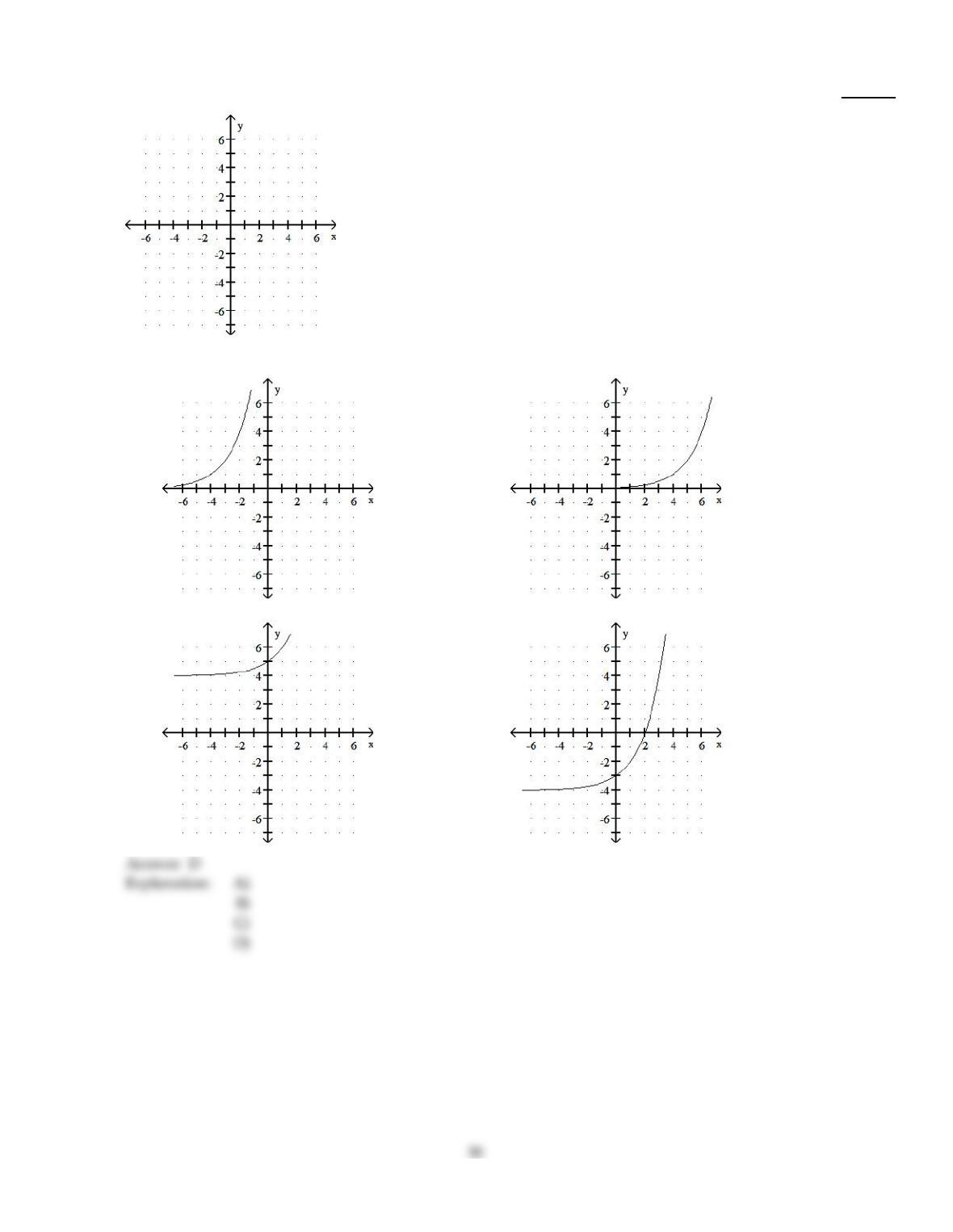
94)
Use the graph of f(x) =2x to obtain the graph of g(x) =2x–4.
94)
A)
B)
C)
D)
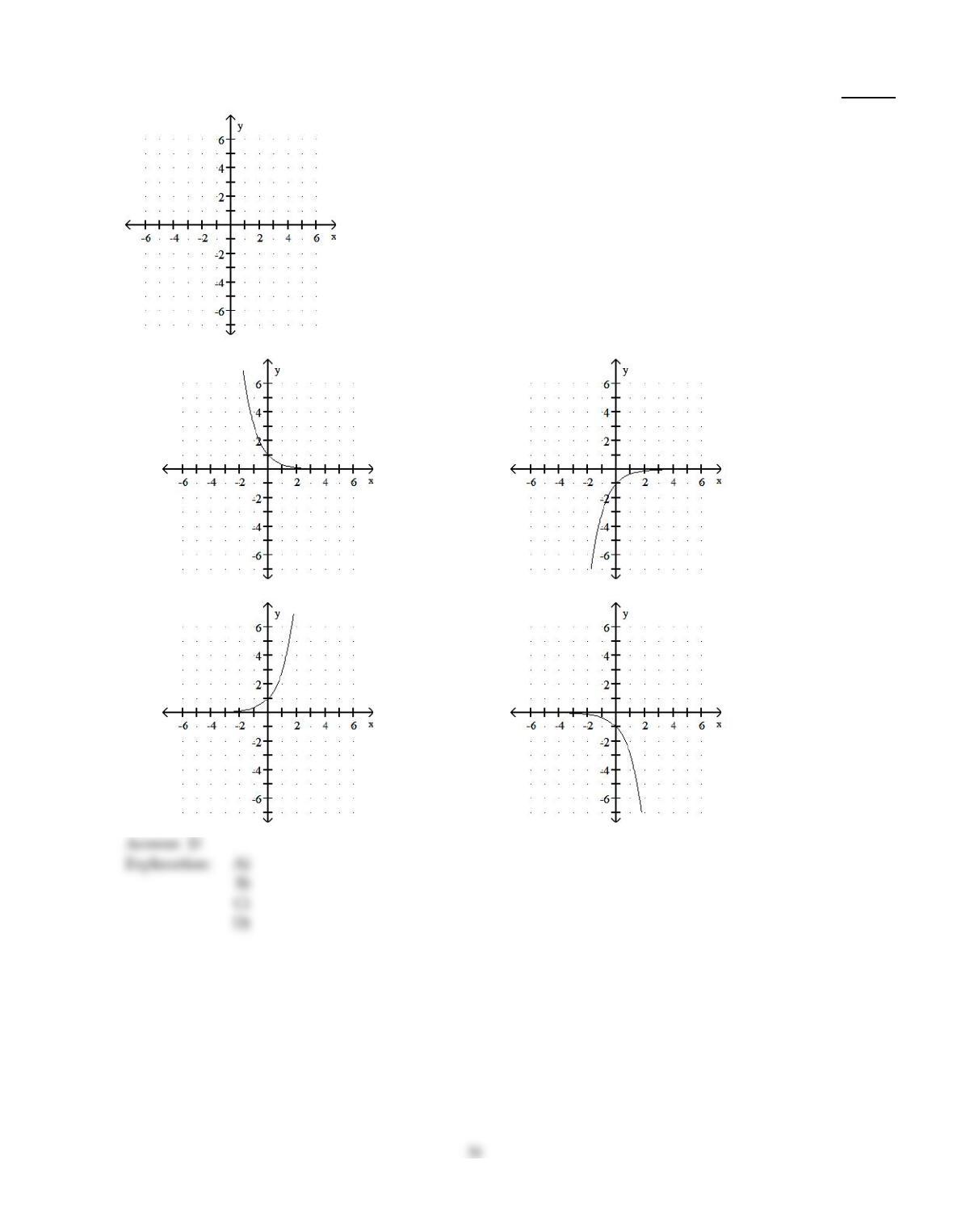
95)
Use the graph of f(x) =3x to obtain the graph of g(x) = – 3x.
95)
A)
B)
C)
D)
Solve the problem.
96)
Find out how long it takes a $3100 investment to earn $500 interest if it is invested at 9%
compounded monthly. Round to the nearest tenth of a year. Use the formula A = P 1 +r
n
nt.
96)
A)
1.5 yr
B)
1.7 yr
C)
1.9 yr
D)
2.1 yr
Use common logarithms or natural logarithms and a calculator to evaluate to four decimal places
97)
log0.6 15
97)
A)
0.9542
B)
–5.3013
C)
–0.1886
D)
1.3979
Use properties of logarithms to condense the logarithmic expression. Write the expression as a single logarithm whose
coefficient is 1. Where possible, evaluate logarithmic expressions.
98)
log6(x + 8) –log6(x – 3)
98)
A)
log6
x + 8
x – 3
B)
log6
x + 8
x + 3
C)
log6(x2+ 5x – 24)
D)
log611
Provide an appropriate response.
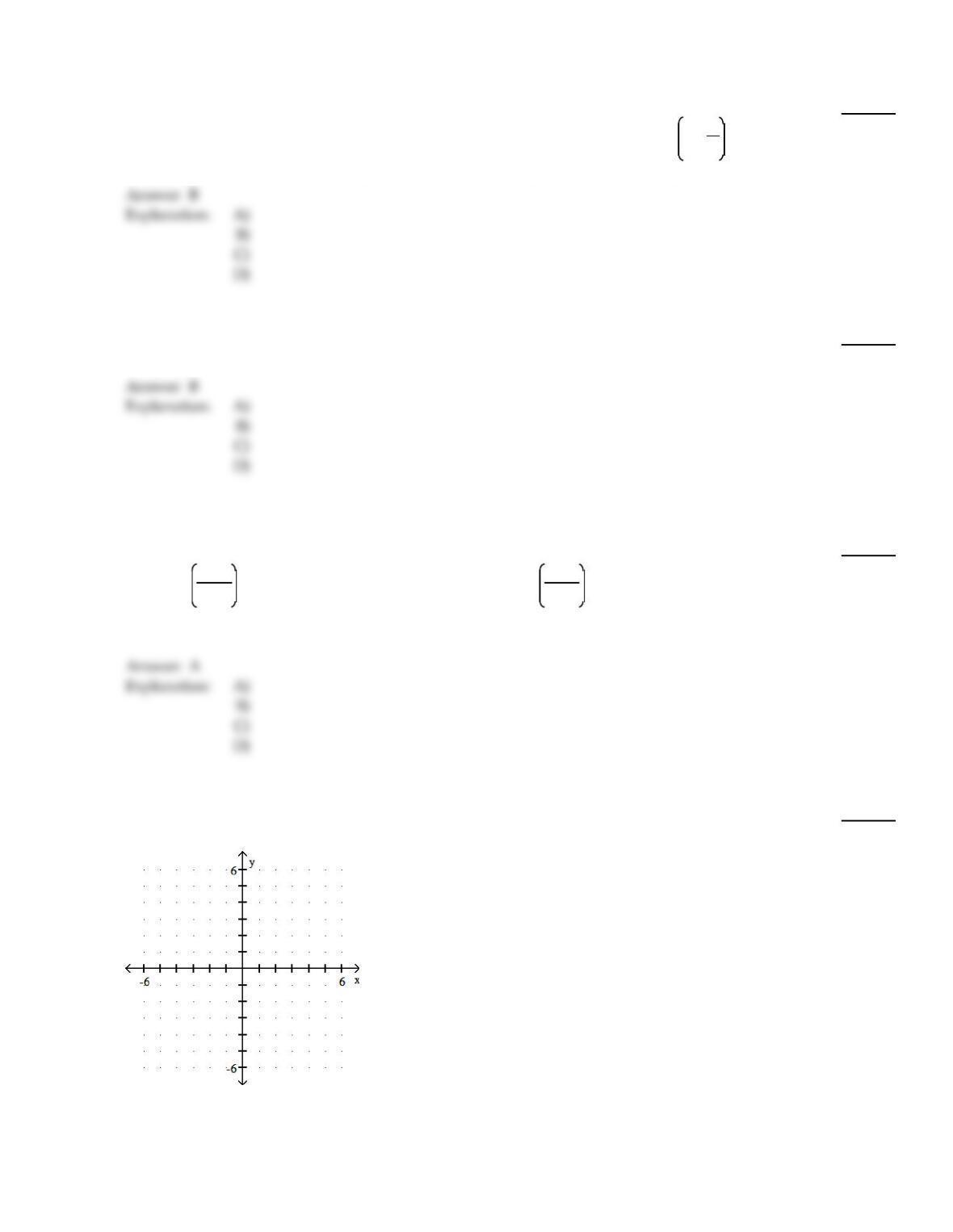
99)
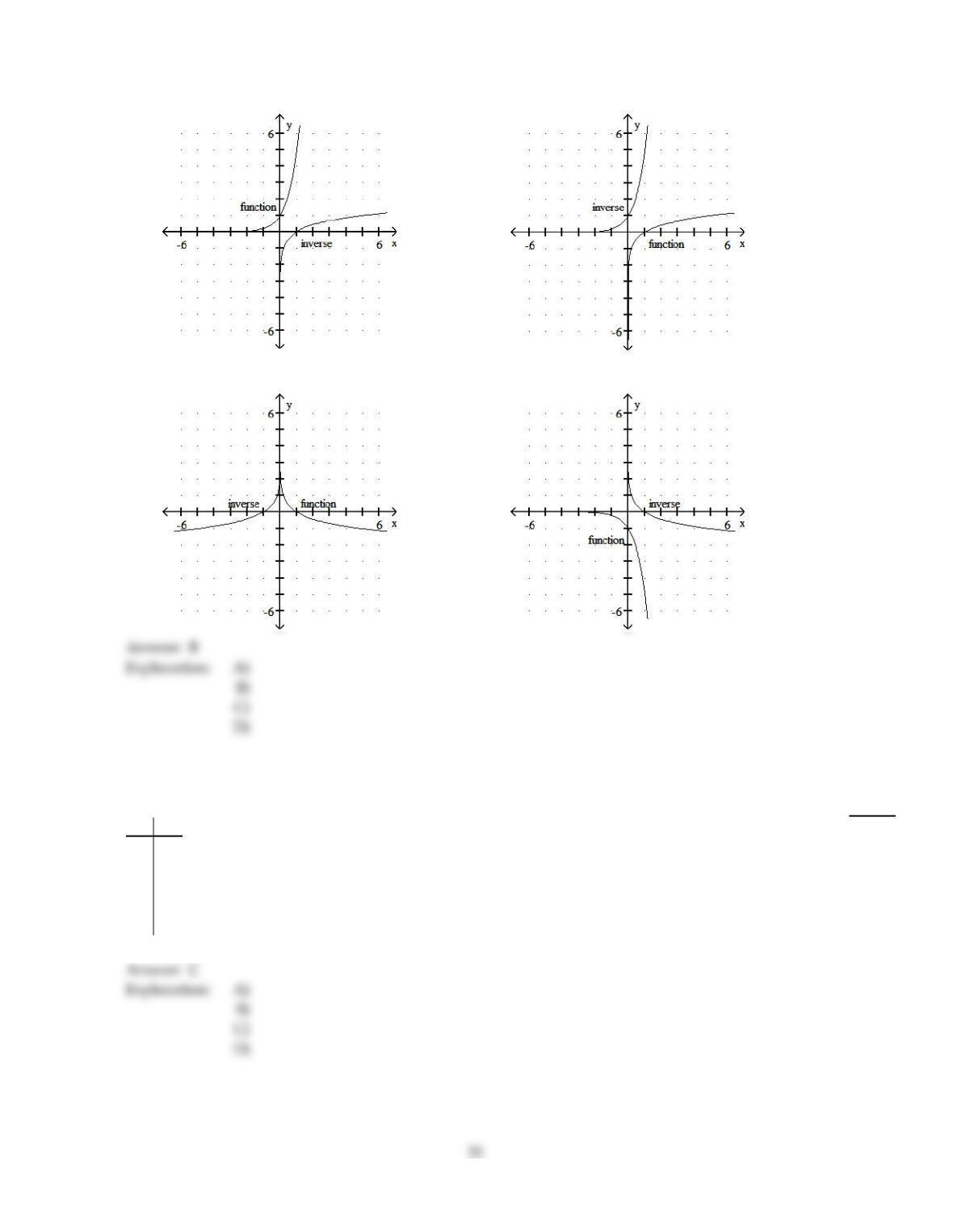
Graph f(x) =5x and g(x) =log 5x in the same rectangular coordinate system. Use the graphs to
determine each function’s domain and range.
99)
32
A)
Domain of f: (0, ), Range of f: ( , )
Domain of g: ( , ), Range of g: (0, )
B)
Domain of f: ( , ), Range of f: (0, )
Domain of g: (0, ), Range of g: ( , )
C)
Domain of f: ( , ), Range of f: (0, )
Domain of g: (0, ), Range of g: ( , )
D)
Domain of f: (0, ), Range of f: ( , )
Domain of g: ( , ), Range of g: (0, )
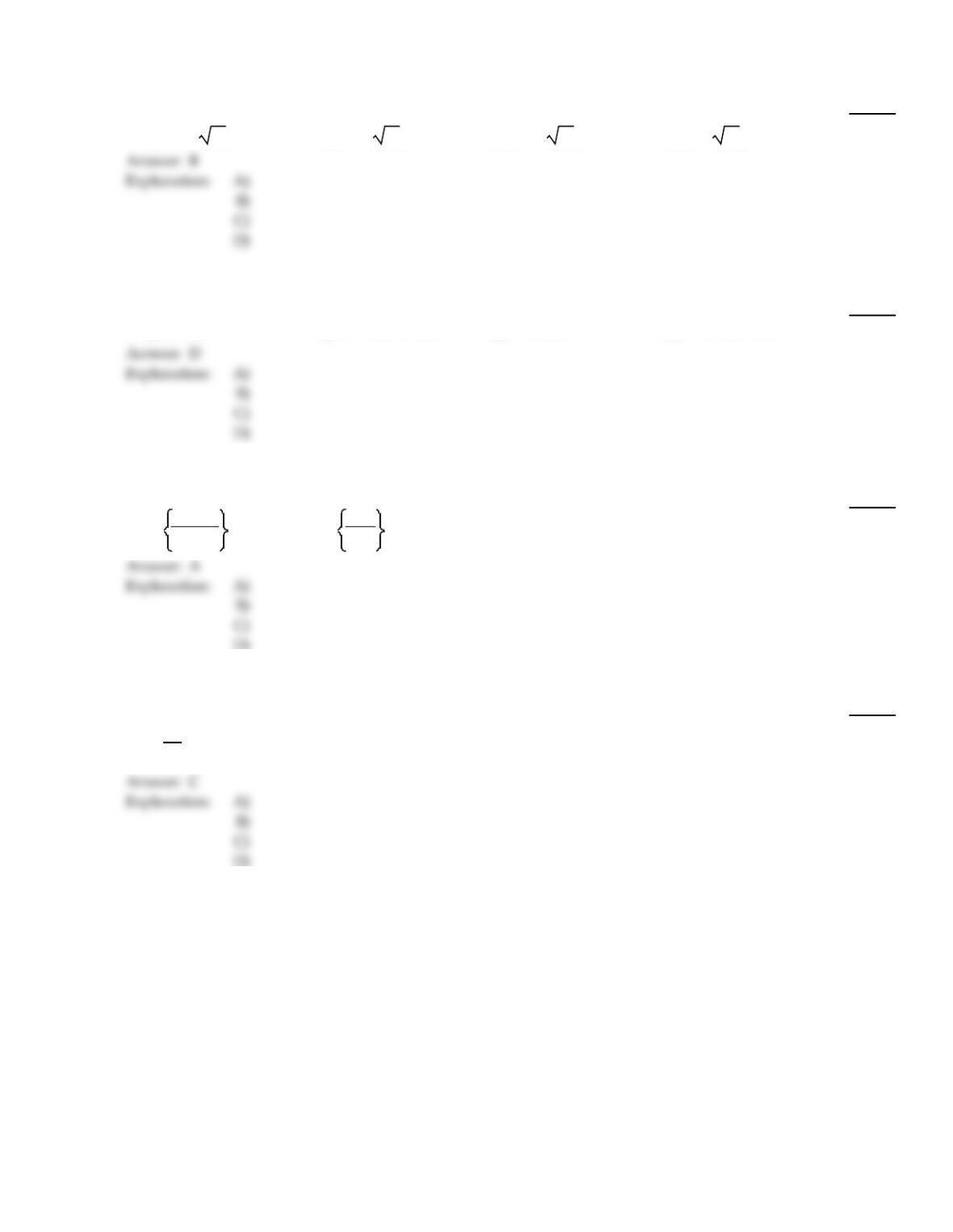
Determine whether the values in the table belong to an exponential function, a logarithmic function, a linear function, or
a quadratic function.
100)
x y
0 6
1 4
2 2
3 0
4–2
100)
A)
logarithmic
B)
quadratic
C)
linear
D)
exponential
Solve the logarithmic equation. Give an exact answer.
101)
log3 x +log3(x + 8) = 1
101)
A)
{–4–19}
B)
{–4+19}
C)
{–1+19}
D)
{4 +19}
Find the composition.
102)
If f(x) =x2+ 8 and g(x) =x2– 10, find (g
f)(x).
102)
A)
x2+ 54
B)
x4– 20x2+ 108
C)
x2+ 108
D)
x4+ 16x2+ 54
D)
Solve the equation.
103)
5x=4.83
103)
A)
ln 4.83
ln 5
B)
4.83
ln 5
C)
{ln 4.83 – ln 5}
D)
{ln 4.83}
D)
Evaluate the expression without using a calculator.
104)
log1010
104)
A)
1
10
B)
–1
C)
1
D)
10
D)
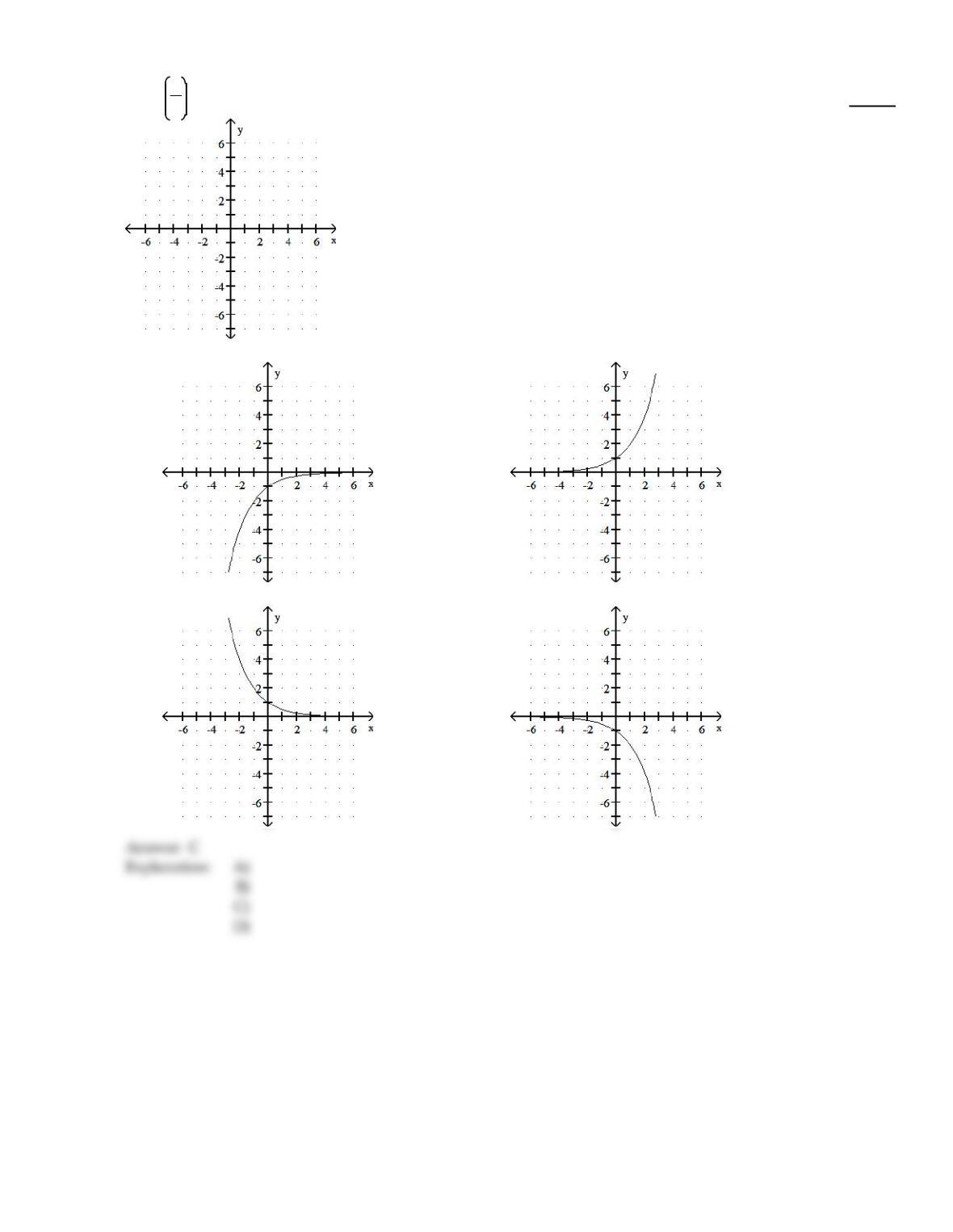
Graph the function by making a table of coordinates.
34
D)
105)
f(x) =1
2
x
105)
A)
B)
C)
D)
35
Provide an appropriate response.
106)
Write in logarithmic form: 3343 =7
106)
A)
log7343 =3
B)
log7343 =1
3
C)
log3433=1
7
D)
log3437=1
3
Solve the equation by expressing each side as a power of the same base and then equating exponents.
107)
3x=1
27
107)
A)
1
3
B)
{3}
C)
{–3}
D)
1
9
Solve the logarithmic equation. Give an exact answer.
108)
log3(x + 1) =4
108)
A)
{13}
B)
{80}
C)
{82}
D)
{11}
109)
log 2x2=log 2(6x + 7)
109)
A)
{7}
B)
7
2
C)
D)
{7, –1}
Write the equation in its equivalent logarithmic form.
110)
3343 =7
110)
A)
log3433=1
7
B)
log3437=1
3
C)
log7343 =1
3
D)
log7343 =3
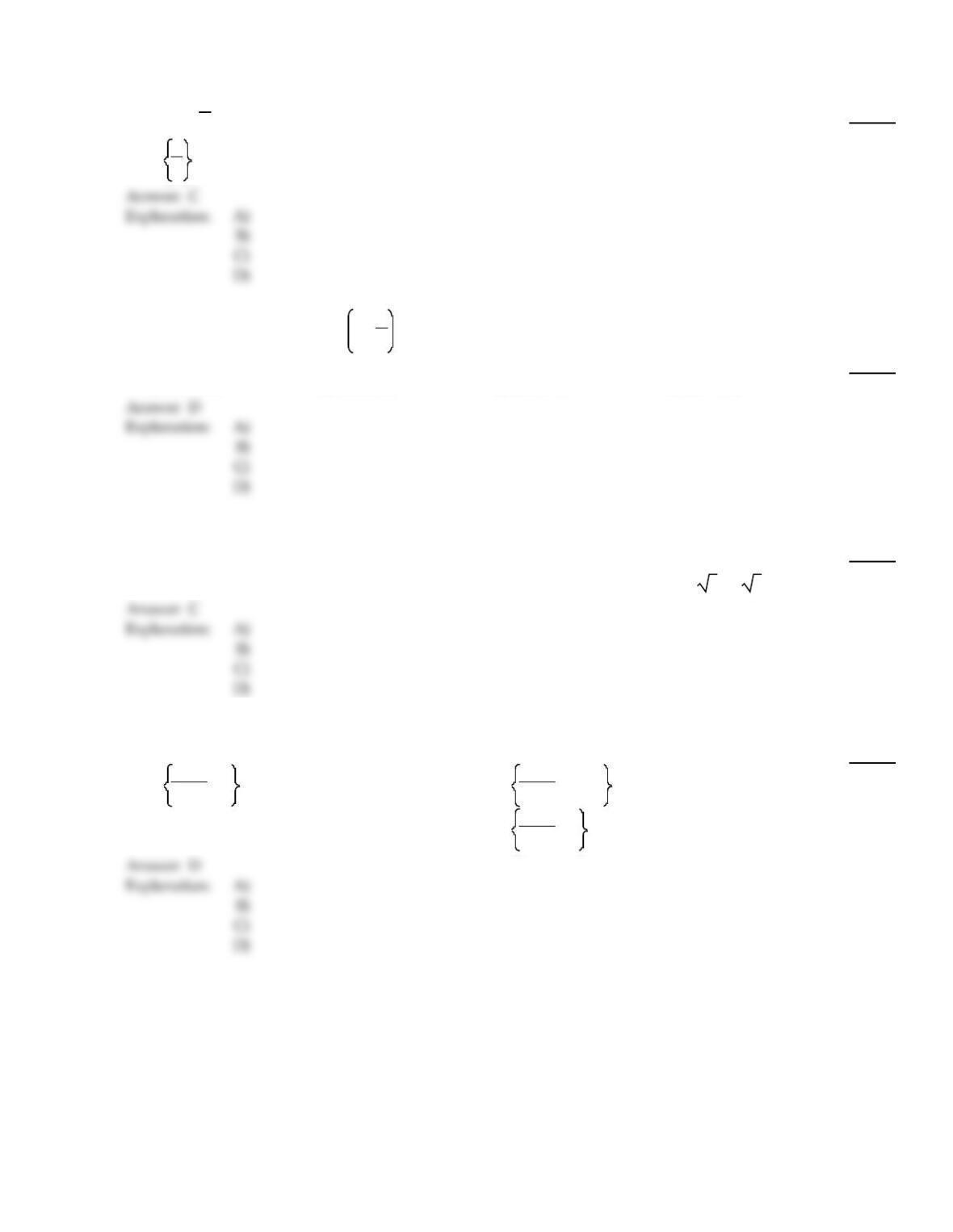
Solve the equation by expressing each side as a power of the same base and then equating exponents.
111)
2(7 – 3x) =1
4
111)
A)
1
2
B)
{–3}
C)
{3}
D)
{1}
Use the compound interest formulas A = P 1 +r
n
nt and A = Pert to solve.
112)
Find the accumulated value of an investment of $2000 at 6.75% compounded annually for 19 years.
112)
A)
$4565.00
B)
$4430.00
C)
$6481.15
D)
$6918.62
Solve the logarithmic equation. Give an exact answer.
113)
log8x2= 4
113)
A)
{256}
B)
{4096}
C)
{64, –64}
D)
{4 2, –4 2}
Solve the exponential equation by taking the logarithm on both sides. Express the solution set in terms of logarithms.
114)
3(x +7) =4
114)
A)
log 3
log 4+7
B)
log 3
log 4+ log 7
C)
{log 4– log 3– log 7}
D)
log 4
log 3– 7
37
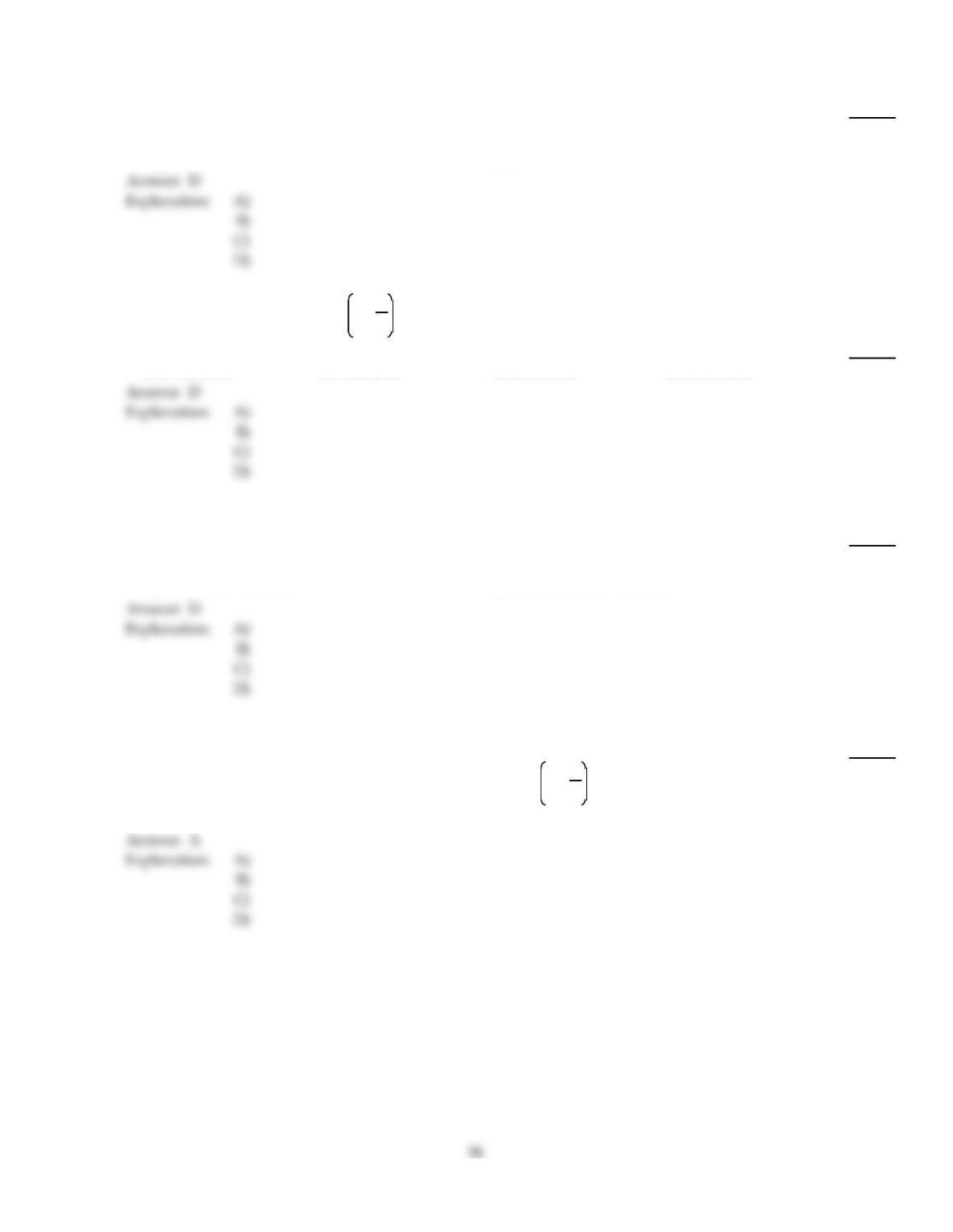
Rewrite the equation in terms of base e. Express the answer in terms of a natural logarithm.
115)
y =1000(4.3)x
115)
A)
y =1000 ln e4.3x
B)
y =4.3e(ln 1000)x
C)
y =4.3 ln e1000x
D)
y =1000e(ln 4.3)x
Use the compound interest formulas A = P 1 +r
n
nt and A = Pert to solve.
116)
Find the accumulated value of an investment of $8000 at 5.25% compounded annually for 17 years.
116)
A)
$14,720.00
B)
$18,140.27
C)
$15,140.00
D)
$19,092.63
Provide an appropriate response.
117)
If f(x) =x2+ 3x and g(x) = x +2, find (f
g)(x) and (g
f)(x).
117)
A)
x2+7x +2; x2+ 3x +2
B)
x2+7x +13; 3x +2
C)
x2+13; x2+ 3x +2
D)
x2+7x +13; x2+ 3x +2
Solve the problem.
118)
How long, to the nearest tenth of a year, will it take for a $3100 investment to double if it is
invested at 5% compounded monthly?Use the formula A = P 1 +r
n
nt.
118)
A)
13.9 yr
B)
14.1 yr
C)
14.3 yr
D)
13.7 yr
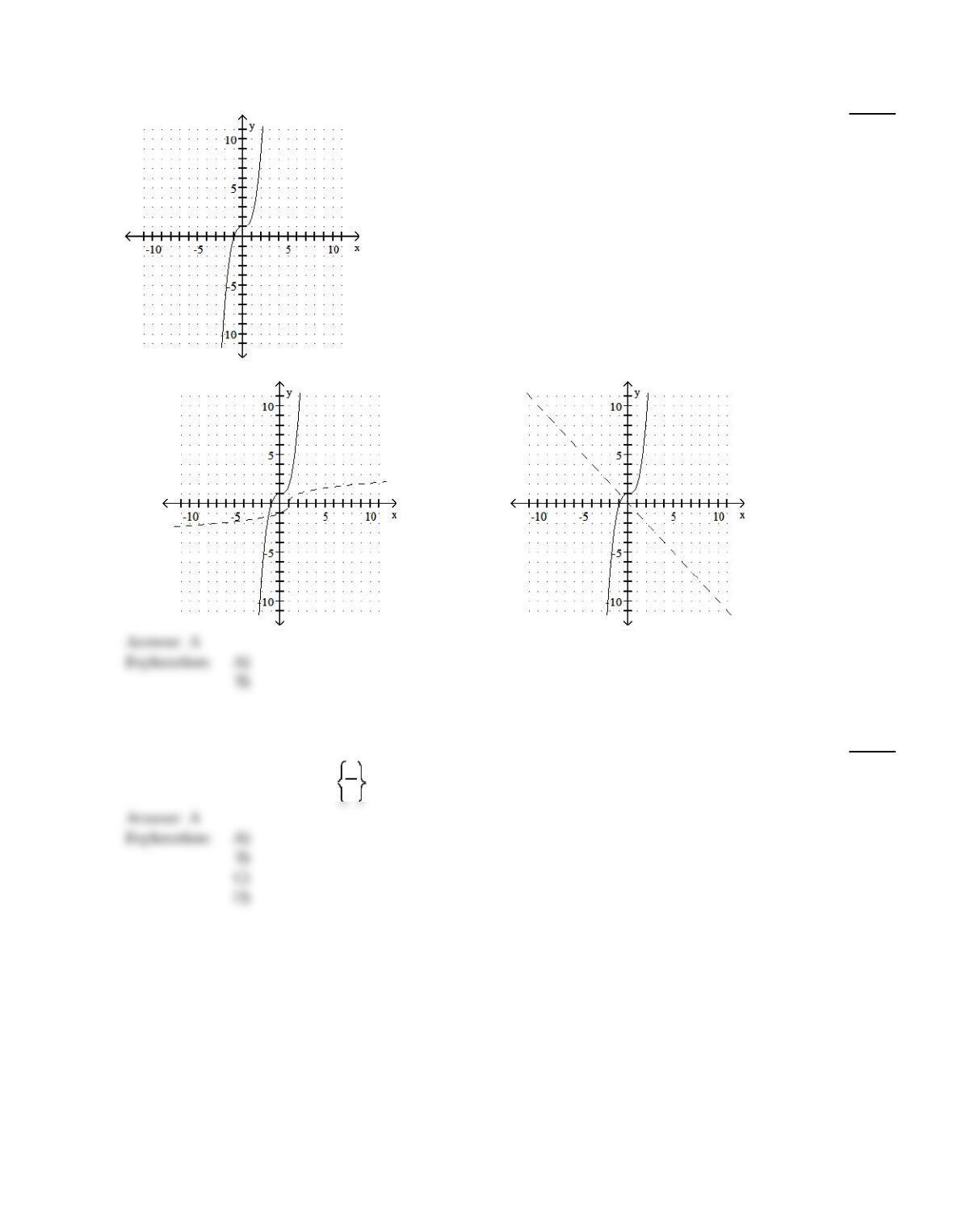
Use the graph of the function to draw the graph of the inverse function.
119)
119)
A)
B)
Solve the logarithmic equation. Give an exact answer.
120)
log 6(7x + 7) =log 6(7x + 2)
120)
A)
B)
9
5
C)
{0}
D)
{5]
39
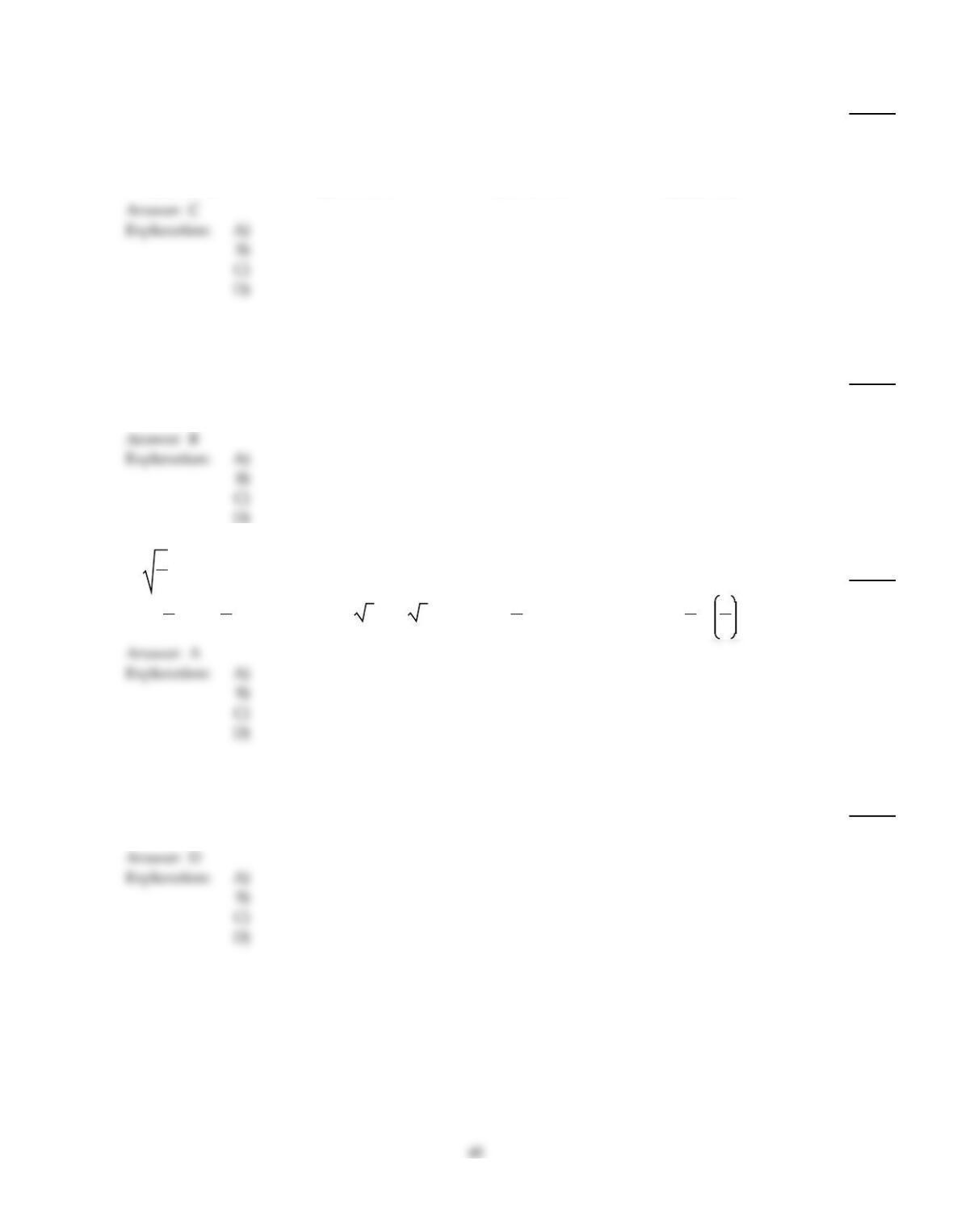
Solve the problem.
121)
The pH of a solution ranges from 0 to 14. An acid has a pH less than 7. Pure water is neutral and
has a pH of 7. The pH of a solution is given by pH = – log x where x represents the concentration of
the hydrogen ions in the solution in moles per liter. Find the hydrogen ion concentration if the
pH =4.4.
121)
A)
2.51 × 10⁻⁴
B)
3.98 × 10⁻⁴
C)
3.98 × 10⁻⁵
D)
2.51 × 10⁻⁵
Use properties of logarithms to expand the logarithmic expression as much as possible. Where possible, evaluate
logarithmic expressions without using a calculator.
122)
log5x2
122)
A)
2log5x2
B)
2log5 x
C)
5 log x
D)
5log2 x
123)
ln x
y
123)
A)
1
2 ln x –1
2 ln y
B)
ln x– ln y
C)
1
2 ln x – ln y
D)
1
2 ln x
y
Evaluate the expression without using a calculator.
124)
8log811
124)
A)
log811
B)
19
C)
8
D)
11