69. In joint-process costing and analysis, which of the following costs would not be relevant when deciding the
point at which a product should be sold to maximize profits?
Use the following to answer questions 70-71:
Cahill Lumber manufactures mulch and wood bark from a joint processing operation using wood as the raw
material. For a recent month, 8,000 pounds of mulch were produced having a sales value after split-off point of
$21,000. 4,000 pounds of wood bark were produced having a sales value after split-off of $14,000. Using the
net– realizable-value method, the portion of the total joint product costs allocated to mulch was $12,000. (CPA
adapteD
Hilton – Chapter 09
70. The amount of joint costs allocated to wood bark using the net-realizable-value method would be:
71. If the physical–measures method of allocation were used, the amount of joint costs allocated to mulch would
be:
Use the following to answer questions 72-74:
Rhone Corporation produces a product called Sharone, which gives rise to a by-product called Erone. The only
costs associated with Erone are additional processing costs of $2 for each unit. Rhone accounts for Erone’s sales
first by deducting its separable costs from its sales and then by deducting this net amount from the cost of goods
sold of Sharone. This year, 4,800 units of Erone were produced. They were all sold for $10 each. Company
operating expenses were $120,000 for the year. Sales revenue and cost of goods sold for Sharone were
$800,000 and $400,000, respectively, for the year. (CPA adapteD
Hilton – Chapter 09
72. Under the existing method of accounting for Erone, what is Rhone’s gross margin?
73. If Rhone changes its method of accounting for Erone’s sales by showing the net amount as “other revenue,”
Rhone’s gross margin would be:
74. If Rhone changes its method of accounting for Erone’s sales, assuming that all of Erone’s production is sold
in the period that it is produced, what would be the effect on Rhone’s overall profits?
75. Sell-or-process-further decisions based on gross margin per unit:
Use the following to answer questions 76-81:
The Stanford Corporation produces three outputs: A, B and C from one input. The net–realizable-value of A at
the split-off point is $200,000. The net-realizable-value of B at the split-off point is $400,000 and the
net-realizable- value of C at the split-off is $50,000. Final sales values are $400,000, $600,000 and $50,000 for
A, B and C respectively. However, these prices are subject to erratic change. The additional processing costs for
A, B and C are $100,000, $150,000 and $0 respectively. Stanford produces 120,000 units of A, 120,000 units of
B and 60,000 units of C. The total costs incurred up to the split–off point are $300,000
Hilton – Chapter 09
76. Which allocation method would be best for Stanford to use?
77. If the net-realizable-value method is used and product C is accounted for as a joint–product, what amount of
joint– costs should be allocated to product A?
78. If the net-realizable-value method is used and product C is accounted for as reduction of joint costs, what
amount of joint– costs should be allocated to product B?
79. If the physical-measures method is used and product C is accounted for as a by-product whose income is
credited to the joint costs of production, what amount of joint-costs should be allocated to product A?
80. If the physical-quantities method is used and product C is accounted for as a joint product, what amount of
joint costs will be allocated to product B?
81. What is the expected gross margin for Stanford Corporation?
82. In the sequence of decisions involved in the management of joint processes, which decision should be made
first?
83. When multiple products are produced in a joint-process, which of the following distinguishes main products
from by-products?
84. Net realizable value at split-off is used to allocate:
85. Which of the following would not be a joint-product cost?
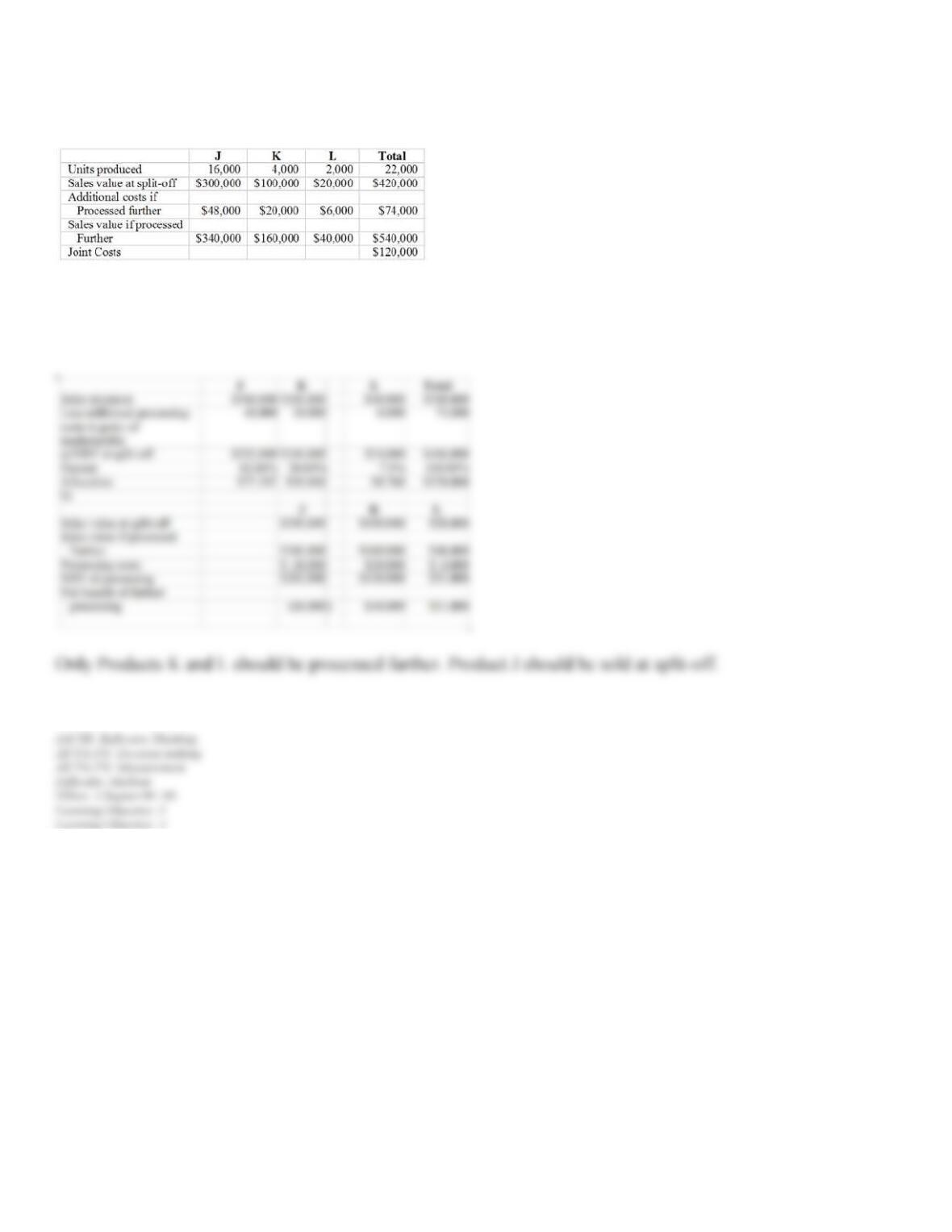
86. Richards Manufacturing Corporation manufactures three products in a joint process. Additional information
is as follows:
Required:
(a) Allocate the joint costs to the three products using the net-realizable-value method.
(b) Determine which products should be sold at split–off and which products should be processed further.
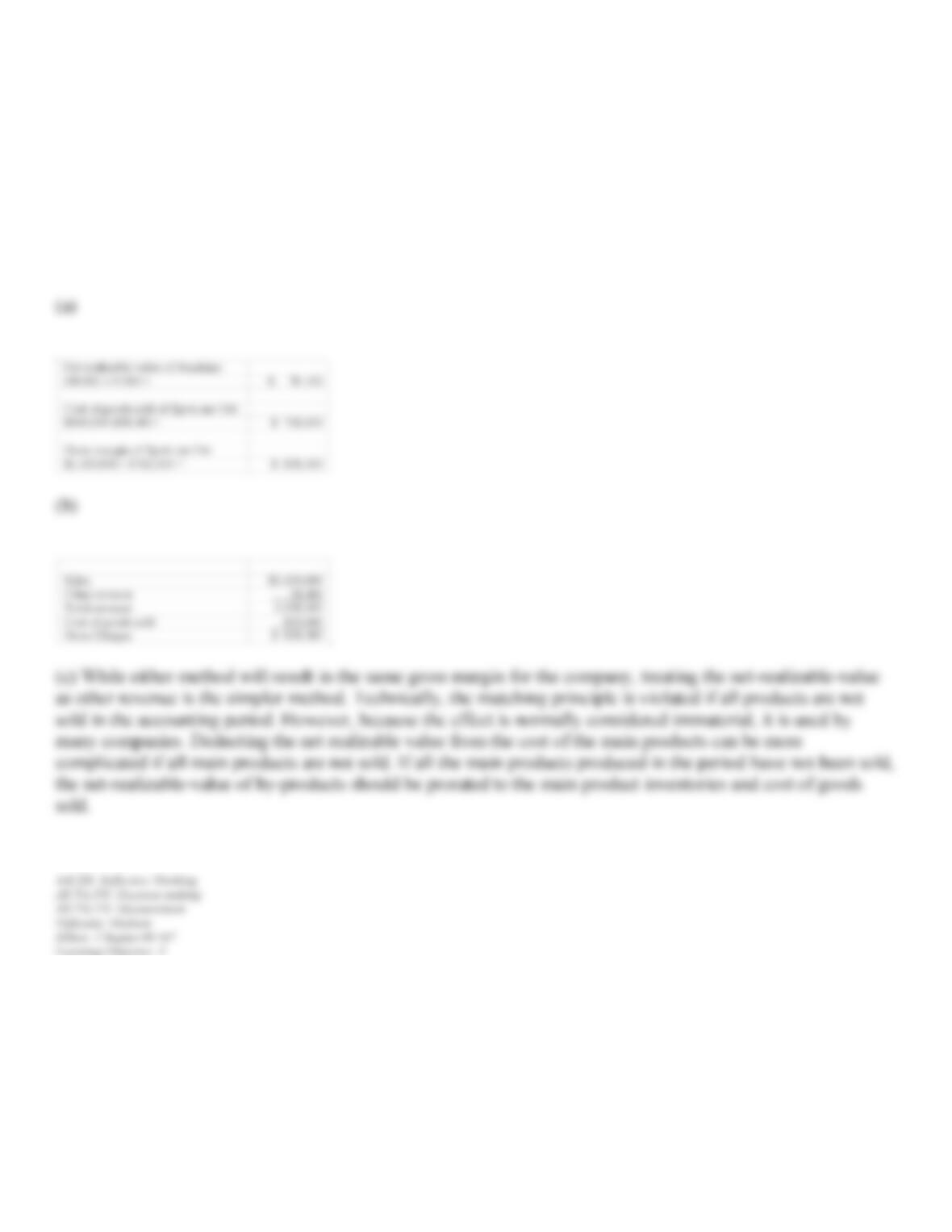
87. Colbert Corporation produces a product called Spots are Out, which gives rise to a byproduct called
Sunshine. The only costs associated with Sunshine are additional processing costs of $4 for each unit. Colbert
accounts for Sunshine‘s sales first by deducting its separable costs from its sales and then by deducting this net
amount from the cost of sales of Spots are Out. This year, 9,600 units of Sunshine were produced. They were all
sold for $8 each. Company operating expenses were $250,000 for the year. Sales revenue and cost of goods sold
for Spots are Out were $1,600,000 and $800,000 respectively. (CPA AdapteD.
(a) Calculate the company’s gross margin under the current accounting method.
(b) Assume the company changes its accounting method and accounts for the byproduct’s net-realizable-value
as “other revenue. ” Calculate the gross margin under the new method.
(c) Under what circumstances would method a or b be preferred?
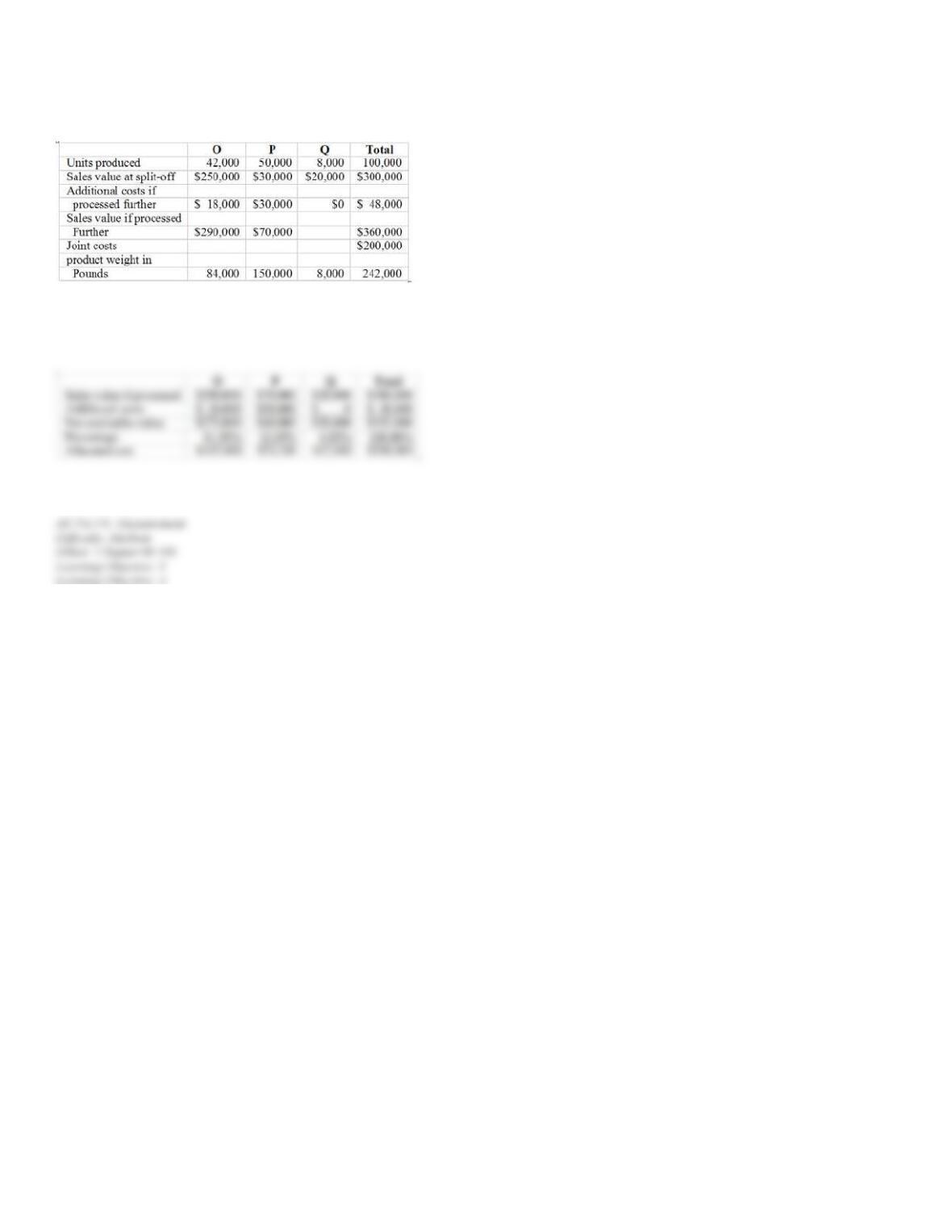
88. Misty Manufacturing produced three products in a joint operation. Products O and P were processed further.
Product Q was sold at the split-off point. Additional information is as follows:
Required:Allocate the joint costs using the net-realizable-value method , accounting for Product Q as a joint
product.
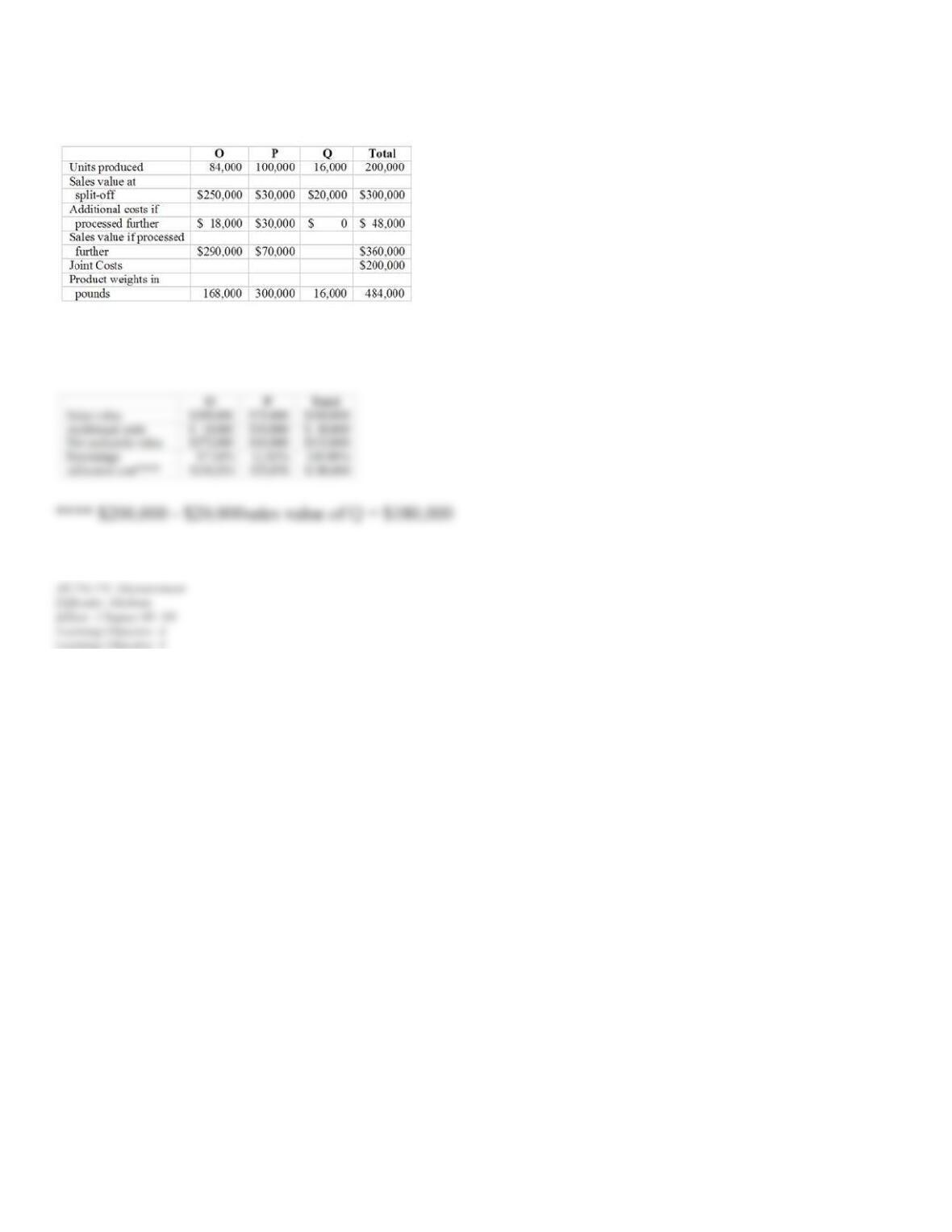
89. Mount IdaManufacturing produces three products in a joint process. Products O and P were processed
further. Additional information is as follows:
Required: Assume that product Q is a by-product whose sales value is credited to the joint production costs.
Allocate the joint costs if the net-realizable-value method is used.
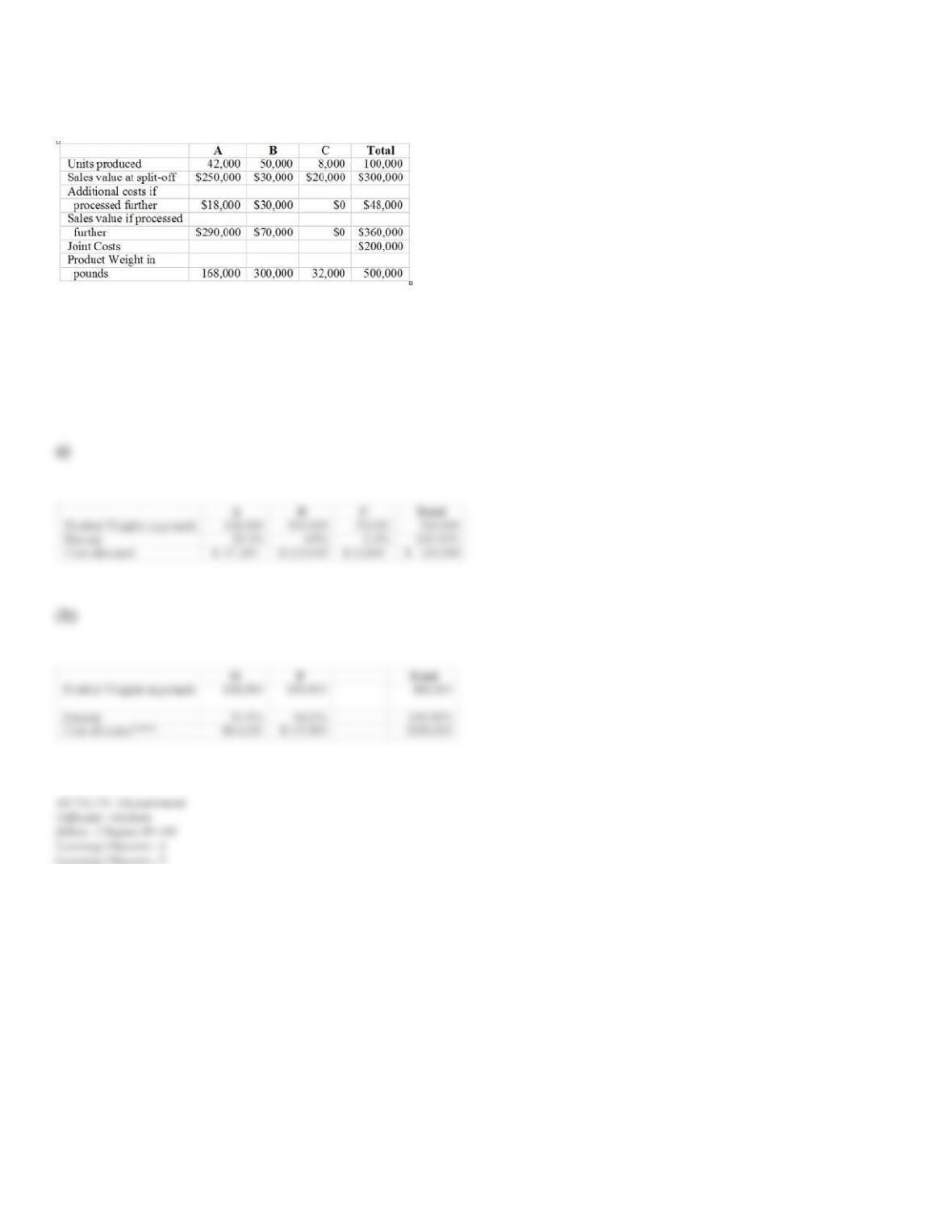
90. Bancroft Manufacturing produces three products in a joint process. Products A and B were processed further.
Additional information is as follows:
Required:
(a) Allocate the joint costs assuming that all products are joint products and joint–costs are allocated using the
physical–measures method.
(b) Allocate the joint costs using the physical-measures method assuming that product Q is considered a
by-product, whose sales value is deducted from the total joint costs.