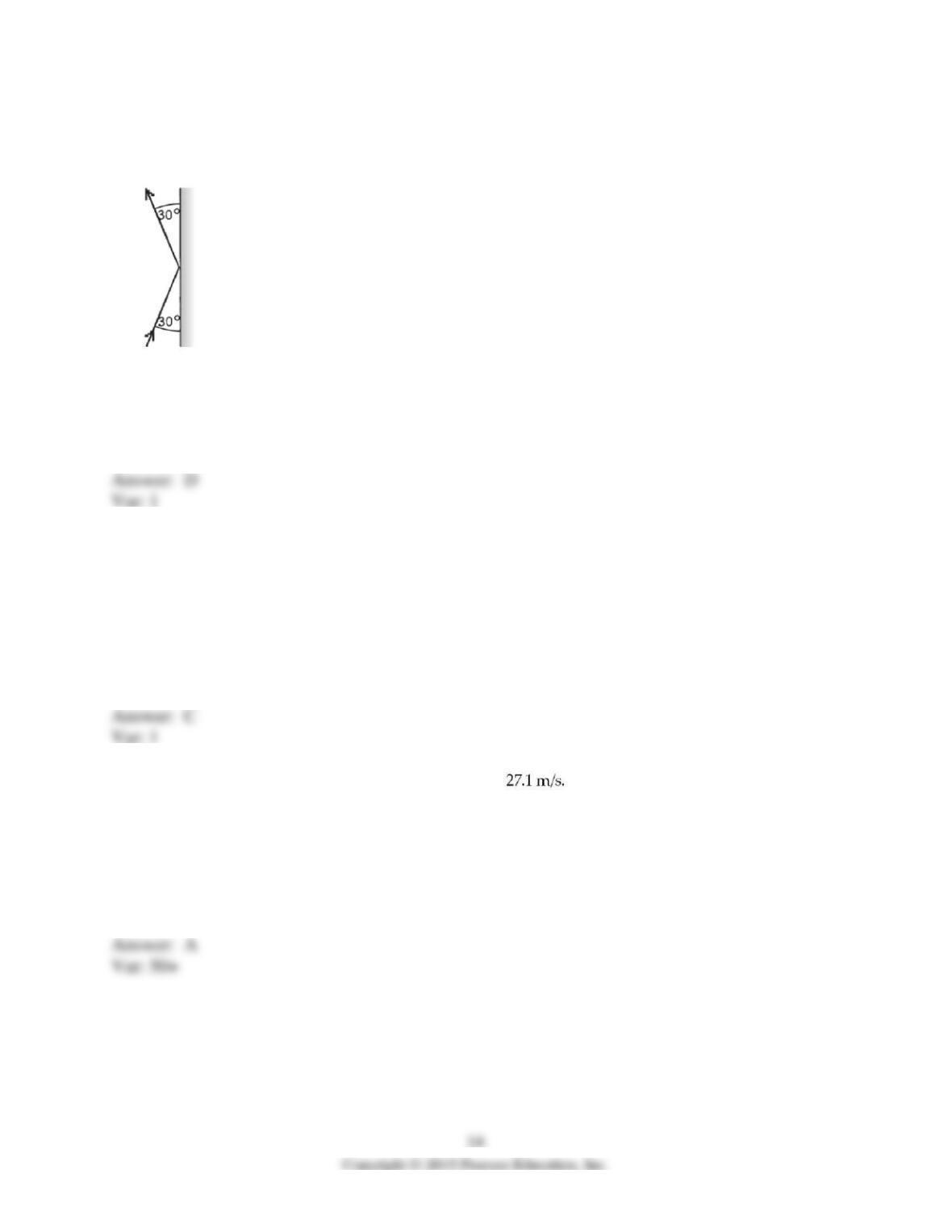
33) A super dart of mass 20 g, traveling at 350 m/s, strikes a steel plate at an angle of 30° with
the plane of the plate, as shown in the figure. It bounces off the plate at the same angle but at a
speed of 320 m/s. What is the magnitude of the impulse that the plate gives to the bullet?
A) 0.52 N ∙ s
B) 4.3 N ∙ s
C) 300 N ∙ s
D) 6.7 N ∙ s
E) 0.30 N ∙ s
34) A golf club exerts an average horizontal force of 1000 N on a 0.045-kg golf ball that is
initially at rest on the tee. The club is in contact with the ball for 1.8 ms. What is the speed of the
golf ball just as it leaves the tee?
A) 30 m/s
B) 35 m/s
C) 40 m/s
D) 45 m/s
E) 50 m/s
35) A 0.140-kg baseball is thrown with a velocity of It is struck by the bat with an
average force of 5000 N, which results in a velocity of 37.0 m/s in the opposite direction from
the original velocity. How long were the bat and ball in contact?
A) 1.79 × 10⁻³ s
B) 1.28 × 10⁻² s
C) 3.07 × 10⁻² s
D) 4.30 × 10⁻³ s
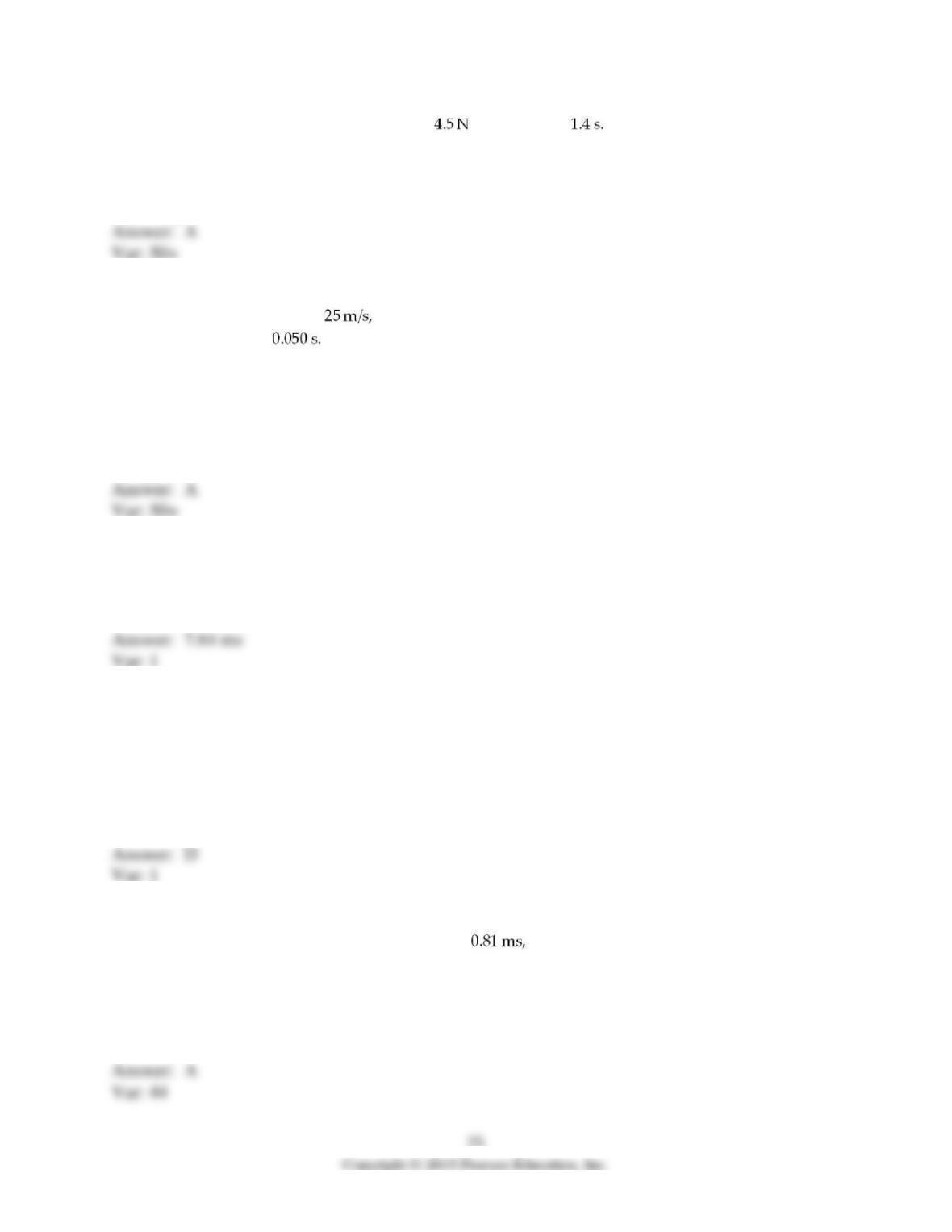
36) Calculate the impulse due to a force of that lasts for
A) 6.3 kg∙ m/s
B) 5.0 kg∙ m/s
C) 5.7 kg∙ m/s
D) 6.9 kg∙ m/s
37) A girl of mass 55 kg throws a ball of mass 0.80 kg against a wall. The ball strikes the wall
horizontally with a speed of and it bounces back with this same speed. The ball is in
contact with the wall What is the magnitude of the average force exerted on the wall by
the ball?
A) 800 N
B) 400 N
C) 55,000 N
D) 27,500 N
E) 13,750 N
38) A 475-gram ball is traveling horizontally at 12.0 m/s to the left when it is suddenly struck
horizontally by a bat, causing it to reverse direction and initially travel at 8.50 m/s to the right. If
the bat produced an average force of 1275 N on the ball, for how long (in milliseconds) was it in
contact with the ball?
39) A 0.140 kg baseball is thrown horizontally with a velocity of 28.9 m/s. It is struck with a
constant horizontal force that lasts for 1.85 ms, which results in a velocity of 37.0 m/s in the
opposite direction. What was the magnitude of the horizontal force?
A) 0.613 kN
B) 2.19 kN
C) 2.80 kN
D) 4.99 kN
40) A golf ball of mass 0.050 kg is at rest on the tee. Just after being struck, it has a velocity of
102 m/s. If the club and ball were in contact for what is the average force exerted on the
ball by the club?
A) 6.3 kN
B) 7.1 kN
C) 5.5 kN
D) 4.9 kN
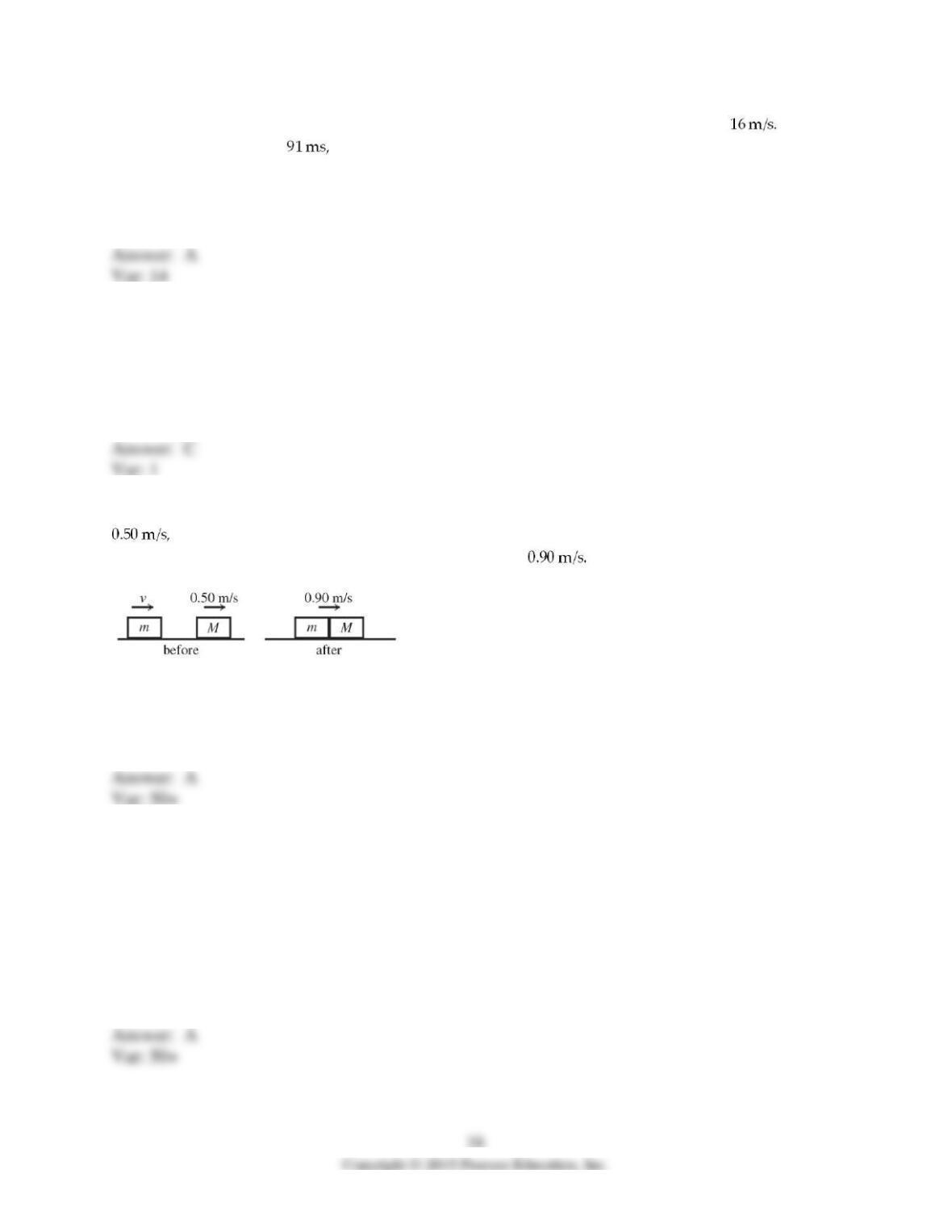
41) A 0.24 kg blob of clay is thrown at a wall with an initial horizontal velocity of If the
clay comes to a stop in what is the average horizontal force on the clay due to the wall?
A) 42 N
B) 26 N
C) 35 N
D) 51 N
42) A steady horizontal force lasting for 2.1 s gives a 1.25 kg object an acceleration of 3.2 m/s2
on a frictionless table. What impulse does this force give to the object?
A) 26 kg ∙ m/s
B) 11 kg ∙ m/s
C) 8.4 kg ∙ m/s
D) 2.6 kg ∙ m/s
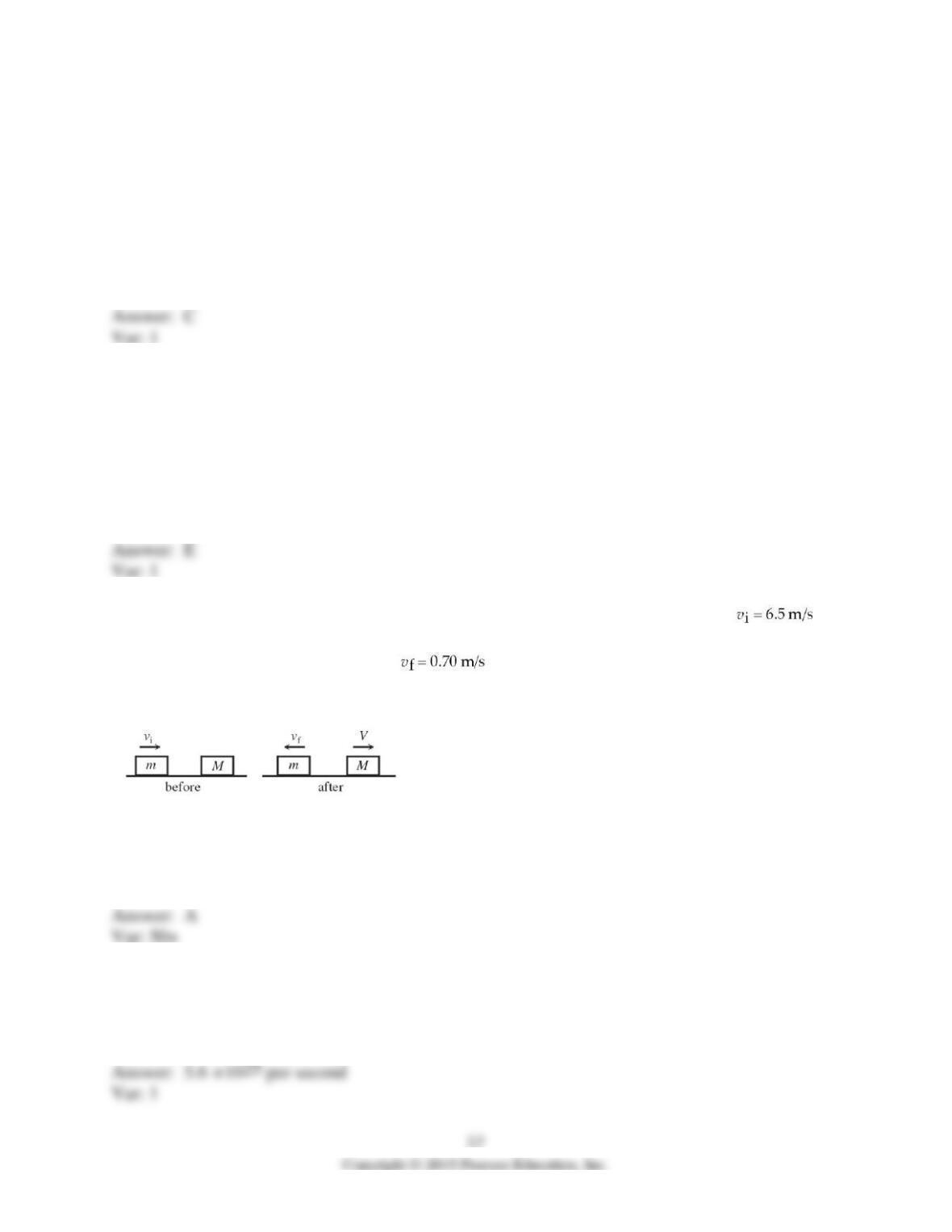
43) A block of mass m = 34 kg and speed V is behind a block of mass M = 81 kg and speed of
as shown in the figure. The surface is frictionless and the blocks collide and couple.
After the collision, the blocks have a common speed of What is the magnitude of the
impulse on the 34-kg block due to the collision?
A) 32 N ∙ s
B) 14 N ∙ s
C) 41 N ∙ s
D) 57 N ∙ s
E) 73 N ∙ s
44) A very small 51-g steel ball is released from rest and falls vertically onto a steel plate. The
ball strikes the plate and is in contact with it for 0.50 ms. The ball rebounds elastically and
returns to its original height. The total time interval for a round trip is 3.00 s. What is the
magnitude of the average force exerted on the ball by the plate during contact with the plate?
A) 3000 N
B) 1500 N
C) 2490 N
D) 2000 N
E) 3500 N
45) A 0.140-kg baseball is dropped from rest. It has a speed of 1.20 m/s just before it hits the
ground, and it rebounds with an upward speed of 1.00 m/s. The ball is in contact with the ground
for 0.0140 s. What is the average force exerted by the ground on the ball during the time of
contact?
A) 2.00 N upwards
B) 2.00 N downwards
C) 22.0 N upwards
D) 22.0 N downwards
E) 0.00 N
46) A batter hits a foul ball. The 0.14-kg baseball that was approaching him at 40 m/s leaves the
bat at 30 m/s in a direction perpendicular to the line between the batter and the pitcher. What is
the magnitude of the impulse delivered to the baseball?
A) 9.8 N ∙ s
B) 1.4 N ∙ s
C) 3.5 N ∙ s
D) 5.6 N ∙ s
E) 7.0 N ∙ s
47) A block of mass m = 5.6 kg, moving on a frictionless surface with a velocity of to
the right, collides with a block of mass M at rest, as shown in the figure. After the collision, the
5.6-kg block recoils with a velocity of to the left. If the blocks are in contact for 0.20
s, what is the magnitude of the average force on the 5.6-kg block, while the two blocks are in
contact?
A) 202 N
B) 192 N
C) 182 N
D) 0 N
E) 0 N
48) A force of 5.3 N is needed to hold on to an umbrella in a strong wind. If the air molecules
each have a mass of 4.7 ×10⁻²⁶ kg, and each one strikes the umbrella (without rebounding) with
a speed of 2.0 m/s in the same direction, how many atoms strike the umbrella each second?
Assume that the wind blows horizontally so that the gravity can be neglected.
49) A fire hose is turned on the door of a burning building in order to knock the door down. This
requires a force of 1000 N. If the hose delivers 40 kg of water per second, what is the minimum
velocity of the stream needed to knock down the door, assuming the water doesn’t bounce back?
A) 15 m/s
B) 20 m/s
C) 25 m/s
D) 30 m/s
50) A 2200-kg auto moving northward at 12.0 m/s runs into a 3800-kg truck which is also
moving northward, but at 5.00 m/s. If the vehicles lock bumpers, how fast are they moving just
after the collision?
51) A 1200-kg car moving at suddenly collides with a stationary car of mass If
the two vehicles lock together, what is their combined velocity immediately after the collision?
A) 6.9 m/s
B) 8.6 m/s
C) 12.1 m/s
D) 5.5 m/s
52) A 1000-kg whale swims horizontally to the right at a speed of 6.0 m/s. It suddenly collides
directly with a stationary seal of mass 200 kg. The seal grabs onto the whale and holds fast. What
is the momentum of these two sea creatures just after their collision? You can neglect any drag
effects of the water during the collision.
A) 0.00 kg ∙ m/s
B) 1200 kg ∙ m/s
C) 2000 kg ∙ m/s
D) 7200 kg ∙ m/s
E) 6000 kg ∙ m/s
53) A 1000-kg whale swims horizontally to the right at a speed of 6.0 m/s. It suddenly collides
directly with a stationary seal of mass 200 kg. The seal grabs onto the whale and holds fast. What
is the speed of these two sea creatures just after their collision? You can neglect any drag effects
of the water during the collision.
A) 0.00 m/s
B) 3.0 m/s
C) 4.0 m/s
D) 5.0 m/s
E) 6.0 m/s
54) A 2.0-kg mass moving at 5.0 m/s suddenly collides head-on with a 3.0-kg mass at rest. If the
collision is perfectly inelastic, what is the speed of the masses just after the collision?
A) 10 m/s
B) 2.5 m/s
C) 2.0 m/s
D) 0 m/s, since the collision is inelastic
55) An 80-kg man is skating northward and happens to suddenly collide with a 20-kg boy who is
ice skating toward the east. Immediately after the collision, the man and boy are seen to be
moving together at 2.5 m/s in a direction 60° north of east. How fast was the boy moving just
before the collision?
56) A car (of mass 1500 kg) and a small truck (of mass 2000 kg) collide suddenly at right angles
at an icy intersection. The car was originally traveling eastward at 20.0 m/s and the truck was
traveling northward at 20.0 m/s just before the collision took place. What is the speed of the
combined wreck just after the collision if the vehicles become enmeshed?
57) Two vehicles approach a right angle intersection and then suddenly collide. After the
collision, they become entangled. If their mass ratios were 1:4 and their respective speeds as they
approached the intersection were both 13 m/s, find the magnitude and direction of the final
velocity of the wreck.
A) 11 m/s at 14° with respect to the original direction of the lighter car
B) 16 m/s at 76° with respect to the original direction of the lighter car
C) 11 m/s at 76° with respect to the original direction of the lighter car
D) 16 m/s at 14° with respect to the original direction of the lighter car
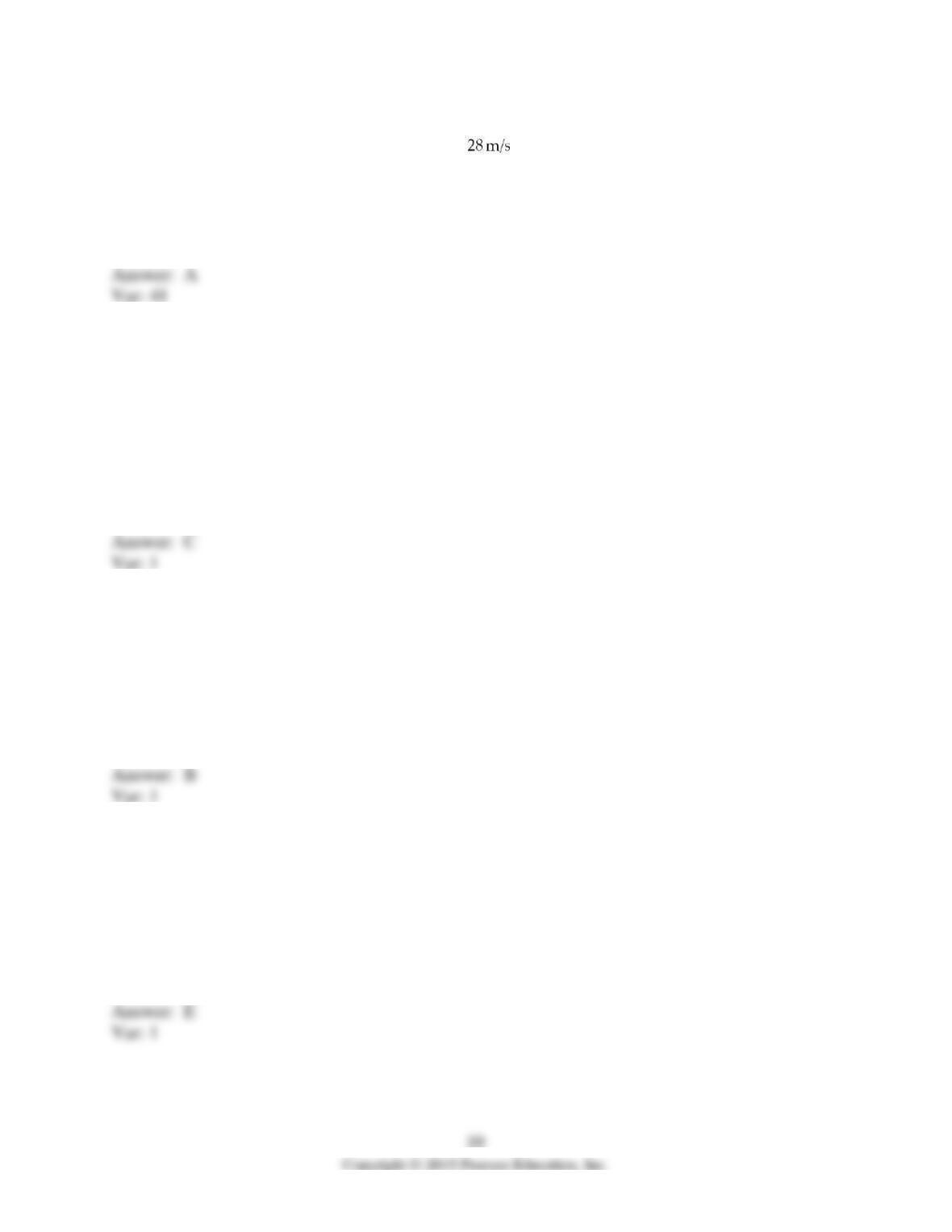
58) A car heading north suddenly collides at an intersection with a truck of the same mass
heading east. If they lock together and travel at at 15° north of east just after the collision,
how fast was the car initially traveling?
A) 14 m/s
B) 7 m/s
C) 28 m/s
D) 11 m/s
59) A puck with a mass m1 = 50 g moving at 1.0 m/s approaches a stationary puck with a mass
m2 = 100 g on a frictionless air table, and they undergo a sudden two-dimensional elastic
collision. After the collision, both pucks have identical speeds, but travel in different directions.
What is the angle between the original and final paths of puck with mass m1?
A) 30°
B) 60°
C) 90°
D) 120°
E) 150°
60) A 900-kg car traveling east at 15.0 m/s suddenly collides with a 750-kg car traveling north at
20.0 m/s. The cars stick together after the collision. What is the speed of the wreckage just after
the collision?
A) 6.10 m/s
B) 12.2 m/s
C) 25.0 m/s
D) 35.0 m/s
E) 17.3 m/s
61) A 900-kg car traveling east at 15.0 m/s suddenly collides with a 750-kg car traveling north at
20.0 m/s. The cars stick together after the collision. In what direction does the wreckage move
just after the collision?
A) 36.9° N of E
B) 42.0° N of E
C) 45.0° N of E
D) 53.1° N of E
E) 48.0° N of E
62) A 900-kg car traveling 30.0° south of east at 12.0 m/s suddenly collides with a 750-kg car
traveling north at 17.0 m/s. The cars stick together after colliding. What is the speed of the
wreckage just after the collision?
A) 7.21 m/s
B) 12.2 m/s
C) 20.4 m/s
D) 25.0 m/s
E) 17.3 m/s
63) A 1500-kg car traveling at 90 km/h toward the east suddenly collides with a 3000-kg car
traveling at 60 km/h toward the south. The two cars stick together after the collision. What is the
speed of the cars after collision?
A) 8.3 m/s
B) 14 m/s
C) 17 m/s
D) 22 m/s
64) A 1500-kg car traveling at 90 km/h toward the east suddenly collides with a 3000-kg car
traveling at 60 km/h toward the south. The two cars stick together after the collision. What is the
direction of motion of the cars after collision?
A) 36.9° S of E
B) 36.9° E of S
C) 53.1° S of E
D) 53.1° E of S
65) Two dogs, Rover and Fido, run on a level frictionless surface. Rover runs eastward with a
momentum of 24 kg . m/s, and Fido runs northward with momentum 10 kg . m/s. They make a
sudden perfectly inelastic collision. What is the magnitude of their combined momentum after
the collision?
A) 14 kg . m/s
B) 26 kg . m/s
C) 34 kg . m/s
D) It cannot be determined without knowing the masses and velocities of the dogs.
66) A ballerina spins initially at 1.5 rev/s when her arms are extended. She then draws in her
arms to her body and her moment of inertia becomes 0.88 kg ∙ m2, and her angular speed
increases to 4.0 rev/s. What was her initial moment of inertia?
67) In a certain cyclotron, a proton of mass 1.67 × 10⁻²⁷ kg moves in a circle of diameter 1.6 m
with an angular speed of 2.0 × 10⁶ rad/s. What is the angular momentum of the proton?
A) 1.3 × 10⁻²¹ kg ∙ m2/s
B) 1.8 × 10⁻²¹ kg ∙ m2/s
C) 2.1 × 10⁻²¹ kg ∙ m2/s
D) 3.2 × 10⁻²¹ kg ∙ m2/s
68) Three solid, uniform, cylindrical flywheels, each of mass 65.0 kg and radius 1.47 m, rotate
independently around a common axis through their centers. Two of the flywheels rotate in one
direction at 8.94 rad/s, but the other one rotates in the opposite direction at 3.42 rad/s. Calculate
the magnitude of the net angular momentum of the system.
A) 1020 kg ∙ m2/s
B) 1500 kg ∙ m2/s
C) 975 kg ∙ m2/s
D) 940 kg ∙ m2/s
69) A uniform, solid, cylindrical flywheel of radius 1.4 m and mass 15 kg rotates at
What is the magnitude of the flywheel’s angular momentum?
A) 40 kg ∙ m2/s
B) 20 kg ∙ m2/s
C) 80 kg ∙ m2/s
D) 60 kg ∙ m2/s
70) A uniform 135-g meter stick rotates about an axis perpendicular to the stick passing through
its center with an angular speed of 3.50 rad/s. What is the magnitude of the angular momentum
of the stick?
A) 0.0394 kg ∙ m2/s
B) 0.473 kg ∙ m2/s
C) 0.0739 kg ∙ m2/s
D) 0.158 kg ∙ m2/s
E) 0.0236 kg ∙ m2/s
71) An ice skater has a moment of inertia of 5.0 kg ∙ m2 when her arms are outstretched, and at
this time she is spinning at 3.0 rev/s. If she pulls in her arms and decreases her moment of inertia
to 2.0 kg ∙ m2, how fast will she be spinning?
A) 2.0 rev/s
B) 3.3 rev/s
C) 7.5 rev/s
D) 10 rev/s
72) A figure skater rotating at 5.00 rad/s with arms extended has a moment of inertia of 2.25 kg ∙
m2. If he pulls in his arms so his moment of inertia decreases to 1.80 kg ∙ m2, what will be his
new angular speed?
A) 2.25 rad/s
B) 4.60 rad/s
C) 6.25 rad/s
D) 0.81 rad/s
73) A solid wood door, 90.0 cm wide by 2.00 m tall has a mass of 35.0 kg. It is open and at rest.
A small 500-g ball is thrown perpendicular to the door with a speed of 20.0 m/s and hits the door
60.0 cm from the hinged side. The ball rebounds with a speed of 16.0 m/s along the same line.
What is the angular speed of the door just after the collision with the ball?
A) 0.127 rad/s
B) 0.925 rad/s
C) 1.14 rad/s
D) 2.28 rad/s
E) 4.57 rad/s
74) A light-weight potter’s wheel, having a moment of inertia of is spinning freely at
40.0 rpm. The potter drops a small but dense lump of clay onto the wheel, where it sticks a
distance 1.2 m from the rotational axis. If the subsequent angular speed of the wheel and clay is
32 rpm, what is the mass of the clay?
A) 4.2 kg
B) 2.8 kg
C) 3.7 kg
D) 4.6 kg
75) A 40.0-kg child running at 3.00 m/s suddenly jumps onto a stationary playground merry-go-
round at a distance 1.50 m from the axis of rotation of the merry-go-round. The child is traveling
tangential to the edge of the merry-go-round just before jumping on. The moment of inertia
about its axis of rotation is 600 kg ∙ m2 and very little friction at its rotation axis. What is the
angular speed of the merry-go-round just after the child has jumped onto it?
A) 0.788 rad/s
B) 0.261 rad/s
C) 6.28 rev/s
D) 2.00 rad/s
E) 3.14 rev/s
76) A 5.0-m radius playground merry-go-round with a moment of inertia of 2000 kg ∙ m2 is
rotating freely with an angular speed of 1.0 rad/s. Two people, each of mass 60 kg, are standing
right outside the edge of the merry-go-round and suddenly step onto the edge with negligible
speed relative to the ground. What is the angular speed of the merry-go-round right after the two
people have stepped on?
A) 0.20 rad/s
B) 0.40 rad/s
C) 0.60 rad/s
D) 0.80 rad/s
E) 0.67 rad/s
77) A 24.5-kg child is standing on the outer edge of a horizontal merry-go-round that has a
moment of inertia of about a vertical axis through its center and a radius of 2.40 m.
The entire system (including the child) is initially rotating at 0.180 rev/s. Find the angular
velocity if the child moves to a new position 1.10 m from the center of the merry-go-round.
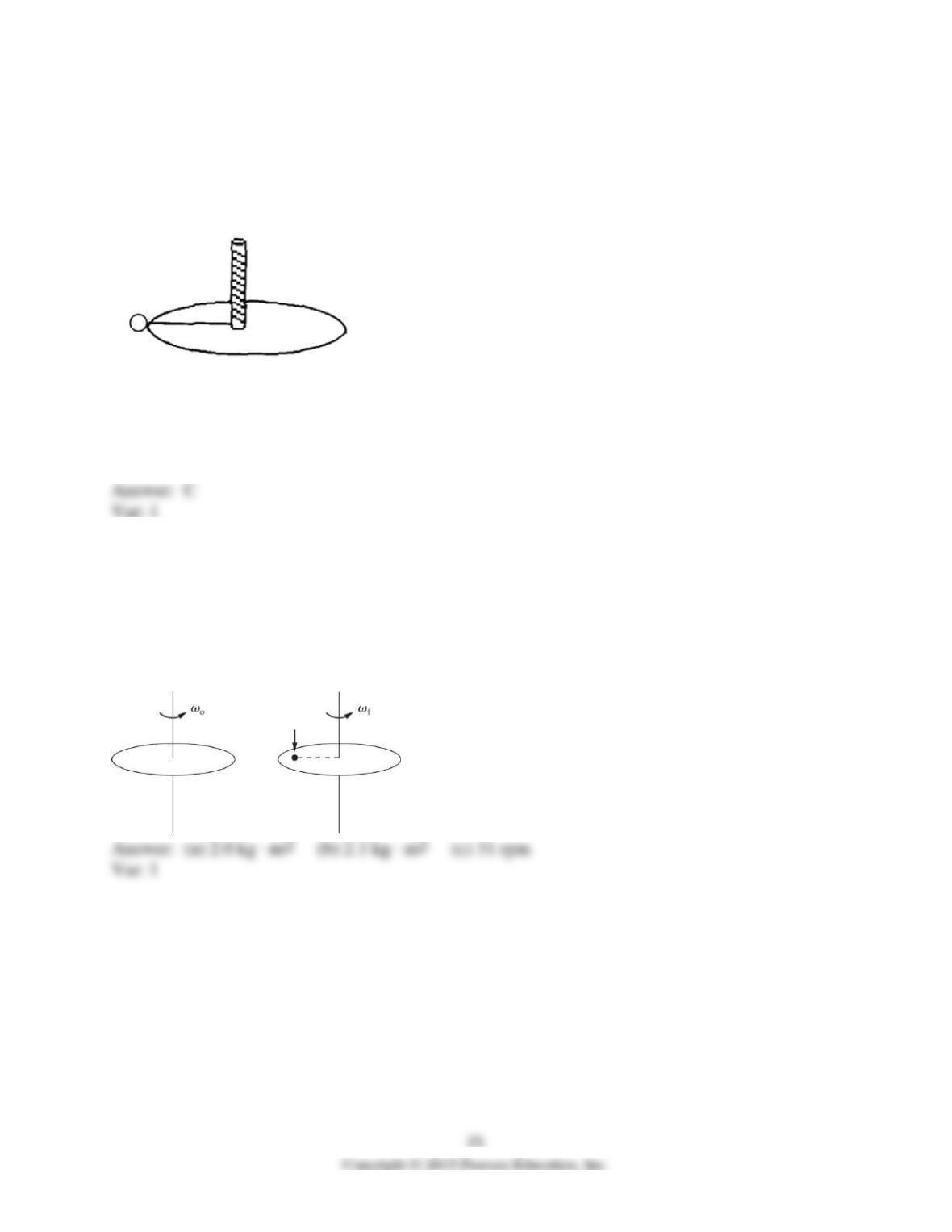
78) Initially, a small 2.0-kg rock is whirling at the end of a very thin string in a circular path of
radius 0.75 m on a horizontal frictionless surface, as shown in the figure. The initial tangential
speed of the rock was 5.0 m/s. The string has been slowly winding around a vertical rod, and a
few seconds later the length of the string has shortened to 0.25 m. What is the instantaneous
speed of the mass at the moment the string reaches a length of 0.25 m?
A) 3.9 m/s
B) 9.3 m/s
C) 15 m/s
D) 225 m/s
E) 75 m/s
79) A solid, uniform, horizontal disk with a diameter of 2.0 m and a mass of 4.0 kg freely rotates
at 36 rpm about a vertical axis through its center. A small 0.50-kg stone is suddenly dropped
onto the disk and sticks to the disk at a distance of 80 cm from the axis of rotation. The figure
shows before and after views.
(a) Before the stone fell, what was the moment of inertia of the disk about its central axis?
(b) After the stone stuck, what was the moment of inertia of the system about the same axis?
(c) What is the angular velocity of the disk (in rpm) after the stone fell onto the disk?
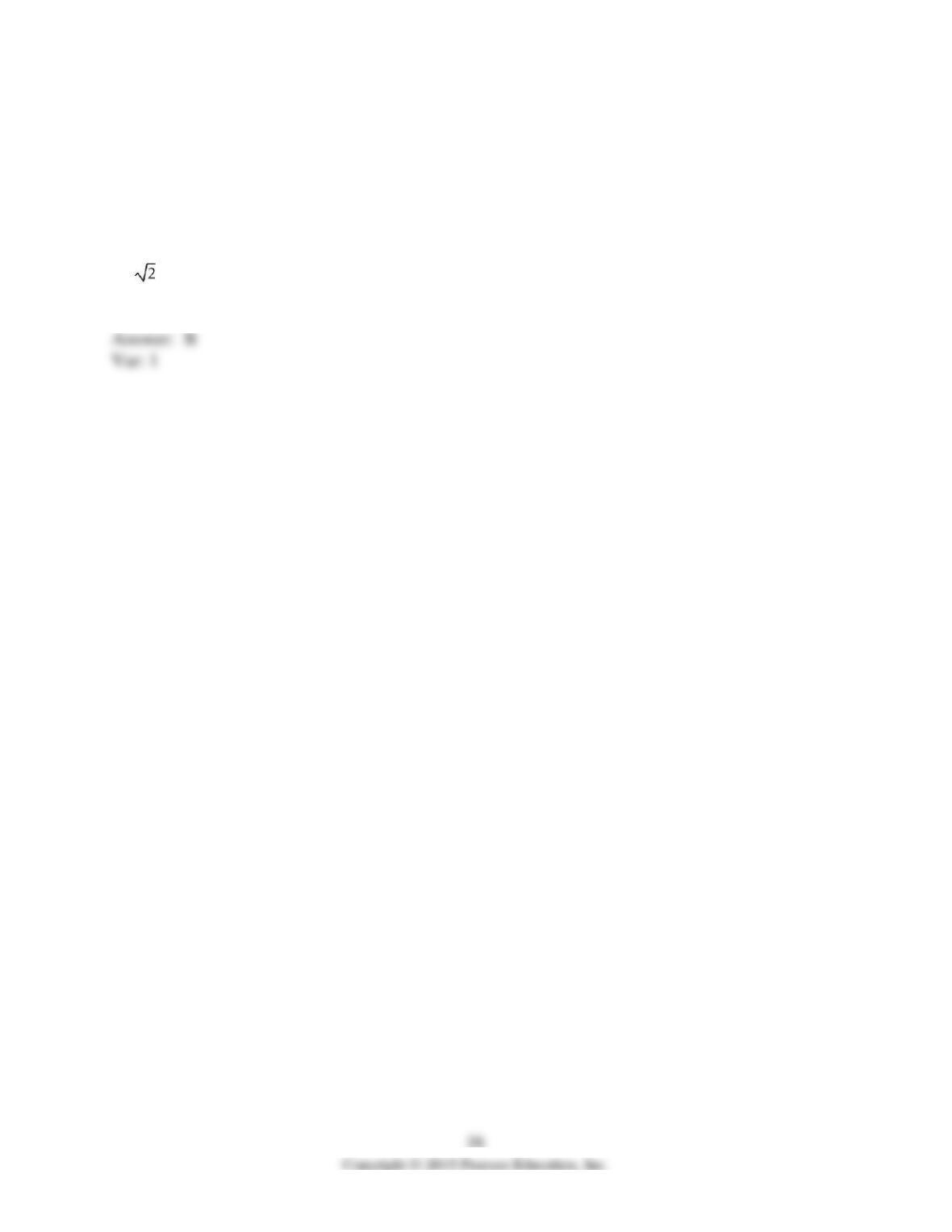
80) A puck moves on a horizontal air table. It is attached to a string that passes through a hole in
the center of the table. As the puck rotates about the hole, the string is pulled downward very
slowly and shortens the radius of rotation, so the puck gradually spirals in towards the center. By
what factor will the puck’s angular speed have changed when the string’s length has decreased to
one-half of its original length?
A) 2
B) 4
C)
D) 1
E) 1/2