55) Figure 9.5 represents the market for used cars. Suppose buyers are willing to pay $5,000 for
a plum (high-quality) used car and $3,000 for a lemon (low-quality) used car. If buyers believe
that 80% of used cameras in the market are lemons (low quality), what% of used cars sold will
actually be plums?
A) 20%
B) 25%
C) 33.33%
D) 75%
56) Figure 9.5 represents the market for used cars. Suppose buyers are willing to pay $5,000 for
a plum (high-quality) used car and $3,000 for a lemon (low-quality) used car. Initially buyers
believe that 80% of used cameras in the market are lemons (low quality). Compared to the
outcome with these initial expectations, how many fewer cars are sold in equilibrium?
A) 50
B) 80
C) 110
D) The number of cars sold in equilibrium is the same as the outcome with neutral expectations.
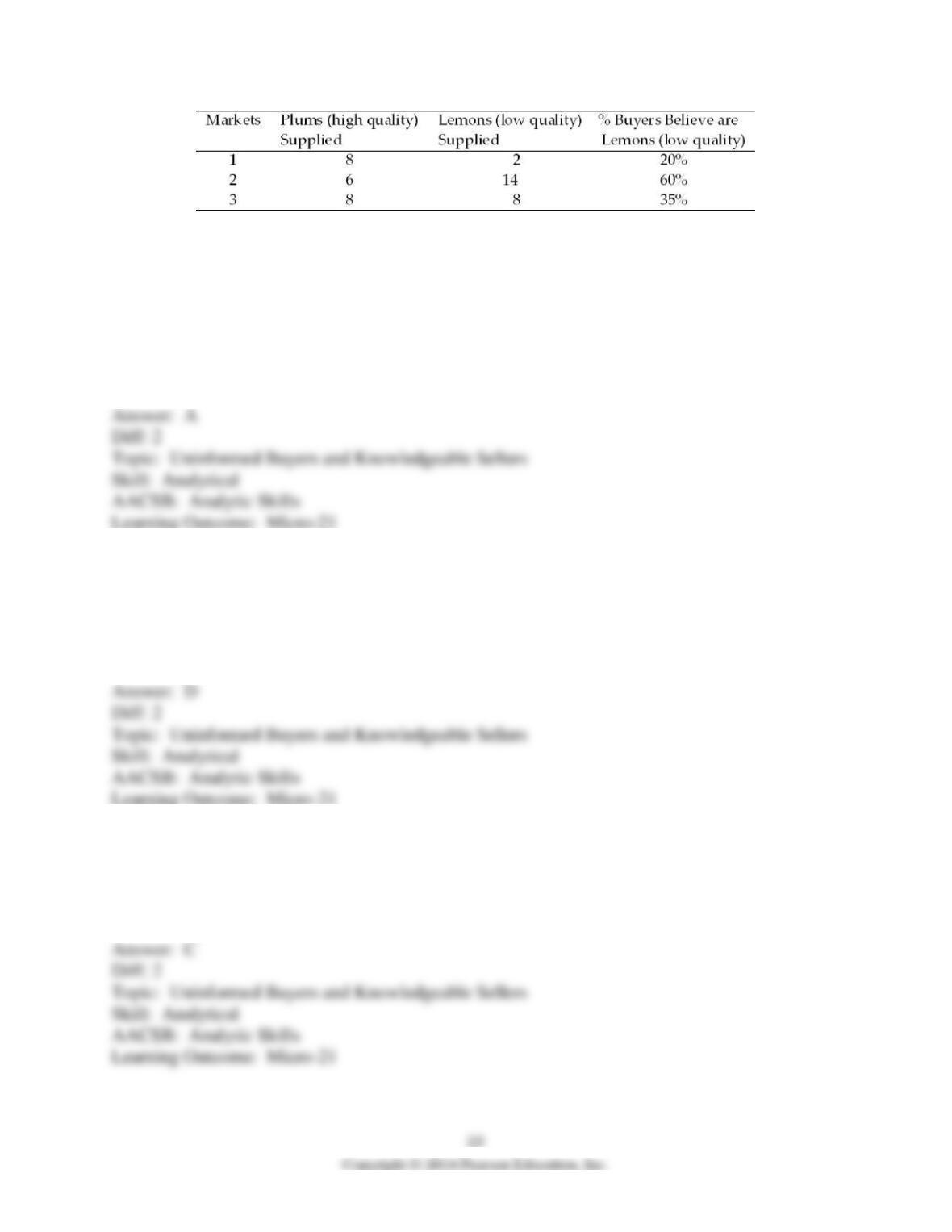
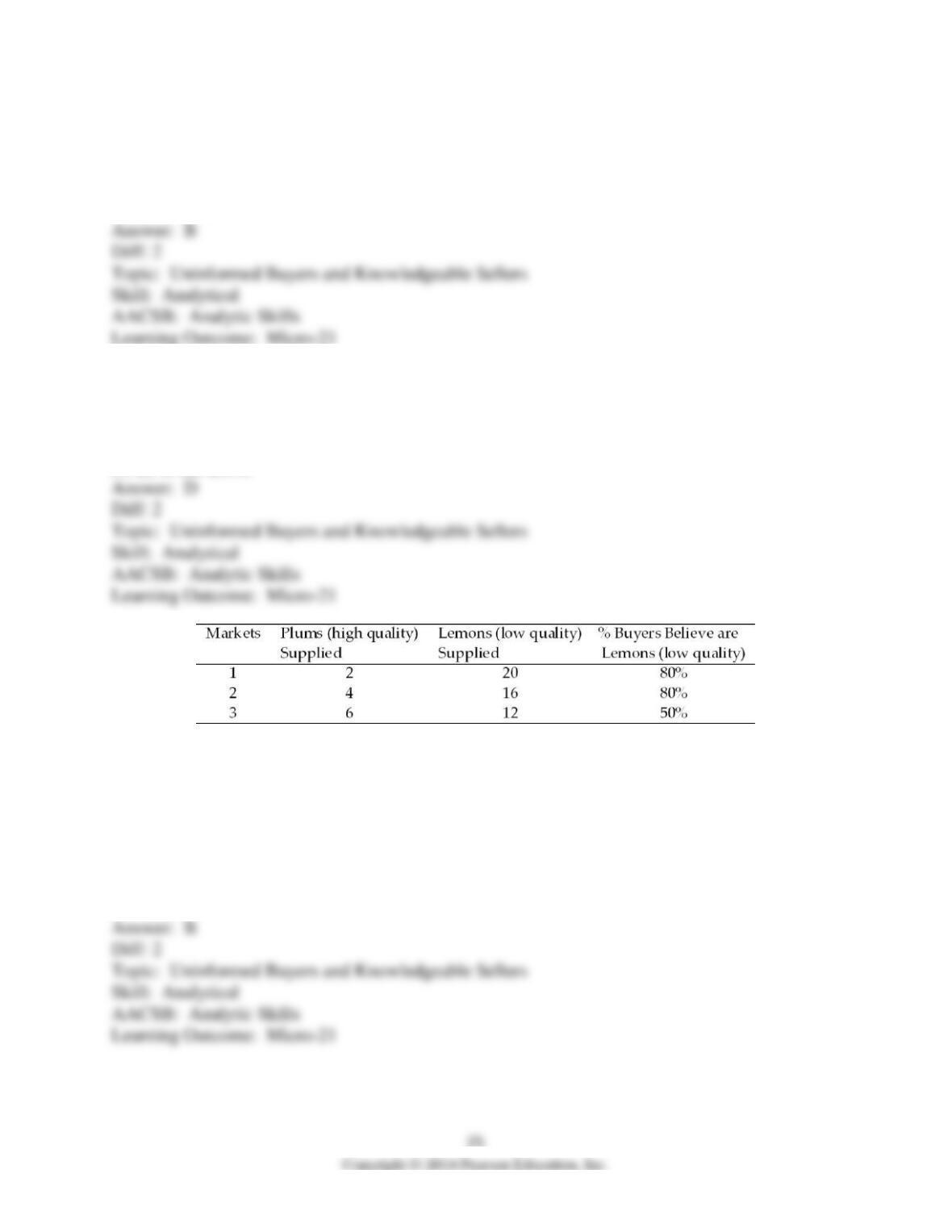
Table 9.2
57) Table 9.2 represents 3 markets for used guitars. Which of the markets in Table 14.2 are in
equilibrium?
A) 1 only
B) 2 only
C) 3 only
D) 2 and 3
58) Table 9.2 represents 3 markets for used guitars. Which of the markets in Table 14.2 are NOT
in equilibrium?
A) 1 only
B) 2 only
C) 3 only
D) 2 and 3
59) In Table 9.2, Market 2 would be in equilibrium if buyers believed lemons account for
A) 55% of the market.
B) 65% of the market.
C) 70% of the market.
D) 80% of the market.
60) In Table 9.2, Market 3 would be in equilibrium if buyers believed plums account for
A) 30% of the market.
B) 40% of the market.
C) 50% of the market.
D) 60% of the market.
61) Refer to Table 9.2. In which market do buyers underestimate the chance of getting a lemon?
A) 1 only
B) 2 only
C) 1 and 3 only
D) 2 and 3 only
Table 9.3
62) Table 9.3 represents 3 markets for used stereos. Which of the markets in Table 14.3 are in
equilibrium?
A) 1 only
B) 2 only
C) 3 only
D) none of the above
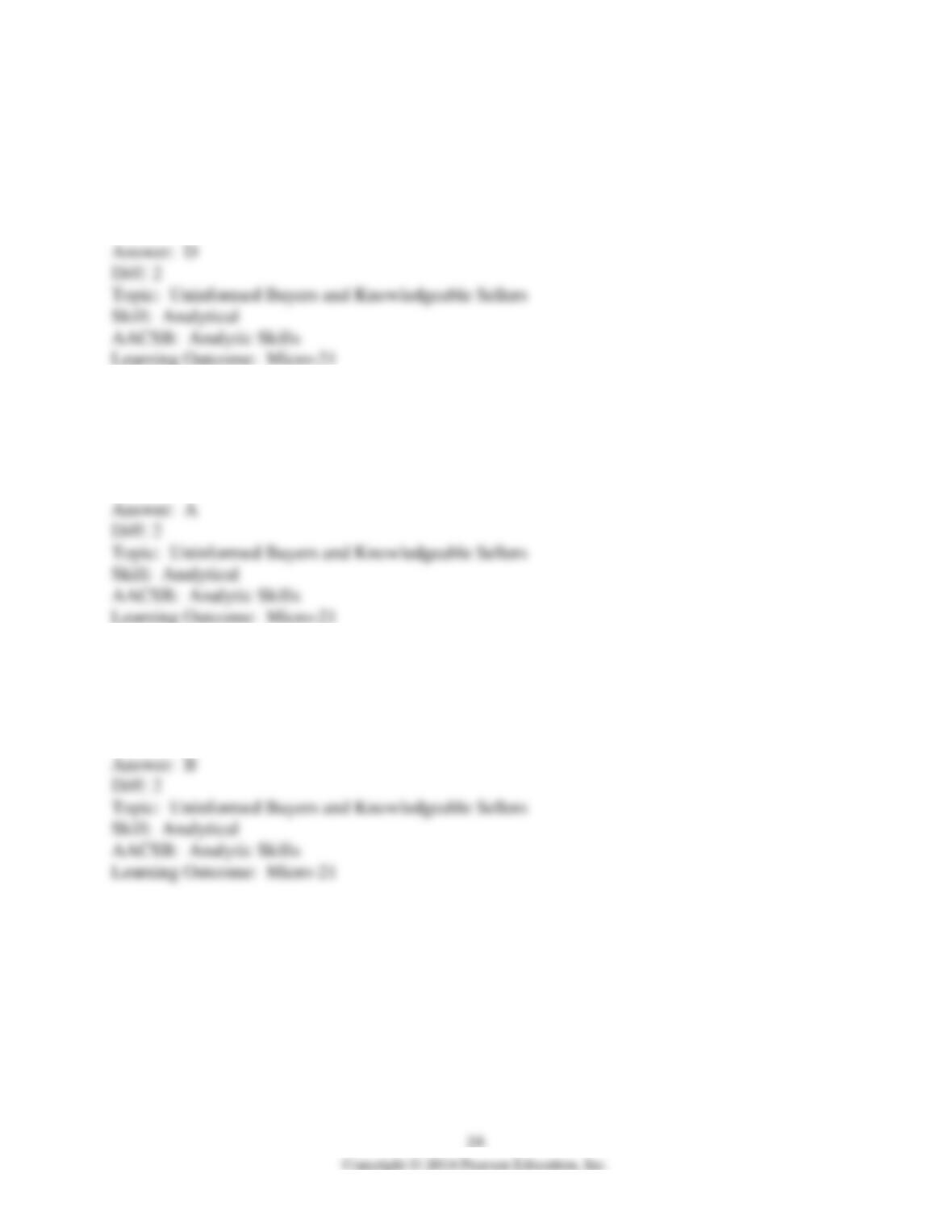
63) Table 9.3 represents 3 markets for used stereos. Which of the markets in Table 14.3 are NOT
in equilibrium?
A) 1 only
B) 2 only
C) 3 only
D) 1, 2, and 3
64) In Table 9.3, Market 1 would be in equilibrium if buyers believed lemons account for
A) about 83.33% of the market.
B) about 71.43% of the market.
C) about 66.67%% of the market.
D) about 42.86% of the market.
65) In Table 9.3, Market 2 would be in equilibrium if buyers believed plums account for
A) about 16.67% of the market.
B) about 33.33% of the market.
C) about 66.67% of the market.
D) about 88.89% of the market.
66) In Table 9.3, Market 3 would be in equilibrium if buyers believed lemons account for
A) 45% of the market.
B) 50% of the market.
C) 55% of the market.
D) 60% of the market.
67) Refer to Table 9.3. In which market do buyers underestimate the chance of getting a lemon?
A) 1 only
B) 2 only
C) 3 only
D) all of the above
Table 9.4
68) Table 9.4 represents 3 markets for used motorcycles. Which of the markets in Table 14.4 are
in equilibrium?
A) 1 only
B) 2 only
C) 3 only
D) 1 and 3
69) Table 9.4 represents 3 markets for used motorcycles. Which of the markets in Table 14.4 are
NOT in equilibrium?
A) 1 only
B) 2 only
C) 3 only
D) 1 and 3
70) In Table 9.4, Market 1 would be in equilibrium if buyers believed lemons accounted for
A) about 90.91% of the market.
B) about 74.5% of the market.
C) about 63.25% of the market.
D) about 57.65% of the market.
71) In Table 9.4, Market 3 would be in equilibrium if buyers believed plums accounted for
A) 11.11% of the market.
B) 22.22% of the market.
C) 33.33% of the market.
D) 66.67% of the market.
72) Refer to Table 9.4. In which market do buyers underestimate the chance of getting a lemon?
A) 1 and 2 only
B) 1 and 3 only
C) 2 and 3 only
D) none of the above
73) You are responsible for purchasing 20 used computers for your company. Red brand
computers costs $1,250 and Green brand computers cost $1,800. Based on experience, you
believe that 60% of Red Brand computers are lemons (low quality) while 20% of green brand
computers are lemons (low quality). You are willing to pay $1,000 for a known lemon and
$2,000 for a known plum. Which brand do you purchase?
A) red
B) green
C) indifferent between brands
D) don’t buy either brand
74) You are responsible for purchasing 25 used cars for your company. Star Brand cars costs
$7,500 and Diamond Brand cars cost $6,000. Based on experience, you believe that 20% of Star
Brand cars are lemons (low quality) while 40% of Diamond Brand cars are lemons (low quality).
You are willing to pay $5,000 for a known lemon and $12,000 for a known plum. Which brand
do you purchase?
A) Star
B) Diamond
C) indifferent between brands
D) don’t buy either brand
75) Suppose buyers in the used car market are willing to pay $3,500 for a plum (high-quality)
used car and $1,500 for a lemon (low-quality) used car. If buyers believe that 30% of the used
cars on the market are lemons (low quality), what would they be willing to pay for a used car?
A) $2,000
B) $2,500
C) $2,900
D) $3,500
76) When sellers have more information about the quality of a good than buyers do, a relatively
large share of the goods in the market will be low-quality goods. This is the ________ problem.
A) free-rider
B) law of diminishing returns
C) adverse selection
D) moral hazard
77) Suppose you notice that the market for used bikes is dominated by lemons (low-quality
bikes). In such a situation, if you are a buyer of used bikes, you are faced with
A) a positive externality.
B) perfect information.
C) an adverse selection problem.
D) symmetric information.
78) If the market for used computers has only lemons (low-quality computers) then the market
A) is an example of a thick market.
B) suffers from an adverse selection problem.
C) is a type of monopoly.
D) must be monopolistically competitive.
79) In a market with an adverse selection problem
A) one side of the market has better information about the goods than the other.
B) the uninformed side of the market must choose from an undesirable selection of goods.
C) some high-quality goods are sold but fewer than would be sold in a market with perfect
information.
D) all of the above
80) Which of the following is NOT an example of the adverse selection problem?
A) Buyers in a market for used cars must choose from an undesirable selection of used cars.
B) An insurance company must choose one price for its coverage for both high-cost and low-cost
people.
C) Commercial banks would rather use credit rationing than raising interest rates in the presence
of excess demand for loans.
D) An insured motorist drives more recklessly.

81) Which one of the following is true of a market for used cars?
A) A consumer typically overestimates the probability of getting a lemon (low-quality car).
B) As buyers become more pessimistic about their chances of buying a high-quality car, the price
of used cars (both low-quality and high-quality) decreases.
C) There is a public information problem.
D) The willingness to pay is less than the willingness to accept.
82) Which of the following statements about a market for used cars is INCORRECT?
A) The presence of low-quality cars decreases consumers’ willingness to pay.
B) An increase in price increases the quantity of high-quality cars supplied.
C) An increase in price decreases the quantity of low-quality cars supplied.
D) The decrease in the quantity of high-quality cars lowers consumers’ willingness to pay.
83) One result of adverse selection in the market for used cars is
A) more lemons (low quality) may be offered for sale than plums (high quality).
B) more plums (high quality) may be offered for sale than lemons (low quality).
C) few lemons (low quality) are sold.
D) no used cars are sold.

84) Buyers in the market for used guitars are getting more pessimistic about the possibility of
getting a good guitar. This will cause the price of used guitars to ________ and the percentage of
good used guitars to ________.
A) increase; increase
B) increase; decrease
C) decrease; increase
D) decrease; decrease
85) The adverse selection problem suggests that
A) the ratio of lemons (low quality) to plums (high quality) is likely to be high.
B) the ratio of plums (high quality) to lemons (low quality) is likely to be high.
C) the price of lemons (low quality) will be below buyer’s willingness to pay.
D) plums (high quality) will sell for more than most buyers’ willingness to pay.
86) An employer can find himself in an adverse selection problem if there are too
A) many applicants for each job.
B) few applicants for each job.
C) many qualified applicants for each job.
D) many underqualified applicants for each job.
87) Adverse selection in employment is more likely when
A) jobs require specific training.
B) everyone is equally qualified for the job.
C) people’s abilities are easy to measure.
D) people’s abilities are difficult for potential employers to observe.
88) In a thin market
A) only high-quality goods are sold.
B) some high-quality goods are sold but fewer than would be sold in a market with perfect
information.
C) some low-quality goods are sold but fewer than would be sold in a market with perfect
information.
D) no high-quality goods are sold.
89) Which one of the following is NOT true of a thin market?
A) It is caused by asymmetric information.
B) There are relatively few high-quality goods sold.
C) There may be some sellers of high-quality goods because people are in a hurry to sell.
D) The price of the good sold will be higher than if the market were thicker.
90) If only a small percentage of used computers on the market are plums (high-quality), then the
asymmetric information concerning the quality of used computers has generated a ________
market.
A) thin
B) weak
C) tight
D) competitive
91) The lemons model predicts that
A) if there are low-quality goods in the market, there will be fewer or no high-quality items.
B) if there are high-quality goods in the market, there will be fewer or no low-quality items.
C) the more low-quality goods there are in the market, the more high-quality goods there will be
in the market.
D) if buyers are pessimistic about the percentage of low-quality goods on the market sellers of
low-quality goods will be able to charge higher prices than if buyers had neutral beliefs.
92) In the used pick-up truck market,
A) some of the predictions of the lemons model are observed some of the time.
B) the lemons model accurately describes the market.
C) none of the predictions of the lemons model are observed.
D) there is no asymmetric information, and so the lemons model does not apply.
Recall the Application about the free-agent market for professional baseball pitchers to
answer the following question(s).
93) Recall the Application. Baseball players who switch teams are more likely to suffer from
injuries because the player’s ________ team has superior information concerning the health of
the player and, if they believe the player will be prone to injury in the future, they ________ be
willing to outbid another team.
A) new; will not
B) old; will not
C) new; will
D) old; will
94) Recall the Application. The market for baseball pitchers suffers from an asymmetric
information problem because
A) the pitcher’s current team has superior information concerning the health of the pitcher.
B) the potential new teams have superior information concerning the health of the pitcher.
C) baseball teams never sign injury-prone pitchers.
D) a physical exam ensures that both the player’s current team and potential new teams have the
same information concerning the player’s health.
95) Recall the Application. The market for baseball players suffers from adverse selection
because ________ the used car market, buyers (potential new teams) ________ goods (pitchers)
that are lemons (low quality).
A) unlike; have difficulty identifying
B) like; have difficulty identifying
C) unlike; can more easily identify
D) like; can more easily identify

96) Recall the Application. Pitchers who switch teams ________ pitchers who do not switch
teams.
A) spend more time on the disabled list, on average, than
B) spend less time on the disabled list, on average, than
C) spend exactly the same amount of time on the disabled list as
D) are less injury-prone than
97) There is asymmetric information in the used car market because sellers cannot distinguish
between lemons (low-quality) and plums (high-quality) but buyers can.
98) If a typical consumer is willing to pay $3,000 for a plum and $1,000 for a lemon, and there is
a 50% chance of getting a lemon, the typical consumer is willing to pay $2,000 for a used car.
99) If eight lemons (low quality) and two plums (high quality) are supplied and buyers assume
that there is a 40% chance of getting a lemon, there is an equilibrium.

100) When buyers assume that there is a 70% chance of getting a lemon, and seven lemons (low
quality) and three plums (high quality) are supplied, there is an equilibrium.
101) In the used car market, the adverse selection problem refers to the fact that a buyer must
choose a used car from an undesirable selection of cars.
102) One result of adverse selection in the used car market is that few plums (high-quality) are
sold.
103) In a market for used cars, if the minimum supply price for plums is lower than consumers’
willingness to pay for a lemon, only plums will be supplied at the consumers’ willingness to pay
for a lemon.
104) If the minimum price of plums (high-quality) decreases, the market will become thinner.
105) There are profit opportunities in a thin market because the gap between what a buyer is
willing to pay for a true plum and the amount a plum owner is willing to accept is large.
Recall the Application about the free-agent market for professional baseball pitchers to
answer the following question(s).
106) Recall the Application. Free-agent baseball pitchers who switch teams spend a relatively
long time on the disabled list compared to those who do not switch teams.
107) Recall the Application. Baseball teams know more about the health of free agent pitchers
than the pitchers themselves.
108) Why do used goods of different qualities often sell for the same price, while used goods of
different sizes sell for different prices?
109) You have just graduated from college and are buying a brand new car. There are two on the
lot: a green one and a blue one. Both have the same features for the same price. Is there a
potential asymmetric information problem?
110) Suppose that buyers assume that there is a 30% chance of getting a plum, and 8 of 10 cars
in the used car market are lemons. Is this an equilibrium?
111) Suppose you own a plum (high-quality) used car that you are thinking about selling.
Further, suppose you know that buyers assume that there is a 30% chance of getting a plum, and
that 8 of 10 cars currently in the used car market are lemons (low-quality). Would you likely sell
your car?
112) It has been said that if buyers of used goods are pessimistic it becomes a self-fulfilling
prophecy. In other words, buyer pessimism causes the market to have more low-quality goods.
Explain why this is true.
Recall the Application about the free-agent market for professional baseball pitchers to
answer the following question(s).
113) Recall the Application. Why is there adverse selection in the baseball pitcher free agent
market?

9.2 Responding to the Lemons Problem
1) Problems associated with thin markets provide incentives for
A) buyers to seek information about identifying high-quality items.
B) sellers to prove that the items they are selling are of high quality.
C) buyers and sellers to agree upon a higher price than would hold in equilibrium.
D) Both A and B.
2) If a seller of a high-quality good cannot prove the quality of that good
A) buyers will not be willing to pay the amount for which they value a high-quality good.
B) buyers will only be willing to pay the amount for which they value a low-quality good.
C) the good will never be offered for sale.
D) the good will trade at its equilibrium price.
3) Reading Consumer Reports before buying a used car
A) helps buyers increase their chances of avoiding a lemon, or low-quality car.
B) does not help buyers because magazines only cover new car sales, not used car sales.
C) makes warranties on used cars unnecessary.
D) is irrational because the cost of the magazine is greater than the benefit of the information.