9.2-31) In items a–f, define whether the bond was issued at a premium (PR), discount, (DI), or par (PAR)
when the face value of the bond was $1,000 with a 10% coupon rate.
a) The market rate of the bond was 11% when sold.
b) The issuing company received $1,050.00.
c) The market rate of the bond was 9% when sold.
d) The issuing company received $1,000.00.
e) The issuing company received $983.00.
f) The market rate of the bond was 10%.
9.2-32) What is the relation between market interest rate and bond issuance price? Include descriptions of
bond discount and premium in your explanation.
Learning Objective 9.3 Questions
9.3-1) Which of the following is false? The discount on bonds payable is
A) amortized over the life of the bond.
B) deducted from bonds payable.
C) a contra account.
D) a trading security account.
E) payable at the maturity date of the bond.
9.3-2) The discount on bonds payable
A) serves to reduce interest expense on the income statement.
B) serves to increase interest expense on the income statement.
C) serves as a disincentive for investment bankers to issue the debt.
D) serves to decrease the amount of cash paid to bondholders over the stated rate of interest.
E) None of the above
9.3-3) Which of the following is not true of bonds issued at a premium?
A) The cash proceeds exceed the face amount of the bonds.
B) The amortization of bond premium decreases the interest expense.
C) The amount of the Premium on Bonds Payable account is subtracted from the face amount of the
bonds to determine the net liability reported in the balance sheet.
D) The market rate was below coupon rate.
E) Amortization decreases the carrying value of the bond.
9.3-4) Early extinguishment of debt
A) is not allowed by the FASB during the first 2 years bonds are outstanding
B) will never have related gains or losses recorded on the books.
C) occurs when the issuer redeems its own bonds by purchases on the open market or by exercising their
rights to redeem callable bonds.
D) requires SEC approval.
E) is permitted only in the banking industry.
9.3-5) The issuance of bonds is shown on the statement of cash flows as
A) a cash inflow from financing activities.
B) a cash inflow from investing activities.
C) a cash inflow from operating activities.
D) a cash outflow from financing activities.
E) a cash outflow from investing activities.
9.3-6) The spreading of bond discount over the life of the bonds as interest expense is called
A) discount amortization.
B) effective–interest amortization.
C) compound interest method.
D) doubling down.
E) income averaging.
9.3-7) What is true regarding zero coupon notes?
A) They provide cash interest payments during their life.
B) They are sold for more than the face or maturity value.
C) The investor determines their market value at the issuance date by calculating the present value of
their maturity value, using the market rate of interest for notes having similar terms and risks.
D) They are only callable debentures.
E) They are also called junk bonds.
9.3-8) The market interest rate that equates the proceeds from a loan with the present value of the loan
payment is called
A) effective interest rate.
B) nominal interest rate.
C) imputed interest rate.
D) coupon interest.
E) agreed upon interest.
9.3-9) Under the effective–interest method of amortization, the amount of discount amortized each
interest period is equal to
A) the amount of interest expense plus the cash paid for interest.
B) the amount of interest expense less the cash paid for interest.
C) the total discount divided by the number of interest payments to be made.
D) the total amount of interest expense divided by the number of interest payments to be made.
E) the amount of the decrease from the cash payment.
9.3-10) Apple Markets just made the interest payment on its $4,000,000 of outstanding bonds. The bonds
are callable at 101 5/8 and the unamortized premium is currently $167,400. The entry to retire half of the
bonds would include a
A) debit to premium on bonds payable for $167,400.
B) credit to cash for $2,000,000.
C) credit to gain on early extinguishment of debt for $51,200.
D) debit to loss on early extinguishment of debt for $52,500.
E) debit to loss on early extinguishments of debt for $167,400.
9.3-11) The premium on bonds payable
A) serves to reduce interest expense on the income statement.
B) serves to increase interest expense on the income statement.
C) serves to increase the amount of cash paid to bondholders over the stated rate of interest.
D) serves to decrease the initial amount of cash paid by bondholders.
E) None of the above
9.3-12) Under the effective–interest method of amortizing bond premium, the interest expense recorded
for each semiannual interest payment
A) is the same percentage of the bond’s carrying value for every interest payment.
B) will increase over the life of the bond.
C) is equal to the carrying value of the bond times the contract rate of interest for each semiannual
interest payment.
D) will equal the amount of cash paid for each semiannual interest payment.
E) will be the same amount each time.
9.3-13) Under the effective–interest method of amortizing bond discount, the cash payment on each
interest payment date is calculated by multiplying the
A) ending net liability times the effective interest rate for the appropriate time period.
B) ending net liability times the coupon interest rate for the appropriate time period.
C) face value of the bonds times the effective interest rate for the appropriate time period.
D) face value of the bonds times the coupon interest rate for the appropriate time period.
E) difference between the market value and the liquidation value by the market rate of interest.
9.3-14) Under the effective–method of amortizing bond premium, the interest expense recorded for each
semiannual interest payment
A) is equal to the face value of the bond times the coupon rate of interest for each semiannual interest
period.
B) is at a different percentage of the bond’s carrying value for every interest payment.
C) will equal the amount of cash paid for each semiannual interest payment.
D) will decrease over the life of the bonds.
E) will increase over the life of the bonds.
9.3-15) Under the effective–interest method of amortization, interest expense each period can be
calculated by multiplying the
A) beginning net liability times the effective interest rate for the appropriate time period.
B) beginning net liability times the coupon interest rate for the appropriate time period.
C) face value of the bonds times the effective interest rate for the appropriate time period.
D) face value of the bonds times the coupon interest rate for the appropriate time period.
E) liquidation value times the effective interest rate for the appropriate time period.
9.3-16) On January 1, 20X9, Amanda Mackenzie purchased a $24,000 car, making a $4,000 down payment,
and borrowing the rest on a 4–year note at 8% interest. She agrees to make annual payments of $6,038.47,
starting January 1, 2X10. What is the journal entry that Amanda would make on January 1, 2X10, for the
first payment on the note?
A) Note Payable 6,038.47
Cash 6,038.47
B) Interest Payable 1,600.00
Note Payable 4,438.47
Cash 6,038.47
C) Interest Expense 483.08
Note Payable 5,555.39
Cash 6,038.47
D) Interest Expense 1,920.00
Note Payable 4,118.47
Cash 6,038.47
E) Interest Expense 5,555.39
Note Payable 438.08
Cash 6,038.47

Table 9–4
Boiler Industries issued 3,000 debentures on January 1, 20X9. The debentures were 12–year, 7% debt,
which paid interest semi–annually, every June 30 and December 31. The face value of each debenture is
$1,000.
9.3-17) Referring to Table 9–4, if the market rate of interest is 7% on January 1, 20X9, what is the journal
entry to record the issuance of the bonds?
A) Cash 3,000,000
Bonds Payable 3,000,000
B) Bonds Payable 3,000,000
Cash 3,000,000
C) Bonds Receivable 3,000,000
Cash 3,000,000
D) Bonds Receivable 3,000,000
Bonds Payable 3,000,000
E) Cannot be determined from the information given
9.3-18) Referring to Table 9–4, if the market rate of interest is 7% on January 1, 20X9, what is the journal
entry to record the payment of interest on June 30, 20X9?
A) Bonds Payable 105,000
Cash 105,000
B) Interest Payable 105,000
Cash 105,000
C) Cash 210,000
Bonds Payable 210,000
D) Interest Expense 105,000
Cash 105,000
E) Interest Expense 210,000
Bonds Payable 210,000
9.3-19) Bookmaster, Inc., issued an 8–year, 10% bond on January 1, 20X9. Each bond sold for face value,
which is $1,000. The bonds pay interest semi–annually on June 30 and December 31. The bonds mature on
December 31, 2X15. Using present value tables, what is the market price of each $1,000 bond on January 1,
2X11, if the market rate of interest has changed to 8%?
A) $ 893.29
B) $ 912.92
C) $1,000.00
D) $1,093.86
E) $1,114.96

9.3-20) Interest expense on bonds exhibits the following attributes except
A) interest expense is greater than the cash payment for interest when a bond is sold at a premium and
effective–interest amortization is used.
B) interest expense is the same dollar amount for every interest payment period, if a bond was issued at a
discount and straight–line amortization is used.
C) interest expense is greater than the cash payment for interest when a bond is sold at a discount,
regardless of whether straight–line or effective–interest amortization is used.
D) interest expense equals the cash payment for interest if a bond is sold at par.
E) interest expense becomes a larger dollar amount over time when a bond is sold at a discount and
effective–interest amortization is used.
9.3-21) Chapley, Inc., was ready to sell 8–year, 10% bonds at a face value of $2,000,000 on January 1, 20X9.
Because of delays and market conditions, the bonds were not sold until March 1, 20X9. The bonds pay
interest every June 30 and December 31. The bonds were sold at par plus accrued interest. What are the
necessary journal entries for Chapley, Inc., on March 1, 20X9, and June 30, 20X9?
March 1, 20X9 June 30, 20X9
A) Cash 2,033,333 Interest Payable 33,333
Bonds Payable 2,000,000 Interest Expense 66,667
Interest Payable 33,333 Cash 100,000
B) Cash 2,033,333 Interest Expense 100,000
Bonds Payable 2,000,000 Cash 100,000
Interest Revenue 33,333
C) Cash 2,033,333 Interest Expense 97,917
Bonds Payable 2,000,000 Premium on Bond
Premium on Bond Payable 2,083
Payable 33,333 Cash 100,000
D) Cash 2,033,333 Interest Expense 66,667
Bonds Payable 2,000,000 Premium on Bond
Premium on Bond Payable 33,333
Payable 33,333 Cash 100,000
E) Cash 1,066,667 Interest Payable 66,667
Bonds Payable 2,000,000 Interest Expense 133,333
Interest Payable 66,667 Cash 200,000
9.3-22) Generally bonds are called at an amount above par, referred to as a call discount.
9.3-23) Underwriters are a group of investment bankers who buy an entire bond or stock issue from a
corporation and then sell the issue to the general investing public.
9.3-24) Zero coupon notes do not provide semiannual interest payments.
9.3-25) Non–interest–bearing notes do not make any interest payments over the life of the note.
9.3-26) A bond issued at a price above its face value is sold at a discount.
9.3-27) The market or effective rate of interest is used to calculate the actual amount of interest
bondholders will receive from a company issuing bonds.
9.3-28) An investor purchasing bonds between interest dates must pay accrued interest on the bonds.
9.3-29) Using the effective–interest method of amortization, interest expense is based on the net liability at
the beginning of the current period times the effective interest rate for the interest period.
9.3-30) Interest expense will increase each period if a company uses the effective–interest method of
amortization and the bonds are issued at a discount.
9.3-31) The net liability of bonds will decrease each interest period if the bonds were issued at a premium.
9.3-32) The effective–interest method of amortization keeps interest expense at the same percentage of the
bond’s carrying value for every interest payment over the bond’s life.
9.3-33) Coupon rate and nominal interest rate are both used to describe the rate of interest to be paid on a
bond.
9.3-34) The market interest rate is affected by general economic conditions, industry conditions, risks of
the use of the proceeds, and specific features of the bonds.
9.3-35) On the day of issuance, the proceeds to the issuer may be above par or below par, depending on
market conditions. If the proceeds are above par, the bonds have been sold at a discount.
9.3-36) The excess of the proceeds over the face amount of a bond is called premium on bonds.
9.3-37) The spreading of the discount over the life of the bonds is called discount amortization.
9.3-38) The difference between the effective–interest amount and the cash interest payment is the amount
of discount amortized for the period.
9.3-39) Implicit interest is a form of interest expense that is not explicitly recognized in a loan agreement.
9.3-40) On January 1, 20X9, Coronation, Inc., issued $5 million of 5–year, 9% debentures at par which are
dated as of January 1, 20X9.
Prepare the journal entries to record the
(a) issuance of the bonds.
(b) the first semi–annual interest payment.
(c) the payment of maturity value.
9.3-41) Arnold Company had a 6–year, 8%, $375,000 bonds ready to be sold on January 1, 20X9. The bonds
will pay interest every June 30 and December 31. However, due to market conditions, the company did
not sell the bonds until March 1, 20X9, at which time the bonds was issued at par.
Given the information presented above, prepare the appropriate journal entry for Arnold Company for
each of the following dates:
a. January 1, 20X9
b. March 1, 20X9
c. June 30, 20X9
d. December 31, 20X9
9.3-42) Alto, Inc., issued a 2–year, $150,000, 14% debenture on January 1, 20X9 dated as of January 1, 20X9.
The bond will pay interest every June 30 and December 31, with the principal to be paid on December 31,
2X10. The effective interest rate on the bond is 10%, and the company uses effective–interest amortization.
Given this information and using the present value tables
a. determine the selling price for the bond.
b. provide the journal entry on January 1, 20X9.
9.3-43) Cola, Inc., issued a 12–year, 10%, $1,500,000 bond on January 1, 20X9 dated as of January 1, 20X9.
The bond pays interest every June 30 and December 31, with the principal to be paid at the end of 12
years. The effective interest rate on the bond is 12%. The company uses effective–interest amortization.
Given this information and using the present value tables
a. Prepare journal entries for Cola, Inc., on each of the following dates:
1) January 1, 20X9
2) June 30, 20X9
3) December 31, 20X9
b. What is the total interest expense for the year ended December 31, 20X9?
c. What is the balance sheet presentation of this bond for Cola, Inc., at December 31, 20X9?
9.3-44) Pepco, Inc., issued $1,000,000 of 6.5%, 8–year bonds dated June 1, 20X9, with semiannual interest
payments on June 1 and December 1. The bonds were issued on June 1, 20X9, at 103 3/8.
a. Were the bonds issued at a premium, a discount, or at face value?
b. Was the market rate of interest higher, lower, or the same as the coupon rate of interest?
c. How much cash was received by Pepco, Inc., upon issuance of the bonds?
9.3-45) On January 1, 20X9, Nelson Company issued $5,000,000 of 9%, 10–year bonds dated January 1,
20X9, with annual interest payments on December 31. The bonds were issued for $4,692,570 yielding an
effective interest rate of 10%. Nelson uses the effective–interest method of amortization.
a. Prepare the necessary journal entries to record the issuance of the bonds and the first interest payment.
b. Determine the ending net liability of the bonds on December 31, 20X9.
9.3-46) Rural Bell Company issued 9–year, 8%, $750,000 bonds on January 1, 20X9. The bonds pay interest
every June 30 and December 31, with the principal to be paid in 9 years. The effective interest rate on the
bonds is 10%, and the company uses the effective–interest method of amortization.
a. Compute the initial selling price of the bonds on January 1, 20X9.
b. Prepare the entry needed on June 30, 20X9.
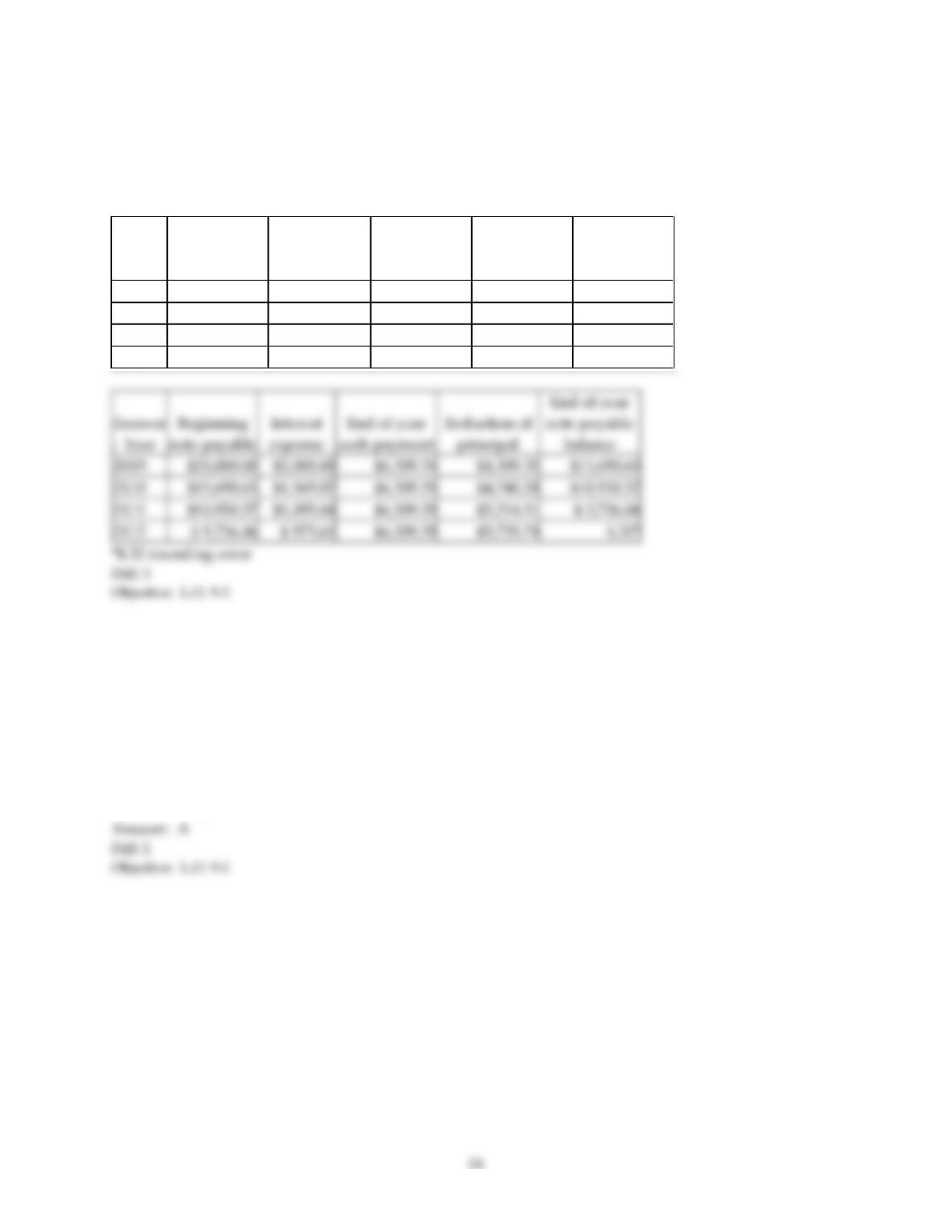
9.3-47) Cincy Company purchased a $25,000 truck on January 1, 20X9. The company paid $5,000 and will
pay the remaining $20,000 with a 4–year note. The note requires that the company make four equal
annual payments starting on December 31, 20X9. The note charges 10% interest. Given this information
and using present value tables, complete the following chart.
Year
Beginning
note payable
Interest
expense
End of year
cash payment
Reduction of
principal
End of year
note payable
balance
20X9
$20,000
2X10
2X11
2X12
: Year
note payable
End of year
20X9
2X10
2X11
2X12
Learning Objective 9.4 Questions
9.4-1) Leases have all of the following attributes except:
A) The lessee would always recognize the liability associated with future cash payments but never an
asset associated with the property being leased.
B) Leases can take the form of a capital lease or an operating lease.
C) Some leases are substantially equivalent to purchases.
D) A lease contract creates property rights and financial obligations.
E) Almost any asset could be leased.
9.4-2) Ratner, Inc., leased a building for 2 years, effective May 1, 20X9. The lease was considered an
operating lease. The lease required that Yeager Flying make payments of $4,000 every 3 months,
beginning on July 31, 20X9. Assume an interest rate of 12%. What is the journal entry to be made by
Ratner, Inc., on July 31, 20X9?
A) Rent Expense 4,000
Cash 4,000
B) Interest Expense 120
Rent Expense 3,880
Cash 4,000
C) Interest Expense 120
Lease Obligation 3,880
Cash 4,000
D) Interest Expense 842
Lease Obligation 3,158
Cash 4,000
E) Interest Expense 842
Rent Expense 3,158
Cash 4,000
Table 9–5
Feature Company entered into a lease agreement on January 1, 20X9, to acquire a machine. The machine
has a useful life of 6 years. Feature Company will make annual lease payments of $13,000 for 6 years,
beginning on December 31, 20X9. Assume a 14% interest rate.
9.4-3) Referring to Table 9–5 and using the present value tables, what journal entry will Feature Company
make on January 1, 20X9?
A) Machine Leasehold 50,553
Capital Lease Liability 50,553
B) Machine Leasehold 78,000
Capital Lease Liability 78,000
C) Machine Leasehold 50,553
Deferred Interest Expense 27,447
Capital Lease Obligation 78,000
D) Machine Leasehold 78,000
Interest Payable 27,447
Capital Lease Liability 50,553
E) No journal entry is necessary.

9.4-4) Referring to Table 9–5 and using the present value tables, what is the journal entry to be made by
Feature Company on December 31, 2X10, to amortize the leased asset, assuming straight–line
amortization is used?
A) No journal entry is necessary.
B) Leasehold Amortization Expense 4,575
Machine Leasehold 4,575
C) Leasehold Amortization Expense 8,426
Machine Leasehold 8,426
D) Leasehold Amortization Expense 13,000
Machine Leasehold 13,000
E) Leasehold Amortization Expense 13,000
Capital Lease Liability 13,000
9.4-5) Referring to Table 9–5 and using the present value tables, what is the journal entry to be made
Feature Company on December 31, 20X9, to record the annual lease payment?
A) Rent Expense 13,000
Cash 13,000
B) Capital Lease Obligation 13,000
Cash 13,000
C) Capital Lease Obligation 2,080
Interest Expense 10,920
Cash 13,000
D) Capital Lease Obligation 5,923
Interest Expense 7,077
Cash 13,000
E) Capital Lease Obligation 11,180
Interest Expense 1,820
Cash 13,000
9.4-6) Which of the following is not one of the conditions for a capital lease?
A) An expensive purchase option is available to the lessee at the end of the lease.
B) The lease term equals or exceeds 75% of the estimated economic life of the property.
C) Title is transferred to the lessee by the end of the lease.
D) The present value of the lease payments is at least 90% of the leased asset’s fair value at the start of the
lease term.
E) The lease contains a bargain purchase option.
9.4-7) A lease that should be accounted for by the lessee as ordinary rent expense is
A) a financing lease.
B) a capital lease.
C) an operating lease.
D) an accounting lease.
E) a sale–leaseback.
9.4-8) All of the following would qualify as a capital lease except:
A) The lease term is 80% of the asset’s estimated useful life.
B) The lease agreement contains a bargain purchase option.
C) The present value of the lease payments equals 70% of the market value of the leased asset.
D) Title to the leased asset transfers to the lessee at the end of the lease term.
9.4-9) A lessee may have a leased item on his balance sheet as an asset, even though the lessee does not
have the legal title of ownership to the leased item.
9.4-10) A lease is a contract whereby an owner grants the use of property to a second party for rental
payments.
9.4-11) The party that has the right to use leased property and makes lease payments to the lessor is called
a lessee.
9.4-12) There are two types of leases: capital leases and financial leases.
9.4-13) A operating lease is a lease that should be accounted for by the lessee as ordinary rent expenses.
9.4-14) A capital lease is a lease that transfers most of the risks and benefits of ownership to the lessee.
9.4-15) Broadwing, Inc., signs an agreement on January 1, 20X9, to lease office equipment for a 5–year
period. The estimated useful life of the office equipment is 8 years. The market value of the office
equipment is $235,000. The lease agreement calls for lease payments of $55,040. The first payment is due
on December 31, 20X9, all subsequent payments are made each December 31 thereafter. The interest rate
stated in the lease agreement is 8%. The present value of the lease payments is $219,758. At the end of the
lease term, the equipment reverts back to the lessor.
Prepare journal entries to record
a. the lease agreement on January 1, 2X10.
b. the first lease payment on December 31, 2X10.
c. the amortization of the leased asset on December 31, 2X10.
9.4-16) Callaway Enterprises has several liabilities on its balance sheet. For each of the liabilities below
decide whether it is a current asset (CA), current liability (CL), long–term asset (LTA), long–term
liability(LTL), or contra–liability (COL).
a. 15 year lease obligation
b. Discount on bonds payable
c. Amounts owed to the utility company
d. A leased asset
e. Current portion of long term debt
f. An asset with a lease term of 75% of the estimated economic life of the property