
Inventories: Additional Valuation Issues
9 – 21
87. Confectioners, a chain of candy stores, purchases its candy in bulk from its suppliers. For
a recent shipment, the company paid $1,500 and received 8,500 pieces of candy that are
allocated among three groups. Group 1 consists of 2,500 pieces that are expected to sell
for $0.15 each. Group 2 consists of 5,500 pieces that are expected to sell for $0.36 each.
Group 3 consists of 500 pieces that are expected to sell for $0.72 each. Using the relative
sales value method, what is the cost per item in Group 2?
a. $0.19.
b. $0.30.
c. $0.18.
d. $0.20.
88. Confectioners, a chain of candy stores, purchases its candy in bulk from its suppliers. For
a recent shipment, the company paid $1,500 and received 8,500 pieces of candy that are
allocated among three groups. Group 1 consists of 2,500 pieces that are expected to sell
for $0.15 each. Group 2 consists of 5,500 pieces that are expected to sell for $0.36 each.
Group 3 consists of 500 pieces that are expected to sell for $0.72 each. Using the relative
sales value method, what is the cost per item in Group 3?
a. $0.40.
b. $0.19.
c. $0.60.
d. $0.45.
89. During the current fiscal year, Jeremiah Corp. signed a long-term noncancellable
purchase commitment with its primary supplier. Jeremiah agreed to purchase $1.5 million
of raw materials during the next fiscal year under this contract. At the end of the current
fiscal year, the raw material to be purchased under this contract had a market value of
$1.2 million. What is the journal entry at the end of the current fiscal year?
a. Debit Unrealized Holding Gain or Loss for $300,000 and credit Estimated Liability on
Purchase Commitment for $300,000.
b. Debit Estimated liability on Purchase Commitments for $300,000 and credit
Unrealized Holding Gain or Loss for $300,000.
c. Debit Unrealized Holding Gain or Loss for $1,200,000 and credit Estimated Liability on
Purchase Commitments for $1,200,000.
d. No journal entry is required.
90. During the prior fiscal year, Jeremiah Corp. signed a long-term noncancellable purchase
commitment with its primary supplier to purchase $1.5 million of raw materials. Jeremiah
paid the $1.5 million to acquire the raw materials when the raw materials were only worth
$1.2 million. Assume that the purchase commitment was properly recorded. What is the
journal entry to record the purchase?
a. Debit Inventory for $1,200,000, and credit Cash for $1,200,000.
b. Debit Inventory for $1,200,000, debit Unrealized Holding Gain or Loss for $300,000,
and credit Cash for $1,500,000.
c. Debit Inventory for $1,200,000, debit Estimated Liability on Purchase Commitments
for $300,000 and credit Cash for $1,500,000.
d. Debit Inventory for $1,500,000, and credit Cash for $1,500,000.

Test Bank for Intermediate Accounting, Fifteenth Edition
9 – 22
91. During 2014, Larue Co., a manufacturer of chocolate candies, contracted to purchase
200,000 pounds of cocoa beans at $4.00 per pound, delivery to be made in the spring of
2015. Because a record harvest is predicted for 2015, the price per pound for cocoa
beans had fallen to $3.30 by December 31, 2014.
Of the following journal entries, the one which would properly reflect in 2014 the effect of
the commitment of Larue Co. to purchase the 200,000 pounds of cocoa is
a. Cocoa Inventory …………………………………………………… 800,000
Accounts Payable ………………………………………. 800,000
b. Cocoa Inventory …………………………………………………… 660,000
Loss on Purchase Commitments ……………………………. 140,000
Accounts Payable ………………………………………. 800,000
c. Unrealized Holding Gain or Loss-Income …………………. 140,000
Estimated Liability on Purchase Commitments .. 140,000
d. No entry would be necessary in 2014
92. RS Corporation, a manufacturer of ethnic foods, contracted in 2014 to purchase 600
pounds of a spice mixture at $5.00 per pound, delivery to be made in spring of 2015. By
12/31/14, the price per pound of the spice mixture had risen to $5.40 per pound. In 2014,
RS should recognize
a. a loss of $3,000.
b. a loss of $240.
c. no gain or loss.
d. a gain of $240.
93. LF Corporation, a manufacturer of Mexican foods, contracted in 2014 to purchase 1,500
pounds of a spice mixture at $5.00 per pound, delivery to be made in spring of 2015. By
12/31/14, the price per pound of the spice mixture had dropped to $4.70 per pound. In
2014, LF should recognize
a a loss of $7,500.
b. a loss of $450.
c. no gain or loss.
d. a gain of $450.
94. The following information is available for October for Barton Company.
Beginning inventory $250,000
Net purchases 750,000
Net sales 1,500,000
Percentage markup on cost 66.67%
A fire destroyed Barton’s October 31 inventory, leaving undamaged inventory with a cost
of $15,000. Using the gross profit method, the estimated ending inventory destroyed by
fire is
a. $85,000.
b. $385,000.
c. $400,000.
d. $500,000.

Inventories: Additional Valuation Issues
9 – 23
95. The following information is available for October for Norton Company.
Beginning inventory $300,000
Net purchases 900,000
Net sales 1,800,000
Percentage markup on cost 66.67%
A fire destroyed Norton’s October 31 inventory, leaving undamaged inventory with a cost
of $18,000. Using the gross profit method, the estimated ending inventory destroyed by
fire is
a. $102,000.
b. $462,000.
c. $480,000.
d. $600,000.
Use the following information for questions 96 and 97.
Miles Company, a wholesaler, budgeted the following sales for the indicated months:
June July August
Sales on account $2,700,000 $2,760,000 $2,850,000
Cash sales 270,000 300,000 390,000
Total sales $2,970,000 $3,060,000 $3,240,000
All merchandise is marked up to sell at its invoice cost plus 25%. Merchandise inventories at the
beginning of each month are at 30% of that month’s projected cost of goods sold.
96. The cost of goods sold for the month of June is anticipated to be
a. $2,025,000.
b. $2,227,500.
c. $2,079,000.
d. $2,376,000.
97. Merchandise purchases for July are anticipated to be
a. $2,295,000.
b. $3,114,000.
c. $2,448,000.
d. $2,491,200.
98. Reyes Company had a gross profit of $720,000, total purchases of $840,000, and an
ending inventory of $480,000 in its first year of operations as a retailer. Reyes’s sales in
its first year must have been
a. $1,080,000.
b. $1,320,000.
c. $360,000.
d. $1,200,000.
99. A markup of 20% on cost is equivalent to what markup on selling price?
a. 17%
b. 20%
c. 80%
d. 83%

Test Bank for Intermediate Accounting, Fifteenth Edition
9 – 24
100. Kesler, Inc. estimates the cost of its physical inventory at March 31 for use in an interim
financial statement. The rate of markup on cost is 25%. The following account balances
are available:
Inventory, March 1 $440,000
Purchases 344,000
Purchase returns 16,000
Sales during March 600,000
The estimate of the cost of inventory at March 31 would be
a. $168,000.
b. $288,000.
c. $318,000.
d. $224,000.
101. On January 1, 2014, the merchandise inventory of Glaus, Inc. was $1,200,000. During
2014 Glaus purchased $2,400,000 of merchandise and recorded sales of $3,000,000. The
gross profit rate on these sales was 25%. What is the merchandise inventory of Glaus at
December 31, 2014?
a. $600,000.
b. $750,000.
c. $1,350,000.
d. $2,250,000.
102. For 2014, cost of goods available for sale for Tate Corporation was $2,700,000. The gross
profit rate on sales was 20%. Sales for the year were $2,400,000. What was the amount
of the ending inventory?
a. $0.
b. $780,000.
c. $540,000.
d. $480,000.
103. On April 15 of the current year, a fire destroyed the entire uninsured inventory of a retail
store. The following data are available:
Sales, January 1 through April 15 $480,000
Inventory, January 1 80,000
Purchases, January 1 through April 15 400,000
Markup on cost 25%
The amount of the inventory loss is estimated to be
a. $96,000.
b. $48,000.
c. $120,000.
d. $80,000.

Inventories: Additional Valuation Issues
9 – 25
104. The inventory account of Irick Company at December 31, 2014, included the following
items:
Inventory Amount
Merchandise out on consignment at sales price
(including markup of 40% on selling price) $30,000
Goods purchased, in transit (shipped f.o.b. shipping point) 24,000
Goods held on consignment by Irick 31,000
Goods out on approval (sales price $15,200, cost $12,800) 15,200
Based on the above information, the inventory account at December 31, 2014, should be
reduced by
a. $45,400.
b. $45,200.
c. $69,400.
d. $51,400.
105. The sales price for a product provides a gross profit of 25% of sales price. What is the
gross profit as a percentage of cost?
a. 25%.
b. 20%.
c. 33%.
d. Not enough information is provided to determine.
106. Gamma Ray Corp. has annual sales totaling $780,000 and an average gross profit of 20%
of cost. What is the dollar amount of the gross profit?
a. $156,000.
b. $117,000.
c. $130,000.
d. $195,000.
107. On August 31, a hurricane destroyed a retail location of Vinny’s Clothier including the
entire inventory on hand at the location. The inventory on hand as of June 30 totaled
$960,000. Since June 30 until the time of the hurricane, the company made purchases of
$255,000 and had sales of $750,000. Assuming the rate of gross profit to selling price is
40%, what is the approximate value of the inventory that was destroyed?
a. $960,000.
b. $544,500.
c. $615,000.
d. $765,000.
108. On October 31, a fire destroyed PH Inc.’s entire retail inventory. The inventory on hand as
of January 1 totaled $2,040,000. From January 1 through the time of the fire, the company
made purchases of $495,000 and had sales of $1,080,000. Assuming the rate of gross
profit to selling price is 40%, what is the approximate value of the inventory that was
destroyed?
a. $2,040,000.
b. $2,019,000.
c. $1,455,000.
d. $1,887,000.

Test Bank for Intermediate Accounting, Fifteenth Edition
9 – 26
109. On March 15, a fire destroyed Interlock Company’s entire retail inventory. The inventory
on hand as of January 1 totaled $4,950,000. From January 1 through the time of the fire,
the company made purchases of $2,049,000, incurred freight-in of $234,000, and had
sales of $3,630,000. Assuming the rate of gross profit to selling price is 30%, what is the
approximate value of the inventory that was destroyed?
a. $6,144,000.
b. $4,458,000.
c. $4,692,000.
d. $7,233,000.
110. Dicer uses the conventional retail method to determine its ending inventory at cost.
Assume the beginning inventory at cost (retail) were $260,000 ($396,000), purchases
during the current year at cost (retail) were $1,370,000 ($2,200,000), freight-in on these
purchases totaled $86,000, sales during the current year totaled $2,000,000, and net
markups (markdowns) were $48,000 ($72,000). What is the ending inventory value at
cost?
a. $371,228.
b. $378,092.
c. $386,804.
d. $572,000.
111. Boxer Inc. uses the conventional retail method to determine its ending inventory at cost.
Assume the beginning inventory at cost (retail) were $196,500 ($297,000), purchases
during the current year at cost (retail) were $1,704,000 ($2,596,800), freight-in on these
purchases totaled $79,500, sales during the current year totaled $2,333,000, and net
markups were $207,000. What is the ending inventory value at cost?
a. $767,800.
b. $541,425.
c. $490,624.
d. $525,175.
112. Barker Pet supply uses the conventional retail method to determine its ending inventory at
cost. Assume the beginning inventory at cost (retail) were $531,200 ($653,800),
purchases during the current year at cost (retail) were $2,137,200 ($2,772,200), freight-in
on these purchases totaled $127,800, sales during the current year totaled $2,704,000,
and net markups (markdowns) were $4,000 ($192,600). What is the ending inventory
value at cost?
a. $533,400.
b. $434,721.
c. $722,000.
d. $588,430.

Inventories: Additional Valuation Issues
9 – 27
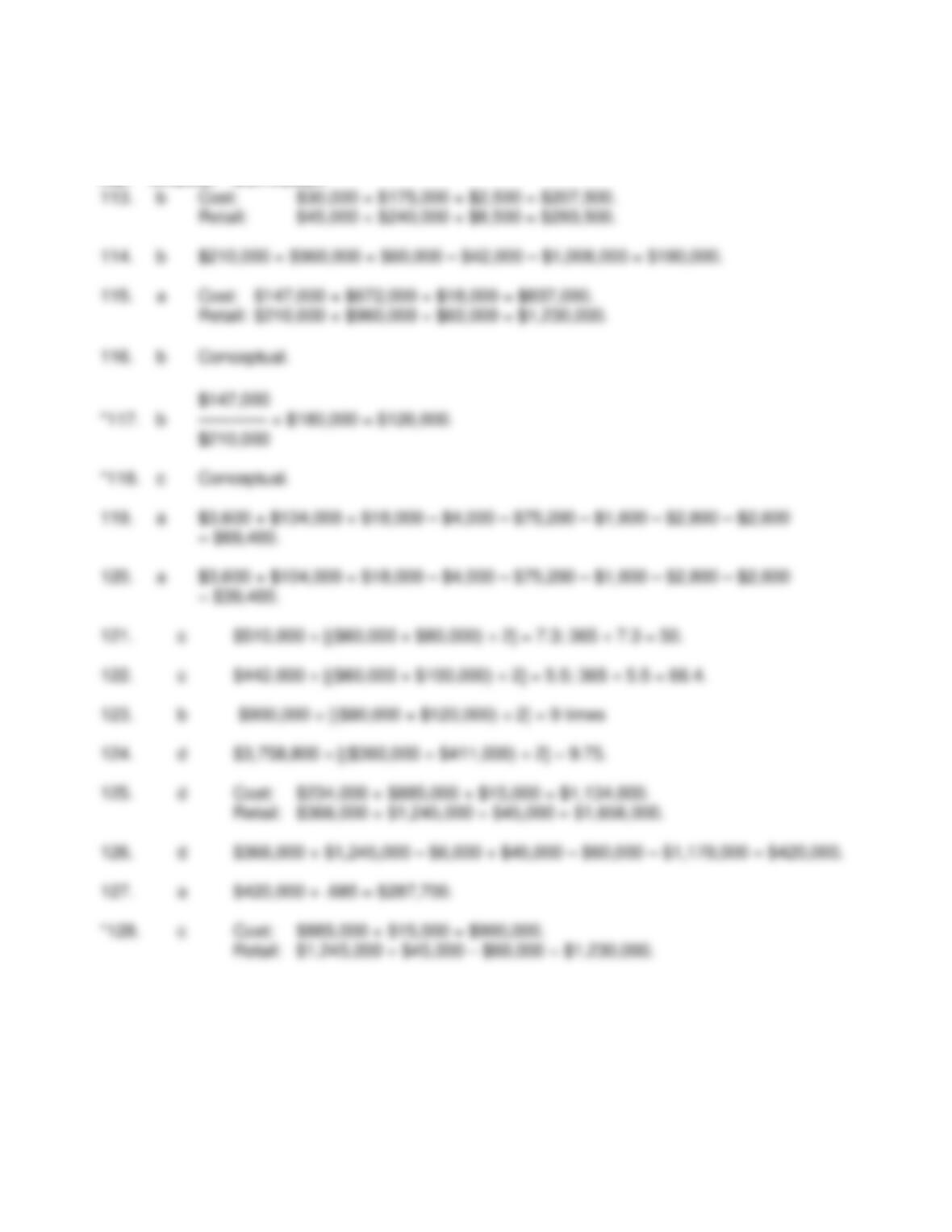
113. Crane Sales Company uses the retail inventory method to value its merchandise
inventory. The following information is available for the current year:
Cost Retail
Beginning inventory $ 30,000 $ 45,000
Purchases 175,000 240,000
Freight-in 2,500 —
Net markups — 8,500
Net markdowns — 10,000
Employee discounts — 1,000
Sales revenue — 205,000
If the ending inventory is to be valued at the lower-of-cost-or-market, what is the cost-to–
retail ratio?
a. $207,500 ÷ $285,000
b. $207,500 ÷ $293,500
c. $205,000 ÷ $295,000
d. $207,500 ÷ $283,500
Use the following information for questions 114 through 118.
The following data concerning the retail inventory method are taken from the financial records of
Welch Company.
Cost Retail
Beginning inventory $ 147,000 $ 210,000
Purchases 672,000 960,000
Freight-in 18,000 —
Net markups — 60,000
Net markdowns — 42,000
Sales — 1,008,000
114. The ending inventory at retail should be
a. $222,000.
b. $180,000.
c. $192,000.
d. $126,000.
115. If the ending inventory is to be valued at approximately the lower of cost or market, the
calculation of the cost-to-retail ratio should be based on goods available for sale at (1)
cost and (2) retail, respectively of
a. $837,000 and $1,230,000.
b. $837,000 and $1,188,000.
c. $837,000 and $1,170,000.
d. $819,000 and $1,170,000.
116. If the foregoing figures are verified and a count of the ending inventory reveals that
merchandise actually on hand amounts to $108,000 at retail, the business has
a. realized a windfall gain.
b. sustained a loss.
c. no gain or loss as there is close coincidence of the inventories.
d. none of these answer choices are correct.

Test Bank for Intermediate Accounting, Fifteenth Edition
9 – 28
*117. Assuming no change in the price level if the LIFO inventory method were used in
conjunction with the data, the ending inventory at cost would be
a. $127,800.
b. $126,000.
c. $122,400.
d. $129,600.
*118. Assuming that the LIFO inventory method were used in conjunction with the data and that
the inventory at retail had increased during the period, then the computation of retail in the
cost-to-retail ratio would
a. exclude both markups and markdowns and include beginning inventory.
b. include markups and exclude both markdowns and beginning inventory.
c. include both markups and markdowns and exclude beginning inventory.
d. exclude markups and include both markdowns and beginning inventory.
119. Drake Corporation had the following amounts, all at retail:
Beginning inventory $ 3,600 Purchases $140,000
Purchase returns 6,000 Net markups 18,000
Abnormal shortage 4,000 Net markdowns 2,800
Sales revenue 77,000 Sales returns 1,800
Employee discounts 1,600 Normal shortage 2,600
What is Drake’s ending inventory at retail?
a. $69,400.
b. $71,000.
c. $72,600.
d. $73,400
120. Goren Corporation had the following amounts, all at retail:
Beginning inventory $ 3,600 Purchases $110,000
Purchase returns 6,000 Net markups 18,000
Abnormal shortage 4,000 Net markdowns 2,800
Sales 77,000 Sales returns 1,800
Employee discounts 1,600 Normal shortage 2,600
What is Goren’s ending inventory at retail?
a. $39,400.
b. $41,000.
c. $42,600.
d. $43,400
121. Fry Corporation’s computation of cost of goods sold is:
Beginning inventory $ 60,000
Add: Cost of goods purchased 530,000
Cost of goods available for sale 590,000
Ending inventory 80,000
Cost of goods sold $510,000
The average days to sell inventory for Fry are
a. 42.9 days.
b. 43.5 days.
c. 50.0 days.
d. 57.0 days.

Inventories: Additional Valuation Issues
9 – 29
122. East Corporation’s computation of cost of goods sold is:
Beginning inventory $ 60,000
Add: Cost of goods purchased 482,000
Cost of goods available for sale 542,000
Ending inventory 100,000
Cost of goods sold $442,000
The average days to sell inventory for East are
a. 49.3 days.
b. 53.7 days.
c. 66.4 days.
d. 83.0 days.
123. The 2014 financial statements of Sito Company reported a beginning inventory of
$80,000, an ending inventory of $120,000, and cost of goods sold of $900,000 for the
year. Sito’s inventory turnover ratio for 2014 is
a. 11.3 times.
b. 9.0 times.
c. 7.5 times.
d. 6.5 times.
124. Boxer Inc. reported inventory at the beginning of the current year of $360,000 and at the
end of the current year of $411,000. If net sales for the current year are $4,429,200 and
the corresponding cost of sales totaled $3,758,800, what is the inventory turnover ratio for
the current year?
a. 11.48.
b. 9.15.
c. 10.44.
d. 9.75.
Use the following information for questions 125 through 129.
Plank Co. uses the retail inventory method. The following information is available for the current
year.
Cost Retail
Beginning inventory $ 234,000 $366,000
Purchases 885,000 1,245,000
Freight-in 15,000 —
Employee discounts — 6,000
Net markups — 45,000
Net markdowns — 60,000
Sales revenue — 1,170,000
125. If the ending inventory is to be valued at approximately lower of average cost or market,
the calculation of the cost ratio should be based on cost and retail of
a. $900,000 and $1,290,000.
b. $900,000 and $1,284,000.
c. $1,119,000 and $1,650,000.
d. $1,134,000 and $1,656,000.

Test Bank for Intermediate Accounting, Fifteenth Edition
9 – 30
126. The ending inventory at retail should be
a. $480,000.
b. $450,000.
c. $432,000.
d. $420,000.
127. The approximate cost of the ending inventory by the conventional retail method is
a. $287,700.
b. $284,760.
c. $294,000.
d. $307,440.
*128. If the ending inventory is to be valued at approximately LIFO cost, the calculation of the
cost ratio should be based on cost and retail amounts of
a. $1,134,000 and $1,656,000.
b. $1,134,000 and $1,596,000.
c. $900,000 and $1,230,000.
d. $900,000 and $1,290,000.
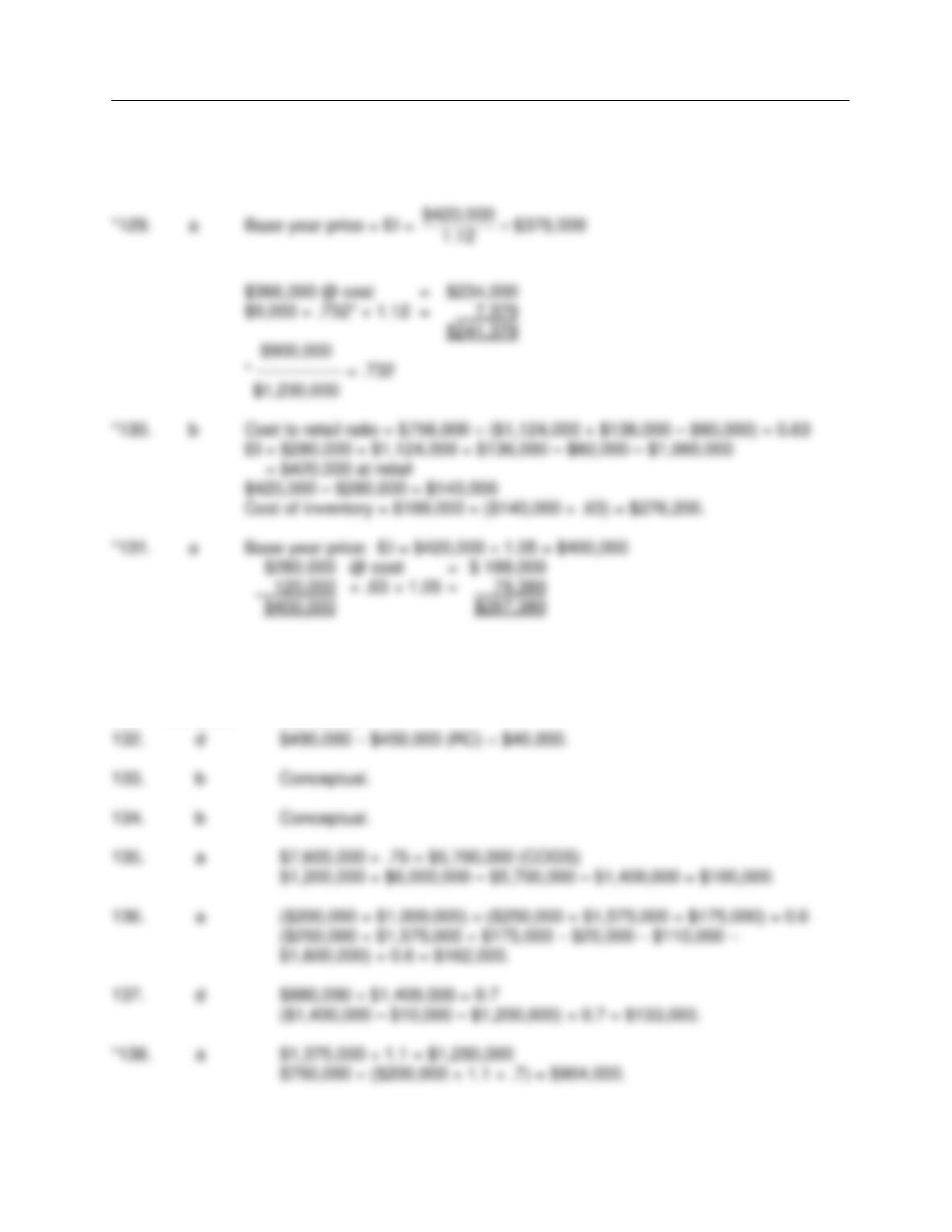
*129. Assuming that the LIFO inventory method is used, that the beginning inventory is the base
inventory when the index was 100, and that the index at year end is 112, the ending
inventory at dollar-value LIFO retail cost is
a. $241,379.
b. $278,271.
c. $287,700.
d. $307,440.
Use the following information for questions 130 and 131.
Eaton Company, which uses the retail LIFO method to determine inventory cost, has provided the
following information for 2014:
Cost Retail
Inventory, 1/1/14 $ 188,000 $280,000
Net purchases 756,000 1,124,000
Net markups 136,000
Net markdowns 60,000
Net sales 1,060,000
*130. Assuming stable prices (no change in the price index during 2014), what is the cost of
Eaton’s inventory at December 31, 2014?
a. $256,200.
b. $276,200.
c. $272,000.
d. $264,600.
*131. Assuming that the price index was 105 at December 31, 2014 and 100 at January 1, 2014,
what is the cost of Eaton’s inventory at December 31, 2014 under the dollar-value-LIFO
retail method?
a. $267,380.
b. $277,830.
c. $280,610.
d. $263,600.
Inventories: Additional Valuation Issues
9 – 31
Multiple Choice Answers—Computational
Item
Ans.
Item
Ans.
Item
Ans.
Item
Ans.
Item
Ans.
Item
Ans.
Item
Ans
MULTIPLE CHOICE—CPA Adapted
132. Ryan Distribution Co. has determined its December 31, 2014 inventory on a FIFO basis at
$490,000. Information pertaining to that inventory follows:
Estimated selling price $510,000
Estimated cost of disposal 20,000
Normal profit margin 60,000
Current replacement cost 450,000
Ryan records losses that result from applying the lower-of-cost-or-market rule. At December
31, 2014, the loss that Ryan should recognize is
a. $0.
b. $10,000.
c. $20,000.
d. $40,000.
133. Under the lower-of-cost-or-market method, the replacement cost of an inventory item
would be used as the designated market value
a. when it is below the net realizable value less the normal profit margin.
b. when it is below the net realizable value and above the net realizable value less the
normal profit margin.
c. when it is above the net realizable value.
d. regardless of net realizable value.
134. The original cost of an inventory item is above the replacement cost and the net realizable
value. The replacement cost is below the net realizable value less the normal profit
margin. As a result, under the lower-of-cost-or-market method, the inventory item should
be reported at the
a. net realizable value.
b. net realizable value less the normal profit margin.
c. replacement cost.
d. original cost.

Test Bank for Intermediate Accounting, Fifteenth Edition
9 – 32
135. Keen Company‘s accounting records indicated the following information:
Inventory, 1/1/14 $ 1,200,000
Purchases during 2014 6,000,000
Sales during 2014 7,600,000
A physical inventory taken on December 31, 2014, resulted in an ending inventory of
$1,400,000. Keen’s gross profit on sales has remained constant at 25% in recent years.
Keen suspects some inventory may have been taken by a new employee. At December
31, 2014, what is the estimated cost of missing inventory?
a. $100,000.
b. $300,000.
c. $400,000.
d. $500,000.
136. Henke Co. uses the retail inventory method to estimate its inventory for interim statement
purposes. Data relating to the computation of the inventory at July 31, 2014, are as
follows:
Cost Retail
Inventory, 2/1/14 $ 200,000 $ 250,000
Purchases 1,000,000 1,575,000
Markups, net 175,000
Sales 1,600,000
Estimated normal shoplifting losses 20,000
Markdowns, net 110,000
Under the lower-of-cost-or-market method, Henke’s estimated inventory at July 31, 2014
is
a. $162,000.
b. $174,000.
c. $186,000.
d. $270,000.
137. At December 31, 2014, the following information was available from Kohl Co.’s accounting
records:
Cost Retail
Inventory, 1/1/14 $147,000 $ 203,000
Purchases 833,000 1,155,000
Additional markups 42,000
Available for sale $980,000 $1,400,000
Sales for the year totaled $1,200,000. Markdowns amounted to $10,000. Under the lower–
of-cost-or-market method, Kohl’s inventory at December 31, 2014 was
a. $294,000.
b. $147,000.
c. $140,000.
d. $133,000.
Inventories: Additional Valuation Issues
9 – 33
*138. On December 31, 2014, Pacer Co. adopted the dollar-value LIFO retail inventory method.
Inventory data for 2015 are as follows:
LIFO Cost Retail
Inventory, 12/31/14 $750,000 $1,050,000
Inventory, 12/31/15 ? 1,375,000
Increase in price level for 2015 10%
Cost to retail ratio for 2015 70%
Under the LIFO retail method, Pacer’s inventory at December 31, 2015, should be
a. $904,000.
b. $962,500.
c. $977,500.
d $1,000,250.
Multiple Choice Answers—CPA Adapted
Item
Ans.
Item
Ans.
Item
Ans.
Item
Ans.
Item
Ans.
Item
Ans.
Item
Ans.
DERIVATIONS — Computational
No. Answer Derivation
Test Bank for Intermediate Accounting, Fifteenth Edition
9 – 34
Inventories: Additional Valuation Issues
9 – 35
DERIVATIONS — Computational (cont.)
No. Answer Derivation
Test Bank for Intermediate Accounting, Fifteenth Edition
9 – 36
DERIVATIONS — Computational (cont.)
No. Answer Derivation
Inventories: Additional Valuation Issues
9 – 37
DERIVATIONS — Computational (cont.)
No. Answer Derivation
DERIVATIONS — CPA Adapted
No. Answer Derivation