79) A bottle of an alcoholic beverage is labelled as “60 proof.” The percentage of ethanol by volume in this
alcoholic beverage is
A) 15%.
B) 30%.
C) 60%.
D) 20%.
80) A bottle contains 5% ethanol. What is the proof of alcohol in this bottle?
A) 2.5
B) 5
C) 10
D) 1.7
81) Excessive ingestion of ethanol over a long period may cause which of the following?
A) physiological addiction
B) memory loss
C) deterioration of the liver
D) all of the above
82) Ethanol acts as a mild
A) stimulant.
B) depressant.
C) hallucinogen.
D) narcotic.
83) Rubbing alcohol contains
A) ethanol.
B) isopropyl alcohol.
C) n-propyl alcohol.
D) methanol.
84) Which substance causes fetal alcohol syndrome?
A) CH3OH
B) CH3CH2OH
C) CH3CHOHCH3
D) CH3OCH3
85) Citronellol, C10H19OH, is a constituent of rose and germanium oils. It is used in perfumery.
Chemically, citronellol is an
A) alcohol.
B) acid.
C) alkane.
D) amine.
86) A homologous series of alcohols contains
A) the same number of carbon atoms, but a different number of hydroxyl groups.
B) the same number of carbon atoms and the same number of hydroxyl groups.
C) a different number of carbon atoms, but the same number of hydroxyl groups.
D) only isomers.
87) The main ingredient in most antifreezes is
A) ethanol.
B) ethylene glycol.
C) glycerol.
D) gasoline.
88) Glycerol is an alcohol with ________ hydroxyl groups
A) one
B) two
C) three
D) four
89) Which of the following statements about industrial grade ethanol and the ethanol used in alcoholic
beverages is NOT correct?
A) Industrial grade ethanol is made by reacting ethylene with water, while ethanol used in beverages is
made by fermentation.
B) Industrial grade ethanol carries no federal excise tax, while ethanol used in beverages is taxed.
C) Industrial grade ethanol and ethanol used in beverages have different molecular structures.
D) Noxious substances are added to industrial grade ethanol so it is not safe to drink.
90) All of the following contain more than one hydroxyl group EXCEPT
A) ethylene glycol.
B) glycerol.
C) methanol.
D) propylene glycol.
91) Compounds with a hydroxyl group attached directly to a benzene ring are called
A) alcohols.
B) aromatic hydrocarbons.
C) ethers.
D) phenols.
92) CH3CH2OCH3 is called
A) ethyl propyl ether.
B) ethyl methyl ether.
C) butyl propyl ether.
D) dimethyl ether.
93) A phenol has a(n) ________ group attached to a benzene ring.
A) amino
B) carbonyl
C) carboxyl
D) hydroxyl
94) Phenol, sometimes called carbolic acid, was the first
A) anesthetic.
B) antiseptic.
C) insecticide.
D) analgesic.
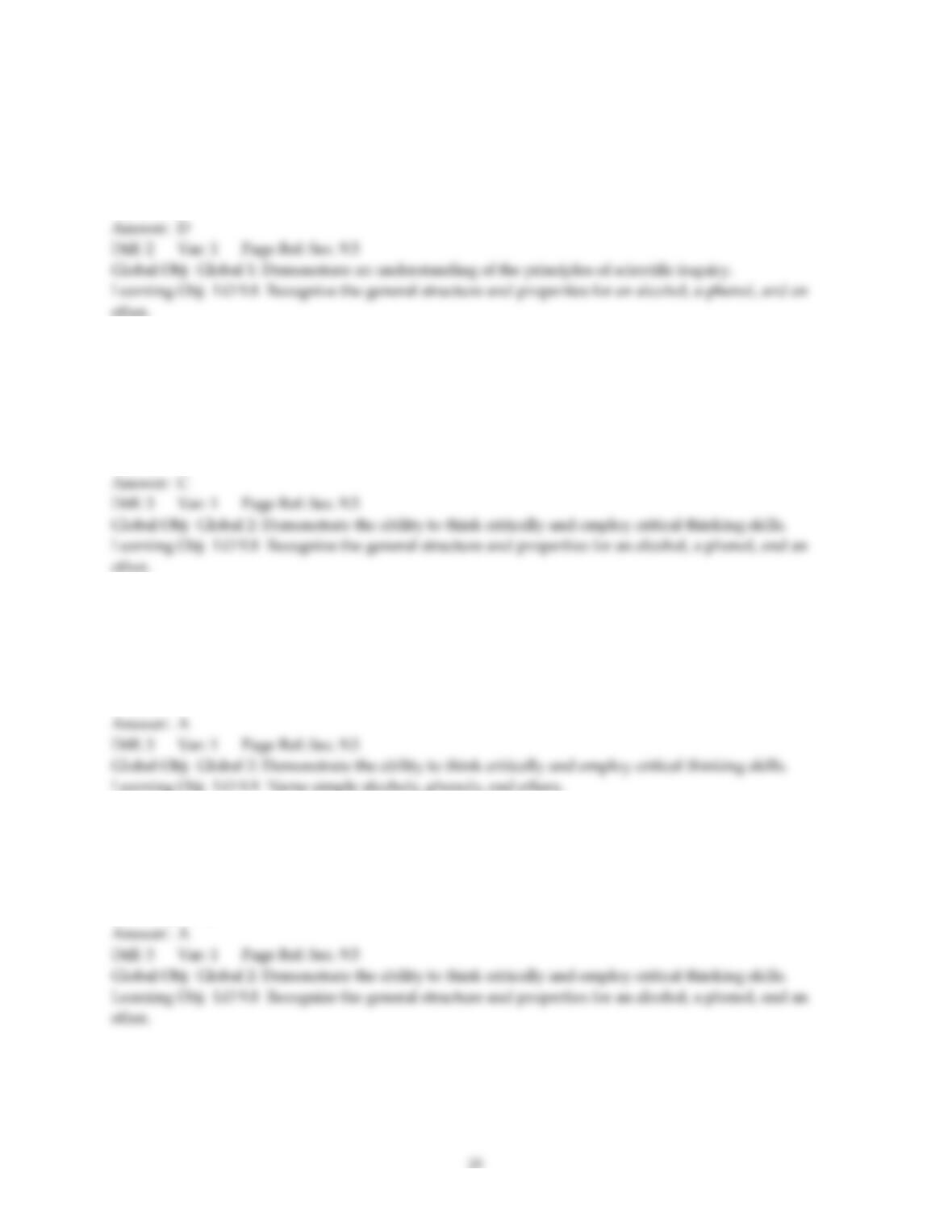
95) Compounds that have two alkyl groups attached to an oxygen atom are called
A) alcohols.
B) phenols.
C) esters.
D) ethers.
96) Methyl tert-butyl ether (MTBE, CH3OC(CH3)3) has been used as a gasoline additive. MTBE is an
example of an ether with the general structure
A) ROR.
B) ROH.
C) ROR’.
D) R’OH.
97) Diethyl ether is the most important of the ethers. It has the structure of
A) CH3CH2OCH2CH3.
B) CH3CH2OH.
C) CH3CH2OCH3.
D) (CH3)2CHOH.
98) The smallest cyclic ether is called
A) ethylene oxide.
B) ethylene glycol.
C) ethanol.
D) diethyl ether.
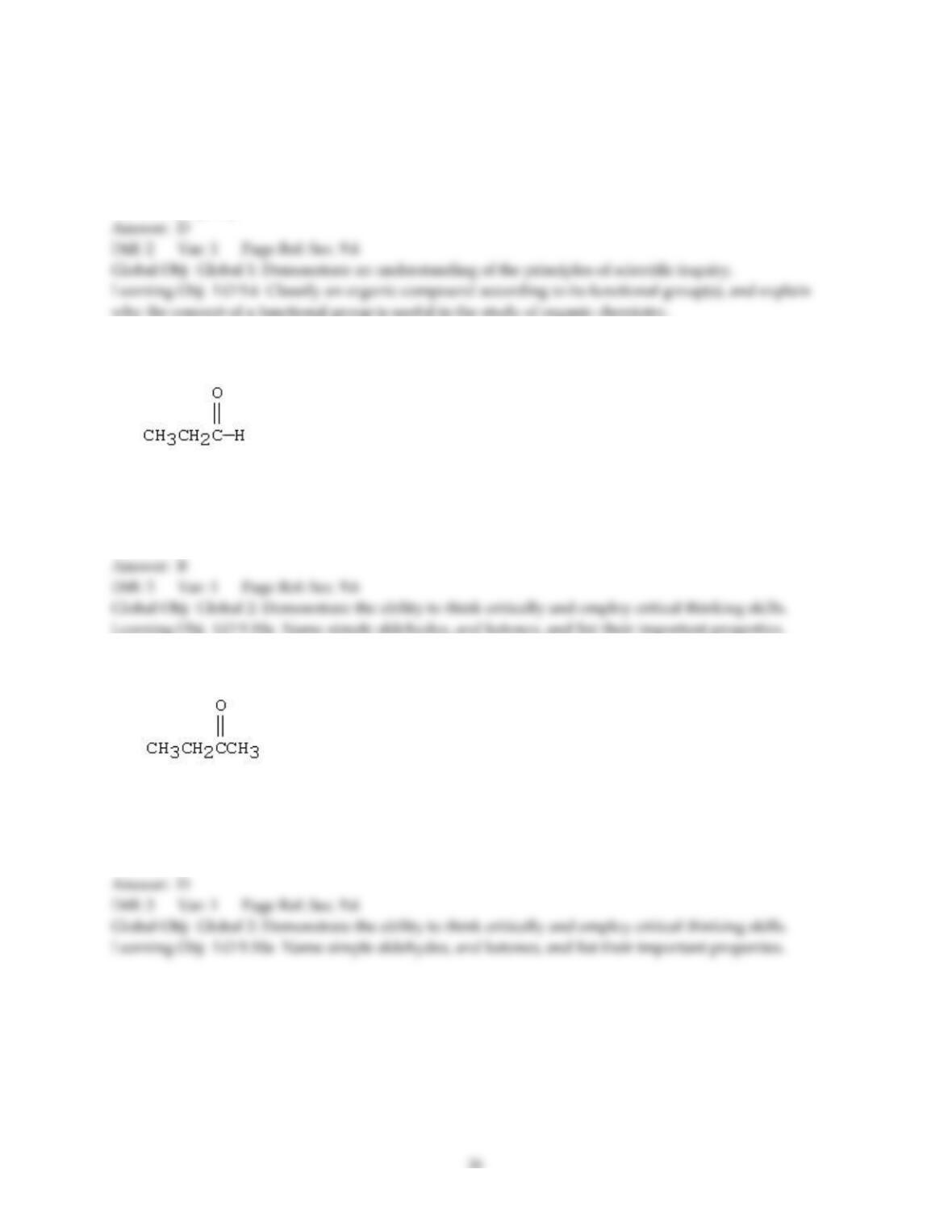
99) Aldehydes and ketones share a common functional group. The group is the
A) hydroxyl group.
B) phenol group.
C) ether group.
D) carbonyl group.
100) The compound below is a(n)
A) carboxylic acid.
B) aldehyde.
C) ketone.
D) alcohol.
101) The compound below is a(n)
A) alcohol.
B) aldehyde.
C) carboxylic acid.
D) ketone.
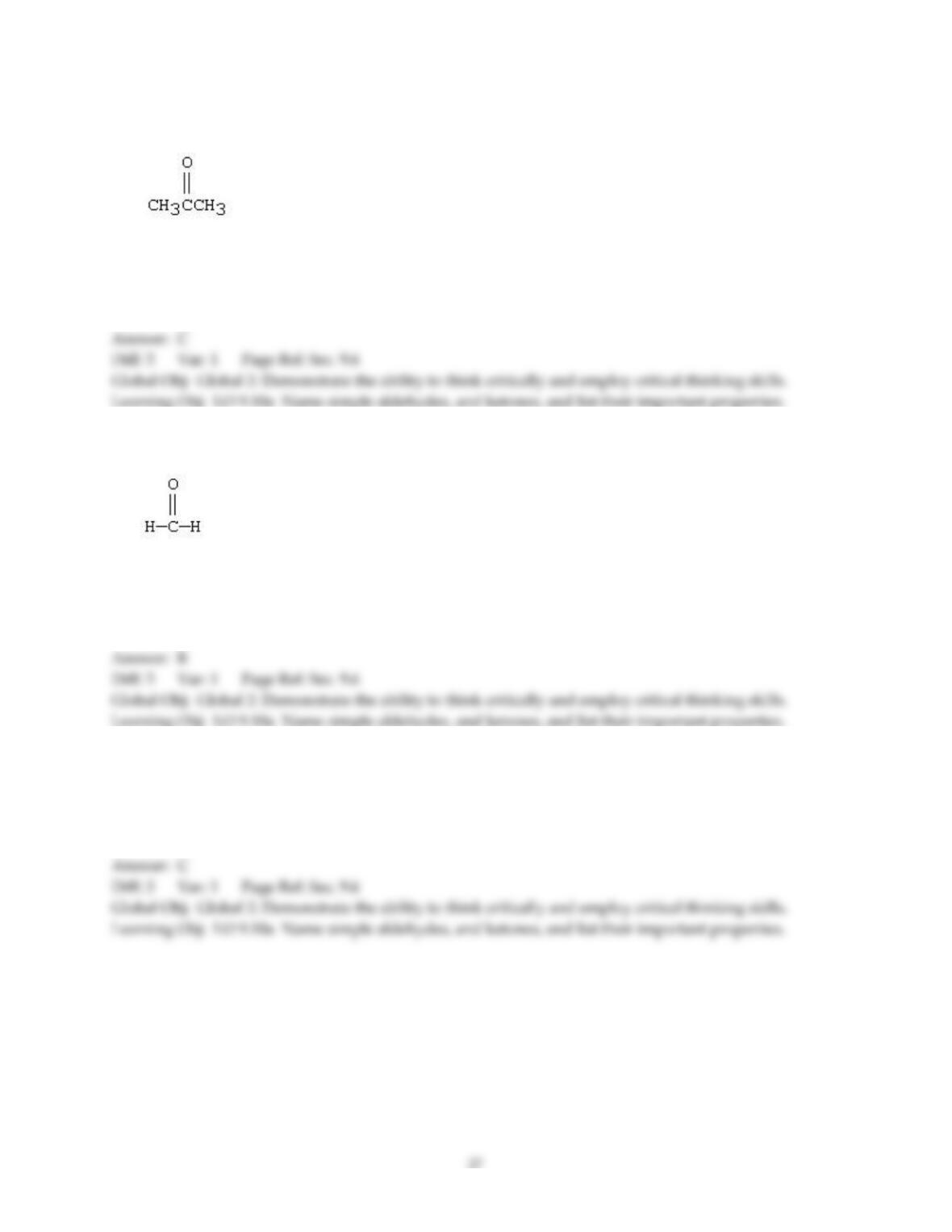
102) The compound below is a(n)
A) carboxylic acid.
B) aldehyde.
C) ketone.
D) alcohol.
103) The compound below is called
A) acetone.
B) formaldehyde.
C) formic acid.
D) methanol.
104) The general formula for a ketone is
A) ROR’.
B) RCOOH.
C) RCOR’.
D) RCOOR’.
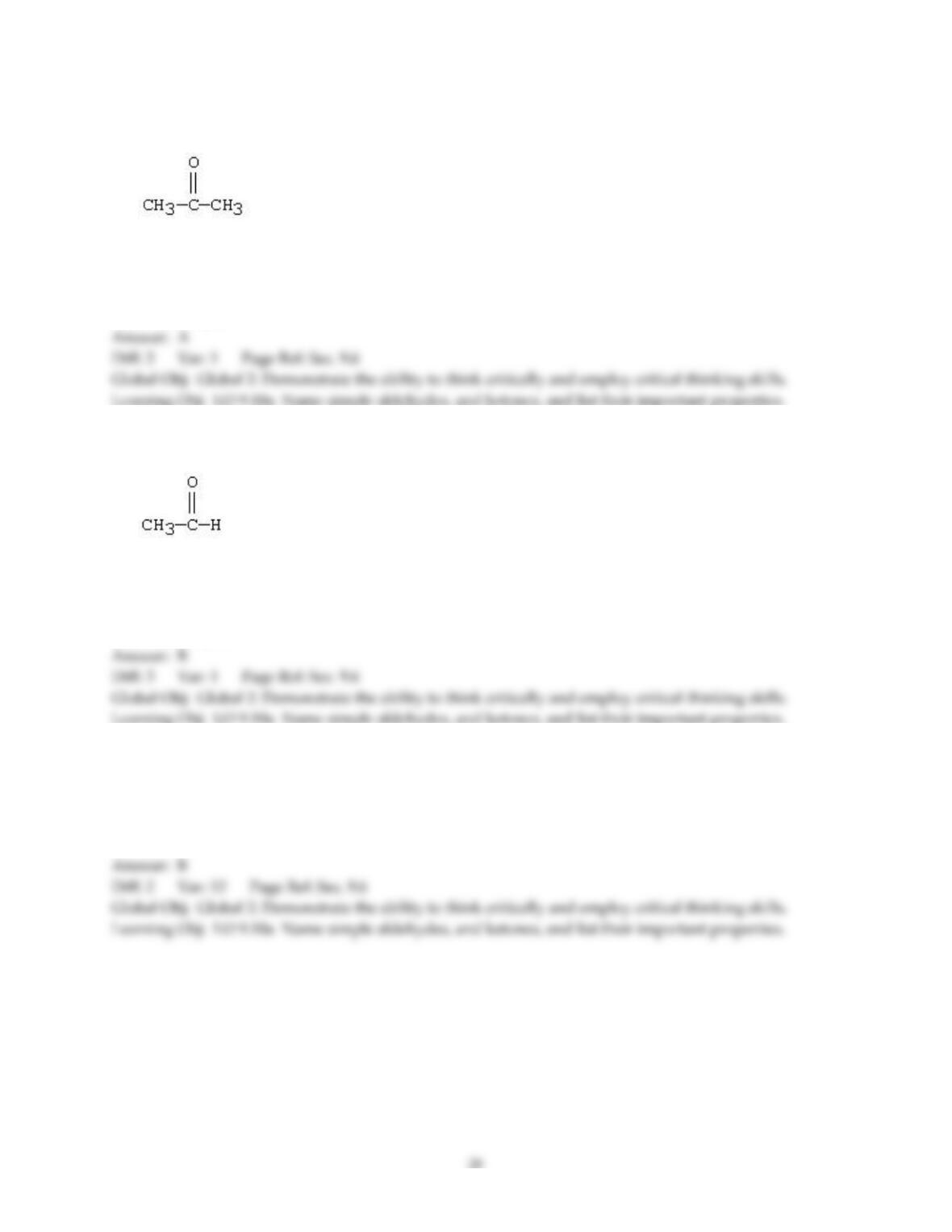
105) The compound below is commonly known as
A) acetone.
B) acetaldehyde.
C) benzaldehyde.
D) formaldehyde.
106) The compound below is commonly known as
A) acetone.
B) acetaldehyde.
C) benzaldehyde.
D) formaldehyde.
107) The simplest aldehyde is
A) acetone.
B) formaldehyde.
C) propionaldehyde.
D) methanol.
108) Esters have been widely used as
A) refrigerants.
B) insecticides.
C) fragrances.
D) disinfectants.
109) The functional group of the organic acids is the
A) hydroxyl group.
B) amine group.
C) carbonyl group.
D) carboxyl group.
110) When a bee stings, one of the compounds it injects is
A) acetic acid.
B) butyric acid.
C) formic acid.
D) hydrochloric acid.
111) One of the primary ingredients in vinegar is
A) ethanoic acid.
B) propanoic acid.
C) formic acid.
D) hydrochloric acid.
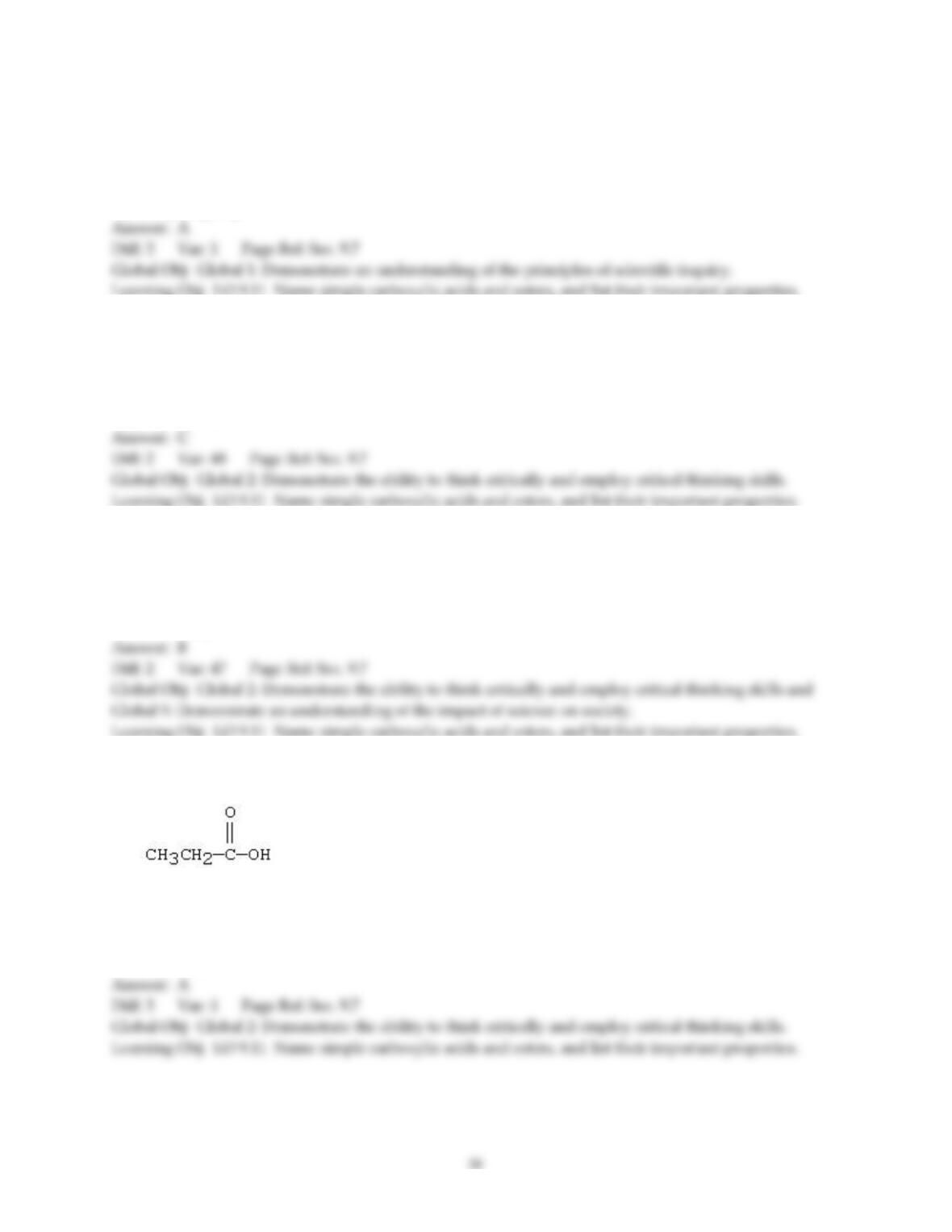
112) The -COOH group represents the
A) carboxyl group.
B) carbonyl group.
C) alcohol group.
D) aldehyde group.
113) The simplest carboxylic acid is commonly known as
A) ethanoic acid.
B) butyric acid.
C) methanoic acid.
D) propionicacid.
114) One of the compounds that is present in rancid butter and body odor is
A) acetic acid.
B) butanoic acid.
C) benzaldehyde.
D) formaldehyde.
115) The compound below is called
A) propanoic acid.
B) ethanoic acid.
C) formic acid.
D) acetic acid.
116) The salts of carboxylic acids, such as sodium benzoate, are often used in foods as
A) flavor enhancers.
B) colorings.
C) sweeteners.
D) preservatives.
117) The general formula for a carboxylic acid is
A) ROR’.
B) RCOOH.
C) RCOR’.
D) RCOOR’.
118) Vinegar is a solution of ________ in water.
A) acetic acid
B) butyric acid
C) formic acid
D) propionic acid
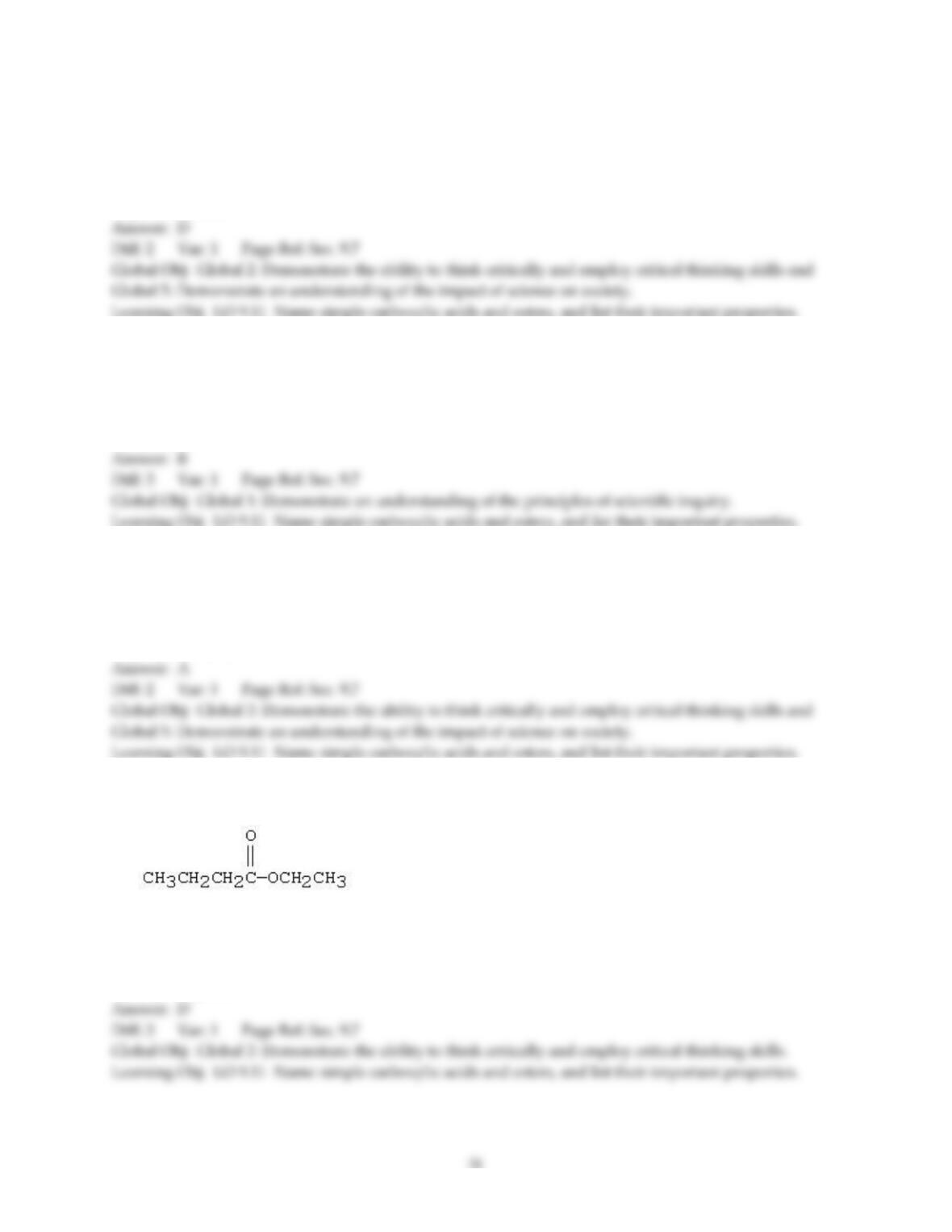
119) This compound is named
A) propyl ethanoate.
B) ethyl propanoate.
C) butyl ethanoate.
D) ethyl butyrate.
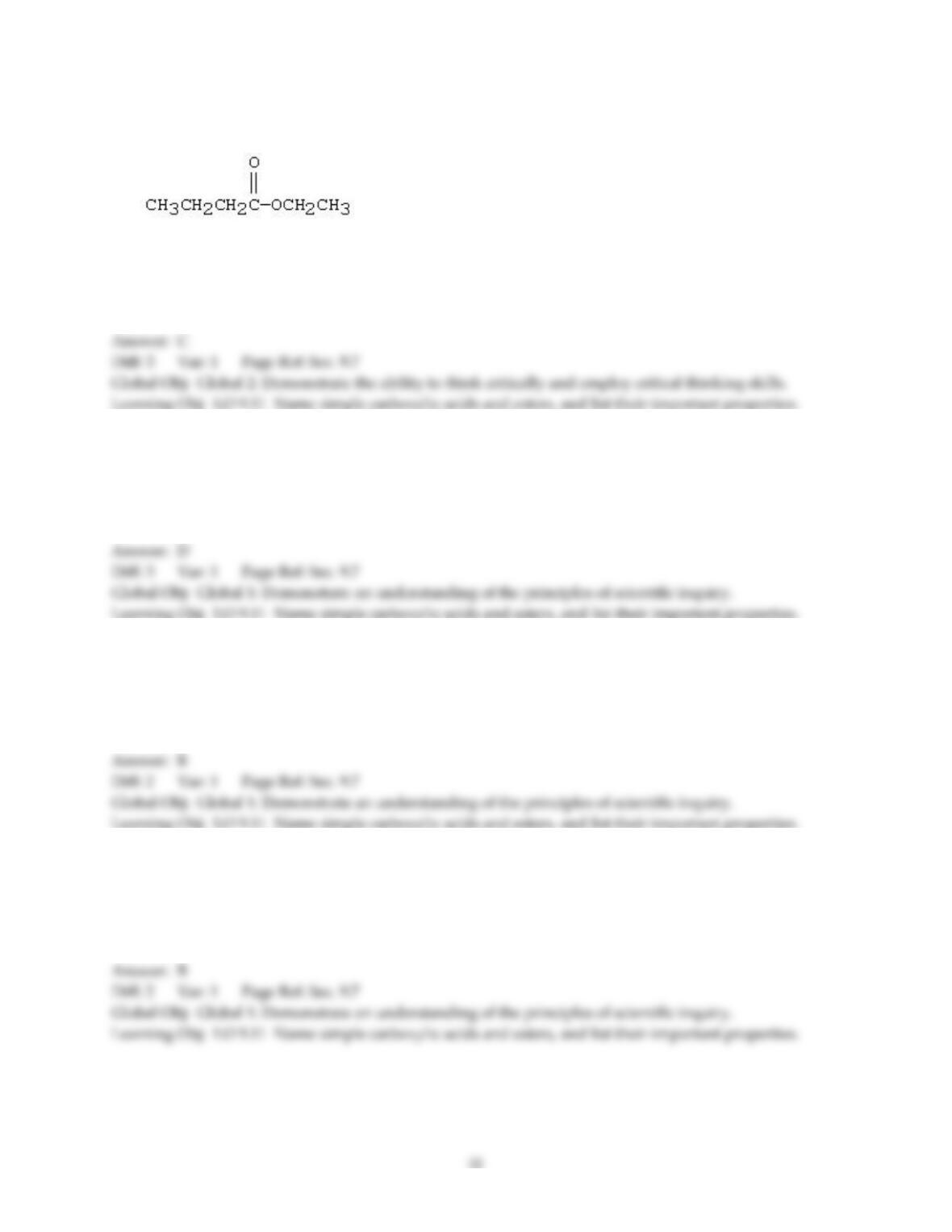
120) The compound below is classified as a(n)
A) aldehyde.
B) carboxylic acid.
C) ester.
D) ketone.
121) The general formula for an ester is
A) ROR’.
B) RCOOH.
C) RCOR’.
D) RCOOR’.
122) The compound formed by the reaction of a carboxylic acid with an alcohol is a(n)
A) aldehyde.
B) ester.
C) ether.
D) ketone.
123) Many of the flavors isolated from foods are
A) carboxylic acids.
B) esters.
C) alcohols.
D) ketones.