Exam
Name___________________________________
MULTIPLE CHOICE. Choose the one alternative that best completes the statement or answers the question.
Provide an appropriate response.
1)
Which one of the following does not define y as a function of x?
1)
A)
x y
1–6
3–3
1–3
6–9
B)
y =6x + 1
C)
{(3, –3), (6, –9), (9, 7)}
2)
Which one of the following is the graph of a function?
2)
A)
B)
C)
D)
SHORT ANSWER. Write the word or phrase that best completes each statement or answers the question.
3)
The equation y = x2 is satisfied by the points (2, 4) and (–2, 4). A horizontal line may be
drawn between these two points. Is y = x2 a function? Explain.
3)
Solve the problem.
4)
The table shows the percentage of seniors at a certain 4–year college who believed that
after graduating they would be able to find a job related to their field of study.
Year Percentage
2000 60.4
2002 58.6
2004 56.8
2006 54.6
2008 48.2
(a) Does the table define a function?
(b) What are the domain and range?
(c) Call this function f. Give two ordered pairs that belong to f.
4)
Write the formula using the “language” of variation.
5)
A = (1/2)bh, where A is the area of a triangle with base b and height h
5)
6)
I = PRT, where I is the simple interest on a principal of P dollars invested for T years at an
interest rate of R per year
6)
7)
C = 2r, where C is the circumference of a circle of radius r
7)
Provide an appropriate response.
8)
Consider an equation of direct variation y = kx. When x increases, does y increase or
decrease?
8)
Write the formula using the “language” of variation.
9)
V =r2h, where V is the volume of a cylinder of radius r and height h.
9)
10)
r = d/t, where r is the rate by which distance d is covered in time t
10)
Provide an appropriate response.
11)
Consider an equation of inverse variation y =k
x. When x increases, does y increase or
decrease?
11)
Write the formula using the “language” of variation.
12)
P = kNT/V, where P is the gas pressure of N molecules of a gas in a volume V at
temperature T
12)
Provide an appropriate response.
13)
The equation of a circle can be written in the form x2+ y2= r2. Is this a function? Explain.
13)
14)
Give a definition of Function.
14)
A relation in which, for each value of the first component
of the ordered pairs, there is exactly one value of the
15)
State whether the following situation represents direct variation, inverse variation, or
neither, and explain why: A runner’s speed in a race and the time that it takes to run the
race.
15)
Write the formula using the “language” of variation.
16)
P = nb, where P is the perimeter of a regular polygon with n sides each of length b.
16)
17)
f–stop = f/D, where f–stop is camera setting with a lens with focal length f and diaphragm
opening D
17)
Provide an appropriate response.
18)
State whether the following situation represents direct variation, inverse variation, or
neither, and explain why: The weight of a roast and the number of servings obtained from
it.
18)
Write the formula using the “language” of variation.
19)
A =r2, where A is the area of a circle of radius r.
19)
20)
f = mv2/r, where f is the centripetal force of an object of mass m moving along a circle of
radius r at velocity v
20)
MULTIPLE CHOICE. Choose the one alternative that best completes the statement or answers the question.
Decide whether the relation is a function.
21)
{(–1, 1), (2, 8), (6, –8), (9, 2), (10, –7)}
21)
A)
Function
B)
Not a function
Solve the problem.
22)
Suppose f(x) = mx + b is a mathematical model for actual time as a function of estimated time,
where f(x) represents actual time (in minutes), x represents estimated time (in minutes), and m and
b are constants. If m =2.6 and b = – 3, find f(x) when x is 60 minutes.
22)
A)
153 min
B)
67.8 min
C)
52.2 min
D)
159 min
23)
Find f(1) when f(x) = x2+ 2x + 3.
23)
A)
6
B)
–4
C)
2
D)
0
4
For the given pair of functions, find the requested function.
24)
f(x) =4x –2, g(x) = – 9x +9; (f – g)(x)
24)
A)
13x +11
B)
13x –11
C)
–5x2+11
D)
–5x – 7
Provide an appropriate response.
25)
If the ordered pair (3, 9) belongs to function g, then g( ) =.
25)
A)
3; 9
B)
y; 3
C)
9; 3
D)
x; 9
For the pair of functions, find the product (fg)(x).
26)
f(x) =4x +2, g(x) =x2+6x –7
26)
A)
x3–26x2–22x –17
B)
5x3+28x2+16x –13
C)
x2–10x +5
D)
4x3+26x2–16x –14
Determine whether the equation represents direct, inverse, joint, or combined variation.
27)
y =4x2
27)
A)
Joint
B)
Combined
C)
Direct
D)
Inverse
Solve the problem.
28)
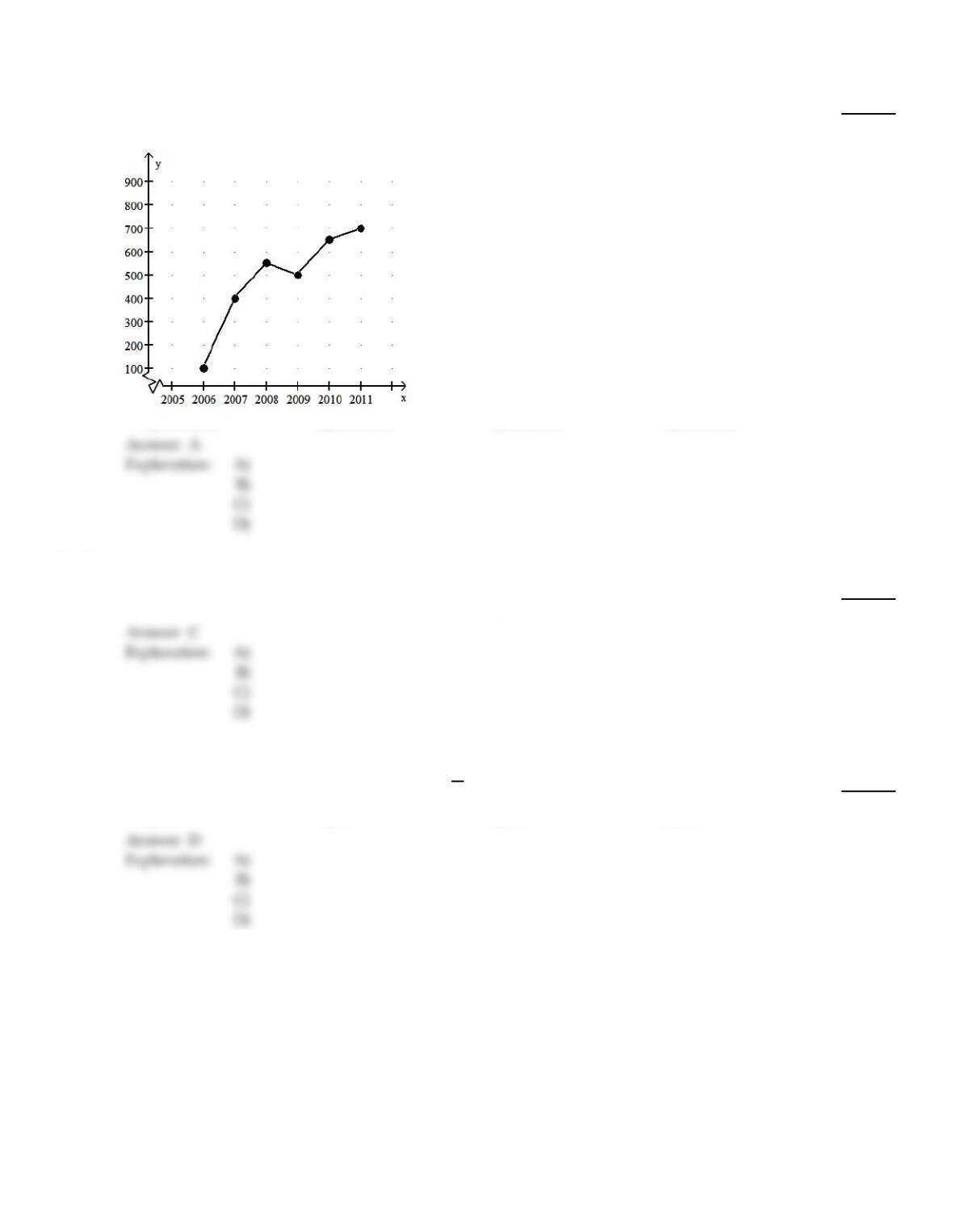
Crafty Bill’s Cool Car Sales opened as a used car sales lot in 2006. The graph shows the number of
cars sold as a function of time. What is the approximate number of cars sold in 2008?
28)
A)
550 cars
B)
500 cars
C)
350 cars
D)
400 cars
For the polynomial function, find the requested value.
29)
f(x) =4x5+ 4x4– 6x3–x2; f(–2)
29)
A)
–24
B)
9
C)
–20
D)
–25
Find the requested value.
30)
If p(x) =63x5–21x4+14x2 and q(x) =7x2, find ( p
q)(2).
30)
A)
64
B)
61
C)
32
D)
62
6
Evaluate the function.
31)
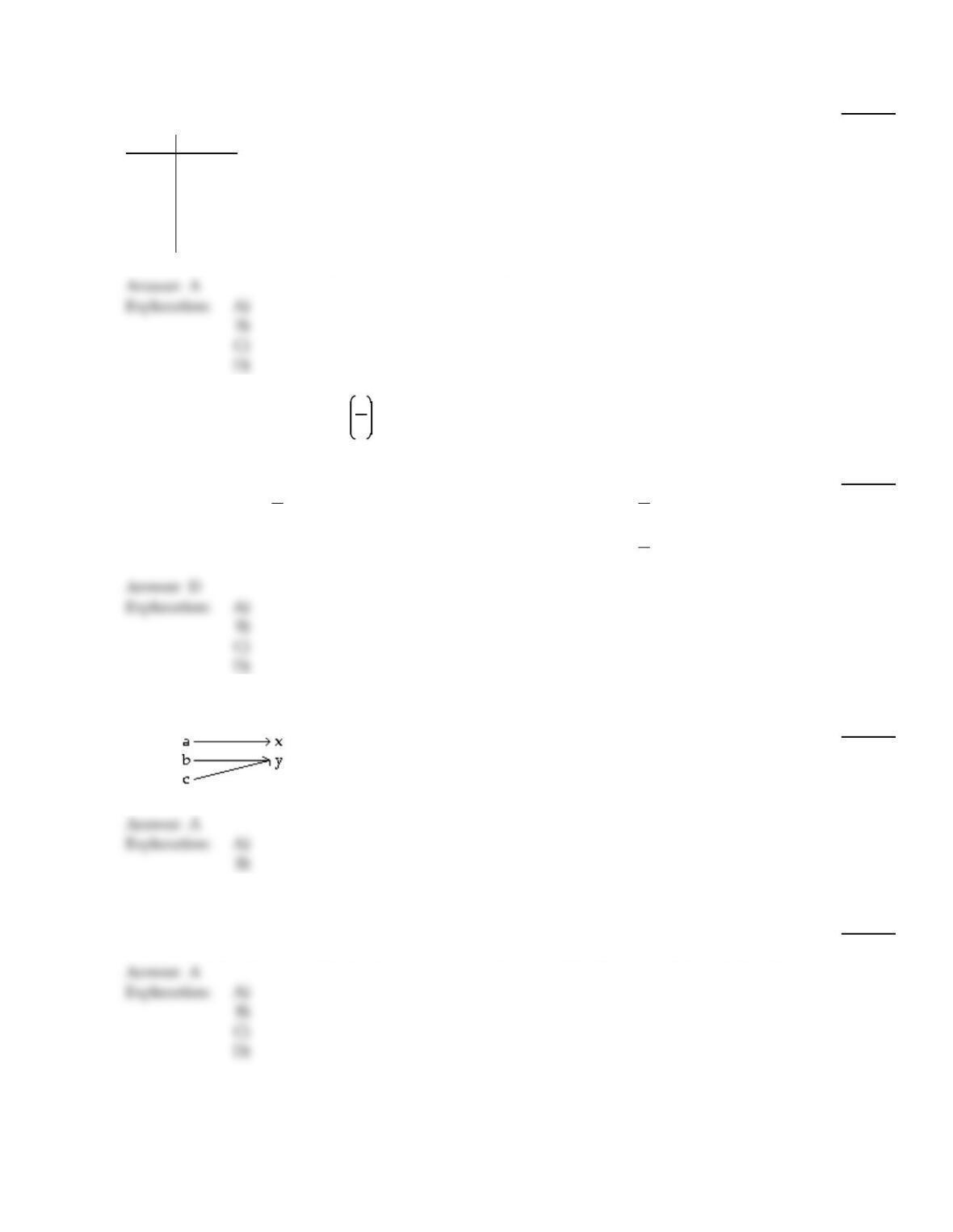
Find f(–2).
x y = f(x)
7 4
4 1
1–2
–2–5
–5–8
31)
A)
–5
B)
–2
C)
5
D)
1
For the pair of functions, find the quotient f
g(x) and give any x–values that are not in the domain of the quotient
function.
32)
f(x) = 64x3+ 8, g(x) = 4x + 2
32)
A)
4x2+ 8x + 4; x 1
2
B)
16x2+ 8x + 4; x –1
2
C)
18x2– 7x + 4; x –2
D)
16x2– 8x + 4; x –1
2
Decide whether the relation is a function.
33)
33)
A)
Function
B)
Not a function
For the pair of functions, find the product (fg)(x).
34)
f(x) =4x +4, g(x) =4x –7
34)
A)
16x2–12x –28
B)
4x2–24x –56
C)
16x2–44x +28
D)
8x2+11x –28
7
35)
f(x) =4x +4, g(x) = – 3x –8
35)
A)
–13x2–46x –34
B)
–10x2+44x –32
C)
12x2+44x –32
D)
–12x2–44x –32
Solve the problem.
36)
The intensity of a radio signal from the radio station varies inversely as the square of the distance
from the station. Suppose the the intensity is 8000 units at a distance of 2 miles. What will the
intensity be at a distance of 12 miles? Round your answer to the nearest unit.
36)
A)
186 units
B)
222 units
C)
205 units
D)
248 units
Decide whether the relation is a function.
37)
37)
A)
Function
B)
Not a function
For the polynomial function, find the requested value.
38)
f(x) = – 4x2+ 9x – 2; f(–2)
38)
A)
–12
B)
–46
C)
–40
D)
–36
Determine whether the relation defines y as a function of x. Give the domain.
39)
y =5
x +18
39)
A)
Not a function; domain: (–, )
B)
Not a function; domain: (–, –18) (–18, 0)
C)
Function; domain: (–, –18)(–18, )
D)
Function; domain: (–18, 18)
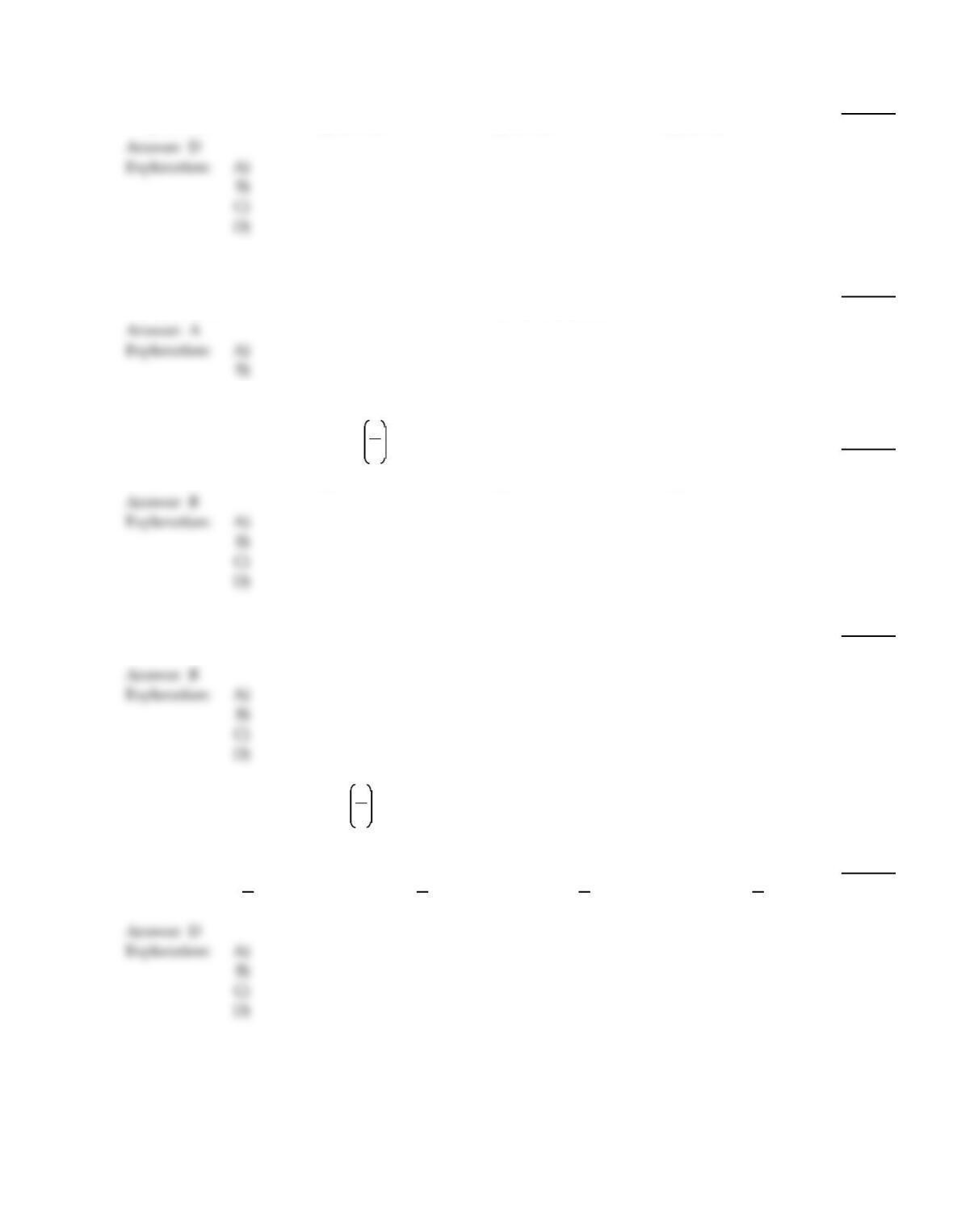
Find (f
g)(x) for the given functions f(x) and g(x).
40)
f(x) = x + 6 and g(x) = 8x – 4
40)
A)
7x + 10
B)
8x + 44
C)
9x + 2
D)
8x + 2
Decide whether the relation is a function.
41)
{(–4, –3), (–3, 9), (3, –5), (7, 5)}
41)
A)
Function
B)
Not a function
For the given pair of functions, find the requested function.
42)
f(x) = x2+ 6 x + 8 and g(x) = x + 2 ; f
g(x)
42)
A)
x2+ 4
B)
x + 4
C)
x – 6
D)
x3– 6
43)
f(x) =5x2– 4x + 6 and g(x) = x – 1; (f
g)(x)
43)
A)
5x2+ 26x + 7
B)
5x2– 14x + 15
C)
5x2– 14x + 7
D)
–14x2+ 5x + 15
For the pair of functions, find the quotient f
g(x) and give any x–values that are not in the domain of the quotient
function.
44)
f(x) = 10x2+ 3x – 18, g(x) = 5x – 6
44)
A)
2x – 3; x –6
5
B)
2x + 3; x –6
5
C)
2x – 3; x 6
5
D)
2x + 3; x 6
5
9
For the given pair of functions, find the requested function.
45)
f(x) =5x –3, g(x) = – 7x2–11x +9; (f + g)(x)
45)
A)
7x2– 2x –12
B)
–8x2–6x –6
C)
–7x2–6x +6
D)
–7x2+6x +6
D)
Graph the linear function. What is its domain and range?
46)
f(x) =2
3x –1
46)
A)
Domain: (–, ); range: (–, )
B)
Domain: (–, ); range: (–, )
C)
Domain: (–, ); range: (–, )
D)
Domain: (–, ); range: (–, )
Solve the problem.
47)
If f varies jointly as q2 and h, and f =96 when q =4 and h =3, find f when q =3 and h =2.
47)
A)
36
B)
18
C)
4
D)
12
Find the requested value.
48)
If p(x) =40x5–40x4+40x2 and q(x) =8x2, find ( p
q)(x).
48)
A)
5x3–5x2+5x
B)
5x3–6x2+8
C)
5x3–5x2+5
D)
5x2–5x +5
11
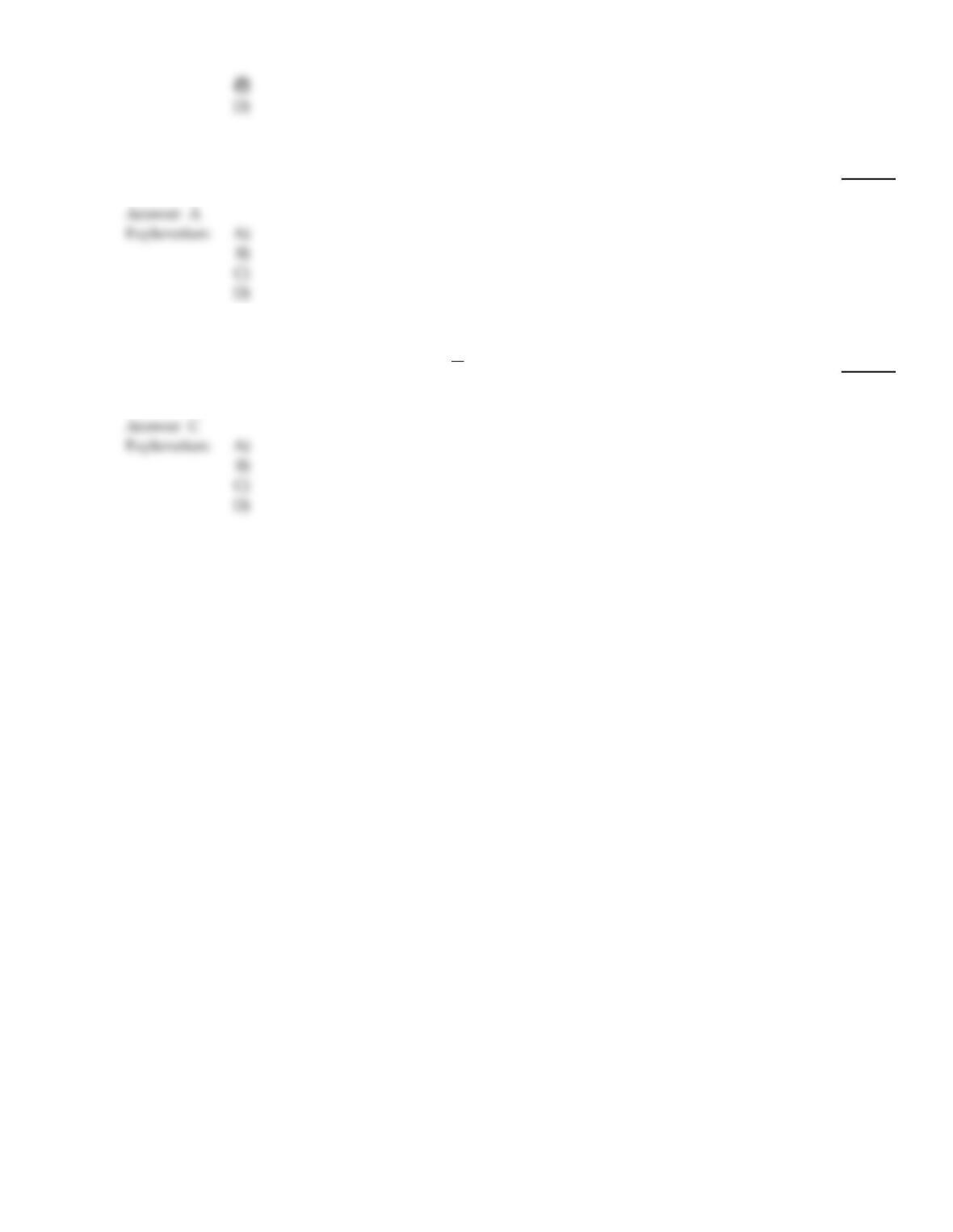
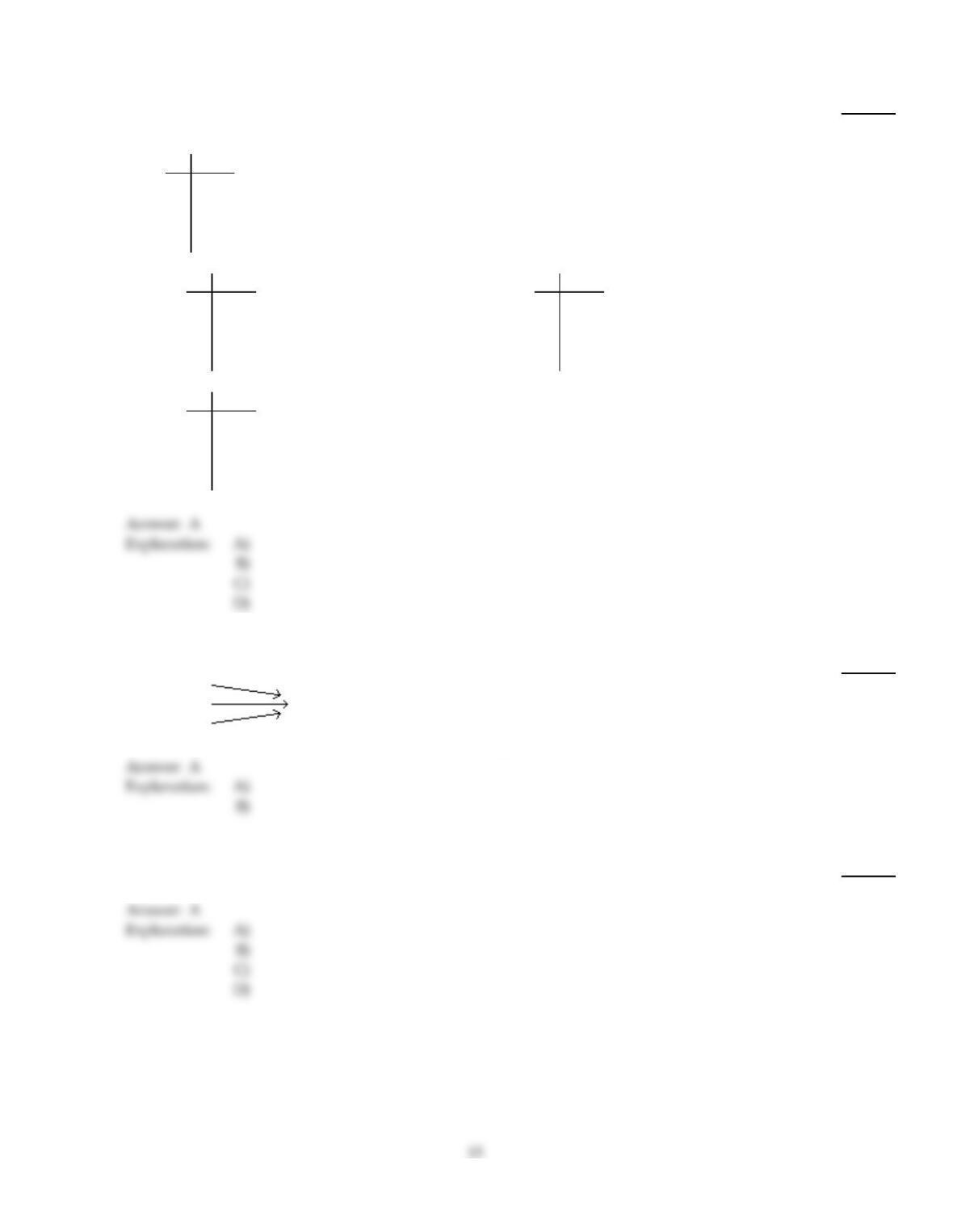
Graph the linear function. Give the domain and range.
49)
f(x) =1
3x – 6
49)
A)
Domain: (–, )
Range: (–, )
B)
Domain: (–, )
Range: (–, )
Solve the problem.
50)
Suppose all items in an ice cream truck cost $0.85 per item. (a) Fill in the table with the correct
response for the cost f(x) of purchasing x items. (b). Write the linear function that gives a rule for
finding the cost.
x f(x)
0
1
2
3
50)
A)
(a)
x f(x)
0 $0
1 $0.85
2 $1.70
3 $2.55
(b) f(x) =0.85x
B)
(a)
x f(x)
0 $0.85
1 $1.70
2 $2.55
3 $3.40
(b) f(x) =0.85x + 0.85
C)
(a)
x f(x)
0 $0
1 $0.85
2 $0.85
3 $0.85
(b) f(x) =0.85
D)
None of these
Decide whether the relation is a function.
51)
–11
2
–13
–13
51)
A)
Function
B)
Not a function
Solve the problem.
52)
If x varies inversely as v, and x =12 when v =4, find x when v =24.
52)
A)
2
B)
8
C)
16
D)
6
For the given pair of functions, find the requested function.
53)
f(x) =15x2+13x +5 and g(x) =9x2+7x – 7; (f – g)(x)
53)
A)
6x2– 6x – 12
B)
6x2+ 6x + 12
C)
6x4+ 6x2+ 12
D)
6x2+ 6x – 2
54)
f(x) =x2–6 and g(x) =4x +9; (f – g)(5)
54)
A)
–10
B)
–9
C)
–5
D)
–12
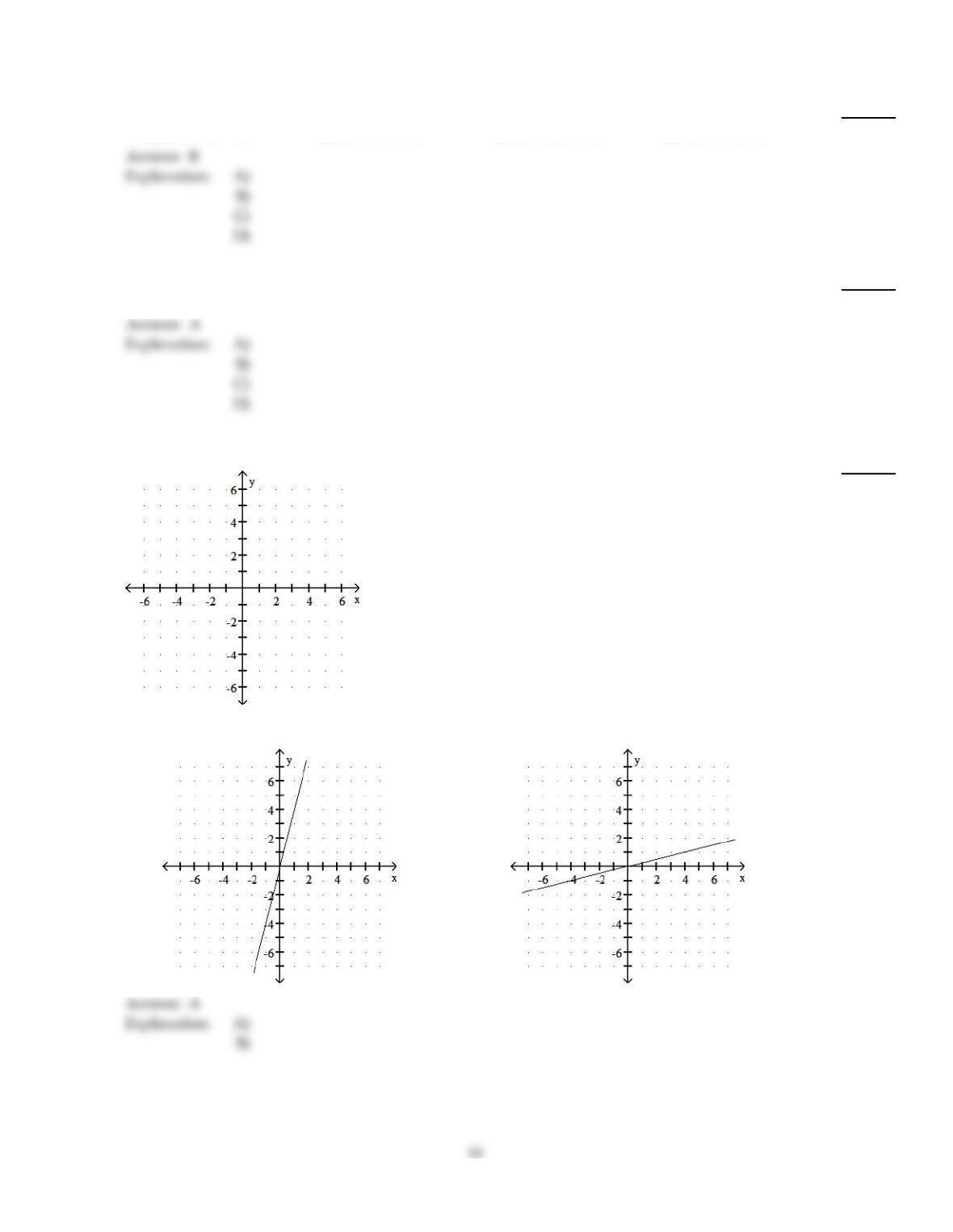
Graph the linear function. Give the domain and range.
55)
h(x) =4x
55)
A)
Domain: (–, )
Range: (–, )
B)
Domain: (–, )
Range: (–, )
Solve the problem.
56)
The distance it takes to stop a car varies directly as the square of the speed of the car. If it takes 112
feet for a car traveling at 40 miles per hour to stop, what distance is required for a speed of 51 miles
per hour?
56)
A)
182.07 ft
B)
182.41 ft
C)
156.06 ft
D)
194.37 ft
Give the domain and range of the relation shown in the following.
57)
{(1, 0), (–3, 1), (4, 7)}
57)
A)
Domain: {1, 4}; range: {0, 7}
B)
Domain: {0, 1, 7}; range: {1, –3, 4}
C)
Domain: {1, –3, 4}; range: {0, 1, 7}
D)
Domain: {1, –3, 4}; range: {7}
Find (f
g)(x) for the given functions f(x) and g(x).
58)
f(x) =5x + 8 and g(x) = – 2x + 6
58)
A)
–10x
B)
–10x + 38
C)
10x + 38
D)
–10x + 22
Decide whether the relation is a function.
59)
1
6
–15
–17
13
2
59)
A)
Function
B)
Not a function
60)
{(2, –9), (2, –2), (5, –9), (9, –8), (11, 1)}
60)
A)
Function
B)
Not a function
Determine whether the relation defines y as a function of x. Give the domain.
61)
y =x + 1
11
61)
A)
Not a function; domain (–, 11) (11, )
B)
Function; domain (–, –1) (–1, )
C)
Not a function; domain: (–,)
D)
Function; domain: (–,)
Decide whether the relation is a function.
62)
{(–6, 7), (–1, –2), (2, –2), (7, 8)}
62)
A)
Function
B)
Not a function
Solve the problem.
63)
Find g(a + 1) when g(x) =1
2x + 1.
63)
A)
1
2a – 2
B)
a + 3
2
C)
1
2a + 1
D)
a – 3
2
Find the requested value.
64)
If f(x) =3x +2 and g(x) =6x2–7x +1, find (fg)(x).
64)
A)
18x3– 9x2– 11x
B)
18x2–21x +5
C)
18x3– 9x2– 11x +2
D)
18x3+ 9x2– 11x +2
Find (f
g)(x) for the given functions f(x) and g(x).
65)
f(x) =5x – 7 and g(x) =6x – 4
65)
A)
12x – 11
B)
30x – 46
C)
30x – 27
D)
5x + 7
Find the requested value.
66)
If f(x) =2x +5 and g(x) =5x2–7x +3, find (fg)(–4).
66)
A)
227
B)
–685
C)
–348
D)
–333
Solve the problem.
67)
Find f(k – 1) when f(x) =3x2– 5x + 4.
67)
A)
3k2+ 7k + 2
B)
–11k2+ 3k + 12
C)
3k2– 11k + 12
D)
3k2– 11k + 2
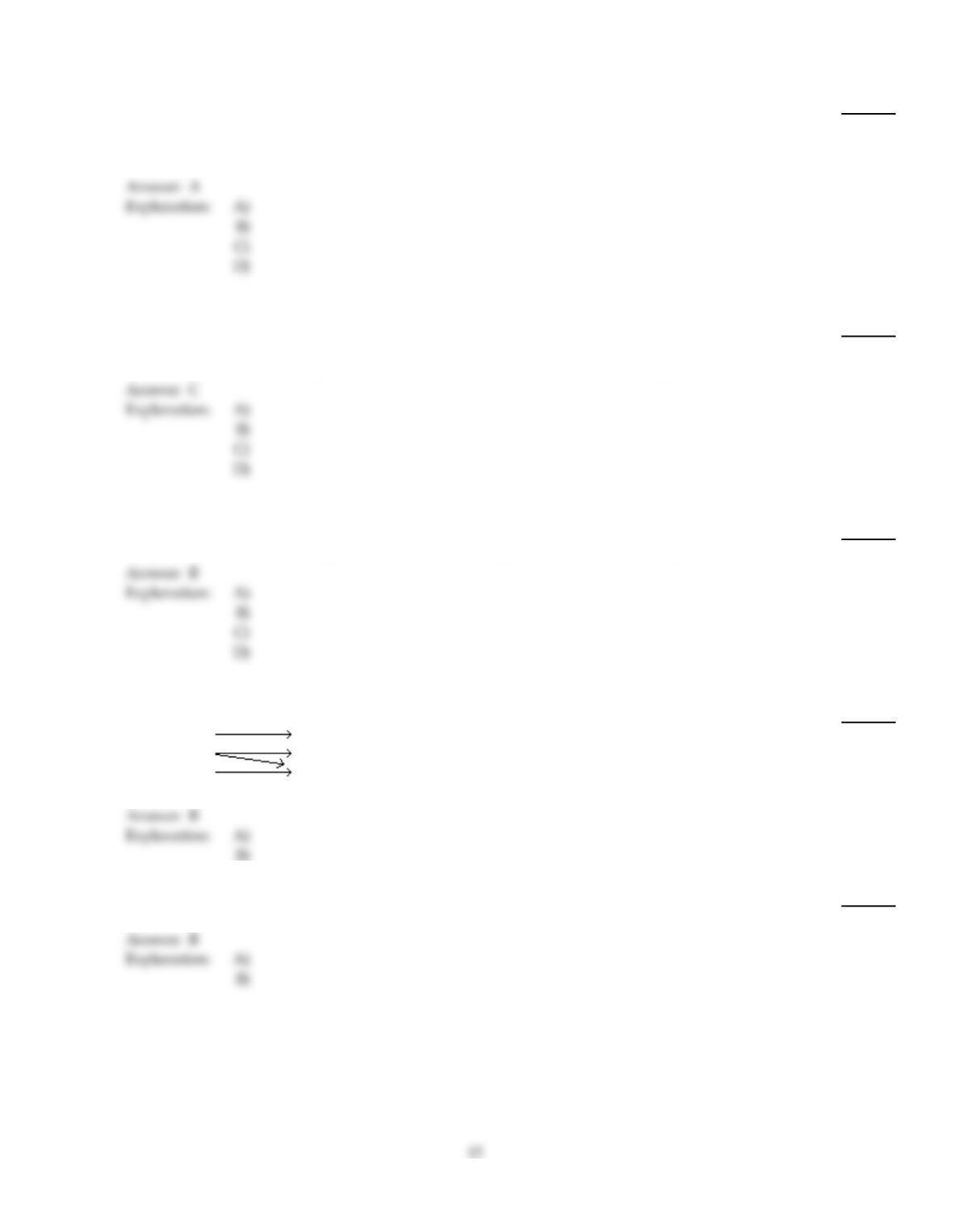
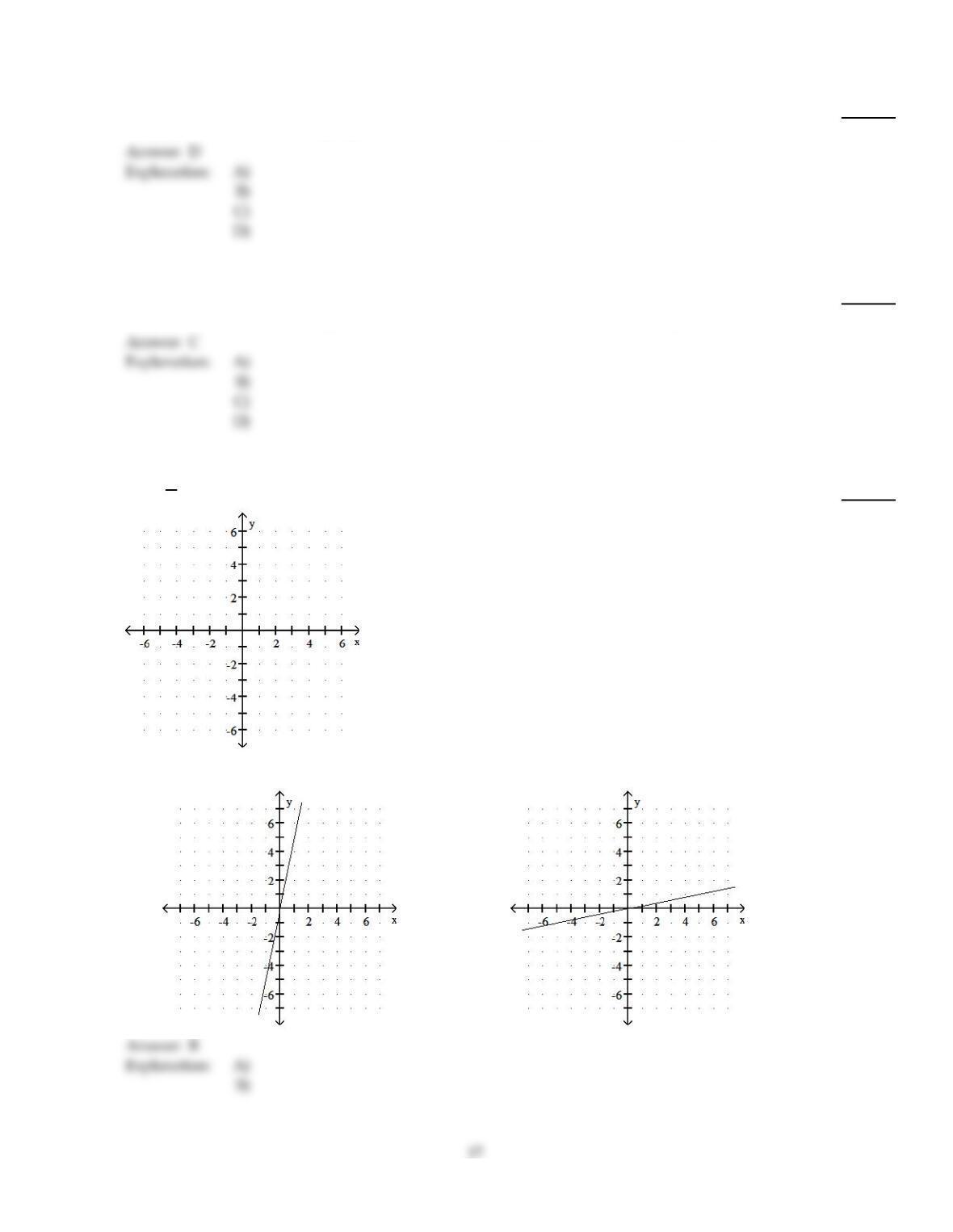
Graph the linear function. Give the domain and range.
68)
f(x) =1
5x
68)
A)
Domain: (–, )
Range: (–, )
B)
Domain: (–, )
Range: (–, )
For the pair of functions, find the quotient f
g(x) and give any x–values that are not in the domain of the quotient
function.
69)
f(x) =28x2+7x, g(x) =7x
69)
A)
4x + 1; x 7
B)
196x3+49x2; x 0
C)
4x2; x 7
D)
4x + 1; x 0
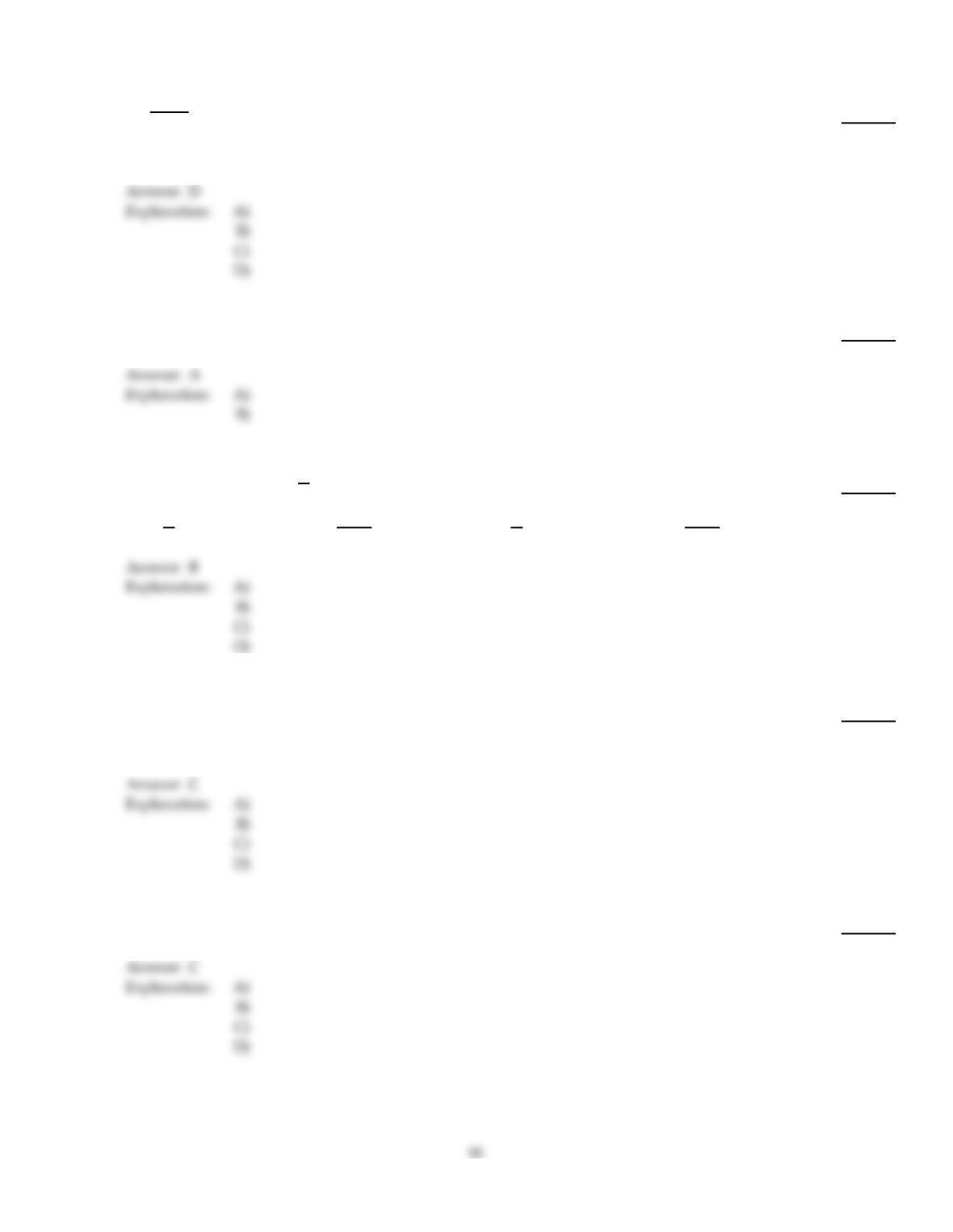
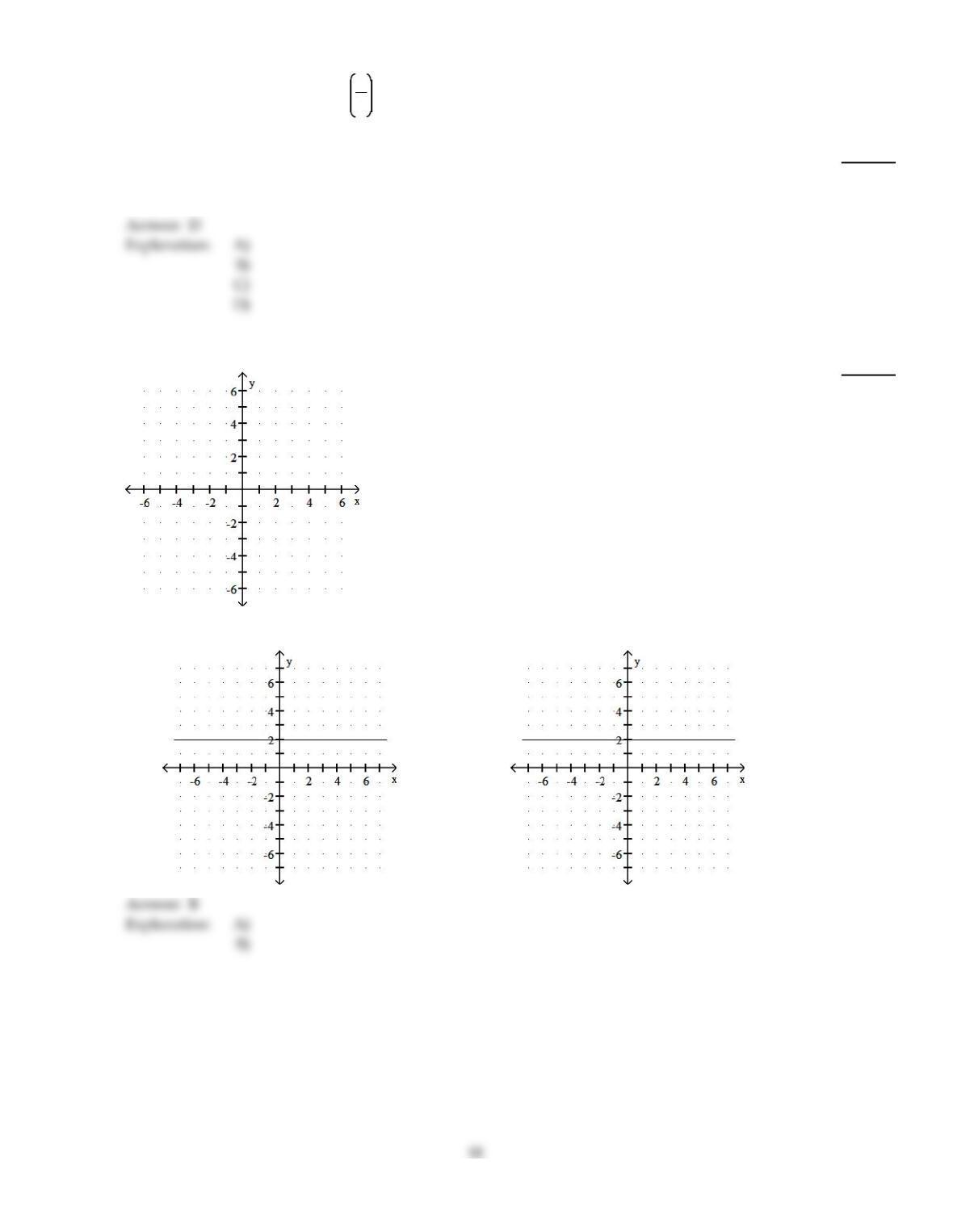
Graph the linear function. Give the domain and range.
70)
h(x) =2
70)
A)
Domain: {2}
Range: (–, )
B)
Domain: (–, )
Range: {2}
Answer the question.
71)
A balloon in the shape of a sphere is deflating. Given that t represents the time, in minutes, since it
began losing air, the radius of the balloon (in cm) is r(t) =19 – t. Let the equation V(r) =4
3r3
represent the volume of a sphere of radius r. Find and interpret (V
r)(t).
71)
A)
(V
r)(t) =19 –4
3(19 – t)3; this is the volume of the air lost by the balloon (in cm3) as a
function of time (in minutes).
B)
(V
r)(t) =4
3(19 – t)3; this is the volume of the air lost by the balloon (in cm3) as a function of
time (in minutes).
C)
(V
r)(t) =4
3(t –19)3; this is the volume of the balloon (in cm3) as a function of time (in
minutes).
D)
(V
r)(t) =4
3(19 – t)3; this is the volume of the balloon (in cm3) as a function of time (in
minutes).
Solve the problem.
72)
Find f( 1
3) if f(x) =4x2+ 6x – 3.
72)
A)
5
9
B)
–7
9
C)
7
9
D)
–5
9
Evaluate the function.
73)
Find f(3) if f = {(–2, 3), (3, 0), (0, 5), (5, –2)}
73)
A)
(0, –2)
B)
None of these
C)
0
D)
–2
Solve.
74)
Wind resistance or atmospheric drag tends to slow down moving objects. Atmospheric drag varies
jointly as an object’s surface area A and velocity v. If a car traveling at a speed of 60 mph with a
surface area of 36 ft2 experiences a drag of 367.2 N (Newtons), how fast must a car with 48 ft2 of
surface area travel in order to experience a drag force of 595.68 N?
74)
A)
75 mph
B)
78 mph
C)
70 mph
D)
73 mph
Evaluate the composition of functions.
75)
Let f(x) =x2+2 and g(x) =3x +6. Find (g
f)(5).
75)
A)
75
B)
443
C)
33
D)
87
Solve the problem.
76)
If f varies jointly as q2 and h, and f = – 36 when q =3 and h =2, find f when q =2 and h =6.
76)
A)
–8
B)
–24
C)
–12
D)
–48
77)
Find f(–1) when f(x) =3x2+ 5x – 4.
77)
A)
4
B)
2
C)
–8
D)
–6
For the polynomial function, find the requested value.
78)
f(x) =4x + 4; f(9)
78)
A)
40
B)
72
C)
32
D)
8
20