Exam
Name___________________________________
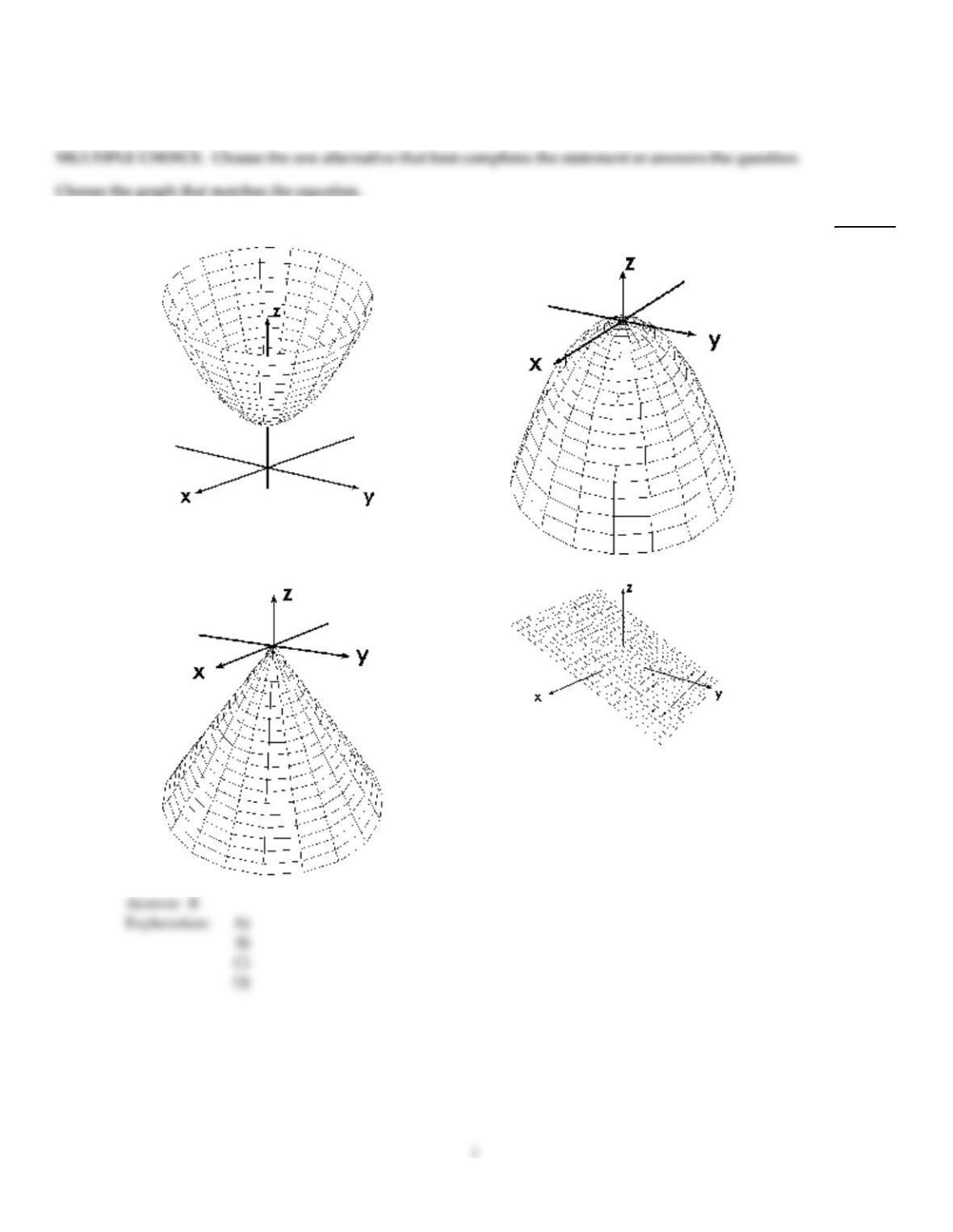
1)
z = – x2–y2
1)
A)
B)
C)
D)
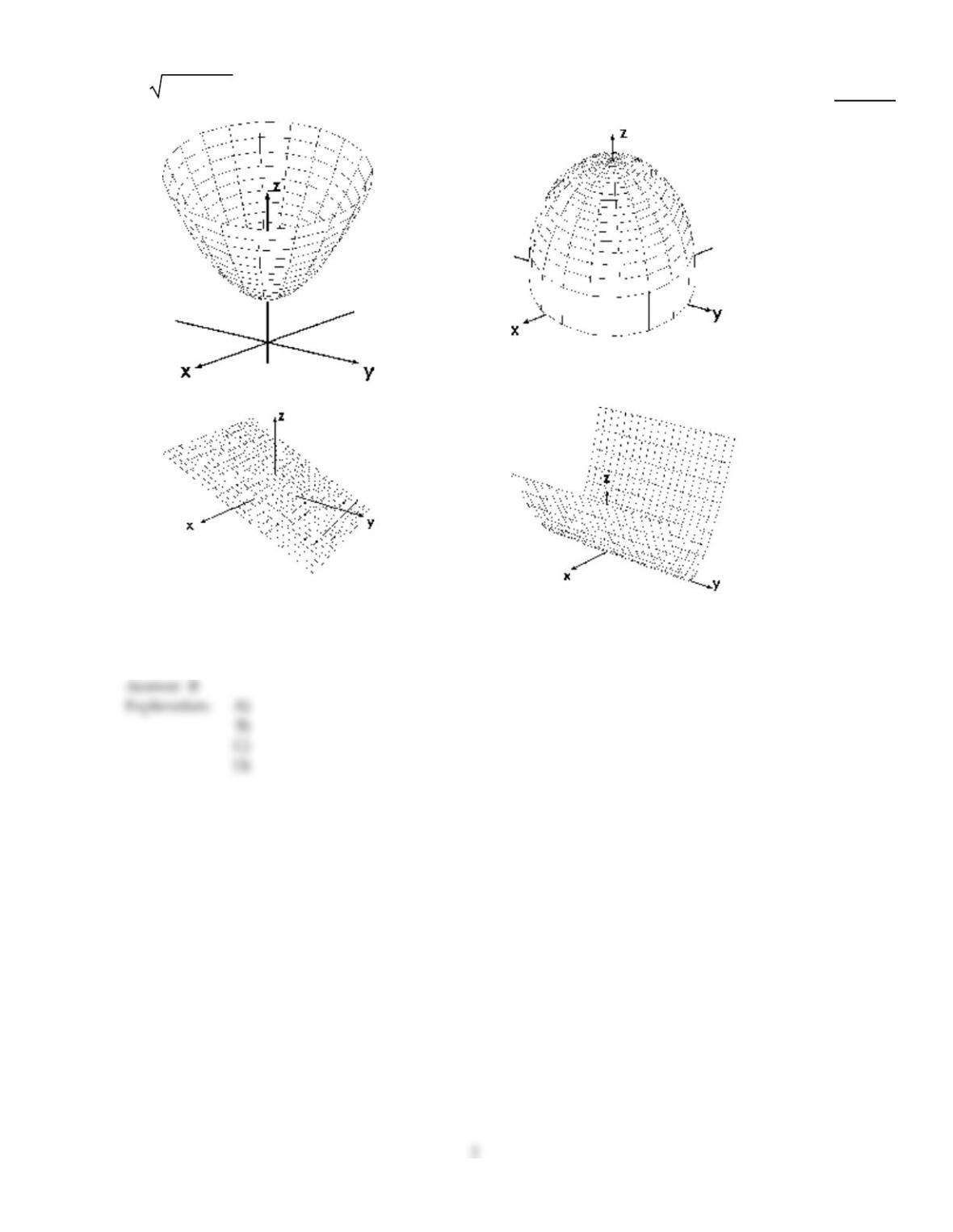
2)
z =4 –x2–y2
2)
A)
B)
C)
D)
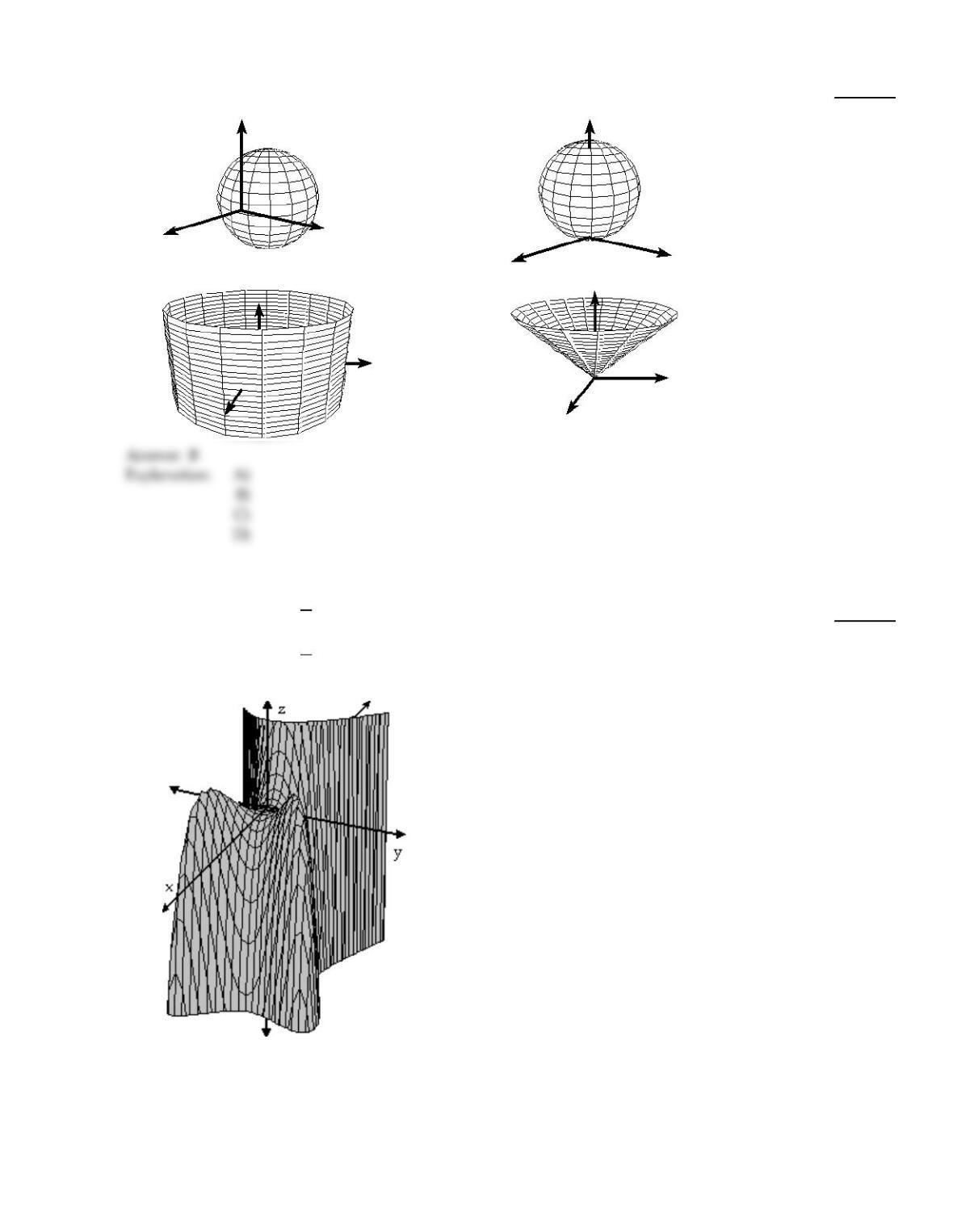
3)
x2+y2+(z – 1)2= 1
3)
A)
B)
C)
D)
Find all relative extrema for the function, and then match the equation to its graph.
4)
z = – x4+y4+ 2x2– 2y2+1
4
4)
A)
Relative maxima of 1
4 at (–1, 1) and
at (1, 1)
3
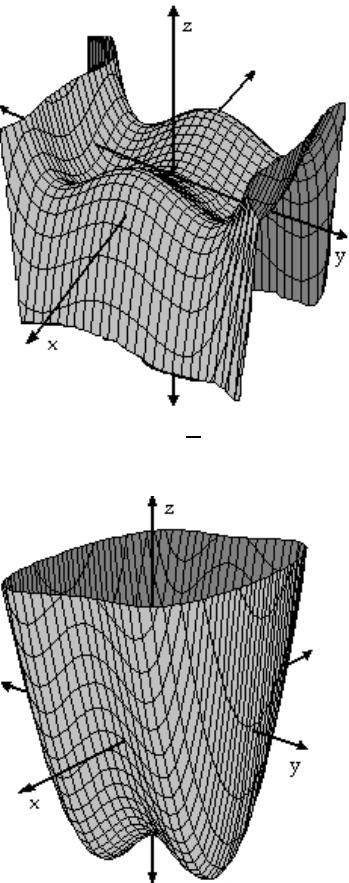
B)
Saddle points at (0, 0), (–1, 1), (1, –1), (1, 1),
and (–1, –1)
C)
Relative minima of –3
4 at (0, 1) and
at (0, –1); saddle point at (0, 0)
4
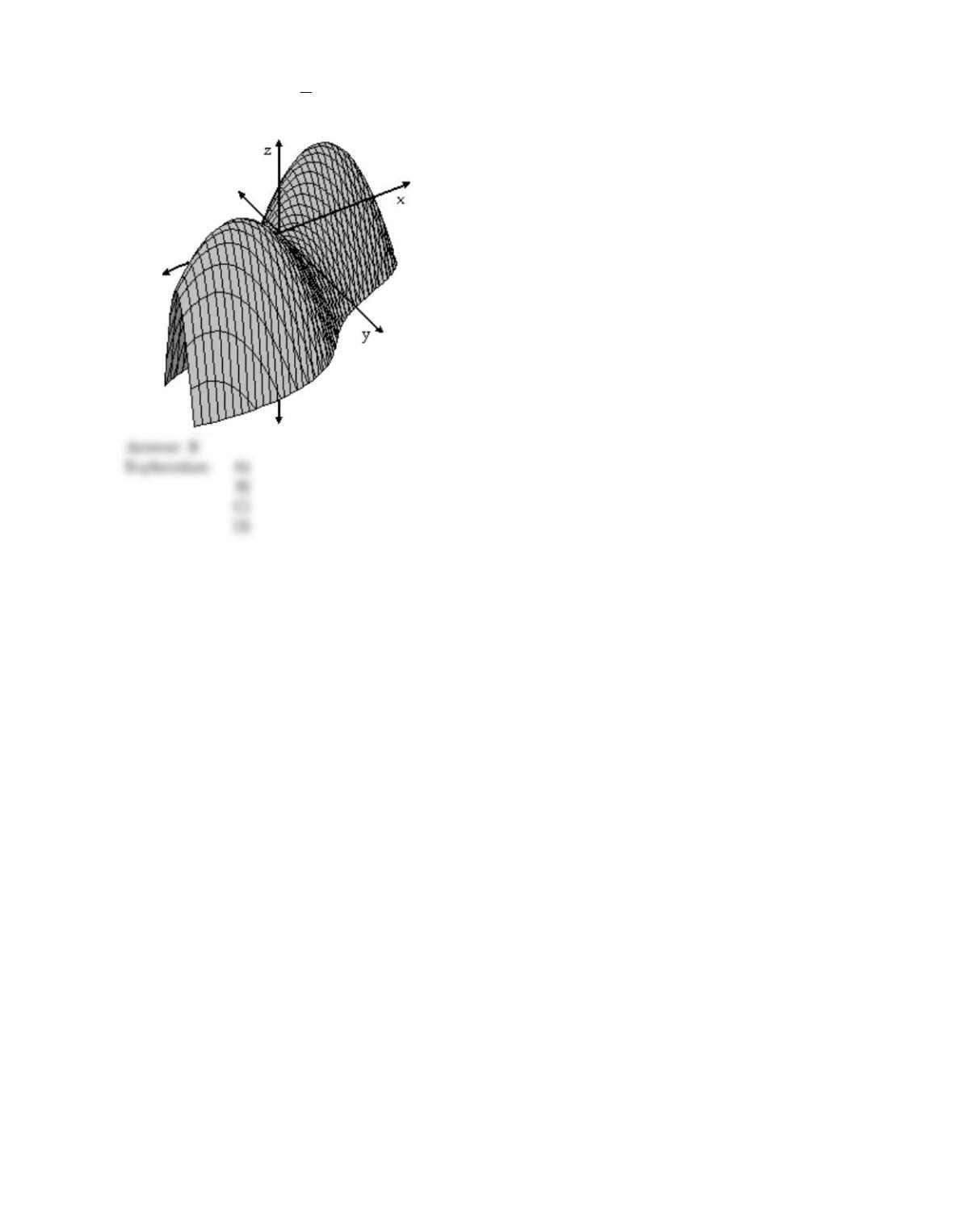
D)
Relative maxima of 1
4 at (1, 1) and
at (–1, –1); saddle point at (0, 0)
5
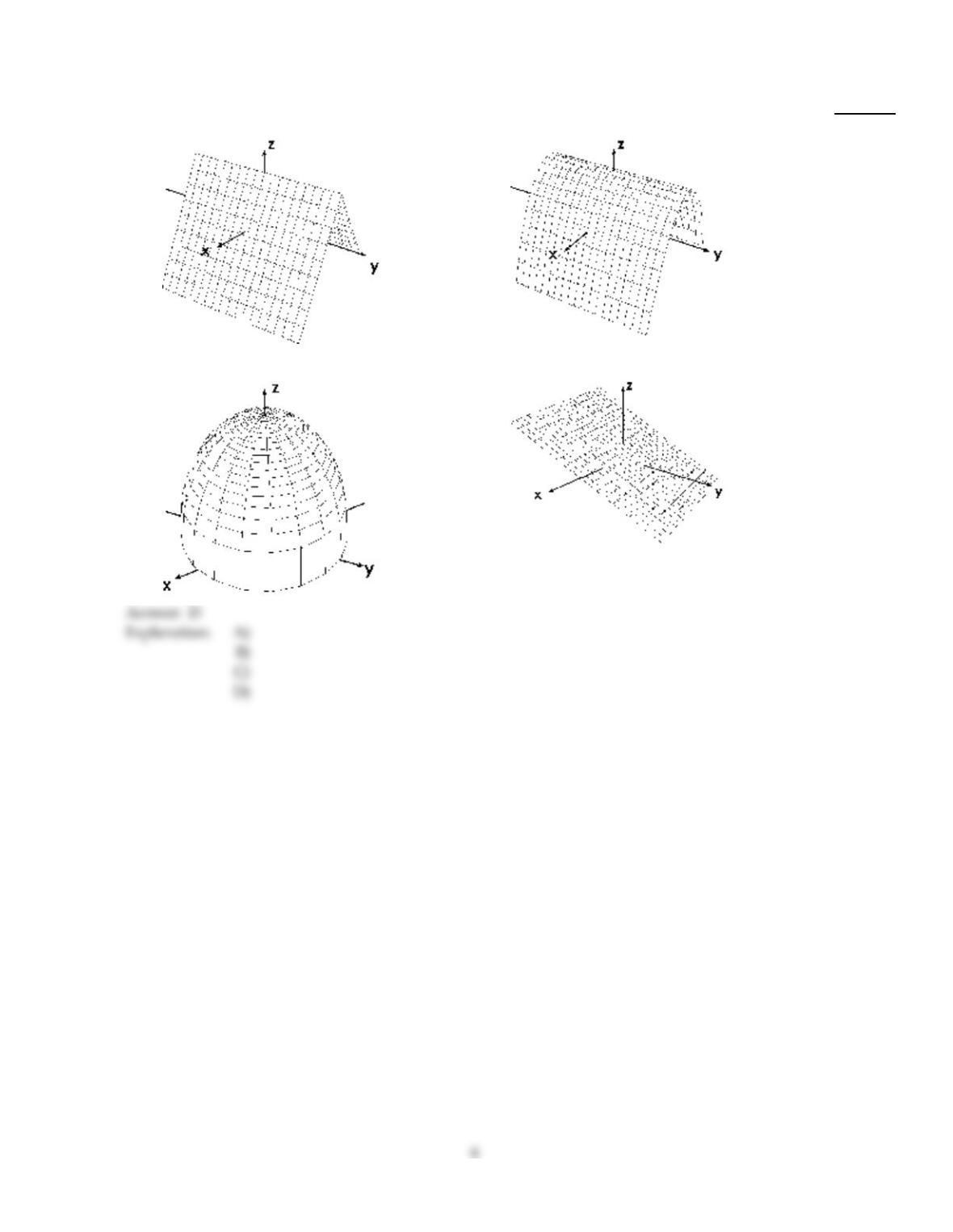
Choose the graph that matches the equation.
5)
z = 1 – x – 2y
5)
A)
B)
C)
D)
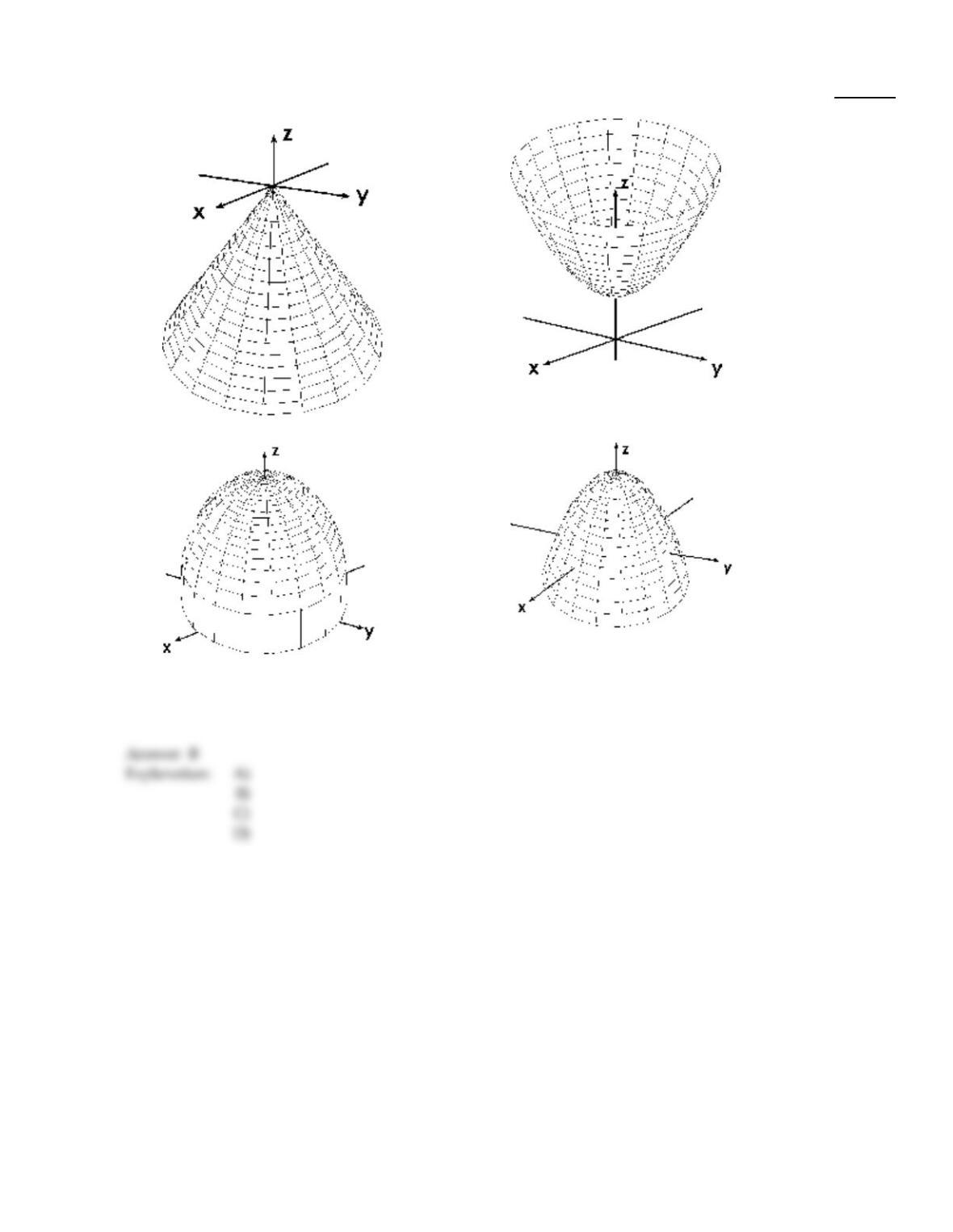
6)
z = 4x2+ 4y2+ 2
6)
A)
B)
C)
D)
Find all relative extrema for the function, and then match the equation to its graph.
7
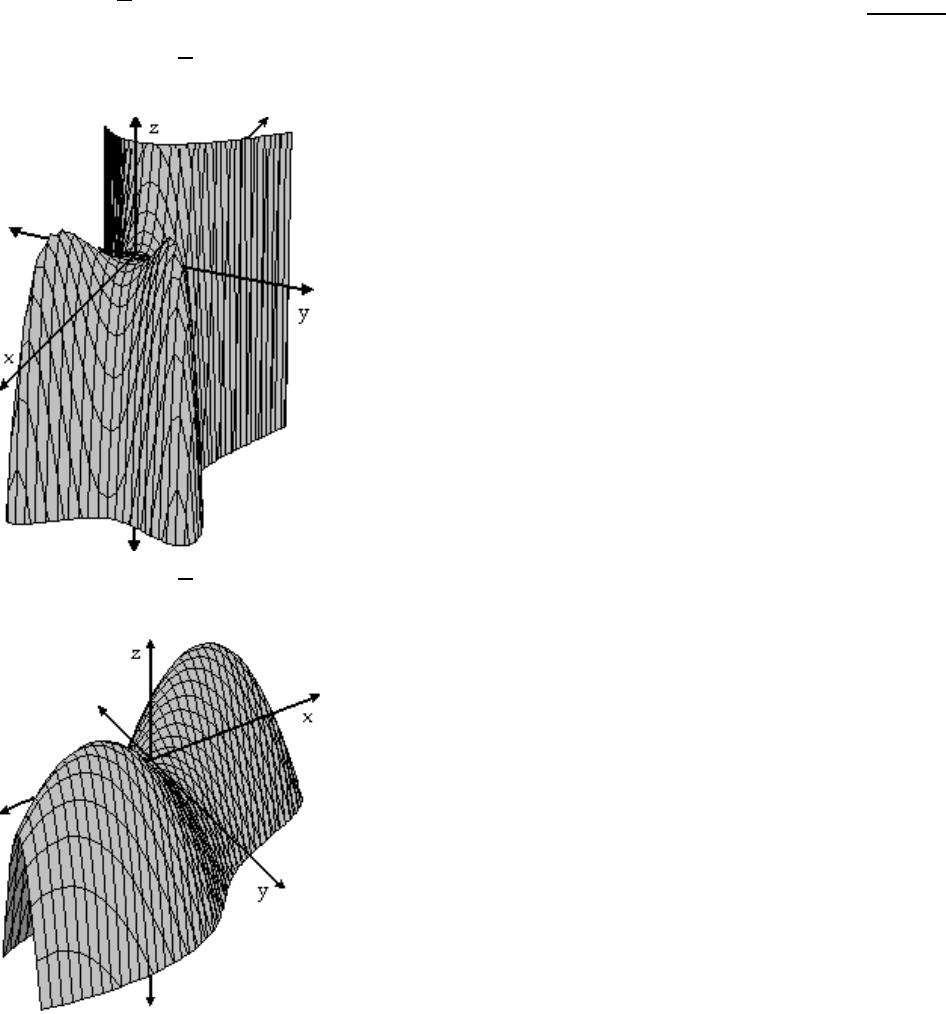
7)
z =y4– 2y2+x2–5
4
7)
A)
Relative maxima of 1
4 at (0, 1) and at (0, –1);
saddle point at (0, 0)
B)
Relative maxima of 9
4 at (0, 1) and at (0, –1);
saddle point at (0, 0)
8
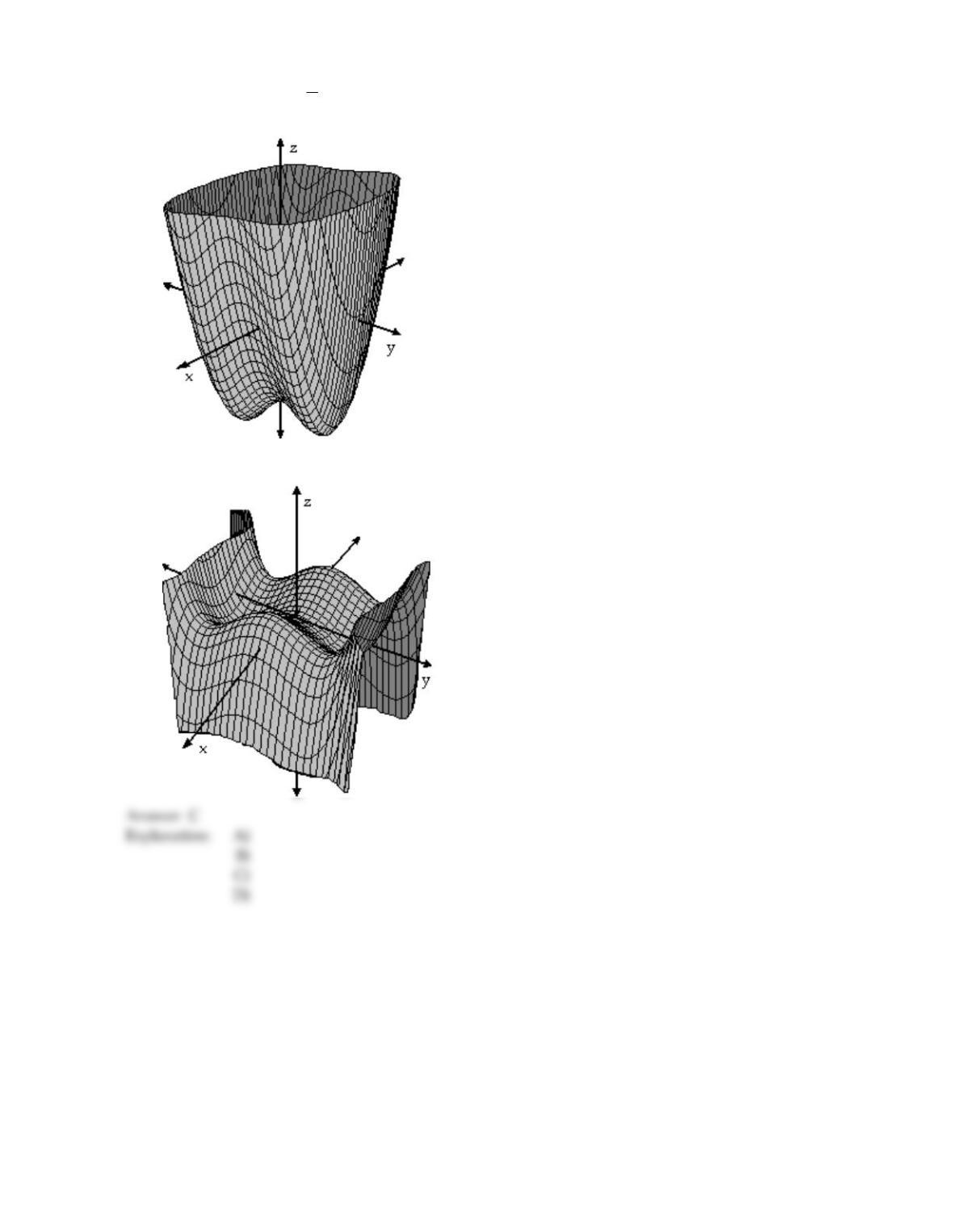
C)
Relative minima of –9
4 at (0, 1) and
at (0, –1); saddle point at (0, 0)
D)
Saddle points at (0, 0), (–1, 1), (1, –1), (1, 1),
and (–1, –1)
9
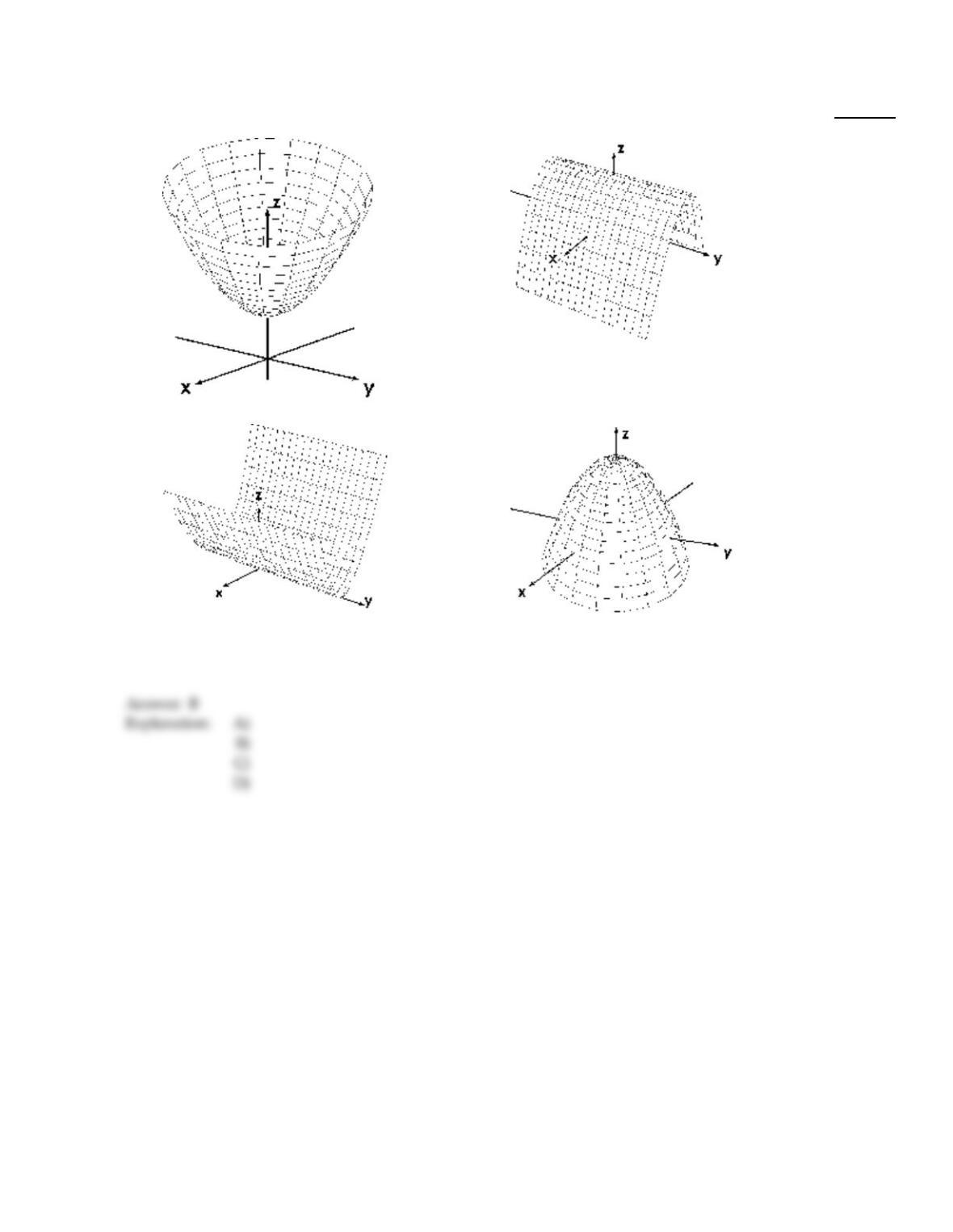
Choose the graph that matches the equation.
8)
z = 3 –x2
8)
A)
B)
C)
D)
Find all relative extrema for the function, and then match the equation to its graph.
10
9)
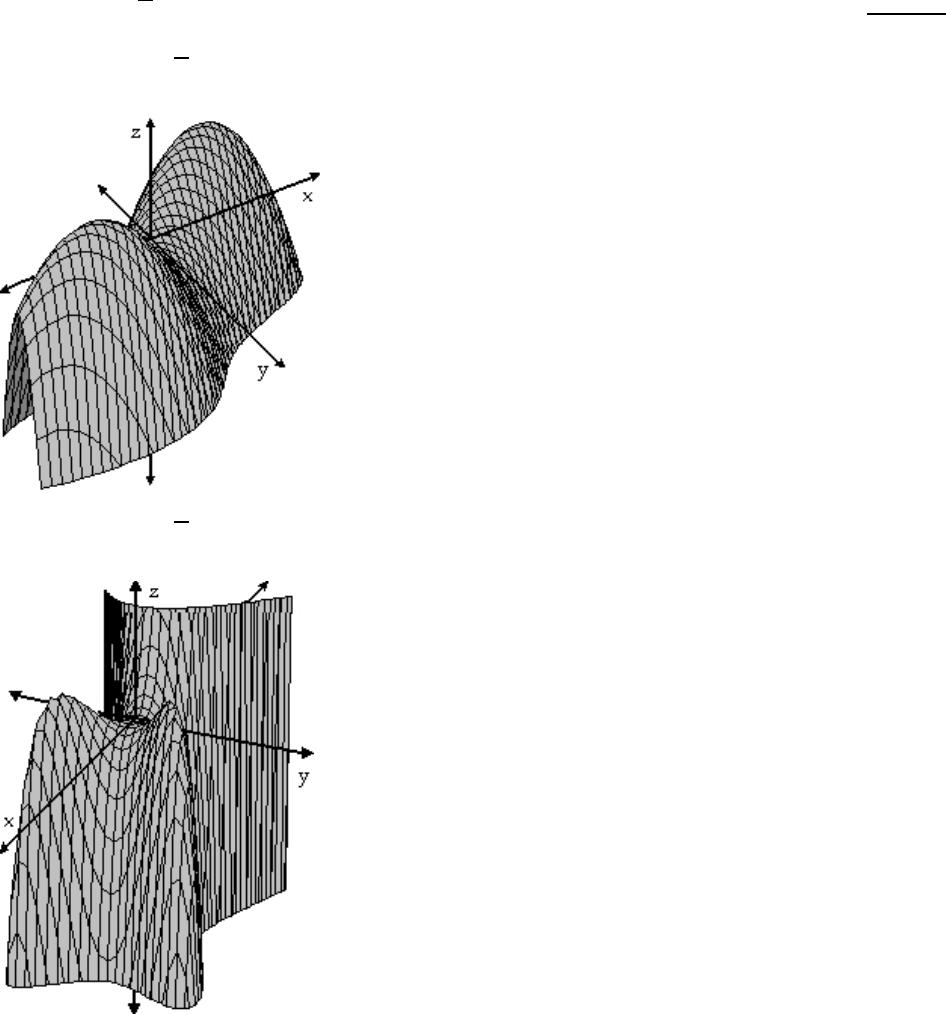
z = – y4+ 4xy – 2x2+1
8
9)
A)
Relative maxima of 9
8 at (1, 1)
and at (–1, –1); saddle point at (0, 0)
B)
Relative maxima of 3
8 at (1, –1)
and at (1, 1);
11
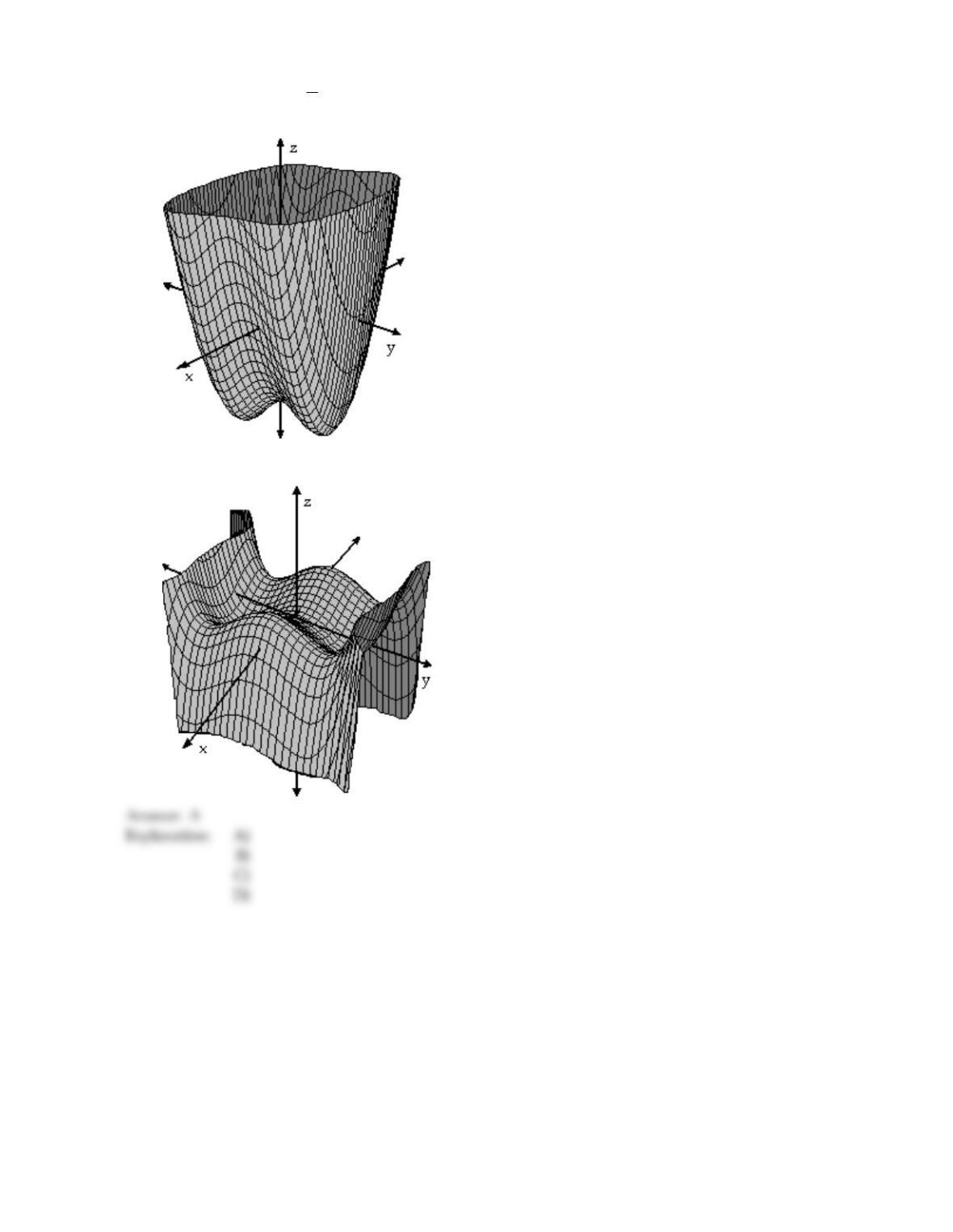
C)
Relative minima of –7
8 at (0, 1) and
at (0, –1); saddle point at (0, 0)
D)
Saddle points at (0, 0), (–1, 1), (1, –1), (1, 1),
and (–1, –1)
12
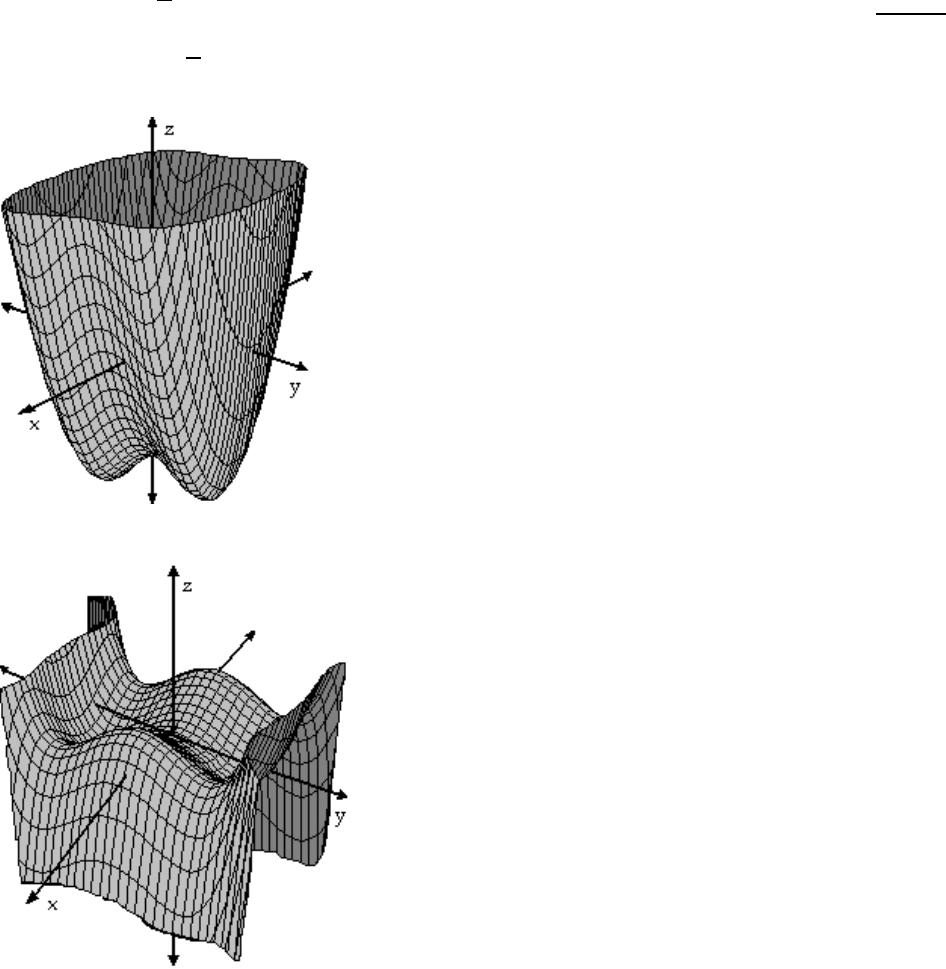
10)
z = – 2x3– 3y4+ 6xy2+1
2
10)
A)
Relative minima of –1
2 at (1, 1) and at (1, –1)
B)
Saddle points at (0, 0), (–1, 1), (1, –1), (1, 1),
and (–1, –1)
13
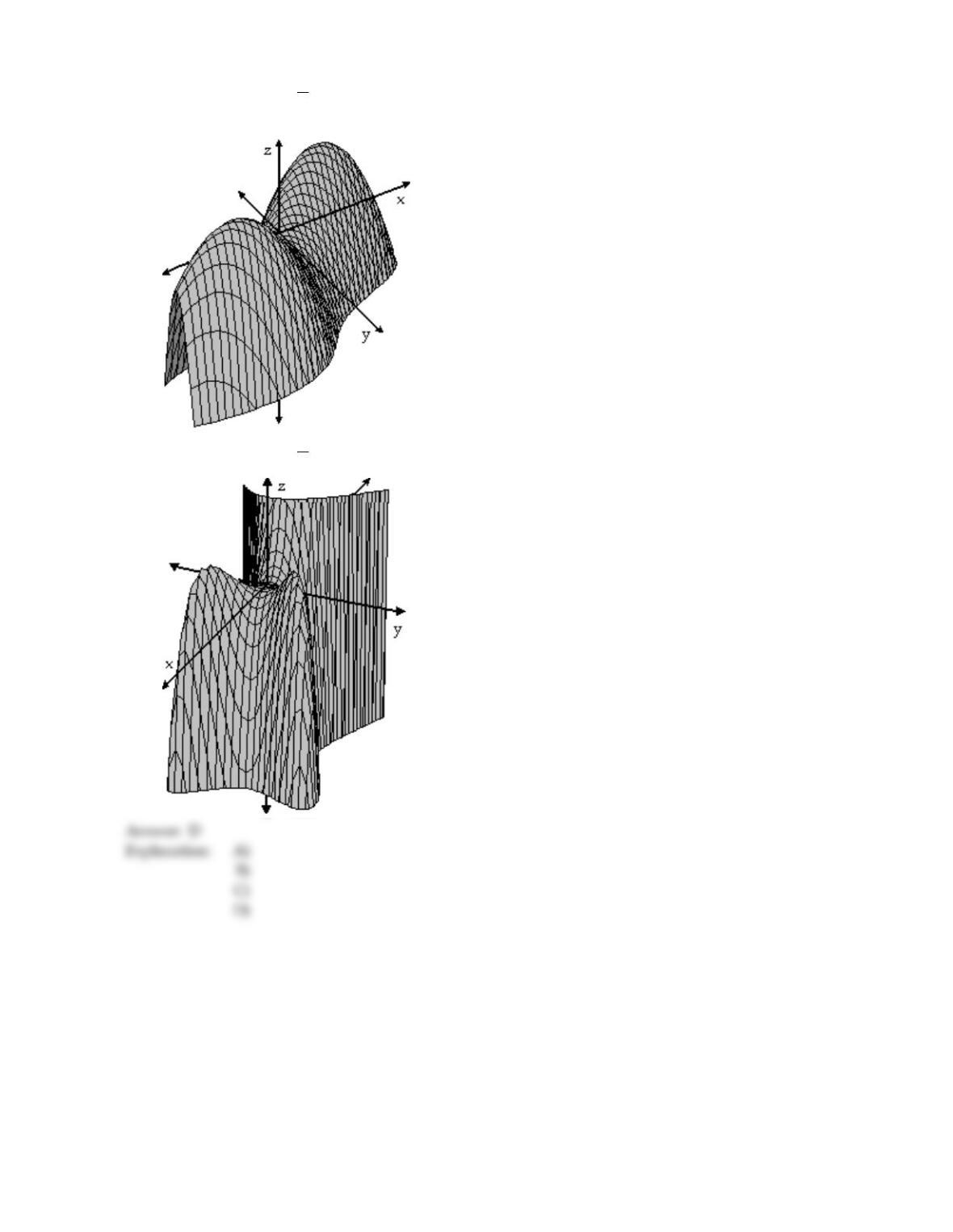
C)
Relative maxima of 3
2 at (1, –1) and at (–1, 1);
saddle point at (0, 0)
D)
Relative maxima of 3
2 at (1, 1) and at (1, –1)
14
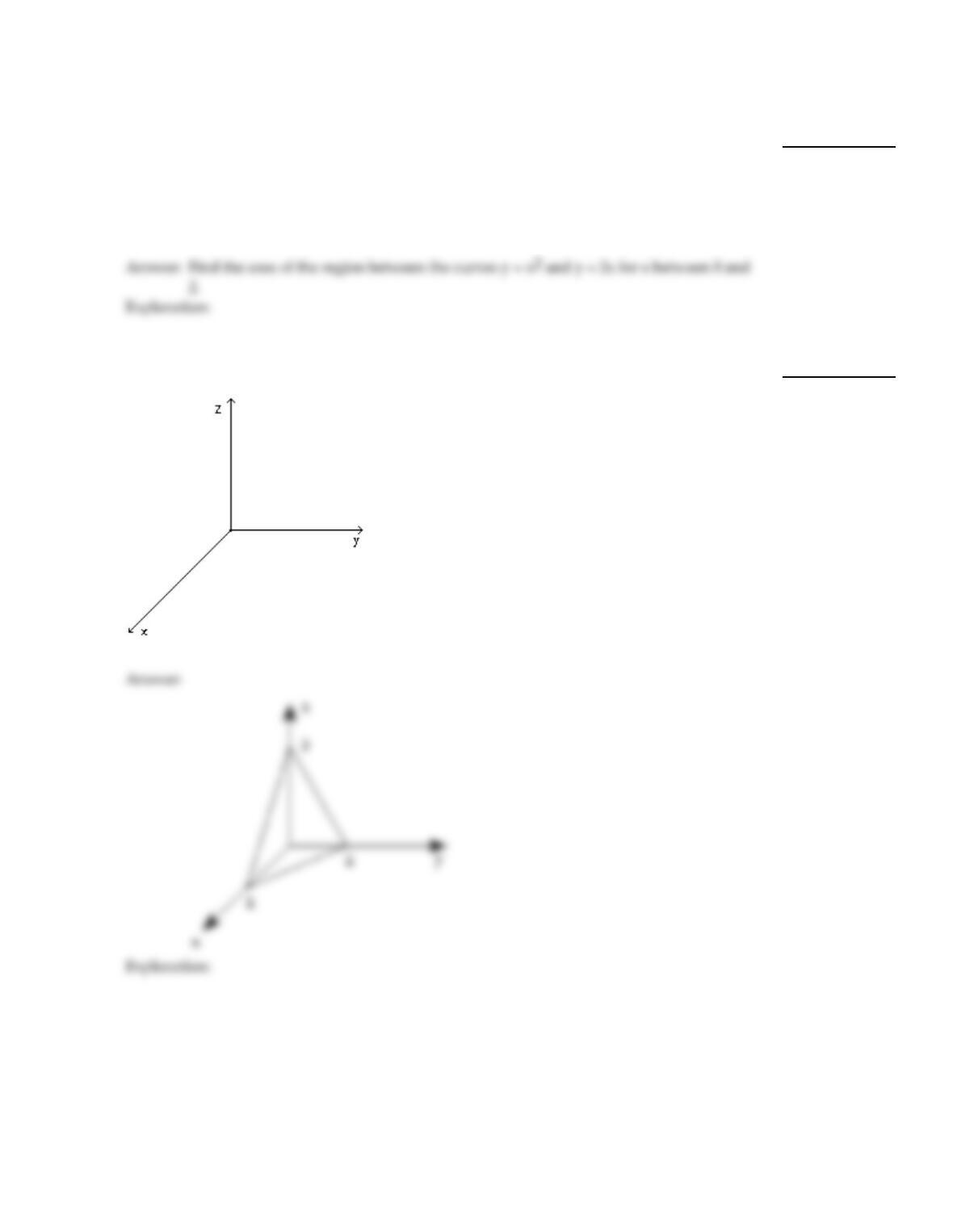
SHORT ANSWER. Write the word or phrase that best completes each statement or answers the question.
Answer the question.
11)
Write an “area” word problem for which finding the solution would involve evaluating the
double integral
2
0
2x
x2
dy dx.
11)
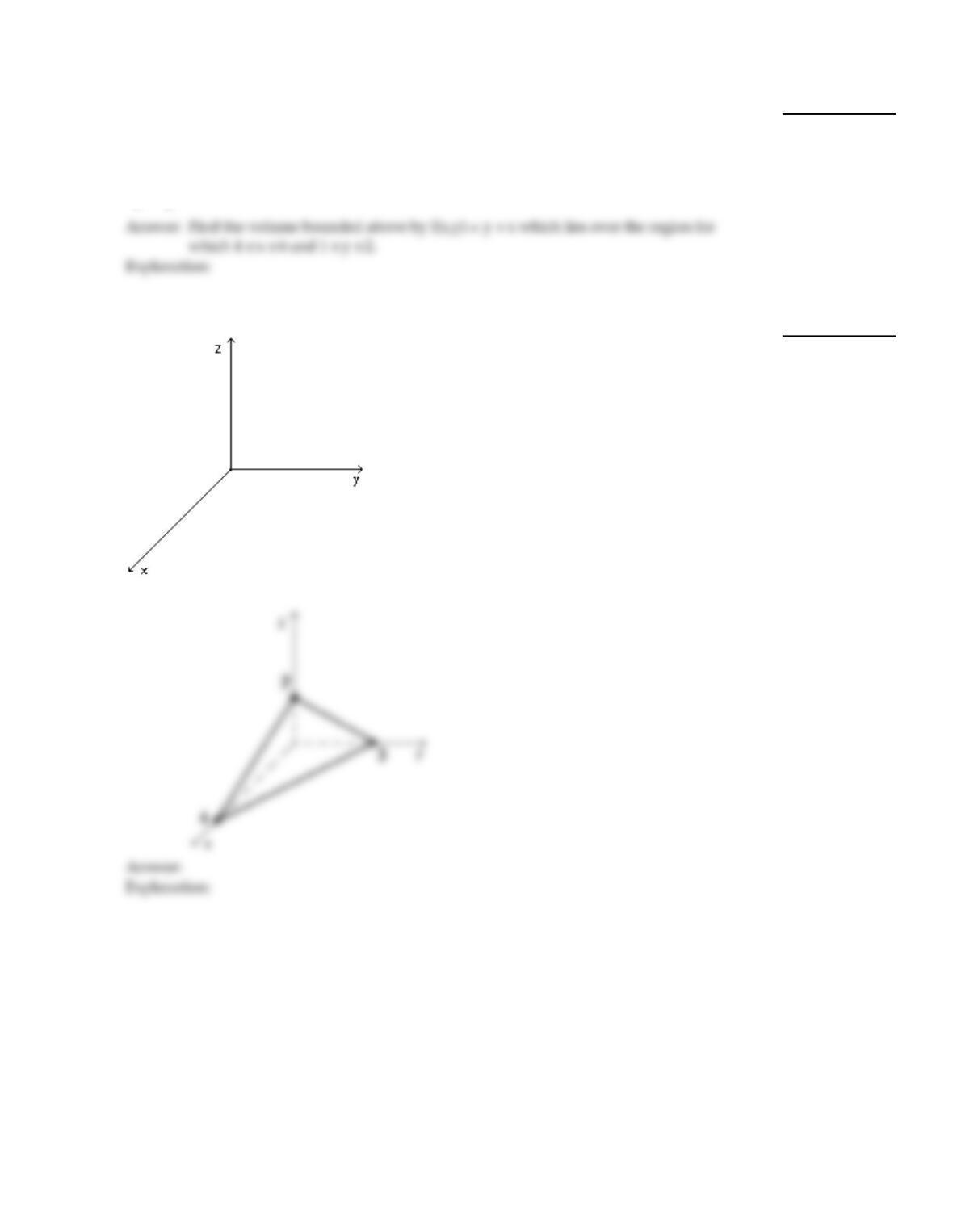
Graph the first–octant portion of the plane.
12)
3x + 3y + 2z = 6
12)
15
Answer the question.
13)
Write a “volume” word problem for which finding the solution would involve evaluating
the double integral
2
1
6
4
(y + x) dx dy.
13)
Graph the first–octant portion of the plane.
14)
9x + 12y + 18z = 36
14)
16
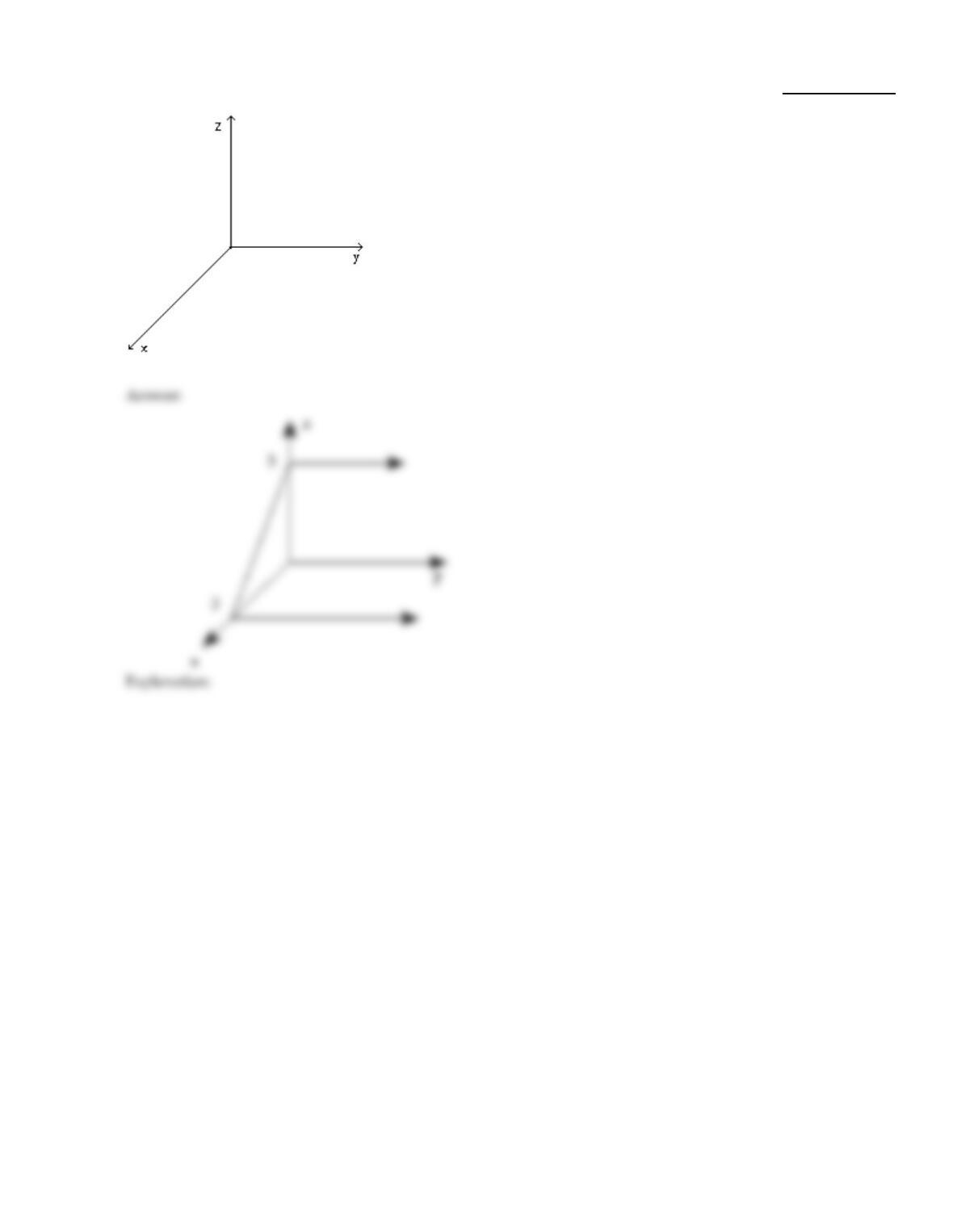
15)
x + z = 3
15)
17
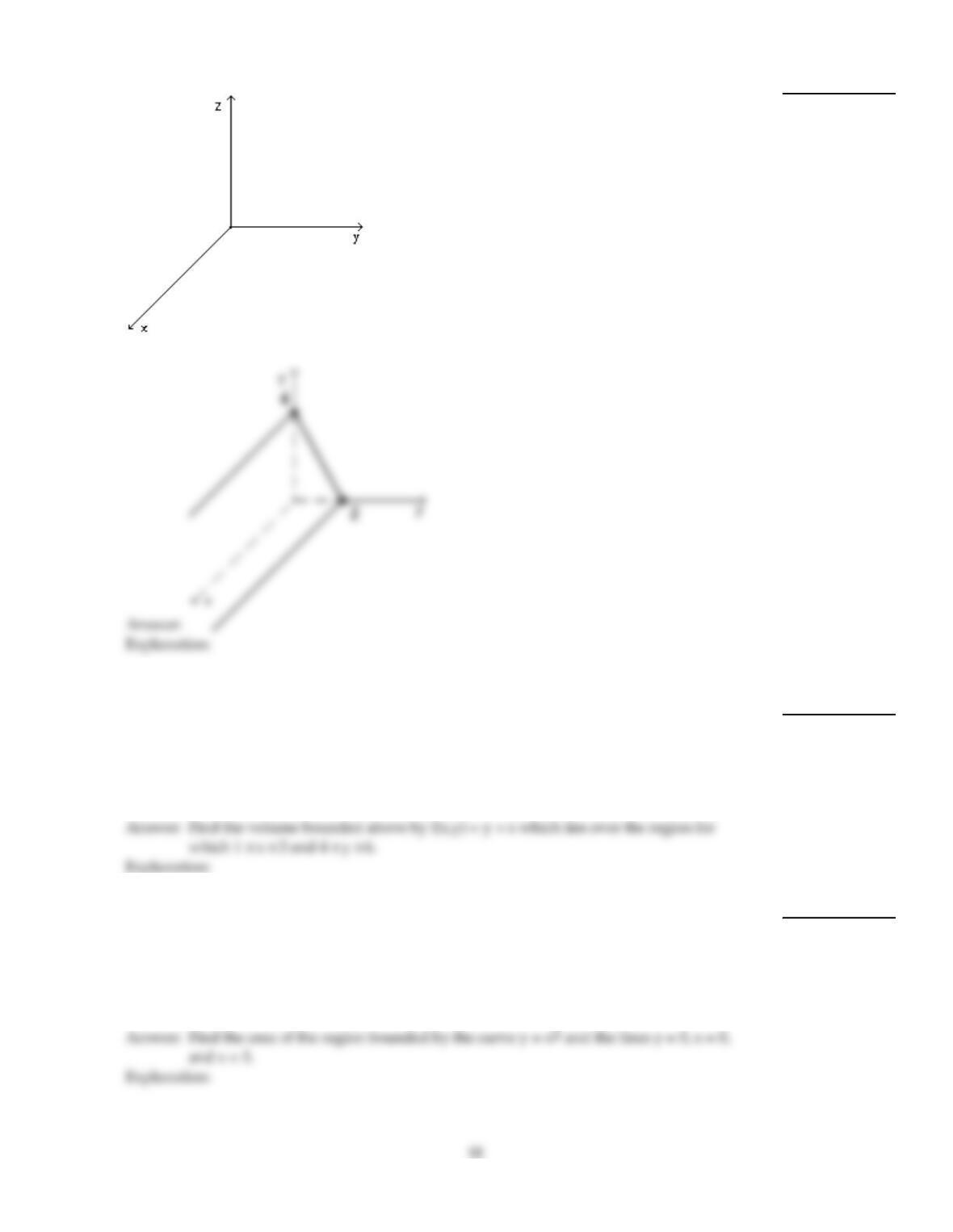
16)
6y + 3z = 12
16)
Answer the question.
17)
Write a “volume” word problem for which finding the solution would involve evaluating
the double integral
2
1
6
4
(y + x) dy dx.
17)
18)
Write an “area” word problem for which finding the solution would involve evaluating the
double integral
5
0
x2
0
dy dx.
18)
MULTIPLE CHOICE. Choose the one alternative that best completes the statement or answers the question.
Find the second–order partial derivative.
19)
Find 2z
y2 when z = ex ln y.
19)
A)
ex
y2
B)
ex
y
C)
–ex
y2
D)
–ex
y
Solve the problem.
20)
Under certain conditions the wind speed S, in miles per hour, of a tornado at a distance d from its
center can be approximated by the function S =aV
0.51d2, where a is an atmospheric constant, and V
is the approximate volume of the tornado, in cubic feet. Interpret S
V .
20)
A)
The rate of change in speed per unit change in distance while volume is held constant.
B)
The rate of change in speed per unit change in volume while distance is held constant.
C)
The rate of change in volume per unit change in speed while distance is held constant..
D)
The rate of change in speed per unit change in volume and distance.
Evaluate the function.
21)
Find h(3, 6) when h(x, y) =3x +y2.
21)
A)
3 5
B)
10
C)
5 3
D)
9
Solve the problem.
22)
A company has the following production function for a certain product:
p(x, y) =31x0.1y0.9 .
Find the marginal productivity with fixed capital, px .
22)
A)
3.1 y
x
0.9
B)
3.1 y
x
1.1
C)
3.1xy0.9
D)
3.1 x
y
0.9
23)
The dimensions of a cardboard box were measured as 50 cm, 90 cm and 50 cm, with the percentage
error in each dimension not exceeding 4 percent. Approximate the worst possible percentage error
in the volume of the box. Assume that the cardboard is of negligible thickness.
23)
A)
9%
B)
12%
C)
8%
D)
4%
Find the second–order partial derivative.
24)
Find fxy when f(x, y) = xy2+ yex2+ 5.
24)
A)
2y + 2xex2
B)
y + xex2
C)
2yex2
D)
2xex2
Evaluate the integral.
25)
4
1
(x + x2y4– 3) dx
25)
A)
1022
5x2+ 3x – 9
B)
26
3y4– 12
C)
1023
5x2+ 3x – 9
D)
21y4–3
2
Solve the problem.
26)
What is the greatest area that a rectangle can have if the length of its diagonal is 2 m?
26)
A)
1 m2
B)
5 m2
C)
2 m2
D)
2 2 m2
Find the partial derivative.
27)
f(x, y) =5(x +6y –5)2. Find fx(x, y).
27)
A)
10x +60y –50
B)
30x +180y
C)
10x +60y +50
D)
5x +30y –25
20